"c14ff6bd758dadb1"{"id":"1000535","slug":"icy-snow-environment-asset-pack","title":"Icy Snow Environment - Asset Pack","category":"Nature \u0026 Plants","engine":"5.4+","assetVersion":"","engineVersion":"Engine Version: 5.4+","tag":"Nature \u0026 Plants","accent":"blue","visual":"city","summary":"Photoscanned Nanite winter asset pack with tiled micro detail materials, 1M-poly average meshes, and path tracer-ready fallback settings for Unreal 5.4.","platform":"Unreal Engine","publishedAt":"2026-07-15T02:17:38.579Z","updatedAt":"2026-07-15T02:17:38.579Z","sourceNotes":[],"fileContents":[],"compatibility":["Unreal Engine","Engine Version: 5.4+"],"featuredImage":{"alt":"Icy Snow Environment - Asset Pack","src":"/wp-content/uploads/published/2026/07/43229206f53c-b4b60840-e842-4b8d-951e-04f0fd8f708c-80fb98fcd2.webp"},"hasDownloadLink":true,"downloads":2,"terms":[{"taxonomy":"category","slug":"nature-and-plants","name":"Nature \u0026 Plants"}],"galleryImages":[{"src":"/wp-content/uploads/published/2026/07/826f96a5fddd-703c7cc6-1dae-4f92-a26e-8e392e2803a8-5d366c1a7e.webp","alt":"Icy Snow Environment - Asset Pack"},{"src":"/wp-content/uploads/published/2026/07/f48707b60834-5b028cd3-1fb6-46b8-8f8e-5ee62c74e4ba-c891a3bdce.webp","alt":"Icy Snow Environment - Asset Pack"},{"src":"/wp-content/uploads/published/2026/07/e903e8c9398e-0cbf94bc-ea6e-45e0-a42b-6e85749d4f45-dfcc4c747d.webp","alt":"Icy Snow Environment - Asset Pack"},{"src":"/wp-content/uploads/published/2026/07/de13ab29bc3c-3d7d54aa-93cc-40a1-9148-6316f76fa4d7-5ba678bc95.webp","alt":"Icy Snow Environment - Asset Pack"},{"src":"/wp-content/uploads/published/2026/07/689b28407fb1-6d10cee7-a320-4b98-9f1d-49623522b383-f62831387b.webp","alt":"Icy Snow Environment - Asset Pack"},{"src":"/wp-content/uploads/published/2026/07/87f4192576f6-85d15d76-c703-4ee0-8e57-a6a5e52d4d5d-93b224d6c5.webp","alt":"Icy Snow Environment - Asset Pack"},{"src":"/wp-content/uploads/published/2026/07/9e38e3cc377d-d5403419-8d67-4e30-94a3-69392a365299-e5e9d022ce.webp","alt":"Icy Snow Environment - Asset Pack"},{"src":"/wp-content/uploads/published/2026/07/4a4b01b5fe41-d2e91c5c-b091-4c91-ac35-a627150ff8c9-89e521e13e.webp","alt":"Icy Snow Environment - Asset Pack"},{"src":"/wp-content/uploads/published/2026/07/27149a319290-eb309bc6-ddbb-4db3-a23d-1e1699e2a288-746efc81de.webp","alt":"Icy Snow Environment - Asset Pack"},{"src":"/wp-content/uploads/published/2026/07/849c82834c00-dca6aa9d-9a23-49c7-ab6c-8b61e4d13aac-2560dea030.webp","alt":"Icy Snow Environment - Asset Pack"}],"accessPanel":{"kind":"resource","title":"Download this resource","eyebrow":"Free Download","message":"Log in or create a free account to start your download.","fileName":"Content.7z","safetyNote":"Resources are manually reviewed before listing to improve quality and reduce obvious risks.","actionLabel":"Download Free","resourceType":"Resource archive"},"contentHtml":"\u003cp\u003eWhen frozen scenery needs to hold up under close camera work, traditional baked textures often start to reveal their limits. The \u003cstrong\u003eIcy Snow Environment - Asset Pack\u003c/strong\u003e Approaches that problem through photogrammetry combined with Unreal Engine 5's Nanite virtualized geometry. Rather than relying on normal maps to fake surface relief, the pack uses densely scanned meshes that retain their physical detail at the polygon level. Each asset averages 1 million polygons, which is where Nanite's streaming and culling pipeline becomes the load-bearing piece — those dense meshes can exist in a scene without forcing a constant cost on the GPU because Nanite resolves only what the camera actually sees.\u003c/p\u003e\u003ch2\u003ePhotoscanned Nanite meshes with individual micro detail materials\u003c/h2\u003e\u003cp\u003eThe assets are unique photoscanned captures, meaning the pack is not built from a small set of modular pieces tiled across a map. Instead, each scanned asset is treated as an individual object that carries its own material instance. These are tiled micro detail material instances — the kind of setup that adds procedural surface grain, snow crust, or ice microstructure on top of the base scan data without consuming additional texture memory for every unique object in the level.\u003c/p\u003e\u003cp\u003eThat matters for a practical reason. When every scanned object has its own material instance, artists can tune micro detail — frost granularity, snow scatter density, surface roughness variation — at the per-asset level without touching a master material or affecting adjacent props. The tiling behavior ensures that regardless of the object's UV scale, the micro detail wraps consistently. It also gives teams the ability to adjust the balance between scan fidelity and procedural overlay, which is often necessary when assets are placed under different lighting conditions — outdoor snowfields, cave interiors, or partially sheltered areas where frost forms differently.\u003c/p\u003e\u003ch2\u003eFallback error set to zero for path tracer rendering\u003c/h2\u003e\u003cp\u003eA specific technical choice in this pack is that the Nanite fallback error on every mesh has been set to 0. For production work, Nanite normally uses a fallback error threshold to decide when to collapse a high-detail mesh into a simpler proxy representation to save performance. Setting that threshold to zero disables the automatic simplification pass. This is done to ensure that the full geometric detail of the scanned mesh remains visible and intact regardless of distance, screen coverage, or performance pressure.\u003c/p\u003e\u003cp\u003eOne direct consequence of that zero fallback error setting is that the assets are also ready to work with Unreal's path tracer. Unreal's path tracing system is extremely sensitive to geometric degeneration — automatic fallbacks, temporary proxy swaps, or LOD-style decimation can disrupt the render and cause visible popping, shadow errors, or mismatched contact between surfaces. By locking the fallback error to 0, the developer is keeping a promise to the renderer: the mesh geometry the scene sees is the mesh geometry the scan produced, no hidden simplifications.\u003c/p\u003e\u003cp\u003eThis makes the pack well-suited to workflows that prioritize visual fidelity over raw frame rate. Architectural visualization, cinematic pre-rendering, environmental close-ups, or any production relying on path-traced image quality can benefit from knowing the assets in the scene will not silently degrade. The trade-off is obvious — no fallback means the camera and the GPU have to handle the full polygon load — but in Nanite-enabled Unreal 5.4 environments, that load is managed by the Nanite pipeline rather than the traditional LOD system.\u003c/p\u003e\u003ch2\u003eWhat the asset set signals about visual intent\u003c/h2\u003e\u003cp\u003eBeyond the technical provisions, the pack's tags — PBR, Snow, Photogrammetry, Winter, Frozen, Nanite, Ice — point clearly at its role. The visual aim is winter environments in which ice and snow are not just background elements but active surface characteristics. PBR-compliant materials ensure the assets respond to lighting and reflection in a physically grounded way, which is critical when snow and ice surfaces interact with directional light, subsurface scattering, or specular reflections from environment probes.\u003c/p\u003e\u003cp\u003ePhotogrammetry as the capture method also implies a level of authenticity that hand-modeled snow assets often lack. Real-world snow packs, refreezes, crusts, and fractures in ways that are difficult to fake procedurally. Scanned ice likewise carries surface history — drip patterns, refrozen melt channels, compression layers — that reads correctly under scrutiny. For teams building outdoor environments where the believability of the snow surface is part of the atmosphere, these scanned details become a significant time saver.\u003c/p\u003e\u003ch2\u003eCompatibility with Unreal Engine 5.4\u003c/h2\u003e\u003cp\u003eThe pack is flagged for Unreal Engine 5.4. That is not a trivial detail, because Nanite's capabilities, material editor behavior, and path tracer support have evolved across the 5.x releases. Unreal 5.4 provides the Nanite foundation required for the high-poly scanned meshes, the material instance workflow that allows per-asset micro detail tuning, and the path tracer implementation that benefits from the zero fallback error setting. Artists importing the pack into a 5.4 project are working in the engine version the developer targeted, which reduces the risk of compatibility drift.\u003c/p\u003e\u003cp\u003eThe reliance on Nanite also means the assets are best suited to PC and console-class target platforms. There is no indication in the pack details that the assets include a separate mobile-ready fallback chain or texture-reduced LOD set. The zero fallback error setting is itself a statement that the developer is not optimizing for older devices or limited hardware — the pack is aimed at environments where fidelity drives the production rather than minimum-spec performance.\u003c/p\u003e\u003ch2\u003eProject types where Icy Snow Environment assets earn their place\u003c/h2\u003e\u003cp\u003eSeveral project archetypes line up with what the pack provides. Cinematic winter sequences, where a camera travels close to snow-covered surfaces or across icy terrain, get clear value from scanned geometry that holds up under fly-by and wide camera moves alike. Architectural visualizations set in winter conditions — mountain lodges, ski facilities, remote research stations — can place scanned snow and ice elements around structures without relying on hand-sculpted equivalents that often look idealized or overly symmetric.\u003c/p\u003e\u003cp\u003eGame environments exploring survival, exploration, or arctic themes can also absorb these assets as background dressing or featured props. Because each asset is photoscanned and unique, level designers are not forced to construct an entire scene from the same handful of ice blocks. The per-asset material instance system also lets artists re-tint snow surfaces to match localized scene mood — warmer sunlight scenes, colder overcast conditions, or stylized moonlight — without changing the scanned base.\u003c/p\u003e\u003cp\u003ePre-rendered sequences using Unreal's path tracer benefit most directly. The zero fallback error setting exists precisely to keep the full polygon detail present during path-traced rendering, avoiding the visual mismatch that often appears when Nanite fallbacks engage partway through a shot. For teams producing high-fidelity winter cinematics or rendered short films, that detail consistency reduces rework.\u003c/p\u003e\u003ch2\u003eWho benefits most from this asset pack\u003c/h2\u003e\u003cp\u003eTeams already committed to Unreal Engine 5.4, Nanite-based workflows, and PBR-driven outdoor environments are the natural fit. The pack rewards projects where visual fidelity is central, where the camera gets close enough to snow and ice surfaces for scanned detail to read, and where production output includes rendered sequences, cinematics, or high-end interactive experiences. Artists who need fast stylized snow or mobile-friendly lightweight meshes will not find that here — the focus is squarely on photoreal winter scenery built from genuine scans, tuned for a rendering pipeline that can stand being patient with a million polygons per asset.\u003c/p\u003e\n\n\u003ch2\u003eContinue Browsing Similar Packs\u003c/h2\u003e\n\u003cul\u003e\n\u003cli\u003e\u003ca href=\"https://3dcghub.com/forest-fungi-mushroom-pack/\" title=\"Forest Fungi - Mushroom Pack\"\u003eForest Fungi - Mushroom Pack\u003c/a\u003e\u003c/li\u003e\n\u003cli\u003e\u003ca href=\"https://3dcghub.com/realistic-grass-2/\" title=\"Realistic Grass 2\"\u003eRealistic Grass 2\u003c/a\u003e\u003c/li\u003e\n\u003cli\u003e\u003ca href=\"https://3dcghub.com/anime-skybox-v1/\" title=\"ANIME SKYBOX V1\"\u003eANIME SKYBOX V1\u003c/a\u003e\u003c/li\u003e\n\u003cli\u003e\u003ca href=\"https://3dcghub.com/nature-set/\" title=\"Nature Set\"\u003eNature Set\u003c/a\u003e\u003c/li\u003e\n\u003cli\u003e\u003ca href=\"https://3dcghub.com/realistic-pine-treesv3/\" title=\"Realistic pine treesV3\"\u003eRealistic pine treesV3\u003c/a\u003e\u003c/li\u003e\n\u003c/ul\u003e","contentTextLength":8135,"navigation":{"current":1327,"total":3719,"previous":{"id":"1000536","slug":"modular-sci-fi-environment-a","title":"Modular sci-fi Environment A","category":"Sci-Fi","platform":"Unreal Engine","updatedAt":"2026-07-15T02:23:25.573Z"},"next":{"id":"1000534","slug":"uscans-workshop-01","title":"Uscans Workshop 01","category":"Apocalyptic / Post-apocalyptic","platform":"Unreal Engine","updatedAt":"2026-07-14T19:26:22.523Z"}},"relatedResources":[{"id":"1001566","slug":"underwater-coral-pack-01","title":"Underwater Coral Pack 01","category":"Nature \u0026 Plants","engine":"5.3+","assetVersion":"","engineVersion":"Engine Version: 5.3+","tag":"Nature \u0026 Plants","accent":"blue","visual":"mech","summary":"Create dense marine environments and cinematic reefs with 77 Nanite-ready underwater coral meshes featuring baked tessellation and 4K textures.","platform":"Unreal Engine","publishedAt":"2026-10-10T03:58:48.350Z","updatedAt":"2026-10-10T03:58:48.350Z","sourceNotes":[],"fileContents":[],"compatibility":["Unreal Engine","Engine Version: 5.3+"],"featuredImage":{"alt":"Underwater Coral Pack 01","src":"/wp-content/uploads/published/2026/10/137cd6ce0061-e682ed39-4be5-4a47-ac8c-a853e8a6a97a-27ecddee27.webp"},"hasDownloadLink":true,"downloads":0},{"id":"1000607","slug":"foliage-vol-26-dead-birch-trees-nanite-low-poly","title":"Foliage VOL.26 - Dead Birch Trees (Nanite + Low Poly)","category":"Nature \u0026 Plants","engine":"5.1+","assetVersion":"","engineVersion":"Engine Version: 5.1+","tag":"Nature \u0026 Plants","accent":"blue","visual":"mech","summary":"Twenty-four dead birch tree meshes by Dekogon Studios, offered in Nanite and low poly variants with 4K channel-packed textures, Lumen support, and game-ready op","platform":"Unreal Engine","publishedAt":"2026-07-20T19:17:05.693Z","updatedAt":"2026-07-20T19:17:05.693Z","sourceNotes":[],"fileContents":[],"compatibility":["Unreal Engine","Engine Version: 5.1+"],"featuredImage":{"alt":"Foliage VOL.26 - Dead Birch Trees (Nanite + Low Poly)","src":"/wp-content/uploads/published/2026/07/41175b88c8ee-9e2e495c-76af-4f8f-8f26-c57a281f7239-cc2d364d8c.webp"},"hasDownloadLink":true,"downloads":0},{"id":"4129","slug":"forest-fungi-mushroom-pack","title":"Forest Fungi - Mushroom Pack","category":"Nature \u0026 Plants","engine":"5.0+","assetVersion":"Engine version: 5.0+","engineVersion":"5.0","tag":"Nature \u0026 Plants","accent":"blue","visual":"mech","summary":"Enhance your Unreal Engine 5 environments with this realistic Forest Fungi pack. Features 48 Nanite-ready meshes, master materials, and stunning detail.","platform":"Unreal Engine","publishedAt":"2026-02-10T09:54:20.000Z","updatedAt":"2026-04-19T15:57:30.000Z","sourceNotes":[],"fileContents":[],"compatibility":["Unreal Engine","Engine version: 5.0+"],"featuredImage":{"alt":"Forest Fungi - Mushroom Pack","src":"https://3dcghub.com/wp-content/uploads/2026/02/7be5546d-9091-4804-9e03-e392b0d72de1.webp"},"hasDownloadLink":true,"downloads":0}]}
Nature & Plants
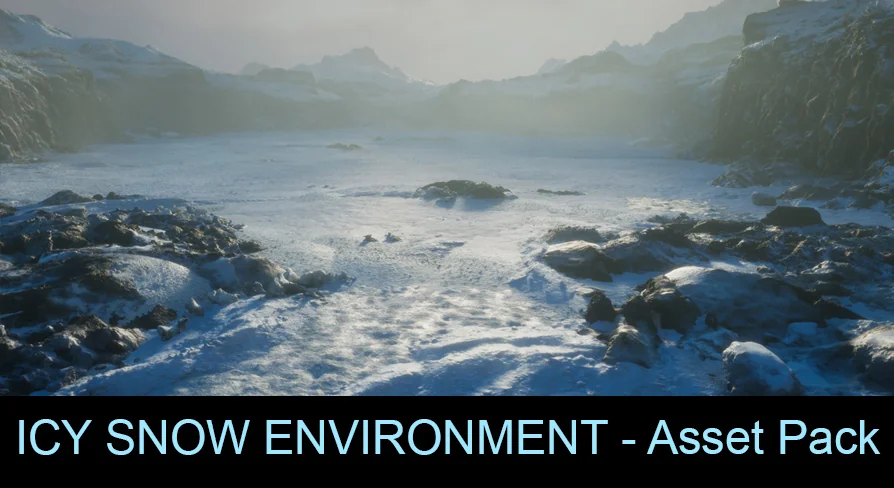
Icy Snow Environment - Asset Pack
Photoscanned Nanite winter asset pack with tiled micro detail materials, 1M-poly average meshes, and path tracer-ready fallback settings for Unreal 5.4.
When frozen scenery needs to hold up under close camera work, traditional baked textures often start to reveal their limits. The Icy Snow Environment - Asset Pack Approaches that problem through photogrammetry combined with Unreal Engine 5's Nanite virtualized geometry. Rather than relying on normal maps to fake surface relief, the pack uses densely scanned meshes that retain their physical detail at the polygon level. Each asset averages 1 million polygons, which is where Nanite's streaming and culling pipeline becomes the load-bearing piece — those dense meshes can exist in a scene without forcing a constant cost on the GPU because Nanite resolves only what the camera actually sees.
Photoscanned Nanite meshes with individual micro detail materials
The assets are unique photoscanned captures, meaning the pack is not built from a small set of modular pieces tiled across a map. Instead, each scanned asset is treated as an individual object that carries its own material instance. These are tiled micro detail material instances — the kind of setup that adds procedural surface grain, snow crust, or ice microstructure on top of the base scan data without consuming additional texture memory for every unique object in the level.
That matters for a practical reason. When every scanned object has its own material instance, artists can tune micro detail — frost granularity, snow scatter density, surface roughness variation — at the per-asset level without touching a master material or affecting adjacent props. The tiling behavior ensures that regardless of the object's UV scale, the micro detail wraps consistently. It also gives teams the ability to adjust the balance between scan fidelity and procedural overlay, which is often necessary when assets are placed under different lighting conditions — outdoor snowfields, cave interiors, or partially sheltered areas where frost forms differently.
Fallback error set to zero for path tracer rendering
A specific technical choice in this pack is that the Nanite fallback error on every mesh has been set to 0. For production work, Nanite normally uses a fallback error threshold to decide when to collapse a high-detail mesh into a simpler proxy representation to save performance. Setting that threshold to zero disables the automatic simplification pass. This is done to ensure that the full geometric detail of the scanned mesh remains visible and intact regardless of distance, screen coverage, or performance pressure.
One direct consequence of that zero fallback error setting is that the assets are also ready to work with Unreal's path tracer. Unreal's path tracing system is extremely sensitive to geometric degeneration — automatic fallbacks, temporary proxy swaps, or LOD-style decimation can disrupt the render and cause visible popping, shadow errors, or mismatched contact between surfaces. By locking the fallback error to 0, the developer is keeping a promise to the renderer: the mesh geometry the scene sees is the mesh geometry the scan produced, no hidden simplifications.
This makes the pack well-suited to workflows that prioritize visual fidelity over raw frame rate. Architectural visualization, cinematic pre-rendering, environmental close-ups, or any production relying on path-traced image quality can benefit from knowing the assets in the scene will not silently degrade. The trade-off is obvious — no fallback means the camera and the GPU have to handle the full polygon load — but in Nanite-enabled Unreal 5.4 environments, that load is managed by the Nanite pipeline rather than the traditional LOD system.
What the asset set signals about visual intent
Beyond the technical provisions, the pack's tags — PBR, Snow, Photogrammetry, Winter, Frozen, Nanite, Ice — point clearly at its role. The visual aim is winter environments in which ice and snow are not just background elements but active surface characteristics. PBR-compliant materials ensure the assets respond to lighting and reflection in a physically grounded way, which is critical when snow and ice surfaces interact with directional light, subsurface scattering, or specular reflections from environment probes.
Photogrammetry as the capture method also implies a level of authenticity that hand-modeled snow assets often lack. Real-world snow packs, refreezes, crusts, and fractures in ways that are difficult to fake procedurally. Scanned ice likewise carries surface history — drip patterns, refrozen melt channels, compression layers — that reads correctly under scrutiny. For teams building outdoor environments where the believability of the snow surface is part of the atmosphere, these scanned details become a significant time saver.
Compatibility with Unreal Engine 5.4
The pack is flagged for Unreal Engine 5.4. That is not a trivial detail, because Nanite's capabilities, material editor behavior, and path tracer support have evolved across the 5.x releases. Unreal 5.4 provides the Nanite foundation required for the high-poly scanned meshes, the material instance workflow that allows per-asset micro detail tuning, and the path tracer implementation that benefits from the zero fallback error setting. Artists importing the pack into a 5.4 project are working in the engine version the developer targeted, which reduces the risk of compatibility drift.
The reliance on Nanite also means the assets are best suited to PC and console-class target platforms. There is no indication in the pack details that the assets include a separate mobile-ready fallback chain or texture-reduced LOD set. The zero fallback error setting is itself a statement that the developer is not optimizing for older devices or limited hardware — the pack is aimed at environments where fidelity drives the production rather than minimum-spec performance.
Project types where Icy Snow Environment assets earn their place
Several project archetypes line up with what the pack provides. Cinematic winter sequences, where a camera travels close to snow-covered surfaces or across icy terrain, get clear value from scanned geometry that holds up under fly-by and wide camera moves alike. Architectural visualizations set in winter conditions — mountain lodges, ski facilities, remote research stations — can place scanned snow and ice elements around structures without relying on hand-sculpted equivalents that often look idealized or overly symmetric.
Game environments exploring survival, exploration, or arctic themes can also absorb these assets as background dressing or featured props. Because each asset is photoscanned and unique, level designers are not forced to construct an entire scene from the same handful of ice blocks. The per-asset material instance system also lets artists re-tint snow surfaces to match localized scene mood — warmer sunlight scenes, colder overcast conditions, or stylized moonlight — without changing the scanned base.
Pre-rendered sequences using Unreal's path tracer benefit most directly. The zero fallback error setting exists precisely to keep the full polygon detail present during path-traced rendering, avoiding the visual mismatch that often appears when Nanite fallbacks engage partway through a shot. For teams producing high-fidelity winter cinematics or rendered short films, that detail consistency reduces rework.
Who benefits most from this asset pack
Teams already committed to Unreal Engine 5.4, Nanite-based workflows, and PBR-driven outdoor environments are the natural fit. The pack rewards projects where visual fidelity is central, where the camera gets close enough to snow and ice surfaces for scanned detail to read, and where production output includes rendered sequences, cinematics, or high-end interactive experiences. Artists who need fast stylized snow or mobile-friendly lightweight meshes will not find that here — the focus is squarely on photoreal winter scenery built from genuine scans, tuned for a rendering pipeline that can stand being patient with a million polygons per asset.
 Nature & Plants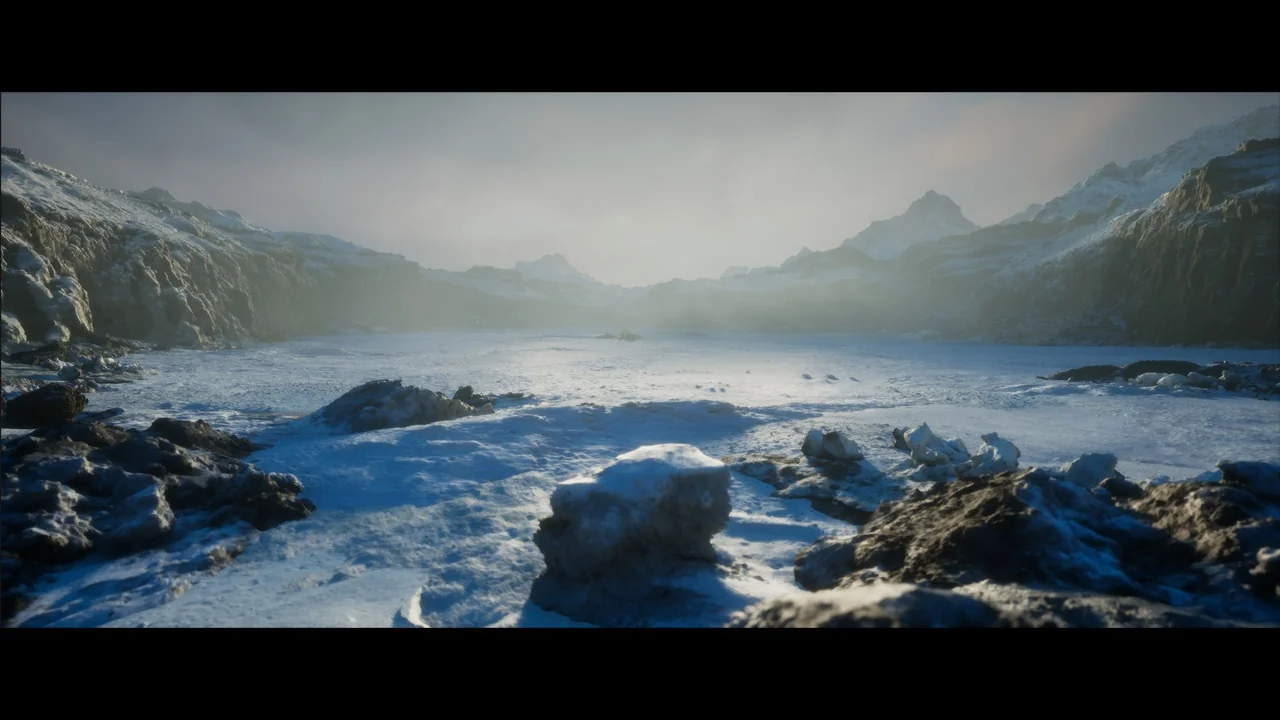
 Nature & Plants
 Nature & Plants
 Nature & Plants