"f813c18d2170b1f6"{"id":"1000060","slug":"fps-animation-pack-ultimate","title":"FPS Animation Pack Ultimate","category":"Animations","engine":"5.3 - 5.6","assetVersion":"Asset Version: 2025.2.0","engineVersion":"Engine version: 5.3 - 5.6","tag":"Animations","accent":"blue","visual":"animation","summary":"A first-person shooter animation pack with 20 animated weapons, procedural actions, FPS arms, sound effects, and quick integration support.","platform":"Unreal Engine","publishedAt":"2026-05-28T12:04:28.021Z","updatedAt":"2026-08-25T11:09:37.967Z","sourceNotes":[],"fileContents":[],"compatibility":["Unreal Engine","Asset Version: 2025.2.0","Engine version: 5.3 - 5.6"],"featuredImage":{"alt":"FPS Animation Pack Ultimate","src":"/wp-content/uploads/published/2026/05/7987e4530bce-dc1469f4-de2a-4d56-989b-9decf4fc6447-a7b620e518.webp"},"hasDownloadLink":true,"downloads":15,"terms":[{"taxonomy":"category","slug":"animations-tools-and-plugins","name":"Animations"}],"galleryImages":[{"src":"/wp-content/uploads/published/2026/05/470c1c443acd-522c2094-3708-4506-847d-903d4c3a8de8-2f1fd51fb0.webp","alt":"FPS Animation Pack Ultimate"},{"src":"/wp-content/uploads/published/2026/05/7f79a9b918e8-11f96452-7e86-43db-a933-94b0d3db6bda-e547e69696.webp","alt":"FPS Animation Pack Ultimate"},{"src":"/wp-content/uploads/published/2026/05/90824bed2ecf-1d3dacbc-1c2d-4f77-a729-a4efd9e44528-30d76d389a.webp","alt":"FPS Animation Pack Ultimate"},{"src":"/wp-content/uploads/published/2026/05/8f8e429f61dd-b98fcacb-89e4-4104-8cd2-5832023bd78d-56421869ae.webp","alt":"FPS Animation Pack Ultimate"},{"src":"/wp-content/uploads/published/2026/05/ed93434e295c-29e6a24d-dfaf-41f9-8341-1b1868401054-fe89b3dde8.webp","alt":"FPS Animation Pack Ultimate"},{"src":"/wp-content/uploads/published/2026/05/78eb806f346d-3d78b1ec-a9d6-4e46-aee6-f3210b47e40f-7756ccd203.webp","alt":"FPS Animation Pack Ultimate"},{"src":"/wp-content/uploads/published/2026/05/b16c7435f487-2e2c60eb-17e6-42bc-8821-ca012f9b8dae-30aa9bc313.webp","alt":"FPS Animation Pack Ultimate"},{"src":"/wp-content/uploads/published/2026/05/2bc0dfb0a233-ed5a3f3b-132f-4397-8fa1-4783de3cb7fc-8b19ab38e1.webp","alt":"FPS Animation Pack Ultimate"},{"src":"/wp-content/uploads/published/2026/05/942edbbc6fba-28526625-efcd-4ec2-b8fb-c3edb5ac6487-cdfb6e2c7b.webp","alt":"FPS Animation Pack Ultimate"},{"src":"/wp-content/uploads/published/2026/05/a514a1a8ea9f-e6b62a3a-029d-45bd-a790-137366b2fd2e-970d73243c.webp","alt":"FPS Animation Pack Ultimate"}],"accessPanel":{"kind":"resource","title":"Download this resource","eyebrow":"Free Download","message":"Log in or create a free account to start your download.","fileName":"FPS Animation Pack Ultimate.7z","safetyNote":"Resources are manually reviewed before listing to improve quality and reduce obvious risks.","actionLabel":"Download Free","resourceType":"Resource archive"},"contentHtml":"\u003cp\u003eMoment-to-moment gun handling is where a first-person shooter starts to feel convincing, and this pack leans hard into that layer of presentation. It brings together 20 animated weapons, a custom first-person arms model, procedural animation, and integrated sound effects in a package aimed at quick use inside an FPS project. The focus is not just on isolated reload clips or single firing actions, but on giving teams a fuller set of movements that help weapons feel active in the player’s hands.\u003c/p\u003e\u003cp\u003eThat makes it useful for more than a static arsenal showcase. The weapon set covers pistols, submachine guns, assault rifles, shotguns, marksman rifles, sniper rifles, a machine gun, and a special launcher, which gives developers room to establish very different combat rhythms while keeping animation handling within one pack. The content is also presented as well-structured, with clean modular code and a plug-and-play approach intended to make setup and customization more direct.\u003c/p\u003e\u003ch2\u003e20 animated weapons across a full FPS spread\u003c/h2\u003e\u003cp\u003eThe pack’s weapon lineup is one of its clearest strengths because it does not stay locked to a single firearm class. Five pistols are included: M1911, Kolibri, DGL-50, X18, and Viper-357. For close-range automatic play, there are three submachine guns: PDW90, MPS5, and Striker-V. Assault rifle coverage is broader still, with ASVal, MX16A4, AKX200, and G3.\u003c/p\u003e\u003cp\u003eShotgun handling is represented by KXG12 and Drake-12, while longer-range roles are split between two marksman rifles, Mk14EBR and SVD, and two sniper rifles, Kar98k and L96X. Heavy fire support comes through MGX5, and the weapon list closes with RPG7 in the special category.\u003c/p\u003e\u003cp\u003eFor teams building out a shooter prototype or a more developed playable arsenal, that spread supports multiple weapon identities without forcing everything into one pacing style. A compact sidearm, a fast SMG, a heavier machine gun, and a launcher all ask for different handling, and this pack approaches that variety through animation coverage rather than leaving the arsenal to feel interchangeable.\u003c/p\u003e\u003ch2\u003eReload behavior, recoil, and movement that shape the feel of play\u003c/h2\u003e\u003cp\u003eThe animation range goes beyond a basic reload-and-fire loop. Reloads include tactical reloads and empty reloads, with extra handling variants called out for specific weapons. MGX5 includes an extended reload, while KXG12 and Kar98k use a start-loop-end reload structure. Those distinctions matter in play because they let certain weapons carry their own rhythm instead of being reduced to one universal animation behavior.\u003c/p\u003e\u003cp\u003eProcedural animation extends the handling set with equip, unequip, recoil, aiming, and movement states. Movement coverage includes idle, walk, sprint, and jump. In use, this gives developers more continuity between weapon actions and locomotion, which is often where first-person presentation either feels fluid or starts to break apart. A weapon that can settle into idle, react through recoil, shift into aim, then carry through sprint and jump states contributes to a more coherent first-person view.\u003c/p\u003e\u003cp\u003eAction animations expand the pack further with grenade throwing and tactical sprint. That makes the content useful not only for standard gunplay but also for the transitions that help define modern shooter movement and combat flow. Tactical sprint in particular can change the visual energy of traversal, while grenade throwing gives another animated interaction layer without moving outside the pack’s first-person focus.\u003c/p\u003e\u003ch2\u003eFPS arms and sound effects working together\u003c/h2\u003e\u003cp\u003eThe included first-person arms model is custom-made for this setup and works with all render pipelines. That gives the pack a visual anchor beyond the weapons themselves, since first-person animation is always read through the relationship between the gun, the hands, and the camera-facing body language of the arms. A consistent arms model can help keep the weapon roster feeling like part of the same playable experience even when the firearm classes shift dramatically.\u003c/p\u003e\u003cp\u003eSound is treated as part of the animation presentation rather than an afterthought. Each animation combines realistic reload, fire, and movement sounds for added immersion. In use, that means the pack does not stop at visual motion alone. The handling of a weapon is reinforced by audio cues tied to the actions on screen, which can make simple interactions like swapping weapons, cycling a reload, or moving at speed feel more tangible.\u003c/p\u003e\u003cp\u003eFor creators, this combination opens up straightforward ways to stage gameplay that feels readable from the player’s perspective. The motion of the arms, the weapon-specific handling, and the matching action sounds all contribute to a first-person presentation where each class can carry more distinct personality.\u003c/p\u003e\u003ch2\u003eWhere the pack fits in an FPS workflow\u003c/h2\u003e\u003cp\u003eThis pack is positioned around ease of use. Its content is described as well-structured for quick setup, with clean and modular code that is meant to be easy to customize. The plug-and-play approach is a practical point for teams that want to spend less time assembling the basics of first-person weapon presentation and more time adapting those pieces to their own project structure.\u003c/p\u003e\u003cp\u003eBecause procedural animation is part of the package, the content is not limited to a rigid sequence of isolated clips. Instead, it supports the kind of layered first-person behavior developers often need when tuning how a weapon reacts during play. That can be useful whether the goal is a tighter arcade feel, a more grounded reload cadence, or simply a broader animation baseline for testing multiple weapon classes.\u003c/p\u003e\u003cp\u003eThe presence of a GASP integration tutorial also suggests a workflow path for teams that want to connect the pack into a larger setup without treating the content as a dead-end asset drop. Combined with documentation and demonstration material, the pack presents itself as something that can be evaluated visually and then brought into a project with integration in mind.\u003c/p\u003e\u003ch2\u003eControl Rig, Enhanced Input, and project readiness\u003c/h2\u003e\u003cp\u003eThere are two explicit dependencies: Control Rig and Enhanced Input. That is an important production note because these are not optional side details but part of the package requirements. Teams evaluating the pack need those plugins in place as part of their project setup.\u003c/p\u003e\u003cp\u003eThe broader tag profile also points to how the pack sits in a real-time workflow. It is associated with Blueprint, rigged content, modular structure, procedural animation, Animation Blueprint, Niagara, first-person shooter use, and Epic Skeleton. Taken together, those tags place it firmly in a game-development context where weapons, animation logic, and gameplay presentation are expected to work together rather than exist as disconnected art elements.\u003c/p\u003e\u003cp\u003eFor developers and artists who want a first-person weapon set that already covers a broad combat range, the strongest takeaway is simple: this pack combines 20 animated weapons, varied reload and movement behavior, custom FPS arms, and integrated sound in a setup meant for fast FPS integration.\u003c/p\u003e\n\n\u003ch2\u003eContinue Browsing Similar Packs\u003c/h2\u003e\n\u003cul\u003e\n\u003cli\u003e\u003ca href=\"https://3dcghub.com/ultimate-gameplay-camera/\" title=\"Ultimate Gameplay Camera\"\u003eUltimate Gameplay Camera\u003c/a\u003e\u003c/li\u003e\n\u003cli\u003e\u003ca href=\"https://3dcghub.com/procedural-fps-recoil-system/\" title=\"Procedural FPS Recoil System\"\u003eProcedural FPS Recoil System\u003c/a\u003e\u003c/li\u003e\n\u003cli\u003e\u003ca href=\"https://3dcghub.com/ultimate-fps-animations-pack/\" title=\"Ultimate FPS Animations Pack\"\u003eUltimate FPS Animations Pack\u003c/a\u003e\u003c/li\u003e\n\u003cli\u003e\u003ca href=\"https://3dcghub.com/fps-first-person-shooter-framework-skg-shooter-framework-v2/\" title=\"FPS First Person Shooter Framework (SKG Shooter Framework V2)\"\u003eFPS First Person Shooter Framework (SKG Shooter Framework V2)\u003c/a\u003e\u003c/li\u003e\n\u003cli\u003e\u003ca href=\"https://3dcghub.com/ultimate-level-art-tool-ulat-tools-plugin-plugins/\" title=\"Ultimate Level Art Tool - ULAT ( Tools / Plugin / Plugins )\"\u003eUltimate Level Art Tool - ULAT ( Tools / Plugin / Plugins )\u003c/a\u003e\u003c/li\u003e\n\u003c/ul\u003e","contentTextLength":7281,"navigation":{"current":733,"total":3651,"previous":{"id":"1001034","slug":"hyper-scalable-interaction-system-v4","title":"Hyper Scalable Interaction System v4","category":"Gameplay Features","platform":"Unreal Engine","updatedAt":"2026-08-25T11:18:18.819Z"},"next":{"id":"15252","slug":"dungeon-architect","title":"Dungeon Architect","category":"Procedural Systems","platform":"Unreal Engine","updatedAt":"2026-08-25T10:55:56.623Z"}},"relatedResources":[{"id":"13487","slug":"runtime-metahuman-lip-sync-ai-for-npcs-cc4-genesis-arkit-and-more","title":"Runtime MetaHuman Lip Sync (AI for NPCs) (+ CC4, Genesis, ARKit, and more)","category":"Animations","engine":"1.0 - 1.18","assetVersion":"Engine version: 5.5 - 5.7","engineVersion":"Asset Version: 1.0 - 1.18","tag":"Animations","accent":"blue","visual":"animation","summary":"Enhance your digital characters with zero-latency, real-time lip synchronization that works completely offline. This plugin supports MetaHumans, CC4, and Genesis characters across multiple platforms.","platform":"Unreal Engine","publishedAt":"2026-03-10T17:28:41.000Z","updatedAt":"2026-07-05T07:03:46.447Z","sourceNotes":[],"fileContents":[],"compatibility":["Unreal Engine","Engine version: 5.5 - 5.7","Asset Version: 1.0 - 1.18"],"featuredImage":{"alt":"Runtime MetaHuman Lip Sync (AI for NPCs) (+ CC4, Genesis, ARKit, and more)","src":"https://3dcghub.com/wp-content/uploads/2026/03/b4351251-5c6e-4b55-9c60-117d4a331ef7.webp"},"hasDownloadLink":true,"downloads":6},{"id":"1001496","slug":"ultimate-multiplayer-fps-kit","title":"Ultimate Multiplayer FPS Kit","category":"Shooter","engine":"5.3+","assetVersion":"","engineVersion":"Engine Version: 5.3+","tag":"Shooter","accent":"blue","visual":"mech","summary":"Explore the Ultimate Multiplayer FPS Kit, featuring replicated mechanics, modular weapons, dynamic locomotion, and flexible objective frameworks.","platform":"Unreal Engine","publishedAt":"2026-10-09T05:55:05.138Z","updatedAt":"2026-10-09T05:55:05.138Z","sourceNotes":[],"fileContents":[],"compatibility":["Unreal Engine","Engine Version: 5.3+"],"featuredImage":{"alt":"Ultimate Multiplayer FPS Kit","src":"/wp-content/uploads/published/2026/10/391e1644e6fa-13c21395-24cd-4606-b1ed-a04edd06457c-0245a33139.webp"},"hasDownloadLink":true,"downloads":3},{"id":"1000666","slug":"rkva-rigless-kinematic-vehicle-animation","title":"RKVA Rigless Kinematic Vehicle Animation","category":"Animations","engine":"5.6","assetVersion":"Asset Version: 1.0.5b","engineVersion":"Engine Version: 5.6","tag":"Animations","accent":"blue","visual":"animation","summary":"A fully procedural, modular vehicle animation system using spline-based distance keyframing. Build cars, trucks, and bikes from static meshes with no rigging re","platform":"Unreal Engine","publishedAt":"2026-07-22T07:06:32.349Z","updatedAt":"2026-07-22T07:06:32.349Z","sourceNotes":[],"fileContents":[],"compatibility":["Unreal Engine","Asset Version: 1.0.5b","Engine Version: 5.6"],"featuredImage":{"alt":"RKVA Rigless Kinematic Vehicle Animation","src":"/wp-content/uploads/published/2026/07/a8d2547b5401-f5c2039a-f122-4a76-8e78-89e7a923f29d-08adddf779.webp"},"hasDownloadLink":true,"downloads":1}]}
Animations
FPS Animation Pack Ultimate
A first-person shooter animation pack with 20 animated weapons, procedural actions, FPS arms, sound effects, and quick integration support.
Category:Unreal Engine,AnimationsPlatform: Unreal EngineAsset Version: 2025.2.0Engine version: 5.3 - 5.6Published: May 28, 2026Updated: Aug 25, 2026
Animations
Resource overview
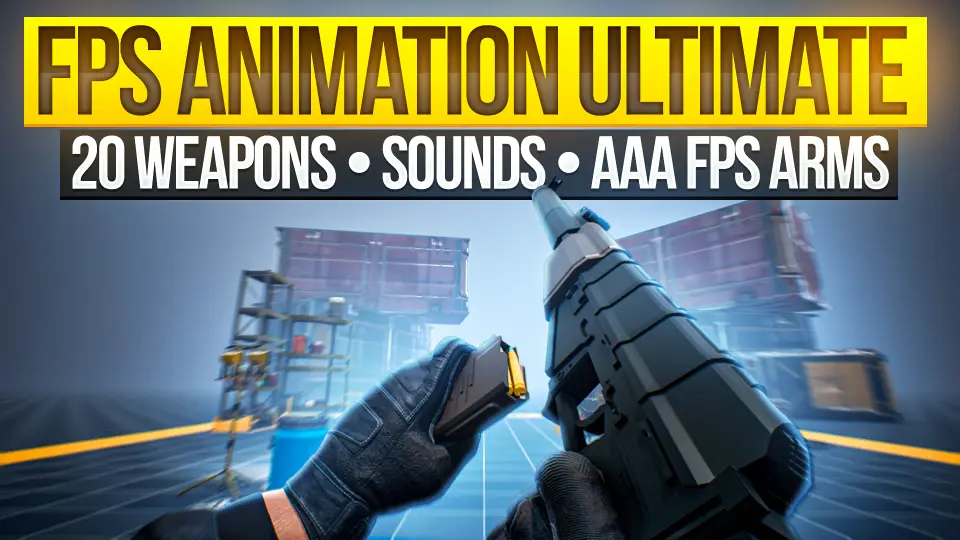
Moment-to-moment gun handling is where a first-person shooter starts to feel convincing, and this pack leans hard into that layer of presentation. It brings together 20 animated weapons, a custom first-person arms model, procedural animation, and integrated sound effects in a package aimed at quick use inside an FPS project. The focus is not just on isolated reload clips or single firing actions, but on giving teams a fuller set of movements that help weapons feel active in the player’s hands.
That makes it useful for more than a static arsenal showcase. The weapon set covers pistols, submachine guns, assault rifles, shotguns, marksman rifles, sniper rifles, a machine gun, and a special launcher, which gives developers room to establish very different combat rhythms while keeping animation handling within one pack. The content is also presented as well-structured, with clean modular code and a plug-and-play approach intended to make setup and customization more direct.
20 animated weapons across a full FPS spread
The pack’s weapon lineup is one of its clearest strengths because it does not stay locked to a single firearm class. Five pistols are included: M1911, Kolibri, DGL-50, X18, and Viper-357. For close-range automatic play, there are three submachine guns: PDW90, MPS5, and Striker-V. Assault rifle coverage is broader still, with ASVal, MX16A4, AKX200, and G3.
Shotgun handling is represented by KXG12 and Drake-12, while longer-range roles are split between two marksman rifles, Mk14EBR and SVD, and two sniper rifles, Kar98k and L96X. Heavy fire support comes through MGX5, and the weapon list closes with RPG7 in the special category.
For teams building out a shooter prototype or a more developed playable arsenal, that spread supports multiple weapon identities without forcing everything into one pacing style. A compact sidearm, a fast SMG, a heavier machine gun, and a launcher all ask for different handling, and this pack approaches that variety through animation coverage rather than leaving the arsenal to feel interchangeable.
Reload behavior, recoil, and movement that shape the feel of play
The animation range goes beyond a basic reload-and-fire loop. Reloads include tactical reloads and empty reloads, with extra handling variants called out for specific weapons. MGX5 includes an extended reload, while KXG12 and Kar98k use a start-loop-end reload structure. Those distinctions matter in play because they let certain weapons carry their own rhythm instead of being reduced to one universal animation behavior.
Procedural animation extends the handling set with equip, unequip, recoil, aiming, and movement states. Movement coverage includes idle, walk, sprint, and jump. In use, this gives developers more continuity between weapon actions and locomotion, which is often where first-person presentation either feels fluid or starts to break apart. A weapon that can settle into idle, react through recoil, shift into aim, then carry through sprint and jump states contributes to a more coherent first-person view.
Action animations expand the pack further with grenade throwing and tactical sprint. That makes the content useful not only for standard gunplay but also for the transitions that help define modern shooter movement and combat flow. Tactical sprint in particular can change the visual energy of traversal, while grenade throwing gives another animated interaction layer without moving outside the pack’s first-person focus.
FPS arms and sound effects working together
The included first-person arms model is custom-made for this setup and works with all render pipelines. That gives the pack a visual anchor beyond the weapons themselves, since first-person animation is always read through the relationship between the gun, the hands, and the camera-facing body language of the arms. A consistent arms model can help keep the weapon roster feeling like part of the same playable experience even when the firearm classes shift dramatically.
Sound is treated as part of the animation presentation rather than an afterthought. Each animation combines realistic reload, fire, and movement sounds for added immersion. In use, that means the pack does not stop at visual motion alone. The handling of a weapon is reinforced by audio cues tied to the actions on screen, which can make simple interactions like swapping weapons, cycling a reload, or moving at speed feel more tangible.
For creators, this combination opens up straightforward ways to stage gameplay that feels readable from the player’s perspective. The motion of the arms, the weapon-specific handling, and the matching action sounds all contribute to a first-person presentation where each class can carry more distinct personality.
Where the pack fits in an FPS workflow
This pack is positioned around ease of use. Its content is described as well-structured for quick setup, with clean and modular code that is meant to be easy to customize. The plug-and-play approach is a practical point for teams that want to spend less time assembling the basics of first-person weapon presentation and more time adapting those pieces to their own project structure.
Because procedural animation is part of the package, the content is not limited to a rigid sequence of isolated clips. Instead, it supports the kind of layered first-person behavior developers often need when tuning how a weapon reacts during play. That can be useful whether the goal is a tighter arcade feel, a more grounded reload cadence, or simply a broader animation baseline for testing multiple weapon classes.
The presence of a GASP integration tutorial also suggests a workflow path for teams that want to connect the pack into a larger setup without treating the content as a dead-end asset drop. Combined with documentation and demonstration material, the pack presents itself as something that can be evaluated visually and then brought into a project with integration in mind.
Control Rig, Enhanced Input, and project readiness
There are two explicit dependencies: Control Rig and Enhanced Input. That is an important production note because these are not optional side details but part of the package requirements. Teams evaluating the pack need those plugins in place as part of their project setup.
The broader tag profile also points to how the pack sits in a real-time workflow. It is associated with Blueprint, rigged content, modular structure, procedural animation, Animation Blueprint, Niagara, first-person shooter use, and Epic Skeleton. Taken together, those tags place it firmly in a game-development context where weapons, animation logic, and gameplay presentation are expected to work together rather than exist as disconnected art elements.
For developers and artists who want a first-person weapon set that already covers a broad combat range, the strongest takeaway is simple: this pack combines 20 animated weapons, varied reload and movement behavior, custom FPS arms, and integrated sound in a setup meant for fast FPS integration.
 Animations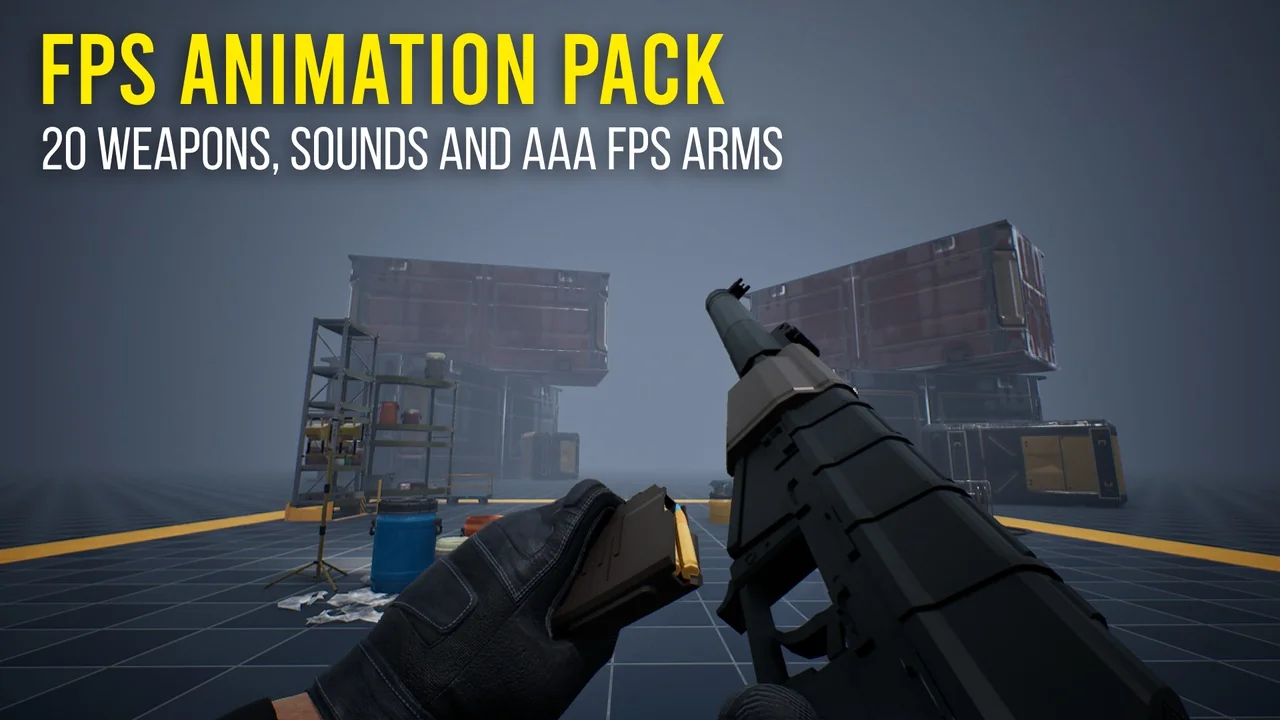
 Animations
 Shooter
 Animations