"c14ff6bd758dadb1"{"id":"1000539","slug":"mothership-service-rooms","title":"Mothership Service Rooms","category":"Industrial","engine":"4.26+,5.0+","assetVersion":"","engineVersion":"Engine Version: 4.26+,5.0+","tag":"Industrial","accent":"blue","visual":"mech","summary":"A retro sci-fi modular environment asset pack featuring dark, dirty service corridors, thin vents, and large hangar segments lit by emergency lighting for Unrea","platform":"Unreal Engine","publishedAt":"2026-07-15T02:47:06.926Z","updatedAt":"2026-07-15T02:47:06.926Z","sourceNotes":[],"fileContents":[],"compatibility":["Unreal Engine","Engine Version: 4.26+,5.0+"],"featuredImage":{"alt":"Mothership Service Rooms","src":"/wp-content/uploads/published/2026/07/2e6272479151-9e384487-b2c8-4372-b466-174daf62192c-eb99c572eb.webp"},"hasDownloadLink":true,"downloads":0,"terms":[{"taxonomy":"category","slug":"industrial-environments","name":"Industrial"}],"galleryImages":[{"src":"/wp-content/uploads/published/2026/07/9c74fee85d92-16cf090e-e354-42e7-8044-d173e3f70bf1-8ee1e9fe89.webp","alt":"Mothership Service Rooms"},{"src":"/wp-content/uploads/published/2026/07/cd4285d4b681-ab05ecf7-ac49-43d9-a02b-940f26491cb0-366c02f77e.webp","alt":"Mothership Service Rooms"},{"src":"/wp-content/uploads/published/2026/07/c990f7f68e47-cde0e64d-13e9-45f5-bd18-e8bccb241d80-67dbfed2a9.webp","alt":"Mothership Service Rooms"},{"src":"/wp-content/uploads/published/2026/07/f9955150bee0-5aed0cae-d13d-4ca4-80be-f6785dcf9b50-266a41bf6c.webp","alt":"Mothership Service Rooms"},{"src":"/wp-content/uploads/published/2026/07/e4c9e811c25f-877471ae-019f-40d2-a16a-7812c8920291-46e64f483e.webp","alt":"Mothership Service Rooms"},{"src":"/wp-content/uploads/published/2026/07/8691a1cffbde-f5878d55-7b9e-4571-8b66-10df46e3b952-424eba52b6.webp","alt":"Mothership Service Rooms"}],"accessPanel":{"kind":"resource","title":"Download this resource","eyebrow":"Free Download","message":"Log in or create a free account to start your download.","fileName":"Content.7z","safetyNote":"Resources are manually reviewed before listing to improve quality and reduce obvious risks.","actionLabel":"Download Free","resourceType":"Resource archive"},"contentHtml":"\u003cp\u003eCorridors sit in near darkness, lit only by the dim glow of emergency lighting. Surfaces carry grime rather than a polished sheen. This is the visual register the package operates in, pushing back against the sleek, sterile aesthetic that dominates contemporary science fiction environments. Instead, it aims for a moodier, retro-cinema atmosphere where the interiors of a large vessel feel lived in, neglected, and utilitarian. The lighting is sparse enough that shadows do much of the storytelling, and the dirt textures imply a long operational history behind every wall panel.\u003c/p\u003e \u003cp\u003eThe toolkit leans on a modular philosophy, allowing level designers to snap together sections of a larger mothership interior. The stylistic intent is specifically retro: think of the visual language of older science fiction films where spaceships were not Apple-store-clean but industrial, shadowy, and cramped. Every segment is designed to reinforce that mood, from the lighting choices to the surface treatments.\u003c/p\u003e \u003ch2\u003eDark, Moody Interiors and Emergency Lighting\u003c/h2\u003e \u003cp\u003eThe core visual identity of the Mothership Service Rooms package rests on its lighting and material approach. Rather than working as a brightly lit pristine environment, the asset set is shaped by the concept of emergency lighting. This means scenarios where standard power has failed or been deliberately dimmed, leaving strips of guidance lights and sparse fixture pools to carve out visibility. Shadows dominate the architecture.\u003c/p\u003e \u003cp\u003eThe term full of dirt is central to the package's value proposition. This signals that the included surfaces, wherever they appear, carry layered grime, wear, and weathering. The dark, moody atmosphere depends on this textural buildup to sell the age of the environment. It is not simply that the rooms lack light; they also lack cleanliness, breaking the visual perfection often associated with futuristic 3D interiors.\u003c/p\u003e \u003cp\u003eThis approach gives the environment a documentary or long-abandoned quality. The atmospheric tone suggests service areas tucked deep inside a massive vessel, places where maintenance crews work or once worked long shifts away from the polished command centers.\u003c/p\u003e \u003ch2\u003eScale Variations From Thin Vents to Huge Hangar Segments\u003c/h2\u003e \u003cp\u003eThe package covers a deliberate range of spatial scales. At the smallest end are thin vents. These tight, restrictive passages serve as the connective tissue inside the mothership, offering narrow routes for the player or camera to navigate. The term thin implies claustrophobic conditions meant for maintenance access rather than crew movement.\u003c/p\u003e \u003cp\u003eBetween the vents and the largest pieces are trough corridors. These are the service hallways that form the standard circulation pattern of the lower decks. They provide a middle scale that bridges the gap between the cramped vents and the open hangars, allowing designers to build longer sight lines and rank ranks of similar hallways.\u003c/p\u003e \u003cp\u003eAt the largest end of the kit are huge hangar segments. These open spaces contrast sharply with the tight corridors and vents. A huge hangar introduces verticality and breathability to the level design, creating moments where the enclosed tension of the service passages gives way to an expansive room. The scale range from vent to hangar covers the basic ductwork, circulation,.Look and voluminous storage spaces needed to block out a full mothership interior.\u003c/p\u003e \u003ch2\u003eRetro Cinema Inspirations and Modular Workflow\u003c/h2\u003e \u003cp\u003eThe visual direction is explicitly inspired by retro cinema. This frames the package as a reaction against modern sci-fi design trends. The mood it aims for harkens back to a period when science fiction on film relied on practical lighting, physical set construction, and visible mechanical detail. The dark, moody texture of the asset set is a direct translation of that sensibility into a 3D workflow.\u003c/p\u003e \u003cp\u003eAll interior pieces are modular. This method of level construction lets designers reuse individual panels, corridor sections, and structural elements to build out larger environment layouts by snapping them together. Because the pieces are modular, a designer can assemble a complex floor plan iteratively, adjusting room sizes and routing corridors as the level design requires. The realistic detailing baked into the assets is intended to hold up under Lumen lighting conditions, letting the global illumination system respond naturally to the dark surfaces and emergency light sources.\u003c/p\u003e \u003ch3\u003eProject Types and Scene Applications\u003c/h2\u003e \u003cp\u003eThe environmental tone and scale range make this package suited to specific kinds of scene work. Games set on large spacecraft are the most immediate fit. The mothership terminology, combined with the mix of vents, corridors, and hangars, supplies the pieces needed to block out multiple decks of a single vessel. The dark, dirty atmosphere works be particularly effective for survival horror, stealth, or exploration narratives where the player moves through a deteriorated or compromised ship.\u003c/p\u003e \u003cp\u003eFor cinematic or pre-rendered projects aiming at a retro science fiction look, the kit offers a set of ready-to-stage interior environments. The emergency lighting setup and grimy textures can stand in for a practical film set aesthetic without requiring custom modeling for each shot.\u003c/p\u003e \u003cp\u003eIt is also positioned for teams building specific scenes where standard bright futuristic elements feel out of place. Any project requiring a maintenance bay, lower deck service route, or cargo-handling area would find the constituent geometry useful.\u003c/p\u003e \u003ch3\u003eCompatibility and Engine Support\u003c/h3\u003e \u003cp\u003eThe packet is available for a range of Unreal Engine versions. Version support covers releases 4.9 and 4.10 through 4.20, spanning a long stretch of Unreal Engine 4 development. This gives teams still working in older UE4 pipelines access to the assets without needing a project jump.\u003c/p\u003e \u003cp\u003eAt the current end of the spectrum, the package also supports Unreal Engine versions 5.4 and 5.5. This means creators working in the newer Lumen-enabled toolset can use the environment pieces and take advantage of the global illumination and shadow response that come with the current engine. The Lumen tag affixed to the pack suggests that the materials and lighting setups have been considered within the context of modern rendering features.\u003c/p\u003e \u003ch3\u003eFinal Considerations for Evaluation Teams\u003c/h3\u003e \u003cp\u003eTeams deciding on an asset purchase should weigh the specific visual register this package targets. It is built for an aesthetic where moody and dark interiors lit by emergency lighting set the tone, replacing polished sci-fi defaults. The presence of huge hangar segments alongside thin vents indicates enough spatial variety to compose a full ship interior without resorting to a single repeated scale type. Material style, spatial flexibility, and multi-version engine support are the primary factors for groups evaluating its application. A support Discord is also available for technical questions or usage inquiries.\u003c/p\u003e\n\n\u003ch2\u003eRelated Resources Worth Checking\u003c/h2\u003e\n\u003cul\u003e\n\u003cli\u003e\u003ca href=\"https://3dcghub.com/subway/\" title=\"Subway\"\u003eSubway\u003c/a\u003e\u003c/li\u003e\n\u003cli\u003e\u003ca href=\"https://3dcghub.com/abandoned-service-garage-vol-4-vehicles-and-service-machines/\" title=\"Abandoned Service Garage - VOL.4 - Vehicles and Service Machines\"\u003eAbandoned Service Garage - VOL.4 - Vehicles and Service Machines\u003c/a\u003e\u003c/li\u003e\n\u003cli\u003e\u003ca href=\"https://3dcghub.com/modular-target-practice-hangar/\" title=\"Modular Target Practice Hangar\"\u003eModular Target Practice Hangar\u003c/a\u003e\u003c/li\u003e\n\u003cli\u003e\u003ca href=\"https://3dcghub.com/industrial-area-hangar/\" title=\"Industrial Area Hangar\"\u003eIndustrial Area Hangar\u003c/a\u003e\u003c/li\u003e\n\u003cli\u003e\u003ca href=\"https://3dcghub.com/tank-cleaning-center/\" title=\"Tank Cleaning Center\"\u003eTank Cleaning Center\u003c/a\u003e\u003c/li\u003e\n\u003c/ul\u003e","contentTextLength":7077,"navigation":{"current":1323,"total":3719,"previous":{"id":"1000540","slug":"mw-conifer-forest-trees-biome","title":"MW Conifer Forest Trees Biome","category":"Forest \u0026 Jungle","platform":"Unreal Engine","updatedAt":"2026-07-15T03:01:54.981Z"},"next":{"id":"1000538","slug":"modular-target-practice-hangar","title":"Modular Target Practice Hangar","category":"Industrial","platform":"Unreal Engine","updatedAt":"2026-07-15T02:41:52.368Z"}},"relatedResources":[{"id":"1001109","slug":"modular-subway-tunnels","title":"Modular Subway Tunnels","category":"Industrial","engine":"4.26+,5.0+","assetVersion":"","engineVersion":"Engine Version: 4.26+,5.0+","tag":"Industrial","accent":"blue","visual":"mech","summary":"A modular kit for building subway tunnels and underground rooms, including rails, pipes, hermetic doors, furniture, and a technical train for Unreal and Unity.","platform":"Unreal Engine","publishedAt":"2026-09-07T07:50:51.958Z","updatedAt":"2026-09-07T07:50:51.958Z","sourceNotes":[],"fileContents":[],"compatibility":["Unreal Engine","Engine Version: 4.26+,5.0+"],"featuredImage":{"alt":"Modular Subway Tunnels","src":"/wp-content/uploads/published/2026/09/61d89297ef4d-edf779ea-b395-4cd8-b3c5-ab28b72ece9f-2084d0cc6d.webp"},"hasDownloadLink":true,"downloads":0},{"id":"1000254","slug":"subway","title":"Subway","category":"Industrial","engine":"4.26+,5.0+","assetVersion":"","engineVersion":"Engine Version: 4.26+,5.0+","tag":"Industrial","accent":"blue","visual":"mech","summary":"Construct realistic underground transit networks with a modular collection of platforms, technical rooms, spline-driven tunnels, and customizable train blueprin","platform":"Unreal Engine","publishedAt":"2026-06-30T21:55:22.710Z","updatedAt":"2026-06-30T21:55:22.710Z","sourceNotes":[],"fileContents":[],"compatibility":["Unreal Engine","Engine Version: 4.26+,5.0+"],"featuredImage":{"alt":"Subway","src":"/wp-content/uploads/published/2026/06/c872537741a5-64daf0a1-bc5d-47d4-b07e-3fc4ecca9c7f-5b87ebb9d0.webp"},"hasDownloadLink":true,"downloads":0},{"id":"1001132","slug":"car-service-garage","title":"CAR SERVICE GARAGE","category":"Interior","engine":"4.26+,5.0+","assetVersion":"","engineVersion":"Engine Version: 4.26+,5.0+","tag":"Interior","accent":"blue","visual":"mech","summary":"Over 220 game-ready modular assets for car service garage levels, including walls, floors, ceilings, AC, pipes, electric cables, traffic signs, and metal and st","platform":"Unreal Engine","publishedAt":"2026-09-09T02:13:45.721Z","updatedAt":"2026-09-09T02:13:45.721Z","sourceNotes":[],"fileContents":[],"compatibility":["Unreal Engine","Engine Version: 4.26+,5.0+"],"featuredImage":{"alt":"CAR SERVICE GARAGE","src":"/wp-content/uploads/published/2026/09/b8e31e85f799-b4a69137-a7b4-4a43-8169-350db8ae76b8-af06ecf35b.webp"},"hasDownloadLink":true,"downloads":2}]}
Industrial
Mothership Service Rooms
A retro sci-fi modular environment asset pack featuring dark, dirty service corridors, thin vents, and large hangar segments lit by emergency lighting for Unrea
Corridors sit in near darkness, lit only by the dim glow of emergency lighting. Surfaces carry grime rather than a polished sheen. This is the visual register the package operates in, pushing back against the sleek, sterile aesthetic that dominates contemporary science fiction environments. Instead, it aims for a moodier, retro-cinema atmosphere where the interiors of a large vessel feel lived in, neglected, and utilitarian. The lighting is sparse enough that shadows do much of the storytelling, and the dirt textures imply a long operational history behind every wall panel.
The toolkit leans on a modular philosophy, allowing level designers to snap together sections of a larger mothership interior. The stylistic intent is specifically retro: think of the visual language of older science fiction films where spaceships were not Apple-store-clean but industrial, shadowy, and cramped. Every segment is designed to reinforce that mood, from the lighting choices to the surface treatments.
Dark, Moody Interiors and Emergency Lighting
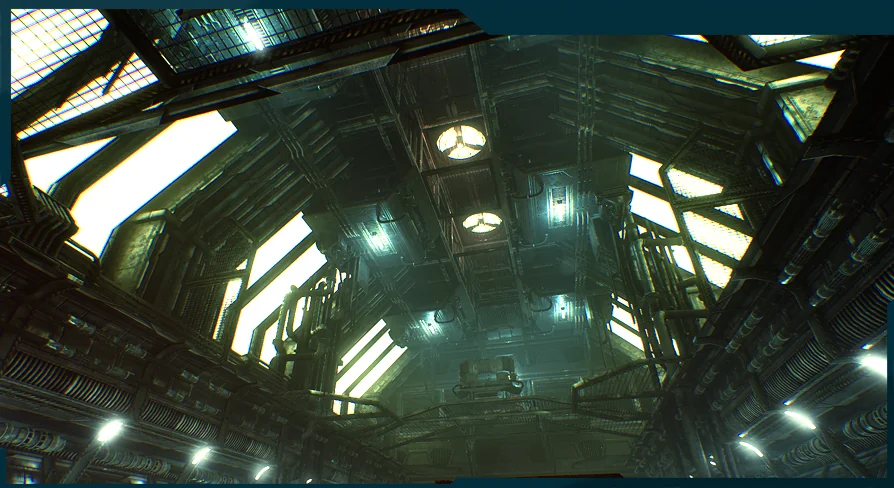
The core visual identity of the Mothership Service Rooms package rests on its lighting and material approach. Rather than working as a brightly lit pristine environment, the asset set is shaped by the concept of emergency lighting. This means scenarios where standard power has failed or been deliberately dimmed, leaving strips of guidance lights and sparse fixture pools to carve out visibility. Shadows dominate the architecture.
The term full of dirt is central to the package's value proposition. This signals that the included surfaces, wherever they appear, carry layered grime, wear, and weathering. The dark, moody atmosphere depends on this textural buildup to sell the age of the environment. It is not simply that the rooms lack light; they also lack cleanliness, breaking the visual perfection often associated with futuristic 3D interiors.
This approach gives the environment a documentary or long-abandoned quality. The atmospheric tone suggests service areas tucked deep inside a massive vessel, places where maintenance crews work or once worked long shifts away from the polished command centers.
Scale Variations From Thin Vents to Huge Hangar Segments
The package covers a deliberate range of spatial scales. At the smallest end are thin vents. These tight, restrictive passages serve as the connective tissue inside the mothership, offering narrow routes for the player or camera to navigate. The term thin implies claustrophobic conditions meant for maintenance access rather than crew movement.
Between the vents and the largest pieces are trough corridors. These are the service hallways that form the standard circulation pattern of the lower decks. They provide a middle scale that bridges the gap between the cramped vents and the open hangars, allowing designers to build longer sight lines and rank ranks of similar hallways.
At the largest end of the kit are huge hangar segments. These open spaces contrast sharply with the tight corridors and vents. A huge hangar introduces verticality and breathability to the level design, creating moments where the enclosed tension of the service passages gives way to an expansive room. The scale range from vent to hangar covers the basic ductwork, circulation,.Look and voluminous storage spaces needed to block out a full mothership interior.
Retro Cinema Inspirations and Modular Workflow
The visual direction is explicitly inspired by retro cinema. This frames the package as a reaction against modern sci-fi design trends. The mood it aims for harkens back to a period when science fiction on film relied on practical lighting, physical set construction, and visible mechanical detail. The dark, moody texture of the asset set is a direct translation of that sensibility into a 3D workflow.
All interior pieces are modular. This method of level construction lets designers reuse individual panels, corridor sections, and structural elements to build out larger environment layouts by snapping them together. Because the pieces are modular, a designer can assemble a complex floor plan iteratively, adjusting room sizes and routing corridors as the level design requires. The realistic detailing baked into the assets is intended to hold up under Lumen lighting conditions, letting the global illumination system respond naturally to the dark surfaces and emergency light sources.
Project Types and Scene Applications
The environmental tone and scale range make this package suited to specific kinds of scene work. Games set on large spacecraft are the most immediate fit. The mothership terminology, combined with the mix of vents, corridors, and hangars, supplies the pieces needed to block out multiple decks of a single vessel. The dark, dirty atmosphere works be particularly effective for survival horror, stealth, or exploration narratives where the player moves through a deteriorated or compromised ship.
For cinematic or pre-rendered projects aiming at a retro science fiction look, the kit offers a set of ready-to-stage interior environments. The emergency lighting setup and grimy textures can stand in for a practical film set aesthetic without requiring custom modeling for each shot.
It is also positioned for teams building specific scenes where standard bright futuristic elements feel out of place. Any project requiring a maintenance bay, lower deck service route, or cargo-handling area would find the constituent geometry useful.
Compatibility and Engine Support
The packet is available for a range of Unreal Engine versions. Version support covers releases 4.9 and 4.10 through 4.20, spanning a long stretch of Unreal Engine 4 development. This gives teams still working in older UE4 pipelines access to the assets without needing a project jump.
At the current end of the spectrum, the package also supports Unreal Engine versions 5.4 and 5.5. This means creators working in the newer Lumen-enabled toolset can use the environment pieces and take advantage of the global illumination and shadow response that come with the current engine. The Lumen tag affixed to the pack suggests that the materials and lighting setups have been considered within the context of modern rendering features.
Final Considerations for Evaluation Teams
Teams deciding on an asset purchase should weigh the specific visual register this package targets. It is built for an aesthetic where moody and dark interiors lit by emergency lighting set the tone, replacing polished sci-fi defaults. The presence of huge hangar segments alongside thin vents indicates enough spatial variety to compose a full ship interior without resorting to a single repeated scale type. Material style, spatial flexibility, and multi-version engine support are the primary factors for groups evaluating its application. A support Discord is also available for technical questions or usage inquiries.
 Industrial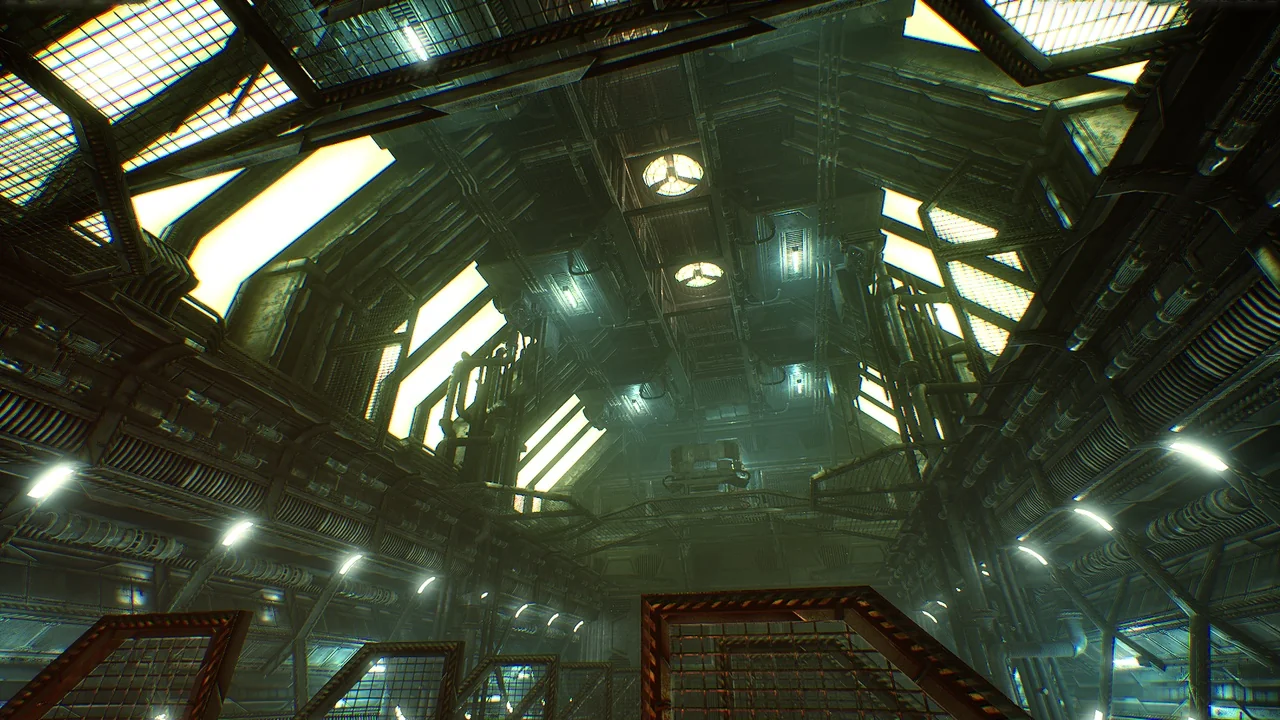
 Industrial
 Industrial
 Interior