"031373f479d9561a"{"id":"1000254","slug":"subway","title":"Subway","category":"Industrial","engine":"4.26+,5.0+","assetVersion":"","engineVersion":"Engine Version: 4.26+,5.0+","tag":"Industrial","accent":"blue","visual":"mech","summary":"Construct realistic underground transit networks with a modular collection of platforms, technical rooms, spline-driven tunnels, and customizable train blueprin","platform":"Unreal Engine","publishedAt":"2026-06-30T21:55:22.710Z","updatedAt":"2026-06-30T21:55:22.710Z","sourceNotes":[],"fileContents":[],"compatibility":["Unreal Engine","Engine Version: 4.26+,5.0+"],"featuredImage":{"alt":"Subway","src":"/wp-content/uploads/published/2026/06/c872537741a5-64daf0a1-bc5d-47d4-b07e-3fc4ecca9c7f-5b87ebb9d0.webp"},"hasDownloadLink":true,"downloads":0,"terms":[{"taxonomy":"category","slug":"industrial-environments","name":"Industrial"}],"galleryImages":[{"src":"/wp-content/uploads/published/2026/06/1ee21e24b340-e30a21ef-d875-4662-8983-ea95f32ec97f-6312670247.webp","alt":"Subway"},{"src":"/wp-content/uploads/published/2026/06/8802431ec995-4a174ae5-a783-426b-aedf-9648cd0f735c-9d5d1b7cee.webp","alt":"Subway"},{"src":"/wp-content/uploads/published/2026/06/f6f2ed65d3d4-858fdcfd-5535-46ba-b4ef-1484b89f1e21-1811d94b44.webp","alt":"Subway"},{"src":"/wp-content/uploads/published/2026/06/c6aa72c9007f-c39483c0-a92d-4d5f-b037-c984af6156e2-5737907c74.webp","alt":"Subway"},{"src":"/wp-content/uploads/published/2026/06/0beba00b5e5b-4573e21c-f3c3-4c0d-9ecd-652e603750bf-94c3538b1f.webp","alt":"Subway"},{"src":"/wp-content/uploads/published/2026/06/a15ea708e57c-8cd80f66-1541-46c7-8fdf-d3241fdb562f-5c0f511248.webp","alt":"Subway"},{"src":"/wp-content/uploads/published/2026/06/9ee00c3b96b6-61f344f2-d52d-4b08-8c87-c3baa94e0f4e-400f9c90dc.webp","alt":"Subway"},{"src":"/wp-content/uploads/published/2026/06/ee9126dce861-57964b40-1a62-44b3-9c56-63ada8f025a5-c01e18af73.webp","alt":"Subway"},{"src":"/wp-content/uploads/published/2026/06/18c4831887d4-ee43eece-efa4-42a7-be3c-2876af69a538-3f7fdd5cef.webp","alt":"Subway"},{"src":"/wp-content/uploads/published/2026/06/135960c0e646-3d4cccb8-3949-4fbf-a05a-8c7158e708bd-4b70b69d09.webp","alt":"Subway"}],"accessPanel":{"kind":"resource","title":"Download this resource","eyebrow":"Free Download","message":"Log in or create a free account to start your download.","fileName":"Content.7z","safetyNote":"Resources are manually reviewed before listing to improve quality and reduce obvious risks.","actionLabel":"Download Free","resourceType":"Resource archive"},"contentHtml":"\u003cp\u003eBuilding compelling underground spaces requires a careful balance between public architecture and hidden industrial infrastructure. This resource focuses on the complete anatomy of a realistic metro system, providing the foundational pieces for expansive subway platforms alongside the dark, utilitarian tunnels and technical rooms that sit just out of public view. Designed with a lowpoly yet realistic aesthetic, the environment allows developers to assemble sprawling underground networks tailored to urban exploration, survival scenarios, or industrial gameplay. By combining modular architecture with heavily customizable systems, the toolset provides everything needed to construct subterranean transit levels of the highest quality.\u003c/p\u003e \u003ch2\u003eStructuring the Underground Network\u003c/h2\u003e\n\u003cp\u003eThe core of the environment relies on modular construction, allowing level designers to snap together complex stations and corridors. The transition between the brightly lit public spaces and the restricted zones is a crucial element of transit design. The provided assets allow for the seamless connection of wide, tiled subway platforms to cramped, utilitarian technical rooms. These technical spaces can be heavily detailed with a vast array of included props, such as heavy industrial doors, complex switchboards, and dense clusters of wires. This stark contrast between the passenger-facing platform and the behind-the-scenes maintenance areas gives the environment a deep sense of realism and scale.\u003c/p\u003e \u003ch2\u003eSpline-Driven Tunnel Generation\u003c/h2\u003e\n\u003cp\u003eOne of the central challenges of subterranean level design is routing the track layout naturally beneath a city. Instead of relying purely on static, rigid tunnel meshes that force a grid-like layout, this toolset utilizes a customizable tunnel blueprint built along a spline. This gives environment artists the flexibility to draw curving underground pathways that snake organically through the level, adapting the track to the specific flow of the gameplay space.\u003c/p\u003e\n\u003cp\u003eThe tunnel blueprint is highly modular in its execution, offering the possibility to automatically include wires, borders, and various rails directly along the generated spline path. This automated distribution of infrastructure along the curve ensures that the tunnel remains visually dense and functionally believable without requiring the tedious manual placement of every individual track tie, wall border, or hanging cable over long distances.\u003c/p\u003e \u003ch2\u003eInteractive and Customizable Transit\u003c/h2\u003e\n\u003cp\u003eA metro environment is anchored by its rolling stock. The central train wagon operates via a customizable blueprint, providing much more than just a static background prop for the station. Developers can quickly adjust the color of the train to match specific municipal branding, fit a particular color palette, or distinguish different transit lines within a massive city network.\u003c/p\u003e\n\u003cp\u003eAlso, the train blueprint supports full door opening functionality. This functional integration allows the wagon to serve as an interactive focal point within the level. The train can be staged as actively arriving at the subway platform to pick up passengers, or it can be left abandoned in a dark tunnel with its doors jammed open, inviting players to step inside and explore the interior.\u003c/p\u003e \u003ch2\u003ePopulating with Utility Blueprints\u003c/h2\u003e\n\u003cp\u003eTo streamline the placement of complex architectural and industrial elements, the package relies on dedicated blueprints for specific utility fixtures. Escalators bridge the vertical gap between the surface city and the underground depths, providing natural transition points between different floors of a massive transit hub. Fans and lamps can be quickly dropped into the technical rooms or tunnel shafts to establish the necessary ventilation and lighting infrastructure.\u003c/p\u003e\n\u003cp\u003eThe inclusion of police line blueprints offers an immediate narrative and level design tool. These modular barriers can be strung across corridors or station entrances to organically block off restricted technical rooms, close down sections of the platform, or guide player navigation without relying on invisible walls.\u003c/p\u003e \u003ch2\u003eWeathering the Environment\u003c/h2\u003e\n\u003cp\u003eSubway systems are defined by their grime, heavy use, and constant exposure to the elements. To achieve a realistic, lived-in atmosphere, the environment relies on a layered approach to surface weathering. The core of this system is a base material that integrates dirt application driven by vertex paint. This allows environment artists to manually brush dirt, soot, and accumulated grime onto surfaces directly where it makes the most sense. By utilizing vertex paint, identical modular walls and platform floors can be given entirely unique wear patterns. This breaks up the repetition of tiling assets, grounding them in the scene by accumulating heavy dirt in secluded corners, while leaving high-traffic walkways relatively clear.\u003c/p\u003e \u003ch2\u003eDetailing with Decals\u003c/h2\u003e\n\u003cp\u003eWorking in tandem with the vertex paint material is a large and varied collection of decals designed to introduce sharp, localized details that give an underground space its distinct urban character. Leaks can be placed under utility pipes or along the curved tunnel walls to suggest groundwater constantly seeping through the aging concrete. Damages and structural wear can be layered onto the platform pillars, floors, or technical room entrances to show decades of heavy industrial use.\u003c/p\u003e\n\u003cp\u003eMeanwhile, graffiti and transit signs provide crucial urban context. Signs direct the flow of traffic and establish the purpose of different zones, while graffiti layers over the pristine architecture to transform a sterile transit hub into a recognizable, heavily trafficked city metro. By combining the lowpoly modular meshes with these dynamic material systems and spline blueprints, developers have a complete toolkit for bringing gritty, realistic underground environments to life.\u003c/p\u003e\n\n\u003ch2\u003eExplore Similar Assets\u003c/h2\u003e\n\u003cul\u003e\n\u003cli\u003e\u003ca href=\"https://3dcghub.com/city-subway-tunnel/\" title=\"City Subway Tunnel\"\u003eCity Subway Tunnel\u003c/a\u003e\u003c/li\u003e\n\u003cli\u003e\u003ca href=\"https://3dcghub.com/sewerage/\" title=\"Sewerage\"\u003eSewerage\u003c/a\u003e\u003c/li\u003e\n\u003cli\u003e\u003ca href=\"https://3dcghub.com/subway-environment/\" title=\"Subway Environment\"\u003eSubway Environment\u003c/a\u003e\u003c/li\u003e\n\u003cli\u003e\u003ca href=\"https://3dcghub.com/subway-hyperloop-train-station-modular-futuristic-sci-fi/\" title=\"SUBWAY HYPERLOOP TRAIN STATION MODULAR FUTURISTIC SCI FI\"\u003eSUBWAY HYPERLOOP TRAIN STATION MODULAR FUTURISTIC SCI FI\u003c/a\u003e\u003c/li\u003e\n\u003cli\u003e\u003ca href=\"https://3dcghub.com/victorian-train-station-and-railroad-modular-set/\" title=\"Victorian Train Station and Railroad Modular Set\"\u003eVictorian Train Station and Railroad Modular Set\u003c/a\u003e\u003c/li\u003e\n\u003c/ul\u003e","contentTextLength":6009,"navigation":{"current":1096,"total":3223,"previous":{"id":"1000255","slug":"underground-car-park","title":"Underground Car Park","category":"Interior","platform":"Unreal Engine","updatedAt":"2026-06-30T22:16:10.275Z"},"next":{"id":"1000253","slug":"subway-environment","title":"Subway Environment","category":"Cities","platform":"Unreal Engine","updatedAt":"2026-06-30T21:49:55.516Z"}},"relatedResources":[{"id":"1001109","slug":"modular-subway-tunnels","title":"Modular Subway Tunnels","category":"Industrial","engine":"4.26+,5.0+","assetVersion":"","engineVersion":"Engine Version: 4.26+,5.0+","tag":"Industrial","accent":"blue","visual":"mech","summary":"A modular kit for building subway tunnels and underground rooms, including rails, pipes, hermetic doors, furniture, and a technical train for Unreal and Unity.","platform":"Unreal Engine","publishedAt":"2026-09-07T07:50:51.958Z","updatedAt":"2026-09-07T07:50:51.958Z","sourceNotes":[],"fileContents":[],"compatibility":["Unreal Engine","Engine Version: 4.26+,5.0+"],"featuredImage":{"alt":"Modular Subway Tunnels","src":"/wp-content/uploads/published/2026/09/61d89297ef4d-edf779ea-b395-4cd8-b3c5-ab28b72ece9f-2084d0cc6d.webp"},"hasDownloadLink":true,"downloads":0},{"id":"8551","slug":"city-subway-tunnel","title":"City Subway Tunnel","category":"Industrial","engine":"4.26+,5.0+","assetVersion":"Engine version: 4.26+,5.0+","engineVersion":"4.19","tag":"Industrial","accent":"blue","visual":"city","summary":"Build realistic underground environments with this professional-grade modular asset pack. It features over 100 high-quality meshes and an intuitive spline system for rapid level development.","platform":"Unreal Engine","publishedAt":"2026-02-23T17:45:34.000Z","updatedAt":"2026-04-19T15:55:25.000Z","sourceNotes":[],"fileContents":[],"compatibility":["Unreal Engine","Engine version: 4.26+,5.0+"],"featuredImage":{"alt":"City Subway Tunnel","src":"https://3dcghub.com/wp-content/uploads/2026/02/e1ad8717-5123-499e-90b2-07453eddd438.webp"},"hasDownloadLink":true,"downloads":0},{"id":"1000585","slug":"cyberpunk-subway-train-kit","title":"Cyberpunk Subway Train Kit","category":"Industrial","engine":"5.0+","assetVersion":"","engineVersion":"Engine Version: 5.0+","tag":"Industrial","accent":"blue","visual":"mech","summary":"Modular cyberpunk subway train construction kit with custom materials, decals, and a demo map featuring a train interior with a moving cityscape backdrop.","platform":"Unreal Engine","publishedAt":"2026-07-17T00:03:49.854Z","updatedAt":"2026-07-17T00:03:49.854Z","sourceNotes":[],"fileContents":[],"compatibility":["Unreal Engine","Engine Version: 5.0+"],"featuredImage":{"alt":"Cyberpunk Subway Train Kit","src":"/wp-content/uploads/published/2026/07/9afb4be55c5c-0286140f-e8ac-40f9-a11b-76179a90cfba-c44c78e080.webp"},"hasDownloadLink":true,"downloads":0}]}
Industrial
Subway
Construct realistic underground transit networks with a modular collection of platforms, technical rooms, spline-driven tunnels, and customizable train blueprin
Category:Unreal Engine,IndustrialPlatform: Unreal EngineEngine Version: 4.26+,5.0+Published: Jun 30, 2026
Industrial
Resource overview
Building compelling underground spaces requires a careful balance between public architecture and hidden industrial infrastructure. This resource focuses on the complete anatomy of a realistic metro system, providing the foundational pieces for expansive subway platforms alongside the dark, utilitarian tunnels and technical rooms that sit just out of public view. Designed with a lowpoly yet realistic aesthetic, the environment allows developers to assemble sprawling underground networks tailored to urban exploration, survival scenarios, or industrial gameplay. By combining modular architecture with heavily customizable systems, the toolset provides everything needed to construct subterranean transit levels of the highest quality.
Structuring the Underground Network
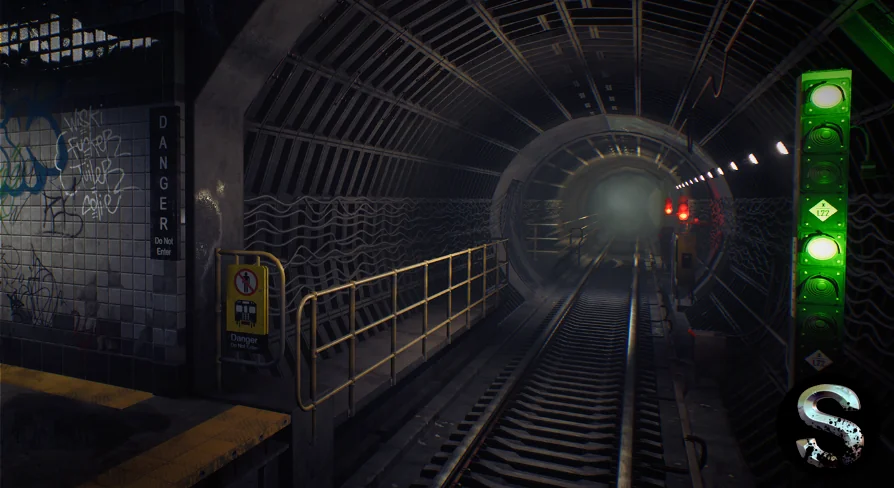
The core of the environment relies on modular construction, allowing level designers to snap together complex stations and corridors. The transition between the brightly lit public spaces and the restricted zones is a crucial element of transit design. The provided assets allow for the seamless connection of wide, tiled subway platforms to cramped, utilitarian technical rooms. These technical spaces can be heavily detailed with a vast array of included props, such as heavy industrial doors, complex switchboards, and dense clusters of wires. This stark contrast between the passenger-facing platform and the behind-the-scenes maintenance areas gives the environment a deep sense of realism and scale.
Spline-Driven Tunnel Generation
One of the central challenges of subterranean level design is routing the track layout naturally beneath a city. Instead of relying purely on static, rigid tunnel meshes that force a grid-like layout, this toolset utilizes a customizable tunnel blueprint built along a spline. This gives environment artists the flexibility to draw curving underground pathways that snake organically through the level, adapting the track to the specific flow of the gameplay space.
The tunnel blueprint is highly modular in its execution, offering the possibility to automatically include wires, borders, and various rails directly along the generated spline path. This automated distribution of infrastructure along the curve ensures that the tunnel remains visually dense and functionally believable without requiring the tedious manual placement of every individual track tie, wall border, or hanging cable over long distances.
Interactive and Customizable Transit
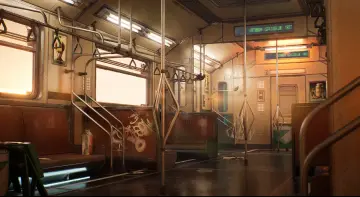
A metro environment is anchored by its rolling stock. The central train wagon operates via a customizable blueprint, providing much more than just a static background prop for the station. Developers can quickly adjust the color of the train to match specific municipal branding, fit a particular color palette, or distinguish different transit lines within a massive city network.
Also, the train blueprint supports full door opening functionality. This functional integration allows the wagon to serve as an interactive focal point within the level. The train can be staged as actively arriving at the subway platform to pick up passengers, or it can be left abandoned in a dark tunnel with its doors jammed open, inviting players to step inside and explore the interior.
Populating with Utility Blueprints
To streamline the placement of complex architectural and industrial elements, the package relies on dedicated blueprints for specific utility fixtures. Escalators bridge the vertical gap between the surface city and the underground depths, providing natural transition points between different floors of a massive transit hub. Fans and lamps can be quickly dropped into the technical rooms or tunnel shafts to establish the necessary ventilation and lighting infrastructure.
The inclusion of police line blueprints offers an immediate narrative and level design tool. These modular barriers can be strung across corridors or station entrances to organically block off restricted technical rooms, close down sections of the platform, or guide player navigation without relying on invisible walls.
Weathering the Environment
Subway systems are defined by their grime, heavy use, and constant exposure to the elements. To achieve a realistic, lived-in atmosphere, the environment relies on a layered approach to surface weathering. The core of this system is a base material that integrates dirt application driven by vertex paint. This allows environment artists to manually brush dirt, soot, and accumulated grime onto surfaces directly where it makes the most sense. By utilizing vertex paint, identical modular walls and platform floors can be given entirely unique wear patterns. This breaks up the repetition of tiling assets, grounding them in the scene by accumulating heavy dirt in secluded corners, while leaving high-traffic walkways relatively clear.
Detailing with Decals
Working in tandem with the vertex paint material is a large and varied collection of decals designed to introduce sharp, localized details that give an underground space its distinct urban character. Leaks can be placed under utility pipes or along the curved tunnel walls to suggest groundwater constantly seeping through the aging concrete. Damages and structural wear can be layered onto the platform pillars, floors, or technical room entrances to show decades of heavy industrial use.
Meanwhile, graffiti and transit signs provide crucial urban context. Signs direct the flow of traffic and establish the purpose of different zones, while graffiti layers over the pristine architecture to transform a sterile transit hub into a recognizable, heavily trafficked city metro. By combining the lowpoly modular meshes with these dynamic material systems and spline blueprints, developers have a complete toolkit for bringing gritty, realistic underground environments to life.
 Industrial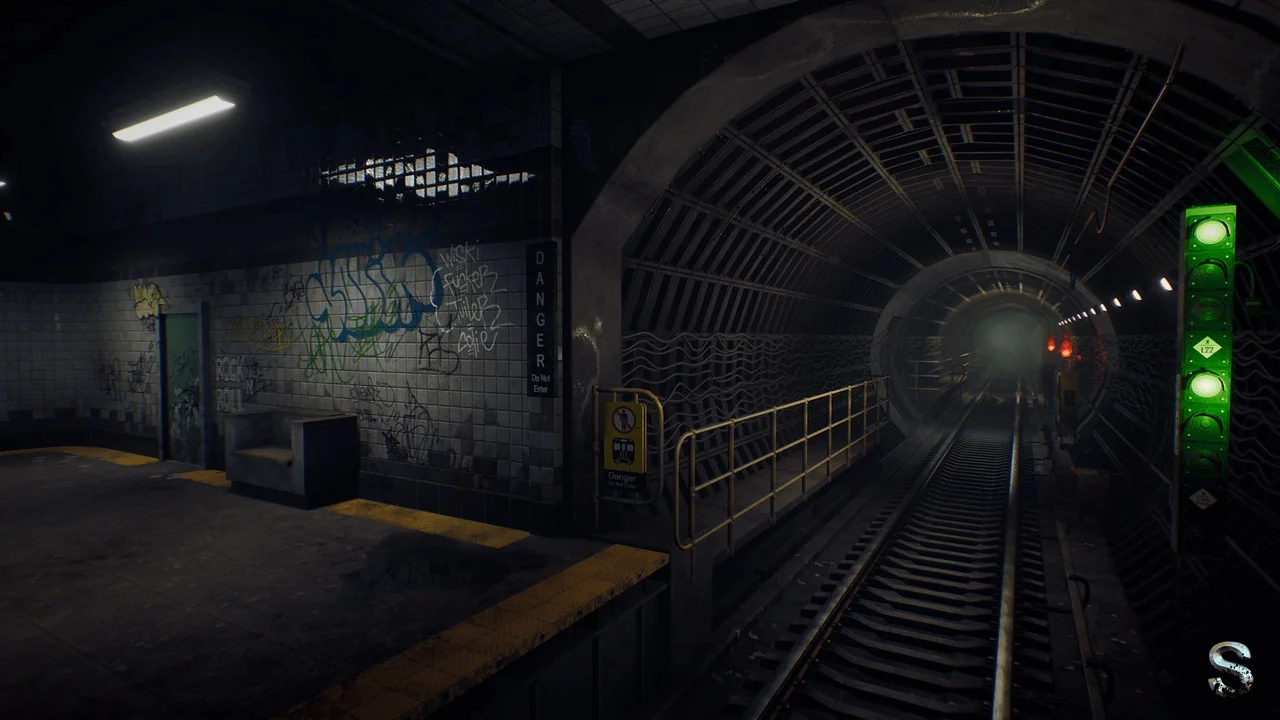
 Industrial
 Industrial
 Industrial