"c14ff6bd758dadb1"{"id":"1000540","slug":"mw-conifer-forest-trees-biome","title":"MW Conifer Forest Trees Biome","category":"Forest \u0026 Jungle","engine":"5.2+","assetVersion":"","engineVersion":"Engine Version: 5.2+","tag":"Forest \u0026 Jungle","accent":"blue","visual":"mech","summary":"A complete UE5 conifer forest biome using photogrammetry scans, procedural generation, Nanite, and Lumen to build photorealistic Nordic woodland environments.","platform":"Unreal Engine","publishedAt":"2026-07-15T03:01:54.981Z","updatedAt":"2026-07-15T03:01:54.981Z","sourceNotes":[],"fileContents":[],"compatibility":["Unreal Engine","Engine Version: 5.2+"],"featuredImage":{"alt":"MW Conifer Forest Trees Biome","src":"/wp-content/uploads/published/2026/07/3dd2c4777675-4c89bb7b-21f5-49bb-b1e2-9dbc379e3dc7-0d55b0a3bb.webp"},"hasDownloadLink":true,"downloads":1,"terms":[{"taxonomy":"category","slug":"forest-and-jungle","name":"Forest \u0026 Jungle"}],"galleryImages":[{"src":"/wp-content/uploads/published/2026/07/e01cd4d1ddf8-e039dd0d-a2cc-42b9-b66e-9a109349cfb4-5aafb252eb.webp","alt":"MW Conifer Forest Trees Biome"},{"src":"/wp-content/uploads/published/2026/07/949631eecee1-87123c1f-1030-4536-a044-3c65a5e354f4-71e0aec5bc.webp","alt":"MW Conifer Forest Trees Biome"},{"src":"/wp-content/uploads/published/2026/07/e535100d386f-710b2944-8380-4ddc-9e68-12ccf002e144-e314155b3e.webp","alt":"MW Conifer Forest Trees Biome"},{"src":"/wp-content/uploads/published/2026/07/c4b48a7cae26-a0caa334-6fe1-4e66-a6af-5a0a867c10ed-ced7b06d6f.webp","alt":"MW Conifer Forest Trees Biome"},{"src":"/wp-content/uploads/published/2026/07/c1419018d3d4-304e1ef9-eb5a-4f15-acbc-ef71dadd9abd-1afe21ca51.webp","alt":"MW Conifer Forest Trees Biome"},{"src":"/wp-content/uploads/published/2026/07/a967c5c04e1b-0c0799f1-8ab1-4c01-be7a-662f53b1a1e2-0ad679702f.webp","alt":"MW Conifer Forest Trees Biome"},{"src":"/wp-content/uploads/published/2026/07/b5dc1a19de6f-c93d93f7-e5f7-47dc-916d-c183334f492e-74997bb354.webp","alt":"MW Conifer Forest Trees Biome"},{"src":"/wp-content/uploads/published/2026/07/c4beb65afe60-b35dd4cb-2da1-4c64-bfac-67e9c30e2606-f290e4b9c0.webp","alt":"MW Conifer Forest Trees Biome"},{"src":"/wp-content/uploads/published/2026/07/807fee8bf7c2-c1f7479c-b336-4f44-a030-b952f41b033a-4fa34b8fb4.webp","alt":"MW Conifer Forest Trees Biome"}],"accessPanel":{"kind":"resource","title":"Download this resource","eyebrow":"Free Download","message":"Log in or create a free account to start your download.","fileName":"Content.7z","safetyNote":"Resources are manually reviewed before listing to improve quality and reduce obvious risks.","actionLabel":"Download Free","resourceType":"Resource archive"},"contentHtml":"\u003cp\u003eDense Nordic woodlands filled with spruce, fir, and layered undergrowth are the kinds of scenes this package is built to produce. Rather than supplying a handful of standalone tree models, it functions as a complete biome solution aimed at procedurally generating a detailed conifer environment in Unreal Engine 5. The focus stays on European and Nordic forest ecology, with scanned trees, ferns, bushes, and forest debris coming together to form a cohesive natural space.\u003c/p\u003e \u003cp\u003eEvery element relies on professional photogrammetry capture, meaning the trees, plants, and supporting assets carry the surface detail and irregular silhouettes of real-world forest growth. The creator positions the package as a tool for building the most photorealistic forests possible within UE5, and the asset selection reflects that goal: hundreds of different foliage scans cover the range of shapes a forest canopy and floor need to feel convincing.\u003c/p\u003e \u003ch2\u003eWhat the Conifer Forest Biome Contains\u003c/h2\u003e \u003cp\u003eThe package centers on masked foliage and photogrammetry-based trees, but the scope extends well beyond trunks and branches. The scan library includes:\u003c/p\u003e \u003cul\u003e\n\u003cli\u003e\u003cp\u003eTrees spanning conifer species such as spruce and fir, modeled from real captures rather than hand-sculpted approximations.\u003c/p\u003e\u003c/li\u003e\n\u003cli\u003e\u003cp\u003eUnderstory plants including ferns and bushes that fill the vertical space between forest floor and canopy.\u003c/p\u003e\u003c/li\u003e\n\u003cli\u003e\u003cp\u003eVarious other forest assets such as debris, giving the ground layer the scattered organic matter that real forests accumulate over time.\u003c/p\u003e\u003c/li\u003e\n\u003c/ul\u003e \u003cp\u003eTagged terms point to fern, bush, spruce, and fir as core vegetation types, with debris rounding out the ground scatter. The biome also carries European and Nordic descriptors, placing it firmly in cold-temperate forest territory rather than tropical or arid ecosystems. This specificity matters for projects that need a recognizable northern woodland character without mixing in mismatched broadleaf or desert flora.\u003c/p\u003e \u003ch2\u003eProcedural Forest Generation Workflow\u003c/h2\u003e \u003cp\u003eThe package is tagged with PCG, pointing to Unreal Engine's Procedural Content Generation framework as the driving tool for laying out the biome. Instead of requiring artists to place each tree and fern by hand, the workflow leans on procedural rules to distribute the hundreds of scanned assets across a landscape. The package then offers a forest that can be regenerated and adjusted at a systemic level rather than edited one mesh at a time.\u003c/p\u003e \u003cp\u003eRuntimeVirtualTexture is listed among the technical requirements, which ties into how the landscape and foliage interact during procedural generation. Virtual texturing allows large terrain surfaces to handle high-resolution texture data without exhausting video memory, a practical necessity when a biome covers expansive outdoor areas with multiple texture layers feeding into the distribution system.\u003c/p\u003e \u003cp\u003eA note in the technical requirements flags the DefaultEngine.ini configuration file, indicating that engine settings need to align with the package's rendering and generation pipeline. This is a detail intended for users who manage project configuration directly, since the biome's reliance on Nanite, Lumen, and virtual shadow maps depends on those features being active and correctly configured at the engine level.\u003c/p\u003e \u003ch2\u003eRendering Pipeline and Hardware Demands\u003c/h2\u003e \u003cp\u003eThe biome is built explicitly around UE5's modern rendering features. Nanite handles the massive polygon load that photogrammetry scans produce, allowing hundreds of detailed tree and plant models to coexist in a single scene without collapsing performance. Lumen provides the dynamic global illumination that gives the forest volume its shifting, natural light response. Virtual Shadow Maps are required alongside them to keep shadow detail coherent across a large outdoor environment with dense occlusion.\u003c/p\u003e \u003cp\u003eOn the hardware side, the package targets a minimum of an RTX 30 series GPU or faster, with 32 gigabytes of system memory. These are not arbitrary spec bumps. Photogrammetry-derived assets with masked foliage alpha layers demand significant texture bandwidth, Lumen's real-time bounce lighting adds GPU cost, and Nanite's virtualized geometry streaming calls for substantial memory headroom. The 32 GB memory figure is tied to system RAM rather than video memory, reflecting the need to hold landscape data, virtual texture caches, and procedural generation logic simultaneously.\u003c/p\u003e \u003ch2\u003eWhere a Photorealistic Nordic Woodland Fits\u003c/h2\u003e \u003cp\u003eScenes that call for a European or Nordic temperate forest are the natural fit. The conifer focus, combined with spruce and fir species plus fern and bush understory, suits northern wilderness settings, survival game environments, adventure level backdrops, and cinematic establishing shots of deep woods. Because the system is tagged across world, landscape, level, environment, and nature categories, it is structured to serve as a full-scene foundation rather than a prop kit dropped into an existing level.\u003c/p\u003e \u003cp\u003eThe photorealistic descriptor signals that the scanned assets aim for visual fidelity matching real-world reference. Projects that need a stylized or hand-painted forest look would be working against the package's core strength. The value here sits with teams targeting realism, where surface detail, bark texture variation, and organic forest-floor litter need to hold up under close inspection and direct lighting.\u003c/p\u003e \u003ch3\u003eTooling Support Beyond the Assets Themselves\u003c/h3\u003e \u003cp\u003eDocumentation is available online, and product support runs through a Discord channel, giving users a path to troubleshoot configuration questions, procedural generation parameters, and rendering setup. The DefaultEngine.ini flag in the technical requirements suggests that getting the biome running correctly involves more than importing assets, which makes the support channel relevant for resolving engine-side configuration issues.\u003c/p\u003e \u003cp\u003eThe package targets UE5 versions 5.2 through 5.8, placing it within the current generation of Unreal Engine releases. Sounds, characters, and visual effects shown in the preview videos are not included, keeping the package focused on environment, foliage, and procedural landscape tooling rather than gameplay systems or audio design.\u003c/p\u003e \u003ch2\u003eWho Benefits From a Complete Forest Biome Package\u003c/h2\u003e \u003cp\u003eTeams working on realistic outdoor environments in Unreal Engine 5 are the primary audience. The combination of photogrammetry scans, procedural generation, and Unreal Engine 5 rendering features makes the package practical for level designers and environment artists who need to generate large, detailed forest areas efficiently rather than assembling them piece by piece. The hardware requirements and engine configuration notes indicate that the target user is someone comfortable managing project settings and working with Nanite, Lumen, and virtual texturing as part of their regular pipeline.\u003c/p\u003e \u003cp\u003eFor projects that need a photorealistic conifer forest populated with hundreds of scanned trees, plants, and debris assets, the MW Conifer Forest Trees Biome provides the building blocks and generation framework to create that environment from the ground up.\u003c/p\u003e\n\n\u003ch2\u003eExplore Similar Assets\u003c/h2\u003e\n\u003cul\u003e\n\u003cli\u003e\u003ca href=\"https://3dcghub.com/mw-meadow-forest-trees-biome/\" title=\"MW Meadow Forest Trees Biome\"\u003eMW Meadow Forest Trees Biome\u003c/a\u003e\u003c/li\u003e\n\u003cli\u003e\u003ca href=\"https://3dcghub.com/mw-broadleaf-forest-trees-biome/\" title=\"MW Broadleaf Forest Trees Biome\"\u003eMW Broadleaf Forest Trees Biome\u003c/a\u003e\u003c/li\u003e\n\u003cli\u003e\u003ca href=\"https://3dcghub.com/mw-redwood-forest-trees-biome/\" title=\"MW Redwood Forest Trees Biome\"\u003eMW Redwood Forest Trees Biome\u003c/a\u003e\u003c/li\u003e\n\u003cli\u003e\u003ca href=\"https://3dcghub.com/forest-essentials-forest-environment-procedural-mountain-forest-forest/\" title=\"Forest Essentials ( Forest Environment , Procedural Mountain Forest, Forest )\"\u003eForest Essentials ( Forest Environment , Procedural Mountain Forest, Forest )\u003c/a\u003e\u003c/li\u003e\n\u003cli\u003e\u003ca href=\"https://3dcghub.com/survival-interactable-procedural-nature-ecosystem/\" title=\"Survival Interactable Procedural Nature Ecosystem\"\u003eSurvival Interactable Procedural Nature Ecosystem\u003c/a\u003e\u003c/li\u003e\n\u003c/ul\u003e","contentTextLength":7277,"navigation":{"current":1322,"total":3719,"previous":{"id":"1000541","slug":"nyc-new-york-city","title":"NYC | New York City","category":"Cities","platform":"Unreal Engine","updatedAt":"2026-07-15T03:33:12.505Z"},"next":{"id":"1000539","slug":"mothership-service-rooms","title":"Mothership Service Rooms","category":"Industrial","platform":"Unreal Engine","updatedAt":"2026-07-15T02:47:06.926Z"}},"relatedResources":[{"id":"1001490","slug":"the-pine-environment-foliage-island-pcg-nature-river-nature-nature-biom","title":"The Pine Environment ( Foliage Island PCG Nature River Nature Nature Biom )","category":"Forest \u0026 Jungle","engine":"5.4+","assetVersion":"","engineVersion":"Engine Version: 5.4+","tag":"Forest \u0026 Jungle","accent":"blue","visual":"city","summary":"Explore The Pine Environment, featuring 53 unique meshes, procedural PCG scattering, river biomes, Nanite and Lumen support, and ULAT modular integration.","platform":"Unreal Engine","publishedAt":"2026-10-08T10:04:47.716Z","updatedAt":"2026-10-08T10:04:47.716Z","sourceNotes":[],"fileContents":[],"compatibility":["Unreal Engine","Engine Version: 5.4+"],"featuredImage":{"alt":"The Pine Environment ( Foliage Island PCG Nature River Nature Nature Biom )","src":"/wp-content/uploads/published/2026/10/3ea4f6900e86-b4efa431-bc2a-403b-8c5c-6b72af4180f0-c94ccb1b90.webp"},"hasDownloadLink":true,"downloads":2},{"id":"1001107","slug":"broadleaf-poplar-forest-pcg-biome","title":"Broadleaf Poplar Forest - PCG Biome","category":"Forest \u0026 Jungle","engine":"5.4+","assetVersion":"","engineVersion":"Engine Version: 5.4+","tag":"Forest \u0026 Jungle","accent":"blue","visual":"mech","summary":"Fully procedural PCG poplar biome for Unreal Engine: photoscanned trees, dynamic wind and foliage interaction, plus World Partition and runtime generation.","platform":"Unreal Engine","publishedAt":"2026-09-07T06:21:06.743Z","updatedAt":"2026-09-07T06:21:06.743Z","sourceNotes":[],"fileContents":[],"compatibility":["Unreal Engine","Engine Version: 5.4+"],"featuredImage":{"alt":"Broadleaf Poplar Forest - PCG Biome","src":"/wp-content/uploads/published/2026/09/62ee8e5ec890-f775a27c-8e9d-49c5-bb9a-6fd09118f806-4aeeb75b35.webp"},"hasDownloadLink":true,"downloads":4},{"id":"1001544","slug":"pine-forest-photogrammetry-based-high-poly-biome","title":"Pine forest - Photogrammetry based High poly Biome","category":"Forest \u0026 Jungle","engine":"5.1+","assetVersion":"","engineVersion":"Engine Version: 5.1+","tag":"Forest \u0026 Jungle","accent":"blue","visual":"mech","summary":"Explore the Pine forest photogrammetry biome, featuring 95 procedural assets, 8K terrain support, RHA texture maps, and high-fidelity wind animation.","platform":"Unreal Engine","publishedAt":"2026-10-10T03:08:19.926Z","updatedAt":"2026-10-10T03:08:19.926Z","sourceNotes":[],"fileContents":[],"compatibility":["Unreal Engine","Engine Version: 5.1+"],"featuredImage":{"alt":"Pine forest - Photogrammetry based High poly Biome","src":"/wp-content/uploads/published/2026/10/82885d3ff947-ab7d61f5-70cf-4902-a8eb-c017c5314e67-95b32130bb.webp"},"hasDownloadLink":true,"downloads":0}]}
Forest & Jungle
MW Conifer Forest Trees Biome
A complete UE5 conifer forest biome using photogrammetry scans, procedural generation, Nanite, and Lumen to build photorealistic Nordic woodland environments.
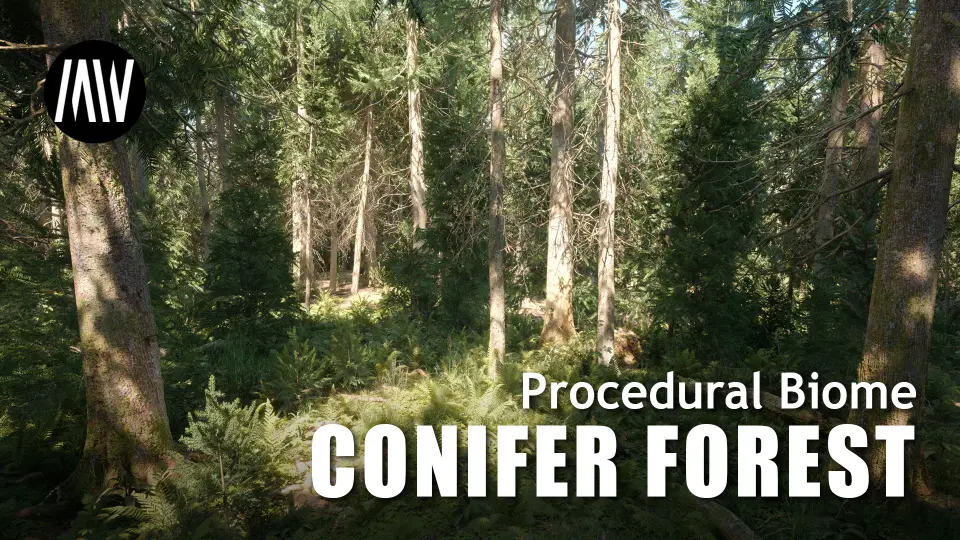
Dense Nordic woodlands filled with spruce, fir, and layered undergrowth are the kinds of scenes this package is built to produce. Rather than supplying a handful of standalone tree models, it functions as a complete biome solution aimed at procedurally generating a detailed conifer environment in Unreal Engine 5. The focus stays on European and Nordic forest ecology, with scanned trees, ferns, bushes, and forest debris coming together to form a cohesive natural space.
Every element relies on professional photogrammetry capture, meaning the trees, plants, and supporting assets carry the surface detail and irregular silhouettes of real-world forest growth. The creator positions the package as a tool for building the most photorealistic forests possible within UE5, and the asset selection reflects that goal: hundreds of different foliage scans cover the range of shapes a forest canopy and floor need to feel convincing.
What the Conifer Forest Biome Contains
The package centers on masked foliage and photogrammetry-based trees, but the scope extends well beyond trunks and branches. The scan library includes:
Trees spanning conifer species such as spruce and fir, modeled from real captures rather than hand-sculpted approximations.
Understory plants including ferns and bushes that fill the vertical space between forest floor and canopy.
Various other forest assets such as debris, giving the ground layer the scattered organic matter that real forests accumulate over time.
Tagged terms point to fern, bush, spruce, and fir as core vegetation types, with debris rounding out the ground scatter. The biome also carries European and Nordic descriptors, placing it firmly in cold-temperate forest territory rather than tropical or arid ecosystems. This specificity matters for projects that need a recognizable northern woodland character without mixing in mismatched broadleaf or desert flora.
Procedural Forest Generation Workflow
The package is tagged with PCG, pointing to Unreal Engine's Procedural Content Generation framework as the driving tool for laying out the biome. Instead of requiring artists to place each tree and fern by hand, the workflow leans on procedural rules to distribute the hundreds of scanned assets across a landscape. The package then offers a forest that can be regenerated and adjusted at a systemic level rather than edited one mesh at a time.
RuntimeVirtualTexture is listed among the technical requirements, which ties into how the landscape and foliage interact during procedural generation. Virtual texturing allows large terrain surfaces to handle high-resolution texture data without exhausting video memory, a practical necessity when a biome covers expansive outdoor areas with multiple texture layers feeding into the distribution system.
A note in the technical requirements flags the DefaultEngine.ini configuration file, indicating that engine settings need to align with the package's rendering and generation pipeline. This is a detail intended for users who manage project configuration directly, since the biome's reliance on Nanite, Lumen, and virtual shadow maps depends on those features being active and correctly configured at the engine level.
Rendering Pipeline and Hardware Demands
The biome is built explicitly around UE5's modern rendering features. Nanite handles the massive polygon load that photogrammetry scans produce, allowing hundreds of detailed tree and plant models to coexist in a single scene without collapsing performance. Lumen provides the dynamic global illumination that gives the forest volume its shifting, natural light response. Virtual Shadow Maps are required alongside them to keep shadow detail coherent across a large outdoor environment with dense occlusion.
On the hardware side, the package targets a minimum of an RTX 30 series GPU or faster, with 32 gigabytes of system memory. These are not arbitrary spec bumps. Photogrammetry-derived assets with masked foliage alpha layers demand significant texture bandwidth, Lumen's real-time bounce lighting adds GPU cost, and Nanite's virtualized geometry streaming calls for substantial memory headroom. The 32 GB memory figure is tied to system RAM rather than video memory, reflecting the need to hold landscape data, virtual texture caches, and procedural generation logic simultaneously.
Where a Photorealistic Nordic Woodland Fits
Scenes that call for a European or Nordic temperate forest are the natural fit. The conifer focus, combined with spruce and fir species plus fern and bush understory, suits northern wilderness settings, survival game environments, adventure level backdrops, and cinematic establishing shots of deep woods. Because the system is tagged across world, landscape, level, environment, and nature categories, it is structured to serve as a full-scene foundation rather than a prop kit dropped into an existing level.
The photorealistic descriptor signals that the scanned assets aim for visual fidelity matching real-world reference. Projects that need a stylized or hand-painted forest look would be working against the package's core strength. The value here sits with teams targeting realism, where surface detail, bark texture variation, and organic forest-floor litter need to hold up under close inspection and direct lighting.
Tooling Support Beyond the Assets Themselves
Documentation is available online, and product support runs through a Discord channel, giving users a path to troubleshoot configuration questions, procedural generation parameters, and rendering setup. The DefaultEngine.ini flag in the technical requirements suggests that getting the biome running correctly involves more than importing assets, which makes the support channel relevant for resolving engine-side configuration issues.
The package targets UE5 versions 5.2 through 5.8, placing it within the current generation of Unreal Engine releases. Sounds, characters, and visual effects shown in the preview videos are not included, keeping the package focused on environment, foliage, and procedural landscape tooling rather than gameplay systems or audio design.
Who Benefits From a Complete Forest Biome Package
Teams working on realistic outdoor environments in Unreal Engine 5 are the primary audience. The combination of photogrammetry scans, procedural generation, and Unreal Engine 5 rendering features makes the package practical for level designers and environment artists who need to generate large, detailed forest areas efficiently rather than assembling them piece by piece. The hardware requirements and engine configuration notes indicate that the target user is someone comfortable managing project settings and working with Nanite, Lumen, and virtual texturing as part of their regular pipeline.
For projects that need a photorealistic conifer forest populated with hundreds of scanned trees, plants, and debris assets, the MW Conifer Forest Trees Biome provides the building blocks and generation framework to create that environment from the ground up.
 Forest & Jungle
 Forest & Jungle
 Forest & Jungle
 Forest & Jungle