"6ac84fdb0bd06614"{"id":"28176","slug":"mw-redwood-forest-trees-biome","title":"MW Redwood Forest Trees Biome","category":"Forest \u0026 Jungle","engine":"5.6","assetVersion":"Engine version: 5.6","engineVersion":"","tag":"Forest \u0026 Jungle","accent":"blue","visual":"city","summary":"MW Redwood Forest Trees Biome is a complete forest biome solution for procedurally generating a detailed next-gen Redwood Forest environment in UE5. It combines hundreds of foliage scans, photogrammetry models, and the rendering features needed for a photor...","platform":"Unreal Engine","publishedAt":"2026-05-04T16:26:09.000Z","updatedAt":"2026-05-04T16:26:10.000Z","sourceNotes":[],"fileContents":[],"compatibility":["Unreal Engine","Engine version: 5.6"],"featuredImage":{"alt":"MW Redwood Forest Trees Biome","src":"https://3dcghub.com/wp-content/uploads/2026/05/ae64466e2db4_59bd4579-4f2c-4c5a-a112-f26d59045710.webp"},"hasDownloadLink":true,"downloads":5,"terms":[{"taxonomy":"category","slug":"forest-and-jungle","name":"Forest \u0026 Jungle"},{"taxonomy":"post_tag","slug":"characters","name":"Characters"},{"taxonomy":"post_tag","slug":"environment","name":"Environment"},{"taxonomy":"post_tag","slug":"unreal-engine-5","name":"Unreal Engine 5"}],"galleryImages":[{"src":"https://3dcghub.com/wp-content/uploads/2026/05/6a13f7c575a8_e8bf6bcd-6650-4ccb-904a-13330d9d8f1e.webp","alt":"MW Redwood Forest Trees Biome"},{"src":"https://3dcghub.com/wp-content/uploads/2026/05/b51bd00617c0_3450ef01-49e8-4715-a13d-499458755b06.webp","alt":"MW Redwood Forest Trees Biome"},{"src":"https://3dcghub.com/wp-content/uploads/2026/05/a3ed36786919_242d9b20-390d-4664-b9ea-c7bbeef01066.webp","alt":"MW Redwood Forest Trees Biome"},{"src":"https://3dcghub.com/wp-content/uploads/2026/05/54faa9858958_c8738908-1226-4d3b-a303-d30a9565e80d.webp","alt":"MW Redwood Forest Trees Biome"},{"src":"https://3dcghub.com/wp-content/uploads/2026/05/ff0f7aa7282b_73198e65-cbb6-4ee7-9173-dac67ce3b422.webp","alt":"MW Redwood Forest Trees Biome"},{"src":"https://3dcghub.com/wp-content/uploads/2026/05/12c7e931cb4e_d87dad44-4d97-40a9-9f8a-c09dc673c4d8.webp","alt":"MW Redwood Forest Trees Biome"},{"src":"https://3dcghub.com/wp-content/uploads/2026/05/55d49af60d82_baf8075e-a9a1-435d-8f0d-0f0b307e9e0c.webp","alt":"MW Redwood Forest Trees Biome"},{"src":"https://3dcghub.com/wp-content/uploads/2026/05/a575dddfed0a_f2c2574d-02be-484f-9735-cf9408ead32e.webp","alt":"MW Redwood Forest Trees Biome"},{"src":"https://3dcghub.com/wp-content/uploads/2026/05/7e5fbd272891_503c22d7-6431-4bd8-9b90-76e19c36fc8d.webp","alt":"MW Redwood Forest Trees Biome"},{"src":"https://3dcghub.com/wp-content/uploads/2026/05/30002c3ecb3d_dc418182-17ec-425d-9420-d2534384c587.webp","alt":"MW Redwood Forest Trees Biome"}],"accessPanel":{"kind":"resource","title":"Access this resource","eyebrow":"Free Download","message":"Log in or create a free account to start your download.","fileName":"MWRedwoodForest.7z","safetyNote":"All resources are 100% manually reviewed to eliminate all risks.","actionLabel":"Download Free","resourceType":"Resource archive"},"contentHtml":"\u003cp\u003eGetting this biome into production starts with the engine features it expects. MW Redwood Forest Trees Biome is a complete forest biome solution for procedurally generating a highly detailed next-gen Redwood Forest environment in UE5, and its setup is tied to a specific rendering stack: Nanite, Lumen, VSM, and Runtime Virtual Texture. There is also a configuration note tied to \u003ccode\u003eDefaultEngine.ini\u003c/code\u003e, which puts the initial focus on project setup before scene dressing.\u003c/p\u003e \u003cp\u003eThe asset centers on one clear task: building a photoreal Redwood Forest with procedural workflows instead of placing every tree and plant by hand. That gives it a practical role in environment production, especially when the goal is a large natural scene made from consistent scanned vegetation and forest assets rather than a small handcrafted patch of foliage.\u003c/p\u003e \u003ch2\u003eSetting up MW Redwood Forest Trees Biome in UE5\u003c/h2\u003e\n\u003cp\u003eThis biome is positioned as a full environment solution rather than a small foliage pack. The setup side reflects that. It requires Nanite, Lumen, and VSM, along with Runtime Virtual Texture support. Hardware expectations are also explicit: an RTX 30 series GPU or faster and 32GB of system memory.\u003c/p\u003e \u003cp\u003eThose requirements frame the implementation path from the start. This is not a lightweight forest kit aimed at minimal rendering features. It is meant for a UE5 project that can use modern real-time rendering and handle dense, detailed natural content. The mention of \u003ccode\u003eDefaultEngine.ini\u003c/code\u003e Also suggests that the project configuration is part of getting the biome running correctly, so this is the kind of environment resource where engine-side preparation matters as much as the content itself.\u003c/p\u003e \u003cp\u003eDocumentation is available, and support is also noted. For teams or solo users moving this into an active project, that matters because environment packs at this scale usually involve more than drag-and-drop use. Here, the implementation details are part of the expected workflow.\u003c/p\u003e \u003ch2\u003eProcedural Redwood Forest generation and foliage coverage\u003c/h2\u003e\n\u003cp\u003eThe core of the biome is procedural generation for a Redwood Forest environment. Instead of focusing on a narrow set of hero trees, it includes hundreds of different foliage scans covering trees, plants, and various other forest assets. That breadth is one of the most important production details because it affects how a forest reads at scale.\u003c/p\u003e \u003cp\u003eA Redwood biome needs more than trunk variation. Ground cover, understory plants, bushes, ferns, and surrounding woodland elements all influence whether the environment feels repetitive or naturally layered. The stated asset makeup points in that direction: the collection spans multiple foliage types rather than only canopy assets.\u003c/p\u003e \u003cp\u003eThe tag set reinforces that range. The biome is associated with conifer, pine, fir, fern, bush, woodland, landscape, world, forest, and nature themes, along with procedural and PCG-oriented usage. Taken together, that places the resource in a workflow where a broad forest scene can be generated with a more varied ecological look instead of relying on a small number of repeated meshes.\u003c/p\u003e \u003cp\u003eFrom a creative standpoint, the strongest use is a large American forest environment with California redwood character and a photoreal natural palette. It is suited to scene building where believable forest density and ground-to-canopy cohesion are part of the visual target.\u003c/p\u003e \u003ch2\u003ePhotogrammetry trees, plants, and masked foliage\u003c/h2\u003e\n\u003cp\u003eThe visual quality pitch is rooted in scans and photogrammetry. The biome includes professional photogrammetry models and textures of trees, along with the surrounding elements needed to generate photoreal forests in UE5. That gives the pack a clear identity: it is not a stylized woodland set or a simplified vegetation collection, but a realism-oriented biome built from scanned natural material.\u003c/p\u003e \u003cp\u003eMasked foliage is also part of the resource name and description. In practice, that places foliage treatment at the center of the environment rather than as an afterthought. Since the biome includes trees, plants, and additional forest assets, the masked foliage approach sits alongside the scan-based content as part of how the forest is assembled visually.\u003c/p\u003e \u003cp\u003eBecause the pack combines photogrammetry with UE5 rendering features such as Nanite and Lumen, the intended result is a forest with detailed geometry, realistic texture information, and lighting that supports a next-gen presentation. The stated goal is very specific: generating some of the most photorealistic forests for UE5.\u003c/p\u003e \u003ch2\u003eNanite, Lumen, VSM, and Runtime Virtual Texture in the Redwood Forest workflow\u003c/h2\u003e\n\u003cp\u003eThe rendering and compatibility details are straightforward and important. Nanite, Lumen, and VSM are listed as technical requirements, with Runtime Virtual Texture included as well. That tells you a lot about the production context of this biome. It is meant to sit inside a UE5 environment workflow that leans on modern geometry handling, dynamic lighting, shadowing, and terrain or surface integration through RVT.\u003c/p\u003e \u003cp\u003eThis has a direct impact on creative usage. A dense redwood forest is one of the harder natural environments to make convincing in real time because it depends on vertical scale, layered foliage, and lighting that can handle shaded woodland spaces. The specified feature set is aligned with exactly that type of scene.\u003c/p\u003e \u003cp\u003eIt also sets expectations for deployment. A project targeting lower hardware tiers or a stripped-down renderer is outside the scope of what is stated here. The required RTX 30 series GPU or faster and 32GB of memory place the biome firmly in a high-end real-time environment workflow.\u003c/p\u003e \u003ch2\u003eWhat is included in the Redwood Forest Biome package\u003c/h2\u003e\n\u003cp\u003eThe content focuses on the environment itself: hundreds of foliage scans, trees, plants, and other forest assets, along with photogrammetry models and textures needed to generate the biome. A video is available for the Redwood Forest Biome, but sounds, character content, and VFX are not included.\u003c/p\u003e \u003cp\u003eThat boundary is useful in production terms. The biome supplies the forest environment layer, while audio, characters, and visual effects remain separate pieces of a larger scene pipeline. For anyone planning a playable level, cinematic environment, or nature-heavy world space, it defines the package as a dedicated biome solution rather than an all-in-one scene assembly.\u003c/p\u003e \u003cp\u003eThe practical takeaway is simple: MW Redwood Forest Trees Biome is best approached as a UE5-ready forest generation package that depends on the correct engine features, sufficient hardware, and project configuration. Once those pieces are in place, its value lies in the scale of its scanned foliage library and its focus on building a photoreal Redwood Forest through procedural environment workflows.\u003c/p\u003e\n\n\u003ch2\u003eRelated Resources Worth Checking\u003c/h2\u003e\n\u003cul\u003e\n\u003cli\u003e\u003ca href=\"https://3dcghub.com/1950s-characters-bundle-1950s-characters-bundle-1950-character-gangster-3d/\" title=\"1950s Characters Bundle ( 1950s Characters Bundle 1950 Character Gangster 3D )\"\u003e1950s Characters Bundle ( 1950s Characters Bundle 1950 Character Gangster 3D )\u003c/a\u003e\u003c/li\u003e\n\u003cli\u003e\u003ca href=\"https://3dcghub.com/character-rigged-npc-character-rigged-npc-rig-characters-animated-3d/\" title=\"Character / Rigged / NPC ( Character Rigged NPC Rig Characters Animated 3D )\"\u003eCharacter / Rigged / NPC ( Character Rigged NPC Rig Characters Animated 3D )\u003c/a\u003e\u003c/li\u003e\n\u003c/ul\u003e","contentTextLength":6943,"navigation":{"current":1325,"total":3181,"previous":{"id":"28194","slug":"modular-soldier-pack-vol-1","title":"MODULAR SOLDIER PACK Vol. 1","category":"Humans","platform":"Unreal Engine","updatedAt":"2026-05-06T13:54:12.000Z"},"next":{"id":"28163","slug":"nature-set","title":"Nature Set","category":"Nature \u0026 Plants","platform":"Unreal Engine","updatedAt":"2026-05-04T15:50:52.000Z"}},"relatedResources":[{"id":"27690","slug":"forest-essentials-forest-environment-procedural-mountain-forest-forest","title":"Forest Essentials ( Forest Environment , Procedural Mountain Forest, Forest )","category":"Forest \u0026 Jungle","engine":"5.4+","assetVersion":"Engine version: 5.4+","engineVersion":"","tag":"Forest \u0026 Jungle","accent":"blue","visual":"city","summary":"Forest Essentials centers on realistic mountain forest scene work in Unreal Engine. It combines scanned forest assets and digitally generated elements, with 85 unique meshes covering trees, plants, mountains, and rocks.","platform":"Unreal Engine","publishedAt":"2026-04-28T13:59:44.000Z","updatedAt":"2026-04-28T13:59:45.000Z","sourceNotes":[],"fileContents":[],"compatibility":["Unreal Engine","Engine version: 5.4+"],"featuredImage":{"alt":"Forest Essentials ( Forest Environment , Procedural Mountain Forest, Forest )","src":"https://3dcghub.com/wp-content/uploads/2026/04/864ba9711e3f_901674a8-fd9e-4c3e-941c-f7bd5df0f947.webp"},"hasDownloadLink":true,"downloads":1},{"id":"27927","slug":"stylized-landscape-5-biomes","title":"Stylized Landscape - 5 Biomes","category":"Forest \u0026 Jungle","engine":"5.2+","assetVersion":"Engine version: 5.2+","engineVersion":"","tag":"Forest \u0026 Jungle","accent":"blue","visual":"city","summary":"Stylized Landscape - 5 Biomes is a landscape pack aimed at getting scenes up and running quickly with strong variety from the start. Its RVT setup focuses on smoother blending between assets, while foliage includes prebaked imposter LODs for performance-min...","platform":"Unreal Engine","publishedAt":"2026-04-30T07:21:43.000Z","updatedAt":"2026-04-30T07:21:44.000Z","sourceNotes":[],"fileContents":[],"compatibility":["Unreal Engine","Engine version: 5.2+"],"featuredImage":{"alt":"Stylized Landscape - 5 Biomes","src":"https://3dcghub.com/wp-content/uploads/2026/04/533d158dcd5b_2cf40ac8-91c4-4248-b97d-90a3716e6f54.webp"},"hasDownloadLink":true,"downloads":0},{"id":"12858","slug":"mw-landscape-auto-material","title":"MW Landscape Auto Material","category":"Nature \u0026 Terrain","engine":"4.26+,5.0+","assetVersion":"Engine version: 4.26+,5.0+","engineVersion":"5.2","tag":"Nature \u0026 Terrain","accent":"blue","visual":"luts","summary":"The MW Landscape Auto Material is a smart, modular solution for creating diverse terrains with five procedural layers. It supports custom textures and high-performance prototyping for various biomes.","platform":"Unreal Engine","publishedAt":"2026-03-09T18:01:14.000Z","updatedAt":"2026-04-19T15:46:35.000Z","sourceNotes":[],"fileContents":[],"compatibility":["Unreal Engine"],"featuredImage":{"alt":"MW Landscape Auto Material","src":"https://3dcghub.com/wp-content/uploads/2026/03/9f041517-302c-41d9-83b3-39bab6a4fd5e.webp"},"hasDownloadLink":true,"downloads":3}]}
Forest & Jungle
MW Redwood Forest Trees Biome
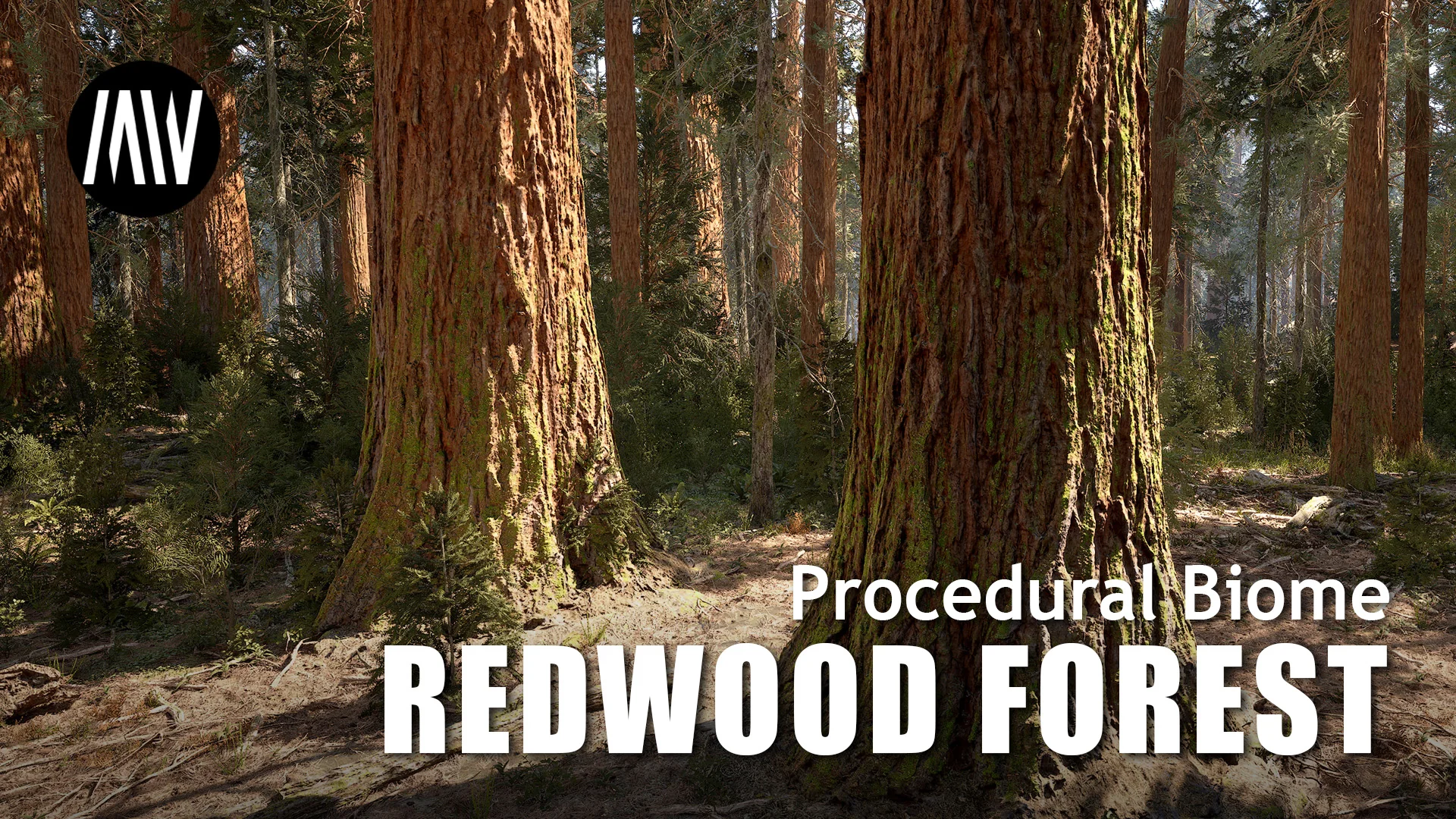
MW Redwood Forest Trees Biome is a complete forest biome solution for procedurally generating a detailed next-gen Redwood Forest environment in UE5. It combines hundreds of foliage scans, photogrammetry models, and the rendering features needed for a photor...
Getting this biome into production starts with the engine features it expects. MW Redwood Forest Trees Biome is a complete forest biome solution for procedurally generating a highly detailed next-gen Redwood Forest environment in UE5, and its setup is tied to a specific rendering stack: Nanite, Lumen, VSM, and Runtime Virtual Texture. There is also a configuration note tied to DefaultEngine.ini, which puts the initial focus on project setup before scene dressing.
The asset centers on one clear task: building a photoreal Redwood Forest with procedural workflows instead of placing every tree and plant by hand. That gives it a practical role in environment production, especially when the goal is a large natural scene made from consistent scanned vegetation and forest assets rather than a small handcrafted patch of foliage.
Setting up MW Redwood Forest Trees Biome in UE5
This biome is positioned as a full environment solution rather than a small foliage pack. The setup side reflects that. It requires Nanite, Lumen, and VSM, along with Runtime Virtual Texture support. Hardware expectations are also explicit: an RTX 30 series GPU or faster and 32GB of system memory.
Those requirements frame the implementation path from the start. This is not a lightweight forest kit aimed at minimal rendering features. It is meant for a UE5 project that can use modern real-time rendering and handle dense, detailed natural content. The mention of DefaultEngine.ini Also suggests that the project configuration is part of getting the biome running correctly, so this is the kind of environment resource where engine-side preparation matters as much as the content itself.
Documentation is available, and support is also noted. For teams or solo users moving this into an active project, that matters because environment packs at this scale usually involve more than drag-and-drop use. Here, the implementation details are part of the expected workflow.
Procedural Redwood Forest generation and foliage coverage
The core of the biome is procedural generation for a Redwood Forest environment. Instead of focusing on a narrow set of hero trees, it includes hundreds of different foliage scans covering trees, plants, and various other forest assets. That breadth is one of the most important production details because it affects how a forest reads at scale.
A Redwood biome needs more than trunk variation. Ground cover, understory plants, bushes, ferns, and surrounding woodland elements all influence whether the environment feels repetitive or naturally layered. The stated asset makeup points in that direction: the collection spans multiple foliage types rather than only canopy assets.
The tag set reinforces that range. The biome is associated with conifer, pine, fir, fern, bush, woodland, landscape, world, forest, and nature themes, along with procedural and PCG-oriented usage. Taken together, that places the resource in a workflow where a broad forest scene can be generated with a more varied ecological look instead of relying on a small number of repeated meshes.
From a creative standpoint, the strongest use is a large American forest environment with California redwood character and a photoreal natural palette. It is suited to scene building where believable forest density and ground-to-canopy cohesion are part of the visual target.
Photogrammetry trees, plants, and masked foliage
The visual quality pitch is rooted in scans and photogrammetry. The biome includes professional photogrammetry models and textures of trees, along with the surrounding elements needed to generate photoreal forests in UE5. That gives the pack a clear identity: it is not a stylized woodland set or a simplified vegetation collection, but a realism-oriented biome built from scanned natural material.
Masked foliage is also part of the resource name and description. In practice, that places foliage treatment at the center of the environment rather than as an afterthought. Since the biome includes trees, plants, and additional forest assets, the masked foliage approach sits alongside the scan-based content as part of how the forest is assembled visually.
Because the pack combines photogrammetry with UE5 rendering features such as Nanite and Lumen, the intended result is a forest with detailed geometry, realistic texture information, and lighting that supports a next-gen presentation. The stated goal is very specific: generating some of the most photorealistic forests for UE5.
Nanite, Lumen, VSM, and Runtime Virtual Texture in the Redwood Forest workflow
The rendering and compatibility details are straightforward and important. Nanite, Lumen, and VSM are listed as technical requirements, with Runtime Virtual Texture included as well. That tells you a lot about the production context of this biome. It is meant to sit inside a UE5 environment workflow that leans on modern geometry handling, dynamic lighting, shadowing, and terrain or surface integration through RVT.
This has a direct impact on creative usage. A dense redwood forest is one of the harder natural environments to make convincing in real time because it depends on vertical scale, layered foliage, and lighting that can handle shaded woodland spaces. The specified feature set is aligned with exactly that type of scene.
It also sets expectations for deployment. A project targeting lower hardware tiers or a stripped-down renderer is outside the scope of what is stated here. The required RTX 30 series GPU or faster and 32GB of memory place the biome firmly in a high-end real-time environment workflow.
What is included in the Redwood Forest Biome package
The content focuses on the environment itself: hundreds of foliage scans, trees, plants, and other forest assets, along with photogrammetry models and textures needed to generate the biome. A video is available for the Redwood Forest Biome, but sounds, character content, and VFX are not included.
That boundary is useful in production terms. The biome supplies the forest environment layer, while audio, characters, and visual effects remain separate pieces of a larger scene pipeline. For anyone planning a playable level, cinematic environment, or nature-heavy world space, it defines the package as a dedicated biome solution rather than an all-in-one scene assembly.
The practical takeaway is simple: MW Redwood Forest Trees Biome is best approached as a UE5-ready forest generation package that depends on the correct engine features, sufficient hardware, and project configuration. Once those pieces are in place, its value lies in the scale of its scanned foliage library and its focus on building a photoreal Redwood Forest through procedural environment workflows.
 Forest & Jungle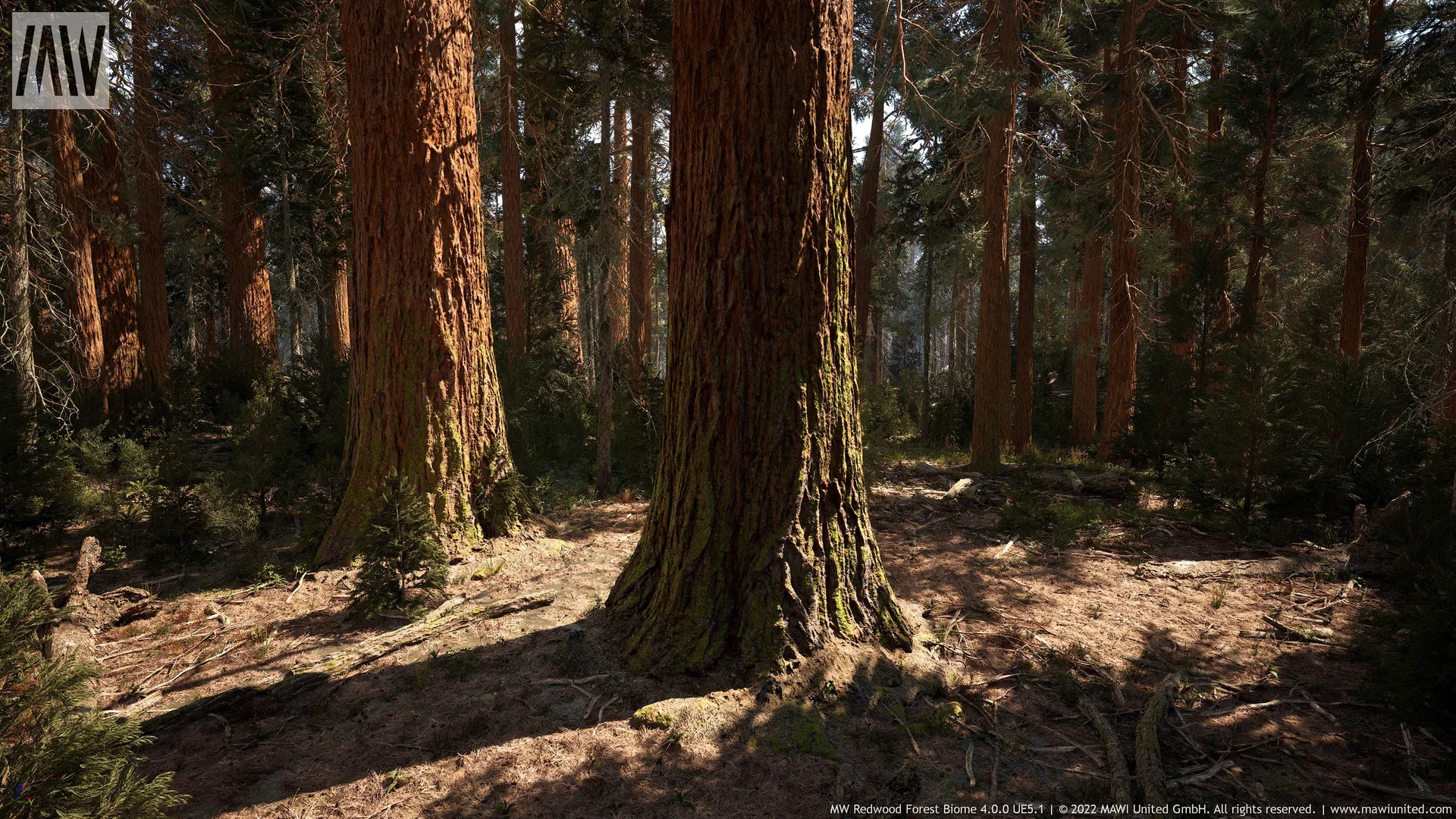
 Forest & Jungle
 Forest & Jungle
 Nature & Terrain