"6ac84fdb0bd06614"{"id":"27966","slug":"stylescape-stylized-environment-kit","title":"Stylescape: Stylized Environment Kit","category":"Forest \u0026 Jungle","engine":"5.0+","assetVersion":"Engine version: 5.0+","engineVersion":"","tag":"Forest \u0026 Jungle","accent":"blue","visual":"city","summary":"Stylescape starts with a practical setup path: landscape tools, foliage systems, and a demo level that shows how the pieces come together. Its feature set focuses on stylized outdoor scene building with layered terrain, animated vegetation, RVT blending, an...","platform":"Unreal Engine","publishedAt":"2026-04-30T07:46:23.000Z","updatedAt":"2026-04-30T07:46:24.000Z","sourceNotes":[],"fileContents":[],"compatibility":["Unreal Engine","Engine version: 5.0+"],"featuredImage":{"alt":"Stylescape: Stylized Environment Kit","src":"https://3dcghub.com/wp-content/uploads/2026/04/919df961bd95_fa7d20f4-93b7-4cca-baea-d2f63da591a6.webp"},"hasDownloadLink":true,"downloads":0,"terms":[{"taxonomy":"category","slug":"forest-and-jungle","name":"Forest \u0026 Jungle"},{"taxonomy":"post_tag","slug":"environment","name":"Environment"},{"taxonomy":"post_tag","slug":"materials","name":"Materials"},{"taxonomy":"post_tag","slug":"unreal-engine-5","name":"Unreal Engine 5"}],"galleryImages":[{"src":"https://3dcghub.com/wp-content/uploads/2026/04/fa3d877b1d82_94c0637b-bd68-4ae2-847d-115f8b98ebc2.webp","alt":"Stylescape: Stylized Environment Kit"},{"src":"https://3dcghub.com/wp-content/uploads/2026/04/ed4b0de910c1_8fd6b418-f11e-4390-9a8a-d00dd19b4784.webp","alt":"Stylescape: Stylized Environment Kit"},{"src":"https://3dcghub.com/wp-content/uploads/2026/04/901bf5cf0863_6cb4b64c-e8cd-45ec-afff-618b32c9138c.webp","alt":"Stylescape: Stylized Environment Kit"},{"src":"https://3dcghub.com/wp-content/uploads/2026/04/2c8ecd20c36e_4353df75-4c87-4b9c-a6fa-705213d77174.webp","alt":"Stylescape: Stylized Environment Kit"},{"src":"https://3dcghub.com/wp-content/uploads/2026/04/bab8c9631bbf_13d95969-e002-4466-8603-f082c9b08211.webp","alt":"Stylescape: Stylized Environment Kit"},{"src":"https://3dcghub.com/wp-content/uploads/2026/04/bc2fc2e4b080_9bde391d-0599-433b-98a4-e91208ec1d56.webp","alt":"Stylescape: Stylized Environment Kit"},{"src":"https://3dcghub.com/wp-content/uploads/2026/04/0381e015c8d5_ab5929bf-0bb5-4993-88ec-81cea588bf5c.webp","alt":"Stylescape: Stylized Environment Kit"},{"src":"https://3dcghub.com/wp-content/uploads/2026/04/dd4982e359e6_c048f9bf-6e12-4959-bbde-3b9e27d8bb7d.webp","alt":"Stylescape: Stylized Environment Kit"},{"src":"https://3dcghub.com/wp-content/uploads/2026/04/5d2bbc097dc7_b6e7de30-17d1-401c-85f0-718b7bdddc18.webp","alt":"Stylescape: Stylized Environment Kit"},{"src":"https://3dcghub.com/wp-content/uploads/2026/04/bf44b2100eb2_487541f5-76b6-4bb6-bb1f-52fb43ebf3dc.webp","alt":"Stylescape: Stylized Environment Kit"}],"accessPanel":{"kind":"resource","title":"Access this resource","eyebrow":"Free Download","message":"Log in or create a free account to start your download.","fileName":"Content.7z","safetyNote":"All resources are 100% manually reviewed to eliminate all risks.","actionLabel":"Download Free","resourceType":"Resource archive"},"contentHtml":"\u003cp\u003eStylescape opens with a workflow that is easy to picture in production: set up the landscape, bring in foliage, place water, and then shape the scene with background mountains and material controls. The kit is positioned as a highly flexible and optimized environment package for Unreal Engine, using UE4 and UE5 features including Landmass, Water, Edit Layers, and Runtime Virtual Textures.\u003c/p\u003e\u003cp\u003eThat gives it a clear identity for artists and level builders who want a stylized outdoor world without treating terrain, vegetation, and water as disconnected parts. The included Demo_Landmass map pushes that idea directly, combining Landmass mountains with Water plugin lakes and streams.\u003c/p\u003e\u003ch2\u003eGetting started with Stylescape and Demo_Landmass\u003c/h2\u003e\u003cp\u003eThe most concrete implementation path begins with the landscape system. Stylescape includes a Landscape Auto Material that covers both broad terrain shaping and more selective manual work. It comes with 2 auto slope layers, an auto grass patches layer, 8 paintable layers, micro and macro tiling blending, and slope noise masks. For anyone blocking out a forest path, hillside, lake edge, or mountain approach, that mix of automatic and paintable behavior gives room to move between fast setup and local art direction.\u003c/p\u003e\u003cp\u003eThe latest version also includes a LAM version with texture normals and 3 extra layers for customization. That makes the material setup feel less locked to a single look. Even within a stylized environment, being able to push additional surface variation matters when one map needs softer open fields and another needs harsher mountain transitions.\u003c/p\u003e\u003cp\u003eDemo_Landmass serves as the clearest example of how the kit can be assembled. It uses Landmass mountains together with Water plugin lakes and streams, so the environment is not just a flat material showcase. It demonstrates the package in terms of terrain formation, water placement, and scene composition. The kit requires the Water and Landmass plugins, which is an important setup note before building around its headline features.\u003c/p\u003e\u003ch2\u003eLandscape Auto Material and foliage placement\u003c/h2\u003e\u003cp\u003eOnce the terrain is in place, Stylescape shifts into vegetation and scene dressing. Ground foliage such as grass and flowers is geometry based, which means nearly zero overdraw. That detail says a lot about the intended use: scenes can lean heavily on ground cover without depending on thin alpha-heavy cards for the entire look.\u003c/p\u003e\u003cp\u003eFoliage placement is also helped by included procedural foliage spawners. For developers building larger maps or artists assembling broad natural spaces, that makes the kit more than a small set of hand-placed props. A procedural pass can establish density and spread, and then the manual controls in the landscape and water tools can refine the final composition.\u003c/p\u003e\u003cp\u003eThe vegetation is not static. All leaves and grass are vertex wind animated, and they also include an extra customizable animated panning wave. That gives outdoor scenes a stronger sense of motion without asking the user to build a separate motion system. In practice, this can help a quiet lakeside, a pine-heavy mountain pass, or a stylized meadow feel active even before gameplay elements are added.\u003c/p\u003e\u003cp\u003eColor control is another useful part of that pipeline. Leaves and grass can be assigned any color, and a tutorial video is available for that process. In creative terms, this lets the same foliage base move across very different palettes, from softer natural greens to more pushed stylized tones.\u003c/p\u003e\u003ch2\u003eRuntime Virtual Textures, impostors, and Nanite updates\u003c/h2\u003e\u003cp\u003eStylescape includes optional RVT assets so that grass, trees, and rocks can blend with the landscape. That blending is important in stylized work, where harsh seams can break the look quickly. With RVT support in the kit, the foliage and stone elements are not treated as isolated pieces dropped onto the terrain. They are meant to sit into the environment more naturally.\u003c/p\u003e\u003cp\u003eTrees also use high quality 4k impostor billboards. That makes the package relevant not only for close-up scene building but also for extending forested spaces into the distance. Background coverage often determines whether a stylized outdoor level feels finished, and impostors are a direct answer to that need. One update specifically restored impostors to high quality, which shows that distant tree presentation remains part of the kit’s ongoing refinement.\u003c/p\u003e\u003cp\u003eThere is also a UE5.1 update that enabled Nanite on grass, rocks, and landscape, along with an updated Demo_RVT level. That note matters less as a sales bullet and more as a practical indicator of how the package has been maintained around newer Unreal workflows. The latest version is listed as v1.6, and a UE5.5+ update dated 4/6/25 updated the demo, improved overall visuals, added bushes, and introduced a new main level named Demo_Landmass.\u003c/p\u003e\u003cp\u003eTaken together, those update notes paint a clear production picture. Stylescape is not just a static set of meshes and materials; it has continued receiving visual and demo-level revisions, including work on impostors, Nanite use, and the main showcase map.\u003c/p\u003e\u003ch2\u003eWater, mountains, and scene shaping in Stylescape\u003c/h2\u003e\u003cp\u003eThe water setup is handled with an easy to place BP water actor that includes material and scaling controls, underwater fog, and distortion. There is also the option to use Water actors. For environment work, this matters because water is not only a visual accent here. It is part of the scene-building structure, especially when paired with the Landmass and landscape systems already in the kit.\u003c/p\u003e\u003cp\u003eThat makes Stylescape useful for more than a single type of outdoor level. A lake can become the focal point of a stylized exploration area. Streams can cut through terrain shaped with slope-based materials. Water edges can sit against procedural grass and rocks that blend through RVT. Since the kit already combines these systems, it supports a more unified build process than manually assembling separate terrain, foliage, and shoreline solutions.\u003c/p\u003e\u003cp\u003eBackground mountain meshes add another layer to that process. They include a dynamic material to control slope angle and textures, which gives the distant environment its own adjustable treatment rather than leaving it as fixed backdrop geometry. That can help frame play spaces, push depth into the horizon, or keep a scene cohesive when the foreground and far background need to share the same stylized language.\u003c/p\u003e\u003ch2\u003eProduction notes around v1.6\u003c/h2\u003e\u003cp\u003eVersion v1.6 is supported with video tutorials covering the usage process, and support is available even for non-related questions. That kind of support structure is notable because Stylescape includes several Unreal-specific systems working together: landscape auto materials, optional RVT blending, procedural foliage, vertex animation, impostors, water tools, and plugin-based terrain features.\u003c/p\u003e\u003cp\u003eFrom a practical standpoint, the kit fits artists and developers who want to assemble stylized natural spaces through layered terrain, dense foliage, and controlled water placement rather than through a single hero environment mesh. The strongest use case is scene construction where land, vegetation, and background elements all need to respond to one another. With Demo_Landmass, Nanite-enabled updates for UE5.1, restored high quality impostors, and a UE5.5+ visual refresh that adds bushes and a new main level, Stylescape reads as a maintained environment workflow rather than a one-off map sample.\u003c/p\u003e\n\n\u003ch2\u003eContinue Browsing Similar Packs\u003c/h2\u003e\n\u003cul\u003e\n\u003cli\u003e\u003ca href=\"https://3dcghub.com/56-fabric-textile-materials-4k-pbr-collection/\" title=\"56 Fabric \u0026amp;amp; Textile Materials (4K PBR Collection)\"\u003e56 Fabric \u0026amp; Textile Materials (4K PBR Collection)\u003c/a\u003e\u003c/li\u003e\n\u003cli\u003e\u003ca href=\"https://3dcghub.com/advanced-road-materials/\" title=\"Advanced road materials\"\u003eAdvanced road materials\u003c/a\u003e\u003c/li\u003e\n\u003cli\u003e\u003ca href=\"https://3dcghub.com/master-materials-and-layer-system-for-daz3d-imports/\" title=\"Master Materials and Layer System for Daz3D Imports\"\u003eMaster Materials and Layer System for Daz3D Imports\u003c/a\u003e\u003c/li\u003e\n\u003cli\u003e\u003ca href=\"https://3dcghub.com/realistic-materials-vol-7-water-ice-25-materials/\" title=\"Realistic Materials Vol. 7 – Water \u0026amp;amp; Ice (25+ Materials)\"\u003eRealistic Materials Vol. 7 – Water \u0026amp; Ice (25+ Materials)\u003c/a\u003e\u003c/li\u003e\n\u003cli\u003e\u003ca href=\"https://3dcghub.com/stylized-250-materials-bundle/\" title=\"Stylized 250 Materials Bundle\"\u003eStylized 250 Materials Bundle\u003c/a\u003e\u003c/li\u003e\n\u003c/ul\u003e","contentTextLength":7704,"navigation":{"current":1343,"total":3181,"previous":{"id":"3961","slug":"chinese-wineset-snack","title":"Chinese Wineset \u0026 Snack","category":"Food \u0026 Drink","platform":"Unreal Engine","updatedAt":"2026-04-30T13:10:36.000Z"},"next":{"id":"27953","slug":"stylized-ancient-crypt","title":"Stylized Ancient Crypt","category":"Dungeon","platform":"Unreal Engine","updatedAt":"2026-04-30T07:46:15.000Z"}},"relatedResources":[{"id":"27927","slug":"stylized-landscape-5-biomes","title":"Stylized Landscape - 5 Biomes","category":"Forest \u0026 Jungle","engine":"5.2+","assetVersion":"Engine version: 5.2+","engineVersion":"","tag":"Forest \u0026 Jungle","accent":"blue","visual":"city","summary":"Stylized Landscape - 5 Biomes is a landscape pack aimed at getting scenes up and running quickly with strong variety from the start. Its RVT setup focuses on smoother blending between assets, while foliage includes prebaked imposter LODs for performance-min...","platform":"Unreal Engine","publishedAt":"2026-04-30T07:21:43.000Z","updatedAt":"2026-04-30T07:21:44.000Z","sourceNotes":[],"fileContents":[],"compatibility":["Unreal Engine","Engine version: 5.2+"],"featuredImage":{"alt":"Stylized Landscape - 5 Biomes","src":"https://3dcghub.com/wp-content/uploads/2026/04/533d158dcd5b_2cf40ac8-91c4-4248-b97d-90a3716e6f54.webp"},"hasDownloadLink":true,"downloads":0},{"id":"27889","slug":"stylized-waterways","title":"Stylized Waterways","category":"Forest \u0026 Jungle","engine":"5.5+","assetVersion":"Engine version: 5.5+","engineVersion":"","tag":"Forest \u0026 Jungle","accent":"blue","visual":"city","summary":"Stylized Waterways focuses on the way waterways and surrounding environment pieces come together inside a scene. The pack includes 146 assets, showcased example levels, controllable material instance parameters, and compatibility with the Ultimate Level Art...","platform":"Unreal Engine","publishedAt":"2026-04-30T06:01:31.000Z","updatedAt":"2026-04-30T06:01:33.000Z","sourceNotes":[],"fileContents":[],"compatibility":["Unreal Engine","Engine version: 5.5+"],"featuredImage":{"alt":"Stylized Waterways","src":"https://3dcghub.com/wp-content/uploads/2026/04/c32b41d6f0f3_4c69796e-202b-43e7-98a6-3384b83c8845.webp"},"hasDownloadLink":true,"downloads":0},{"id":"8281","slug":"stylized-landscape","title":"Stylized Landscape","category":"Forest \u0026 Jungle","engine":"4.26+,5.0+","assetVersion":"Engine version: 4.26+,5.0+","engineVersion":"4.20","tag":"Forest \u0026 Jungle","accent":"blue","visual":"city","summary":"Build breathtaking fantasy worlds with ease using this comprehensive stylized environment kit. It is perfect for developers seeking a unique artistic direction for their next project.","platform":"Unreal Engine","publishedAt":"2026-02-23T16:37:43.000Z","updatedAt":"2026-04-19T15:55:30.000Z","sourceNotes":[],"fileContents":[],"compatibility":["Unreal Engine","Engine version: 4.26+,5.0+"],"featuredImage":{"alt":"Stylized Landscape","src":"https://3dcghub.com/wp-content/uploads/2026/02/0d2aa9ef-a3de-46a2-a5df-476be513e5f0.webp"},"hasDownloadLink":true,"downloads":0}]}
Forest & Jungle
Stylescape: Stylized Environment Kit
Stylescape starts with a practical setup path: landscape tools, foliage systems, and a demo level that shows how the pieces come together. Its feature set focuses on stylized outdoor scene building with layered terrain, animated vegetation, RVT blending, an...
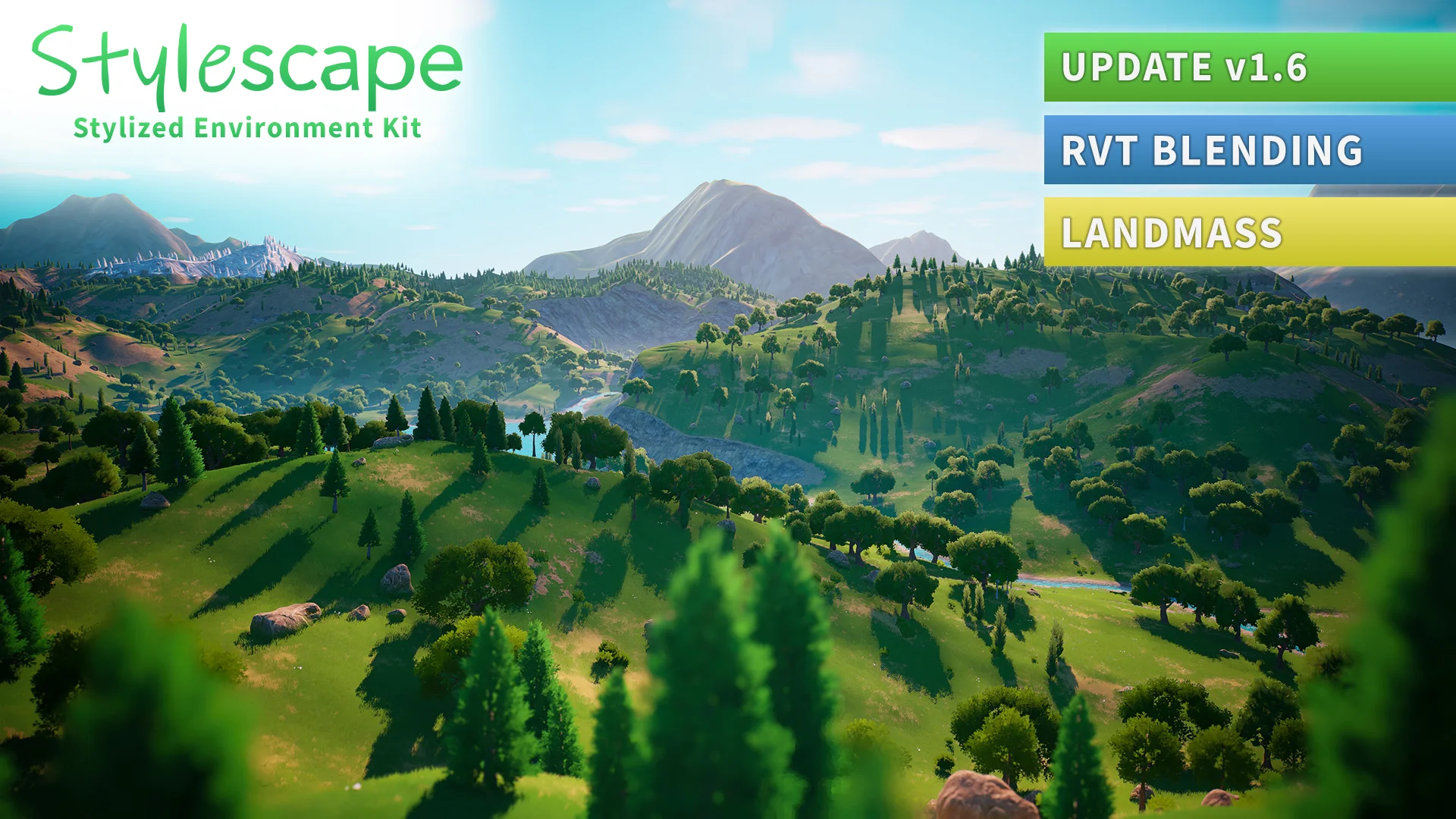
Stylescape opens with a workflow that is easy to picture in production: set up the landscape, bring in foliage, place water, and then shape the scene with background mountains and material controls. The kit is positioned as a highly flexible and optimized environment package for Unreal Engine, using UE4 and UE5 features including Landmass, Water, Edit Layers, and Runtime Virtual Textures.
That gives it a clear identity for artists and level builders who want a stylized outdoor world without treating terrain, vegetation, and water as disconnected parts. The included Demo_Landmass map pushes that idea directly, combining Landmass mountains with Water plugin lakes and streams.
Getting started with Stylescape and Demo_Landmass
The most concrete implementation path begins with the landscape system. Stylescape includes a Landscape Auto Material that covers both broad terrain shaping and more selective manual work. It comes with 2 auto slope layers, an auto grass patches layer, 8 paintable layers, micro and macro tiling blending, and slope noise masks. For anyone blocking out a forest path, hillside, lake edge, or mountain approach, that mix of automatic and paintable behavior gives room to move between fast setup and local art direction.
The latest version also includes a LAM version with texture normals and 3 extra layers for customization. That makes the material setup feel less locked to a single look. Even within a stylized environment, being able to push additional surface variation matters when one map needs softer open fields and another needs harsher mountain transitions.
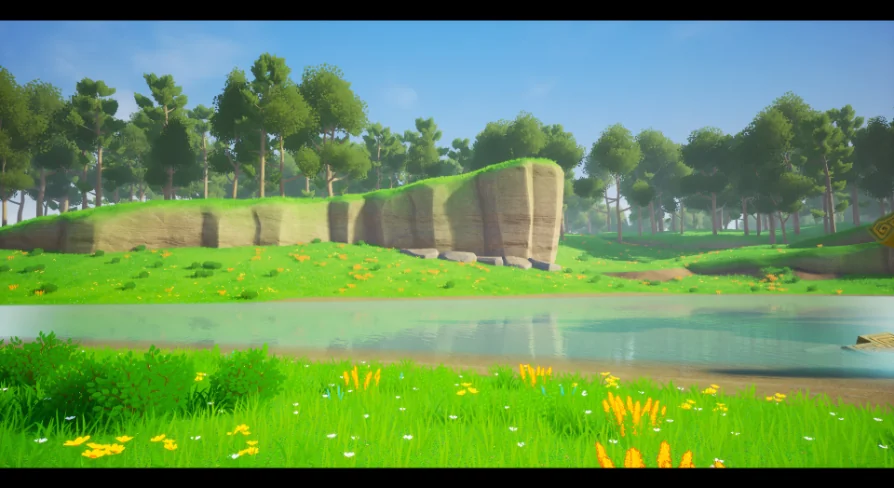
Demo_Landmass serves as the clearest example of how the kit can be assembled. It uses Landmass mountains together with Water plugin lakes and streams, so the environment is not just a flat material showcase. It demonstrates the package in terms of terrain formation, water placement, and scene composition. The kit requires the Water and Landmass plugins, which is an important setup note before building around its headline features.
Landscape Auto Material and foliage placement
Once the terrain is in place, Stylescape shifts into vegetation and scene dressing. Ground foliage such as grass and flowers is geometry based, which means nearly zero overdraw. That detail says a lot about the intended use: scenes can lean heavily on ground cover without depending on thin alpha-heavy cards for the entire look.
Foliage placement is also helped by included procedural foliage spawners. For developers building larger maps or artists assembling broad natural spaces, that makes the kit more than a small set of hand-placed props. A procedural pass can establish density and spread, and then the manual controls in the landscape and water tools can refine the final composition.
The vegetation is not static. All leaves and grass are vertex wind animated, and they also include an extra customizable animated panning wave. That gives outdoor scenes a stronger sense of motion without asking the user to build a separate motion system. In practice, this can help a quiet lakeside, a pine-heavy mountain pass, or a stylized meadow feel active even before gameplay elements are added.
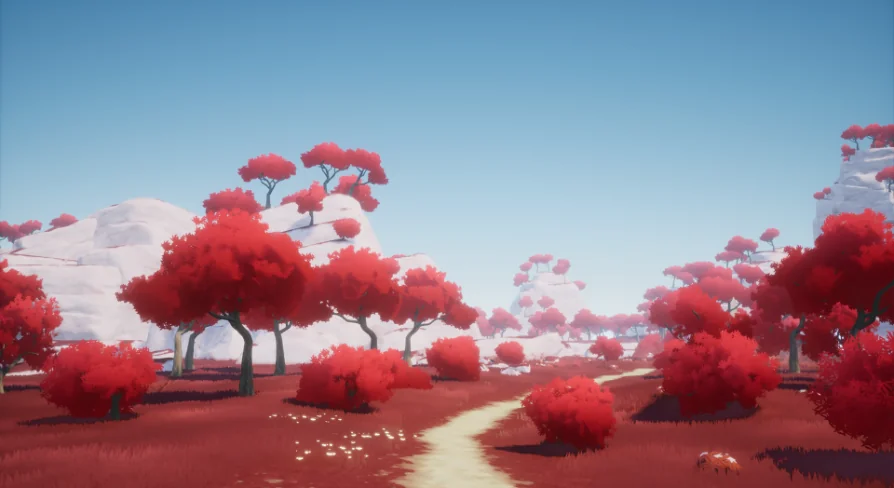
Color control is another useful part of that pipeline. Leaves and grass can be assigned any color, and a tutorial video is available for that process. In creative terms, this lets the same foliage base move across very different palettes, from softer natural greens to more pushed stylized tones.
Runtime Virtual Textures, impostors, and Nanite updates
Stylescape includes optional RVT assets so that grass, trees, and rocks can blend with the landscape. That blending is important in stylized work, where harsh seams can break the look quickly. With RVT support in the kit, the foliage and stone elements are not treated as isolated pieces dropped onto the terrain. They are meant to sit into the environment more naturally.
Trees also use high quality 4k impostor billboards. That makes the package relevant not only for close-up scene building but also for extending forested spaces into the distance. Background coverage often determines whether a stylized outdoor level feels finished, and impostors are a direct answer to that need. One update specifically restored impostors to high quality, which shows that distant tree presentation remains part of the kit’s ongoing refinement.
There is also a UE5.1 update that enabled Nanite on grass, rocks, and landscape, along with an updated Demo_RVT level. That note matters less as a sales bullet and more as a practical indicator of how the package has been maintained around newer Unreal workflows. The latest version is listed as v1.6, and a UE5.5+ update dated 4/6/25 updated the demo, improved overall visuals, added bushes, and introduced a new main level named Demo_Landmass.
Taken together, those update notes paint a clear production picture. Stylescape is not just a static set of meshes and materials; it has continued receiving visual and demo-level revisions, including work on impostors, Nanite use, and the main showcase map.
Water, mountains, and scene shaping in Stylescape
The water setup is handled with an easy to place BP water actor that includes material and scaling controls, underwater fog, and distortion. There is also the option to use Water actors. For environment work, this matters because water is not only a visual accent here. It is part of the scene-building structure, especially when paired with the Landmass and landscape systems already in the kit.
That makes Stylescape useful for more than a single type of outdoor level. A lake can become the focal point of a stylized exploration area. Streams can cut through terrain shaped with slope-based materials. Water edges can sit against procedural grass and rocks that blend through RVT. Since the kit already combines these systems, it supports a more unified build process than manually assembling separate terrain, foliage, and shoreline solutions.
Background mountain meshes add another layer to that process. They include a dynamic material to control slope angle and textures, which gives the distant environment its own adjustable treatment rather than leaving it as fixed backdrop geometry. That can help frame play spaces, push depth into the horizon, or keep a scene cohesive when the foreground and far background need to share the same stylized language.
Production notes around v1.6
Version v1.6 is supported with video tutorials covering the usage process, and support is available even for non-related questions. That kind of support structure is notable because Stylescape includes several Unreal-specific systems working together: landscape auto materials, optional RVT blending, procedural foliage, vertex animation, impostors, water tools, and plugin-based terrain features.
From a practical standpoint, the kit fits artists and developers who want to assemble stylized natural spaces through layered terrain, dense foliage, and controlled water placement rather than through a single hero environment mesh. The strongest use case is scene construction where land, vegetation, and background elements all need to respond to one another. With Demo_Landmass, Nanite-enabled updates for UE5.1, restored high quality impostors, and a UE5.5+ visual refresh that adds bushes and a new main level, Stylescape reads as a maintained environment workflow rather than a one-off map sample.
 Forest & Jungle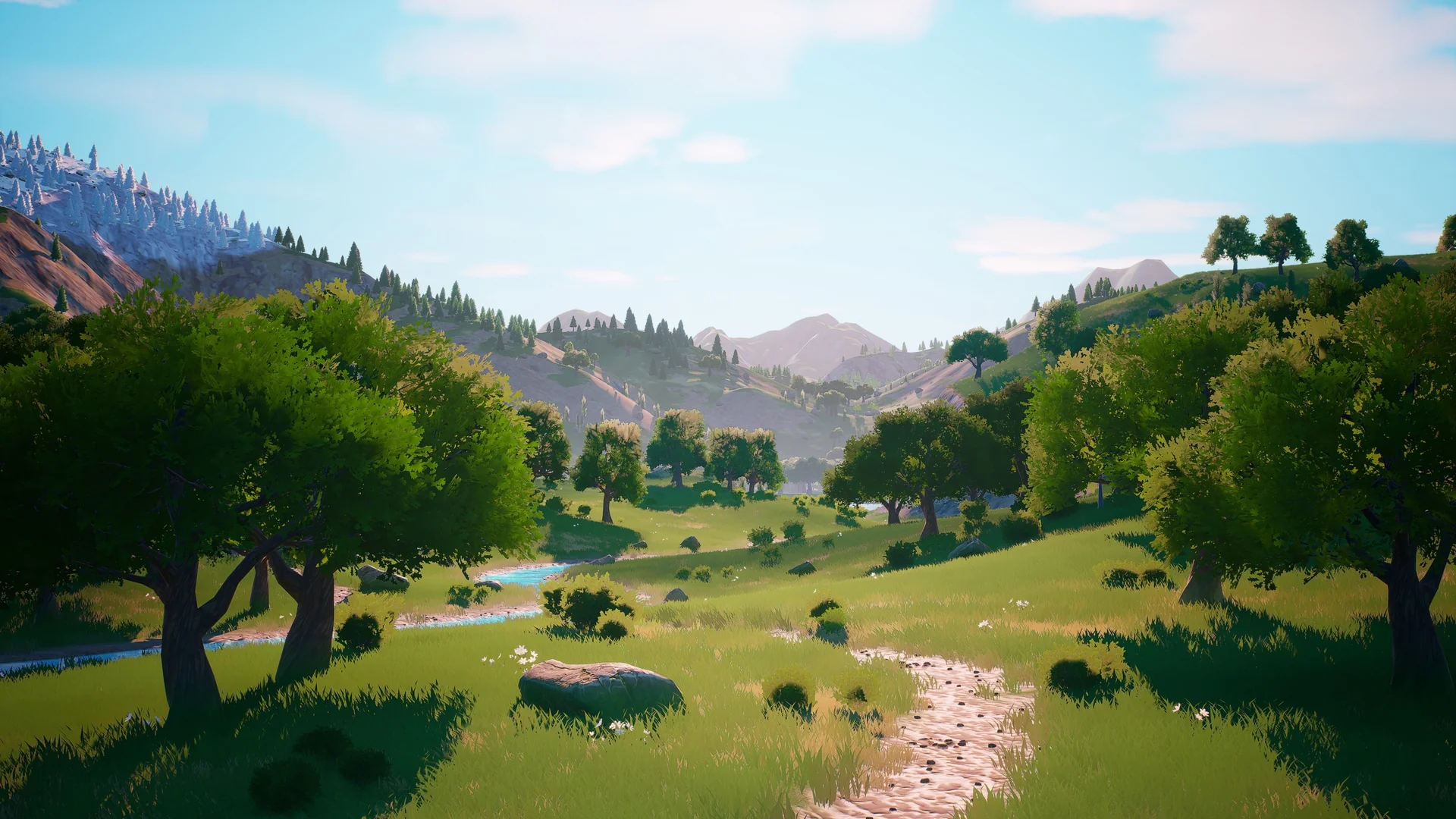
 Forest & Jungle
 Forest & Jungle
 Forest & Jungle