"c68a05d5e51405b3"{"id":"1001107","slug":"broadleaf-poplar-forest-pcg-biome","title":"Broadleaf Poplar Forest - PCG Biome","category":"Forest \u0026 Jungle","engine":"5.4+","assetVersion":"","engineVersion":"Engine Version: 5.4+","tag":"Forest \u0026 Jungle","accent":"blue","visual":"mech","summary":"Fully procedural PCG poplar biome for Unreal Engine: photoscanned trees, dynamic wind and foliage interaction, plus World Partition and runtime generation.","platform":"Unreal Engine","publishedAt":"2026-09-07T06:21:06.743Z","updatedAt":"2026-09-07T06:21:06.743Z","sourceNotes":[],"fileContents":[],"compatibility":["Unreal Engine","Engine Version: 5.4+"],"featuredImage":{"alt":"Broadleaf Poplar Forest - PCG Biome","src":"/wp-content/uploads/published/2026/09/62ee8e5ec890-f775a27c-8e9d-49c5-bb9a-6fd09118f806-4aeeb75b35.webp"},"hasDownloadLink":true,"downloads":4,"terms":[{"taxonomy":"category","slug":"forest-and-jungle","name":"Forest \u0026 Jungle"}],"galleryImages":[{"src":"/wp-content/uploads/published/2026/09/f5f312101002-009986ca-08c3-4e08-884c-293db74d8e3b-23f7e102ab.webp","alt":"Broadleaf Poplar Forest - PCG Biome"},{"src":"/wp-content/uploads/published/2026/09/09af326321dc-36dc00f8-f830-4902-95f4-0758f735b255-4e00266c37.webp","alt":"Broadleaf Poplar Forest - PCG Biome"},{"src":"/wp-content/uploads/published/2026/09/6518ab69332f-0739f11a-b1bc-4470-b0c7-39d87316bc10-a64d2dab3b.webp","alt":"Broadleaf Poplar Forest - PCG Biome"},{"src":"/wp-content/uploads/published/2026/09/dcb80a2f849b-bb44791e-0768-428c-a8aa-1f6e959d07ed-50d29cb911.webp","alt":"Broadleaf Poplar Forest - PCG Biome"},{"src":"/wp-content/uploads/published/2026/09/e5ddc8fcac1c-beeba1d0-74d5-45e5-acea-22c2f3a0d171-2b909c69f2.webp","alt":"Broadleaf Poplar Forest - PCG Biome"},{"src":"/wp-content/uploads/published/2026/09/b1abd7fb392a-3dc41c22-fd12-419f-91b4-3b7f64aa33a5-00062f2274.webp","alt":"Broadleaf Poplar Forest - PCG Biome"},{"src":"/wp-content/uploads/published/2026/09/e74d6fda6bc5-b2d8ed38-1f69-4f89-8240-4cc95f2414fd-70bc6f4def.webp","alt":"Broadleaf Poplar Forest - PCG Biome"},{"src":"/wp-content/uploads/published/2026/09/2cd2631893cc-61f3fcf6-9205-44ba-bff9-1dc18f173a48-85b3ee6d36.webp","alt":"Broadleaf Poplar Forest - PCG Biome"},{"src":"/wp-content/uploads/published/2026/09/c50e0bc5d454-2e665313-c432-4d1b-915b-165fa10ebdfa-eeb2fc8085.webp","alt":"Broadleaf Poplar Forest - PCG Biome"},{"src":"/wp-content/uploads/published/2026/09/7a410c6bea67-7416379a-4148-47e6-862e-f9fe5854f86b-a91ed49443.webp","alt":"Broadleaf Poplar Forest - PCG Biome"}],"accessPanel":{"kind":"resource","title":"Download this resource","eyebrow":"Free Download","message":"Log in or create a free account to start your download.","fileName":"PCGBiomeForestPoplar.7z","safetyNote":"Resources are manually reviewed before listing to improve quality and reduce obvious risks.","actionLabel":"Download Free","resourceType":"Resource archive"},"contentHtml":"\u003cp\u003eGenerating a convincing broadleaf forest in Unreal Engine can become a long run of hand-placed scattering and masking. This asset takes a procedural route by treating the whole biome as a PCG layer: poplar forests and meadows that respond to the terrain and keep working as the level changes.\u003c/p\u003e\u003ch2\u003ePoplar forest generation that follows terrain, not paintmaps\u003c/h2\u003e\u003cp\u003eThe package is structured through poplar forest generation in UE5. It automatically creates ultra-realistic poplar forests and meadows, and those areas evolve with the landscape underneath. There is no paintmap routine and no manually placed vegetation to manage.\u003c/p\u003e\u003cp\u003eInstead, you pick from biome presets or tune your own. Because the growth is driven by the terrain shape, you can return to world editing at any moment and the forest follows along. For artists who like to reshape levels after scattering has started, this removes the usual need to clear and regenerate tree placement by hand.\u003c/p\u003e\u003ch2\u003eWind on every leaf, interaction in every clump of grass\u003c/h2\u003e\u003cp\u003eOne of the strongest parts of the package is the wind response. The system was developed to produce ultra-realistic wind in UE5, with movement that reaches every leaf rather than treating the canopy as a single shader wobble. The effect also stays efficient when compared to simple wind solutions. A single slider moves the forest from a peaceful breeze up to a serious storm.\u003c/p\u003e\u003cp\u003eThe vegetation is not just visual. Walk through tall grass or bushes and they bend naturally as you pass. Flowers shift when you step on them, and overhanging branches react to a character moving through them, which deepens the sense that the biome is alive.\u003c/p\u003e\u003ch2\u003ePhotoscanned poplar assets inside a PCG ecosystem\u003c/h2\u003e\u003cp\u003eThis is not stylized vegetation generated from a few painted textures. The foliage assets come from photogrammetry, with a background of more than eight years of research in that area. Photoscanned assets like these tend to bring in the subtle color and shape details that make a screen read as a real location.\u003c/p\u003e\u003cp\u003eThe assets sit in a PCG-powered ecosystem, which also gives the pack an unusual advantage: the biomes blend seamlessly with one another. The idea is that all of the forest biomes in this family fit together in quality, performance, and style, with no extra action needed to make a transition work. Just drop the biome in and let it grow with nearby areas.\u003c/p\u003e\u003ch2\u003eThe Giant Update: World Partition, runtime generation, proxy meshes, roads\u003c/h2\u003e\u003cp\u003eThe Giant Update adds several production-facing features. World Partition and HLODs support mean the biome can appear in large, streamed open worlds. Runtime Generation is now implemented, which is the feature behind the faster loading times mentioned in the changelog.\u003c/p\u003e\u003cp\u003eProxy meshes extend the biome across extreme render distances, so distant forest still forms a coherent shape. A new Road System works across all biomes, aligning vegetation with paths instead of forcing you to cut roads out of the forest afterward.\u003c/p\u003e\u003cp\u003eTools were redesigned with an emphasis on a smoother, cleaner workflow, and the whole package is fully supported on Unreal Engine 5.6, with 5.7 support present as an experimental starting point. The changelog also advises backing up any existing project and performing a clean install rather than updating over an older release.\u003c/p\u003e\u003cp\u003eFor teams working in UE 5.8, note the developer's warning: a confirmed PCG plugin bug may break spline detection in partitioned graphs. An official fix is expected in UE 5.8.1. It is worth checking that warning before starting a large partitioned build with the latest engine preview.\u003c/p\u003e\u003ch2\u003ePerformance targets with two or more biomes combined\u003c/h2\u003e\u003cp\u003eSince poplar forests rarely sit alone in a scene, the listed performance targets are measured with two or more biomes combined. The test settings are 4K resolution at 50 percent scale, Ultra settings, no frame generation, and Unreal Engine 5.6.\u003c/p\u003e\u003cul\u003e\u003cli\u003eRTX 4090: 80–90 FPS\u003c/li\u003e\u003cli\u003eRTX 3080: 45–55 FPS\u003c/li\u003e\u003cli\u003eRTX 3060 Ti: 30–40 FPS\u003c/li\u003e\u003c/ul\u003e\u003cp\u003eThose numbers are useful for anyone deciding how much a second biome pack will cost in frame time on a target machine.\u003c/p\u003e\u003ch2\u003eWhere a living poplar biome fits in production\u003c/h2\u003e\u003cp\u003eEasy controls and clear documentation make it possible for someone new to UE5 to place a believable broadleaf forest without a long technical setup. At the same time, the runtime generation, proxy meshes, and World Partition integration are aimed at larger environments where loading speed and streaming budget matter.\u003c/p\u003e\u003cp\u003eThis is an asset for level designers who need forests that stay editable: place it early, shape it later, and let the trees keep pace with changes to the terrain or to gameplay flow. It is also a strong second layer for any Unreal project that already uses a mix of scanned nature assets and wants the broadleaf forest to feel as present as the ground beneath it.\u003c/p\u003e\n\n\u003ch2\u003eContinue Browsing Similar Packs\u003c/h2\u003e\n\u003cul\u003e\n\u003cli\u003e\u003ca href=\"https://3dcghub.com/burnt-forest-aftermath-environment/\" title=\"Burnt Forest Aftermath Environment\"\u003eBurnt Forest Aftermath Environment\u003c/a\u003e\u003c/li\u003e\n\u003cli\u003e\u003ca href=\"https://3dcghub.com/red-pine-biome/\" title=\"Red Pine Biome\"\u003eRed Pine Biome\u003c/a\u003e\u003c/li\u003e\n\u003cli\u003e\u003ca href=\"https://3dcghub.com/procedural-biomes/\" title=\"Procedural Biomes\"\u003eProcedural Biomes\u003c/a\u003e\u003c/li\u003e\n\u003cli\u003e\u003ca href=\"https://3dcghub.com/mw-meadow-forest-trees-biome/\" title=\"MW Meadow Forest Trees Biome\"\u003eMW Meadow Forest Trees Biome\u003c/a\u003e\u003c/li\u003e\n\u003cli\u003e\u003ca href=\"https://3dcghub.com/stylized-landscape-5-biomes-stylized-low-poly-forest-orasot-bundle/\" title=\"Stylized Landscape 5 Biomes + Stylized + Low poly forest : Orasot Bundle\"\u003eStylized Landscape 5 Biomes + Stylized + Low poly forest : Orasot Bundle\u003c/a\u003e\u003c/li\u003e\n\u003c/ul\u003e","contentTextLength":4975,"navigation":{"current":868,"total":3860,"previous":{"id":"1001108","slug":"abandoned-manor","title":"Abandoned Manor","category":"Historical","platform":"Unreal Engine","updatedAt":"2026-09-07T07:03:05.275Z"},"next":{"id":"1001106","slug":"modular-sci-fi-quarry-environment","title":"Modular Sci-Fi Quarry Environment","category":"Sci-Fi","platform":"Unreal Engine","updatedAt":"2026-09-07T05:54:31.086Z"}},"relatedResources":[{"id":"1001490","slug":"the-pine-environment-foliage-island-pcg-nature-river-nature-nature-biom","title":"The Pine Environment ( Foliage Island PCG Nature River Nature Nature Biom )","category":"Forest \u0026 Jungle","engine":"5.4+","assetVersion":"","engineVersion":"Engine Version: 5.4+","tag":"Forest \u0026 Jungle","accent":"blue","visual":"city","summary":"Explore The Pine Environment, featuring 53 unique meshes, procedural PCG scattering, river biomes, Nanite and Lumen support, and ULAT modular integration.","platform":"Unreal Engine","publishedAt":"2026-10-08T10:04:47.716Z","updatedAt":"2026-10-08T10:04:47.716Z","sourceNotes":[],"fileContents":[],"compatibility":["Unreal Engine","Engine Version: 5.4+"],"featuredImage":{"alt":"The Pine Environment ( Foliage Island PCG Nature River Nature Nature Biom )","src":"/wp-content/uploads/published/2026/10/3ea4f6900e86-b4efa431-bc2a-403b-8c5c-6b72af4180f0-c94ccb1b90.webp"},"hasDownloadLink":true,"downloads":2},{"id":"1001544","slug":"pine-forest-photogrammetry-based-high-poly-biome","title":"Pine forest - Photogrammetry based High poly Biome","category":"Forest \u0026 Jungle","engine":"5.1+","assetVersion":"","engineVersion":"Engine Version: 5.1+","tag":"Forest \u0026 Jungle","accent":"blue","visual":"mech","summary":"Explore the Pine forest photogrammetry biome, featuring 95 procedural assets, 8K terrain support, RHA texture maps, and high-fidelity wind animation.","platform":"Unreal Engine","publishedAt":"2026-10-10T03:08:19.926Z","updatedAt":"2026-10-10T03:08:19.926Z","sourceNotes":[],"fileContents":[],"compatibility":["Unreal Engine","Engine Version: 5.1+"],"featuredImage":{"alt":"Pine forest - Photogrammetry based High poly Biome","src":"/wp-content/uploads/published/2026/10/82885d3ff947-ab7d61f5-70cf-4902-a8eb-c017c5314e67-95b32130bb.webp"},"hasDownloadLink":true,"downloads":0},{"id":"1001081","slug":"burnt-forest-aftermath-environment","title":"Burnt Forest Aftermath Environment","category":"Forest \u0026 Jungle","engine":"5.6+","assetVersion":"","engineVersion":"Engine Version: 5.6+","tag":"Forest \u0026 Jungle","accent":"blue","visual":"city","summary":"A PCG-driven environment for a burnt forest coming back to life, with 100+ meshes, scanned charred assets, lush regrowth, cabin props, and a riverside forest bi","platform":"Unreal Engine","publishedAt":"2026-09-04T16:18:47.027Z","updatedAt":"2026-09-04T16:18:47.027Z","sourceNotes":[],"fileContents":[],"compatibility":["Unreal Engine","Engine Version: 5.6+"],"featuredImage":{"alt":"Burnt Forest Aftermath Environment","src":"/wp-content/uploads/published/2026/09/fb000e2baf84-d3761560-ff83-41be-acfb-aa4c8162359d-c789317805.webp"},"hasDownloadLink":true,"downloads":2}]}
Forest & Jungle
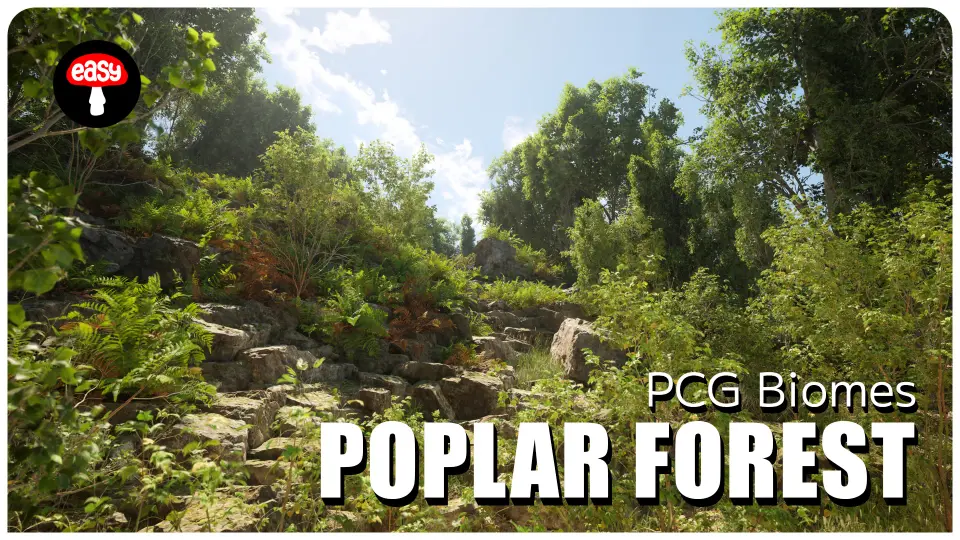
Broadleaf Poplar Forest - PCG Biome
Fully procedural PCG poplar biome for Unreal Engine: photoscanned trees, dynamic wind and foliage interaction, plus World Partition and runtime generation.
Generating a convincing broadleaf forest in Unreal Engine can become a long run of hand-placed scattering and masking. This asset takes a procedural route by treating the whole biome as a PCG layer: poplar forests and meadows that respond to the terrain and keep working as the level changes.
Poplar forest generation that follows terrain, not paintmaps
The package is structured through poplar forest generation in UE5. It automatically creates ultra-realistic poplar forests and meadows, and those areas evolve with the landscape underneath. There is no paintmap routine and no manually placed vegetation to manage.
Instead, you pick from biome presets or tune your own. Because the growth is driven by the terrain shape, you can return to world editing at any moment and the forest follows along. For artists who like to reshape levels after scattering has started, this removes the usual need to clear and regenerate tree placement by hand.
Wind on every leaf, interaction in every clump of grass
One of the strongest parts of the package is the wind response. The system was developed to produce ultra-realistic wind in UE5, with movement that reaches every leaf rather than treating the canopy as a single shader wobble. The effect also stays efficient when compared to simple wind solutions. A single slider moves the forest from a peaceful breeze up to a serious storm.
The vegetation is not just visual. Walk through tall grass or bushes and they bend naturally as you pass. Flowers shift when you step on them, and overhanging branches react to a character moving through them, which deepens the sense that the biome is alive.
Photoscanned poplar assets inside a PCG ecosystem
This is not stylized vegetation generated from a few painted textures. The foliage assets come from photogrammetry, with a background of more than eight years of research in that area. Photoscanned assets like these tend to bring in the subtle color and shape details that make a screen read as a real location.
The assets sit in a PCG-powered ecosystem, which also gives the pack an unusual advantage: the biomes blend seamlessly with one another. The idea is that all of the forest biomes in this family fit together in quality, performance, and style, with no extra action needed to make a transition work. Just drop the biome in and let it grow with nearby areas.
The Giant Update: World Partition, runtime generation, proxy meshes, roads
The Giant Update adds several production-facing features. World Partition and HLODs support mean the biome can appear in large, streamed open worlds. Runtime Generation is now implemented, which is the feature behind the faster loading times mentioned in the changelog.
Proxy meshes extend the biome across extreme render distances, so distant forest still forms a coherent shape. A new Road System works across all biomes, aligning vegetation with paths instead of forcing you to cut roads out of the forest afterward.
Tools were redesigned with an emphasis on a smoother, cleaner workflow, and the whole package is fully supported on Unreal Engine 5.6, with 5.7 support present as an experimental starting point. The changelog also advises backing up any existing project and performing a clean install rather than updating over an older release.
For teams working in UE 5.8, note the developer's warning: a confirmed PCG plugin bug may break spline detection in partitioned graphs. An official fix is expected in UE 5.8.1. It is worth checking that warning before starting a large partitioned build with the latest engine preview.
Performance targets with two or more biomes combined
Since poplar forests rarely sit alone in a scene, the listed performance targets are measured with two or more biomes combined. The test settings are 4K resolution at 50 percent scale, Ultra settings, no frame generation, and Unreal Engine 5.6.
RTX 4090: 80–90 FPS
RTX 3080: 45–55 FPS
RTX 3060 Ti: 30–40 FPS
Those numbers are useful for anyone deciding how much a second biome pack will cost in frame time on a target machine.
Where a living poplar biome fits in production
Easy controls and clear documentation make it possible for someone new to UE5 to place a believable broadleaf forest without a long technical setup. At the same time, the runtime generation, proxy meshes, and World Partition integration are aimed at larger environments where loading speed and streaming budget matter.
This is an asset for level designers who need forests that stay editable: place it early, shape it later, and let the trees keep pace with changes to the terrain or to gameplay flow. It is also a strong second layer for any Unreal project that already uses a mix of scanned nature assets and wants the broadleaf forest to feel as present as the ground beneath it.
 Forest & Jungle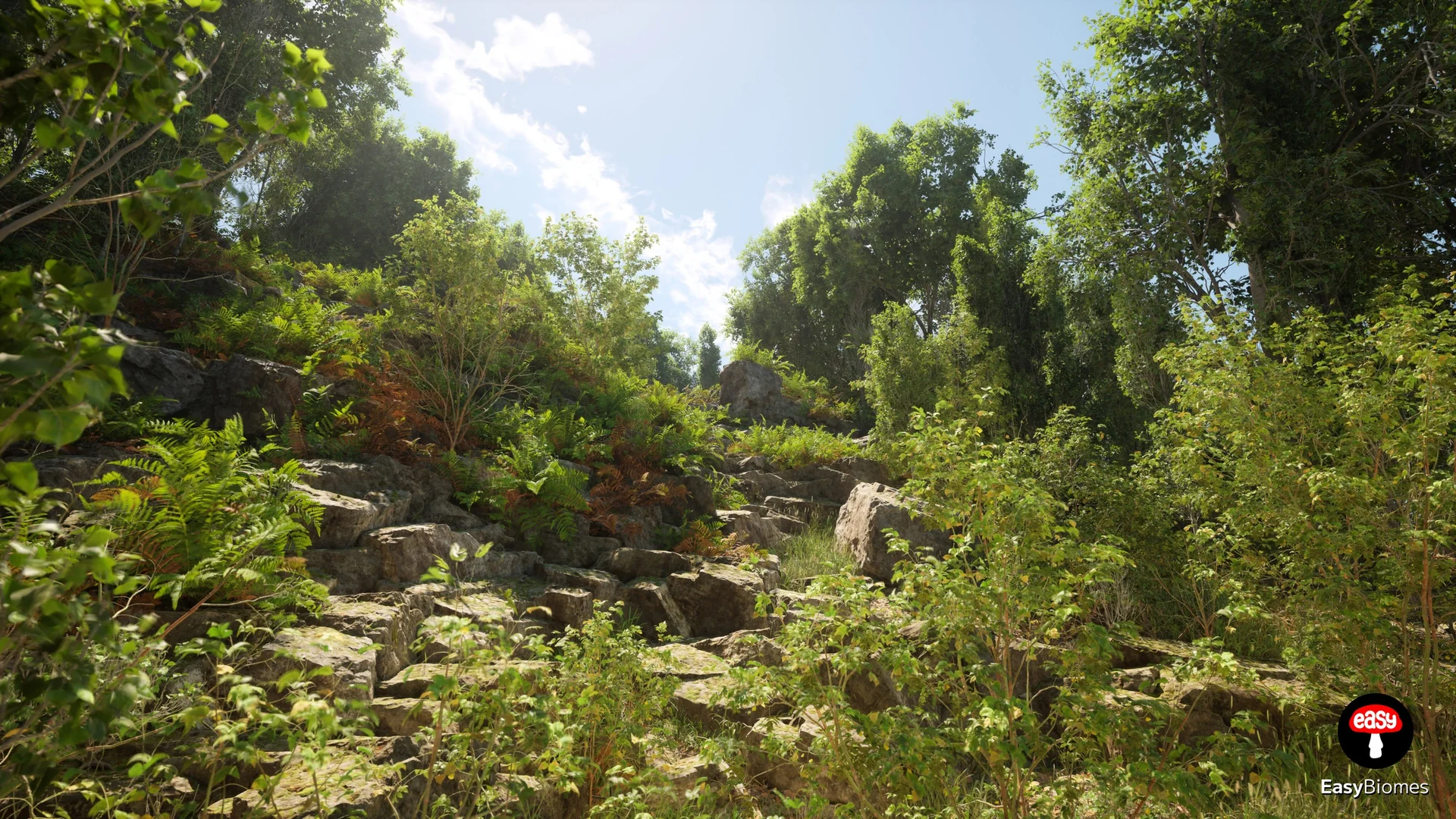
 Forest & Jungle
 Forest & Jungle
 Forest & Jungle