"c68a05d5e51405b3"{"id":"1000663","slug":"red-pine-biome","title":"Red Pine Biome","category":"Forest \u0026 Jungle","engine":"5.4+","assetVersion":"","engineVersion":"Engine Version: 5.4+","tag":"Forest \u0026 Jungle","accent":"blue","visual":"mech","summary":"Red Pine Biome delivers Mediterranean red pine trees, endemic vegetation, cliffs, and scatter with landscape material, procedural foliage, and wind interaction.","platform":"Unreal Engine","publishedAt":"2026-07-22T06:41:11.442Z","updatedAt":"2026-07-22T06:41:11.442Z","sourceNotes":[],"fileContents":[],"compatibility":["Unreal Engine","Engine Version: 5.4+"],"featuredImage":{"alt":"Red Pine Biome","src":"/wp-content/uploads/published/2026/07/b774421f9718-c6d49ccf-c1a0-425a-bc09-3d64bdd79653-d7a4531c7f.webp"},"hasDownloadLink":true,"downloads":1,"terms":[{"taxonomy":"category","slug":"forest-and-jungle","name":"Forest \u0026 Jungle"}],"galleryImages":[{"src":"/wp-content/uploads/published/2026/07/9649aceea57f-758ba545-7c3c-40f9-94fe-aa05a4b64722-05cc02dc15.webp","alt":"Red Pine Biome"},{"src":"/wp-content/uploads/published/2026/07/f92a22fb9bbe-d8d1daa3-e06a-409f-affd-1f48e3b1f044-2913a4c09a.webp","alt":"Red Pine Biome"},{"src":"/wp-content/uploads/published/2026/07/e43619a2d293-fbe73506-7aeb-4569-9884-1fd411b2f42f-8361f81dca.webp","alt":"Red Pine Biome"},{"src":"/wp-content/uploads/published/2026/07/fea0398a0a38-76c8d2ce-ad07-441e-97c3-65bc57826365-6329d9ecfa.webp","alt":"Red Pine Biome"},{"src":"/wp-content/uploads/published/2026/07/98220c4a9536-065ba42c-a270-41e6-9e54-6eb3c0a4030f-d8594a8f60.webp","alt":"Red Pine Biome"},{"src":"/wp-content/uploads/published/2026/07/83a47ed617c5-67501b8b-9c2a-4b4c-969f-c9a26f664be8-c54b679266.webp","alt":"Red Pine Biome"},{"src":"/wp-content/uploads/published/2026/07/531f36e8b654-6df62825-3bf3-4123-b3c6-15cc874aecc6-9487f5d9cf.webp","alt":"Red Pine Biome"},{"src":"/wp-content/uploads/published/2026/07/fe8adb708d4f-38c75d74-6984-47d7-ab5f-45f532320bea-341e8e1c90.webp","alt":"Red Pine Biome"},{"src":"/wp-content/uploads/published/2026/07/a09433e7e1f8-68a0fff5-bf2d-4c6d-8fdb-c17f1f4f5887-173084f48a.webp","alt":"Red Pine Biome"},{"src":"/wp-content/uploads/published/2026/07/9ca9fab20e0f-29759ba4-29ec-4a50-8d92-e0011e6c5002-0b47c3356d.webp","alt":"Red Pine Biome"}],"accessPanel":{"kind":"resource","title":"Download this resource","eyebrow":"Free Download","message":"Log in or create a free account to start your download.","fileName":"Redpine.7z","safetyNote":"Resources are manually reviewed before listing to improve quality and reduce obvious risks.","actionLabel":"Download Free","resourceType":"Resource archive"},"contentHtml":"\u003cp\u003eBuilding a convincing stretch of Mediterranean wilderness means getting the trees, the ground cover, and the rocky terrain to read as a single ecosystem rather than a collection of separate props. \u003cstrong\u003eRed Pine Biome\u003c/strong\u003e is based on that exact challenge, bringing together red pine trees native to the Mediterranean region alongside the endemic vegetation, soils, cliffs, and scatter elements that would naturally surround them. It is aimed at creators who need to build out large forest environments without manually placing every last shrub and stone by hand.\u003c/p\u003e\n\n\u003ch2\u003eMediterranean Red Pine Trees and Endemic Vegetation\u003c/h2\u003e\n\u003cp\u003eThe asset centers on Mediterranean red pines, the kind of tree that defines large stretches of coastal and inland forest across the basin. The creator pairs these pines with endemic vegetation, meaning the undergrowth and plant life match what would actually grow on the forest floor in that climate. Tagged as photorealistic and realistic, the package leans into natural variation across the biome. The tags make clear the scope: tree, foliage, vegetation, pine, forest, nature. The combination of canopy trees and ground-level plants gives scenes vertical layering. The taller pines cover the upper silhouette of the forest, while the smaller endemic plants fill in the midground and base.\u003c/p\u003e\n\n\u003ch2\u003eScatter, Rocks, Soils, and Cliffs\u003c/h2\u003e\n\u003cp\u003eThe resource extends beyond the plant life into the hard geology of the region. Rocks, soils, and cliffs are included as part of the realistic forest elements, giving level designers and environment artists the raw material needed to shape terrain that feels eroded and weathered rather than flat. Scatter elements handle the fine detail that makes a forest floor believable, which is often the hardest gap to close when building outdoor scenes. The cliffs support dramatic elevation changes, letting a landscape go from gentle slopes to sharp drops. Soils round out the ground layers, connecting the organic plant scatter to the stony and rocky areas in between.\u003c/p\u003e\n\n\u003ch2\u003eSetting Up the System With Landscape Material and Procedural Spawners\u003c/h2\u003e\n\u003cp\u003eOne of the ways this package is intended for production workflows is found in how the environment is distributed across a scene. It supports quick setup through landscape material and Procedural Foliage Spawners, plus the newer Procedural Content Generation (PCG) framework. That means the broader biome can be populated across a terrain through procedural rules and material layers rather than the brute-force placement of individual meshes. For large forests, this keeps iteration fast. The landscape material ties the visual surface of the terrain to the scattering logic, so ground textures, scatter distribution, and the overall ground response stay connected.\u003c/p\u003e\n\u003cp\u003eThis procedural approach matters most once a scene grows past a handful of trees. It lets a large area feel consistent across distances, with the spawners handling the density and variation that would be impractical to manage by hand. Procedural Content Generation gives teams another way to govern that distribution, which is especially useful when a project needs controllable, rule-based placement across complex terrain.\u003c/p\u003e\n\n\u003ch2\u003eDirt Road Mesh and Background Continuity Meshes\u003c/h2\u003e\n\u003cp\u003eA working forest environment usually needs more than just wild growth; it needs traces of use and ways to guide a viewer or player through the space. The package includes a dirt road mesh suitable for forest use. It reads as a worn path through the biome rather than a modern surface, which keeps the natural setting convincing. Beyond that, background meshes are provided to maintain continuity. These supporting meshes help the focused, detailed area blend into the surroundings, preventing the hard edges that often appear where a built environment stops and empty terrain begins. Together, the road and the background meshes serve the scene as a whole, keeping transitions smooth across playable and non-playable space.\u003c/p\u003e\n\n\u003ch3\u003ePivot Painter 2.0 Update and Plant Wind Interaction\u003c/h3\u003e\n\u003cp\u003eThe most recent update, dated November 18, 2025, introduced Pivot Painter 2.0 support to the package. Pivot Painter is a workflow built for controllable, pivot-based animation of foliage and branches, and the 2.0 update points to improved handling of how the trees and plants move. All plants in the package feature wind and interaction capabilities. That means the vegetation is not static; it responds to wind as a dynamic element, and it supports interaction, so plants can react when a character or object moves through them. For a forest environment, that motion is often what sells the realism, since a still forest tends to look frozen regardless of how good the textures and modeling are.\u003c/p\u003e\n\u003cp\u003eWith Pivot Painter 2.0, the wind motion can be driven from the actual pivot points of the plant geometry, which gives a more natural bend and sway than simple whole-mesh movement. The interaction capability adds another layer of response, so the scene does not just animate on its own but also reacts to the events happening within it.\u003c/p\u003e\n\n\u003ch3\u003eWhere Red Pine Biome Fits in a Production Pipeline\u003c/h3\u003e\n\u003cp\u003eThis package is aimed at projects that need photorealistic Mediterranean forest environments built at scale. The combination of endemic vegetation, geology, procedural spawning, and responsive wind makes it suited to scenes where the landscape itself is a major character, such as open-world levels or nature-focused sequences. The editor notes flag compatibility with Ultimate Farming, which suggests the biome is intended to slot into farming and rural simulation workflows where realistic, region-specific vegetation is required.\u003c/p\u003e\n\u003cp\u003eFor a team deciding whether the resource fits a project, the core question is whether the production needs a specifically Mediterranean biome with the supporting scatter and geology, and whether the pipeline already supports procedural foliage and landscape material workflows. If both conditions hold, much of the manual scatter and placement work is handled by the system itself.\u003c/p\u003e\n\u003cp\u003eThe practical takeaway is straightforward: this is a biome-scale toolkit, not a set of isolated tree models. Use the landscape material and Procedural Foliage Spawners or PCG to cover large terrain, lean on the dirt road and background meshes to guide movement and hide scene edges, and rely on the Pivot Painter 2.0 wind and interaction to keep the forest alive once the camera or player is moving through it.\u003c/p\u003e\n\n\u003ch2\u003eExplore Similar Assets\u003c/h2\u003e\n\u003cul\u003e\n\u003cli\u003e\u003ca href=\"https://3dcghub.com/wildlands-stylized-nature-pine-forest-trees-foliage-nature-forest-biome/\" title=\"Wildlands: Stylized Nature (Pine Forest, Trees, Foliage, Nature, Forest, Biome)\"\u003eWildlands: Stylized Nature (Pine Forest, Trees, Foliage, Nature, Forest, Biome)\u003c/a\u003e\u003c/li\u003e\n\u003cli\u003e\u003ca href=\"https://3dcghub.com/procedural-biomes/\" title=\"Procedural Biomes\"\u003eProcedural Biomes\u003c/a\u003e\u003c/li\u003e\n\u003cli\u003e\u003ca href=\"https://3dcghub.com/stylized-landscape-5-biomes/\" title=\"Stylized Landscape - 5 Biomes\"\u003eStylized Landscape - 5 Biomes\u003c/a\u003e\u003c/li\u003e\n\u003cli\u003e\u003ca href=\"https://3dcghub.com/mw-meadow-forest-trees-biome/\" title=\"MW Meadow Forest Trees Biome\"\u003eMW Meadow Forest Trees Biome\u003c/a\u003e\u003c/li\u003e\n\u003cli\u003e\u003ca href=\"https://3dcghub.com/mw-conifer-forest-trees-biome/\" title=\"MW Conifer Forest Trees Biome\"\u003eMW Conifer Forest Trees Biome\u003c/a\u003e\u003c/li\u003e\n\u003c/ul\u003e","contentTextLength":6599,"navigation":{"current":1342,"total":3860,"previous":{"id":"1000664","slug":"replicated-interaction-kit-vol-1-switch-valve-chain-etc","title":"Replicated Interaction Kit Vol 1 (Switch, Valve, Chain etc.)","category":"Gameplay Features","platform":"Unreal Engine","updatedAt":"2026-07-22T06:49:04.419Z"},"next":{"id":"1000662","slug":"radiation-vfx","title":"Radiation VFX","category":"Variety","platform":"Unreal Engine","updatedAt":"2026-07-21T20:44:48.746Z"}},"relatedResources":[{"id":"1001544","slug":"pine-forest-photogrammetry-based-high-poly-biome","title":"Pine forest - Photogrammetry based High poly Biome","category":"Forest \u0026 Jungle","engine":"5.1+","assetVersion":"","engineVersion":"Engine Version: 5.1+","tag":"Forest \u0026 Jungle","accent":"blue","visual":"mech","summary":"Explore the Pine forest photogrammetry biome, featuring 95 procedural assets, 8K terrain support, RHA texture maps, and high-fidelity wind animation.","platform":"Unreal Engine","publishedAt":"2026-10-10T03:08:19.926Z","updatedAt":"2026-10-10T03:08:19.926Z","sourceNotes":[],"fileContents":[],"compatibility":["Unreal Engine","Engine Version: 5.1+"],"featuredImage":{"alt":"Pine forest - Photogrammetry based High poly Biome","src":"/wp-content/uploads/published/2026/10/82885d3ff947-ab7d61f5-70cf-4902-a8eb-c017c5314e67-95b32130bb.webp"},"hasDownloadLink":true,"downloads":0},{"id":"1000351","slug":"wildlands-stylized-nature-pine-forest-trees-foliage-nature-forest-biome","title":"Wildlands: Stylized Nature (Pine Forest, Trees, Foliage, Nature, Forest, Biome)","category":"Forest \u0026 Jungle","engine":"5.2+","assetVersion":"","engineVersion":"Engine Version: 5.2+","tag":"Forest \u0026 Jungle","accent":"blue","visual":"mech","summary":"Implement a stylized nature ecosystem with a procedural landscape system, Nanite-ready assets, smart materials, and dynamic weather in Unreal Engine.","platform":"Unreal Engine","publishedAt":"2026-07-05T09:58:16.836Z","updatedAt":"2026-07-05T09:58:16.836Z","sourceNotes":[],"fileContents":[],"compatibility":["Unreal Engine","Engine Version: 5.2+"],"featuredImage":{"alt":"Wildlands: Stylized Nature (Pine Forest, Trees, Foliage, Nature, Forest, Biome)","src":"/wp-content/uploads/published/2026/07/f21a5fbc4225-6e5084cb-4357-4112-8e9f-2a0ff3086973-41cd4bd8e7.webp"},"hasDownloadLink":true,"downloads":1},{"id":"1001490","slug":"the-pine-environment-foliage-island-pcg-nature-river-nature-nature-biom","title":"The Pine Environment ( Foliage Island PCG Nature River Nature Nature Biom )","category":"Forest \u0026 Jungle","engine":"5.4+","assetVersion":"","engineVersion":"Engine Version: 5.4+","tag":"Forest \u0026 Jungle","accent":"blue","visual":"city","summary":"Explore The Pine Environment, featuring 53 unique meshes, procedural PCG scattering, river biomes, Nanite and Lumen support, and ULAT modular integration.","platform":"Unreal Engine","publishedAt":"2026-10-08T10:04:47.716Z","updatedAt":"2026-10-08T10:04:47.716Z","sourceNotes":[],"fileContents":[],"compatibility":["Unreal Engine","Engine Version: 5.4+"],"featuredImage":{"alt":"The Pine Environment ( Foliage Island PCG Nature River Nature Nature Biom )","src":"/wp-content/uploads/published/2026/10/3ea4f6900e86-b4efa431-bc2a-403b-8c5c-6b72af4180f0-c94ccb1b90.webp"},"hasDownloadLink":true,"downloads":2}]}
Forest & Jungle
Red Pine Biome
Red Pine Biome delivers Mediterranean red pine trees, endemic vegetation, cliffs, and scatter with landscape material, procedural foliage, and wind interaction.
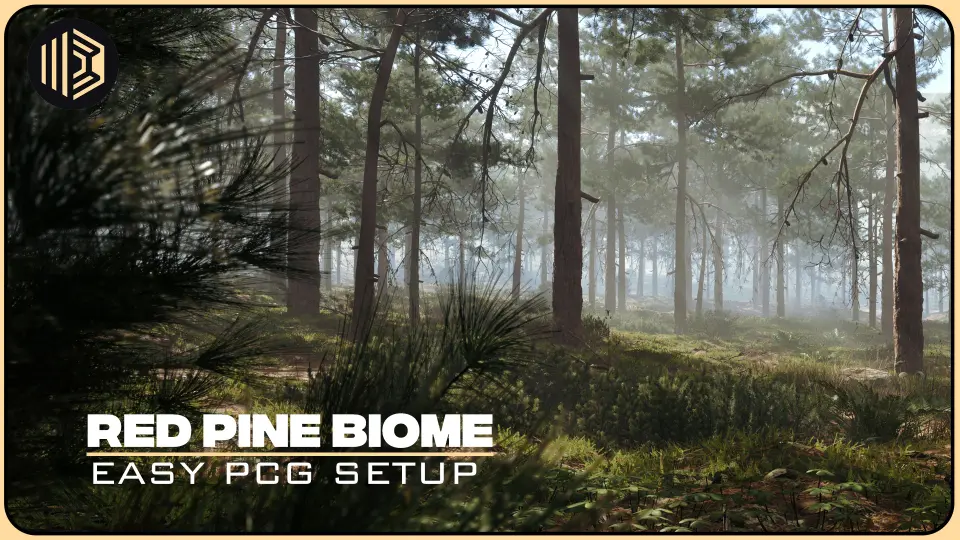
Building a convincing stretch of Mediterranean wilderness means getting the trees, the ground cover, and the rocky terrain to read as a single ecosystem rather than a collection of separate props. Red Pine Biome is based on that exact challenge, bringing together red pine trees native to the Mediterranean region alongside the endemic vegetation, soils, cliffs, and scatter elements that would naturally surround them. It is aimed at creators who need to build out large forest environments without manually placing every last shrub and stone by hand.
Mediterranean Red Pine Trees and Endemic Vegetation
The asset centers on Mediterranean red pines, the kind of tree that defines large stretches of coastal and inland forest across the basin. The creator pairs these pines with endemic vegetation, meaning the undergrowth and plant life match what would actually grow on the forest floor in that climate. Tagged as photorealistic and realistic, the package leans into natural variation across the biome. The tags make clear the scope: tree, foliage, vegetation, pine, forest, nature. The combination of canopy trees and ground-level plants gives scenes vertical layering. The taller pines cover the upper silhouette of the forest, while the smaller endemic plants fill in the midground and base.
Scatter, Rocks, Soils, and Cliffs
The resource extends beyond the plant life into the hard geology of the region. Rocks, soils, and cliffs are included as part of the realistic forest elements, giving level designers and environment artists the raw material needed to shape terrain that feels eroded and weathered rather than flat. Scatter elements handle the fine detail that makes a forest floor believable, which is often the hardest gap to close when building outdoor scenes. The cliffs support dramatic elevation changes, letting a landscape go from gentle slopes to sharp drops. Soils round out the ground layers, connecting the organic plant scatter to the stony and rocky areas in between.
Setting Up the System With Landscape Material and Procedural Spawners
One of the ways this package is intended for production workflows is found in how the environment is distributed across a scene. It supports quick setup through landscape material and Procedural Foliage Spawners, plus the newer Procedural Content Generation (PCG) framework. That means the broader biome can be populated across a terrain through procedural rules and material layers rather than the brute-force placement of individual meshes. For large forests, this keeps iteration fast. The landscape material ties the visual surface of the terrain to the scattering logic, so ground textures, scatter distribution, and the overall ground response stay connected.
This procedural approach matters most once a scene grows past a handful of trees. It lets a large area feel consistent across distances, with the spawners handling the density and variation that would be impractical to manage by hand. Procedural Content Generation gives teams another way to govern that distribution, which is especially useful when a project needs controllable, rule-based placement across complex terrain.
Dirt Road Mesh and Background Continuity Meshes
A working forest environment usually needs more than just wild growth; it needs traces of use and ways to guide a viewer or player through the space. The package includes a dirt road mesh suitable for forest use. It reads as a worn path through the biome rather than a modern surface, which keeps the natural setting convincing. Beyond that, background meshes are provided to maintain continuity. These supporting meshes help the focused, detailed area blend into the surroundings, preventing the hard edges that often appear where a built environment stops and empty terrain begins. Together, the road and the background meshes serve the scene as a whole, keeping transitions smooth across playable and non-playable space.
Pivot Painter 2.0 Update and Plant Wind Interaction
The most recent update, dated November 18, 2025, introduced Pivot Painter 2.0 support to the package. Pivot Painter is a workflow built for controllable, pivot-based animation of foliage and branches, and the 2.0 update points to improved handling of how the trees and plants move. All plants in the package feature wind and interaction capabilities. That means the vegetation is not static; it responds to wind as a dynamic element, and it supports interaction, so plants can react when a character or object moves through them. For a forest environment, that motion is often what sells the realism, since a still forest tends to look frozen regardless of how good the textures and modeling are.
With Pivot Painter 2.0, the wind motion can be driven from the actual pivot points of the plant geometry, which gives a more natural bend and sway than simple whole-mesh movement. The interaction capability adds another layer of response, so the scene does not just animate on its own but also reacts to the events happening within it.
Where Red Pine Biome Fits in a Production Pipeline
This package is aimed at projects that need photorealistic Mediterranean forest environments built at scale. The combination of endemic vegetation, geology, procedural spawning, and responsive wind makes it suited to scenes where the landscape itself is a major character, such as open-world levels or nature-focused sequences. The editor notes flag compatibility with Ultimate Farming, which suggests the biome is intended to slot into farming and rural simulation workflows where realistic, region-specific vegetation is required.
For a team deciding whether the resource fits a project, the core question is whether the production needs a specifically Mediterranean biome with the supporting scatter and geology, and whether the pipeline already supports procedural foliage and landscape material workflows. If both conditions hold, much of the manual scatter and placement work is handled by the system itself.
The practical takeaway is straightforward: this is a biome-scale toolkit, not a set of isolated tree models. Use the landscape material and Procedural Foliage Spawners or PCG to cover large terrain, lean on the dirt road and background meshes to guide movement and hide scene edges, and rely on the Pivot Painter 2.0 wind and interaction to keep the forest alive once the camera or player is moving through it.
 Forest & Jungle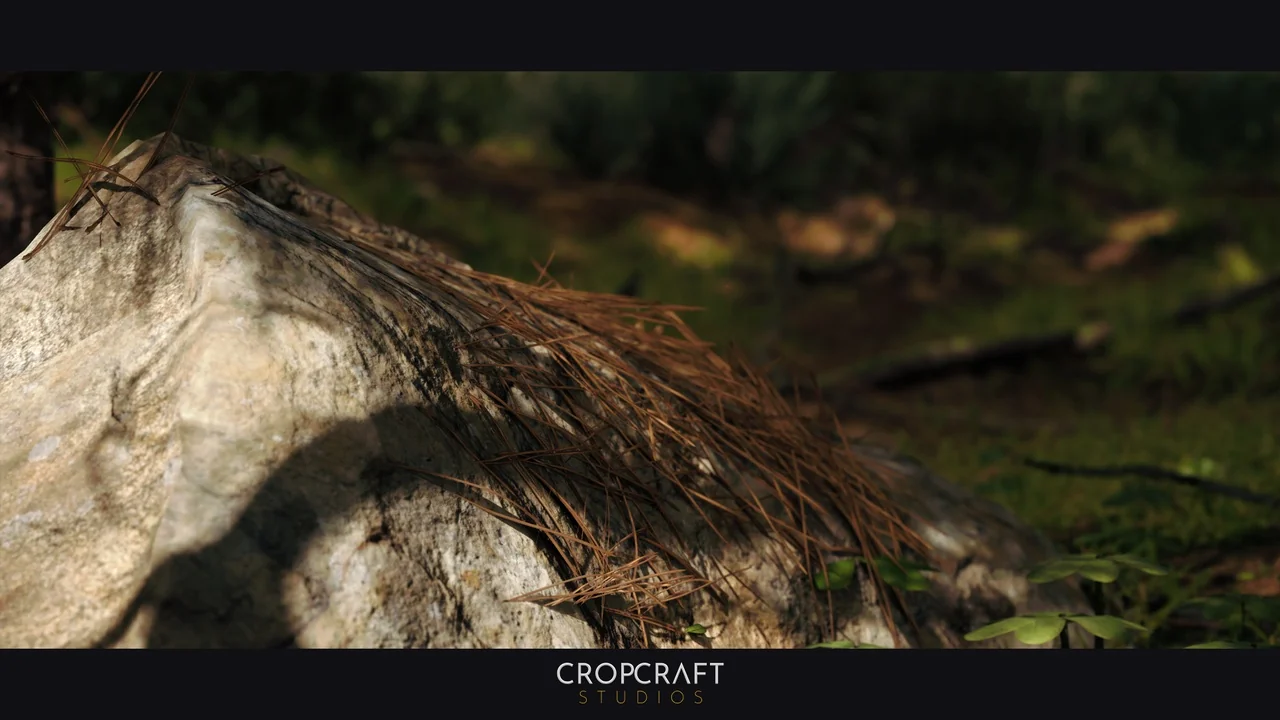
 Forest & Jungle
 Forest & Jungle
 Forest & Jungle