"7b46a695175d8694"{"id":"1000385","slug":"mw-meadow-forest-trees-biome","title":"MW Meadow Forest Trees Biome","category":"Forest \u0026 Jungle","engine":"5.2+","assetVersion":"","engineVersion":"Engine Version: 5.2+","tag":"Forest \u0026 Jungle","accent":"blue","visual":"mech","summary":"A complete procedural forest biome solution for Unreal Engine 5, featuring hundreds of full-geometry photogrammetry scans designed for Nanite and Lumen.","platform":"Unreal Engine","publishedAt":"2026-07-07T09:35:41.862Z","updatedAt":"2026-07-07T09:35:41.862Z","sourceNotes":[],"fileContents":[],"compatibility":["Unreal Engine","Engine Version: 5.2+"],"featuredImage":{"alt":"MW Meadow Forest Trees Biome","src":"/wp-content/uploads/published/2026/07/e47aa46c7827-8889385e-af81-427d-8ddd-d445cdb1a4df-7c0fd7f41c.webp"},"hasDownloadLink":true,"downloads":5,"terms":[{"taxonomy":"category","slug":"forest-and-jungle","name":"Forest \u0026 Jungle"}],"galleryImages":[{"src":"/wp-content/uploads/published/2026/07/a8fc56644fa9-3d9abd16-7518-41f9-80ee-b634d42aefec-af9ede4c3f.webp","alt":"MW Meadow Forest Trees Biome"},{"src":"/wp-content/uploads/published/2026/07/ba559ae803b6-876713c6-d5f2-441a-a422-a2014b45fac8-abe958919a.webp","alt":"MW Meadow Forest Trees Biome"},{"src":"/wp-content/uploads/published/2026/07/1aae774163ad-c211ff0b-4673-4abe-8c03-ad96a1452227-19fce3ea1c.webp","alt":"MW Meadow Forest Trees Biome"},{"src":"/wp-content/uploads/published/2026/07/0fc3013b6c92-f3549d29-29a1-4602-a761-96ca118a42ef-206aca7a9b.webp","alt":"MW Meadow Forest Trees Biome"},{"src":"/wp-content/uploads/published/2026/07/e5da689d54b3-5820b42c-5cb2-4ed2-bba7-0176b44f5ee0-8a4c12bc0b.webp","alt":"MW Meadow Forest Trees Biome"},{"src":"/wp-content/uploads/published/2026/07/2244a8bc1cac-6261b77a-2330-44bd-8a4f-a02c018a4be8-73288d922f.webp","alt":"MW Meadow Forest Trees Biome"},{"src":"/wp-content/uploads/published/2026/07/3291906d0696-1945350a-0ee0-4830-b361-b1650c41d803-9172009d62.webp","alt":"MW Meadow Forest Trees Biome"},{"src":"/wp-content/uploads/published/2026/07/eaa3603d9577-fd6b8d9a-3569-42e4-a4a3-bcf04e6b21cb-f2d6face94.webp","alt":"MW Meadow Forest Trees Biome"}],"accessPanel":{"kind":"resource","title":"Download this resource","eyebrow":"Free Download","message":"Log in or create a free account to start your download.","fileName":"Content.7z","safetyNote":"Resources are manually reviewed before listing to improve quality and reduce obvious risks.","actionLabel":"Download Free","resourceType":"Resource archive"},"contentHtml":"\u003ch2\u003eResolving Large-Scale World Generation with PCG\u003c/h2\u003e\n\u003cp\u003eBuilding expansive, realistic outdoor environments often forces technical artists to balance sheer scale against close-up asset fidelity. The MW Meadow Forest Trees Biome directly addresses this workflow bottleneck by providing a complete forest biome solution designed specifically for Unreal Engine 5. Rather than hand-placing individual plants across a massive landscape, environment teams can leverage procedural generation techniques to populate vast areas automatically while maintaining cinematic quality.\u003c/p\u003e\n\u003cp\u003eThe package supplies the foundational elements necessary to construct highly detailed next-generation meadow and forest landscapes. By relying on procedural content generation (PCG) workflows, developers can rapidly iterate on level design across varied terrain. This approach allows a team to establish sprawling grasslands, dense broadleaf woods, and scattered birch groves without the manual layout constraints that typically slow down world-building. The sheer volume of included assets ensures that procedural scattering algorithms have enough variety to prevent visible repetition across large-scale maps.\u003c/p\u003e\n\u003ch2\u003eFull Geometry Photogrammetry for Birch and Broadleaf Trees\u003c/h2\u003e\n\u003cp\u003eSourcing realistic plant life for high-fidelity scenes requires meticulous scanning and optimization. This environment solution utilizes hundreds of distinct foliage scans, encompassing trees, ground plants, and various other forest elements. Every asset is derived from professional photogrammetry models, ensuring accurate bark textures, leaf structures, and natural organic variations across the entire plant library.\u003c/p\u003e\n\u003cp\u003eThe inclusion of full geometry foliage marks a critical requirement for modern photorealistic rendering in game development and virtual production. Because the trees and plants are built as complete geometric meshes rather than simplified flat alpha cards, they retain their structural volume and silhouette from any viewing angle. This full-geometry approach directly supports the realistic intent of the package, allowing complex branch systems and individual leaf structures to react accurately to dynamic environmental lighting and extreme close-up camera angles.\u003c/p\u003e\n\u003ch2\u003eTransitioning from Grasslands to Wetlands\u003c/h2\u003e\n\u003cp\u003eWhile the primary focus rests on standard meadow and forest environments, the included vegetation scans extend into specialized ecological zones. The library features assets specifically suited for wetlands and swamps, including dense reeds and varied water-adjacent plant life that require distinct structural shapes compared to dry grass.\u003c/p\u003e\n\u003cp\u003eThis variety allows level designers to transition a dry grassland smoothly into a damp, overgrown swamp within the same map or level instance. By feeding these specific plant types into a procedural generation tool, teams can designate moisture maps or elevation data to automatically spawn reeds near water bodies while keeping broadleaf and birch trees restricted to higher, drier ground. The flexibility of the biome ensures that distinct natural zones blend seamlessly into one cohesive landscape, allowing for complex ecological shifts without requiring multiple disparate asset packs.\u003c/p\u003e\n\u003ch2\u003eConfiguring Nanite, Lumen, and Virtual Shadow Maps\u003c/h2\u003e\n\u003cp\u003eRendering hundreds of thousands of full-geometry photogrammetry scans is highly computationally intensive, which is why this environment relies entirely on Unreal Engine 5’s Nanite virtualized geometry system. Nanite handles the massive polygon counts of the scanned foliage natively, allowing scenes to maintain dense populations of trees without standard Level of Detail (LOD) popping or aggressive distance culling.\u003c/p\u003e\n\u003cp\u003eLighting these dense environments requires specific project configurations, initiated by modifying the DefaultEngine.ini file to enable the correct rendering features. The biome is built to operate with Lumen for real-time global illumination, ensuring that light accurately bounces through thick, overlapping forest canopies. Virtual Shadow Maps (VSM) are also a strict technical requirement for this package. VSM provides the high-resolution, accurate self-shadowing necessary to define the complex, overlapping leaf geometries of the broadleaf and birch assets, ensuring the forest floor receives realistic dappled lighting.\u003c/p\u003e\n\u003ch2\u003eGrounding the Environment with Runtime Virtual Textures\u003c/h2\u003e\n\u003cp\u003eIntegrating dense foliage into a landscape requires smooth visual transitions between the 3D meshes and the underlying terrain. To achieve this seamless integration, the package utilizes Runtime Virtual Textures (RVT) alongside its procedural generation rules.\u003c/p\u003e\n\u003cp\u003eRVT allows the grass, ground plants, and tree roots to sample the color and lighting data of the landscape beneath them. This technique blends the photogrammetry assets smoothly into the terrain, eliminating harsh, artificial seams where the foliage geometry intersects with the soil. Implementing RVT is a necessary step for achieving a truly photorealistic nature scene, as it grounds the procedural foliage firmly into the environment, making the transition from dirt to grass appear entirely natural.\u003c/p\u003e\n\u003ch2\u003eHardware Constraints for Photorealistic Rendering\u003c/h2\u003e\n\u003cp\u003eDriving a fully procedural, Nanite-enabled forest demands substantial hardware overhead. Because the biome utilizes full geometry instead of optimized flat planes, the technical requirements strictly target high-end development environments and modern gaming hardware.\u003c/p\u003e\n\u003cp\u003eDevelopment machines must be equipped with an RTX 30 series GPU or faster to process the Lumen lighting calculations, VSM shadow rendering, and Nanite geometry efficiently. System memory is equally critical, requiring a minimum of 32GB of RAM to handle the hundreds of high-resolution photogrammetry textures and complex procedural generation rules without bottlenecking the engine. Teams incorporating this biome into their world-building pipeline must ensure their workstations meet these specifications, keeping in mind that the package focuses purely on the visual landscape and does not include environmental sounds, character models, or visual effects.\u003c/p\u003e\n\n\u003ch2\u003eRelated Resources Worth Checking\u003c/h2\u003e\n\u003cul\u003e\n\u003cli\u003e\u003ca href=\"https://3dcghub.com/mw-broadleaf-forest-trees-biome/\" title=\"MW Broadleaf Forest Trees Biome\"\u003eMW Broadleaf Forest Trees Biome\u003c/a\u003e\u003c/li\u003e\n\u003cli\u003e\u003ca href=\"https://3dcghub.com/mw-redwood-forest-trees-biome/\" title=\"MW Redwood Forest Trees Biome\"\u003eMW Redwood Forest Trees Biome\u003c/a\u003e\u003c/li\u003e\n\u003cli\u003e\u003ca href=\"https://3dcghub.com/forest-essentials-forest-environment-procedural-mountain-forest-forest/\" title=\"Forest Essentials ( Forest Environment , Procedural Mountain Forest, Forest )\"\u003eForest Essentials ( Forest Environment , Procedural Mountain Forest, Forest )\u003c/a\u003e\u003c/li\u003e\n\u003cli\u003e\u003ca href=\"https://3dcghub.com/survival-interactable-procedural-nature-ecosystem/\" title=\"Survival Interactable Procedural Nature Ecosystem\"\u003eSurvival Interactable Procedural Nature Ecosystem\u003c/a\u003e\u003c/li\u003e\n\u003cli\u003e\u003ca href=\"https://3dcghub.com/wildlands-stylized-nature-pine-forest-trees-foliage-nature-forest-biome/\" title=\"Wildlands: Stylized Nature (Pine Forest, Trees, Foliage, Nature, Forest, Biome)\"\u003eWildlands: Stylized Nature (Pine Forest, Trees, Foliage, Nature, Forest, Biome)\u003c/a\u003e\u003c/li\u003e\n\u003c/ul\u003e","contentTextLength":6395,"navigation":{"current":1235,"total":3481,"previous":{"id":"1000386","slug":"niagaraexplosion01","title":"NiagaraExplosion01","category":"Fire \u0026 Explosions","platform":"Unreal Engine","updatedAt":"2026-07-07T12:37:10.979Z"},"next":{"id":"1000384","slug":"modular-seaside-town","title":"Modular Seaside Town","category":"Cities","platform":"Unreal Engine","updatedAt":"2026-07-07T08:43:02.678Z"}},"relatedResources":[{"id":"1001490","slug":"the-pine-environment-foliage-island-pcg-nature-river-nature-nature-biom","title":"The Pine Environment ( Foliage Island PCG Nature River Nature Nature Biom )","category":"Forest \u0026 Jungle","engine":"5.4+","assetVersion":"","engineVersion":"Engine Version: 5.4+","tag":"Forest \u0026 Jungle","accent":"blue","visual":"city","summary":"Explore The Pine Environment, featuring 53 unique meshes, procedural PCG scattering, river biomes, Nanite and Lumen support, and ULAT modular integration.","platform":"Unreal Engine","publishedAt":"2026-10-08T10:04:47.716Z","updatedAt":"2026-10-08T10:04:47.716Z","sourceNotes":[],"fileContents":[],"compatibility":["Unreal Engine","Engine Version: 5.4+"],"featuredImage":{"alt":"The Pine Environment ( Foliage Island PCG Nature River Nature Nature Biom )","src":"/wp-content/uploads/published/2026/10/3ea4f6900e86-b4efa431-bc2a-403b-8c5c-6b72af4180f0-c94ccb1b90.webp"},"hasDownloadLink":true,"downloads":1},{"id":"1001107","slug":"broadleaf-poplar-forest-pcg-biome","title":"Broadleaf Poplar Forest - PCG Biome","category":"Forest \u0026 Jungle","engine":"5.4+","assetVersion":"","engineVersion":"Engine Version: 5.4+","tag":"Forest \u0026 Jungle","accent":"blue","visual":"mech","summary":"Fully procedural PCG poplar biome for Unreal Engine: photoscanned trees, dynamic wind and foliage interaction, plus World Partition and runtime generation.","platform":"Unreal Engine","publishedAt":"2026-09-07T06:21:06.743Z","updatedAt":"2026-09-07T06:21:06.743Z","sourceNotes":[],"fileContents":[],"compatibility":["Unreal Engine","Engine Version: 5.4+"],"featuredImage":{"alt":"Broadleaf Poplar Forest - PCG Biome","src":"/wp-content/uploads/published/2026/09/62ee8e5ec890-f775a27c-8e9d-49c5-bb9a-6fd09118f806-4aeeb75b35.webp"},"hasDownloadLink":true,"downloads":3},{"id":"1001125","slug":"stylized-forest-trees-and-rocks-forest-rocks-trees-stylized-forest","title":"Stylized Forest - Trees \u0026 Rocks (Forest, Rocks, Trees, Stylized Forest)","category":"Forest \u0026 Jungle","engine":"5.0+","assetVersion":"","engineVersion":"Engine Version: 5.0+","tag":"Forest \u0026 Jungle","accent":"blue","visual":"mech","summary":"A large, optimized collection of stylized trees, rocks, and bushes with modular tree setups. Each tree has three bush variations.","platform":"Unreal Engine","publishedAt":"2026-09-07T13:23:58.967Z","updatedAt":"2026-09-07T13:23:58.967Z","sourceNotes":[],"fileContents":[],"compatibility":["Unreal Engine","Engine Version: 5.0+"],"featuredImage":{"alt":"Stylized Forest - Trees \u0026 Rocks (Forest, Rocks, Trees, Stylized Forest)","src":"/wp-content/uploads/published/2026/09/f43732e43a20-5d216d25-cf6b-4186-9dcb-255b9927ae4f-d2c3766be6.webp"},"hasDownloadLink":true,"downloads":0}]}
Forest & Jungle
MW Meadow Forest Trees Biome
A complete procedural forest biome solution for Unreal Engine 5, featuring hundreds of full-geometry photogrammetry scans designed for Nanite and Lumen.
Building expansive, realistic outdoor environments often forces technical artists to balance sheer scale against close-up asset fidelity. The MW Meadow Forest Trees Biome directly addresses this workflow bottleneck by providing a complete forest biome solution designed specifically for Unreal Engine 5. Rather than hand-placing individual plants across a massive landscape, environment teams can leverage procedural generation techniques to populate vast areas automatically while maintaining cinematic quality.
The package supplies the foundational elements necessary to construct highly detailed next-generation meadow and forest landscapes. By relying on procedural content generation (PCG) workflows, developers can rapidly iterate on level design across varied terrain. This approach allows a team to establish sprawling grasslands, dense broadleaf woods, and scattered birch groves without the manual layout constraints that typically slow down world-building. The sheer volume of included assets ensures that procedural scattering algorithms have enough variety to prevent visible repetition across large-scale maps.
Full Geometry Photogrammetry for Birch and Broadleaf Trees
Sourcing realistic plant life for high-fidelity scenes requires meticulous scanning and optimization. This environment solution utilizes hundreds of distinct foliage scans, encompassing trees, ground plants, and various other forest elements. Every asset is derived from professional photogrammetry models, ensuring accurate bark textures, leaf structures, and natural organic variations across the entire plant library.
The inclusion of full geometry foliage marks a critical requirement for modern photorealistic rendering in game development and virtual production. Because the trees and plants are built as complete geometric meshes rather than simplified flat alpha cards, they retain their structural volume and silhouette from any viewing angle. This full-geometry approach directly supports the realistic intent of the package, allowing complex branch systems and individual leaf structures to react accurately to dynamic environmental lighting and extreme close-up camera angles.
Transitioning from Grasslands to Wetlands
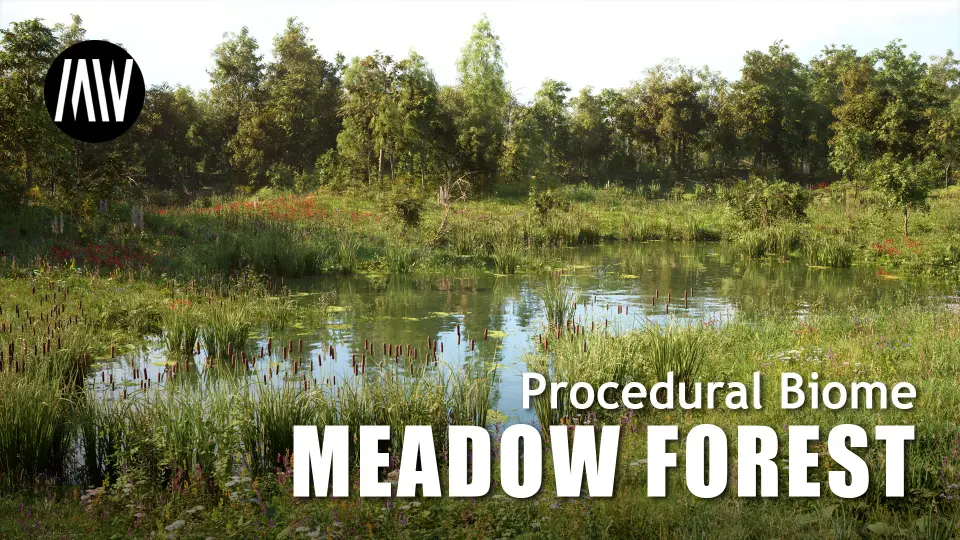
While the primary focus rests on standard meadow and forest environments, the included vegetation scans extend into specialized ecological zones. The library features assets specifically suited for wetlands and swamps, including dense reeds and varied water-adjacent plant life that require distinct structural shapes compared to dry grass.
This variety allows level designers to transition a dry grassland smoothly into a damp, overgrown swamp within the same map or level instance. By feeding these specific plant types into a procedural generation tool, teams can designate moisture maps or elevation data to automatically spawn reeds near water bodies while keeping broadleaf and birch trees restricted to higher, drier ground. The flexibility of the biome ensures that distinct natural zones blend seamlessly into one cohesive landscape, allowing for complex ecological shifts without requiring multiple disparate asset packs.
Configuring Nanite, Lumen, and Virtual Shadow Maps
Rendering hundreds of thousands of full-geometry photogrammetry scans is highly computationally intensive, which is why this environment relies entirely on Unreal Engine 5’s Nanite virtualized geometry system. Nanite handles the massive polygon counts of the scanned foliage natively, allowing scenes to maintain dense populations of trees without standard Level of Detail (LOD) popping or aggressive distance culling.
Lighting these dense environments requires specific project configurations, initiated by modifying the DefaultEngine.ini file to enable the correct rendering features. The biome is built to operate with Lumen for real-time global illumination, ensuring that light accurately bounces through thick, overlapping forest canopies. Virtual Shadow Maps (VSM) are also a strict technical requirement for this package. VSM provides the high-resolution, accurate self-shadowing necessary to define the complex, overlapping leaf geometries of the broadleaf and birch assets, ensuring the forest floor receives realistic dappled lighting.
Grounding the Environment with Runtime Virtual Textures
Integrating dense foliage into a landscape requires smooth visual transitions between the 3D meshes and the underlying terrain. To achieve this seamless integration, the package utilizes Runtime Virtual Textures (RVT) alongside its procedural generation rules.
RVT allows the grass, ground plants, and tree roots to sample the color and lighting data of the landscape beneath them. This technique blends the photogrammetry assets smoothly into the terrain, eliminating harsh, artificial seams where the foliage geometry intersects with the soil. Implementing RVT is a necessary step for achieving a truly photorealistic nature scene, as it grounds the procedural foliage firmly into the environment, making the transition from dirt to grass appear entirely natural.
Hardware Constraints for Photorealistic Rendering
Driving a fully procedural, Nanite-enabled forest demands substantial hardware overhead. Because the biome utilizes full geometry instead of optimized flat planes, the technical requirements strictly target high-end development environments and modern gaming hardware.
Development machines must be equipped with an RTX 30 series GPU or faster to process the Lumen lighting calculations, VSM shadow rendering, and Nanite geometry efficiently. System memory is equally critical, requiring a minimum of 32GB of RAM to handle the hundreds of high-resolution photogrammetry textures and complex procedural generation rules without bottlenecking the engine. Teams incorporating this biome into their world-building pipeline must ensure their workstations meet these specifications, keeping in mind that the package focuses purely on the visual landscape and does not include environmental sounds, character models, or visual effects.
 Forest & Jungle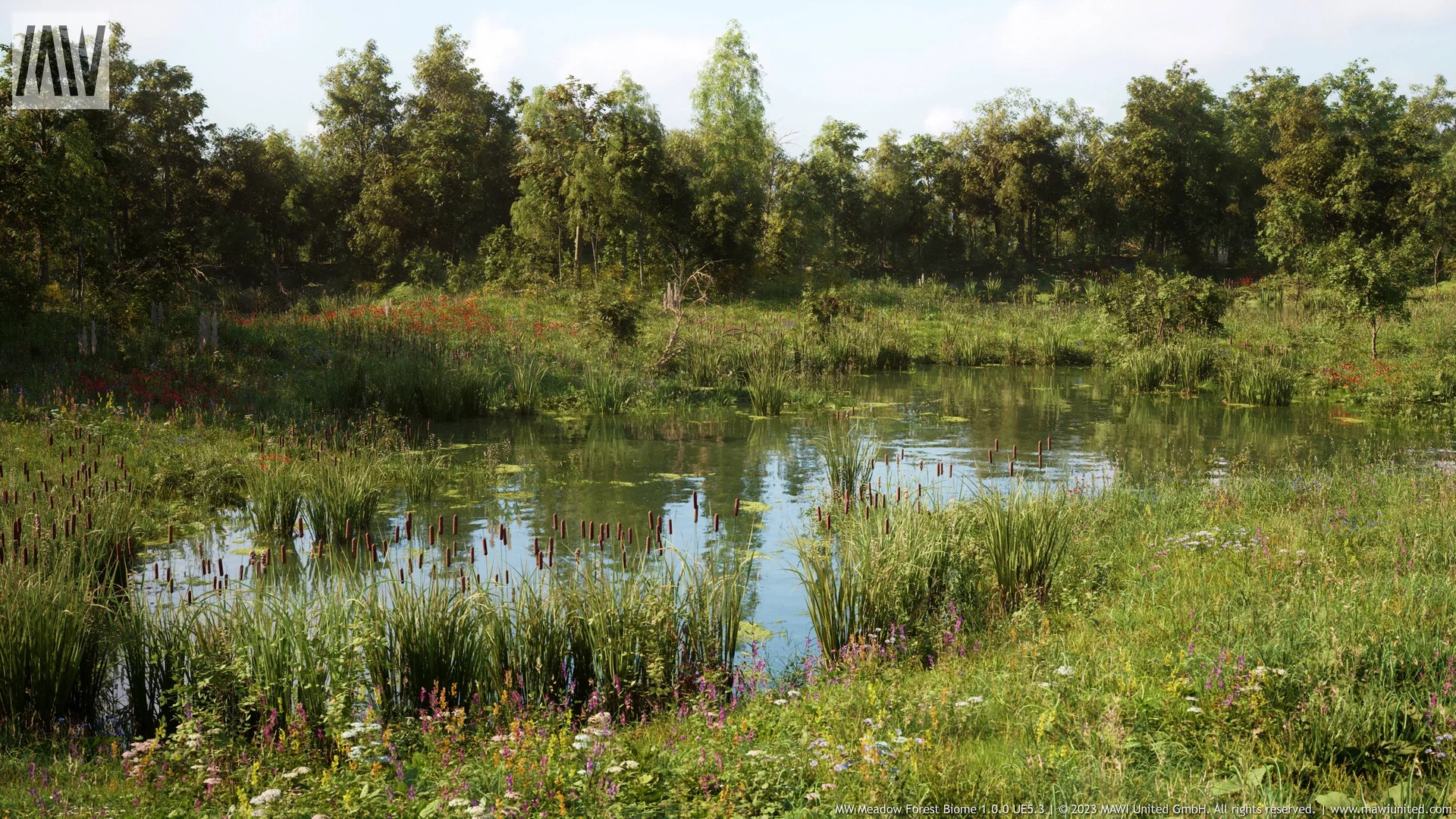
 Forest & Jungle
 Forest & Jungle
 Forest & Jungle