"c14ff6bd758dadb1"{"id":"1000560","slug":"alien-planet-pack","title":"Alien Planet Pack","category":"Fantasy","engine":"4.26+,5.0+","assetVersion":"","engineVersion":"Engine Version: 4.26+,5.0+","tag":"Fantasy","accent":"blue","visual":"mech","summary":"A lowpoly Unreal Engine environment pack with 158 meshes across four biomes, modular alien structures, spaceships with spline paths, and dynamic weather particl","platform":"Unreal Engine","publishedAt":"2026-07-16T04:43:47.861Z","updatedAt":"2026-07-16T04:43:47.861Z","sourceNotes":[],"fileContents":[],"compatibility":["Unreal Engine","Engine Version: 4.26+,5.0+"],"featuredImage":{"alt":"Alien Planet Pack","src":"/wp-content/uploads/published/2026/07/85824b592254-f5a8409b-79ad-48cc-b04c-f5ba1757e1ac-06fbbe3478.webp"},"hasDownloadLink":true,"downloads":0,"terms":[{"taxonomy":"category","slug":"fantasy","name":"Fantasy"}],"galleryImages":[{"src":"/wp-content/uploads/published/2026/07/e83e10a1df28-8785b46e-d670-4349-afbc-75b51301c432-c2fe5e62a4.webp","alt":"Alien Planet Pack"},{"src":"/wp-content/uploads/published/2026/07/8160bb758027-c57e875f-dede-4e7d-8003-d5070f556eb8-cc9248ff7e.webp","alt":"Alien Planet Pack"},{"src":"/wp-content/uploads/published/2026/07/935a21c15772-b6cb092b-b3ca-4dba-add8-c15e270d7edc-30b74866c6.webp","alt":"Alien Planet Pack"},{"src":"/wp-content/uploads/published/2026/07/c49a35f7069f-e61337c7-90a8-4039-8456-84c282656135-7a0e523529.webp","alt":"Alien Planet Pack"},{"src":"/wp-content/uploads/published/2026/07/664a2fffdb7c-dd87fc4f-fda5-40a6-902f-5fb4760d8502-4e9df8835c.webp","alt":"Alien Planet Pack"},{"src":"/wp-content/uploads/published/2026/07/2516fffa9fe6-0ca69225-d235-4602-9e94-634448be683e-e81267e38d.webp","alt":"Alien Planet Pack"},{"src":"/wp-content/uploads/published/2026/07/3cea3c34f154-4fce1d84-2330-4591-aa48-1b523fa730c9-fb800c0138.webp","alt":"Alien Planet Pack"},{"src":"/wp-content/uploads/published/2026/07/a3578ae7601c-566f3770-f471-4263-9711-3c262c94925e-5befd107c2.webp","alt":"Alien Planet Pack"},{"src":"/wp-content/uploads/published/2026/07/58b541799921-839d4617-437b-4195-9e56-881428775882-771cfc9781.webp","alt":"Alien Planet Pack"},{"src":"/wp-content/uploads/published/2026/07/b586fe6637d5-faff70e1-7986-4b71-90d6-c9dc8fd928db-aa47f1b3bf.webp","alt":"Alien Planet Pack"}],"accessPanel":{"kind":"resource","title":"Download this resource","eyebrow":"Free Download","message":"Log in or create a free account to start your download.","fileName":"Content.7z","safetyNote":"Resources are manually reviewed before listing to improve quality and reduce obvious risks.","actionLabel":"Download Free","resourceType":"Resource archive"},"contentHtml":"\u003cp\u003eScenes built with this asset unfold across four distinct biome types—Desert, Snow, Tropical, and Gas—each carrying its own set of rocks, foliage, terrain materials, and weather particles. The total mesh count sits at 158, giving level designers a broad library to assemble alien worlds without leaving the stylized lowpoly aesthetic. Every biome follows a consistent structural pattern, so teams moving from one environment to another can expect the same category of building blocks repackaged for a different climate and visual mood.\u003c/p\u003e \u003cp\u003eThe pack targets two performance tiers simultaneously: low-power mobile titles and stylized projects on PC and console. That dual focus shapes how the content is organized. Rather than heavy, high-resolution assets, the mesh library leans on lowpoly geometry that holds up at close range in stylized renders while remaining lightweight enough for mobile hardware constraints. The biome count and the mesh distribution within each biome make it possible to prototype a full planetary surface with varied regions instead of one repeating landscape.\u003c/p\u003e \u003ch2\u003eBiome Contents and Terrain Setup in Alien Planet Pack\u003c/h2\u003e \u003cp\u003eEach of the four biomes delivers a consistent spread of environmental meshes. Designers working within any single biome get 10 to 20 rock meshes and 10 to 14 foliage meshes. That range allows for scattered natural detail—boulder clusters, ground cover, and larger plant life—without requiring custom modeling to fill gaps. The rock and foliage sets are biome-specific, so the Desert palette differs from the Snow set, which in turn differs from the Tropical and Gas collections.\u003c/p\u003e \u003cp\u003eOn the terrain side, every biome ships with 4 terrain materials. These give surface variation across ground planes within a single biome, letting designers blend or switch materials to avoid monotony across large landscape areas. Because the material count stays fixed at four per biome, teams can predict how much surface variety they have to work with before supplementing with any external content.\u003c/p\u003e \u003ch2\u003eWeather Particle System and Camera-Relative Behavior\u003c/h2\u003e \u003cp\u003eThe pack treats atmosphere as an active scene element rather than static backdrop. Each biome includes its own weather particles, tied to a Weather Particle blueprint that automatically updates particle locations to stay close to the camera in use. This means the weather effects follow the active viewport rather than sitting fixed in world space, so rain, snow, or drifting gas motes remain visible as the camera moves through the level.\u003c/p\u003e \u003cp\u003eFive weather particle types are included across the pack:\u003c/p\u003e \u003cul\u003e\n\u003cli\u003eGas plumes\u003c/li\u003e\n\u003cli\u003eSnow\u003c/li\u003e\n\u003cli\u003eRain\u003c/li\u003e\n\u003cli\u003eDust\u003c/li\u003e\n\u003cli\u003eGlow motes\u003c/li\u003e\n\u003c/ul\u003e \u003cp\u003eThese effects map directly to the biome themes. Gas plumes belong to the Gas biome, snow to the Snow biome, dust to the Desert, and rain to the Tropical. Glow motes serve as a ambient light-enhancement tool that can add atmospheric depth to any of the four environments. Because the Weather Particle blueprint handles position updates, designers do not need to manually scale or re-place particle emitters when reworking camera paths or expanding a playable area.\u003c/p\u003e \u003ch2\u003eAncient Alien Modular Structures and Material Variants\u003c/h2\u003e \u003cp\u003eBeyond natural environment content, the pack includes 11 Ancient Alien modular structure meshes. These are built for assembly—meaning designers can snap wall sections, pillars, platforms, or architectural fragments together to construct larger ruins or installations. The modular approach supports variation across a level without requiring each structure to be a unique mesh, which keeps memory usage manageable on both mobile and higher-end platforms.\u003c/p\u003e \u003cp\u003eEach of the 11 structures ships with 2 material types. This allows visual differentiation between structures using the same base mesh. A single wall piece can appear in two surface treatments, giving teams a way to separate weathered stone from polished alien metal, or to distinguish two structural eras within the same level without needing additional geometry.\u003c/p\u003e \u003ch2\u003eSpaceships with Blueprint Spline Path Routing\u003c/h2\u003e \u003cp\u003eThe pack includes 4 different spaceship meshes, each offered in 3 material variants. That gives designers 12 visual configurations from the ship set alone—enough to populate landing pads, orbitals, or flyby sequences without obvious repetition. The material variants allow the same hull silhouette to read as distinct vessel types through surface changes alone.\u003c/p\u003e \u003cp\u003eTo place these ships in motion rather than as static set dressing, the pack provides a Blueprint Spline system. This system enables looping spaceship paths around levels. Designers define a spline route, and the ships follow that path continuously, which is useful for establishing a sense of activity and scale in scenes where vessels need to appear as part of the environment traffic. Because the spline setup is built into the pack, teams do not need to author a custom cinematic or matinee to achieve visible movement—the spline handles the looping behavior directly.\u003c/p\u003e \u003ch2\u003eEngine Compatibility and Practical Scene Assembly\u003c/h2\u003e \u003cp\u003eThe Alien Planet Pack supports Unreal Engine versions 4.23 through 4.27 and the full 5.0 through 5.3 range. That covers projects still maintained on the later 4.x builds and those migrated to the current-generation 5.x releases. The wide compatibility range means teams evaluating this pack can introduce it into existing projects without forcing an engine upgrade, and new projects started on 5.3 can use it from the outset.\u003c/p\u003e \u003cp\u003eWorking with four biomes simultaneously is a realistic scenario given the mesh count. The natural sets—rocks and foliage—are biome-specific, which means designers building a multi-biome planet need to bring the relevant biome groups into a level independently. The weather particles, through the Weather Particle blueprint, handle their own camera-relative positioning once placed, so multi-biome transitions do not require retooling the particle systems per region. The terrain materials stay consistent at four per biome, so multi-biome landscapes rely on material assignment and placement logic rather than a global material system.\u003c/p\u003e \u003cp\u003eThe modular alien structures and spline-driven ships exist outside the biome framework. They are cross-cutting assets that can appear anywhere. A structure from the alien set can be placed in a Tropical clearing or on a Snow ridge without biome restrictions. Ships following spline paths can traverse above any biome, so designers can set up flyby sequences crossing biome boundaries without switching systems.\u003c/p\u003e \u003cp\u003eFor teams evaluating how this content fits their pipeline, the strongest takeaway is that the pack operates at three layers: natural biome content, modular alien architecture, and autonomous scene elements in the ships and weather particles. The biome-specific layer handles terrain, rocks, and foliage. The cross-cutting alien set and spline ship system handle structural and movement-based set dressing. The weather blueprint ties atmosphere to the camera, lighting, and movement set. This three-tier organization is what allows a 158-mesh pack to stretch across mobile and console/PC targets without requiring teams to strip or rebuild content for different platforms.\u003c/p\u003e\n\n\u003ch2\u003eExplore Similar Assets\u003c/h2\u003e\n\u003cul\u003e\n\u003cli\u003e\u003ca href=\"https://3dcghub.com/alien-planets-environment-w-planet-creator-pcg/\" title=\"Alien Planets Environment w/ Planet Creator PCG\"\u003eAlien Planets Environment w/ Planet Creator PCG\u003c/a\u003e\u003c/li\u003e\n\u003cli\u003e\u003ca href=\"https://3dcghub.com/alien-planet-fantasy-environment-swamp-plants/\" title=\"Alien Planet Fantasy Environment - Swamp Plants\"\u003eAlien Planet Fantasy Environment - Swamp Plants\u003c/a\u003e\u003c/li\u003e\n\u003cli\u003e\u003ca href=\"https://3dcghub.com/elite-landscapes-alien-part-i/\" title=\"Elite Landscapes: Alien Part I\"\u003eElite Landscapes: Alien Part I\u003c/a\u003e\u003c/li\u003e\n\u003cli\u003e\u003ca href=\"https://3dcghub.com/elite-landscapes-alien-skybox-bundle/\" title=\"Elite Landscapes: Alien Skybox Bundle\"\u003eElite Landscapes: Alien Skybox Bundle\u003c/a\u003e\u003c/li\u003e\n\u003cli\u003e\u003ca href=\"https://3dcghub.com/planetarium-planet-blueprint/\" title=\"Planetarium Planet Blueprint\"\u003ePlanetarium Planet Blueprint\u003c/a\u003e\u003c/li\u003e\n\u003c/ul\u003e","contentTextLength":7333,"navigation":{"current":1303,"total":3719,"previous":{"id":"1000561","slug":"animated-low-poly-weapons-v1-0","title":"Animated Low Poly Weapons v1.0","category":"Combat","platform":"Unreal Engine","updatedAt":"2026-07-16T04:51:47.005Z"},"next":{"id":"1000559","slug":"alien-growth-environment","title":"Alien Growth Environment","category":"Sci-Fi","platform":"Unreal Engine","updatedAt":"2026-07-15T18:44:12.611Z"}},"relatedResources":[{"id":"7890","slug":"alien-planets-environment-w-planet-creator-pcg","title":"Alien Planets Environment w/ Planet Creator PCG","category":"Fantasy","engine":"5.4+","assetVersion":"Engine version: 5.4+","engineVersion":"5.3","tag":"Fantasy","accent":"blue","visual":"city","summary":"Transform your sci-fi projects with a powerful procedural toolset designed for Unreal Engine 5.3. This pack includes over 170 meshes and a custom PCG system for creating diverse alien worlds.","platform":"Unreal Engine","publishedAt":"2026-02-22T15:40:06.000Z","updatedAt":"2026-04-19T15:55:53.000Z","sourceNotes":[],"fileContents":[],"compatibility":["Unreal Engine","Engine version: 5.4+"],"featuredImage":{"alt":"Alien Planets Environment w/ Planet Creator PCG","src":"https://3dcghub.com/wp-content/uploads/2026/02/a1eb56ed-6c58-4a0c-8d61-8bc474e96c67.webp"},"hasDownloadLink":true,"downloads":0},{"id":"1001768","slug":"tropical-alien-world","title":"Tropical Alien World","category":"Fantasy","engine":"5.1+","assetVersion":"","engineVersion":"Engine Version: 5.1+","tag":"Fantasy","accent":"blue","visual":"mech","summary":"Explore the implementation, dual-map performance setup, Nanite geometry, and Water plugin requirements of the Tropical Alien World environment for UE 5.1+.","platform":"Unreal Engine","publishedAt":"2026-10-20T03:16:14.596Z","updatedAt":"2026-10-20T03:16:14.596Z","sourceNotes":[],"fileContents":[],"compatibility":["Unreal Engine","Engine Version: 5.1+"],"featuredImage":{"alt":"Tropical Alien World","src":"/wp-content/uploads/published/2026/10/b749927b282e-6f06c4ae-dbc9-45be-92d5-d5747e53de6f-47c16c1427.webp"},"hasDownloadLink":true,"downloads":0},{"id":"1001718","slug":"alien-planet-fantasy-environment-grassland-plants","title":"Alien Planet Fantasy Environment - Grassland Plants","category":"Forest \u0026 Jungle","engine":"4.26+,5.0+","assetVersion":"","engineVersion":"Engine Version: 4.26+,5.0+","tag":"Forest \u0026 Jungle","accent":"blue","visual":"city","summary":"A technical breakdown of the Alien Planet Fantasy Environment asset pack, detailing its interactive foliage physics, World Creator landscape, and audio.","platform":"Unreal Engine","publishedAt":"2026-10-19T15:50:53.489Z","updatedAt":"2026-10-19T15:50:53.489Z","sourceNotes":[],"fileContents":[],"compatibility":["Unreal Engine","Engine Version: 4.26+,5.0+"],"featuredImage":{"alt":"Alien Planet Fantasy Environment - Grassland Plants","src":"/wp-content/uploads/published/2026/10/9a28e0fe65b3-a4a97ffe-1de3-44ae-b9e6-b0202052018b-e9621ed93a.webp"},"hasDownloadLink":true,"downloads":0}]}
Fantasy
Alien Planet Pack
A lowpoly Unreal Engine environment pack with 158 meshes across four biomes, modular alien structures, spaceships with spline paths, and dynamic weather particl
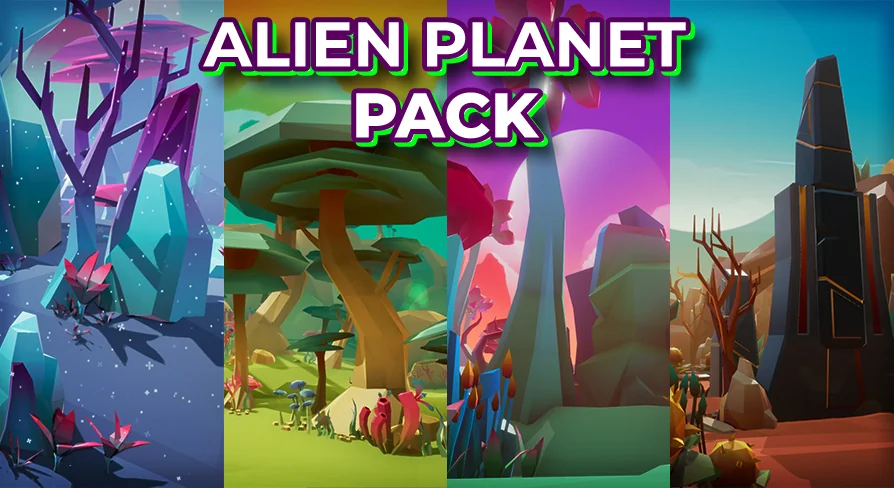
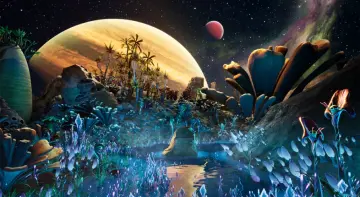
Scenes built with this asset unfold across four distinct biome types—Desert, Snow, Tropical, and Gas—each carrying its own set of rocks, foliage, terrain materials, and weather particles. The total mesh count sits at 158, giving level designers a broad library to assemble alien worlds without leaving the stylized lowpoly aesthetic. Every biome follows a consistent structural pattern, so teams moving from one environment to another can expect the same category of building blocks repackaged for a different climate and visual mood.
The pack targets two performance tiers simultaneously: low-power mobile titles and stylized projects on PC and console. That dual focus shapes how the content is organized. Rather than heavy, high-resolution assets, the mesh library leans on lowpoly geometry that holds up at close range in stylized renders while remaining lightweight enough for mobile hardware constraints. The biome count and the mesh distribution within each biome make it possible to prototype a full planetary surface with varied regions instead of one repeating landscape.
Biome Contents and Terrain Setup in Alien Planet Pack
Each of the four biomes delivers a consistent spread of environmental meshes. Designers working within any single biome get 10 to 20 rock meshes and 10 to 14 foliage meshes. That range allows for scattered natural detail—boulder clusters, ground cover, and larger plant life—without requiring custom modeling to fill gaps. The rock and foliage sets are biome-specific, so the Desert palette differs from the Snow set, which in turn differs from the Tropical and Gas collections.
On the terrain side, every biome ships with 4 terrain materials. These give surface variation across ground planes within a single biome, letting designers blend or switch materials to avoid monotony across large landscape areas. Because the material count stays fixed at four per biome, teams can predict how much surface variety they have to work with before supplementing with any external content.
Weather Particle System and Camera-Relative Behavior
The pack treats atmosphere as an active scene element rather than static backdrop. Each biome includes its own weather particles, tied to a Weather Particle blueprint that automatically updates particle locations to stay close to the camera in use. This means the weather effects follow the active viewport rather than sitting fixed in world space, so rain, snow, or drifting gas motes remain visible as the camera moves through the level.
Five weather particle types are included across the pack:
Gas plumes
Snow
Rain
Dust
Glow motes
These effects map directly to the biome themes. Gas plumes belong to the Gas biome, snow to the Snow biome, dust to the Desert, and rain to the Tropical. Glow motes serve as a ambient light-enhancement tool that can add atmospheric depth to any of the four environments. Because the Weather Particle blueprint handles position updates, designers do not need to manually scale or re-place particle emitters when reworking camera paths or expanding a playable area.
Ancient Alien Modular Structures and Material Variants
Beyond natural environment content, the pack includes 11 Ancient Alien modular structure meshes. These are built for assembly—meaning designers can snap wall sections, pillars, platforms, or architectural fragments together to construct larger ruins or installations. The modular approach supports variation across a level without requiring each structure to be a unique mesh, which keeps memory usage manageable on both mobile and higher-end platforms.
Each of the 11 structures ships with 2 material types. This allows visual differentiation between structures using the same base mesh. A single wall piece can appear in two surface treatments, giving teams a way to separate weathered stone from polished alien metal, or to distinguish two structural eras within the same level without needing additional geometry.
Spaceships with Blueprint Spline Path Routing
The pack includes 4 different spaceship meshes, each offered in 3 material variants. That gives designers 12 visual configurations from the ship set alone—enough to populate landing pads, orbitals, or flyby sequences without obvious repetition. The material variants allow the same hull silhouette to read as distinct vessel types through surface changes alone.
To place these ships in motion rather than as static set dressing, the pack provides a Blueprint Spline system. This system enables looping spaceship paths around levels. Designers define a spline route, and the ships follow that path continuously, which is useful for establishing a sense of activity and scale in scenes where vessels need to appear as part of the environment traffic. Because the spline setup is built into the pack, teams do not need to author a custom cinematic or matinee to achieve visible movement—the spline handles the looping behavior directly.
Engine Compatibility and Practical Scene Assembly
The Alien Planet Pack supports Unreal Engine versions 4.23 through 4.27 and the full 5.0 through 5.3 range. That covers projects still maintained on the later 4.x builds and those migrated to the current-generation 5.x releases. The wide compatibility range means teams evaluating this pack can introduce it into existing projects without forcing an engine upgrade, and new projects started on 5.3 can use it from the outset.
Working with four biomes simultaneously is a realistic scenario given the mesh count. The natural sets—rocks and foliage—are biome-specific, which means designers building a multi-biome planet need to bring the relevant biome groups into a level independently. The weather particles, through the Weather Particle blueprint, handle their own camera-relative positioning once placed, so multi-biome transitions do not require retooling the particle systems per region. The terrain materials stay consistent at four per biome, so multi-biome landscapes rely on material assignment and placement logic rather than a global material system.
The modular alien structures and spline-driven ships exist outside the biome framework. They are cross-cutting assets that can appear anywhere. A structure from the alien set can be placed in a Tropical clearing or on a Snow ridge without biome restrictions. Ships following spline paths can traverse above any biome, so designers can set up flyby sequences crossing biome boundaries without switching systems.
For teams evaluating how this content fits their pipeline, the strongest takeaway is that the pack operates at three layers: natural biome content, modular alien architecture, and autonomous scene elements in the ships and weather particles. The biome-specific layer handles terrain, rocks, and foliage. The cross-cutting alien set and spline ship system handle structural and movement-based set dressing. The weather blueprint ties atmosphere to the camera, lighting, and movement set. This three-tier organization is what allows a 158-mesh pack to stretch across mobile and console/PC targets without requiring teams to strip or rebuild content for different platforms.
 Fantasy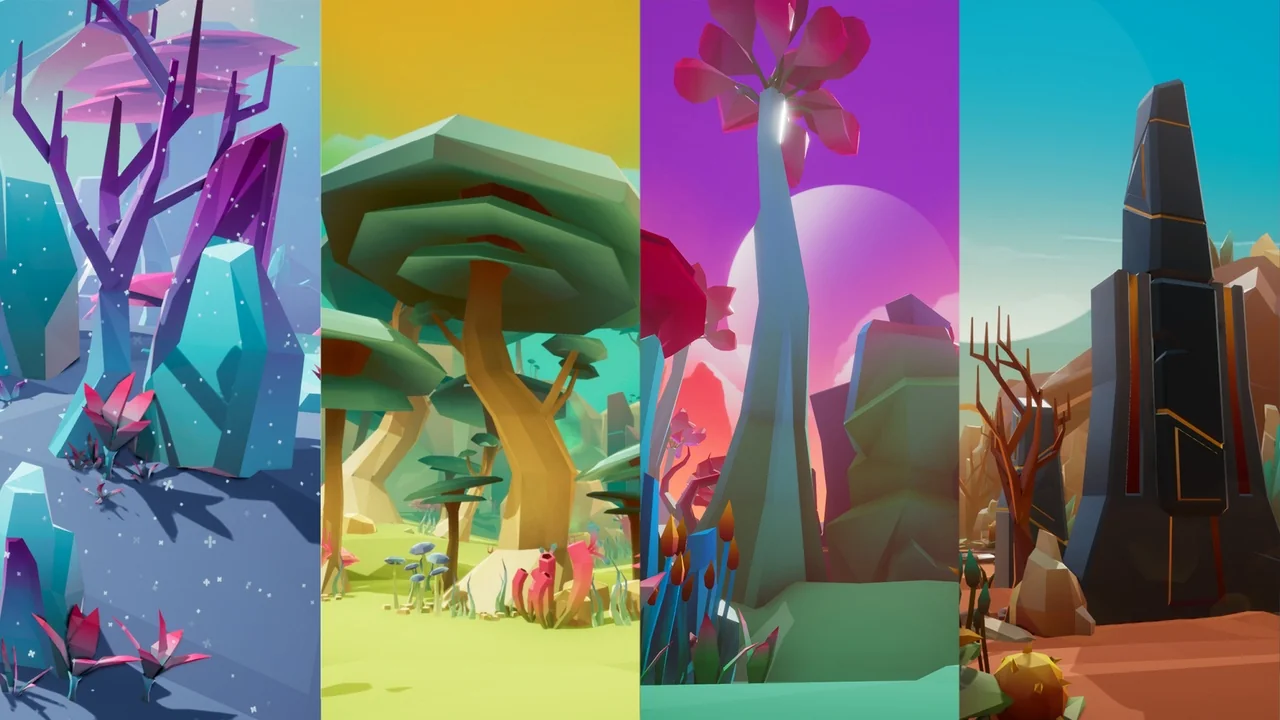
 Fantasy
 Fantasy
 Forest & Jungle