"c14ff6bd758dadb1"{"id":"1001768","slug":"tropical-alien-world","title":"Tropical Alien World","category":"Fantasy","engine":"5.1+","assetVersion":"","engineVersion":"Engine Version: 5.1+","tag":"Fantasy","accent":"blue","visual":"mech","summary":"Explore the implementation, dual-map performance setup, Nanite geometry, and Water plugin requirements of the Tropical Alien World environment for UE 5.1+.","platform":"Unreal Engine","publishedAt":"2026-10-20T03:16:14.596Z","updatedAt":"2026-10-20T03:16:14.596Z","sourceNotes":[],"fileContents":[],"compatibility":["Unreal Engine","Engine Version: 5.1+"],"featuredImage":{"alt":"Tropical Alien World","src":"/wp-content/uploads/published/2026/10/b749927b282e-6f06c4ae-dbc9-45be-92d5-d5747e53de6f-47c16c1427.webp"},"hasDownloadLink":true,"downloads":0,"terms":[{"taxonomy":"category","slug":"fantasy","name":"Fantasy"}],"galleryImages":[{"src":"/wp-content/uploads/published/2026/10/1e4e34b8ba64-8ff17496-def1-4480-9e82-893ab3ed8d16-43e3dedf8d.webp","alt":"Tropical Alien World"},{"src":"/wp-content/uploads/published/2026/10/caa28f6a99d2-ee898594-9887-4fcb-91f8-7d1f9949121c-71afa0f2fe.webp","alt":"Tropical Alien World"},{"src":"/wp-content/uploads/published/2026/10/4ea4ffe71902-5365b98b-11b3-45fc-9c05-37232c3f8ae1-cae2b3b4f3.webp","alt":"Tropical Alien World"},{"src":"/wp-content/uploads/published/2026/10/f9888220231c-4f0d85d9-aa39-4735-bd21-0170832795fd-c53a315ad5.webp","alt":"Tropical Alien World"},{"src":"/wp-content/uploads/published/2026/10/8177dc4846ef-9b2ac9eb-594e-4a71-83c1-9bda981d2f9f-cdb09099cd.webp","alt":"Tropical Alien World"},{"src":"/wp-content/uploads/published/2026/10/099e6bcd4d91-85448aa2-7133-4678-86e2-1b8afeadb1c7-81dedf5813.webp","alt":"Tropical Alien World"},{"src":"/wp-content/uploads/published/2026/10/bd152a137f8e-d72e7f4e-345b-45f0-a1ef-2835c348db83-215ddfa9be.webp","alt":"Tropical Alien World"},{"src":"/wp-content/uploads/published/2026/10/c3c8770e9163-476801c2-f400-4786-bba6-2735eedc5cf4-bd13743968.webp","alt":"Tropical Alien World"},{"src":"/wp-content/uploads/published/2026/10/85a3e20772bc-dd9666f5-3285-4cba-b77d-ed4fcc73df0c-07fbbd3065.webp","alt":"Tropical Alien World"}],"accessPanel":{"kind":"resource","title":"Download this resource","eyebrow":"Free Download","message":"Log in or create a free account to start your download.","fileName":"Content.7z","safetyNote":"Resources are manually reviewed before listing to improve quality and reduce obvious risks.","actionLabel":"Download Free","resourceType":"Resource archive"},"contentHtml":"\u003ch2\u003eEnabling the Water Plugin and Initial Engine Configuration\u003c/h2\u003e\n\u003cp\u003eDeploying Tropical Alien World requires specific engine settings to be configured before opening the project levels. The environment relies directly on Unreal Engine's native Water plugin to handle its ocean surfaces and island shorelines. Users must navigate to the main editor menu, open Edit, select Plugins, locate the Water plugin, and check its activation box. Once enabled, a full editor restart is mandatory. Launching the project without completing this step causes asset failures across the water bodies and disrupts the coastal geometry integration across both included levels.\u003c/p\u003e\n\u003cp\u003eThe package targets Unreal Engine 5.1 and newer versions, establishing baseline dependencies on modern rendering pipelines. Because core architectural features depend on this version threshold, attempting to migrate the package into older versions of Unreal Engine breaks shader networks, post-processing chains, and procedural water interactions.\u003c/p\u003e \u003ch2\u003eEvaluating the Two Tropical Alien World Pre-Built Environments\u003c/h2\u003e\n\u003cp\u003eThe package contains two distinct, fully realized island maps that cater to contrasting hardware budgets and production goals. Rather than forcing a single compromise between visual fidelity and real-time responsiveness, the package separates its layout into a quality-optimized map and a performance-optimized map.\u003c/p\u003e\n\u003cp\u003eThe quality-optimized level prioritizes maximum graphic impact. Every setting within this level is tailored to push detail, leveraging complete rendering profiles for lighting, environmental particles, and complex post-processing effects. This configuration serves productions such as cinematic sequences, virtual production backdrops, or high-end benchmark captures where visual presence takes priority over marginal frame-time savings.\u003c/p\u003e\n\u003cp\u003eThe performance-optimized level targets active gameplay pipelines where maintaining consistent frame rates is essential. In this configuration, lighting complexity, particle emission densities, and specific post-processing calculations are scaled down. By testing both maps directly, developers can evaluate baseline hardware behavior and select the preset that mirrors the target project's frame-rate constraints.\u003c/p\u003e \u003ch2\u003eNanite Integration and High-Density Island Mesh Handling\u003c/h2\u003e\n\u003cp\u003eGeometry within Tropical Alien World is authored specifically for Unreal Engine's Nanite virtualization framework. Several individual meshes throughout the island environments feature extremely high polygon counts. These high-density assets are not built with conventional manual level-of-detail (LOD) hierarchies; they are intended exclusively to run with Nanite enabled.\u003c/p\u003e\n\u003cp\u003eRunning high-poly meshes through Nanite allows the alien landscape to present intricate rocky forms, extraterrestrial terrain details, and complex biological surfaces without traditional draw-call choking. The mesh virtualization dynamically adapts polygon density relative to screen-space distance. If Nanite is disabled globally or bypassed on these specific meshes, the raw vertex density will heavily tax system memory and disrupt rendering throughput. Maintaining Nanite support across target platforms is therefore a structural necessity when utilizing these island assets.\u003c/p\u003e \u003ch2\u003eLumen Illumination and Environmental Post-Processing\u003c/h2\u003e\n\u003cp\u003eBoth pre-built island maps are configured to utilize Lumen, the dynamic global illumination and reflections system introduced in Unreal Engine 5. Lumen handles real-time light bounces across the alien terrain, balancing deep shadows cast by tropical canopies with ambient light bouncing off the ocean surface and extraterrestrial ground cover.\u003c/p\u003e\n\u003cp\u003eEach level includes a pre-configured environmental stack encompassing custom lighting rigs, ambient particle systems, and focused post-processing volumes. Floating particulates and atmospheric elements are tuned to give the extraterrestrial world a distinct fantasy tone while preserving physical realism across surface shaders. Because the post-processing and lighting are already embedded into both pre-built environments, the package operates as a self-contained backdrop immediately upon loading.\u003c/p\u003e \u003ch2\u003eAsset Provenance and Texturing Framework\u003c/h2\u003e\n\u003cp\u003eThe thematic direction blends realistic tropical island topography with fantasy and extraterrestrial details. Scenes incorporate beach terrain, exotic trees, lush vegetation, and stylized alien biological elements surrounded by deep ocean water. Surface definition across the landmasses balances organic irregularities with realistic physical shading responses.\u003c/p\u003e\n\u003cp\u003eTexture mapping across the package incorporates material elements sourced from ambientcg.com under the CC0 1.0 Universal license. This public domain dedication guarantees that the underlying surface textures can be integrated into broader commercial or non-commercial pipelines without licensing friction, providing clean architectural compliance alongside the original proprietary alien meshes.\u003c/p\u003e \u003ch2\u003ePipeline Verification and Project Integration\u003c/h2\u003e\n\u003cp\u003eVerifying stability across different target machines is streamlined through the dual-map setup. Productions can benchmark runtime requirements early in pre-production by comparing the quality map directly against the performance map. When questions or technical issues emerge during level setup, the developer provides technical assistance to assist in resolving workflow bottlenecks. Verifying the Water plugin activation, validating Nanite mesh states, and establishing proper Lumen exposure settings will resolve the majority of implementation challenges, leaving a fully configured alien world ready for level designers and technical artists.\u003c/p\u003e\n\n\u003ch2\u003eRelated Resources Worth Checking\u003c/h2\u003e\n\u003cul\u003e\n\u003cli\u003e\u003ca href=\"https://3dcghub.com/alien-planets-environment-w-planet-creator-pcg/\" title=\"Alien Planets Environment w/ Planet Creator PCG\"\u003eAlien Planets Environment w/ Planet Creator PCG\u003c/a\u003e\u003c/li\u003e\n\u003cli\u003e\u003ca href=\"https://3dcghub.com/alien-planet-pack/\" title=\"Alien Planet Pack\"\u003eAlien Planet Pack\u003c/a\u003e\u003c/li\u003e\n\u003cli\u003e\u003ca href=\"https://3dcghub.com/fantasy-alien-castle/\" title=\"Fantasy Alien Castle\"\u003eFantasy Alien Castle\u003c/a\u003e\u003c/li\u003e\n\u003cli\u003e\u003ca href=\"https://3dcghub.com/post-apocalyptic-world/\" title=\"Post Apocalyptic World\"\u003ePost Apocalyptic World\u003c/a\u003e\u003c/li\u003e\n\u003cli\u003e\u003ca href=\"https://3dcghub.com/alien-planet-fantasy-environment-grassland-plants/\" title=\"Alien Planet Fantasy Environment - Grassland Plants\"\u003eAlien Planet Fantasy Environment - Grassland Plants\u003c/a\u003e\u003c/li\u003e\n\u003c/ul\u003e","contentTextLength":5822,"navigation":{"current":15,"total":3719,"previous":{"id":"1001769","slug":"tv-studio-environment-set","title":"TV Studio Environment Set","category":"Interior","platform":"Unreal Engine","updatedAt":"2026-10-20T03:16:58.432Z"},"next":{"id":"1001767","slug":"the-big-mansion","title":"The Big Mansion","category":"Interior","platform":"Unreal Engine","updatedAt":"2026-10-20T03:13:15.790Z"}},"relatedResources":[{"id":"7890","slug":"alien-planets-environment-w-planet-creator-pcg","title":"Alien Planets Environment w/ Planet Creator PCG","category":"Fantasy","engine":"5.4+","assetVersion":"Engine version: 5.4+","engineVersion":"5.3","tag":"Fantasy","accent":"blue","visual":"city","summary":"Transform your sci-fi projects with a powerful procedural toolset designed for Unreal Engine 5.3. This pack includes over 170 meshes and a custom PCG system for creating diverse alien worlds.","platform":"Unreal Engine","publishedAt":"2026-02-22T15:40:06.000Z","updatedAt":"2026-04-19T15:55:53.000Z","sourceNotes":[],"fileContents":[],"compatibility":["Unreal Engine","Engine version: 5.4+"],"featuredImage":{"alt":"Alien Planets Environment w/ Planet Creator PCG","src":"https://3dcghub.com/wp-content/uploads/2026/02/a1eb56ed-6c58-4a0c-8d61-8bc474e96c67.webp"},"hasDownloadLink":true,"downloads":0},{"id":"1000560","slug":"alien-planet-pack","title":"Alien Planet Pack","category":"Fantasy","engine":"4.26+,5.0+","assetVersion":"","engineVersion":"Engine Version: 4.26+,5.0+","tag":"Fantasy","accent":"blue","visual":"mech","summary":"A lowpoly Unreal Engine environment pack with 158 meshes across four biomes, modular alien structures, spaceships with spline paths, and dynamic weather particl","platform":"Unreal Engine","publishedAt":"2026-07-16T04:43:47.861Z","updatedAt":"2026-07-16T04:43:47.861Z","sourceNotes":[],"fileContents":[],"compatibility":["Unreal Engine","Engine Version: 4.26+,5.0+"],"featuredImage":{"alt":"Alien Planet Pack","src":"/wp-content/uploads/published/2026/07/85824b592254-f5a8409b-79ad-48cc-b04c-f5ba1757e1ac-06fbbe3478.webp"},"hasDownloadLink":true,"downloads":0},{"id":"1000600","slug":"fantasy-alien-castle","title":"Fantasy Alien Castle","category":"Fantasy","engine":"5.2+","assetVersion":"","engineVersion":"Engine Version: 5.2+","tag":"Fantasy","accent":"blue","visual":"mech","summary":"Fantasy Alien Castle is a 117-mesh Unreal Engine environment pack with Lumen and Nanite enabled, a preassembled scene, demo map, and ULAT modular building compa","platform":"Unreal Engine","publishedAt":"2026-07-18T15:43:42.616Z","updatedAt":"2026-07-18T15:43:42.616Z","sourceNotes":[],"fileContents":[],"compatibility":["Unreal Engine","Engine Version: 5.2+"],"featuredImage":{"alt":"Fantasy Alien Castle","src":"/wp-content/uploads/published/2026/07/3f747bf70c7f-e32ab066-0592-4a9a-ade9-d3b8f273caf3-f6a8dff48f.webp"},"hasDownloadLink":true,"downloads":1}]}
Fantasy
Tropical Alien World
Explore the implementation, dual-map performance setup, Nanite geometry, and Water plugin requirements of the Tropical Alien World environment for UE 5.1+.
Category:Unreal Engine,FantasyPlatform: Unreal EngineEngine Version: 5.1+Published: Oct 20, 2026
Fantasy
Resource overview
Enabling the Water Plugin and Initial Engine Configuration
Deploying Tropical Alien World requires specific engine settings to be configured before opening the project levels. The environment relies directly on Unreal Engine's native Water plugin to handle its ocean surfaces and island shorelines. Users must navigate to the main editor menu, open Edit, select Plugins, locate the Water plugin, and check its activation box. Once enabled, a full editor restart is mandatory. Launching the project without completing this step causes asset failures across the water bodies and disrupts the coastal geometry integration across both included levels.
The package targets Unreal Engine 5.1 and newer versions, establishing baseline dependencies on modern rendering pipelines. Because core architectural features depend on this version threshold, attempting to migrate the package into older versions of Unreal Engine breaks shader networks, post-processing chains, and procedural water interactions.
Evaluating the Two Tropical Alien World Pre-Built Environments
The package contains two distinct, fully realized island maps that cater to contrasting hardware budgets and production goals. Rather than forcing a single compromise between visual fidelity and real-time responsiveness, the package separates its layout into a quality-optimized map and a performance-optimized map.
The quality-optimized level prioritizes maximum graphic impact. Every setting within this level is tailored to push detail, leveraging complete rendering profiles for lighting, environmental particles, and complex post-processing effects. This configuration serves productions such as cinematic sequences, virtual production backdrops, or high-end benchmark captures where visual presence takes priority over marginal frame-time savings.
The performance-optimized level targets active gameplay pipelines where maintaining consistent frame rates is essential. In this configuration, lighting complexity, particle emission densities, and specific post-processing calculations are scaled down. By testing both maps directly, developers can evaluate baseline hardware behavior and select the preset that mirrors the target project's frame-rate constraints.
Nanite Integration and High-Density Island Mesh Handling
Geometry within Tropical Alien World is authored specifically for Unreal Engine's Nanite virtualization framework. Several individual meshes throughout the island environments feature extremely high polygon counts. These high-density assets are not built with conventional manual level-of-detail (LOD) hierarchies; they are intended exclusively to run with Nanite enabled.
Running high-poly meshes through Nanite allows the alien landscape to present intricate rocky forms, extraterrestrial terrain details, and complex biological surfaces without traditional draw-call choking. The mesh virtualization dynamically adapts polygon density relative to screen-space distance. If Nanite is disabled globally or bypassed on these specific meshes, the raw vertex density will heavily tax system memory and disrupt rendering throughput. Maintaining Nanite support across target platforms is therefore a structural necessity when utilizing these island assets.
Lumen Illumination and Environmental Post-Processing
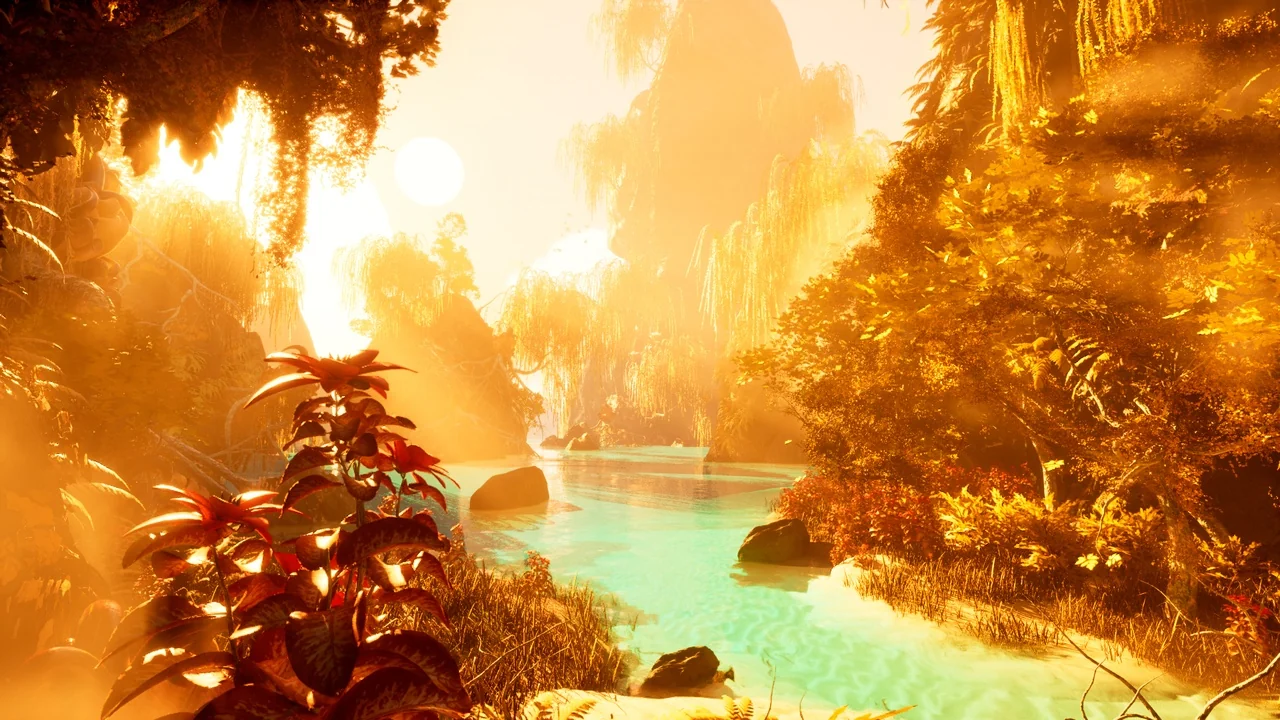
Both pre-built island maps are configured to utilize Lumen, the dynamic global illumination and reflections system introduced in Unreal Engine 5. Lumen handles real-time light bounces across the alien terrain, balancing deep shadows cast by tropical canopies with ambient light bouncing off the ocean surface and extraterrestrial ground cover.
Each level includes a pre-configured environmental stack encompassing custom lighting rigs, ambient particle systems, and focused post-processing volumes. Floating particulates and atmospheric elements are tuned to give the extraterrestrial world a distinct fantasy tone while preserving physical realism across surface shaders. Because the post-processing and lighting are already embedded into both pre-built environments, the package operates as a self-contained backdrop immediately upon loading.
Asset Provenance and Texturing Framework
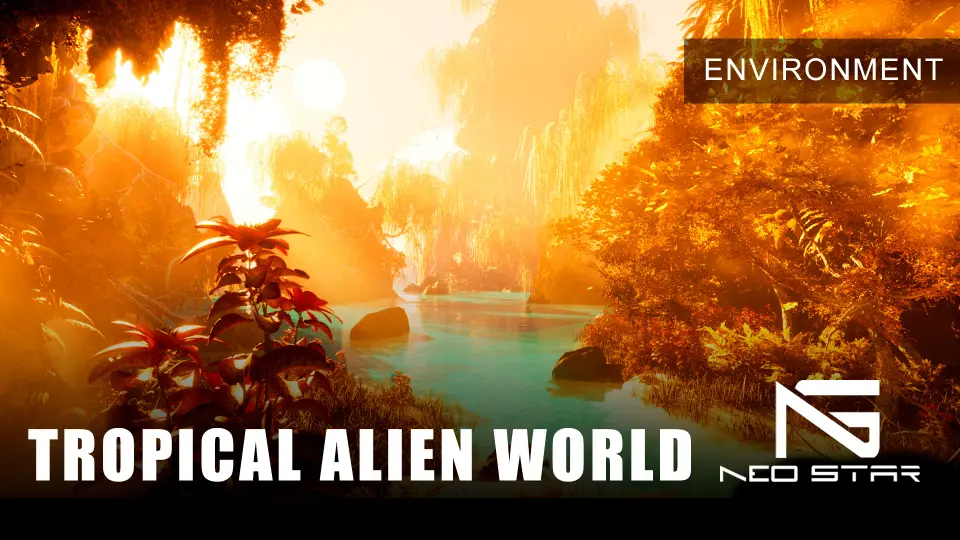
The thematic direction blends realistic tropical island topography with fantasy and extraterrestrial details. Scenes incorporate beach terrain, exotic trees, lush vegetation, and stylized alien biological elements surrounded by deep ocean water. Surface definition across the landmasses balances organic irregularities with realistic physical shading responses.
Texture mapping across the package incorporates material elements sourced from ambientcg.com under the CC0 1.0 Universal license. This public domain dedication guarantees that the underlying surface textures can be integrated into broader commercial or non-commercial pipelines without licensing friction, providing clean architectural compliance alongside the original proprietary alien meshes.
Pipeline Verification and Project Integration
Verifying stability across different target machines is streamlined through the dual-map setup. Productions can benchmark runtime requirements early in pre-production by comparing the quality map directly against the performance map. When questions or technical issues emerge during level setup, the developer provides technical assistance to assist in resolving workflow bottlenecks. Verifying the Water plugin activation, validating Nanite mesh states, and establishing proper Lumen exposure settings will resolve the majority of implementation challenges, leaving a fully configured alien world ready for level designers and technical artists.
 Fantasy
 Fantasy
 Fantasy
 Fantasy