"c14ff6bd758dadb1"{"id":"1001767","slug":"the-big-mansion","title":"The Big Mansion","category":"Interior","engine":"5.3+","assetVersion":"","engineVersion":"Engine Version: 5.3+","tag":"Interior","accent":"blue","visual":"mech","summary":"Explore The Big Mansion, a modular Unreal Engine 5 interior pack featuring 118 Nanite meshes, Lumen lighting variations, and UE5.5 MegaLights horror environment","platform":"Unreal Engine","publishedAt":"2026-10-20T03:13:15.790Z","updatedAt":"2026-10-20T03:13:15.790Z","sourceNotes":[],"fileContents":[],"compatibility":["Unreal Engine","Engine Version: 5.3+"],"featuredImage":{"alt":"The Big Mansion","src":"/wp-content/uploads/published/2026/10/c1f5dfb13acf-ee3cbcfc-2339-4c87-aa09-484a3f060468-e286e774f5.webp"},"hasDownloadLink":true,"downloads":0,"terms":[{"taxonomy":"category","slug":"interior","name":"Interior"}],"galleryImages":[{"src":"/wp-content/uploads/published/2026/10/01b0ca11c828-ca8aa95c-451e-4d8d-bc01-ae238b367923-9624fe0c38.webp","alt":"The Big Mansion"},{"src":"/wp-content/uploads/published/2026/10/a544f6f5d6f0-efdbdb1d-2d81-4693-ad81-3a0cdfe8e5e0-37e4498239.webp","alt":"The Big Mansion"},{"src":"/wp-content/uploads/published/2026/10/11d2a6c9365a-5b16d904-779a-4026-8bb0-8f20182d02d0-22e611ff07.webp","alt":"The Big Mansion"},{"src":"/wp-content/uploads/published/2026/10/300a57536ebb-41bcb305-162a-417e-8fa8-81b22d58102c-6567dbbc34.webp","alt":"The Big Mansion"},{"src":"/wp-content/uploads/published/2026/10/3307028ea48f-a10c8935-3f6f-47e2-9f94-78da755a16ac-24335455ba.webp","alt":"The Big Mansion"},{"src":"/wp-content/uploads/published/2026/10/2c4ed8b785d3-2911805d-735e-48a6-9394-b7dd59809271-56e4dc68fe.webp","alt":"The Big Mansion"},{"src":"/wp-content/uploads/published/2026/10/6b427b05ddb3-60dfbcff-a8b4-45bb-8010-9b2e2fb2a84c-a01ea0c5ee.webp","alt":"The Big Mansion"},{"src":"/wp-content/uploads/published/2026/10/055a399f1d3a-448531c3-0629-4bda-bcc8-7f3fd957d3ed-aeff082299.webp","alt":"The Big Mansion"},{"src":"/wp-content/uploads/published/2026/10/1786ef271e3e-03f29676-de90-46e2-aa87-abee21ca14e9-0b01dd80ac.webp","alt":"The Big Mansion"}],"accessPanel":{"kind":"resource","title":"Download this resource","eyebrow":"Free Download","message":"Log in or create a free account to start your download.","fileName":"The Big Mansion.7z","safetyNote":"Resources are manually reviewed before listing to improve quality and reduce obvious risks.","actionLabel":"Download Free","resourceType":"Resource archive"},"contentHtml":"\u003cp\u003eConstructing sprawling historical interiors often introduces steep production bottlenecks. Assembling grand halls, curving staircases, and connected corridors requires vast libraries of structural pieces that align cleanly without visible seam errors or performance drops. When projects demand both architectural visualization polish and the oppressive mood of a horror title, balancing high-density geometry against dynamic illumination becomes an ongoing challenge.\u003c/p\u003e \u003cp\u003eThe Big Mansion resolves these layout hurdles by providing a structured kit of 118 unique meshes engineered specifically for Unreal Engine 5. Built to support royal, Victorian, and atmospheric period settings, the environment integrates architectural frameworks, modular furniture, interactive blueprints, and dedicated lighting setups designed to streamline environment production from initial blockout to finished scene.\u003c/p\u003e \u003ch2\u003eConstructing Grand Halls and Corridors with Modular Meshes\u003c/h2\u003e \u003cp\u003eInterior layout work relies heavily on consistent grid logic to prevent geometry overlaps and lighting artifacts.\u003c/p\u003e \u003cp\u003eThe structural core of the asset collection centers around modular walls, ceilings, floors, and expansive corridor sections. These components allow level designers to map out varied floorplans, transitioning effortlessly from cavernous ballrooms to cramped, winding passages. Structural elements like stairs integrate directly with the floor and wall modules, enabling multi-story layouts that maintain consistent architectural proportion throughout. Because the components share uniform design cues inspired by classic Victorian and royal architecture, individual rooms can be reconfigured repeatedly while preserving visual continuity across an entire estate.\u003c/p\u003e \u003cp\u003eSurface finishing relies on a tile-based texture workflow, which keeps memory overhead low while allowing materials to scale cleanly over broad wall surfaces and high ceilings. Artists can adapt the mood and wear of individual rooms by adjusting customizable material colors across surfaces, altering pristine estate walls into faded, aged chambers. To break up architectural repetition, decals and signage sheets can be applied across surfaces, introducing local wear, surface variation, and context-specific indicators without requiring dedicated, bespoke textures for every wall panel.\u003c/p\u003e \u003ch2\u003eDay and Horror Lighting Variations with UE5.5 MegaLights\u003c/h2\u003e \u003cp\u003eLighting large interior volumes presents distinct difficulties, particularly when shifting between clean architectural showcases and high-contrast cinematic gloom.\u003c/p\u003e \u003cp\u003eThe pack tackles this by including prebuilt showcase maps configured for Lumen lighting, offering distinct daytime and horror lighting presets. The daytime configuration provides clean, indirect bounce light suitable for set-dressing evaluation and architectural visualization sweeps. For darker, story-driven scenes, a dedicated UE5.5 MegaLights horror map uses the upgraded illumination framework to cast complex, atmospheric shadows across dimly lit chambers and grand corridors, ensuring crisp shadow falloff even in expansive interior scenes.\u003c/p\u003e \u003cp\u003eLighting blueprints simplify setup across the mansion's rooms by incorporating customizable parameters directly into the fixtures. Chandeliers and wall fixtures include adjustable emissive controls, intensity settings, and built-in blink functions. These controls enable developers to craft unstable, flickering light sources common in horror sequences without needing to script custom timeline events or material instances from scratch.\u003c/p\u003e \u003ch2\u003eInteractive Systems for Horror and Narrative Setups\u003c/h2\u003e \u003cp\u003eBeyond static level dressing, establishing player agency within an interior requires responsive props and interface mechanics.\u003c/p\u003e \u003cp\u003eThe environment incorporates pre-wired gameplay elements tailored directly to narrative and survival horror pacing. Central to this is a functional door blueprint equipped with defined lock states and accompanying UI panels. These doors interface smoothly with level streaming corridors, letting designers gate progression, trigger loading volumes between mansion wings, or script locked-room puzzles without creating custom interaction logic.\u003c/p\u003e \u003cp\u003eNarrative discovery is supported by an included note UI system, giving creators a direct method for delivering lore, clues, or exposition as players inspect desks, drawers, and side tables. To govern exploration through dark corridors and unlit chambers, an integrated flashlight system provides immediate player-perspective illumination, pairing cleanly with the high-contrast shadow maps generated by the Lumen and MegaLights configurations.\u003c/p\u003e \u003ch2\u003eFurnishing Chambers with Victorian Set-Dressing Assets\u003c/h2\u003e \u003cp\u003eBelievable spaces depend on secondary dressing that complements the primary architectural shell without overwhelming the viewport.\u003c/p\u003e \u003cp\u003eThe collection supplies a curated selection of modular furniture suited for mid-range viewing and dense set-dressing. Seating arrangements feature detailed sofas, while perimeter spaces can be dressed using classic wooden drawers, tables, and tailored curtains that frame the modular window assemblies. Plush carpets add soft surface breaks to hard floor tiles, aiding in visual warmth or contrasting with decaying paint layers in horror variations.\u003c/p\u003e \u003cp\u003eBecause these decorative props match the scale and architectural trims of the modular walls and ceilings, set dressing proceeds quickly. Designers can populate private quarters, studies, or reception chambers using cohesive Victorian furnishings that blend into the scene architecture rather than appearing out of place.\u003c/p\u003e \u003ch2\u003eNanite Optimization and Level Streaming Across Large Interiors\u003c/h2\u003e \u003cp\u003eHigh-polygon architectural assets often trigger heavy performance penalties when stacked in dense interior environments.\u003c/p\u003e \u003cp\u003eBy leveraging Nanite for Unreal Engine 5, the 118 meshes preserve crisp surface contours, ornate mouldings, and intricate structural details without stalling the GPU. Nanite automatically manages continuous levels of detail across chandeliers, carved stairs, and architectural trims, maintaining smooth performance whether a camera is framing a close-up prop or viewing the entirety of a grand hall.\u003c/p\u003e \u003cp\u003eFor broad multi-wing mansion designs, prebuilt maps take advantage of streaming corridors to divide large floorplans into manageable, performant chunks. This modular segregation allows heavy chambers to load in and out smoothly based on player proximity, making the pack equally suited for cinematic virtual production, atmospheric story adventures, or architectural visualization flythroughs that require pristine stability across complex interior spaces.\u003c/p\u003e\n\n\u003ch2\u003eRelated Resources Worth Checking\u003c/h2\u003e\n\u003cul\u003e\n\u003cli\u003e\u003ca href=\"https://3dcghub.com/classic-mansion/\" title=\"Classic Mansion\"\u003eClassic Mansion\u003c/a\u003e\u003c/li\u003e\n\u003cli\u003e\u003ca href=\"https://3dcghub.com/big-office/\" title=\"Big Office\"\u003eBig Office\u003c/a\u003e\u003c/li\u003e\n\u003cli\u003e\u003ca href=\"https://3dcghub.com/big-locomotion-pack-v04/\" title=\"Big Locomotion Pack V04\"\u003eBig Locomotion Pack V04\u003c/a\u003e\u003c/li\u003e\n\u003cli\u003e\u003ca href=\"https://3dcghub.com/big-zombie-animation-pack/\" title=\"Big Zombie Animation Pack\"\u003eBig Zombie Animation Pack\u003c/a\u003e\u003c/li\u003e\n\u003cli\u003e\u003ca href=\"https://3dcghub.com/abandoned-horror-mansion-interior-abandoned-horror-mansion-abandoned-horror/\" title=\"Abandoned Horror Mansion Interior ( Abandoned Horror Mansion Abandoned Horror )\"\u003eAbandoned Horror Mansion Interior ( Abandoned Horror Mansion Abandoned Horror )\u003c/a\u003e\u003c/li\u003e\n\u003c/ul\u003e","contentTextLength":6776,"navigation":{"current":16,"total":3719,"previous":{"id":"1001768","slug":"tropical-alien-world","title":"Tropical Alien World","category":"Fantasy","platform":"Unreal Engine","updatedAt":"2026-10-20T03:16:14.596Z"},"next":{"id":"1001766","slug":"the-aftermath-environment-medieval-village-medieval-village-witcher","title":"The Aftermath Environment ( Medieval Village Medieval Village Witcher )","category":"Medieval","platform":"Unreal Engine","updatedAt":"2026-10-20T03:11:51.807Z"}},"relatedResources":[{"id":"1001383","slug":"classic-mansion","title":"Classic Mansion","category":"Interior","engine":"4.24+,5.0+","assetVersion":"","engineVersion":"Engine Version: 4.24+,5.0+","tag":"Interior","accent":"blue","visual":"mech","summary":"Explore Classic Mansion, a game environment featuring modular structural meshes, detailed furniture, and customizable blueprints for horror level design.","platform":"Unreal Engine","publishedAt":"2026-10-04T13:56:00.563Z","updatedAt":"2026-10-04T13:56:00.563Z","sourceNotes":[],"fileContents":[],"compatibility":["Unreal Engine","Engine Version: 4.24+,5.0+"],"featuredImage":{"alt":"Classic Mansion","src":"/wp-content/uploads/published/2026/10/b58971168642-8a8b57a0-d536-468f-8b52-2eab4e74c99b-5801179d5a.webp"},"hasDownloadLink":true,"downloads":1},{"id":"1001131","slug":"big-office","title":"Big Office","category":"Interior","engine":"4.26+,5.0+","assetVersion":"","engineVersion":"Engine Version: 4.26+,5.0+","tag":"Interior","accent":"blue","visual":"mech","summary":"Big Office is a low-poly UE5.1-ready environment with 18 interior spaces, from security and lounge areas to seven managers' rooms, a coffee shop, and more.","platform":"Unreal Engine","publishedAt":"2026-09-09T02:07:18.459Z","updatedAt":"2026-09-09T02:07:18.459Z","sourceNotes":[],"fileContents":[],"compatibility":["Unreal Engine","Engine Version: 4.26+,5.0+"],"featuredImage":{"alt":"Big Office","src":"/wp-content/uploads/published/2026/09/1fc67bdacb0e-912f6c79-55f8-4791-8fe7-bdb3422334af-659f2d3649.webp"},"hasDownloadLink":true,"downloads":1},{"id":"1001428","slug":"big-locomotion-pack-v04","title":"Big Locomotion Pack V04","category":"Locomotion / Gaits","engine":"5.0+","assetVersion":"","engineVersion":"Engine Version: 5.0+","tag":"Locomotion / Gaits","accent":"blue","visual":"animation","summary":"Comprehensive analysis of Big Locomotion Pack V04, featuring 601 animations, 27 aim offset poses, multi-weapon sets, and crawling transition updates.","platform":"Unreal Engine","publishedAt":"2026-10-07T06:05:55.282Z","updatedAt":"2026-10-07T06:05:55.282Z","sourceNotes":[],"fileContents":[],"compatibility":["Unreal Engine","Engine Version: 5.0+"],"featuredImage":{"alt":"Big Locomotion Pack V04","src":"/wp-content/uploads/published/2026/10/04032812410e-69c19691-ef01-4992-bc9f-adf462573cc9-4d809faeb4.webp"},"hasDownloadLink":true,"downloads":2}]}
Interior
The Big Mansion
Explore The Big Mansion, a modular Unreal Engine 5 interior pack featuring 118 Nanite meshes, Lumen lighting variations, and UE5.5 MegaLights horror environment
Category:Unreal Engine,InteriorPlatform: Unreal EngineEngine Version: 5.3+Published: Oct 20, 2026
Interior
Resource overview
Constructing sprawling historical interiors often introduces steep production bottlenecks. Assembling grand halls, curving staircases, and connected corridors requires vast libraries of structural pieces that align cleanly without visible seam errors or performance drops. When projects demand both architectural visualization polish and the oppressive mood of a horror title, balancing high-density geometry against dynamic illumination becomes an ongoing challenge.
The Big Mansion resolves these layout hurdles by providing a structured kit of 118 unique meshes engineered specifically for Unreal Engine 5. Built to support royal, Victorian, and atmospheric period settings, the environment integrates architectural frameworks, modular furniture, interactive blueprints, and dedicated lighting setups designed to streamline environment production from initial blockout to finished scene.
Constructing Grand Halls and Corridors with Modular Meshes
Interior layout work relies heavily on consistent grid logic to prevent geometry overlaps and lighting artifacts.
The structural core of the asset collection centers around modular walls, ceilings, floors, and expansive corridor sections. These components allow level designers to map out varied floorplans, transitioning effortlessly from cavernous ballrooms to cramped, winding passages. Structural elements like stairs integrate directly with the floor and wall modules, enabling multi-story layouts that maintain consistent architectural proportion throughout. Because the components share uniform design cues inspired by classic Victorian and royal architecture, individual rooms can be reconfigured repeatedly while preserving visual continuity across an entire estate.
Surface finishing relies on a tile-based texture workflow, which keeps memory overhead low while allowing materials to scale cleanly over broad wall surfaces and high ceilings. Artists can adapt the mood and wear of individual rooms by adjusting customizable material colors across surfaces, altering pristine estate walls into faded, aged chambers. To break up architectural repetition, decals and signage sheets can be applied across surfaces, introducing local wear, surface variation, and context-specific indicators without requiring dedicated, bespoke textures for every wall panel.
Day and Horror Lighting Variations with UE5.5 MegaLights
Lighting large interior volumes presents distinct difficulties, particularly when shifting between clean architectural showcases and high-contrast cinematic gloom.
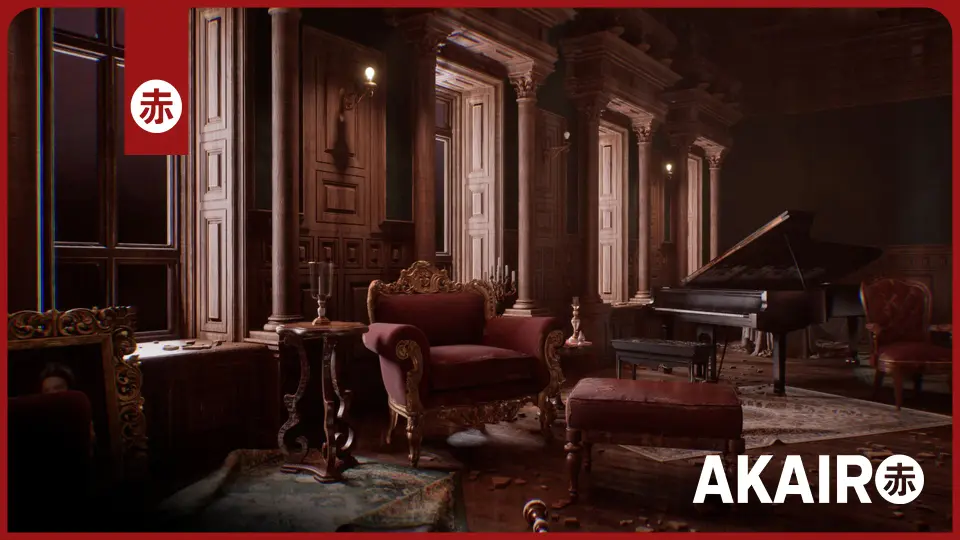
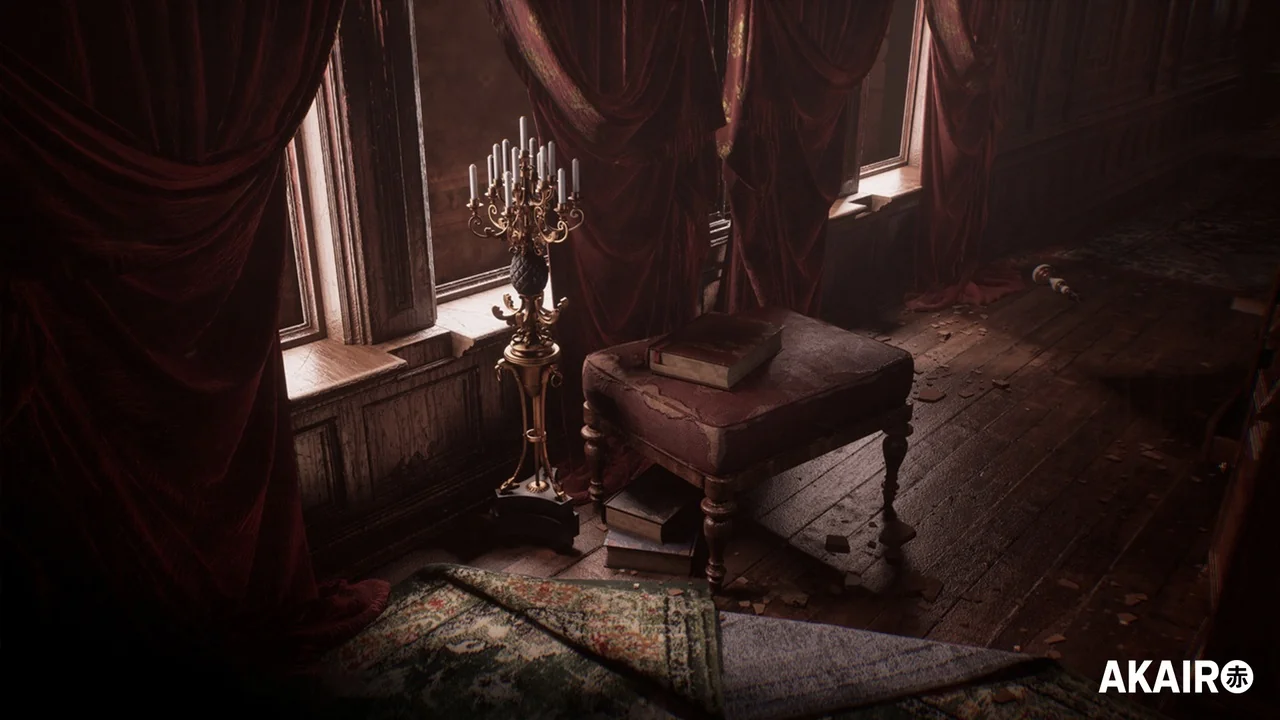
The pack tackles this by including prebuilt showcase maps configured for Lumen lighting, offering distinct daytime and horror lighting presets. The daytime configuration provides clean, indirect bounce light suitable for set-dressing evaluation and architectural visualization sweeps. For darker, story-driven scenes, a dedicated UE5.5 MegaLights horror map uses the upgraded illumination framework to cast complex, atmospheric shadows across dimly lit chambers and grand corridors, ensuring crisp shadow falloff even in expansive interior scenes.
Lighting blueprints simplify setup across the mansion's rooms by incorporating customizable parameters directly into the fixtures. Chandeliers and wall fixtures include adjustable emissive controls, intensity settings, and built-in blink functions. These controls enable developers to craft unstable, flickering light sources common in horror sequences without needing to script custom timeline events or material instances from scratch.
Interactive Systems for Horror and Narrative Setups
Beyond static level dressing, establishing player agency within an interior requires responsive props and interface mechanics.
The environment incorporates pre-wired gameplay elements tailored directly to narrative and survival horror pacing. Central to this is a functional door blueprint equipped with defined lock states and accompanying UI panels. These doors interface smoothly with level streaming corridors, letting designers gate progression, trigger loading volumes between mansion wings, or script locked-room puzzles without creating custom interaction logic.
Narrative discovery is supported by an included note UI system, giving creators a direct method for delivering lore, clues, or exposition as players inspect desks, drawers, and side tables. To govern exploration through dark corridors and unlit chambers, an integrated flashlight system provides immediate player-perspective illumination, pairing cleanly with the high-contrast shadow maps generated by the Lumen and MegaLights configurations.
Furnishing Chambers with Victorian Set-Dressing Assets
Believable spaces depend on secondary dressing that complements the primary architectural shell without overwhelming the viewport.
The collection supplies a curated selection of modular furniture suited for mid-range viewing and dense set-dressing. Seating arrangements feature detailed sofas, while perimeter spaces can be dressed using classic wooden drawers, tables, and tailored curtains that frame the modular window assemblies. Plush carpets add soft surface breaks to hard floor tiles, aiding in visual warmth or contrasting with decaying paint layers in horror variations.
Because these decorative props match the scale and architectural trims of the modular walls and ceilings, set dressing proceeds quickly. Designers can populate private quarters, studies, or reception chambers using cohesive Victorian furnishings that blend into the scene architecture rather than appearing out of place.
Nanite Optimization and Level Streaming Across Large Interiors
High-polygon architectural assets often trigger heavy performance penalties when stacked in dense interior environments.
By leveraging Nanite for Unreal Engine 5, the 118 meshes preserve crisp surface contours, ornate mouldings, and intricate structural details without stalling the GPU. Nanite automatically manages continuous levels of detail across chandeliers, carved stairs, and architectural trims, maintaining smooth performance whether a camera is framing a close-up prop or viewing the entirety of a grand hall.
For broad multi-wing mansion designs, prebuilt maps take advantage of streaming corridors to divide large floorplans into manageable, performant chunks. This modular segregation allows heavy chambers to load in and out smoothly based on player proximity, making the pack equally suited for cinematic virtual production, atmospheric story adventures, or architectural visualization flythroughs that require pristine stability across complex interior spaces.
 Interior
 Interior
 Interior
 Locomotion / Gaits