"148d1066ed74e216"{"id":"1002952","slug":"ultimate-movement-system","title":"Ultimate Movement System","category":"Action-Adventure","engine":"5.1+","assetVersion":"","engineVersion":"Engine Version: 5.1+","tag":"Action-Adventure","accent":"blue","visual":"mech","summary":"Examine the Ultimate Movement System, a replicated character movement constructor using game-driven animations, warping, and single-component architecture.","platform":"Unreal Engine","indexPolicy":"index","publishedAt":"2026-11-22T07:07:06.222Z","updatedAt":"2026-11-22T07:07:06.222Z","sourceNotes":[],"fileContents":[],"compatibility":["Unreal Engine","Engine Version: 5.1+"],"featuredImage":{"alt":"Ultimate Movement System","src":"/wp-content/uploads/published/2026/11/9339a5e843f5-60fe4ecf-1a0e-4a69-900c-96e60d37e8b8-30ab6e92a3.webp"},"fileSizeBytes":264789536,"hasDownloadLink":true,"downloads":0,"terms":[{"taxonomy":"category","slug":"action-adventure","name":"Action-Adventure"}],"galleryImages":[{"src":"/wp-content/uploads/published/2026/11/2be88839d9a0-2545caa0-abb0-4e47-a8d1-54c2b6827db6-788cba3826.webp","alt":"Ultimate Movement System"},{"src":"/wp-content/uploads/published/2026/11/7e0b4674561f-d992ab0c-8efb-4c46-92df-0b76cb86dbe6-68842a0747.webp","alt":"Ultimate Movement System"},{"src":"/wp-content/uploads/published/2026/11/9237824c265f-5d50adc2-523f-45b0-95d7-0b481f6b1a16-355215edc8.webp","alt":"Ultimate Movement System"},{"src":"/wp-content/uploads/published/2026/11/2a7395e11aba-4061c354-4095-4114-9295-15fa31a71fa3-54f5d1b8e8.webp","alt":"Ultimate Movement System"},{"src":"/wp-content/uploads/published/2026/11/8844d5259973-cf69de8c-15d7-4c07-af1d-bf21b4aa0ab6-1063a30e70.webp","alt":"Ultimate Movement System"},{"src":"/wp-content/uploads/published/2026/11/0a9a949dfe89-2019a9a8-0477-42e0-acbd-a3891ba576e9-e50d6378d2.webp","alt":"Ultimate Movement System"},{"src":"/wp-content/uploads/published/2026/11/786e7a81418b-5f73d7fb-d49e-4a45-9c52-328093105360-a6de13933b.webp","alt":"Ultimate Movement System"},{"src":"/wp-content/uploads/published/2026/11/08f59fef786c-16495623-070c-4059-bbbd-8a3751b9701b-205530a890.webp","alt":"Ultimate Movement System"},{"src":"/wp-content/uploads/published/2026/11/db2ada87dd0d-3370aa70-2535-4037-bb62-0dcac1f2d09e-88152df4c6.webp","alt":"Ultimate Movement System"},{"src":"/wp-content/uploads/published/2026/11/99684bd41c9e-7745036b-6cd7-4b7e-b0a5-3a0ea028e8e6-0db10efea7.webp","alt":"Ultimate Movement System"}],"accessPanel":{"kind":"resource","title":"Get this resource","safetyNote":"Resources are manually reviewed before listing to improve quality and reduce obvious risks.","fileName":"Ultimate Movement System.7z","resourceType":"Resource archive","versions":[]},"contentHtml":"\u003cp\u003eMultiplayer productions and action projects frequently struggle to balance detailed character movement with manageable animation assets. When a character controller demands unique motion cycles for every conceivable directional transition, state change, and speed adjustment, production pipelines quickly become bogged down by vast animation asset requirements. Character setups facing these constraints require a locomotion framework capable of generating fluid, directional movement from minimal source assets while remaining fully synchronized across a network. Ultimate Movement System addresses this production environment by acting as a replicated character movement constructor focused on procedural runtime adaptation rather than exhaustive animation libraries.\u003c/p\u003e \u003ch2\u003eArchitecting Locomotion with the Ultimate Movement Component\u003c/h2\u003e \u003cp\u003eAt the center of the framework is a single-component architecture designed to establish, configure, and modify distinct movement types. Rather than requiring developers to construct disparate controllers for every alternate navigation mode, the system organizes motion through centralized component logic. This structure enables creators to tailor movement models to the specific behavioral parameters of their projects without re-engineering base character functionality.\u003c/p\u003e \u003cp\u003eThe system gives developers direct control over a granular set of movement properties across different setups. Stances, poses, overlay states, and distinct gait profiles can each be configured with dedicated numerical properties. These parameters include precise values for movement speeds, acceleration curves, deceleration rates, ground friction, and rotation rates. Because these variables are managed within unified movement models, shifting a character from a deliberate, high-friction tactical crouch to a low-friction sprint requires only configuring the respective profile settings rather than scripting custom math routines from scratch.\u003c/p\u003e \u003ch2\u003eAnimation Economy through Orientation Warping and IK\u003c/h2\u003e \u003cp\u003eOne primary objective of the package is enabling visually polished movement while operating under strict asset limitations. Dense motion libraries often introduce performance bottlenecks and extensive asset management burdens. To bypass the requirement for dozens of directional blend spaces, the system relies on game-driven procedural animation adaptation powered by distance matching, orientation warping, and inverse kinematics (IK).\u003c/p\u003e \u003cp\u003eThe real-world implementation of this philosophy is demonstrated through the included sample locomotion setup. The example project achieves full eight-way directional movement using merely two base animations: a forward locomotion clip and a backward locomotion clip. By applying orientation warping dynamically at runtime, the system redirects character momentum and facing angle to cover diagonal and lateral navigation. Distance matching aligns the playback of these core motion cycles with the actual physical displacement of the character capsule, while IK adjusts limb placement to ground the character. The resulting motion demonstrates that extensive animation capture is not an absolute prerequisite for responsive, multi-directional navigation.\u003c/p\u003e \u003ch2\u003eTraversal Mechanics and Swimming Movement Types\u003c/h2\u003e \u003cp\u003eBeyond standard grounded locomotion, the framework expands character mobility through discrete movement modes introduced across engine versions. Swimming functionality is implemented as a specialized movement type, broadening the environments a player character can navigate without breaking the underlying movement state logic. This dedicated aquatic state integrates alongside existing component settings to preserve unified control handling.\u003c/p\u003e \u003cp\u003eBasic traversal mechanics, introduced for version 5.3, incorporate verticality and environmental navigation directly into the framework. This includes parkour-style interactions and wall running. Network replication forms a core pillar of the constructor, ensuring that player state shifts, poses, and speeds transmit cleanly across server-client architectures. A technical limitation to plan for within this traversal toolset is that wall running is currently not replicated. Developers implementing wall running in dedicated multiplayer environments must take this known constraint into account when planning server validation and networked character behavior.\u003c/p\u003e \u003ch2\u003eManaging System States from Stances to Gait Profiles\u003c/h2\u003e \u003cp\u003eStructuring the logic behind diverse character states is handled through an extensible hierarchy of stances, poses, and gait profiles. When building a game that requires distinct tiers of movement—such as walking, jogging, sprinting, and aiming—the framework treats each layer as a modular parameter set. Overlay states operate over base poses, allowing upper-body or stance adjustments to modify the active locomotion model without interfering with physical parameters like ground friction or turning velocity.\u003c/p\u003e \u003cp\u003eBecause physical movement traits are modular, developers can experiment with highly differentiated mobility profiles. An armored character archetype might adopt a movement profile characterized by aggressive deceleration, low rotation rates, and limited top speeds, while an agile scout archetype uses rapid acceleration and high rotation rates. Because these values reside within the movement models and overlay profiles, tuning movement feel becomes an iterative, non-destructive process inside the component settings.\u003c/p\u003e \u003ch2\u003eBlueprint Prerequisites and Implementation Demands\u003c/h2\u003e \u003cp\u003eDespite the streamlined asset footprint, this asset is not built as a plug-and-play solution. Proper integration requires at least a baseline working knowledge of Unreal Engine Blueprints. The internal architecture behaves as a constructor for assembling complex, customized controllers rather than an automated drag-and-drop character. Without foundational Blueprint comprehension, tracing the data flow between component parameters, game-driven animation graphs, and state profiles can easily become confusing.\u003c/p\u003e \u003cp\u003eTo assist developers in deconstructing its underlying systems, the package includes several practical reference resources. A playable demo allows creators to evaluate the responsiveness and feel of the locomotion firsthand. A dedicated MetaHuman example demonstrates how high-fidelity character skeletal meshes hook into the component, distance matching nodes, and orientation warping logic. Developers seeking non-player character integration can inspect the included example AI setup to observe how automated agents interact with the movement profiles. Ongoing devlogs detail structural changes, while future updates are slated to expand the library with additional movement types.\u003c/p\u003e \u003ch2\u003eWorkflow Fit and Ideal Use Cases\u003c/h2\u003e \u003cp\u003eUltimate Movement System serves teams and solo creators who require custom, network-aware locomotion architectures but lack the resources to produce massive motion-capture suites. It fits cleanly into projects where characters must transition smoothly between varied gaits, stances, and environmental states like swimming or basic traversal without compounding animation technical debt.\u003c/p\u003e \u003cp\u003eTechnical designers and Blueprint developers who understand animation graphs, warping systems, and component setups will gain the most utility from the package. By treating the asset as an adaptable movement engine rather than a static template, developers can construct robust, highly tailored character mechanics suited to their specific gameplay requirements.\u003c/p\u003e\n\n\u003ch2\u003eExplore Similar Assets\u003c/h2\u003e\n\u003cul\u003e\n\u003cli\u003e\u003ca href=\"https://3dcghub.com/ultimate-character/\" rel=\"noopener noreferrer\"\u003eUltimate Character\u003c/a\u003e\u003c/li\u003e\n\u003cli\u003e\u003ca href=\"https://3dcghub.com/ultimate-game-ready-character-and-enemy-ai/\" rel=\"noopener noreferrer\"\u003eUltimate Game Ready Character and Enemy AI\u003c/a\u003e\u003c/li\u003e\n\u003cli\u003e\u003ca href=\"https://3dcghub.com/enhanced-movement-system/\" rel=\"noopener noreferrer\"\u003eEnhanced Movement System\u003c/a\u003e\u003c/li\u003e\n\u003cli\u003e\u003ca href=\"https://3dcghub.com/ultimate-gameplay-camera/\" rel=\"noopener noreferrer\"\u003eUltimate Gameplay Camera\u003c/a\u003e\u003c/li\u003e\n\u003cli\u003e\u003ca href=\"https://3dcghub.com/dynamic-ragdoll/\" rel=\"noopener noreferrer\"\u003eDynamic Ragdoll\u003c/a\u003e\u003c/li\u003e\n\u003c/ul\u003e","contentTextLength":7620,"navigation":{"current":18,"total":4890,"previous":{"id":"1002953","slug":"flexible-combat-system-melee","title":"Flexible Combat System - Melee","category":"Fighting","platform":"Unreal Engine","updatedAt":"2026-11-22T07:08:02.838Z"},"next":{"id":"1002951","slug":"third-person-platformer-template","title":"Third Person Platformer Template","category":"Platformer","platform":"Unreal Engine","updatedAt":"2026-11-22T07:06:13.578Z"}},"relatedResources":[{"id":"1002618","slug":"ultimate-character","title":"Ultimate Character","category":"Action-Adventure","engine":"5.0+","assetVersion":"","engineVersion":"Engine Version: 5.0+","tag":"Action-Adventure","accent":"blue","visual":"character","summary":"A fully Blueprint-based combat and character framework featuring AI behavior trees, melee, guns, magic attacks, inventory, dynamic camera, and data tables.","platform":"Unreal Engine","indexPolicy":"index","publishedAt":"2026-11-14T09:13:01.059Z","updatedAt":"2026-11-14T09:13:01.059Z","sourceNotes":[],"fileContents":[],"compatibility":["Unreal Engine","Engine Version: 5.0+"],"featuredImage":{"alt":"Ultimate Character","src":"/wp-content/uploads/published/2026/11/879d8d74ce55-23aefc68-afef-4a3b-8b2c-7ea2c27c89c8-3e62ddab61.webp"},"fileSizeBytes":3371416552,"hasDownloadLink":true,"downloads":0},{"id":"1001473","slug":"ultimate-game-ready-character-and-enemy-ai","title":"Ultimate Game Ready Character and Enemy AI","category":"Action-Adventure","engine":"5.4+","assetVersion":"","engineVersion":"Engine Version: 5.4+","tag":"Action-Adventure","accent":"blue","visual":"character","summary":"Explore the mechanics of Ultimate Game Ready Character and Enemy AI, featuring Behavior Tree combatants, Niagara VFX, and modular player systems.","platform":"Unreal Engine","indexPolicy":"index","publishedAt":"2026-10-08T08:24:45.975Z","updatedAt":"2026-10-08T08:24:45.975Z","sourceNotes":[],"fileContents":[],"compatibility":["Unreal Engine","Engine Version: 5.4+"],"featuredImage":{"alt":"Ultimate Game Ready Character and Enemy AI","src":"https://media.fab.com/image_previews/gallery_images/179897da-4b4e-4fd2-a0e2-f27677b2278e/daaa7fc3-a13a-4879-80a9-5bfe18feb434.png"},"fileSizeBytes":321354554,"hasDownloadLink":true,"downloads":2},{"id":"1000732","slug":"enhanced-movement-system","title":"Enhanced Movement System","category":"Action-Adventure","engine":"5.5+","assetVersion":"","engineVersion":"Engine Version: 5.5+","tag":"Action-Adventure","accent":"blue","visual":"mech","summary":"Unreal Engine character movement toolkit with parkour vaulting, grappling hook, stamina UI, fall damage, footstep SFX, and a built-in tutorial system.","platform":"Unreal Engine","indexPolicy":"index","publishedAt":"2026-07-26T16:09:42.506Z","updatedAt":"2026-07-26T16:09:42.506Z","sourceNotes":[],"fileContents":[],"compatibility":["Unreal Engine","Engine Version: 5.5+"],"featuredImage":{"alt":"Enhanced Movement System","src":"/wp-content/uploads/published/2026/07/b8b1ddf5c110-41b67793-7ddd-4d06-a732-99b15b075a9e-8f7eecf2bd.webp"},"fileSizeBytes":369293826,"hasDownloadLink":true,"downloads":0}]}[{"id":4225,"sourceId":4225,"taxonomyId":4225,"taxonomy":"category","slug":"asset-library","name":"Asset Library","parentId":null,"count":4744,"hasChildren":true,"href":"/","seoTitle":"Free Game Assets Library | 3DCGHUB","seoDescription":"Browse free Unreal Engine, Unity, Blender assets and game development tutorials on 3DCGHUB with previews, compatibility notes, and secure downloads.","sitemapEnabled":true,"children":[{"id":4227,"sourceId":4227,"taxonomyId":4227,"taxonomy":"category","slug":"blender-add-ons-plugins","name":"Blender Add-ons \u0026 Plugins","parentId":4225,"count":10,"hasChildren":false,"href":"/category/blender-add-ons-plugins/","seoTitle":"Free Blender Add-ons \u0026 Plugins | 3DCGHUB","seoDescription":"Browse free Blender Add-ons \u0026 Plugins tools for Blender on 3DCGHUB: curated downloads with preview images, compatibility notes and secure download access.","sitemapEnabled":true},{"id":514,"sourceId":514,"taxonomyId":514,"taxonomy":"category","slug":"unity-2","name":"Unity","parentId":4225,"count":453,"hasChildren":true,"href":"/category/unity-2/","seoTitle":"Free Unity Assets | 3DCGHUB","seoDescription":"Browse free Unity resources on 3DCGHUB: curated downloads with preview images, compatibility notes and secure download access.","sitemapEnabled":true,"children":[{"id":523,"sourceId":523,"taxonomyId":523,"taxonomy":"category","slug":"2d","name":"2D","parentId":514,"count":1,"hasChildren":true,"href":"/category/2d/","seoTitle":"Free Unity 2D | 3DCGHUB","seoDescription":"Browse free 2D assets for Unity on 3DCGHUB: curated downloads with preview images, compatibility notes and secure download access.","sitemapEnabled":true},{"id":515,"sourceId":515,"taxonomyId":515,"taxonomy":"category","slug":"3d-unity-2","name":"3D","parentId":514,"count":162,"hasChildren":true,"href":"/category/3d-unity-2/","seoTitle":"Free Unity 3D Assets | 3DCGHUB","seoDescription":"Browse free 3D assets for Unity on 3DCGHUB: curated downloads with preview images, compatibility notes and secure download access.","sitemapEnabled":true},{"id":565,"sourceId":565,"taxonomyId":565,"taxonomy":"category","slug":"add-ons","name":"Add-Ons","parentId":514,"count":2,"hasChildren":false,"href":"/category/add-ons/","seoTitle":"Free Unity Add-Ons | 3DCGHUB","seoDescription":"Browse free Add-Ons assets for Unity on 3DCGHUB: curated downloads with preview images, compatibility notes and secure download access.","sitemapEnabled":true},{"id":529,"sourceId":529,"taxonomyId":529,"taxonomy":"category","slug":"audio-unity-2","name":"Audio","parentId":514,"count":1,"hasChildren":true,"href":"/category/audio-unity-2/","seoTitle":"Free Unity Audio | 3DCGHUB","seoDescription":"Browse free Audio for Unity on 3DCGHUB: curated downloads with preview images, compatibility notes and secure download access.","sitemapEnabled":true},{"id":557,"sourceId":557,"taxonomyId":557,"taxonomy":"category","slug":"templates","name":"Templates","parentId":514,"count":36,"hasChildren":true,"href":"/category/templates/","seoTitle":"Free Unity Templates | 3DCGHUB","seoDescription":"Browse free Unity project templates on 3DCGHUB. Starter kits with previews, compatibility notes, and secure download access.","sitemapEnabled":true},{"id":533,"sourceId":533,"taxonomyId":533,"taxonomy":"category","slug":"tools-unity-2","name":"Tools","parentId":514,"count":0,"hasChildren":true,"href":"/category/tools-unity-2/","sitemapEnabled":true},{"id":554,"sourceId":554,"taxonomyId":554,"taxonomy":"category","slug":"vfx-unity-2","name":"VFX","parentId":514,"count":4,"hasChildren":true,"href":"/category/vfx-unity-2/","seoTitle":"Free Unity VFX | 3DCGHUB","seoDescription":"Browse free VFX for Unity on 3DCGHUB: curated downloads with preview images, compatibility notes and secure download access.","sitemapEnabled":true}]},{"id":511,"sourceId":511,"taxonomyId":511,"taxonomy":"category","slug":"unreal-engine-2","name":"Unreal Engine","parentId":4225,"count":4282,"hasChildren":true,"href":"/category/unreal-engine-2/","seoTitle":"Free Unreal Engine Assets | 3DCGHUB","seoDescription":"Browse free Unreal Engine resources on 3DCGHUB: curated downloads with preview images, compatibility notes and secure download access.","sitemapEnabled":true,"children":[{"id":54,"sourceId":54,"taxonomyId":54,"taxonomy":"category","slug":"3d","name":"3D","parentId":511,"count":2428,"hasChildren":true,"href":"/category/3d/","seoTitle":"Free Unreal Engine 3D | 3DCGHUB","seoDescription":"Browse free 3D assets for Unreal Engine on 3DCGHUB: curated downloads with preview images, compatibility notes and secure download access.","sitemapEnabled":true},{"id":441,"sourceId":441,"taxonomyId":441,"taxonomy":"category","slug":"animations","name":"Animations","parentId":511,"count":245,"hasChildren":true,"href":"/category/animations/","seoTitle":"Free Unreal Engine Animations | 3DCGHUB","seoDescription":"Browse free Animations for Unreal Engine on 3DCGHUB: curated downloads with preview images, compatibility notes and secure download access.","sitemapEnabled":true},{"id":446,"sourceId":446,"taxonomyId":446,"taxonomy":"category","slug":"audio","name":"Audio","parentId":511,"count":63,"hasChildren":true,"href":"/category/audio/","seoTitle":"Free Unreal Engine Audio Resources | 3DCGHUB","seoDescription":"Browse free Unreal Engine audio resources including sound effects, voices, dialogue, and ambient sounds. Curated free downloads on 3DCGHUB.","sitemapEnabled":true},{"id":466,"sourceId":466,"taxonomyId":466,"taxonomy":"category","slug":"game-systems","name":"Game Systems","parentId":511,"count":356,"hasChildren":true,"href":"/category/game-systems/","seoTitle":"Free Unreal Engine Game Systems | 3DCGHUB","seoDescription":"Browse free Game Systems tools for Unreal Engine on 3DCGHUB: curated downloads with preview images, compatibility notes and secure download access.","sitemapEnabled":true},{"id":478,"sourceId":478,"taxonomyId":478,"taxonomy":"category","slug":"game-templates","name":"Game Templates","parentId":511,"count":150,"hasChildren":true,"href":"/category/game-templates/","seoTitle":"Free Unreal Engine Game Templates | 3DCGHUB","seoDescription":"Browse free Game Templates for Unreal Engine on 3DCGHUB: curated downloads with preview images, compatibility notes and secure download access.","sitemapEnabled":true},{"id":432,"sourceId":432,"taxonomyId":432,"taxonomy":"category","slug":"hdri","name":"HDRI","parentId":511,"count":6,"hasChildren":true,"href":"/category/hdri/","seoTitle":"Free Unreal Engine HDRI | 3DCGHUB","seoDescription":"Browse free Unreal Engine HDRI skies and lighting maps on 3DCGHUB. Environment lighting with previews and secure downloads.","sitemapEnabled":true},{"id":228,"sourceId":228,"taxonomyId":228,"taxonomy":"category","slug":"material-and-textures","name":"Material \u0026 Textures","parentId":511,"count":172,"hasChildren":true,"href":"/category/material-and-textures/","seoTitle":"Free Unreal Engine Material \u0026 Textures | 3DCGHUB","seoDescription":"Browse free Material \u0026 Textures for Unreal Engine on 3DCGHUB: curated downloads with preview images, compatibility notes and secure download access.","sitemapEnabled":true},{"id":298,"sourceId":298,"taxonomyId":298,"taxonomy":"category","slug":"sprites-and-flipbooks","name":"Sprites \u0026 Flipbooks","parentId":511,"count":17,"hasChildren":true,"href":"/category/sprites-and-flipbooks/","seoTitle":"Free Unreal Engine Sprites \u0026 Flipbooks | 3DCGHUB","seoDescription":"Browse free Sprites \u0026 Flipbooks assets for Unreal Engine on 3DCGHUB: curated downloads with preview images, compatibility notes and secure download access.","sitemapEnabled":true},{"id":489,"sourceId":489,"taxonomyId":489,"taxonomy":"category","slug":"tools-and-plugins","name":"Tools \u0026 Plugins","parentId":511,"count":390,"hasChildren":true,"href":"/category/tools-and-plugins/","seoTitle":"Free Unreal Engine Tools \u0026 Plugins | 3DCGHUB","seoDescription":"Browse free Tools \u0026 Plugins for Unreal Engine on 3DCGHUB: curated downloads with preview images, compatibility notes and secure download access.","sitemapEnabled":true},{"id":459,"sourceId":459,"taxonomyId":459,"taxonomy":"category","slug":"ui","name":"UI","parentId":511,"count":43,"hasChildren":true,"href":"/category/ui/","seoTitle":"Free Unreal Engine UI | 3DCGHUB","seoDescription":"Browse free UI for Unreal Engine on 3DCGHUB: curated downloads with preview images, compatibility notes and secure download access.","sitemapEnabled":true},{"id":450,"sourceId":450,"taxonomyId":450,"taxonomy":"category","slug":"vfx","name":"VFX","parentId":511,"count":412,"hasChildren":true,"href":"/category/vfx/","seoTitle":"Free Unreal Engine VFX | 3DCGHUB","seoDescription":"Browse free VFX for Unreal Engine on 3DCGHUB: curated downloads with preview images, compatibility notes and secure download access.","sitemapEnabled":true}]}]},{"id":4222,"sourceId":4222,"taxonomyId":4222,"taxonomy":"category","slug":"tutorial-library","name":"Tutorial Library","parentId":null,"count":117,"hasChildren":false,"href":"/tutorials/","seoTitle":"Free Game Development Tutorial Library | 3DCGHUB","seoDescription":"Browse free game development tutorials for Unreal Engine, Unity, Blender, and more on 3DCGHUB with practical workflows and secure downloads.","sitemapEnabled":true}]
Resource screenshots
1 / 10
Join our channel
Follow 3DCGHUB on Telegram for new resource drops, migration updates, and community notices.
Resources are manually reviewed before listing to improve quality and reduce obvious risks.
No account required
Action-Adventure
Ultimate Movement System
Examine the Ultimate Movement System, a replicated character movement constructor using game-driven animations, warping, and single-component architecture.
Multiplayer productions and action projects frequently struggle to balance detailed character movement with manageable animation assets. When a character controller demands unique motion cycles for every conceivable directional transition, state change, and speed adjustment, production pipelines quickly become bogged down by vast animation asset requirements. Character setups facing these constraints require a locomotion framework capable of generating fluid, directional movement from minimal source assets while remaining fully synchronized across a network. Ultimate Movement System addresses this production environment by acting as a replicated character movement constructor focused on procedural runtime adaptation rather than exhaustive animation libraries.
Architecting Locomotion with the Ultimate Movement Component
At the center of the framework is a single-component architecture designed to establish, configure, and modify distinct movement types. Rather than requiring developers to construct disparate controllers for every alternate navigation mode, the system organizes motion through centralized component logic. This structure enables creators to tailor movement models to the specific behavioral parameters of their projects without re-engineering base character functionality.
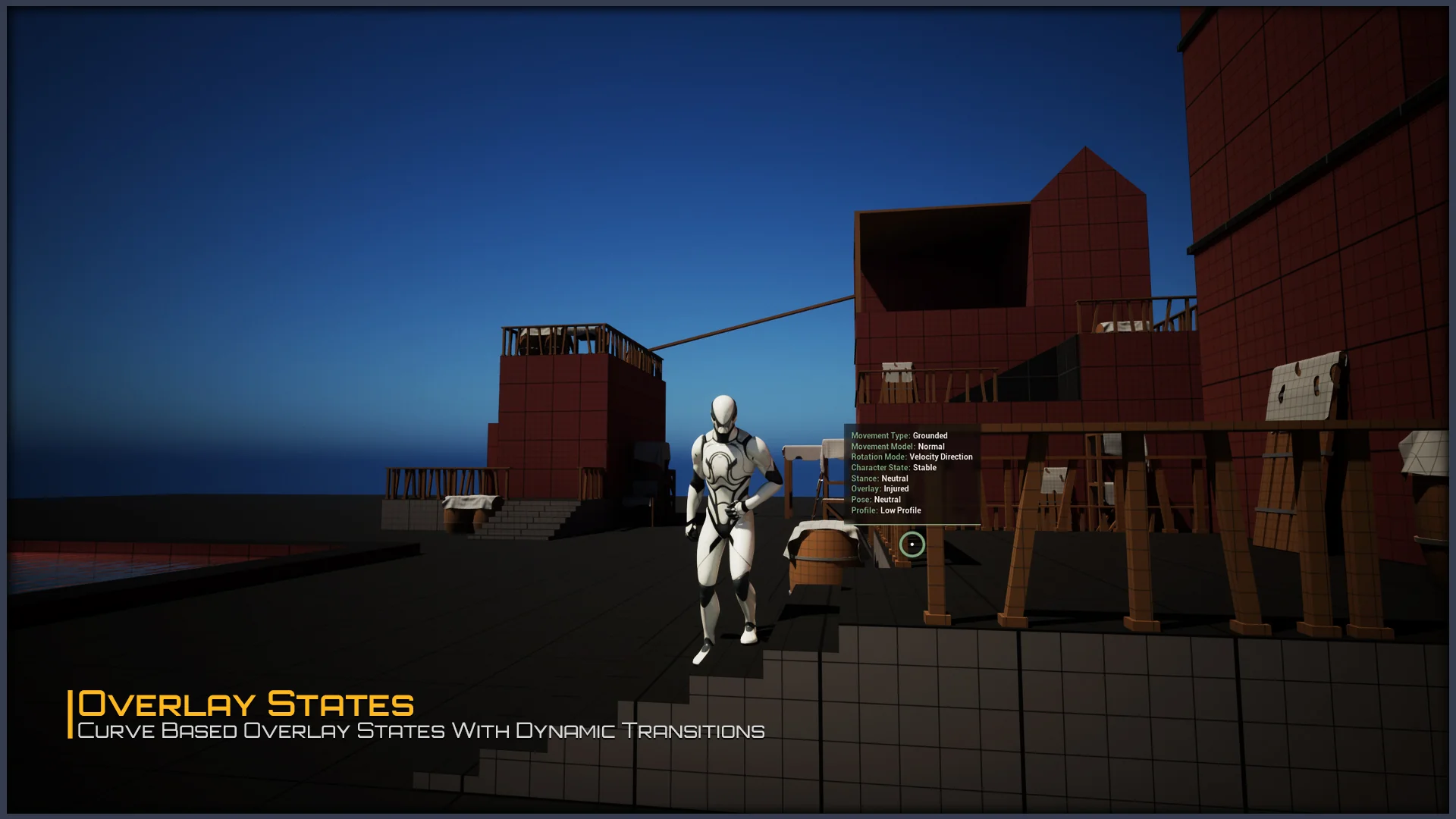
The system gives developers direct control over a granular set of movement properties across different setups. Stances, poses, overlay states, and distinct gait profiles can each be configured with dedicated numerical properties. These parameters include precise values for movement speeds, acceleration curves, deceleration rates, ground friction, and rotation rates. Because these variables are managed within unified movement models, shifting a character from a deliberate, high-friction tactical crouch to a low-friction sprint requires only configuring the respective profile settings rather than scripting custom math routines from scratch.
Animation Economy through Orientation Warping and IK
One primary objective of the package is enabling visually polished movement while operating under strict asset limitations. Dense motion libraries often introduce performance bottlenecks and extensive asset management burdens. To bypass the requirement for dozens of directional blend spaces, the system relies on game-driven procedural animation adaptation powered by distance matching, orientation warping, and inverse kinematics (IK).
The real-world implementation of this philosophy is demonstrated through the included sample locomotion setup. The example project achieves full eight-way directional movement using merely two base animations: a forward locomotion clip and a backward locomotion clip. By applying orientation warping dynamically at runtime, the system redirects character momentum and facing angle to cover diagonal and lateral navigation. Distance matching aligns the playback of these core motion cycles with the actual physical displacement of the character capsule, while IK adjusts limb placement to ground the character. The resulting motion demonstrates that extensive animation capture is not an absolute prerequisite for responsive, multi-directional navigation.
Traversal Mechanics and Swimming Movement Types
Beyond standard grounded locomotion, the framework expands character mobility through discrete movement modes introduced across engine versions. Swimming functionality is implemented as a specialized movement type, broadening the environments a player character can navigate without breaking the underlying movement state logic. This dedicated aquatic state integrates alongside existing component settings to preserve unified control handling.
Basic traversal mechanics, introduced for version 5.3, incorporate verticality and environmental navigation directly into the framework. This includes parkour-style interactions and wall running. Network replication forms a core pillar of the constructor, ensuring that player state shifts, poses, and speeds transmit cleanly across server-client architectures. A technical limitation to plan for within this traversal toolset is that wall running is currently not replicated. Developers implementing wall running in dedicated multiplayer environments must take this known constraint into account when planning server validation and networked character behavior.
Managing System States from Stances to Gait Profiles
Structuring the logic behind diverse character states is handled through an extensible hierarchy of stances, poses, and gait profiles. When building a game that requires distinct tiers of movement—such as walking, jogging, sprinting, and aiming—the framework treats each layer as a modular parameter set. Overlay states operate over base poses, allowing upper-body or stance adjustments to modify the active locomotion model without interfering with physical parameters like ground friction or turning velocity.
Because physical movement traits are modular, developers can experiment with highly differentiated mobility profiles. An armored character archetype might adopt a movement profile characterized by aggressive deceleration, low rotation rates, and limited top speeds, while an agile scout archetype uses rapid acceleration and high rotation rates. Because these values reside within the movement models and overlay profiles, tuning movement feel becomes an iterative, non-destructive process inside the component settings.
Blueprint Prerequisites and Implementation Demands
Despite the streamlined asset footprint, this asset is not built as a plug-and-play solution. Proper integration requires at least a baseline working knowledge of Unreal Engine Blueprints. The internal architecture behaves as a constructor for assembling complex, customized controllers rather than an automated drag-and-drop character. Without foundational Blueprint comprehension, tracing the data flow between component parameters, game-driven animation graphs, and state profiles can easily become confusing.
To assist developers in deconstructing its underlying systems, the package includes several practical reference resources. A playable demo allows creators to evaluate the responsiveness and feel of the locomotion firsthand. A dedicated MetaHuman example demonstrates how high-fidelity character skeletal meshes hook into the component, distance matching nodes, and orientation warping logic. Developers seeking non-player character integration can inspect the included example AI setup to observe how automated agents interact with the movement profiles. Ongoing devlogs detail structural changes, while future updates are slated to expand the library with additional movement types.
Workflow Fit and Ideal Use Cases
Ultimate Movement System serves teams and solo creators who require custom, network-aware locomotion architectures but lack the resources to produce massive motion-capture suites. It fits cleanly into projects where characters must transition smoothly between varied gaits, stances, and environmental states like swimming or basic traversal without compounding animation technical debt.
Technical designers and Blueprint developers who understand animation graphs, warping systems, and component setups will gain the most utility from the package. By treating the asset as an adaptable movement engine rather than a static template, developers can construct robust, highly tailored character mechanics suited to their specific gameplay requirements.
 Action-Adventure
 Action-Adventure
 Action-Adventure