"148d1066ed74e216"{"id":"1002951","slug":"third-person-platformer-template","title":"Third Person Platformer Template","category":"Platformer","engine":"5.3+","assetVersion":"","engineVersion":"Engine Version: 5.3+","tag":"Platformer","accent":"blue","visual":"mech","summary":"Explore how the Third Person Platformer Template provides character mechanics, enemy encounters, gameplay objectives, and extensible Blueprint objects.","platform":"Unreal Engine","indexPolicy":"index","publishedAt":"2026-11-22T07:06:13.578Z","updatedAt":"2026-11-22T07:06:13.578Z","sourceNotes":[],"fileContents":[],"compatibility":["Unreal Engine","Engine Version: 5.3+"],"featuredImage":{"alt":"Third Person Platformer Template","src":"/wp-content/uploads/published/2026/11/f4b095e61305-a5882bce-2956-463f-b51a-15f091ae6c7b-ac6b031ab8.webp"},"fileSizeBytes":96068195,"hasDownloadLink":true,"downloads":0,"terms":[{"taxonomy":"category","slug":"platformer","name":"Platformer"}],"galleryImages":[{"src":"/wp-content/uploads/published/2026/11/d9d64344ce2d-122aa275-96ea-43ea-8eb0-d684889f035f-cff21b56dc.webp","alt":"Third Person Platformer Template"},{"src":"/wp-content/uploads/published/2026/11/4ee1c8f4f975-9e71b12d-8868-43bc-85c0-3f50e10ec940-51e53cad0d.webp","alt":"Third Person Platformer Template"},{"src":"/wp-content/uploads/published/2026/11/1cab5e735b94-35ea6dc7-261a-47dd-b19c-5a01daabfdd0-fd7fe90b9f.webp","alt":"Third Person Platformer Template"},{"src":"/wp-content/uploads/published/2026/11/15f53054cc40-7e86b388-09f0-4923-96a2-2cbbbdd7b5e1-1fea582a81.webp","alt":"Third Person Platformer Template"},{"src":"/wp-content/uploads/published/2026/11/f04150bd847a-2293f682-1c34-4161-9976-a3e406a2b2fe-927a4e8304.webp","alt":"Third Person Platformer Template"},{"src":"/wp-content/uploads/published/2026/11/3a5de4265e3f-0c2de708-bf27-4b9a-88ac-563253af35f5-ed5a0f105b.webp","alt":"Third Person Platformer Template"},{"src":"/wp-content/uploads/published/2026/11/1aee3f535d12-993dc4e1-50c2-44b7-b8de-27676d00181a-d948fd273b.webp","alt":"Third Person Platformer Template"},{"src":"/wp-content/uploads/published/2026/11/8aa518f4d735-22d75e2c-b4ad-4847-b038-aec9869e1595-5a376b39e1.webp","alt":"Third Person Platformer Template"},{"src":"/wp-content/uploads/published/2026/11/7f3e7f9948f3-7fbbd808-a7a6-47d7-9616-f49817057ed1-c3b3855a63.webp","alt":"Third Person Platformer Template"}],"accessPanel":{"kind":"resource","title":"Get this resource","safetyNote":"Resources are manually reviewed before listing to improve quality and reduce obvious risks.","fileName":"Third Person Platformer Template.7z","resourceType":"Resource archive","versions":[]},"contentHtml":"\u003cp\u003eA responsive character navigates floating terrain, evades roaming hazards, and pushes toward a designated goal. In game production, establishing this moment-to-moment interaction usually requires setting up input handling, camera orientation, collision response, dynamic enemy states, and clear win conditions. The Third Person Platformer Template establishes that core cycle directly, packaging fundamental gameplay systems into an organized framework intended for rapid expansion and iteration.\u003c/p\u003e\u003cp\u003eBy pairing a standard adventure perspective with foundational mechanics, the project provides developers with an operational baseline rather than an empty environment. Creating a playable platformer from scratch involves addressing multiple interdependent disciplines at once: camera tracking must align with movement trajectories, spatial collisions must reliably support leaping and landing, and game rules must monitor player success or failure. This template consolidates those baseline responsibilities into a cohesive structure shaped by playable character mechanics, active enemies, a simple gameplay objective, and an array of objects crafted specifically to facilitate the authoring of new mechanics.\u003c/p\u003e\u003ch2\u003eCore Mechanics in the Third Person Platformer Experience\u003c/h2\u003e\u003cp\u003eThird-person games rely heavily on the visual harmony between camera framing, spatial awareness, and player locomotion. When navigating jumping puzzles, traversal gaps, or elevated structures, player input must feel immediate and predictable. The Third Person Platformer Template centers on these essential character mechanics, providing a baseline of locomotion suited to spatial negotiation and environmental traversal.\u003c/p\u003e\u003cp\u003eBy handling character control from a third-person vantage point, the template ensures that distance calculation, ledge clearance, and directional momentum function cohesively out of the box. Rather than building camera tracking and character physics parameters from scratch, developers gain an immediate baseline where trajectory, grounding, and spatial recovery work together. This third-person viewpoint gives players an unobstructed view of incoming threats and immediate terrain features, establishing the foundational clarity that platforming games require.\u003c/p\u003e\u003cp\u003eThe character mechanics also provide the bedrock for jump timing and mid-air trajectory control. In platforming setups, character responsiveness during lift-off, ascent, peak arc, and descent dictates how fair or punishing an obstacle course feels. With the core movement logic already hooked up, creators can concentrate directly on environmental scaling, determining how far platforms should be spaced, how high ledges should sit, and how quickly moving surfaces should travel relative to player velocity.\u003c/p\u003e\u003ch2\u003eStructuring Level Flow Around the Gameplay Objective\u003c/h2\u003e\u003cp\u003eA playable platformer requires purposeful tension, which the template introduces through integrated enemies and a clear gameplay objective. Objectives define the player's path through a level, transforming abstract collections of platforms into a cohesive progression challenge. Whether navigating toward an endpoint, reaching a specific threshold, or satisfying a completion parameter, the included objective structure provides a concrete framework that guides level sequencing.\u003c/p\u003e\u003cp\u003eWithout a defined goal, spatial challenges remain isolated exercises without contextual stakes. By incorporating a simple gameplay objective directly into the flow, the template establishes a clear loop of initiation, challenge, and resolution. Designers can position this objective at the climax of a traversal sequence or hide it behind a succession of timed hazards. Because the underlying logic tracks this completion milestone, extending the loop to support multi-stage progression, keys, checkpoints, or level transitions requires merely tapping into existing state triggers.\u003c/p\u003e\u003ch2\u003eAdversarial Encounters and Enemy Behavioral Roles\u003c/h2\u003e\u003cp\u003eEnemies serve as interactive impediments within the gameplay loop. Rather than leaving environments static, the inclusion of hostile elements forces the player to time jumps, calculate clearance margins, and observe patrol patterns or engagement zones. This interplay between moving hazards and character positioning is central to the adventure platforming genre.\u003c/p\u003e\u003cp\u003eHaving working enemy entities within the template allows creators to immediately test timing windows, combat or evasion scenarios, and threat density across various level configurations without having to author basic adversarial logic from zero. An enemy occupying a narrow bridge changes a straightforward sprint into a tactical pause where the player must observe movement cadence, identify safe windows, and commit to an advance. The relationship between character health, hazard collision, and enemy positioning functions out of the box, offering a dynamic counterweight to static platform surfaces.\u003c/p\u003e\u003ch2\u003eExtending Gameplay Systems with Modular Template Objects\u003c/h2\u003e\u003cp\u003eBeyond its active gameplay participants, the package places a deliberate focus on extensible architecture through Blueprint visual scripting. The system includes multiple objects that make creating new mechanics easier. In practical level design, objects rarely function in complete isolation; they interact with the player, respond to collisions, trigger state changes, and signal broader game rules.\u003c/p\u003e\u003cp\u003eThe provided helper objects function as structural blueprints for expanding interactive possibilities. By examining how these entities handle triggers, communicate with the player character, or update the objective state, creators can duplicate, alter, and scaffold novel interactions. For example, interactive elements can be adapted into switches, moving hazards, mechanical lifts, collecting pickups, or timed obstacles. Because the implementation is handled via Blueprints, every logic branch remains fully exposed, enabling designers to inspect variables, modify data flows, and connect custom events without recompiling source code.\u003c/p\u003e\u003cp\u003eThese modular objects also establish consistent communication pathways across the scene. Instead of writing custom event dispatchers or reference searches for every new prop, developers can use the existing object structures as working templates. This simplifies the creation of interactive set pieces, such as pressure plates that lower barriers, sequential switches that reveal hidden pathways, or hazard zones that reset player position upon contact.\u003c/p\u003e\u003ch2\u003eBlueprint Integration and Custom Platformer Prototyping\u003c/h2\u003e\u003cp\u003eWith its grounding in the adventure genre, the template suits projects ranging from compact vertical slice prototypes to sprawling environmental puzzle games. Adventure titles often require a blend of exploration, athletic movement, and incremental problem-solving. Because the framework already integrates character mobility, enemy presence, and goal mechanics, production teams can skip technical boilerplate and focus immediately on world geometry, pacing, and visual storytelling.\u003c/p\u003e\u003cp\u003eThe modular setup also accommodates iterative level greyboxing. Level designers can drop the template character, place enemy encounters along critical routes, position the gameplay objective at an exit point, and pepper the route with interactive objects to test pacing in minutes. If a particular jump feels too punishing or an enemy placement creates an unintended bottleneck, the foundational parameters can be tuned directly within the logic graphs. This high level of flexibility makes the toolkit equally practical for game jams, instructional study of third-person design patterns, and full-scale commercial prototyping.\u003c/p\u003e\u003cp\u003eBy unifying player mechanics, active adversaries, a distinct objective loop, and dedicated Blueprint construction objects, the Third Person Platformer Template delivers a cohesive staging ground for creators building interactive adventure experiences.\u003c/p\u003e\n\n\u003ch2\u003eMore From The Same Workflow\u003c/h2\u003e\n\u003cul\u003e\n\u003cli\u003e\u003ca href=\"https://3dcghub.com/endless-runner-mega-template/\" rel=\"noopener noreferrer\"\u003eEndless Runner Mega Template\u003c/a\u003e\u003c/li\u003e\n\u003cli\u003e\u003ca href=\"https://3dcghub.com/third-person-shooter-kit-v2-2/\" rel=\"noopener noreferrer\"\u003eThird Person Shooter Kit v2.2\u003c/a\u003e\u003c/li\u003e\n\u003cli\u003e\u003ca href=\"https://3dcghub.com/voyager-third-person-shooter-v3/\" rel=\"noopener noreferrer\"\u003eVoyager: Third Person Shooter v3\u003c/a\u003e\u003c/li\u003e\n\u003cli\u003e\u003ca href=\"https://3dcghub.com/third-person-story-adventure-template/\" rel=\"noopener noreferrer\"\u003eThird Person Story Adventure Template\u003c/a\u003e\u003c/li\u003e\n\u003cli\u003e\u003ca href=\"https://3dcghub.com/shootlikeme-unreal-engine-third-person-shooter-template/\" rel=\"noopener noreferrer\"\u003eShootLikeMe - Unreal Engine Third Person Shooter Template\u003c/a\u003e\u003c/li\u003e\n\u003c/ul\u003e","contentTextLength":8078,"navigation":{"current":19,"total":4890,"previous":{"id":"1002952","slug":"ultimate-movement-system","title":"Ultimate Movement System","category":"Action-Adventure","platform":"Unreal Engine","updatedAt":"2026-11-22T07:07:06.222Z"},"next":{"id":"14610","slug":"simple-tree-generator","title":"Simple Tree Generator","category":"Engine Tools","platform":"Unreal Engine","updatedAt":"2026-11-22T07:01:17.249Z"}},"relatedResources":[{"id":"1001803","slug":"endless-runner-mega-template","title":"Endless Runner Mega Template","category":"Platformer","engine":"5.0+","assetVersion":"","engineVersion":"Engine Version: 5.0+","tag":"Platformer","accent":"blue","visual":"mech","summary":"Explore the Endless Runner Mega Template, featuring procedural generation, character spells, dynamic difficulty scaling, and tickless Blueprint optimization.","platform":"Unreal Engine","indexPolicy":"index","publishedAt":"2026-10-21T07:54:58.391Z","updatedAt":"2026-10-21T07:54:58.391Z","sourceNotes":[],"fileContents":[],"compatibility":["Unreal Engine","Engine Version: 5.0+"],"featuredImage":{"alt":"Endless Runner Mega Template","src":"/wp-content/uploads/published/2026/10/ee153be13f3e-99a6af0a-95bb-4bdb-84cf-24cbc1f5debc-5a4dc71c0d.webp"},"fileSizeBytes":308930239,"hasDownloadLink":true,"downloads":0},{"id":"1000930","slug":"third-person-shooter-kit-v2-2","title":"Third Person Shooter Kit v2.2","category":"Shooter","engine":"5.3+","assetVersion":"Asset Version: 2.1.4","engineVersion":"Engine Version: 5.3+","tag":"Shooter","accent":"blue","visual":"mech","summary":"A 100% blueprint third-person shooter kit for UE 5.7 with motion matching, Metahuman integration, cover system, AI spawner, melee combat, and a v2.3 roadmap.","platform":"Unreal Engine","indexPolicy":"index","publishedAt":"2026-08-09T16:46:36.929Z","updatedAt":"2026-08-09T16:46:36.929Z","sourceNotes":[],"fileContents":[],"compatibility":["Unreal Engine","Asset Version: 2.1.4","Engine Version: 5.3+"],"featuredImage":{"alt":"Third Person Shooter Kit v2.2","src":"/wp-content/uploads/published/2026/08/129d7f0905b1-a404f6fb-bc6f-46c6-a1b5-7272f5ba35b7-b64197e5fd.webp"},"fileSizeBytes":7211629947,"hasDownloadLink":true,"downloads":11},{"id":"1001028","slug":"voyager-third-person-shooter-v3","title":"Voyager: Third Person Shooter v3","category":"Shooter","engine":"5.0+","assetVersion":"","engineVersion":"Engine Version: 5.0+","tag":"Shooter","accent":"blue","visual":"mech","summary":"Voyager v3.1 adds Motion Matching, GASP, and MetaHuman support to a complete Blueprint-based third-person shooter template for Unreal Engine 5.","platform":"Unreal Engine","indexPolicy":"index","publishedAt":"2026-08-23T07:15:51.381Z","updatedAt":"2026-08-23T07:15:51.381Z","sourceNotes":[],"fileContents":[],"compatibility":["Unreal Engine","Engine Version: 5.0+"],"featuredImage":{"alt":"Voyager: Third Person Shooter v3","src":"/wp-content/uploads/published/2026/08/a952d07d573f-48b41468-ba94-4442-ad62-16918e04e434-ef11e8c209.webp"},"fileSizeBytes":1533122800,"hasDownloadLink":true,"downloads":5}]}[{"id":4225,"sourceId":4225,"taxonomyId":4225,"taxonomy":"category","slug":"asset-library","name":"Asset Library","parentId":null,"count":4744,"hasChildren":true,"href":"/","seoTitle":"Free Game Assets Library | 3DCGHUB","seoDescription":"Browse free Unreal Engine, Unity, Blender assets and game development tutorials on 3DCGHUB with previews, compatibility notes, and secure downloads.","sitemapEnabled":true,"children":[{"id":4227,"sourceId":4227,"taxonomyId":4227,"taxonomy":"category","slug":"blender-add-ons-plugins","name":"Blender Add-ons \u0026 Plugins","parentId":4225,"count":10,"hasChildren":false,"href":"/category/blender-add-ons-plugins/","seoTitle":"Free Blender Add-ons \u0026 Plugins | 3DCGHUB","seoDescription":"Browse free Blender Add-ons \u0026 Plugins tools for Blender on 3DCGHUB: curated downloads with preview images, compatibility notes and secure download access.","sitemapEnabled":true},{"id":514,"sourceId":514,"taxonomyId":514,"taxonomy":"category","slug":"unity-2","name":"Unity","parentId":4225,"count":453,"hasChildren":true,"href":"/category/unity-2/","seoTitle":"Free Unity Assets | 3DCGHUB","seoDescription":"Browse free Unity resources on 3DCGHUB: curated downloads with preview images, compatibility notes and secure download access.","sitemapEnabled":true,"children":[{"id":523,"sourceId":523,"taxonomyId":523,"taxonomy":"category","slug":"2d","name":"2D","parentId":514,"count":1,"hasChildren":true,"href":"/category/2d/","seoTitle":"Free Unity 2D | 3DCGHUB","seoDescription":"Browse free 2D assets for Unity on 3DCGHUB: curated downloads with preview images, compatibility notes and secure download access.","sitemapEnabled":true},{"id":515,"sourceId":515,"taxonomyId":515,"taxonomy":"category","slug":"3d-unity-2","name":"3D","parentId":514,"count":162,"hasChildren":true,"href":"/category/3d-unity-2/","seoTitle":"Free Unity 3D Assets | 3DCGHUB","seoDescription":"Browse free 3D assets for Unity on 3DCGHUB: curated downloads with preview images, compatibility notes and secure download access.","sitemapEnabled":true},{"id":565,"sourceId":565,"taxonomyId":565,"taxonomy":"category","slug":"add-ons","name":"Add-Ons","parentId":514,"count":2,"hasChildren":false,"href":"/category/add-ons/","seoTitle":"Free Unity Add-Ons | 3DCGHUB","seoDescription":"Browse free Add-Ons assets for Unity on 3DCGHUB: curated downloads with preview images, compatibility notes and secure download access.","sitemapEnabled":true},{"id":529,"sourceId":529,"taxonomyId":529,"taxonomy":"category","slug":"audio-unity-2","name":"Audio","parentId":514,"count":1,"hasChildren":true,"href":"/category/audio-unity-2/","seoTitle":"Free Unity Audio | 3DCGHUB","seoDescription":"Browse free Audio for Unity on 3DCGHUB: curated downloads with preview images, compatibility notes and secure download access.","sitemapEnabled":true},{"id":557,"sourceId":557,"taxonomyId":557,"taxonomy":"category","slug":"templates","name":"Templates","parentId":514,"count":36,"hasChildren":true,"href":"/category/templates/","seoTitle":"Free Unity Templates | 3DCGHUB","seoDescription":"Browse free Unity project templates on 3DCGHUB. Starter kits with previews, compatibility notes, and secure download access.","sitemapEnabled":true},{"id":533,"sourceId":533,"taxonomyId":533,"taxonomy":"category","slug":"tools-unity-2","name":"Tools","parentId":514,"count":0,"hasChildren":true,"href":"/category/tools-unity-2/","sitemapEnabled":true},{"id":554,"sourceId":554,"taxonomyId":554,"taxonomy":"category","slug":"vfx-unity-2","name":"VFX","parentId":514,"count":4,"hasChildren":true,"href":"/category/vfx-unity-2/","seoTitle":"Free Unity VFX | 3DCGHUB","seoDescription":"Browse free VFX for Unity on 3DCGHUB: curated downloads with preview images, compatibility notes and secure download access.","sitemapEnabled":true}]},{"id":511,"sourceId":511,"taxonomyId":511,"taxonomy":"category","slug":"unreal-engine-2","name":"Unreal Engine","parentId":4225,"count":4282,"hasChildren":true,"href":"/category/unreal-engine-2/","seoTitle":"Free Unreal Engine Assets | 3DCGHUB","seoDescription":"Browse free Unreal Engine resources on 3DCGHUB: curated downloads with preview images, compatibility notes and secure download access.","sitemapEnabled":true,"children":[{"id":54,"sourceId":54,"taxonomyId":54,"taxonomy":"category","slug":"3d","name":"3D","parentId":511,"count":2428,"hasChildren":true,"href":"/category/3d/","seoTitle":"Free Unreal Engine 3D | 3DCGHUB","seoDescription":"Browse free 3D assets for Unreal Engine on 3DCGHUB: curated downloads with preview images, compatibility notes and secure download access.","sitemapEnabled":true},{"id":441,"sourceId":441,"taxonomyId":441,"taxonomy":"category","slug":"animations","name":"Animations","parentId":511,"count":245,"hasChildren":true,"href":"/category/animations/","seoTitle":"Free Unreal Engine Animations | 3DCGHUB","seoDescription":"Browse free Animations for Unreal Engine on 3DCGHUB: curated downloads with preview images, compatibility notes and secure download access.","sitemapEnabled":true},{"id":446,"sourceId":446,"taxonomyId":446,"taxonomy":"category","slug":"audio","name":"Audio","parentId":511,"count":63,"hasChildren":true,"href":"/category/audio/","seoTitle":"Free Unreal Engine Audio Resources | 3DCGHUB","seoDescription":"Browse free Unreal Engine audio resources including sound effects, voices, dialogue, and ambient sounds. Curated free downloads on 3DCGHUB.","sitemapEnabled":true},{"id":466,"sourceId":466,"taxonomyId":466,"taxonomy":"category","slug":"game-systems","name":"Game Systems","parentId":511,"count":356,"hasChildren":true,"href":"/category/game-systems/","seoTitle":"Free Unreal Engine Game Systems | 3DCGHUB","seoDescription":"Browse free Game Systems tools for Unreal Engine on 3DCGHUB: curated downloads with preview images, compatibility notes and secure download access.","sitemapEnabled":true},{"id":478,"sourceId":478,"taxonomyId":478,"taxonomy":"category","slug":"game-templates","name":"Game Templates","parentId":511,"count":150,"hasChildren":true,"href":"/category/game-templates/","seoTitle":"Free Unreal Engine Game Templates | 3DCGHUB","seoDescription":"Browse free Game Templates for Unreal Engine on 3DCGHUB: curated downloads with preview images, compatibility notes and secure download access.","sitemapEnabled":true},{"id":432,"sourceId":432,"taxonomyId":432,"taxonomy":"category","slug":"hdri","name":"HDRI","parentId":511,"count":6,"hasChildren":true,"href":"/category/hdri/","seoTitle":"Free Unreal Engine HDRI | 3DCGHUB","seoDescription":"Browse free Unreal Engine HDRI skies and lighting maps on 3DCGHUB. Environment lighting with previews and secure downloads.","sitemapEnabled":true},{"id":228,"sourceId":228,"taxonomyId":228,"taxonomy":"category","slug":"material-and-textures","name":"Material \u0026 Textures","parentId":511,"count":172,"hasChildren":true,"href":"/category/material-and-textures/","seoTitle":"Free Unreal Engine Material \u0026 Textures | 3DCGHUB","seoDescription":"Browse free Material \u0026 Textures for Unreal Engine on 3DCGHUB: curated downloads with preview images, compatibility notes and secure download access.","sitemapEnabled":true},{"id":298,"sourceId":298,"taxonomyId":298,"taxonomy":"category","slug":"sprites-and-flipbooks","name":"Sprites \u0026 Flipbooks","parentId":511,"count":17,"hasChildren":true,"href":"/category/sprites-and-flipbooks/","seoTitle":"Free Unreal Engine Sprites \u0026 Flipbooks | 3DCGHUB","seoDescription":"Browse free Sprites \u0026 Flipbooks assets for Unreal Engine on 3DCGHUB: curated downloads with preview images, compatibility notes and secure download access.","sitemapEnabled":true},{"id":489,"sourceId":489,"taxonomyId":489,"taxonomy":"category","slug":"tools-and-plugins","name":"Tools \u0026 Plugins","parentId":511,"count":390,"hasChildren":true,"href":"/category/tools-and-plugins/","seoTitle":"Free Unreal Engine Tools \u0026 Plugins | 3DCGHUB","seoDescription":"Browse free Tools \u0026 Plugins for Unreal Engine on 3DCGHUB: curated downloads with preview images, compatibility notes and secure download access.","sitemapEnabled":true},{"id":459,"sourceId":459,"taxonomyId":459,"taxonomy":"category","slug":"ui","name":"UI","parentId":511,"count":43,"hasChildren":true,"href":"/category/ui/","seoTitle":"Free Unreal Engine UI | 3DCGHUB","seoDescription":"Browse free UI for Unreal Engine on 3DCGHUB: curated downloads with preview images, compatibility notes and secure download access.","sitemapEnabled":true},{"id":450,"sourceId":450,"taxonomyId":450,"taxonomy":"category","slug":"vfx","name":"VFX","parentId":511,"count":412,"hasChildren":true,"href":"/category/vfx/","seoTitle":"Free Unreal Engine VFX | 3DCGHUB","seoDescription":"Browse free VFX for Unreal Engine on 3DCGHUB: curated downloads with preview images, compatibility notes and secure download access.","sitemapEnabled":true}]}]},{"id":4222,"sourceId":4222,"taxonomyId":4222,"taxonomy":"category","slug":"tutorial-library","name":"Tutorial Library","parentId":null,"count":117,"hasChildren":false,"href":"/tutorials/","seoTitle":"Free Game Development Tutorial Library | 3DCGHUB","seoDescription":"Browse free game development tutorials for Unreal Engine, Unity, Blender, and more on 3DCGHUB with practical workflows and secure downloads.","sitemapEnabled":true}]
Resource screenshots
1 / 9
Join our channel
Follow 3DCGHUB on Telegram for new resource drops, migration updates, and community notices.
Resources are manually reviewed before listing to improve quality and reduce obvious risks.
Reviewed archive
Platformer
Third Person Platformer Template
Explore how the Third Person Platformer Template provides character mechanics, enemy encounters, gameplay objectives, and extensible Blueprint objects.
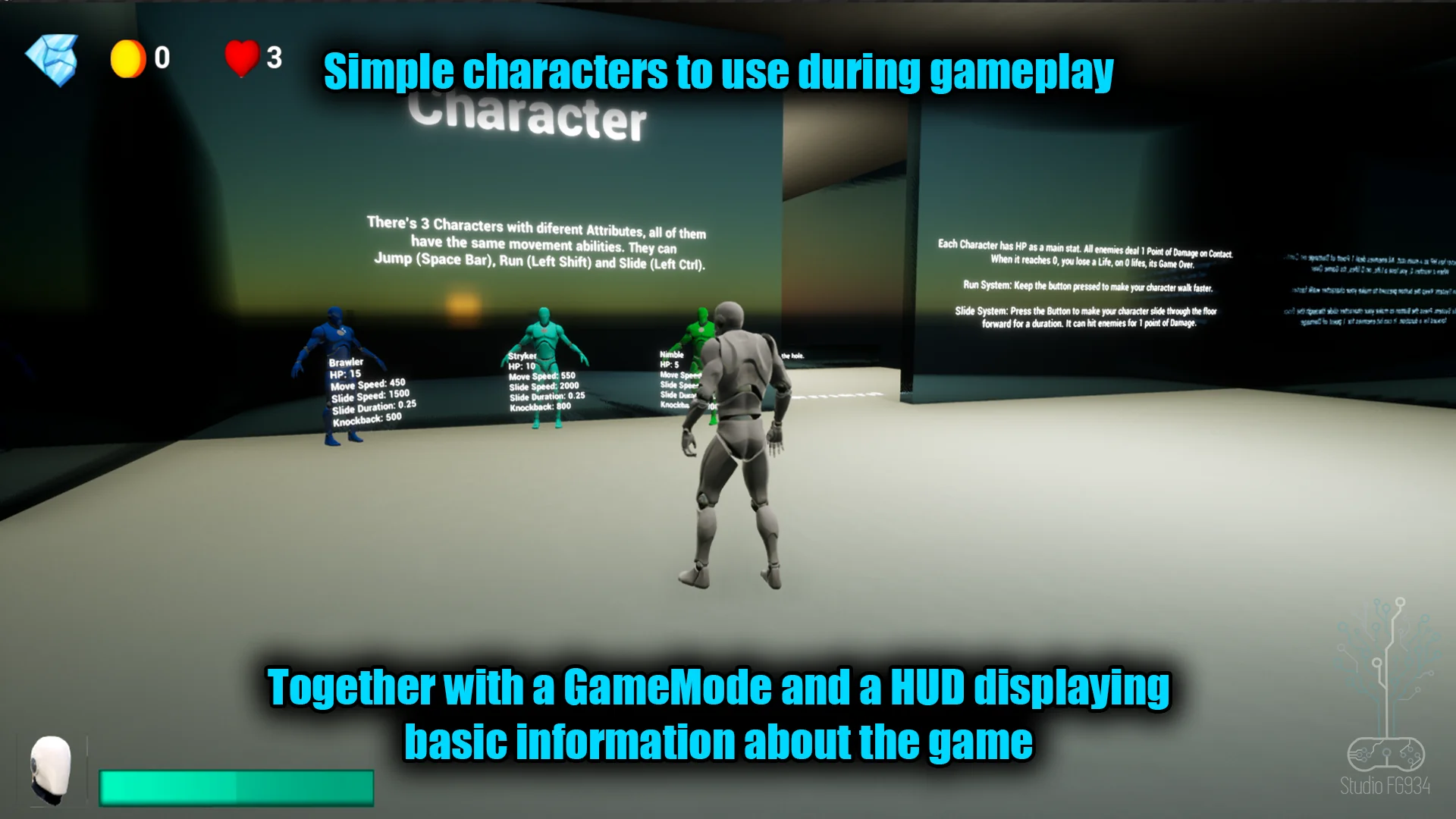
A responsive character navigates floating terrain, evades roaming hazards, and pushes toward a designated goal. In game production, establishing this moment-to-moment interaction usually requires setting up input handling, camera orientation, collision response, dynamic enemy states, and clear win conditions. The Third Person Platformer Template establishes that core cycle directly, packaging fundamental gameplay systems into an organized framework intended for rapid expansion and iteration.
By pairing a standard adventure perspective with foundational mechanics, the project provides developers with an operational baseline rather than an empty environment. Creating a playable platformer from scratch involves addressing multiple interdependent disciplines at once: camera tracking must align with movement trajectories, spatial collisions must reliably support leaping and landing, and game rules must monitor player success or failure. This template consolidates those baseline responsibilities into a cohesive structure shaped by playable character mechanics, active enemies, a simple gameplay objective, and an array of objects crafted specifically to facilitate the authoring of new mechanics.
Core Mechanics in the Third Person Platformer Experience
Third-person games rely heavily on the visual harmony between camera framing, spatial awareness, and player locomotion. When navigating jumping puzzles, traversal gaps, or elevated structures, player input must feel immediate and predictable. The Third Person Platformer Template centers on these essential character mechanics, providing a baseline of locomotion suited to spatial negotiation and environmental traversal.
By handling character control from a third-person vantage point, the template ensures that distance calculation, ledge clearance, and directional momentum function cohesively out of the box. Rather than building camera tracking and character physics parameters from scratch, developers gain an immediate baseline where trajectory, grounding, and spatial recovery work together. This third-person viewpoint gives players an unobstructed view of incoming threats and immediate terrain features, establishing the foundational clarity that platforming games require.
The character mechanics also provide the bedrock for jump timing and mid-air trajectory control. In platforming setups, character responsiveness during lift-off, ascent, peak arc, and descent dictates how fair or punishing an obstacle course feels. With the core movement logic already hooked up, creators can concentrate directly on environmental scaling, determining how far platforms should be spaced, how high ledges should sit, and how quickly moving surfaces should travel relative to player velocity.
Structuring Level Flow Around the Gameplay Objective
A playable platformer requires purposeful tension, which the template introduces through integrated enemies and a clear gameplay objective. Objectives define the player's path through a level, transforming abstract collections of platforms into a cohesive progression challenge. Whether navigating toward an endpoint, reaching a specific threshold, or satisfying a completion parameter, the included objective structure provides a concrete framework that guides level sequencing.
Without a defined goal, spatial challenges remain isolated exercises without contextual stakes. By incorporating a simple gameplay objective directly into the flow, the template establishes a clear loop of initiation, challenge, and resolution. Designers can position this objective at the climax of a traversal sequence or hide it behind a succession of timed hazards. Because the underlying logic tracks this completion milestone, extending the loop to support multi-stage progression, keys, checkpoints, or level transitions requires merely tapping into existing state triggers.
Adversarial Encounters and Enemy Behavioral Roles
Enemies serve as interactive impediments within the gameplay loop. Rather than leaving environments static, the inclusion of hostile elements forces the player to time jumps, calculate clearance margins, and observe patrol patterns or engagement zones. This interplay between moving hazards and character positioning is central to the adventure platforming genre.
Having working enemy entities within the template allows creators to immediately test timing windows, combat or evasion scenarios, and threat density across various level configurations without having to author basic adversarial logic from zero. An enemy occupying a narrow bridge changes a straightforward sprint into a tactical pause where the player must observe movement cadence, identify safe windows, and commit to an advance. The relationship between character health, hazard collision, and enemy positioning functions out of the box, offering a dynamic counterweight to static platform surfaces.
Extending Gameplay Systems with Modular Template Objects
Beyond its active gameplay participants, the package places a deliberate focus on extensible architecture through Blueprint visual scripting. The system includes multiple objects that make creating new mechanics easier. In practical level design, objects rarely function in complete isolation; they interact with the player, respond to collisions, trigger state changes, and signal broader game rules.
The provided helper objects function as structural blueprints for expanding interactive possibilities. By examining how these entities handle triggers, communicate with the player character, or update the objective state, creators can duplicate, alter, and scaffold novel interactions. For example, interactive elements can be adapted into switches, moving hazards, mechanical lifts, collecting pickups, or timed obstacles. Because the implementation is handled via Blueprints, every logic branch remains fully exposed, enabling designers to inspect variables, modify data flows, and connect custom events without recompiling source code.
These modular objects also establish consistent communication pathways across the scene. Instead of writing custom event dispatchers or reference searches for every new prop, developers can use the existing object structures as working templates. This simplifies the creation of interactive set pieces, such as pressure plates that lower barriers, sequential switches that reveal hidden pathways, or hazard zones that reset player position upon contact.
Blueprint Integration and Custom Platformer Prototyping
With its grounding in the adventure genre, the template suits projects ranging from compact vertical slice prototypes to sprawling environmental puzzle games. Adventure titles often require a blend of exploration, athletic movement, and incremental problem-solving. Because the framework already integrates character mobility, enemy presence, and goal mechanics, production teams can skip technical boilerplate and focus immediately on world geometry, pacing, and visual storytelling.
The modular setup also accommodates iterative level greyboxing. Level designers can drop the template character, place enemy encounters along critical routes, position the gameplay objective at an exit point, and pepper the route with interactive objects to test pacing in minutes. If a particular jump feels too punishing or an enemy placement creates an unintended bottleneck, the foundational parameters can be tuned directly within the logic graphs. This high level of flexibility makes the toolkit equally practical for game jams, instructional study of third-person design patterns, and full-scale commercial prototyping.
By unifying player mechanics, active adversaries, a distinct objective loop, and dedicated Blueprint construction objects, the Third Person Platformer Template delivers a cohesive staging ground for creators building interactive adventure experiences.
 Platformer
 Shooter
 Shooter