"26aaab8a5d5ed4fc"{"id":"1001028","slug":"voyager-third-person-shooter-v3","title":"Voyager: Third Person Shooter v3","category":"Shooter","engine":"5.0+","assetVersion":"","engineVersion":"Engine Version: 5.0+","tag":"Shooter","accent":"blue","visual":"mech","summary":"Voyager v3.1 adds Motion Matching, GASP, and MetaHuman support to a complete Blueprint-based third-person shooter template for Unreal Engine 5.","platform":"Unreal Engine","publishedAt":"2026-08-23T07:15:51.381Z","updatedAt":"2026-08-23T07:15:51.381Z","sourceNotes":[],"fileContents":[],"compatibility":["Unreal Engine","Engine Version: 5.0+"],"featuredImage":{"alt":"Voyager: Third Person Shooter v3","src":"/wp-content/uploads/published/2026/08/a952d07d573f-48b41468-ba94-4442-ad62-16918e04e434-ef11e8c209.webp"},"hasDownloadLink":true,"downloads":3,"terms":[{"taxonomy":"category","slug":"shooter","name":"Shooter"}],"galleryImages":[{"src":"/wp-content/uploads/published/2026/08/f5a9fb096d07-c476c9d5-08ce-46fb-bbb1-74c602dbbc77-99573bc161.webp","alt":"Voyager: Third Person Shooter v3"},{"src":"/wp-content/uploads/published/2026/08/f23e164b50d5-4047e5fa-af3e-4d7d-8dcd-f47e0975d143-4f249aaed7.webp","alt":"Voyager: Third Person Shooter v3"},{"src":"/wp-content/uploads/published/2026/08/6231204e2da3-9c783bc9-8ca9-4a67-9e64-48cc594bdd4f-fb3bf5319a.webp","alt":"Voyager: Third Person Shooter v3"},{"src":"/wp-content/uploads/published/2026/08/850bb51ef57c-41d17d7f-faf3-439a-bf29-da6341fb663f-c45052b872.webp","alt":"Voyager: Third Person Shooter v3"},{"src":"/wp-content/uploads/published/2026/08/6dcf15103741-b23d1ff1-1659-4d7f-bdb6-a81a05582517-776fc8227c.webp","alt":"Voyager: Third Person Shooter v3"},{"src":"/wp-content/uploads/published/2026/08/72c6567f6262-d1436caf-e0a9-428b-8a0c-0294f11135f8-5653f4f580.webp","alt":"Voyager: Third Person Shooter v3"},{"src":"/wp-content/uploads/published/2026/08/705ae074bf8f-2d65c3a4-9781-4bea-8b56-5106606275a7-48d49d7565.webp","alt":"Voyager: Third Person Shooter v3"},{"src":"/wp-content/uploads/published/2026/08/482d43d6ef3e-e34ea5f4-2895-425f-81b7-6cb9b8f708ef-8d7bba05f7.webp","alt":"Voyager: Third Person Shooter v3"},{"src":"/wp-content/uploads/published/2026/08/af0d90519061-52c85edf-3134-4397-b1a0-c88a4ad6ea92-dc14afb3c3.webp","alt":"Voyager: Third Person Shooter v3"},{"src":"/wp-content/uploads/published/2026/08/2977a3dbc9ab-4d5ec779-6678-412f-bec1-b2081307b666-de4f11f751.webp","alt":"Voyager: Third Person Shooter v3"}],"accessPanel":{"kind":"resource","title":"Download this resource","eyebrow":"Free Download","message":"Log in or create a free account to start your download.","fileName":"Voyager Third Person Shooter v3.7z","safetyNote":"Resources are manually reviewed before listing to improve quality and reduce obvious risks.","actionLabel":"Download Free","resourceType":"Resource archive"},"contentHtml":"\u003cp\u003eStarting a third-person shooter in Unreal Engine 5 usually means assembling movement, camera, shooting, cover, health, inventory, and objectives from scratch. Voyager v3.1 tries to remove that setup phase with a complete Blueprint-based template that has been showcased twice by Epic Games. The new update pushes the framework further with Motion-Matching, Game Animation Sample Project (GASP) integration, and MetaHuman support, while keeping the whole thing 100% Blueprint.\u003c/p\u003e \u003ch2\u003eThe v3.1 Animation Overhaul: Motion Matching, GASP, and MetaHuman\u003c/h2\u003e \u003cp\u003eVoyager v3.1 is a major update focused on animation. It introduces Motion Matching, which becomes available starting with v3.1 for Unreal Engine 5.5 through 5.8. The integration of Epic's Game Animation Sample Project (GASP) gives the template a reference locomotion set, and MetaHuman integration opens up higher-fidelity character faces and bodies. Beyond the headline additions, the update includes a large batch of animation improvements that touch the way characters move, aim, and react in combat.\u003c/p\u003e \u003cp\u003eBecause Voyager is built entirely in Blueprints, the animation logic stays accessible for modification. You're not digging through C++ code to adjust how the motion-matching controller behaves; instead, the loops and state logic are visible in the Blueprint graph, which fits the template's educational design goal.\u003c/p\u003e \u003ch2\u003eBlueprint-First Design with 660+ Blueprints\u003c/h2\u003e \u003cp\u003eThe template contains more than 660 Blueprints. The developer describes the design as educational, with tons of examples, and the whole project is handcrafted rather than AI-generated. For developers who want to learn how a systemic shooter framework goes together, these Blueprints serve as a library of patterns for character setup, interaction, AI, UI, and more. The sheer number of Blueprints also means most gameplay logic is already separated into reusable pieces rather than buried in one monolithic character class.\u003c/p\u003e \u003cp\u003eVoyager is intended to be the base project. The developer notes that it is not meant to be migrated into an existing project; instead, the recommended approach is to start from Voyager and bring your own assets and systems into it. That structure lets you cherry-pick individual systems—like the objective manager or the dialogue UI—while still having the full framework available when you need it.\u003c/p\u003e \u003ch2\u003eThe Shooter Systems: Cover, Objectives, Inventory, and Combat\u003c/h2\u003e \u003cp\u003eThe feature set mirrors what a full shooter needs in production. A modular cover system allows characters to snap to walls and shoot from cover. An objective system tracks tasks and includes off-screen indicator support, so players can be guided toward goals even when the objective is not in view. The view can toggle between third-person and first-person, and a migratable settings menu ships with support for the UMG Input System Addon.\u003c/p\u003e \u003cp\u003eCombat includes firearms and melee with an upgrade system, 9+ weapon types, grenades, laser sights, and an ability system. AI is driven by Behavior Trees. Inventory and equipment manage weapons, armor, healing items, and ammo. There's a stats and damage system for health and armor, an interaction system for using, picking up, looting, and talking, plus save and load support. Gamepad input is covered for both gameplay and UI, making controller testing straightforward from the start.\u003c/p\u003e \u003ch2\u003eModular Characters, Dialogue, and Project Structure\u003c/h2\u003e \u003cp\u003eCharacters are built with separated mesh parts and a Blueprint config, meaning you can swap armor pieces, headgear, and other parts without rebuilding the character class. This approach suits games that rely on customizing loadouts or visual equipment changes. The dialogue system is UI-driven and works with stats and choices, giving narrative projects a way to hook gameplay values into conversations and let players feel the consequences of their dialogue decisions.\u003c/p\u003e \u003cp\u003eVoyager pulls in free assets from Epic Games, including Game Animation Sample Project, Scifi Hallway, Lyra, Showdown VR Demo, Infiltrator Demo, Soul City, Subway Sequencer, Action RPG, Blueprints, Shooter Game, Paragon, Content Examples, Infinity Blade: Weapons, Realistic Rendering, UI Material Lab, and the Animation Starter Pack. All of the assets seen in the trailer and screenshots are included in the project file, so there's no gap between the presentation and the actual content.\u003c/p\u003e \u003ch2\u003eVersion Notes and Update Cadence\u003c/h2\u003e \u003cp\u003eVersion compatibility is one of the first things to check before adopting a template. Voyager supports Unreal Engine 5.0 through 5.3 up to v2.9.3, UE 5.4 up to v3.0.6, and UE 5.5 through 5.8 with the latest version. Motion Matching is limited to the UE 5.5–5.8 branch, starting with v3.1. If you're working on an older engine version, you'll be on an earlier Voyager release. The developer also advises backing up your project before updating, since the template is constantly evolving with each engine generation.\u003c/p\u003e \u003ch2\u003ePlayable Demos, Tutorials, and Community Resources\u003c/h2\u003e \u003cp\u003eA v3.1.3 playable demo is available with the original project assets, and a second demo swaps in ZeroArtProject 3D models. Video showcases include a 2:32 main trailer and a 4:50 gameplay video. The support material covers step-by-step video tutorials, written documentation, and a Discord community. Tutorial walkthroughs cover creating a level from scratch, adding a character, using the Objective Manager, and working with screen indicators—so even a new Unreal user can get oriented without guessing.\u003c/p\u003e \u003cp\u003eVoyager carries a 4.9 rating from over 103 reviews. Its design targets rapid prototyping and scalable game development, from game jams to commercial releases. The developer positions it as a fit for RPGs, tactical shooters, and story-driven projects. With the v3.1 animation upgrade, the template now gives a production-ready base that keeps both character control and the underlying systems in Blueprint land, which means a smaller barrier to entry for teams that want to focus on game design rather than engine plumbing.\u003c/p\u003e\n\n\u003ch2\u003eExplore Similar Assets\u003c/h2\u003e\n\u003cul\u003e\n\u003cli\u003e\u003ca href=\"https://3dcghub.com/third-person-shooter-kit-v2-2/\" title=\"Third Person Shooter Kit v2.2\"\u003eThird Person Shooter Kit v2.2\u003c/a\u003e\u003c/li\u003e\n\u003cli\u003e\u003ca href=\"https://3dcghub.com/shootlikeme-unreal-engine-third-person-shooter-template/\" title=\"ShootLikeMe - Unreal Engine Third Person Shooter Template\"\u003eShootLikeMe - Unreal Engine Third Person Shooter Template\u003c/a\u003e\u003c/li\u003e\n\u003cli\u003e\u003ca href=\"https://3dcghub.com/infected-multiplayer-zombie-survival-third-person-shooter-template-by-kekdot/\" title=\"Infected - Multiplayer Zombie Survival Third Person Shooter Template - By Kekdot\"\u003eInfected - Multiplayer Zombie Survival Third Person Shooter Template - By Kekdot\u003c/a\u003e\u003c/li\u003e\n\u003cli\u003e\u003ca href=\"https://3dcghub.com/definitive-fps-kit/\" title=\"DEFINITIVE FPS KIT\"\u003eDEFINITIVE FPS KIT\u003c/a\u003e\u003c/li\u003e\n\u003cli\u003e\u003ca href=\"https://3dcghub.com/first-person-shooter-kit/\" title=\"First Person Shooter Kit\"\u003eFirst Person Shooter Kit\u003c/a\u003e\u003c/li\u003e\n\u003c/ul\u003e","contentTextLength":6189,"navigation":{"current":490,"total":3400,"previous":{"id":"1001029","slug":"smart-spline-generator","title":"Smart Spline Generator","category":"Procedural Systems","platform":"Unreal Engine","updatedAt":"2026-08-23T12:07:57.773Z"},"next":{"id":"1001027","slug":"vehicle-variety-first-person-vehicle-interaction-system-fpvis","title":"Vehicle Variety First Person Vehicle Interaction System (FPVIS)","category":"Vehicles \u0026 Transportation","platform":"Unreal Engine","updatedAt":"2026-08-23T06:31:45.549Z"}},"relatedResources":[{"id":"1000930","slug":"third-person-shooter-kit-v2-2","title":"Third Person Shooter Kit v2.2","category":"Shooter","engine":"5.3+","assetVersion":"Asset Version: 2.1.4","engineVersion":"Engine Version: 5.3+","tag":"Shooter","accent":"blue","visual":"mech","summary":"A 100% blueprint third-person shooter kit for UE 5.7 with motion matching, Metahuman integration, cover system, AI spawner, melee combat, and a v2.3 roadmap.","platform":"Unreal Engine","publishedAt":"2026-08-09T16:46:36.929Z","updatedAt":"2026-08-09T16:46:36.929Z","sourceNotes":[],"fileContents":[],"compatibility":["Unreal Engine","Asset Version: 2.1.4","Engine Version: 5.3+"],"featuredImage":{"alt":"Third Person Shooter Kit v2.2","src":"/wp-content/uploads/published/2026/08/129d7f0905b1-a404f6fb-bc6f-46c6-a1b5-7272f5ba35b7-b64197e5fd.webp"},"hasDownloadLink":true,"downloads":6},{"id":"25145","slug":"shootlikeme-unreal-engine-third-person-shooter-template","title":"ShootLikeMe - Unreal Engine Third Person Shooter Template","category":"Shooter","engine":"5.5+","assetVersion":"Engine version: 5.5+","engineVersion":"","tag":"Shooter","accent":"blue","visual":"audio","summary":"This third-person shooter template brings together working firearms, grenades, enemy AI, and battlefield systems in one Unreal Engine project. It is shaped for projects that need more than a basic character setup and already includes the pieces for faction-...","platform":"Unreal Engine","publishedAt":"2026-04-19T11:43:36.000Z","updatedAt":"2026-04-20T06:12:32.000Z","sourceNotes":[],"fileContents":[],"compatibility":["Unreal Engine","Engine version: 5.5+"],"featuredImage":{"alt":"ShootLikeMe - Unreal Engine Third Person Shooter Template","src":"https://3dcghub.com/wp-content/uploads/2026/04/b068b2952629_1.webp"},"hasDownloadLink":true,"downloads":8},{"id":"12066","slug":"infected-multiplayer-zombie-survival-third-person-shooter-template-by-kekdot","title":"Infected - Multiplayer Zombie Survival Third Person Shooter Template - By Kekdot","category":"Shooter","engine":"5.2+","assetVersion":"Engine version: 5.2+","engineVersion":"5.0","tag":"Shooter","accent":"blue","visual":"mech","summary":"Launch your game development journey with this comprehensive multiplayer zombie survival template. It features full match flow logic, shooter mechanics, and replicated gameplay actors for a seamless experience.","platform":"Unreal Engine","publishedAt":"2026-03-06T16:43:34.000Z","updatedAt":"2026-04-19T15:48:04.000Z","sourceNotes":[],"fileContents":[],"compatibility":["Unreal Engine","Engine version: 5.2+"],"featuredImage":{"alt":"Infected - Multiplayer Zombie Survival Third Person Shooter Template - By Kekdot","src":"https://3dcghub.com/wp-content/uploads/2026/03/bf7b5670-4dc2-4918-a33d-e50c42132107.webp"},"hasDownloadLink":true,"downloads":2}]}
Shooter
Voyager: Third Person Shooter v3
Voyager v3.1 adds Motion Matching, GASP, and MetaHuman support to a complete Blueprint-based third-person shooter template for Unreal Engine 5.
Category:Unreal Engine,ShooterPlatform: Unreal EngineEngine Version: 5.0+Published: Aug 23, 2026
Shooter
Resource overview
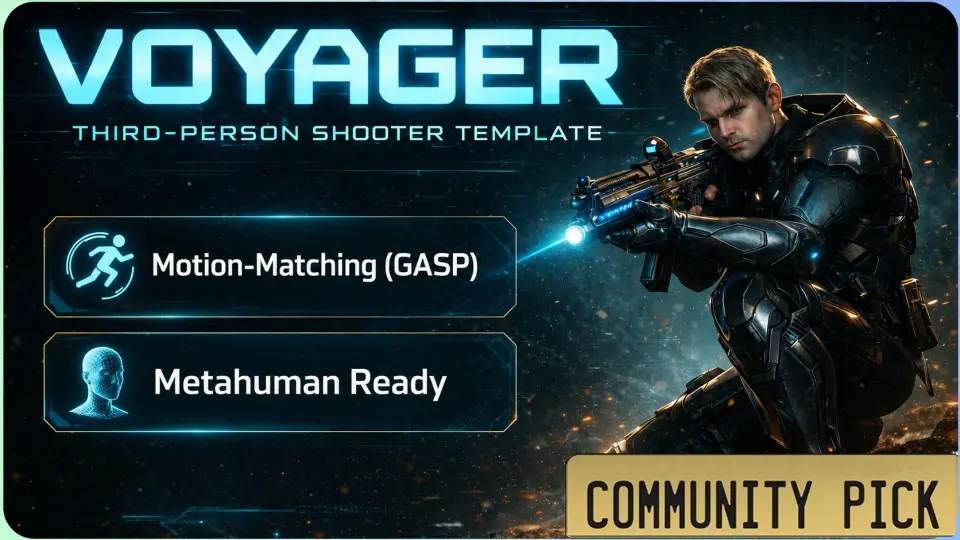
Starting a third-person shooter in Unreal Engine 5 usually means assembling movement, camera, shooting, cover, health, inventory, and objectives from scratch. Voyager v3.1 tries to remove that setup phase with a complete Blueprint-based template that has been showcased twice by Epic Games. The new update pushes the framework further with Motion-Matching, Game Animation Sample Project (GASP) integration, and MetaHuman support, while keeping the whole thing 100% Blueprint.
The v3.1 Animation Overhaul: Motion Matching, GASP, and MetaHuman
Voyager v3.1 is a major update focused on animation. It introduces Motion Matching, which becomes available starting with v3.1 for Unreal Engine 5.5 through 5.8. The integration of Epic's Game Animation Sample Project (GASP) gives the template a reference locomotion set, and MetaHuman integration opens up higher-fidelity character faces and bodies. Beyond the headline additions, the update includes a large batch of animation improvements that touch the way characters move, aim, and react in combat.
Because Voyager is built entirely in Blueprints, the animation logic stays accessible for modification. You're not digging through C++ code to adjust how the motion-matching controller behaves; instead, the loops and state logic are visible in the Blueprint graph, which fits the template's educational design goal.
Blueprint-First Design with 660+ Blueprints
The template contains more than 660 Blueprints. The developer describes the design as educational, with tons of examples, and the whole project is handcrafted rather than AI-generated. For developers who want to learn how a systemic shooter framework goes together, these Blueprints serve as a library of patterns for character setup, interaction, AI, UI, and more. The sheer number of Blueprints also means most gameplay logic is already separated into reusable pieces rather than buried in one monolithic character class.
Voyager is intended to be the base project. The developer notes that it is not meant to be migrated into an existing project; instead, the recommended approach is to start from Voyager and bring your own assets and systems into it. That structure lets you cherry-pick individual systems—like the objective manager or the dialogue UI—while still having the full framework available when you need it.
The Shooter Systems: Cover, Objectives, Inventory, and Combat
The feature set mirrors what a full shooter needs in production. A modular cover system allows characters to snap to walls and shoot from cover. An objective system tracks tasks and includes off-screen indicator support, so players can be guided toward goals even when the objective is not in view. The view can toggle between third-person and first-person, and a migratable settings menu ships with support for the UMG Input System Addon.
Combat includes firearms and melee with an upgrade system, 9+ weapon types, grenades, laser sights, and an ability system. AI is driven by Behavior Trees. Inventory and equipment manage weapons, armor, healing items, and ammo. There's a stats and damage system for health and armor, an interaction system for using, picking up, looting, and talking, plus save and load support. Gamepad input is covered for both gameplay and UI, making controller testing straightforward from the start.
Modular Characters, Dialogue, and Project Structure
Characters are built with separated mesh parts and a Blueprint config, meaning you can swap armor pieces, headgear, and other parts without rebuilding the character class. This approach suits games that rely on customizing loadouts or visual equipment changes. The dialogue system is UI-driven and works with stats and choices, giving narrative projects a way to hook gameplay values into conversations and let players feel the consequences of their dialogue decisions.
Voyager pulls in free assets from Epic Games, including Game Animation Sample Project, Scifi Hallway, Lyra, Showdown VR Demo, Infiltrator Demo, Soul City, Subway Sequencer, Action RPG, Blueprints, Shooter Game, Paragon, Content Examples, Infinity Blade: Weapons, Realistic Rendering, UI Material Lab, and the Animation Starter Pack. All of the assets seen in the trailer and screenshots are included in the project file, so there's no gap between the presentation and the actual content.
Version Notes and Update Cadence
Version compatibility is one of the first things to check before adopting a template. Voyager supports Unreal Engine 5.0 through 5.3 up to v2.9.3, UE 5.4 up to v3.0.6, and UE 5.5 through 5.8 with the latest version. Motion Matching is limited to the UE 5.5–5.8 branch, starting with v3.1. If you're working on an older engine version, you'll be on an earlier Voyager release. The developer also advises backing up your project before updating, since the template is constantly evolving with each engine generation.
Playable Demos, Tutorials, and Community Resources
A v3.1.3 playable demo is available with the original project assets, and a second demo swaps in ZeroArtProject 3D models. Video showcases include a 2:32 main trailer and a 4:50 gameplay video. The support material covers step-by-step video tutorials, written documentation, and a Discord community. Tutorial walkthroughs cover creating a level from scratch, adding a character, using the Objective Manager, and working with screen indicators—so even a new Unreal user can get oriented without guessing.
Voyager carries a 4.9 rating from over 103 reviews. Its design targets rapid prototyping and scalable game development, from game jams to commercial releases. The developer positions it as a fit for RPGs, tactical shooters, and story-driven projects. With the v3.1 animation upgrade, the template now gives a production-ready base that keeps both character control and the underlying systems in Blueprint land, which means a smaller barrier to entry for teams that want to focus on game design rather than engine plumbing.
 Shooter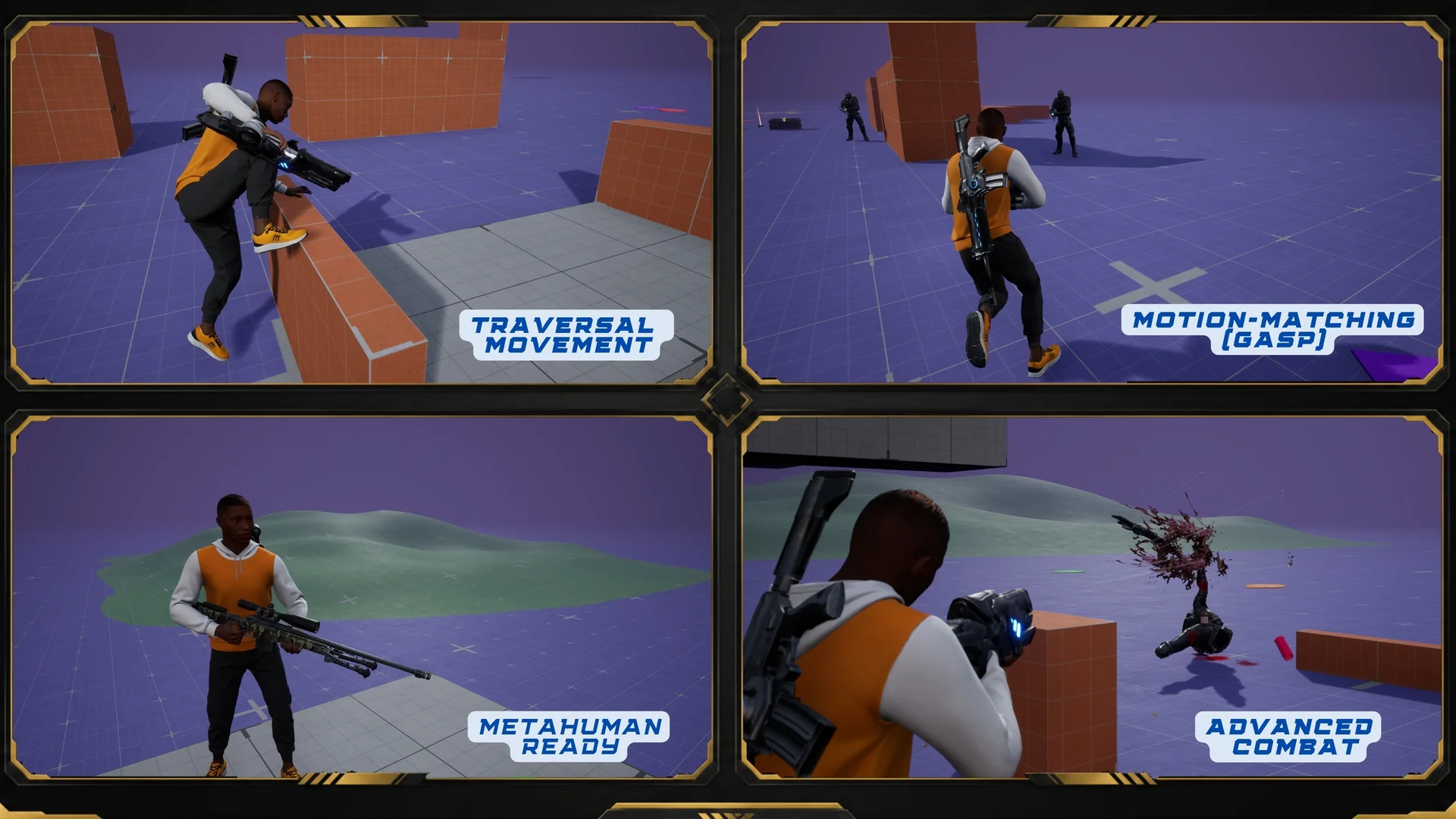
 Shooter
 Shooter
 Shooter