"7b46a695175d8694"{"id":"1001473","slug":"ultimate-game-ready-character-and-enemy-ai","title":"Ultimate Game Ready Character and Enemy AI","category":"Action-Adventure","engine":"5.4+","assetVersion":"","engineVersion":"Engine Version: 5.4+","tag":"Action-Adventure","accent":"blue","visual":"character","summary":"Explore the mechanics of Ultimate Game Ready Character and Enemy AI, featuring Behavior Tree combatants, Niagara VFX, and modular player systems.","platform":"Unreal Engine","publishedAt":"2026-10-08T08:24:45.975Z","updatedAt":"2026-10-08T08:24:45.975Z","sourceNotes":[],"fileContents":[],"compatibility":["Unreal Engine","Engine Version: 5.4+"],"featuredImage":{"alt":"Ultimate Game Ready Character and Enemy AI","src":"https://media.fab.com/image_previews/gallery_images/179897da-4b4e-4fd2-a0e2-f27677b2278e/daaa7fc3-a13a-4879-80a9-5bfe18feb434.png"},"hasDownloadLink":true,"downloads":0,"terms":[{"taxonomy":"category","slug":"action-adventure","name":"Action-Adventure"}],"galleryImages":[{"src":"/wp-content/uploads/published/2026/10/9fcb1bcd0481-05cdbe8a-3a29-44f9-b210-306619975e44-bdbc2d06ed.webp","alt":"Ultimate Game Ready Character and Enemy AI"},{"src":"/wp-content/uploads/published/2026/10/74575a4195c1-cc88a76e-5b6e-4845-80a0-d1fc5c93b796-7638568183.webp","alt":"Ultimate Game Ready Character and Enemy AI"}],"accessPanel":{"kind":"resource","title":"Download this resource","eyebrow":"Free Download","message":"Log in or create a free account to start your download.","fileName":"Ultimate Game Ready Character and Enemy AI.7z","safetyNote":"Resources are manually reviewed before listing to improve quality and reduce obvious risks.","actionLabel":"Download Free","resourceType":"Resource archive"},"contentHtml":"\u003cp\u003eClose-quarters combat setups in real-time engines rely on precise coordination between character inputs, hit confirmation, and enemy spatial queries. When a katana strike lands or an evasion trigger fires, multiple interconnected scripts handle attribute changes, UI updates, and visual cues simultaneously. This framework establishes an immediate foundation for action, hack-and-slash, and samurai-style gameplay, offering a player foundation and five dedicated enemy types right out of the box.\u003c/p\u003e \u003ch2\u003eBehavior Trees and EQS Across Five Enemy AI Variants\u003c/h2\u003e\n\u003cp\u003eEnemy decision-making throughout the project is structured around Unreal Engine's native Behavior Tree system coupled with the Environment Query System (EQS). Rather than relying on simple hardcoded distance checks, EQS calculates spatial awareness to direct enemy positioning, target evaluation, and movement options across the terrain.\u003c/p\u003e\n\u003cp\u003eThe core logic handles standard non-player routines, including patrolling routes, active pathfinding, evasive strafing, and initiating attacks once a target is within operational range. Designers can tune these behaviors directly, altering parameters to make encounters intensely aggressive or dialing back responsiveness for more passive encounters. Because all enemy archetypes originate from a standardized base enemy structure, teams can branch off new variants without rewriting foundational pathing routines.\u003c/p\u003e\n\u003cp\u003eFive preconfigured enemy AI types are supplied to fill different encounter roles:\u003c/p\u003e\n\u003cul\u003e\n\u003cli\u003e\u003cstrong\u003eMelee AI:\u003c/strong\u003e Engages in direct sword combat, closing distances and maintaining proximity through directional strafing.\u003c/li\u003e\n\u003cli\u003e\u003cstrong\u003eMelee Spinning AI:\u003c/strong\u003e A specialized close-quarters combatant executing continuous rotational melee attacks to control immediate space.\u003c/li\u003e\n\u003cli\u003e\u003cstrong\u003eRanged AI:\u003c/strong\u003e Keeps distance while discharging firearm or projectile weapons directly at the player.\u003c/li\u003e\n\u003cli\u003e\u003cstrong\u003eLong Ranged AI:\u003c/strong\u003e Functions at extended sightlines, forcing players to close the gap or utilize environmental cover.\u003c/li\u003e\n\u003cli\u003e\u003cstrong\u003eMage AI:\u003c/strong\u003e Utilizes specialized spellcasting patterns, capable of launching ranged fireballs and executing tactical teleportation when threatened or relocating.\u003c/li\u003e\n\u003c/ul\u003e \u003ch2\u003ePlayer Abilities, Health System, and Invisibility Logic\u003c/h2\u003e\n\u003cp\u003eThe player character incorporates a fully realized action toolkit supported by dedicated stat tracking. Instead of relying solely on basic health values, the character script tracks four separate functional meters: Health Points (HP), Magic Points (MP), a dedicated Skill meter, and an Invisibility resource bar. This resource distribution supports standard hack-and-slash swordplay alongside covert, stealth-oriented gameplay loops.\u003c/p\u003e\n\u003cp\u003eCombat interactions are mediated through an integrated damage pipeline that synchronizes both character states and on-screen metrics. Whenever offensive strikes connect, damage values process through the receiving character's health logic and trigger floating damage numbers directly in the world space. This visual floating text provides instant feedback on hit efficacy without requiring players to look away toward fixed interface elements.\u003c/p\u003e \u003ch2\u003eDual Weapon Configurations and Base Blueprint Expansion\u003c/h2\u003e\n\u003cp\u003eCombat versatility is anchored by a two-weapon carrying system. Out of the box, the character is set up to wield a traditional sword alongside a staff or stick weapon, switching between them according to the immediate combat scenario. Both implementations operate through an underlying weapon base blueprint.\u003c/p\u003e\n\u003cp\u003eThis centralized weapon base contains the parent logic needed to manage weapon attachment points, collision traces, and hit generation. Developers looking to expand the arsenal beyond the included sword and staff can derive new weapon children from this master blueprint, inheriting core combat functionality while swapping out static meshes, animations, or specific damage properties without re-engineering player-socket mechanics.\u003c/p\u003e \u003ch2\u003eCombat Niagara VFX Systems\u003c/h2\u003e\n\u003cp\u003eVisual feedback during offensive moves and evasive maneuvers is driven by Unreal Engine's Niagara System. Rather than relying on legacy particle emitters, all visual effects run through Niagara simulation nodes to maintain consistent performance and aesthetic control across combat animations.\u003c/p\u003e\n\u003cp\u003eThe visual package covers key action moments with dedicated particle assets:\u003c/p\u003e\n\u003cul\u003e\n\u003cli\u003e\u003cstrong\u003eSword Trail Effects:\u003c/strong\u003e Render distinct motion arcs behind melee swings, providing clear visual readouts of attack hitboxes and weapon trajectories.\u003c/li\u003e\n\u003cli\u003e\u003cstrong\u003eBlink Skill FX:\u003c/strong\u003e Emits visual distortion and particle dissipation when the character executes short-range teleportation maneuvers.\u003c/li\u003e\n\u003cli\u003e\u003cstrong\u003eBlood Impact Effects:\u003c/strong\u003e Triggers localized splatter and impact bursts at the exact vector where physical strikes land on target meshes.\u003c/li\u003e\n\u003cli\u003e\u003cstrong\u003eSpeed Flash FX:\u003c/strong\u003e Highlights rapid character bursts or dash movements to communicate high-velocity repositioning.\u003c/li\u003e\n\u003c/ul\u003e \u003ch2\u003eHUD Widgets and Core Technical Specifications\u003c/h2\u003e\n\u003cp\u003eInformation delivery relies on dedicated Unreal Motion Graphics (UMG) widgets separated by role. The player UI displays current HP, MP, and active skill meters in real time, while enemy units draw from separate widget elements to present individualized overhead health indicators during combat exchanges.\u003c/p\u003e\n\u003cp\u003eIn addition to standard attribute meters, the interface framework includes contextual on-screen widgets made for grappling points, allowing designers to mark anchor locations throughout a level for traversal or tactical positioning. A functional starting menu widget is also provided within the package, giving developers an initial baseline for title screens and configuration layouts.\u003c/p\u003e\n\u003cp\u003eUnder the hood, the entire logic framework is delivered through 25 Blueprints, meaning developers do not need to work with C++ source code to alter behaviors or configure mechanics. While a foundational understanding of Blueprints is beneficial for adjusting node networks and behavior logic, the setup is packaged to be usable without advanced visual scripting knowledge. Input maps are preconfigured for standard mouse and keyboard controls. The architecture is targeted strictly for single-player environments, containing no network replication code, and is supported on Windows development environments.\u003c/p\u003e\n\n\u003ch2\u003eExplore Similar Assets\u003c/h2\u003e\n\u003cul\u003e\n\u003cli\u003e\u003ca href=\"https://3dcghub.com/demonstrating-animation-blueprints-and-ai-for-gameplay-designers/\" title=\"Demonstrating Animation Blueprints and AI for Gameplay Designers\"\u003eDemonstrating Animation Blueprints and AI for Gameplay Designers\u003c/a\u003e\u003c/li\u003e\n\u003cli\u003e\u003ca href=\"https://3dcghub.com/wasps-pack/\" title=\"Wasps pack\"\u003eWasps pack\u003c/a\u003e\u003c/li\u003e\n\u003cli\u003e\u003ca href=\"https://3dcghub.com/ultimate-open-world/\" title=\"Ultimate Open World\"\u003eUltimate Open World\u003c/a\u003e\u003c/li\u003e\n\u003cli\u003e\u003ca href=\"https://3dcghub.com/easy-ai-toolkit/\" title=\"Easy AI Toolkit\"\u003eEasy AI Toolkit\u003c/a\u003e\u003c/li\u003e\n\u003cli\u003e\u003ca href=\"https://3dcghub.com/asymmetric-multiplayer-horror/\" title=\"Asymmetric Multiplayer Horror\"\u003eAsymmetric Multiplayer Horror\u003c/a\u003e\u003c/li\u003e\n\u003c/ul\u003e","contentTextLength":6267,"navigation":{"current":74,"total":3481,"previous":{"id":"1001474","slug":"volcano-3d-vdb-pack","title":"Volcano 3D VDB Pack","category":"Fire \u0026 Explosions","platform":"Unreal Engine","updatedAt":"2026-10-08T08:25:41.080Z"},"next":{"id":"1001472","slug":"trash-vol-1-city-streets-nanite-and-low-poly-versions","title":"Trash VOL.1 - City Streets (Nanite and Low Poly Versions)","category":"Trashyard","platform":"Unreal Engine","updatedAt":"2026-10-08T08:24:01.253Z"}},"relatedResources":[{"id":"1001231","slug":"demonstrating-animation-blueprints-and-ai-for-gameplay-designers","title":"Demonstrating Animation Blueprints and AI for Gameplay Designers","category":"Action-Adventure","engine":"5.0+","assetVersion":"","engineVersion":"Engine Version: 5.0+","tag":"Action-Adventure","accent":"blue","visual":"animation","summary":"Explore the connection between Animation Blueprints, behavior trees, montages, and basic enemy character AI for gameplay designers.","platform":"Unreal Engine","publishedAt":"2026-09-21T03:35:26.508Z","updatedAt":"2026-09-21T03:35:26.508Z","sourceNotes":[],"fileContents":[],"compatibility":["Unreal Engine","Engine Version: 5.0+"],"featuredImage":{"alt":"Demonstrating Animation Blueprints and AI for Gameplay Designers","src":"/wp-content/uploads/published/2026/09/17ead882c717-6d1822dd-94f6-42cb-bab3-18f794094846-660798aead.webp"},"hasDownloadLink":true,"downloads":0},{"id":"3796","slug":"wasps-pack","title":"Wasps pack","category":"Characters \u0026 Creatures","engine":"4.26,5.0+","assetVersion":"Engine version: 4.26,5.0+","engineVersion":"4.26","tag":"Characters","accent":"blue","visual":"character","summary":"Enhance your project with this professional animated wasps pack. Features two 3D models, 4K textures, and 14 unique animations for realistic insect enemies.","platform":"Unreal Engine","publishedAt":"2026-02-09T09:38:04.000Z","updatedAt":"2026-04-19T15:57:34.000Z","sourceNotes":[],"fileContents":[],"compatibility":["Unreal Engine","Engine version: 4.26,5.0+"],"featuredImage":{"alt":"Wasps pack","src":"https://3dcghub.com/wp-content/uploads/2026/02/cc45cbfe-cf77-4cc5-8f95-84216dc815ff.webp"},"hasDownloadLink":true,"downloads":0},{"id":"24823","slug":"ultimate-open-world","title":"Ultimate Open World","category":"Shooter","engine":"5.5+","assetVersion":"Engine version: 5.5+","engineVersion":"Asset Version:1.1 - 1.2","tag":"Shooter","accent":"blue","visual":"character","summary":"Ultimate Open World is set up as a starting point for open world games that need a clear, organized base. It combines the studioâs work in models, animations, programming, and ready-to-use environments with materials that help frame setup and implementation.","platform":"Unreal Engine","publishedAt":"2026-04-17T09:16:54.000Z","updatedAt":"2026-04-29T05:47:19.000Z","sourceNotes":[],"fileContents":[],"compatibility":["Unreal Engine","Engine version: 5.5+","Asset Version: 1.1 - 1.2"],"featuredImage":{"alt":"Ultimate Open World","src":"https://3dcghub.com/wp-content/uploads/2026/04/f6218a722e6e_0253a61c-4a7a-4655-abf5-4f829b521192.webp"},"hasDownloadLink":true,"downloads":17}]}
Action-Adventure
Ultimate Game Ready Character and Enemy AI
Explore the mechanics of Ultimate Game Ready Character and Enemy AI, featuring Behavior Tree combatants, Niagara VFX, and modular player systems.
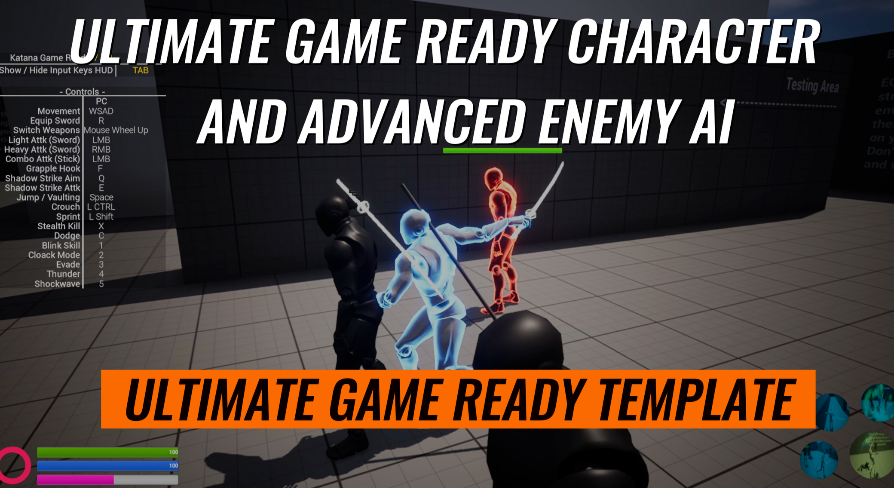
Close-quarters combat setups in real-time engines rely on precise coordination between character inputs, hit confirmation, and enemy spatial queries. When a katana strike lands or an evasion trigger fires, multiple interconnected scripts handle attribute changes, UI updates, and visual cues simultaneously. This framework establishes an immediate foundation for action, hack-and-slash, and samurai-style gameplay, offering a player foundation and five dedicated enemy types right out of the box.
Behavior Trees and EQS Across Five Enemy AI Variants
Enemy decision-making throughout the project is structured around Unreal Engine's native Behavior Tree system coupled with the Environment Query System (EQS). Rather than relying on simple hardcoded distance checks, EQS calculates spatial awareness to direct enemy positioning, target evaluation, and movement options across the terrain.
The core logic handles standard non-player routines, including patrolling routes, active pathfinding, evasive strafing, and initiating attacks once a target is within operational range. Designers can tune these behaviors directly, altering parameters to make encounters intensely aggressive or dialing back responsiveness for more passive encounters. Because all enemy archetypes originate from a standardized base enemy structure, teams can branch off new variants without rewriting foundational pathing routines.
Five preconfigured enemy AI types are supplied to fill different encounter roles:
Melee AI: Engages in direct sword combat, closing distances and maintaining proximity through directional strafing.
Melee Spinning AI: A specialized close-quarters combatant executing continuous rotational melee attacks to control immediate space.
Ranged AI: Keeps distance while discharging firearm or projectile weapons directly at the player.
Long Ranged AI: Functions at extended sightlines, forcing players to close the gap or utilize environmental cover.
Mage AI: Utilizes specialized spellcasting patterns, capable of launching ranged fireballs and executing tactical teleportation when threatened or relocating.
Player Abilities, Health System, and Invisibility Logic
The player character incorporates a fully realized action toolkit supported by dedicated stat tracking. Instead of relying solely on basic health values, the character script tracks four separate functional meters: Health Points (HP), Magic Points (MP), a dedicated Skill meter, and an Invisibility resource bar. This resource distribution supports standard hack-and-slash swordplay alongside covert, stealth-oriented gameplay loops.
Combat interactions are mediated through an integrated damage pipeline that synchronizes both character states and on-screen metrics. Whenever offensive strikes connect, damage values process through the receiving character's health logic and trigger floating damage numbers directly in the world space. This visual floating text provides instant feedback on hit efficacy without requiring players to look away toward fixed interface elements.
Dual Weapon Configurations and Base Blueprint Expansion
Combat versatility is anchored by a two-weapon carrying system. Out of the box, the character is set up to wield a traditional sword alongside a staff or stick weapon, switching between them according to the immediate combat scenario. Both implementations operate through an underlying weapon base blueprint.
This centralized weapon base contains the parent logic needed to manage weapon attachment points, collision traces, and hit generation. Developers looking to expand the arsenal beyond the included sword and staff can derive new weapon children from this master blueprint, inheriting core combat functionality while swapping out static meshes, animations, or specific damage properties without re-engineering player-socket mechanics.
Combat Niagara VFX Systems
Visual feedback during offensive moves and evasive maneuvers is driven by Unreal Engine's Niagara System. Rather than relying on legacy particle emitters, all visual effects run through Niagara simulation nodes to maintain consistent performance and aesthetic control across combat animations.
The visual package covers key action moments with dedicated particle assets:
Sword Trail Effects: Render distinct motion arcs behind melee swings, providing clear visual readouts of attack hitboxes and weapon trajectories.
Blink Skill FX: Emits visual distortion and particle dissipation when the character executes short-range teleportation maneuvers.
Blood Impact Effects: Triggers localized splatter and impact bursts at the exact vector where physical strikes land on target meshes.
Speed Flash FX: Highlights rapid character bursts or dash movements to communicate high-velocity repositioning.
HUD Widgets and Core Technical Specifications
Information delivery relies on dedicated Unreal Motion Graphics (UMG) widgets separated by role. The player UI displays current HP, MP, and active skill meters in real time, while enemy units draw from separate widget elements to present individualized overhead health indicators during combat exchanges.
In addition to standard attribute meters, the interface framework includes contextual on-screen widgets made for grappling points, allowing designers to mark anchor locations throughout a level for traversal or tactical positioning. A functional starting menu widget is also provided within the package, giving developers an initial baseline for title screens and configuration layouts.
Under the hood, the entire logic framework is delivered through 25 Blueprints, meaning developers do not need to work with C++ source code to alter behaviors or configure mechanics. While a foundational understanding of Blueprints is beneficial for adjusting node networks and behavior logic, the setup is packaged to be usable without advanced visual scripting knowledge. Input maps are preconfigured for standard mouse and keyboard controls. The architecture is targeted strictly for single-player environments, containing no network replication code, and is supported on Windows development environments.
 Action-Adventure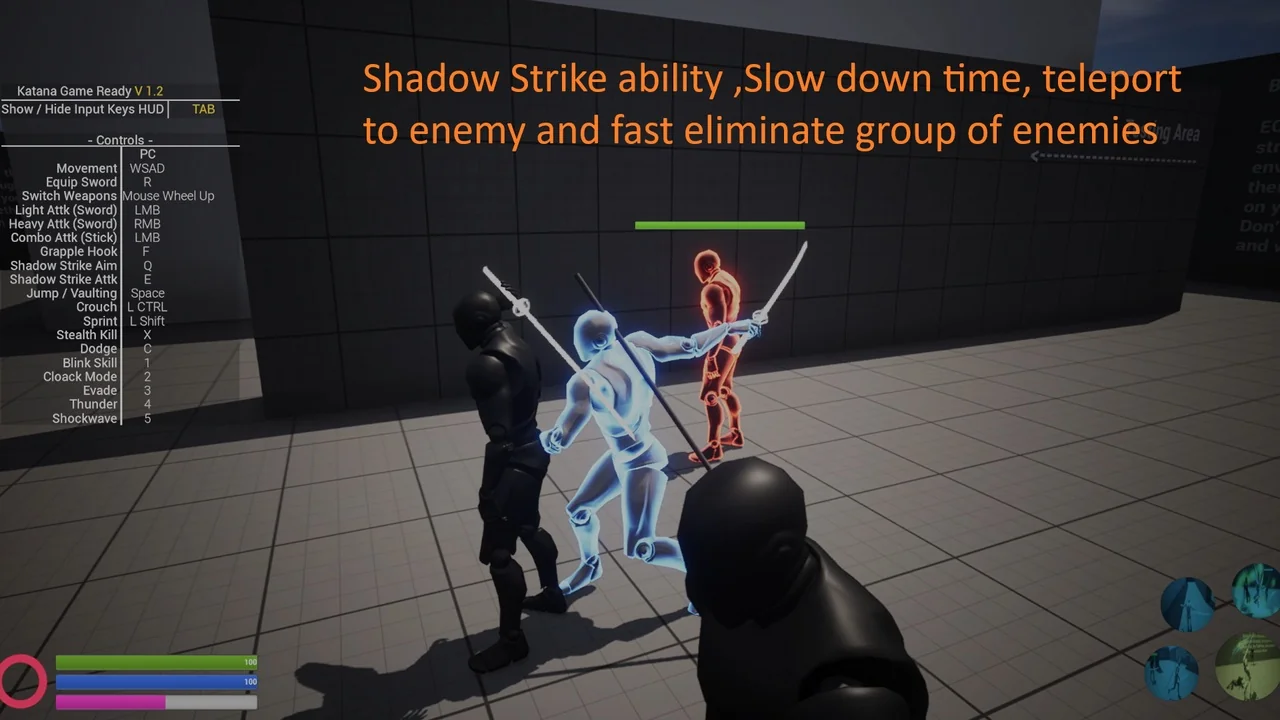
 Action-Adventure
 Characters
 Shooter