"7b46a695175d8694"{"id":"1001472","slug":"trash-vol-1-city-streets-nanite-and-low-poly-versions","title":"Trash VOL.1 - City Streets (Nanite and Low Poly Versions)","category":"Trashyard","engine":"5.1+","assetVersion":"","engineVersion":"Engine Version: 5.1+","tag":"Trashyard","accent":"blue","visual":"city","summary":"Examine Trash VOL.1 - City Streets, featuring 300 Nanite and low-poly meshes, 4K RMAO textures, custom branding, and Unreal Engine Lumen support.","platform":"Unreal Engine","publishedAt":"2026-10-08T08:24:01.253Z","updatedAt":"2026-10-08T08:24:01.253Z","sourceNotes":[],"fileContents":[],"compatibility":["Unreal Engine","Engine Version: 5.1+"],"featuredImage":{"alt":"Trash VOL.1 - City Streets (Nanite and Low Poly Versions)","src":"/wp-content/uploads/published/2026/10/7f1bd73b760f-91f75056-4bad-41e2-a9dc-08955bd55e6b-5ea8ee19a4.webp"},"hasDownloadLink":true,"downloads":0,"terms":[{"taxonomy":"category","slug":"trashyard","name":"Trashyard"}],"galleryImages":[{"src":"/wp-content/uploads/published/2026/10/9b448750fea8-c8d974c6-47fd-4e2f-b943-984de7991cb8-a925cc982a.webp","alt":"Trash VOL.1 - City Streets (Nanite and Low Poly Versions)"},{"src":"/wp-content/uploads/published/2026/10/6db6cdbdecc8-eca10581-6bdd-4a4a-a129-59f55988783d-fedc638175.webp","alt":"Trash VOL.1 - City Streets (Nanite and Low Poly Versions)"},{"src":"/wp-content/uploads/published/2026/10/f19086150760-336b1281-68c8-4ad5-a7a4-96ac53972a25-20f2a1a63a.webp","alt":"Trash VOL.1 - City Streets (Nanite and Low Poly Versions)"},{"src":"/wp-content/uploads/published/2026/10/0ec5df4b4b51-04a81515-3dbc-4198-b715-b28377a0e7c0-5e6c6cbca4.webp","alt":"Trash VOL.1 - City Streets (Nanite and Low Poly Versions)"},{"src":"/wp-content/uploads/published/2026/10/e7b493d04d3d-e7775e98-3393-4d09-ab16-34545de38636-4a44873fc4.webp","alt":"Trash VOL.1 - City Streets (Nanite and Low Poly Versions)"},{"src":"/wp-content/uploads/published/2026/10/7cd9d756c2e7-9e39a44d-0111-4368-9b03-393bcdd160ab-7793c52d6a.webp","alt":"Trash VOL.1 - City Streets (Nanite and Low Poly Versions)"},{"src":"/wp-content/uploads/published/2026/10/e3b19a9e0077-df24843e-998f-46ba-a3ac-ff97e6c0f76b-7939fb14b0.webp","alt":"Trash VOL.1 - City Streets (Nanite and Low Poly Versions)"},{"src":"/wp-content/uploads/published/2026/10/12595c23c0b6-e0f08329-deac-4f3e-9256-8abf3b53605d-20fbdcf473.webp","alt":"Trash VOL.1 - City Streets (Nanite and Low Poly Versions)"},{"src":"/wp-content/uploads/published/2026/10/8c66ab8c1722-b350a9be-35fa-4a65-a11a-015d01d82cb4-8e89f055b5.webp","alt":"Trash VOL.1 - City Streets (Nanite and Low Poly Versions)"},{"src":"/wp-content/uploads/published/2026/10/e401e70d0526-fc7ceef4-7235-4ca1-acc3-e83b208bc0c8-c4f458592d.webp","alt":"Trash VOL.1 - City Streets (Nanite and Low Poly Versions)"}],"accessPanel":{"kind":"resource","title":"Download this resource","eyebrow":"Free Download","message":"Log in or create a free account to start your download.","fileName":"Content.7z","safetyNote":"Resources are manually reviewed before listing to improve quality and reduce obvious risks.","actionLabel":"Download Free","resourceType":"Resource archive"},"contentHtml":"\u003ch2\u003ePopulating City Streets with Ground-Level Debris\u003c/h2\u003e\u003cp\u003eModern game environments fall apart when pristine architectural assets meet sterile, empty sidewalks. Urban scenes, dystopian backdrops, alleyways, and survival horror zones require layers of discarded materials to communicate history, human presence, and neglect. Building realistic ground clutter presents a constant battle between geometric fidelity and rendering budgets. A city curb demands crumpled paper, food containers, bins, broken materials, and dumpsters, but populating these areas by hand often results in visual repetition or bloated shader counts.\u003c/p\u003e\u003cp\u003eTrash VOL.1 - City Streets resolves this scene-dressing bottleneck by providing a cohesive set of urban clutter built natively inside Unreal Engine. Developed by Dekogon Studios artists, the asset collection provides realistic AAA-quality visuals while accounting for real-time game constraints. Rather than forcing creators to choose between high-end cinematic density and optimized runtime performance, the release provides parallel geometric assets coupled with an efficient master shader pipeline.\u003c/p\u003e\u003ch2\u003eEvaluating the 300 Meshes Across Nanite and Low Poly Versions\u003c/h2\u003e\u003cp\u003eThe core geometry spans 300 meshes divided equally between two specific modeling workflows: high-density Nanite meshes and standard low-poly variants. Every single prop in the pack is supplied in both forms, letting technical directors and environment artists choose the exact mesh standard that matches their platform target and engine setup.\u003c/p\u003e\u003cp\u003eFor Unreal Engine 5 projects leveraging virtualized micro-polygon geometry, the Nanite meshes preserve deep surface curvature, torn edges, and crumpled silhouettes without requiring aggressive polygon culling. In workflows where traditional polygon counts dictate performance—such as competitive titles, target platforms without Nanite support, or rigid draw call constraints—the included low-poly versions drop in smoothly without altering asset placement or scale.\u003c/p\u003e\u003cp\u003eA critical technical choice across all 300 meshes is that each asset is modeled and textured from every perspective. Scattering objects such as garbage cans, dumpsters, bins, and broken refuse requires rotating props along irregular angles, flipping them on their sides, or piling them into dense mounds. Because these meshes are fully detailed on all sides, props remain visually solid whether standing upright on a sidewalk or overturned in an alley gutter, leaving no untextured undersides or open geometry exposed to the camera.\u003c/p\u003e\u003ch2\u003eMaterial Workflows: 4K Sets and Channel Packed Textures\u003c/h2\u003e\u003cp\u003eManaging visual fidelity across hundreds of small-to-medium clutter props requires a clean, unified shading approach. Rather than relying on isolated, uncoordinated shaders, this project runs on a centralized master material setup that governs the majority of the props and models.\u003c/p\u003e\u003cp\u003eThe texture foundation relies on 4K texture sets, preserving granular surface details like dirt streaks, peeling labels, grease spots, and paper fibers up close. Memory management remains disciplined through channel packing. Roughness, Metalness, and Ambient Occlusion are packed together into individual texture maps (RMAO), cutting down on texture sampler calls and optimizing runtime memory bandwidth across complex street environments.\u003c/p\u003e\u003cp\u003eWithin the material instances, artists have access to fine-tuned parameters that alter surface response directly on the meshes:\u003c/p\u003e\u003cul\u003e\u003cli\u003eIndividual roughness remapping to dial in wet, greasy, or matte finishes.\u003c/li\u003e\u003cli\u003eAlbedo modifications to blend scattered trash seamlessly with surrounding curb and asphalt tones.\u003c/li\u003e\u003cli\u003eNormal strength and texture adjustment parameters to tune micro-surface relief under varying light angles.\u003c/li\u003e\u003cli\u003eDedicated tint controls for painted elements, enabling color changes across bins, lids, and containers to prevent noticeable asset duplication across repetitive street corners.\u003c/li\u003e\u003c/ul\u003e\u003ch2\u003eCustom Studio Branding and Post Process Integration\u003c/h2\u003e\u003cp\u003eDeploying realistic debris into commercial projects often introduces subtle legal challenges. Real-world street litter consists heavily of printed packaging, logos, labels, and branded typography. Placing recognizable brands or trademarks into a published title poses intellectual property risks, while blank, generic packaging instantly ruins environmental immersion.\u003c/p\u003e\u003cp\u003eAll packaging, graphics, and labels throughout this collection were custom-authored by the studio artists. The visual identity of every food carton, discarded box, paper slip, and container feels authentic to modern consumer life while remaining free of third-party legal restrictions. Teams can dress convenience store backdoors, subway platforms, and apocalyptic city blocks without needing to redact or replace surface textures prior to shipping.\u003c/p\u003e\u003cp\u003eVisual coherence is maintained through an included post-process setup and custom Look Up Table (LUT). This color and contrast grading works alongside Unreal Engine default rendering systems to unify the tone of the scatter meshes against surrounding roads and structural geometry. Lighting behavior is further validated through full Lumen support in Unreal Engine 5.0 and newer versions. Indirect bounce light naturally interacts with complex cavities within open dumpsters, hollow bins, and irregular paper piles without producing the light leaks or harsh black artifacts often associated with non-Lumen content.\u003c/p\u003e\u003ch2\u003ePractical Alignment for City and Apocalyptic Set Dressing\u003c/h2\u003e\u003cp\u003eThis collection addresses a spectrum of urban themes, ranging from active municipal roads to dilapidated post-apocalyptic settlements and atmospheric horror settings. The assets scale across different stages of scene assembly: large dumpsters and collection bins anchor foundational layout passes, while loose paper scatter, broken refuse, and small litter packs provide the micro-level clutter needed along curbs, building corners, and drainage areas.\u003c/p\u003e\u003cp\u003eBecause the pack combines ready-to-run master materials, dual-pipeline Nanite and low-poly options, and fully finished 360-degree prop geometry, it functions equally well for cinematic backdrop rendering and performance-sensitive game levels. Teams can establish gritty environmental storytelling across city sidewalks while keeping memory consumption, shading costs, and visual fidelity closely managed.\u003c/p\u003e\n\n\u003ch2\u003eMore From The Same Workflow\u003c/h2\u003e\n\u003cul\u003e\n\u003cli\u003e\u003ca href=\"https://3dcghub.com/vehicles-vol-9-future-cars-low-poly/\" title=\"Vehicles VOL.9- Future Cars (Low Poly)\"\u003eVehicles VOL.9- Future Cars (Low Poly)\u003c/a\u003e\u003c/li\u003e\n\u003cli\u003e\u003ca href=\"https://3dcghub.com/vehicles-vol-12-emergency-response-low-poly/\" title=\"Vehicles VOL.12- Emergency Response (Low Poly)\"\u003eVehicles VOL.12- Emergency Response (Low Poly)\u003c/a\u003e\u003c/li\u003e\n\u003cli\u003e\u003ca href=\"https://3dcghub.com/vehicles-vol-10-military-low-poly/\" title=\"Vehicles VOL.10 - Military (Low Poly)\"\u003eVehicles VOL.10 - Military (Low Poly)\u003c/a\u003e\u003c/li\u003e\n\u003cli\u003e\u003ca href=\"https://3dcghub.com/vehicles-vol-8-construction-low-poly/\" title=\"Vehicles VOL.8 - Construction (Low Poly)\"\u003eVehicles VOL.8 - Construction (Low Poly)\u003c/a\u003e\u003c/li\u003e\n\u003cli\u003e\u003ca href=\"https://3dcghub.com/vehicles-vol-4-retro-cars-low-poly/\" title=\"Vehicles VOL.4 - Retro Cars (Low Poly)\"\u003eVehicles VOL.4 - Retro Cars (Low Poly)\u003c/a\u003e\u003c/li\u003e\n\u003c/ul\u003e","contentTextLength":6515,"navigation":{"current":75,"total":3481,"previous":{"id":"1001473","slug":"ultimate-game-ready-character-and-enemy-ai","title":"Ultimate Game Ready Character and Enemy AI","category":"Action-Adventure","platform":"Unreal Engine","updatedAt":"2026-10-08T08:24:45.975Z"},"next":{"id":"1001471","slug":"scythe-animation-pack","title":"Scythe Animation Pack","category":"Combat","platform":"Unreal Engine","updatedAt":"2026-10-08T08:23:10.847Z"}},"relatedResources":[{"id":"1000709","slug":"vehicles-vol-9-future-cars-low-poly","title":"Vehicles VOL.9- Future Cars (Low Poly)","category":"Cars \u0026 Trucks","engine":"5.3+","assetVersion":"","engineVersion":"Engine Version: 5.3+","tag":"Cars \u0026 Trucks","accent":"blue","visual":"mech","summary":"Seven futuristic low-poly car props with 4K textures, channel-packed maps, tintable paint, and Lumen support for Unreal Engine 5.0+.","platform":"Unreal Engine","publishedAt":"2026-07-24T02:11:02.648Z","updatedAt":"2026-07-24T02:11:02.648Z","sourceNotes":[],"fileContents":[],"compatibility":["Unreal Engine","Engine Version: 5.3+"],"featuredImage":{"alt":"Vehicles VOL.9- Future Cars (Low Poly)","src":"/wp-content/uploads/published/2026/07/1299c7959656-ce73ca95-e379-4b7d-9098-f38abd0ef20e-72885a4f92.webp"},"hasDownloadLink":true,"downloads":1},{"id":"1000711","slug":"vehicles-vol-12-emergency-response-low-poly","title":"Vehicles VOL.12- Emergency Response (Low Poly)","category":"Service \u0026 Commercial Vehicles","engine":"5.1+","assetVersion":"","engineVersion":"Engine Version: 5.1+","tag":"Service","accent":"blue","visual":"mech","summary":"Seven emergency response vehicles with split meshes, 4K channel-packed textures, master material controls, Lumen support, and custom branding for Unreal Engine","platform":"Unreal Engine","publishedAt":"2026-07-24T02:26:51.479Z","updatedAt":"2026-07-24T02:26:51.479Z","sourceNotes":[],"fileContents":[],"compatibility":["Unreal Engine","Engine Version: 5.1+"],"featuredImage":{"alt":"Vehicles VOL.12- Emergency Response (Low Poly)","src":"/wp-content/uploads/published/2026/07/730427ce7704-1028ccea-5fa7-4469-9018-b9b7722bb7fb-d40c3a37b3.webp"},"hasDownloadLink":true,"downloads":0},{"id":"1000710","slug":"vehicles-vol-10-military-low-poly","title":"Vehicles VOL.10 - Military (Low Poly)","category":"Military","engine":"5.1+","assetVersion":"","engineVersion":"Engine Version: 5.1+","tag":"Military","accent":"blue","visual":"mech","summary":"Military low poly vehicle prop pack for Unreal Engine with 5 cars, police variant, 4K textures, channel-packed maps, tintable paint, and Lumen support.","platform":"Unreal Engine","publishedAt":"2026-07-24T02:19:57.675Z","updatedAt":"2026-07-24T02:19:57.675Z","sourceNotes":[],"fileContents":[],"compatibility":["Unreal Engine","Engine Version: 5.1+"],"featuredImage":{"alt":"Vehicles VOL.10 - Military (Low Poly)","src":"/wp-content/uploads/published/2026/07/b31586286c42-5225be35-9f55-4706-8857-5690ae5b91c5-5a4f87ffc6.webp"},"hasDownloadLink":true,"downloads":0}]}
Trashyard
Trash VOL.1 - City Streets (Nanite and Low Poly Versions)
Examine Trash VOL.1 - City Streets, featuring 300 Nanite and low-poly meshes, 4K RMAO textures, custom branding, and Unreal Engine Lumen support.
Category:Unreal Engine,TrashyardPlatform: Unreal EngineEngine Version: 5.1+Published: Oct 8, 2026
Trashyard
Resource overview
Populating City Streets with Ground-Level Debris
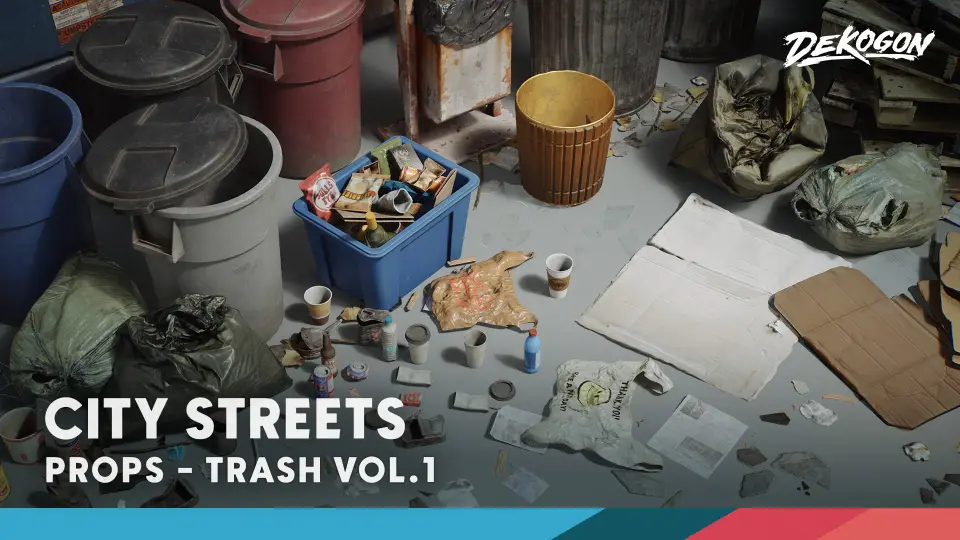
Modern game environments fall apart when pristine architectural assets meet sterile, empty sidewalks. Urban scenes, dystopian backdrops, alleyways, and survival horror zones require layers of discarded materials to communicate history, human presence, and neglect. Building realistic ground clutter presents a constant battle between geometric fidelity and rendering budgets. A city curb demands crumpled paper, food containers, bins, broken materials, and dumpsters, but populating these areas by hand often results in visual repetition or bloated shader counts.
Trash VOL.1 - City Streets resolves this scene-dressing bottleneck by providing a cohesive set of urban clutter built natively inside Unreal Engine. Developed by Dekogon Studios artists, the asset collection provides realistic AAA-quality visuals while accounting for real-time game constraints. Rather than forcing creators to choose between high-end cinematic density and optimized runtime performance, the release provides parallel geometric assets coupled with an efficient master shader pipeline.
Evaluating the 300 Meshes Across Nanite and Low Poly Versions
The core geometry spans 300 meshes divided equally between two specific modeling workflows: high-density Nanite meshes and standard low-poly variants. Every single prop in the pack is supplied in both forms, letting technical directors and environment artists choose the exact mesh standard that matches their platform target and engine setup.
For Unreal Engine 5 projects leveraging virtualized micro-polygon geometry, the Nanite meshes preserve deep surface curvature, torn edges, and crumpled silhouettes without requiring aggressive polygon culling. In workflows where traditional polygon counts dictate performance—such as competitive titles, target platforms without Nanite support, or rigid draw call constraints—the included low-poly versions drop in smoothly without altering asset placement or scale.
A critical technical choice across all 300 meshes is that each asset is modeled and textured from every perspective. Scattering objects such as garbage cans, dumpsters, bins, and broken refuse requires rotating props along irregular angles, flipping them on their sides, or piling them into dense mounds. Because these meshes are fully detailed on all sides, props remain visually solid whether standing upright on a sidewalk or overturned in an alley gutter, leaving no untextured undersides or open geometry exposed to the camera.
Material Workflows: 4K Sets and Channel Packed Textures
Managing visual fidelity across hundreds of small-to-medium clutter props requires a clean, unified shading approach. Rather than relying on isolated, uncoordinated shaders, this project runs on a centralized master material setup that governs the majority of the props and models.
The texture foundation relies on 4K texture sets, preserving granular surface details like dirt streaks, peeling labels, grease spots, and paper fibers up close. Memory management remains disciplined through channel packing. Roughness, Metalness, and Ambient Occlusion are packed together into individual texture maps (RMAO), cutting down on texture sampler calls and optimizing runtime memory bandwidth across complex street environments.
Within the material instances, artists have access to fine-tuned parameters that alter surface response directly on the meshes:
Individual roughness remapping to dial in wet, greasy, or matte finishes.
Albedo modifications to blend scattered trash seamlessly with surrounding curb and asphalt tones.
Normal strength and texture adjustment parameters to tune micro-surface relief under varying light angles.
Dedicated tint controls for painted elements, enabling color changes across bins, lids, and containers to prevent noticeable asset duplication across repetitive street corners.
Custom Studio Branding and Post Process Integration
Deploying realistic debris into commercial projects often introduces subtle legal challenges. Real-world street litter consists heavily of printed packaging, logos, labels, and branded typography. Placing recognizable brands or trademarks into a published title poses intellectual property risks, while blank, generic packaging instantly ruins environmental immersion.
All packaging, graphics, and labels throughout this collection were custom-authored by the studio artists. The visual identity of every food carton, discarded box, paper slip, and container feels authentic to modern consumer life while remaining free of third-party legal restrictions. Teams can dress convenience store backdoors, subway platforms, and apocalyptic city blocks without needing to redact or replace surface textures prior to shipping.
Visual coherence is maintained through an included post-process setup and custom Look Up Table (LUT). This color and contrast grading works alongside Unreal Engine default rendering systems to unify the tone of the scatter meshes against surrounding roads and structural geometry. Lighting behavior is further validated through full Lumen support in Unreal Engine 5.0 and newer versions. Indirect bounce light naturally interacts with complex cavities within open dumpsters, hollow bins, and irregular paper piles without producing the light leaks or harsh black artifacts often associated with non-Lumen content.
Practical Alignment for City and Apocalyptic Set Dressing
This collection addresses a spectrum of urban themes, ranging from active municipal roads to dilapidated post-apocalyptic settlements and atmospheric horror settings. The assets scale across different stages of scene assembly: large dumpsters and collection bins anchor foundational layout passes, while loose paper scatter, broken refuse, and small litter packs provide the micro-level clutter needed along curbs, building corners, and drainage areas.
Because the pack combines ready-to-run master materials, dual-pipeline Nanite and low-poly options, and fully finished 360-degree prop geometry, it functions equally well for cinematic backdrop rendering and performance-sensitive game levels. Teams can establish gritty environmental storytelling across city sidewalks while keeping memory consumption, shading costs, and visual fidelity closely managed.
 Trashyard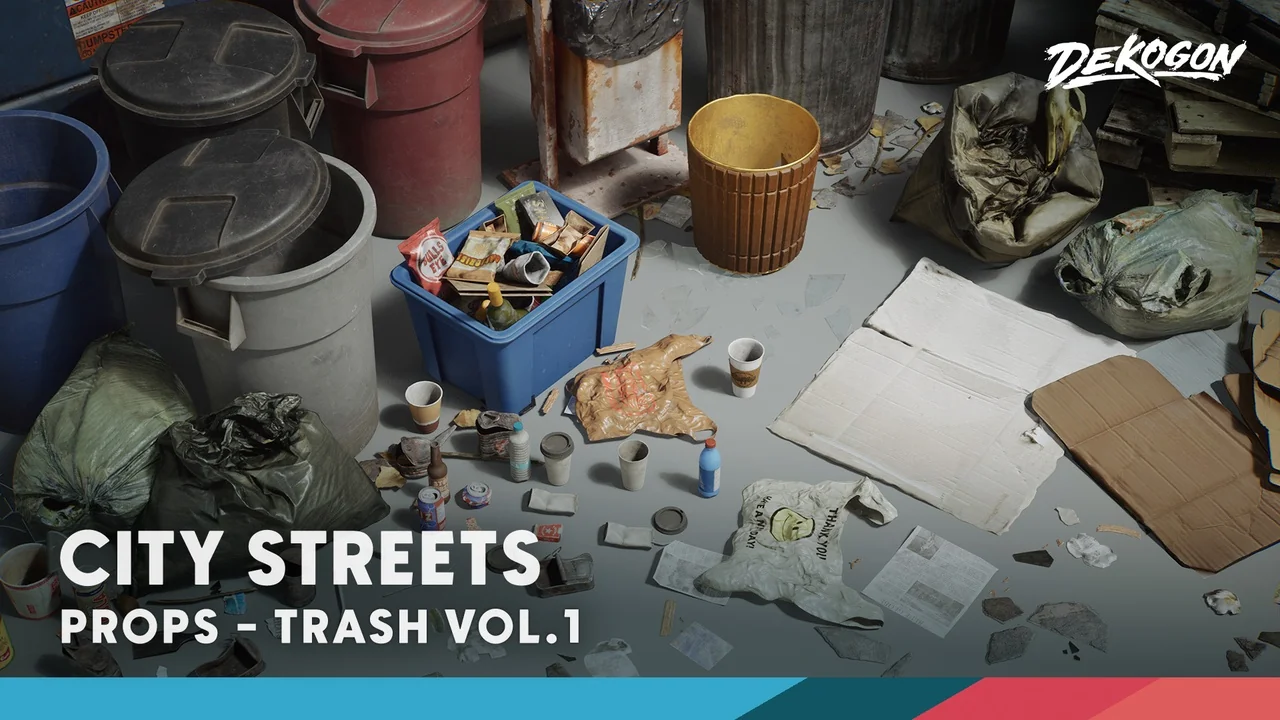
 Cars & Trucks
 Service
 Military