"c68a05d5e51405b3"{"id":"1000710","slug":"vehicles-vol-10-military-low-poly","title":"Vehicles VOL.10 - Military (Low Poly)","category":"Military","engine":"5.1+","assetVersion":"","engineVersion":"Engine Version: 5.1+","tag":"Military","accent":"blue","visual":"mech","summary":"Military low poly vehicle prop pack for Unreal Engine with 5 cars, police variant, 4K textures, channel-packed maps, tintable paint, and Lumen support.","platform":"Unreal Engine","publishedAt":"2026-07-24T02:19:57.675Z","updatedAt":"2026-07-24T02:19:57.675Z","sourceNotes":[],"fileContents":[],"compatibility":["Unreal Engine","Engine Version: 5.1+"],"featuredImage":{"alt":"Vehicles VOL.10 - Military (Low Poly)","src":"/wp-content/uploads/published/2026/07/b31586286c42-5225be35-9f55-4706-8857-5690ae5b91c5-5a4f87ffc6.webp"},"hasDownloadLink":true,"downloads":0,"terms":[{"taxonomy":"category","slug":"military-vehicles-and-transportation","name":"Military"}],"galleryImages":[{"src":"/wp-content/uploads/published/2026/07/56ed96527ba4-6d47b01f-4704-41d5-bf88-76a27f4c84af-a132e82e53.webp","alt":"Vehicles VOL.10 - Military (Low Poly)"},{"src":"/wp-content/uploads/published/2026/07/e97b838328f6-8b22b232-6f11-44ac-b126-dfa73c5ee9bf-2b0b634d5c.webp","alt":"Vehicles VOL.10 - Military (Low Poly)"},{"src":"/wp-content/uploads/published/2026/07/96d84227c002-82235c66-bf71-49e8-8564-f83f072d4a32-f16335c1d5.webp","alt":"Vehicles VOL.10 - Military (Low Poly)"},{"src":"/wp-content/uploads/published/2026/07/c2b92a2c4d31-ff21ae92-7388-4f26-8c91-9f7a362be2ca-e2ec211163.webp","alt":"Vehicles VOL.10 - Military (Low Poly)"},{"src":"/wp-content/uploads/published/2026/07/31ff41b59a70-98a06ca7-7f66-4070-9f8a-7850cc15c759-10b152427f.webp","alt":"Vehicles VOL.10 - Military (Low Poly)"},{"src":"/wp-content/uploads/published/2026/07/6302d4815604-6acbc9ae-e753-4214-879c-f7fd316d8a87-e23495cfc9.webp","alt":"Vehicles VOL.10 - Military (Low Poly)"},{"src":"/wp-content/uploads/published/2026/07/9405ecc1310e-3093b48d-16ef-401a-b295-d09a6f8fe5b2-5db3545117.webp","alt":"Vehicles VOL.10 - Military (Low Poly)"},{"src":"/wp-content/uploads/published/2026/07/1d8aae191f04-553ff14c-e8eb-4d62-b1fb-7401ec3f8fb2-d8a5ea7b14.webp","alt":"Vehicles VOL.10 - Military (Low Poly)"},{"src":"/wp-content/uploads/published/2026/07/14f95bc5dc1e-d364941a-d415-4ac6-a001-1f3b890ef09a-8904a65014.webp","alt":"Vehicles VOL.10 - Military (Low Poly)"},{"src":"/wp-content/uploads/published/2026/07/342e5619e511-83cda9d3-4503-4468-919c-b814c6e15b7b-727c4ec619.webp","alt":"Vehicles VOL.10 - Military (Low Poly)"}],"accessPanel":{"kind":"resource","title":"Download this resource","eyebrow":"Free Download","message":"Log in or create a free account to start your download.","fileName":"Content.7z","safetyNote":"Resources are manually reviewed before listing to improve quality and reduce obvious risks.","actionLabel":"Download Free","resourceType":"Resource archive"},"contentHtml":"\u003cp\u003eSetting up Vehicles VOL.10 - Military (Low Poly) in an Unreal Engine project means working with static props rather than functional drivable vehicles. These assets ship without bones or animations, positioning them as environmental dressing for scenes that need realistic military presence without the overhead of rigging or physics systems. The pack comes from Dekogon Studios Artists and targets AAA-quality visuals while maintaining a budget-conscious approach suitable for game development.\u003c/p\u003e\n\n\u003ch2\u003eAsset Composition and Mesh Structure\u003c/h2\u003e\n\u003cp\u003eThe collection centers on five cars built with split meshes, giving developers modular control over how each vehicle is assembled or broken apart within a scene. A police car variant expands the lineup, broadening the range of scenarios these props can service. Each model is fully detailed from all sides, meaning there are no flat or unfinished faces hidden from view. That level of completeness matters when vehicles need to sit in open environments where players or cameras can circle them freely.\u003c/p\u003e\n\n\u003cp\u003eThe tag set attached to the pack — Car, Tanker, Shooter, Mobile, Transport, Truck, Driving, Military, Tank, Van, Wheel — points to the breadth of vehicle types represented. While the core count sits at five cars plus the police variant, the tags suggest the collection spans multiple military vehicle categories rather than repeating a single body style. The split-mesh approach lets developers swap parts, isolate damage regions, or configure LOD setups without rebuilding geometry from scratch.\u003c/p\u003e\n\n\u003ch2\u003eMaster Material Controls and Channel Packing\u003c/h2\u003e\n\u003cp\u003eA master material setup governs the majority of props and models in the pack. Rather than each vehicle relying on its own isolated material instance, the shared master gives artists a single entry point for adjusting visual properties across the collection. Exposure controls extend to roughness, albedo, normals, and additional parameters, so surface response can be dialed in without editing texture files.\u003c/p\u003e\n\n\u003cp\u003eTexture sets run at 4K resolution and carry channel-packed data for Roughness, Metalness, and Ambient Occlusion. Packing these three maps into a single texture reduces the number of samples the material needs to read, which keeps material instruction counts lean. The channel-packed workflow also means fewer texture files to manage when iterating on look development.\u003c/p\u003e\n\n\u003ch3\u003eTintable Painted Areas\u003c/h3\u003e\n\u003cp\u003ePainted regions across the vehicles are tintable through material parameters. A developer can shift the base color of a vehicle's body panels without opening an image editor or generating new textures. For a military context, this opens quick visual variation across squads, factions, or weathering states. Multiple instances of the same mesh can sit side by side in a scene and read as distinct units simply by adjusting tint values.\u003c/p\u003e\n\n\u003ch2\u003eBranding and Legal Clearance\u003c/h2\u003e\n\u003cp\u003eAll branding and labels across the vehicles are custom-made by the studio. This removes a common pain point in military and police-themed asset work, where real-world manufacturer logos, unit insignia, or government markings can create licensing complications. Custom branding ensures the props are free of legal issues, letting developers ship them in commercial projects without auditing each decal or placard. For teams building shooter or military simulation experiences, that clearance is a practical advantage at certification and release time.\u003c/p\u003e\n\n\u003ch2\u003eRendering Pipeline and Lumen Compatibility\u003c/h2\u003e\n\u003cp\u003eThe pack supports Lumen for Unreal Engine 5.0 and later. Lumen's global illumination reacts to the geometry and material properties of these vehicles in real time, so parked trucks or tanks in dynamic lighting conditions will receive bounced light and shadow falloff consistent with the surrounding environment. The inclusion of a realistic post-processing setup and a Lookup Table gives developers a starting point for tone mapping and color grading that matches the intended visual style before custom grading is applied.\u003c/p\u003e\n\n\u003cp\u003eOptimization for games is noted as a core quality of the pack. Combined with the low-poly designation, the 4K textures, and the channel-packed material workflow, the assets sit at a balance point between visual fidelity and runtime performance. The master material reduces draw-call overhead by sharing setup logic, while the split meshes let developers configure culling and LOD strategies tailored to their scene density.\u003c/p\u003e\n\n\u003ch2\u003eProduction Placement and Scene Integration\u003c/h2\u003e\n\u003cp\u003eThese vehicles fit as static dressing in military bases, checkpoints, convoy scenes, urban conflict zones, or transport yards. The police variant adds flexibility for civil-military scenarios or occupation narratives. Because there are no bones or animations, the vehicles are best placed as environmental storytelling props — abandoned, parked, destroyed, or arranged as set dressing — rather than as interactive AI-driven units.\u003c/p\u003e\n\n\u003cp\u003eCompatibility is noted with \u003cem\u003eMeridian 1988: Cedar Point School - Modular Environment (VOL 57)\u003c/em\u003e, suggesting the vehicle pack shares visual and technical conventions with that environment release. Developers already using the Meridian environment lineup can drop these vehicles into matching scenes with minimal material or lighting reconciliation. The shared aesthetic target — realistic AAA-quality — keeps cross-pack consistency intact when combining releases.\u003c/p\u003e\n\n\u003cp\u003eFor a production workflow, the practical takeaway is straightforward: drop the vehicles in as static props, use the master material to tune roughness and albedo per scene lighting condition, tint painted areas for faction or unit variation, and let Lumen handle indirect lighting response. The custom branding keeps legal review simple, and the split meshes give enough modularity for damage variation or LOD tuning without needing a 3D modeling pass.\u003c/p\u003e\n\n\u003ch2\u003eMore From The Same Workflow\u003c/h2\u003e\n\u003cul\u003e\n\u003cli\u003e\u003ca href=\"https://3dcghub.com/armor-bundle/\" title=\"ARMOR - Bundle\"\u003eARMOR - Bundle\u003c/a\u003e\u003c/li\u003e\n\u003cli\u003e\u003ca href=\"https://3dcghub.com/battle-tank-military-pack/\" title=\"Battle Tank Military Pack\"\u003eBattle Tank Military Pack\u003c/a\u003e\u003c/li\u003e\n\u003cli\u003e\u003ca href=\"https://3dcghub.com/vehicles-vol-1-small-rides-nanite-and-low-poly/\" title=\"Vehicles VOL.1 - Small Rides (Nanite and Low Poly)\"\u003eVehicles VOL.1 - Small Rides (Nanite and Low Poly)\u003c/a\u003e\u003c/li\u003e\n\u003cli\u003e\u003ca href=\"https://3dcghub.com/vehicles-vol-9-future-cars-low-poly/\" title=\"Vehicles VOL.9- Future Cars (Low Poly)\"\u003eVehicles VOL.9- Future Cars (Low Poly)\u003c/a\u003e\u003c/li\u003e\n\u003cli\u003e\u003ca href=\"https://3dcghub.com/vehicles-vol-8-construction-low-poly/\" title=\"Vehicles VOL.8 - Construction (Low Poly)\"\u003eVehicles VOL.8 - Construction (Low Poly)\u003c/a\u003e\u003c/li\u003e\n\u003c/ul\u003e","contentTextLength":5969,"navigation":{"current":1293,"total":3860,"previous":{"id":"1000711","slug":"vehicles-vol-12-emergency-response-low-poly","title":"Vehicles VOL.12- Emergency Response (Low Poly)","category":"Service \u0026 Commercial Vehicles","platform":"Unreal Engine","updatedAt":"2026-07-24T02:26:51.479Z"},"next":{"id":"14433","slug":"rdlodtools-rd-tools-pro","title":"rdLODtools (rd Tools Pro)","category":"Engine Tools","platform":"Unreal Engine","updatedAt":"2026-07-24T02:13:03.808Z"}},"relatedResources":[{"id":"1001759","slug":"scifi-military-car","title":"SciFi Military Car","category":"Military","engine":"4.26+,5.0+","assetVersion":"","engineVersion":"Engine Version: 4.26+,5.0+","tag":"Military","accent":"blue","visual":"mech","summary":"Explore the SciFi Military Car blueprint featuring functional suspension, weapon aiming animations, modular roof attachments, and customizable materials.","platform":"Unreal Engine","publishedAt":"2026-10-20T03:05:07.620Z","updatedAt":"2026-10-20T03:05:07.620Z","sourceNotes":[],"fileContents":[],"compatibility":["Unreal Engine","Engine Version: 4.26+,5.0+"],"featuredImage":{"alt":"SciFi Military Car","src":"/wp-content/uploads/published/2026/10/77eacbe5ab3a-3e0207af-e2b5-456c-9e82-38c00ebdc4ca-2706391c6d.webp"},"hasDownloadLink":true,"downloads":0},{"id":"1001001","slug":"light-military-vehicle","title":"Light Military Vehicle","category":"Military","engine":"5.0+","assetVersion":"","engineVersion":"Engine Version: 5.0+","tag":"Military","accent":"blue","visual":"mech","summary":"Driveable Light Military Vehicle with changeable body paint, rust amount, and show/hide parts like jerrycans, dump bed seating, and tent. UE5 updates.","platform":"Unreal Engine","publishedAt":"2026-08-20T10:04:53.165Z","updatedAt":"2026-08-20T10:04:53.165Z","sourceNotes":[],"fileContents":[],"compatibility":["Unreal Engine","Engine Version: 5.0+"],"featuredImage":{"alt":"Light Military Vehicle","src":"/wp-content/uploads/published/2026/08/a4e6b774055a-bbd1be1b-31ea-48a1-8b44-9822b8295864-17df1c7baf.webp"},"hasDownloadLink":true,"downloads":3},{"id":"1000150","slug":"armor-bundle","title":"ARMOR - Bundle","category":"Military","engine":"5.5+","assetVersion":"","engineVersion":"Engine Version: 5.5+","tag":"Military","accent":"blue","visual":"mech","summary":"A cinematic-focused collection of hero vehicles, rigged character assets, and modular mechanical parts for building gritty armored scenes.","platform":"Unreal Engine","publishedAt":"2026-06-18T21:14:11.604Z","updatedAt":"2026-06-18T21:14:11.604Z","sourceNotes":[],"fileContents":[],"compatibility":["Unreal Engine","Engine Version: 5.5+"],"featuredImage":{"alt":"ARMOR - Bundle","src":"/wp-content/uploads/published/2026/06/eb6a7be4e67a-42bf3d8b-8cae-4cde-a88b-afe167c55155-1472d85109.webp"},"hasDownloadLink":true,"downloads":3}]}
Military
Vehicles VOL.10 - Military (Low Poly)
Military low poly vehicle prop pack for Unreal Engine with 5 cars, police variant, 4K textures, channel-packed maps, tintable paint, and Lumen support.
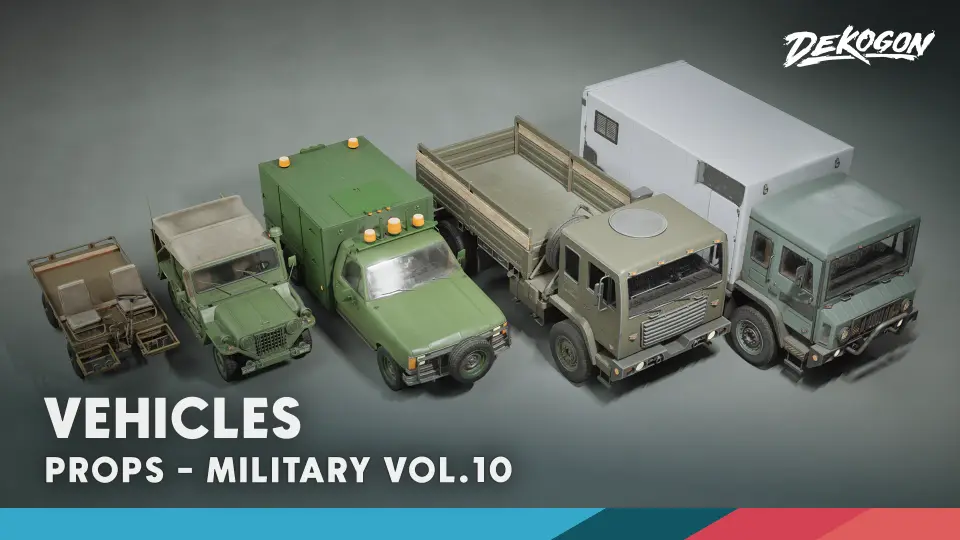
Setting up Vehicles VOL.10 - Military (Low Poly) in an Unreal Engine project means working with static props rather than functional drivable vehicles. These assets ship without bones or animations, positioning them as environmental dressing for scenes that need realistic military presence without the overhead of rigging or physics systems. The pack comes from Dekogon Studios Artists and targets AAA-quality visuals while maintaining a budget-conscious approach suitable for game development.
Asset Composition and Mesh Structure
The collection centers on five cars built with split meshes, giving developers modular control over how each vehicle is assembled or broken apart within a scene. A police car variant expands the lineup, broadening the range of scenarios these props can service. Each model is fully detailed from all sides, meaning there are no flat or unfinished faces hidden from view. That level of completeness matters when vehicles need to sit in open environments where players or cameras can circle them freely.
The tag set attached to the pack — Car, Tanker, Shooter, Mobile, Transport, Truck, Driving, Military, Tank, Van, Wheel — points to the breadth of vehicle types represented. While the core count sits at five cars plus the police variant, the tags suggest the collection spans multiple military vehicle categories rather than repeating a single body style. The split-mesh approach lets developers swap parts, isolate damage regions, or configure LOD setups without rebuilding geometry from scratch.
Master Material Controls and Channel Packing
A master material setup governs the majority of props and models in the pack. Rather than each vehicle relying on its own isolated material instance, the shared master gives artists a single entry point for adjusting visual properties across the collection. Exposure controls extend to roughness, albedo, normals, and additional parameters, so surface response can be dialed in without editing texture files.
Texture sets run at 4K resolution and carry channel-packed data for Roughness, Metalness, and Ambient Occlusion. Packing these three maps into a single texture reduces the number of samples the material needs to read, which keeps material instruction counts lean. The channel-packed workflow also means fewer texture files to manage when iterating on look development.
Tintable Painted Areas
Painted regions across the vehicles are tintable through material parameters. A developer can shift the base color of a vehicle's body panels without opening an image editor or generating new textures. For a military context, this opens quick visual variation across squads, factions, or weathering states. Multiple instances of the same mesh can sit side by side in a scene and read as distinct units simply by adjusting tint values.
Branding and Legal Clearance
All branding and labels across the vehicles are custom-made by the studio. This removes a common pain point in military and police-themed asset work, where real-world manufacturer logos, unit insignia, or government markings can create licensing complications. Custom branding ensures the props are free of legal issues, letting developers ship them in commercial projects without auditing each decal or placard. For teams building shooter or military simulation experiences, that clearance is a practical advantage at certification and release time.
Rendering Pipeline and Lumen Compatibility
The pack supports Lumen for Unreal Engine 5.0 and later. Lumen's global illumination reacts to the geometry and material properties of these vehicles in real time, so parked trucks or tanks in dynamic lighting conditions will receive bounced light and shadow falloff consistent with the surrounding environment. The inclusion of a realistic post-processing setup and a Lookup Table gives developers a starting point for tone mapping and color grading that matches the intended visual style before custom grading is applied.
Optimization for games is noted as a core quality of the pack. Combined with the low-poly designation, the 4K textures, and the channel-packed material workflow, the assets sit at a balance point between visual fidelity and runtime performance. The master material reduces draw-call overhead by sharing setup logic, while the split meshes let developers configure culling and LOD strategies tailored to their scene density.
Production Placement and Scene Integration
These vehicles fit as static dressing in military bases, checkpoints, convoy scenes, urban conflict zones, or transport yards. The police variant adds flexibility for civil-military scenarios or occupation narratives. Because there are no bones or animations, the vehicles are best placed as environmental storytelling props — abandoned, parked, destroyed, or arranged as set dressing — rather than as interactive AI-driven units.
Compatibility is noted with Meridian 1988: Cedar Point School - Modular Environment (VOL 57), suggesting the vehicle pack shares visual and technical conventions with that environment release. Developers already using the Meridian environment lineup can drop these vehicles into matching scenes with minimal material or lighting reconciliation. The shared aesthetic target — realistic AAA-quality — keeps cross-pack consistency intact when combining releases.
For a production workflow, the practical takeaway is straightforward: drop the vehicles in as static props, use the master material to tune roughness and albedo per scene lighting condition, tint painted areas for faction or unit variation, and let Lumen handle indirect lighting response. The custom branding keeps legal review simple, and the split meshes give enough modularity for damage variation or LOD tuning without needing a 3D modeling pass.
 Military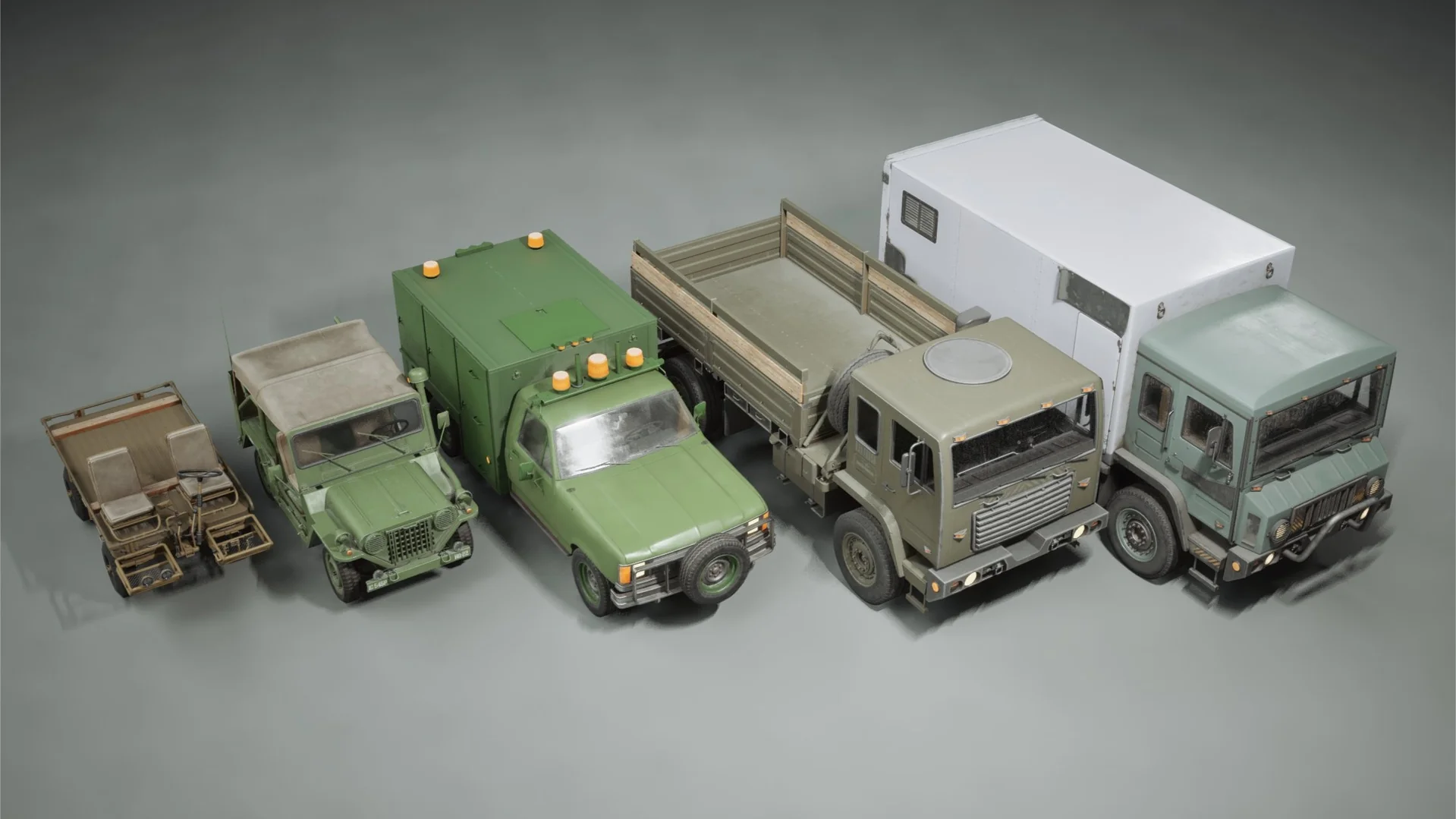
 Military
 Military
 Military