"78ad2531a1fbe017"{"id":"1000150","slug":"armor-bundle","title":"ARMOR - Bundle","category":"Military","engine":"5.5+","assetVersion":"","engineVersion":"Engine Version: 5.5+","tag":"Military","accent":"blue","visual":"mech","summary":"A cinematic-focused collection of hero vehicles, rigged character assets, and modular mechanical parts for building gritty armored scenes.","platform":"Unreal Engine","publishedAt":"2026-06-18T21:14:11.604Z","updatedAt":"2026-06-18T21:14:11.604Z","sourceNotes":[],"fileContents":[],"compatibility":["Unreal Engine","Engine Version: 5.5+"],"featuredImage":{"alt":"ARMOR - Bundle","src":"/wp-content/uploads/published/2026/06/eb6a7be4e67a-42bf3d8b-8cae-4cde-a88b-afe167c55155-1472d85109.webp"},"hasDownloadLink":true,"downloads":1,"terms":[{"taxonomy":"category","slug":"military-vehicles-and-transportation","name":"Military"}],"galleryImages":[{"src":"/wp-content/uploads/published/2026/06/1d05d3d00d56-2b8fbb0f-66a5-4494-9229-c5069206e0f3-6b9febf4ab.webp","alt":"ARMOR - Bundle"},{"src":"/wp-content/uploads/published/2026/06/8b7033b732bb-a8a7dc4f-82c7-4715-a0ea-9c279c105f2f-c738678539.webp","alt":"ARMOR - Bundle"},{"src":"/wp-content/uploads/published/2026/06/70efa709db70-68016c83-b3fc-4bb7-81b3-74ef6bb7a3dc-989055a5d8.webp","alt":"ARMOR - Bundle"},{"src":"/wp-content/uploads/published/2026/06/e957329e968f-abeeb3f1-35ea-4495-9032-0722ae731fa2-0385f34b1b.webp","alt":"ARMOR - Bundle"},{"src":"/wp-content/uploads/published/2026/06/9f61036a725f-823cbc59-247e-428c-9f0a-0fff2c7d87b9-01ad242872.webp","alt":"ARMOR - Bundle"},{"src":"/wp-content/uploads/published/2026/06/320edda2ccd1-ff8ddc67-3b32-4b0a-8f4f-468dffee2410-3b85434d4e.webp","alt":"ARMOR - Bundle"},{"src":"/wp-content/uploads/published/2026/06/c766dd0642b2-a7fb2dfb-6f37-41dd-935d-349dadcca16c-6e6eee3a2b.webp","alt":"ARMOR - Bundle"},{"src":"/wp-content/uploads/published/2026/06/b7835a822216-6f7a6da1-e8cd-49d5-a42b-050d342c8660-8f10eaa20a.webp","alt":"ARMOR - Bundle"},{"src":"/wp-content/uploads/published/2026/06/700916d6ed98-dc14dec9-7434-435b-b4f0-c17e9d624af9-be878ec1d5.webp","alt":"ARMOR - Bundle"},{"src":"/wp-content/uploads/published/2026/06/326397674617-d4a52d8a-3e5a-45af-82a6-e5f5f06b9f7c-346ceed665.webp","alt":"ARMOR - Bundle"}],"accessPanel":{"kind":"resource","title":"Download this resource","eyebrow":"Free Download","message":"Log in or create a free account to start your download.","fileName":"ARMORCollection.7z","safetyNote":"Resources are manually reviewed before listing to improve quality and reduce obvious risks.","actionLabel":"Download Free","resourceType":"Resource archive"},"contentHtml":"\u003cp\u003eWhen a project needs armored vehicles, matching character elements, and enough mechanical parts to keep the whole production visually consistent, piecing those elements together one by one can slow everything down. ARMOR - Bundle addresses that workflow directly with a single collection of high-detail vehicle assets, rigged character content, and modular hard-surface parts aimed at cinematic-quality work.\u003c/p\u003e\u003cp\u003eThe package leans into a gritty mechanical look from the start: grease, steel, combat wear, and heavy transport influence run through the entire set. Instead of treating vehicles, characters, and assembly pieces as separate categories, it presents them as parts of the same battle-ready fleet, which makes it easier to move from a hero asset shot to a broader environment or support scene without breaking the visual language.\u003c/p\u003e\u003ch2\u003eSetting up a battle-ready fleet with ARMOR - Bundle\u003c/h2\u003e\u003cp\u003eThe central appeal here is not just the presence of multiple asset types, but how they work together in production. Three hero vehicles form the backbone of the bundle, giving a scene immediate focal points for close framing, turntables, cinematic reveals, or staged transport and combat imagery.\u003c/p\u003e\u003cp\u003eThose hero vehicles include Blueprint-based rotating parts and lighting controls. For production work, that means they are not static display pieces alone. Rotating elements help support presentation and staged action, while lighting controls add another layer of shot preparation without requiring the vehicle to be treated as a purely inert model. For cinematic work, that matters most in moments where a vehicle needs to feel responsive on camera, whether the goal is a hangar lineup, a moving column, or a stylized concept frame shaped by armor, artillery, and transport themes.\u003c/p\u003e\u003cp\u003eThe bundle positions those vehicles as the starting point for a cohesive fleet rather than isolated set pieces. That idea carries across the rest of the package: instead of stopping with a few flagship models, it expands outward into modular assembly and character support so the wider scene can hold up around the hero assets.\u003c/p\u003e\u003ch2\u003eHero vehicles, rotating parts, and lighting controls\u003c/h2\u003e\u003cp\u003eThe three hero vehicles are the most direct route to a finished image. They provide the large-scale shapes and mechanical identity that define the collection.\u003c/p\u003e\u003cp\u003eBlueprint-based rotating parts suggest a vehicle setup that supports controlled presentation and visual variation inside a scene. A rotating component can change the posture and attitude of a machine without forcing a complete redesign, which is useful when several shots need to come from the same asset base. Lighting controls add another practical layer for look development and scene adjustment. In a cinematic pipeline, vehicle lighting can influence readability, silhouette, and emphasis, especially when a shot needs to push a photorealistic or concept-driven mood. The bundle’s focus stays on detailed, hard-surface machinery rather than lightweight game-ready props, so the vehicles make the most sense as centerpiece assets in high-quality visual work.\u003c/p\u003e\u003cp\u003eThis also shapes where the vehicles fit best. They suit sequences and stills where detail needs to hold up, where armor and mechanical surfaces are meant to be seen clearly, and where a project benefits from consistent military-inspired design language across multiple assets.\u003c/p\u003e\u003ch2\u003e500+ modular kitbash parts and 34 pre-assembled models\u003c/h2\u003e\u003cp\u003eBeyond the hero vehicles, the kitbash side of the bundle is what broadens its production value. More than 500 modular kitbash parts are included, along with UVs and textures, plus 34 pre-assembled kitbash models.\u003c/p\u003e\u003cp\u003eThat combination supports two different working styles. One path is direct assembly from pre-built forms. The 34 pre-assembled models can help fill out scenes, establish secondary machinery, or provide a fast mechanical base that complements the larger vehicles. The other path is custom construction. With 500 or more modular parts available, the collection can be used to build original designs, alter silhouettes, and generate support machinery that still matches the same visual family. For concept-oriented scenes, this is relevant because one of the fastest ways to lose cohesion is to mix unrelated mechanical languages. Here, the modular inventory gives room to create variety while staying within the same gritty armored identity.\u003c/p\u003e\u003cp\u003eUVs and textures are explicitly included for the modular kitbash parts, which makes them more than raw blockout pieces. They are prepared for visual use, not just rough shape exploration. That suits artists building transport, turret, artillery, or general mechanical forms that need to sit alongside the hero vehicles rather than feeling like placeholders.\u003c/p\u003e\u003ch2\u003eRigged character work, posed presets, and outfit toggles\u003c/h2\u003e\u003cp\u003eThe character side of the bundle keeps the human element aligned with the machines. One fully rigged character is included, along with 35 posed presets and gear variations.\u003c/p\u003e\u003cp\u003eThat makes the character useful for staging and composition even without a dedicated animation set. A posed character can anchor scale, reinforce the militarized setting, and help transition a vehicle-focused scene into something more narrative. The 35 posed presets suggest coverage for different display states and presentation needs, while gear variations help keep repeated appearances from feeling identical. A modular character Blueprint adds outfit toggles and posed states, giving the character setup more flexibility than a single locked configuration.\u003c/p\u003e\u003cp\u003eCamouflage customization is handled through material instances, which keeps the visual direction tied to a familiar production control point. Rather than treating camo as a fixed skin, the bundle leaves room to tune appearance in a way that can better match the rest of the fleet. In practice, this helps when a scene needs vehicles and character elements to read as part of the same unit, operation, or environment.\u003c/p\u003e\u003ch2\u003eWhere this cinematic collection fits in a real pipeline\u003c/h2\u003e\u003cp\u003eARMOR - Bundle is not presented as a general-purpose game pack. It is specifically noted as not optimized for games, and it may require adjustments for game use.\u003c/p\u003e\u003cp\u003eThat statement is important because it clarifies the bundle’s strongest role in production. This is a collection for cinematic or high-quality visual projects first. It belongs in workflows anchored in detailed rendering, look development, concept visualization, key art, hero shot creation, and scene assembly where asset fidelity takes priority over game optimization. The focus on hero vehicles, lighting controls, rigged and posed character presentation, and large-scale kitbashing all aligns with that kind of use.\u003c/p\u003e\u003cp\u003eThere is also a clear note on animation: no animations are included. The character assets are rigged and posed, and animation retargeting may be required. That places the bundle in an interesting middle ground for motion work. It can support character presence and staging immediately, but teams expecting out-of-the-box animation content should plan for additional rig or retargeting steps. For still imagery, presentation scenes, and cinematic layouts based on controlled poses, that limitation is far less restrictive.\u003c/p\u003e\u003cp\u003eAnother practical note concerns scene expectations. Example scenes may contain additional background elements that are not part of the pack. That means the bundle covers the core armored subjects and modular mechanical content, while broader scene dressing may still need to come from elsewhere in a production. In workflow terms, the collection handles the primary combat vehicle and character identity, then leaves room for a team to build out the surrounding world as needed.\u003c/p\u003e\u003ch2\u003eFrom concept frames to polished mechanical scenes\u003c/h2\u003e\u003cp\u003eThe collaboration behind the pack points toward a deliberate gritty mechanical design direction with ties to AAA-style visual sensibilities. That shows up in the way the bundle balances hero assets with modular construction tools.\u003c/p\u003e\u003cp\u003eFor concept-heavy production, the strongest use case is straightforward: start with one of the hero vehicles as the visual anchor, extend the setting with pre-assembled mechanical models, then push the scene further with the modular kitbash library. Add the rigged character in one of the included posed states, adjust outfit toggles, and use camouflage material instances to keep the character and machines visually aligned. This gives a package that fits best where scene cohesion matters as much as individual asset detail. Rather than serving as a catch-all game library, it sits most naturally in cinematic pipelines that need armored transport, combat-ready machinery, and supporting character presence to arrive in the same visual register.\u003c/p\u003e\n\n\u003ch2\u003eRelated Resources Worth Checking\u003c/h2\u003e\n\u003cul\u003e\n\u003cli\u003e\u003ca href=\"https://3dcghub.com/apocalypse-bundle/\" title=\"Apocalypse - Bundle\"\u003eApocalypse - Bundle\u003c/a\u003e\u003c/li\u003e\n\u003cli\u003e\u003ca href=\"https://3dcghub.com/special-ops-modular-character-bundle/\" title=\"Special Ops - Modular Character Bundle\"\u003eSpecial Ops - Modular Character Bundle\u003c/a\u003e\u003c/li\u003e\n\u003cli\u003e\u003ca href=\"https://3dcghub.com/astronova-bundle/\" title=\"Astronova - Bundle\"\u003eAstronova - Bundle\u003c/a\u003e\u003c/li\u003e\n\u003cli\u003e\u003ca href=\"https://3dcghub.com/ghouls-mega-bundle/\" title=\"Ghouls Mega Bundle\"\u003eGhouls Mega Bundle\u003c/a\u003e\u003c/li\u003e\n\u003cli\u003e\u003ca href=\"https://3dcghub.com/necromancer-armor/\" title=\"Necromancer Armor\"\u003eNecromancer Armor\u003c/a\u003e\u003c/li\u003e\n\u003c/ul\u003e","contentTextLength":8838,"navigation":{"current":1150,"total":3196,"previous":{"id":"8542","slug":"bike-repairing","title":"Bike Repairing","category":"Industrial","platform":"Unreal Engine","updatedAt":"2026-06-18T21:23:12.653Z"},"next":{"id":"1000149","slug":"apocalypse-bundle","title":"Apocalypse - Bundle","category":"Military","platform":"Unreal Engine","updatedAt":"2026-06-18T07:52:08.720Z"}},"relatedResources":[{"id":"1000149","slug":"apocalypse-bundle","title":"Apocalypse - Bundle","category":"Military","engine":"5.1+","assetVersion":"","engineVersion":"Engine Version: 5.1+","tag":"Military","accent":"blue","visual":"mech","summary":"A post-apocalyptic Unreal Engine bundle with 100+ assets, hazmat characters, photo-scanned vehicles, modular buildings, debris, and blueprint controls.","platform":"Unreal Engine","publishedAt":"2026-06-18T07:52:08.720Z","updatedAt":"2026-06-18T07:52:08.720Z","sourceNotes":[],"fileContents":[],"compatibility":["Unreal Engine","Engine Version: 5.1+"],"featuredImage":{"alt":"Apocalypse - Bundle","src":"/wp-content/uploads/published/2026/06/313636db9542-fb80d84c-05b9-4de2-93e5-430151c7302d-8f7f9ca3e5.webp"},"hasDownloadLink":true,"downloads":2},{"id":"1001001","slug":"light-military-vehicle","title":"Light Military Vehicle","category":"Military","engine":"5.0+","assetVersion":"","engineVersion":"Engine Version: 5.0+","tag":"Military","accent":"blue","visual":"mech","summary":"Driveable Light Military Vehicle with changeable body paint, rust amount, and show/hide parts like jerrycans, dump bed seating, and tent. UE5 updates.","platform":"Unreal Engine","publishedAt":"2026-08-20T10:04:53.165Z","updatedAt":"2026-08-20T10:04:53.165Z","sourceNotes":[],"fileContents":[],"compatibility":["Unreal Engine","Engine Version: 5.0+"],"featuredImage":{"alt":"Light Military Vehicle","src":"/wp-content/uploads/published/2026/08/a4e6b774055a-bbd1be1b-31ea-48a1-8b44-9822b8295864-17df1c7baf.webp"},"hasDownloadLink":true,"downloads":0},{"id":"1000710","slug":"vehicles-vol-10-military-low-poly","title":"Vehicles VOL.10 - Military (Low Poly)","category":"Military","engine":"5.1+","assetVersion":"","engineVersion":"Engine Version: 5.1+","tag":"Military","accent":"blue","visual":"mech","summary":"Military low poly vehicle prop pack for Unreal Engine with 5 cars, police variant, 4K textures, channel-packed maps, tintable paint, and Lumen support.","platform":"Unreal Engine","publishedAt":"2026-07-24T02:19:57.675Z","updatedAt":"2026-07-24T02:19:57.675Z","sourceNotes":[],"fileContents":[],"compatibility":["Unreal Engine","Engine Version: 5.1+"],"featuredImage":{"alt":"Vehicles VOL.10 - Military (Low Poly)","src":"/wp-content/uploads/published/2026/07/b31586286c42-5225be35-9f55-4706-8857-5690ae5b91c5-5a4f87ffc6.webp"},"hasDownloadLink":true,"downloads":0}]}
Military
ARMOR - Bundle
A cinematic-focused collection of hero vehicles, rigged character assets, and modular mechanical parts for building gritty armored scenes.
Category:Unreal Engine, MilitaryPlatform: Unreal EngineEngine Version: 5.5+Published: Jun 18, 2026
Military
Resource overview
When a project needs armored vehicles, matching character elements, and enough mechanical parts to keep the whole production visually consistent, piecing those elements together one by one can slow everything down. ARMOR - Bundle addresses that workflow directly with a single collection of high-detail vehicle assets, rigged character content, and modular hard-surface parts aimed at cinematic-quality work.
The package leans into a gritty mechanical look from the start: grease, steel, combat wear, and heavy transport influence run through the entire set. Instead of treating vehicles, characters, and assembly pieces as separate categories, it presents them as parts of the same battle-ready fleet, which makes it easier to move from a hero asset shot to a broader environment or support scene without breaking the visual language.
Setting up a battle-ready fleet with ARMOR - Bundle
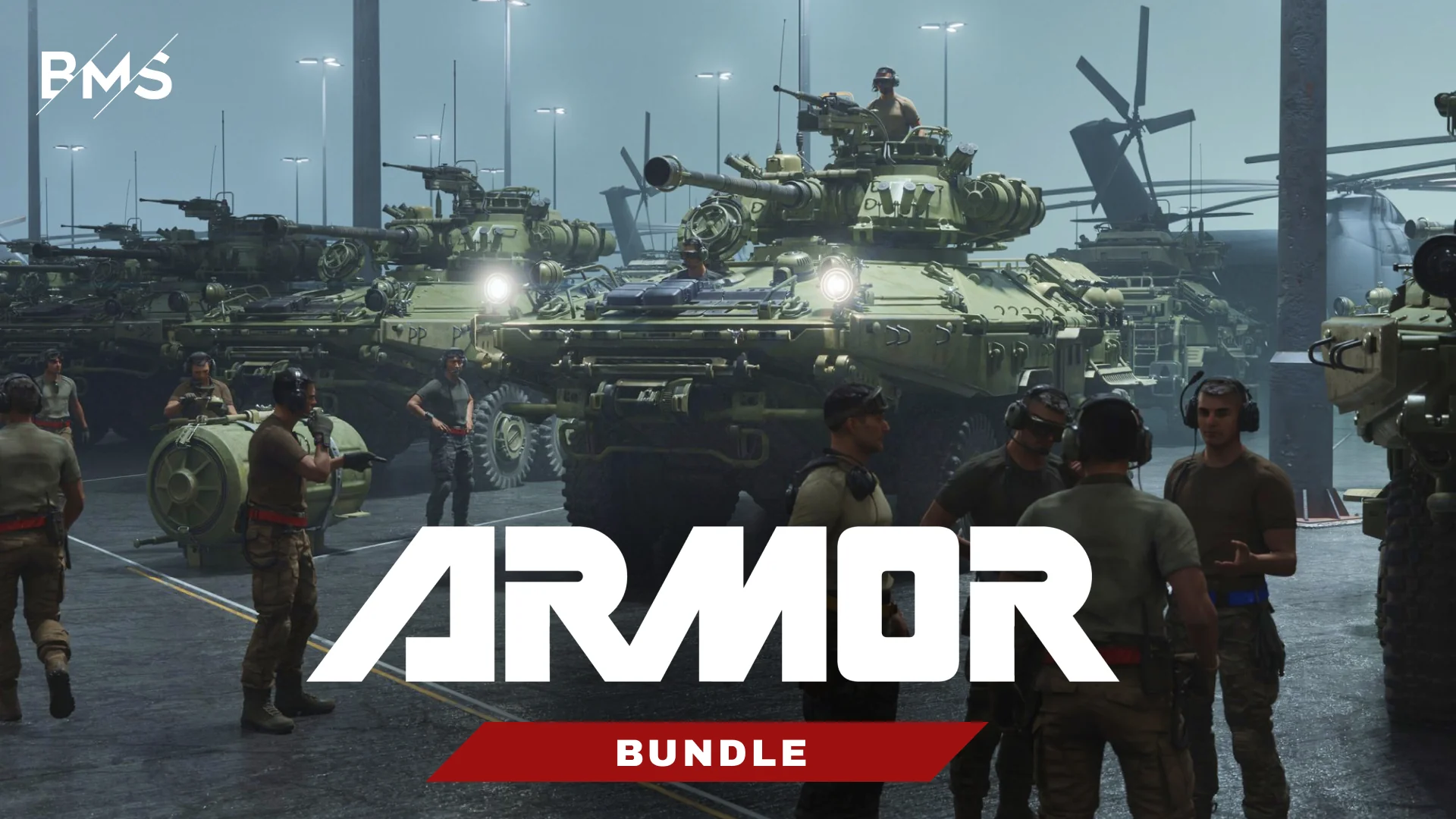
The central appeal here is not just the presence of multiple asset types, but how they work together in production. Three hero vehicles form the backbone of the bundle, giving a scene immediate focal points for close framing, turntables, cinematic reveals, or staged transport and combat imagery.
Those hero vehicles include Blueprint-based rotating parts and lighting controls. For production work, that means they are not static display pieces alone. Rotating elements help support presentation and staged action, while lighting controls add another layer of shot preparation without requiring the vehicle to be treated as a purely inert model. For cinematic work, that matters most in moments where a vehicle needs to feel responsive on camera, whether the goal is a hangar lineup, a moving column, or a stylized concept frame shaped by armor, artillery, and transport themes.
The bundle positions those vehicles as the starting point for a cohesive fleet rather than isolated set pieces. That idea carries across the rest of the package: instead of stopping with a few flagship models, it expands outward into modular assembly and character support so the wider scene can hold up around the hero assets.
Hero vehicles, rotating parts, and lighting controls
The three hero vehicles are the most direct route to a finished image. They provide the large-scale shapes and mechanical identity that define the collection.
Blueprint-based rotating parts suggest a vehicle setup that supports controlled presentation and visual variation inside a scene. A rotating component can change the posture and attitude of a machine without forcing a complete redesign, which is useful when several shots need to come from the same asset base. Lighting controls add another practical layer for look development and scene adjustment. In a cinematic pipeline, vehicle lighting can influence readability, silhouette, and emphasis, especially when a shot needs to push a photorealistic or concept-driven mood. The bundle’s focus stays on detailed, hard-surface machinery rather than lightweight game-ready props, so the vehicles make the most sense as centerpiece assets in high-quality visual work.
This also shapes where the vehicles fit best. They suit sequences and stills where detail needs to hold up, where armor and mechanical surfaces are meant to be seen clearly, and where a project benefits from consistent military-inspired design language across multiple assets.
500+ modular kitbash parts and 34 pre-assembled models
Beyond the hero vehicles, the kitbash side of the bundle is what broadens its production value. More than 500 modular kitbash parts are included, along with UVs and textures, plus 34 pre-assembled kitbash models.
That combination supports two different working styles. One path is direct assembly from pre-built forms. The 34 pre-assembled models can help fill out scenes, establish secondary machinery, or provide a fast mechanical base that complements the larger vehicles. The other path is custom construction. With 500 or more modular parts available, the collection can be used to build original designs, alter silhouettes, and generate support machinery that still matches the same visual family. For concept-oriented scenes, this is relevant because one of the fastest ways to lose cohesion is to mix unrelated mechanical languages. Here, the modular inventory gives room to create variety while staying within the same gritty armored identity.
UVs and textures are explicitly included for the modular kitbash parts, which makes them more than raw blockout pieces. They are prepared for visual use, not just rough shape exploration. That suits artists building transport, turret, artillery, or general mechanical forms that need to sit alongside the hero vehicles rather than feeling like placeholders.
Rigged character work, posed presets, and outfit toggles
The character side of the bundle keeps the human element aligned with the machines. One fully rigged character is included, along with 35 posed presets and gear variations.
That makes the character useful for staging and composition even without a dedicated animation set. A posed character can anchor scale, reinforce the militarized setting, and help transition a vehicle-focused scene into something more narrative. The 35 posed presets suggest coverage for different display states and presentation needs, while gear variations help keep repeated appearances from feeling identical. A modular character Blueprint adds outfit toggles and posed states, giving the character setup more flexibility than a single locked configuration.
Camouflage customization is handled through material instances, which keeps the visual direction tied to a familiar production control point. Rather than treating camo as a fixed skin, the bundle leaves room to tune appearance in a way that can better match the rest of the fleet. In practice, this helps when a scene needs vehicles and character elements to read as part of the same unit, operation, or environment.
Where this cinematic collection fits in a real pipeline
ARMOR - Bundle is not presented as a general-purpose game pack. It is specifically noted as not optimized for games, and it may require adjustments for game use.
That statement is important because it clarifies the bundle’s strongest role in production. This is a collection for cinematic or high-quality visual projects first. It belongs in workflows anchored in detailed rendering, look development, concept visualization, key art, hero shot creation, and scene assembly where asset fidelity takes priority over game optimization. The focus on hero vehicles, lighting controls, rigged and posed character presentation, and large-scale kitbashing all aligns with that kind of use.
There is also a clear note on animation: no animations are included. The character assets are rigged and posed, and animation retargeting may be required. That places the bundle in an interesting middle ground for motion work. It can support character presence and staging immediately, but teams expecting out-of-the-box animation content should plan for additional rig or retargeting steps. For still imagery, presentation scenes, and cinematic layouts based on controlled poses, that limitation is far less restrictive.
Another practical note concerns scene expectations. Example scenes may contain additional background elements that are not part of the pack. That means the bundle covers the core armored subjects and modular mechanical content, while broader scene dressing may still need to come from elsewhere in a production. In workflow terms, the collection handles the primary combat vehicle and character identity, then leaves room for a team to build out the surrounding world as needed.
From concept frames to polished mechanical scenes
The collaboration behind the pack points toward a deliberate gritty mechanical design direction with ties to AAA-style visual sensibilities. That shows up in the way the bundle balances hero assets with modular construction tools.
For concept-heavy production, the strongest use case is straightforward: start with one of the hero vehicles as the visual anchor, extend the setting with pre-assembled mechanical models, then push the scene further with the modular kitbash library. Add the rigged character in one of the included posed states, adjust outfit toggles, and use camouflage material instances to keep the character and machines visually aligned. This gives a package that fits best where scene cohesion matters as much as individual asset detail. Rather than serving as a catch-all game library, it sits most naturally in cinematic pipelines that need armored transport, combat-ready machinery, and supporting character presence to arrive in the same visual register.
 Military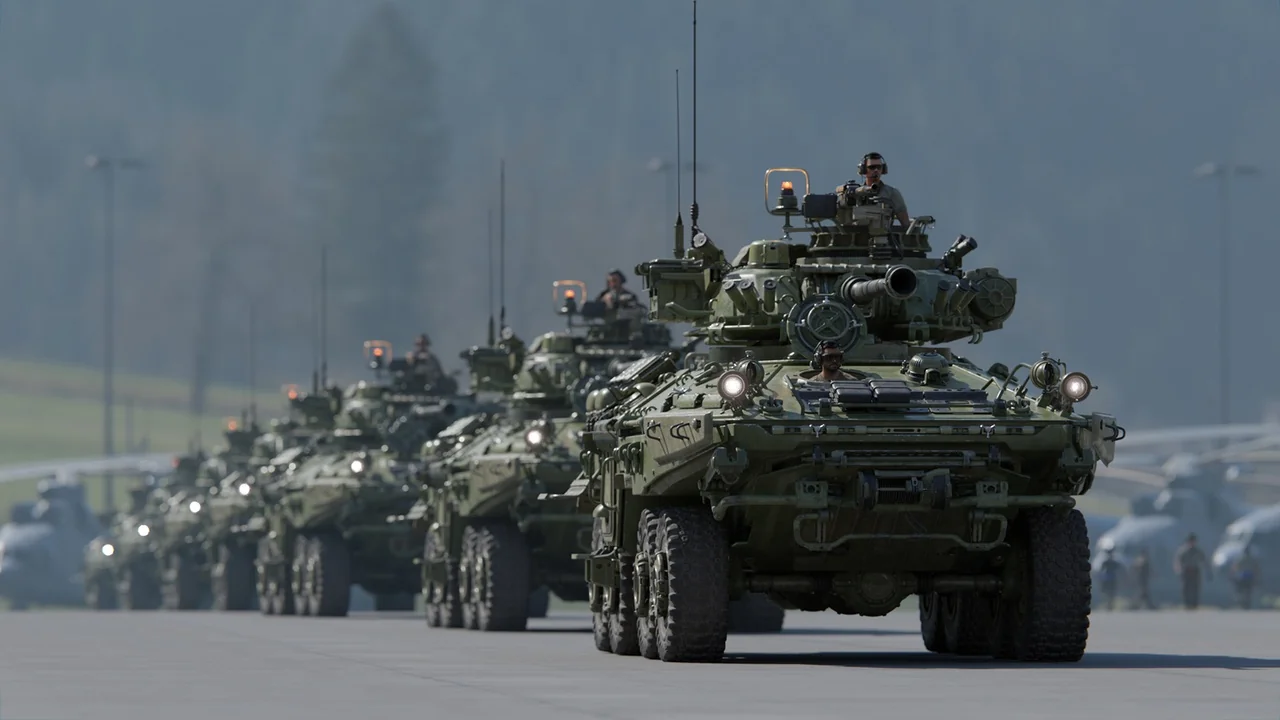
 Military
 Military
 Military