"7e6fc58c410f2894"{"id":"1000492","slug":"vehicles-vol-1-small-rides-nanite-and-low-poly","title":"Vehicles VOL.1 - Small Rides (Nanite and Low Poly)","category":"Vehicles \u0026 Transportation","engine":"5.1+","assetVersion":"","engineVersion":"Engine Version: 5.1+","tag":"Vehicles","accent":"blue","visual":"mech","summary":"Dekogon Studios' Vehicles VOL.1 offers 20 prop meshes of small rides with Nanite and low poly versions, 4K textures, channel-packed maps, and Lumen support.","platform":"Unreal Engine","publishedAt":"2026-07-13T03:19:03.713Z","updatedAt":"2026-07-13T03:19:03.713Z","sourceNotes":[],"fileContents":[],"compatibility":["Unreal Engine","Engine Version: 5.1+"],"featuredImage":{"alt":"Vehicles VOL.1 - Small Rides (Nanite and Low Poly)","src":"/wp-content/uploads/published/2026/07/b776a8249353-9a7d2c1f-cdad-4863-8934-4b9f0c637c61-3249c444ee.webp"},"hasDownloadLink":true,"downloads":0,"terms":[{"taxonomy":"category","slug":"vehicles-and-transportation","name":"Vehicles \u0026 Transportation"}],"galleryImages":[{"src":"/wp-content/uploads/published/2026/07/b09ec530d79c-c6afa427-dc16-4b3a-9424-410cd9088942-deb8b83cf9.webp","alt":"Vehicles VOL.1 - Small Rides (Nanite and Low Poly)"},{"src":"/wp-content/uploads/published/2026/07/ee69049a0e7d-5fa2a876-7b7f-4ef0-aa3c-c2180a27799f-081157f70b.webp","alt":"Vehicles VOL.1 - Small Rides (Nanite and Low Poly)"},{"src":"/wp-content/uploads/published/2026/07/a2b392c1b8b8-a3bd84b2-1ee0-409f-9749-bf4d12adceb4-5f8ce40853.webp","alt":"Vehicles VOL.1 - Small Rides (Nanite and Low Poly)"},{"src":"/wp-content/uploads/published/2026/07/c2e200d81d6f-671e3504-99cb-400a-9d2f-432a943cd13b-9a0de54108.webp","alt":"Vehicles VOL.1 - Small Rides (Nanite and Low Poly)"},{"src":"/wp-content/uploads/published/2026/07/0033aeccc4f4-737e77e0-e730-41a4-87ca-72bfef489874-764bcd06dc.webp","alt":"Vehicles VOL.1 - Small Rides (Nanite and Low Poly)"},{"src":"/wp-content/uploads/published/2026/07/7a7e51aaebcb-3922bac2-0af1-43b8-b0e7-501b4c124166-ff0ec8c3a6.webp","alt":"Vehicles VOL.1 - Small Rides (Nanite and Low Poly)"},{"src":"/wp-content/uploads/published/2026/07/e06a572f1c49-12b58e9d-dfb3-44ba-b7b3-ab86b5f3bd4f-18cbfb69b8.webp","alt":"Vehicles VOL.1 - Small Rides (Nanite and Low Poly)"},{"src":"/wp-content/uploads/published/2026/07/5f060430e68f-3f03fc19-7554-4452-bc80-f27fb0f3f39c-e520fb7840.webp","alt":"Vehicles VOL.1 - Small Rides (Nanite and Low Poly)"},{"src":"/wp-content/uploads/published/2026/07/4cc6d1b8688e-5fa691f3-539d-4657-a2ed-c060c6869741-20576a41a8.webp","alt":"Vehicles VOL.1 - Small Rides (Nanite and Low Poly)"},{"src":"/wp-content/uploads/published/2026/07/59d85e46900b-0f79693b-b072-45c0-a03d-4f046faa17c9-c6ed6ec191.webp","alt":"Vehicles VOL.1 - Small Rides (Nanite and Low Poly)"}],"accessPanel":{"kind":"resource","title":"Download this resource","eyebrow":"Free Download","message":"Log in or create a free account to start your download.","fileName":"Content.7z","safetyNote":"Resources are manually reviewed before listing to improve quality and reduce obvious risks.","actionLabel":"Download Free","resourceType":"Resource archive"},"contentHtml":"\u003cp\u003ePopulating a modern Unreal Engine scene with realistic transportation often presents a workflow split: artists need high-fidelity visuals for cinematic captures, but performance-friendly geometry for active gameplay spaces. Vehicles VOL.1 - Small Rides (Nanite and Low Poly) addresses this by providing dual-resolution prop assets built natively for the engine. The collection includes 20 meshes split between Nanite and low poly versions of each model, allowing environment artists to swap rendering workflows without replacing the underlying asset.\u003c/p\u003e \u003ch2\u003eFilling Small Transportation Needs in Unreal Engine Scenes\u003c/h2\u003e\n\u003cp\u003eThe pack focuses on compact vehicles rather than full-sized automobiles. The tagged categories indicate a range of small transportation modes, including cars, bicycles, motorcycles, scooters, and golf carts. Other tags suggest suitability for traffic-oriented scenes, post-apocalyptic settings, and dune buggy off-road environments. This focus makes the assets suitable for urban environments where standard-sized cars would overpower narrow streets or tight alleyway compositions.\u003c/p\u003e\n\u003cp\u003eTo ensure seamless integration into custom projects, all branding and labels across the assets are custom-made by the studio. This design choice keeps the models free of real-world trademark imagery, allowing developers to deploy the vehicles in commercial projects without encountering legal compatibility issues related to existing corporate identities.\u003c/p\u003e \u003ch2\u003eSwitching Between Nanite Fidelity and Low Poly Budgets\u003c/h2\u003e\n\u003cp\u003eEach mesh in the collection is constructed in two forms. The Nanite versions utilize Unreal Engine's virtualized geometry system to provide high-quality fidelity polycounts, capturing fine surface details suitable for close-up rendering and hero shots. The low poly versions serve standard rendering pipelines or mobile and VR applications where maintaining a strict polygon budget is necessary.\u003c/p\u003e\n\u003cp\u003eBy offering both variants of the 20 meshes, artists can maintain visual consistency across different render targets. A developer can use the Nanite models for a high-fidelity cinematic sequence and switch to the low poly equivalents for distant background elements in a playable level. This approach keeps memory usage in check while maximizing visual density where the camera requires it.\u003c/p\u003e \u003ch3\u003eMaterial Controls and Channel-Packed Textures\u003c/h3\u003e\n\u003cp\u003eSurface fidelity relies on a master material setup that controls the majority of the included props. Rather than relying on individual material instances for every vehicle component, artists can adjust universal parameters to modify the look of the assets. The material provides additional controls for roughness, albedo, and normals.\u003c/p\u003e\n\u003cp\u003eTexture sets utilize 4K resolutions to maintain crisp surface details across the high-polycount Nanite models. The pack employs channel packing for Roughness, Metalness, and Ambient Occlusion maps to consolidate texture data efficiently. This technique reduces the number of simultaneous texture samples required, streamlining the rendering process while preserving the detailed surface reactions needed for AAA-quality shading under various lighting conditions.\u003c/p\u003e \u003ch2\u003eBones, Animation, and Prop Implementation\u003c/h2\u003e\n\u003cp\u003eThese assets are built strictly as static props. The models do not contain bones or rigging setups, and the pack does not include vehicle animations. This functional identity shapes how developers must implement the rides in their scenes.\u003c/p\u003e\n\u003cp\u003eArtists using these assets must rely on placement and environmental storytelling rather than dynamic character interactions. Adding movement to these vehicles requires developers to apply their own animation logic or physics systems to the static meshes. The fully detailed models are designed to look complete from all sides, allowing for flexible placement in open-world environments or showroom-style dioramas where players or cameras can orbit the vehicles entirely.\u003c/p\u003e \u003ch2\u003eRendering Pipelines for Lumen and Post-Processing\u003c/h2\u003e\n\u003cp\u003eVehicles VOL.1 - Small Rides supports Lumen for Unreal Engine 5.0 and above. Lumen compatibility means the vehicle surfaces will bounce and react to global illumination accurately, pulling colored light from surrounding environment materials and dynamic light sources. This integration ensures the mesh surfaces blend naturally into dynamic lighting scenes.\u003c/p\u003e\nThe pack also includes a Realistic Post Process and Look Up Table (LUT). Including these visual framework tools allows developers to match the specific color grading and atmosphere envisioned by the studio during the assets' creation. The assets are optimized for games, ensuring the included materials and mesh resolutions perform well within real-time interactive environments. \u003ch3\u003ePositioning the Rides in Production Pipelines\u003c/h3\u003e\n\u003cp\u003eThis asset collection fits naturally into environment art pipelines that need reliable, unbranded transportation props without the overhead of modeling custom vehicles from scratch. The combination of 4K textures, channel-packed maps, and a master material system makes the assets visually cohesive out of the box. For teams building traffic-heavy cities, dune environments, or apocalyptic wastelands in Unreal Engine 5.1 through 5.8, the dual Nanite and low poly meshes offer a practical solution for maintaining high visual standards across varying hardware capabilities and scene complexity scales.\u003c/p\u003e\n\n\u003ch2\u003eRelated Resources Worth Checking\u003c/h2\u003e\n\u003cul\u003e\n\u003cli\u003e\u003ca href=\"https://3dcghub.com/boatyard-vol-5-tugboat-nanite/\" title=\"Boatyard VOL.5 - Tugboat (Nanite)\"\u003eBoatyard VOL.5 - Tugboat (Nanite)\u003c/a\u003e\u003c/li\u003e\n\u003cli\u003e\u003ca href=\"https://3dcghub.com/intelligent-traffic-system/\" title=\"Intelligent Traffic System\"\u003eIntelligent Traffic System\u003c/a\u003e\u003c/li\u003e\n\u003cli\u003e\u003ca href=\"https://3dcghub.com/driveable-steampunk-car-vehicle-steampunk-car-retro-futuristic-victorian/\" title=\"Driveable SteamPunk Car / Vehicle ( SteamPunk Car Retro Futuristic Victorian)\"\u003eDriveable SteamPunk Car / Vehicle ( SteamPunk Car Retro Futuristic Victorian)\u003c/a\u003e\u003c/li\u003e\n\u003cli\u003e\u003ca href=\"https://3dcghub.com/stellar-phoenix-shuttle-spaceship-with-controller/\" title=\"Stellar Phoenix Shuttle - Spaceship With Controller\"\u003eStellar Phoenix Shuttle - Spaceship With Controller\u003c/a\u003e\u003c/li\u003e\n\u003cli\u003e\u003ca href=\"https://3dcghub.com/medieval-siege-weapons/\" title=\"Medieval Siege Weapons\"\u003eMedieval Siege Weapons\u003c/a\u003e\u003c/li\u003e\n\u003c/ul\u003e","contentTextLength":5567,"navigation":{"current":1267,"total":3618,"previous":{"id":"1000493","slug":"vehicles-vol-2-retro-cars-low-poly","title":"Vehicles VOL.2 - Retro Cars (Low Poly)","category":"Vehicles \u0026 Transportation","platform":"Unreal Engine","updatedAt":"2026-07-13T03:29:26.435Z"},"next":{"id":"1000491","slug":"suburbs-vol-21-knick-knack-decor-nanite-and-low-poly","title":"Suburbs VOL.21 - Knick Knack Decor (Nanite and Low Poly)","category":"Art \u0026 Statues","platform":"Unreal Engine","updatedAt":"2026-07-13T03:04:06.962Z"}},"relatedResources":[{"id":"1000707","slug":"vehicles-vol-4-retro-cars-low-poly","title":"Vehicles VOL.4 - Retro Cars (Low Poly)","category":"Vehicles \u0026 Transportation","engine":"5.1+","assetVersion":"","engineVersion":"Engine Version: 5.1+","tag":"Vehicles","accent":"blue","visual":"mech","summary":"Five retro low-poly vehicles with split meshes, 4k textures, tintable paint, channel-packed masks, and Lumen support for Unreal Engine 5.0+.","platform":"Unreal Engine","publishedAt":"2026-07-24T01:51:03.278Z","updatedAt":"2026-07-24T01:51:03.278Z","sourceNotes":[],"fileContents":[],"compatibility":["Unreal Engine","Engine Version: 5.1+"],"featuredImage":{"alt":"Vehicles VOL.4 - Retro Cars (Low Poly)","src":"/wp-content/uploads/published/2026/07/e0d046dad155-ef4a759a-30af-4e29-9985-9418dfe7ed11-02e1c9682c.webp"},"hasDownloadLink":true,"downloads":0},{"id":"1000495","slug":"vehicles-vol-5-trucks-tractors-buses-low-poly","title":"Vehicles VOL.5 - Trucks, Tractors, Buses (Low Poly)","category":"Vehicles \u0026 Transportation","engine":"5.1+","assetVersion":"","engineVersion":"Engine Version: 5.1+","tag":"Vehicles","accent":"blue","visual":"mech","summary":"A prop-only vehicle pack of trucks, tractors, and buses with 4k textures, master material controls, and Lumen support for Unreal Engine 5.1+.","platform":"Unreal Engine","publishedAt":"2026-07-13T03:43:56.572Z","updatedAt":"2026-07-13T03:43:56.572Z","sourceNotes":[],"fileContents":[],"compatibility":["Unreal Engine","Engine Version: 5.1+"],"featuredImage":{"alt":"Vehicles VOL.5 - Trucks, Tractors, Buses (Low Poly)","src":"/wp-content/uploads/published/2026/07/58cb2f5ebbef-d7b63d3f-8209-40ea-8f7f-03c754bd1f60-b0de32e215.webp"},"hasDownloadLink":true,"downloads":0},{"id":"1000494","slug":"vehicles-vol-3-retro-cars-low-poly","title":"Vehicles VOL.3 - Retro Cars (Low Poly)","category":"Vehicles \u0026 Transportation","engine":"5.1+","assetVersion":"","engineVersion":"Engine Version: 5.1+","tag":"Vehicles","accent":"blue","visual":"mech","summary":"Five retro low-poly cars with Police and Taxi variants, 4K textures, master material controls, Lumen support for Unreal Engine 5.0+, and custom branding.","platform":"Unreal Engine","publishedAt":"2026-07-13T03:37:05.947Z","updatedAt":"2026-07-13T03:37:05.947Z","sourceNotes":[],"fileContents":[],"compatibility":["Unreal Engine","Engine Version: 5.1+"],"featuredImage":{"alt":"Vehicles VOL.3 - Retro Cars (Low Poly)","src":"/wp-content/uploads/published/2026/07/cc034263a868-564937b7-8588-42e1-a8f1-e2490a8b9177-a0640cadd4.webp"},"hasDownloadLink":true,"downloads":0}]}
Vehicles
Vehicles VOL.1 - Small Rides (Nanite and Low Poly)
Dekogon Studios' Vehicles VOL.1 offers 20 prop meshes of small rides with Nanite and low poly versions, 4K textures, channel-packed maps, and Lumen support.
Populating a modern Unreal Engine scene with realistic transportation often presents a workflow split: artists need high-fidelity visuals for cinematic captures, but performance-friendly geometry for active gameplay spaces. Vehicles VOL.1 - Small Rides (Nanite and Low Poly) addresses this by providing dual-resolution prop assets built natively for the engine. The collection includes 20 meshes split between Nanite and low poly versions of each model, allowing environment artists to swap rendering workflows without replacing the underlying asset.
Filling Small Transportation Needs in Unreal Engine Scenes
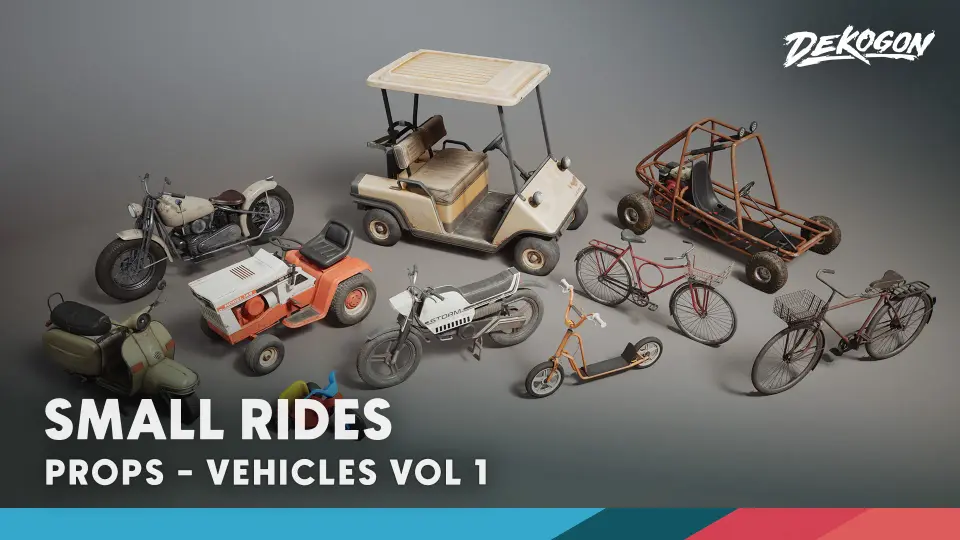
The pack focuses on compact vehicles rather than full-sized automobiles. The tagged categories indicate a range of small transportation modes, including cars, bicycles, motorcycles, scooters, and golf carts. Other tags suggest suitability for traffic-oriented scenes, post-apocalyptic settings, and dune buggy off-road environments. This focus makes the assets suitable for urban environments where standard-sized cars would overpower narrow streets or tight alleyway compositions.
To ensure seamless integration into custom projects, all branding and labels across the assets are custom-made by the studio. This design choice keeps the models free of real-world trademark imagery, allowing developers to deploy the vehicles in commercial projects without encountering legal compatibility issues related to existing corporate identities.
Switching Between Nanite Fidelity and Low Poly Budgets
Each mesh in the collection is constructed in two forms. The Nanite versions utilize Unreal Engine's virtualized geometry system to provide high-quality fidelity polycounts, capturing fine surface details suitable for close-up rendering and hero shots. The low poly versions serve standard rendering pipelines or mobile and VR applications where maintaining a strict polygon budget is necessary.
By offering both variants of the 20 meshes, artists can maintain visual consistency across different render targets. A developer can use the Nanite models for a high-fidelity cinematic sequence and switch to the low poly equivalents for distant background elements in a playable level. This approach keeps memory usage in check while maximizing visual density where the camera requires it.
Material Controls and Channel-Packed Textures
Surface fidelity relies on a master material setup that controls the majority of the included props. Rather than relying on individual material instances for every vehicle component, artists can adjust universal parameters to modify the look of the assets. The material provides additional controls for roughness, albedo, and normals.
Texture sets utilize 4K resolutions to maintain crisp surface details across the high-polycount Nanite models. The pack employs channel packing for Roughness, Metalness, and Ambient Occlusion maps to consolidate texture data efficiently. This technique reduces the number of simultaneous texture samples required, streamlining the rendering process while preserving the detailed surface reactions needed for AAA-quality shading under various lighting conditions.
Bones, Animation, and Prop Implementation
These assets are built strictly as static props. The models do not contain bones or rigging setups, and the pack does not include vehicle animations. This functional identity shapes how developers must implement the rides in their scenes.
Artists using these assets must rely on placement and environmental storytelling rather than dynamic character interactions. Adding movement to these vehicles requires developers to apply their own animation logic or physics systems to the static meshes. The fully detailed models are designed to look complete from all sides, allowing for flexible placement in open-world environments or showroom-style dioramas where players or cameras can orbit the vehicles entirely.
Rendering Pipelines for Lumen and Post-Processing
Vehicles VOL.1 - Small Rides supports Lumen for Unreal Engine 5.0 and above. Lumen compatibility means the vehicle surfaces will bounce and react to global illumination accurately, pulling colored light from surrounding environment materials and dynamic light sources. This integration ensures the mesh surfaces blend naturally into dynamic lighting scenes.
The pack also includes a Realistic Post Process and Look Up Table (LUT). Including these visual framework tools allows developers to match the specific color grading and atmosphere envisioned by the studio during the assets' creation. The assets are optimized for games, ensuring the included materials and mesh resolutions perform well within real-time interactive environments.
Positioning the Rides in Production Pipelines
This asset collection fits naturally into environment art pipelines that need reliable, unbranded transportation props without the overhead of modeling custom vehicles from scratch. The combination of 4K textures, channel-packed maps, and a master material system makes the assets visually cohesive out of the box. For teams building traffic-heavy cities, dune environments, or apocalyptic wastelands in Unreal Engine 5.1 through 5.8, the dual Nanite and low poly meshes offer a practical solution for maintaining high visual standards across varying hardware capabilities and scene complexity scales.
 Vehicles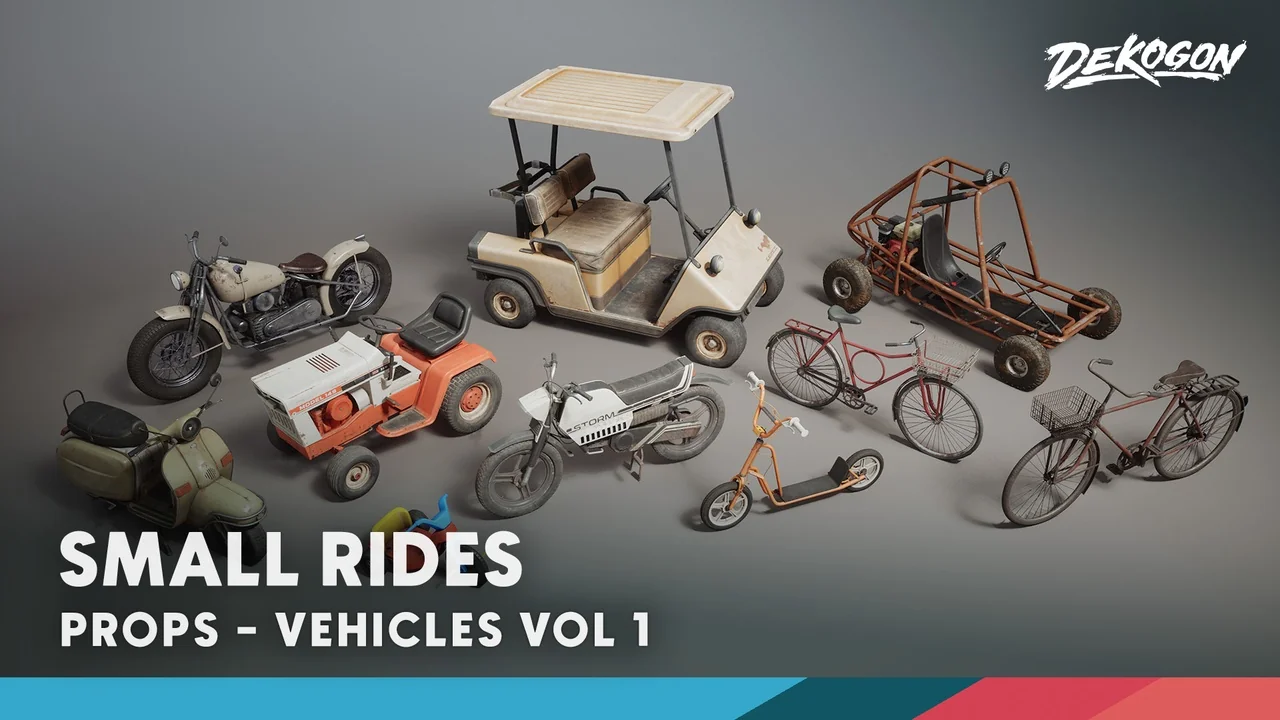
 Vehicles
 Vehicles
 Vehicles