"7b46a695175d8694"{"id":"1000422","slug":"boatyard-vol-5-tugboat-nanite","title":"Boatyard VOL.5 - Tugboat (Nanite)","category":"Vehicles \u0026 Transportation","engine":"5.1+","assetVersion":"","engineVersion":"Engine Version: 5.1+","tag":"Vehicles","accent":"blue","visual":"mech","summary":"Nanite-powered tugboat asset pack for Unreal Engine 5.1-5.8 with 35 meshes, 4K textures, master material controls, Lumen support, and custom branding.","platform":"Unreal Engine","publishedAt":"2026-07-09T20:22:08.780Z","updatedAt":"2026-07-09T20:22:08.780Z","sourceNotes":[],"fileContents":[],"compatibility":["Unreal Engine","Engine Version: 5.1+"],"featuredImage":{"alt":"Boatyard VOL.5 - Tugboat (Nanite)","src":"/wp-content/uploads/published/2026/07/a2458fa3bc3c-dd42984c-9371-4554-adf6-17eec92e8f8e-3e66d3dcfd.webp"},"hasDownloadLink":true,"downloads":0,"terms":[{"taxonomy":"category","slug":"vehicles-and-transportation","name":"Vehicles \u0026 Transportation"}],"galleryImages":[{"src":"/wp-content/uploads/published/2026/07/8baa2be4bd61-f91d12cb-0e4b-44f7-9ff2-4193f38d351b-fc09503d57.webp","alt":"Boatyard VOL.5 - Tugboat (Nanite)"},{"src":"/wp-content/uploads/published/2026/07/b1e624436d25-31a6f3f9-b675-462d-ac45-1b5733df2d82-5538f9e3e4.webp","alt":"Boatyard VOL.5 - Tugboat (Nanite)"},{"src":"/wp-content/uploads/published/2026/07/fc6427f998b7-cfff5b59-33fc-41d4-98c7-34df81c4bae8-18fe16b06b.webp","alt":"Boatyard VOL.5 - Tugboat (Nanite)"},{"src":"/wp-content/uploads/published/2026/07/4dcd05512d97-3d463090-e06e-4d16-82c1-62ec08cf6eb5-86ea3cce43.webp","alt":"Boatyard VOL.5 - Tugboat (Nanite)"},{"src":"/wp-content/uploads/published/2026/07/dd74d9453f2d-7b7d441d-3740-4213-bedf-06268fab6273-afb7f1dffc.webp","alt":"Boatyard VOL.5 - Tugboat (Nanite)"},{"src":"/wp-content/uploads/published/2026/07/ab8b35ad35ac-56866771-9e9c-43ad-92aa-a242d129df80-148760ab99.webp","alt":"Boatyard VOL.5 - Tugboat (Nanite)"},{"src":"/wp-content/uploads/published/2026/07/3f5510ce0bcd-06369007-2d02-4028-a8d0-82a5529a01fa-5661e07ae2.webp","alt":"Boatyard VOL.5 - Tugboat (Nanite)"},{"src":"/wp-content/uploads/published/2026/07/a817ae877c67-f860934e-f3ea-4aad-b7b9-097c3b7e384d-82f17fb6f7.webp","alt":"Boatyard VOL.5 - Tugboat (Nanite)"},{"src":"/wp-content/uploads/published/2026/07/d87dba6884c2-4777b4b5-0a88-4e3a-bd44-78b84c5e8299-54cb1c92d8.webp","alt":"Boatyard VOL.5 - Tugboat (Nanite)"},{"src":"/wp-content/uploads/published/2026/07/2d4dd21472f5-db81f2f1-49e9-495a-80a4-346d69b3751b-28bfe89a5f.webp","alt":"Boatyard VOL.5 - Tugboat (Nanite)"}],"accessPanel":{"kind":"resource","title":"Download this resource","eyebrow":"Free Download","message":"Log in or create a free account to start your download.","fileName":"Content.7z","safetyNote":"Resources are manually reviewed before listing to improve quality and reduce obvious risks.","actionLabel":"Download Free","resourceType":"Resource archive"},"contentHtml":"\u003cp\u003eDropping a tugboat into an Unreal Engine scene usually means wrestling with LODs, silhouette loss, and texture memory. This package sidesteps that pipeline friction by building every mesh on Nanite, allowing geometry density to scale with camera proximity rather than manual decimation passes. The project ships with thirty-five meshes covering named props related to harbor, fish, sailing, and ocean environments. Every asset is built within the engine itself, with all maps and materials already configured for use.\u003c/p\u003e\u003ch2\u003eNanite construction and the 35 mesh lineup\u003c/h2\u003e\u003cp\u003eAll meshes in this collection are constructed using Nanite, Epic's virtualized geometry system in Unreal Engine. What this means practically is each model maintains high-fidelity polycount detail Nanite handles streaming those triangles intelligently at runtime, so fully detailed models can occupy a scene without the usual performance cliff associated with dense imported geometry. The thirty-five meshes are tagged across several nautical themes: tugboat, fish, sailing, sailor, ship, and boat. Additional descriptive tags like rusty, abandoned, and sea suggest the aesthetic leans toward weathered, lived-in harbor use rather than pristine showroom condition.\u003c/p\u003e\u003cp\u003eBecause branding and labels across the props are custom made by Dekogon Studios, there no trademark workarounds required before placing these models in a commercial project. Every logo, marking, or identifier visible on the assets is original studio artwork, eliminating third-party legal exposure before a scene ships.\u003c/p\u003e\u003ch2\u003eMaterial controls beyond the defaults\u003c/h2\u003e\u003cp\u003eA single master material setup controls the majority of props in the package. Rather than inputing a unique material instance for every mesh, users adjust shared parameters that propagate across compatible models. Beyond basic material assignment, the master material exposes controls for roughness, albedo, normals, and additional surface properties. These sliders allow artists to match a tugboat's hull to scene lighting or art direction without re-exporting texture maps.\u003c/p\u003e\u003cp\u003eTexture resolution runs at 4K across high-quality sets. The packing scheme follows standard PBR convention: Roughness, Metalness, and Ambient Occlusion are channel-packed into textures, reducing the number of samplers active during rendering. This packing keeps memory footprint predictable while preserving the individual contribution of each property to the final shaded result.\u003c/p\u003e\u003ch3\u003ePost-process and look-up table integration\u003c/h3\u003e\u003cp\u003eThe package includes realistic post-process settings and a Look-Up Table (LUT). These additions let artists match color grading to the intended visual tone of the assets on import. Rather than spending hours tuning bloom, exposure, or tonemapping curves from scratch, the included LUT provides a baseline grade aligned with the studio's AAA visual target, serving as a reasonable starting point that can be pushed further or pulled back as the scene demands.\u003c/p\u003e\u003ch2\u003eLumen and Unreal Engine 5.1 through 5.8\u003c/h2\u003e\u003cp\u003eVisual fidelity is tied to Lumen, Unreal Engine 5's real-time global illumination system. The product explicitly supports Lumen, meaning materials and meshes are configured to respond correctly to dynamic bounced light. This is where the combination of Nanite geometry and Lumen lighting becomes relevant: fine surface detail from Nanite geometry catches accurate indirect light from Lumen, producing the contact shadows and grazing highlights expected in a modern marine environment.\u003c/p\u003e\u003cp\u003eCompatibility extends across Unreal Engine 5.1 through 5.8, covering current and forward-looking engine versions. Artists can integrate these assets into ongoing Unreal Engine 5 projects without significant migration friction, and the Nanite plus Lumen feature set remains the most relevant path forward for architecture within this engine generation.\u003c/p\u003e\u003ch2\u003eMarine and harbor scene applications\u003c/h2\u003e\u003cp\u003eThe tag pool reveals specific scene types where these assets fit best. Tugboat, harbor, ship, sailor, boat, and fishing tags point toward dockside compositions. Sea, ocean, sailing, and fish tags expand into open-water settings. The rusty and abandoned tags suggest post-critical or neglected harbor environments, where weathered hulls and aged equipment reinforce a narrative of disrepair or long industrial service. Master material controls for roughness and albedo support these themes directly: roughness can be pushed to simulate salt corrosion, while albedo adjustment can bake in the muted tones of aged marine paint.\u003c/p\u003e\u003cp\u003eThirty-five meshes provide enough variety to populate a dockside scene with clutter and infrastructure. Props can be scattered as foreground hero objects near a moored tugboat or arranged as background dressing along a quay wall. Because every mesh has a Nanite version, density is not capped by manual draw call budgets artists typically face when filling harbor environments with incidental detail.\u003c/p\u003e\u003ch3\u003eProduction-readiness for solo and team workflows\u003c/h3\u003e\u003cp\u003eOptimization is stated the assets are optimized for games. Combined with custom branding and in-engine material construction, the package is positioned for direct insertion into a playable build rather than serving as reference geometry for offline rendering. A solo developer gains immediate access to a cohesive set of nautical assets without managing outsourced art pipelines. A team benefits from the master material approach across the set, allowing a technical artist to adjust surface properties uniformly without hunting through dozens of individual material files. Free of legal issues related to branding, and with all constructed assets completed by Dekogon Studios artists, the collection is ready for commercial deployment in Unreal Engine projects targeting versions 5.1 and beyond.\u003c/p\u003e\n\n\u003ch2\u003eRelated Resources Worth Checking\u003c/h2\u003e\n\u003cul\u003e\n\u003cli\u003e\u003ca href=\"https://3dcghub.com/boatyard-vol-2-old-boats-nanite/\" title=\"Boatyard VOL.2 - Old Boats (Nanite)\"\u003eBoatyard VOL.2 - Old Boats (Nanite)\u003c/a\u003e\u003c/li\u003e\n\u003cli\u003e\u003ca href=\"https://3dcghub.com/driveable-steampunk-car-vehicle-steampunk-car-retro-futuristic-victorian/\" title=\"Driveable SteamPunk Car / Vehicle ( SteamPunk Car Retro Futuristic Victorian)\"\u003eDriveable SteamPunk Car / Vehicle ( SteamPunk Car Retro Futuristic Victorian)\u003c/a\u003e\u003c/li\u003e\n\u003cli\u003e\u003ca href=\"https://3dcghub.com/stellar-phoenix-shuttle-spaceship-with-controller/\" title=\"Stellar Phoenix Shuttle - Spaceship With Controller\"\u003eStellar Phoenix Shuttle - Spaceship With Controller\u003c/a\u003e\u003c/li\u003e\n\u003cli\u003e\u003ca href=\"https://3dcghub.com/medieval-siege-weapons/\" title=\"Medieval Siege Weapons\"\u003eMedieval Siege Weapons\u003c/a\u003e\u003c/li\u003e\n\u003cli\u003e\u003ca href=\"https://3dcghub.com/scifi-cyber-car-2/\" title=\"SciFi Cyber Car 2\"\u003eSciFi Cyber Car 2\u003c/a\u003e\u003c/li\u003e\n\u003c/ul\u003e","contentTextLength":5967,"navigation":{"current":1198,"total":3481,"previous":{"id":"1000423","slug":"camo-sniper","title":"Camo Sniper","category":"Humans","platform":"Unreal Engine","updatedAt":"2026-07-09T20:24:51.594Z"},"next":{"id":"1000421","slug":"assassin-girl-modular","title":"Assassin Girl Modular","category":"Humans","platform":"Unreal Engine","updatedAt":"2026-07-09T20:16:25.138Z"}},"relatedResources":[{"id":"1000495","slug":"vehicles-vol-5-trucks-tractors-buses-low-poly","title":"Vehicles VOL.5 - Trucks, Tractors, Buses (Low Poly)","category":"Vehicles \u0026 Transportation","engine":"5.1+","assetVersion":"","engineVersion":"Engine Version: 5.1+","tag":"Vehicles","accent":"blue","visual":"mech","summary":"A prop-only vehicle pack of trucks, tractors, and buses with 4k textures, master material controls, and Lumen support for Unreal Engine 5.1+.","platform":"Unreal Engine","publishedAt":"2026-07-13T03:43:56.572Z","updatedAt":"2026-07-13T03:43:56.572Z","sourceNotes":[],"fileContents":[],"compatibility":["Unreal Engine","Engine Version: 5.1+"],"featuredImage":{"alt":"Vehicles VOL.5 - Trucks, Tractors, Buses (Low Poly)","src":"/wp-content/uploads/published/2026/07/58cb2f5ebbef-d7b63d3f-8209-40ea-8f7f-03c754bd1f60-b0de32e215.webp"},"hasDownloadLink":true,"downloads":0},{"id":"1000492","slug":"vehicles-vol-1-small-rides-nanite-and-low-poly","title":"Vehicles VOL.1 - Small Rides (Nanite and Low Poly)","category":"Vehicles \u0026 Transportation","engine":"5.1+","assetVersion":"","engineVersion":"Engine Version: 5.1+","tag":"Vehicles","accent":"blue","visual":"mech","summary":"Dekogon Studios' Vehicles VOL.1 offers 20 prop meshes of small rides with Nanite and low poly versions, 4K textures, channel-packed maps, and Lumen support.","platform":"Unreal Engine","publishedAt":"2026-07-13T03:19:03.713Z","updatedAt":"2026-07-13T03:19:03.713Z","sourceNotes":[],"fileContents":[],"compatibility":["Unreal Engine","Engine Version: 5.1+"],"featuredImage":{"alt":"Vehicles VOL.1 - Small Rides (Nanite and Low Poly)","src":"/wp-content/uploads/published/2026/07/b776a8249353-9a7d2c1f-cdad-4863-8934-4b9f0c637c61-3249c444ee.webp"},"hasDownloadLink":true,"downloads":0},{"id":"1000568","slug":"boatyard-vol-7-fishing-nanite-and-low-poly","title":"Boatyard VOL.7 - Fishing (Nanite and Low Poly)","category":"Tools, Objects \u0026 Decor","engine":"5.1+","assetVersion":"","engineVersion":"Engine Version: 5.1+","tag":"Tools","accent":"blue","visual":"mech","summary":"Dekogon's Boatyard VOL.7 delivers 142 fishing-themed meshes with Nanite and low-poly variants, 4K textures, Lumen support, and custom branding for Unreal Engine","platform":"Unreal Engine","publishedAt":"2026-07-16T21:16:43.999Z","updatedAt":"2026-07-16T21:16:43.999Z","sourceNotes":[],"fileContents":[],"compatibility":["Unreal Engine","Engine Version: 5.1+"],"featuredImage":{"alt":"Boatyard VOL.7 - Fishing (Nanite and Low Poly)","src":"/wp-content/uploads/published/2026/07/dd143590b4f9-909f8610-f93f-4ee5-b194-99aa369b8b65-156af295fb.webp"},"hasDownloadLink":true,"downloads":0}]}
Vehicles
Boatyard VOL.5 - Tugboat (Nanite)
Nanite-powered tugboat asset pack for Unreal Engine 5.1-5.8 with 35 meshes, 4K textures, master material controls, Lumen support, and custom branding.
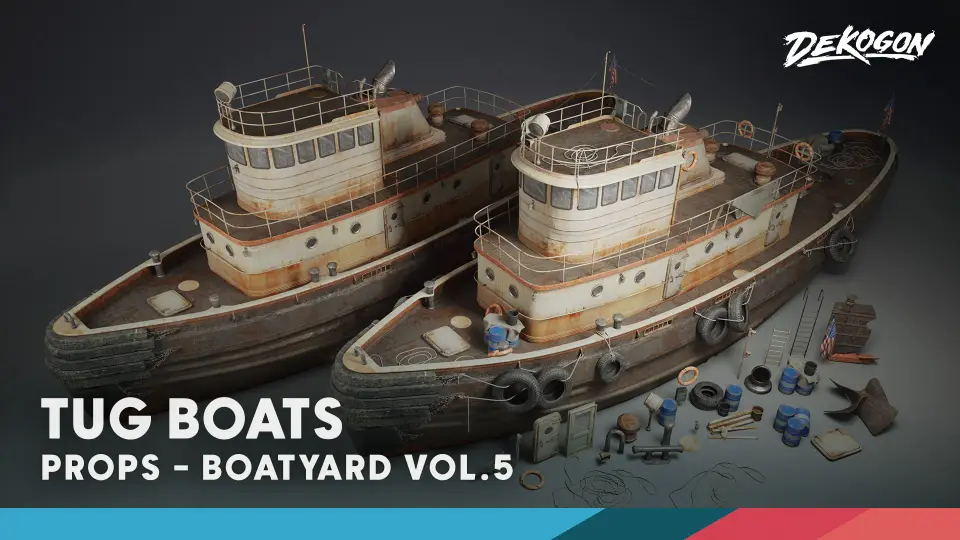
Dropping a tugboat into an Unreal Engine scene usually means wrestling with LODs, silhouette loss, and texture memory. This package sidesteps that pipeline friction by building every mesh on Nanite, allowing geometry density to scale with camera proximity rather than manual decimation passes. The project ships with thirty-five meshes covering named props related to harbor, fish, sailing, and ocean environments. Every asset is built within the engine itself, with all maps and materials already configured for use.
Nanite construction and the 35 mesh lineup
All meshes in this collection are constructed using Nanite, Epic's virtualized geometry system in Unreal Engine. What this means practically is each model maintains high-fidelity polycount detail Nanite handles streaming those triangles intelligently at runtime, so fully detailed models can occupy a scene without the usual performance cliff associated with dense imported geometry. The thirty-five meshes are tagged across several nautical themes: tugboat, fish, sailing, sailor, ship, and boat. Additional descriptive tags like rusty, abandoned, and sea suggest the aesthetic leans toward weathered, lived-in harbor use rather than pristine showroom condition.
Because branding and labels across the props are custom made by Dekogon Studios, there no trademark workarounds required before placing these models in a commercial project. Every logo, marking, or identifier visible on the assets is original studio artwork, eliminating third-party legal exposure before a scene ships.
Material controls beyond the defaults
A single master material setup controls the majority of props in the package. Rather than inputing a unique material instance for every mesh, users adjust shared parameters that propagate across compatible models. Beyond basic material assignment, the master material exposes controls for roughness, albedo, normals, and additional surface properties. These sliders allow artists to match a tugboat's hull to scene lighting or art direction without re-exporting texture maps.
Texture resolution runs at 4K across high-quality sets. The packing scheme follows standard PBR convention: Roughness, Metalness, and Ambient Occlusion are channel-packed into textures, reducing the number of samplers active during rendering. This packing keeps memory footprint predictable while preserving the individual contribution of each property to the final shaded result.
Post-process and look-up table integration
The package includes realistic post-process settings and a Look-Up Table (LUT). These additions let artists match color grading to the intended visual tone of the assets on import. Rather than spending hours tuning bloom, exposure, or tonemapping curves from scratch, the included LUT provides a baseline grade aligned with the studio's AAA visual target, serving as a reasonable starting point that can be pushed further or pulled back as the scene demands.
Lumen and Unreal Engine 5.1 through 5.8
Visual fidelity is tied to Lumen, Unreal Engine 5's real-time global illumination system. The product explicitly supports Lumen, meaning materials and meshes are configured to respond correctly to dynamic bounced light. This is where the combination of Nanite geometry and Lumen lighting becomes relevant: fine surface detail from Nanite geometry catches accurate indirect light from Lumen, producing the contact shadows and grazing highlights expected in a modern marine environment.
Compatibility extends across Unreal Engine 5.1 through 5.8, covering current and forward-looking engine versions. Artists can integrate these assets into ongoing Unreal Engine 5 projects without significant migration friction, and the Nanite plus Lumen feature set remains the most relevant path forward for architecture within this engine generation.
Marine and harbor scene applications
The tag pool reveals specific scene types where these assets fit best. Tugboat, harbor, ship, sailor, boat, and fishing tags point toward dockside compositions. Sea, ocean, sailing, and fish tags expand into open-water settings. The rusty and abandoned tags suggest post-critical or neglected harbor environments, where weathered hulls and aged equipment reinforce a narrative of disrepair or long industrial service. Master material controls for roughness and albedo support these themes directly: roughness can be pushed to simulate salt corrosion, while albedo adjustment can bake in the muted tones of aged marine paint.
Thirty-five meshes provide enough variety to populate a dockside scene with clutter and infrastructure. Props can be scattered as foreground hero objects near a moored tugboat or arranged as background dressing along a quay wall. Because every mesh has a Nanite version, density is not capped by manual draw call budgets artists typically face when filling harbor environments with incidental detail.
Production-readiness for solo and team workflows
Optimization is stated the assets are optimized for games. Combined with custom branding and in-engine material construction, the package is positioned for direct insertion into a playable build rather than serving as reference geometry for offline rendering. A solo developer gains immediate access to a cohesive set of nautical assets without managing outsourced art pipelines. A team benefits from the master material approach across the set, allowing a technical artist to adjust surface properties uniformly without hunting through dozens of individual material files. Free of legal issues related to branding, and with all constructed assets completed by Dekogon Studios artists, the collection is ready for commercial deployment in Unreal Engine projects targeting versions 5.1 and beyond.
 Vehicles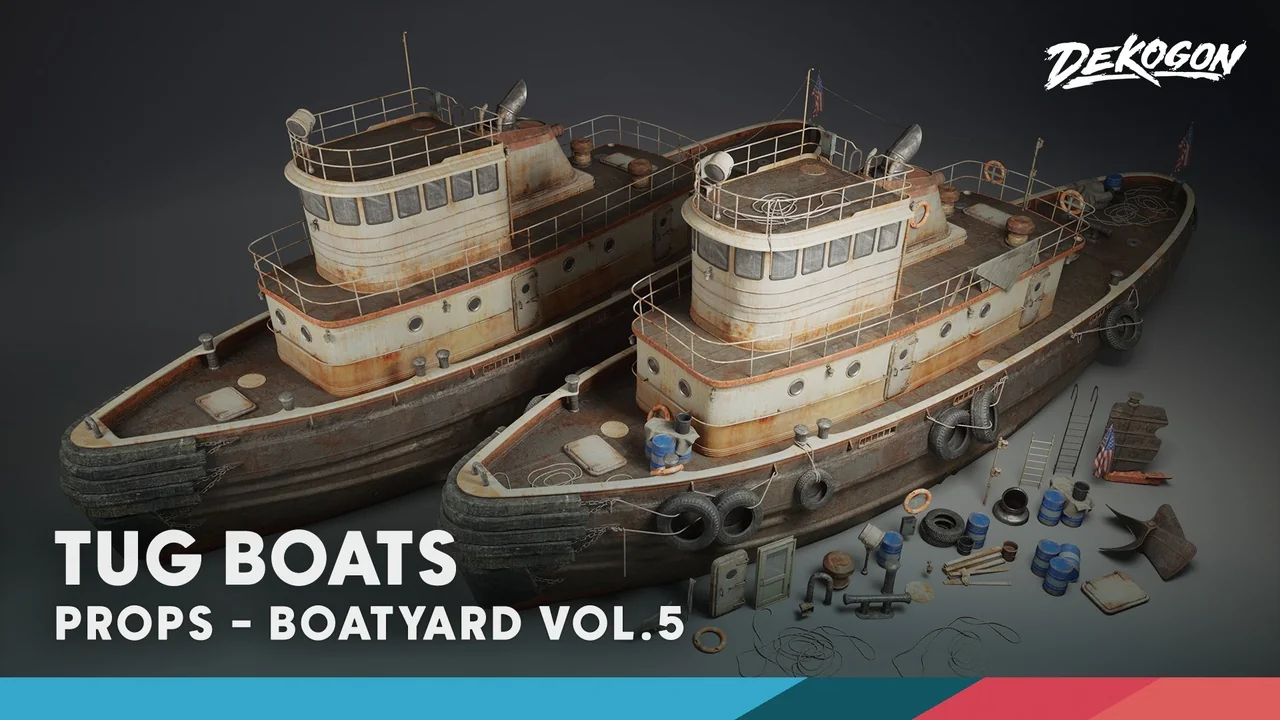
 Vehicles
 Vehicles
 Tools
Tools