"7e6fc58c410f2894"{"id":"1000494","slug":"vehicles-vol-3-retro-cars-low-poly","title":"Vehicles VOL.3 - Retro Cars (Low Poly)","category":"Vehicles \u0026 Transportation","engine":"5.1+","assetVersion":"","engineVersion":"Engine Version: 5.1+","tag":"Vehicles","accent":"blue","visual":"mech","summary":"Five retro low-poly cars with Police and Taxi variants, 4K textures, master material controls, Lumen support for Unreal Engine 5.0+, and custom branding.","platform":"Unreal Engine","publishedAt":"2026-07-13T03:37:05.947Z","updatedAt":"2026-07-13T03:37:05.947Z","sourceNotes":[],"fileContents":[],"compatibility":["Unreal Engine","Engine Version: 5.1+"],"featuredImage":{"alt":"Vehicles VOL.3 - Retro Cars (Low Poly)","src":"/wp-content/uploads/published/2026/07/cc034263a868-564937b7-8588-42e1-a8f1-e2490a8b9177-a0640cadd4.webp"},"hasDownloadLink":true,"downloads":0,"terms":[{"taxonomy":"category","slug":"vehicles-and-transportation","name":"Vehicles \u0026 Transportation"}],"galleryImages":[{"src":"/wp-content/uploads/published/2026/07/dae49a3092e5-6c7f665c-9af2-437c-8e90-11cd31401bae-d1a64b9a3f.webp","alt":"Vehicles VOL.3 - Retro Cars (Low Poly)"},{"src":"/wp-content/uploads/published/2026/07/015642d93abf-3c21dfb4-8535-41dd-9215-eb87086deab5-3e1ea04825.webp","alt":"Vehicles VOL.3 - Retro Cars (Low Poly)"},{"src":"/wp-content/uploads/published/2026/07/5fc0fdc8a210-0e32aaeb-7351-4009-bc23-c477bb7997a3-71e437a8a1.webp","alt":"Vehicles VOL.3 - Retro Cars (Low Poly)"},{"src":"/wp-content/uploads/published/2026/07/f454937bb00c-abea7753-01cf-4a2b-8196-f8292a0d3b60-41e896e07d.webp","alt":"Vehicles VOL.3 - Retro Cars (Low Poly)"},{"src":"/wp-content/uploads/published/2026/07/41ee487c2e9f-7049b68c-de90-4c89-a247-c22cacd028fb-014cc01e9b.webp","alt":"Vehicles VOL.3 - Retro Cars (Low Poly)"},{"src":"/wp-content/uploads/published/2026/07/9c73a817d950-686215be-3071-4bcd-91f0-fd62ab0a2002-01c2aba42d.webp","alt":"Vehicles VOL.3 - Retro Cars (Low Poly)"},{"src":"/wp-content/uploads/published/2026/07/61e8db3e09b8-4400bf1b-7177-442d-ba4c-3f074a5aa5fa-ac090cb479.webp","alt":"Vehicles VOL.3 - Retro Cars (Low Poly)"},{"src":"/wp-content/uploads/published/2026/07/c9ecb21579ca-13785cb8-1bd1-419b-ad23-5f1d69cf6793-9942c823de.webp","alt":"Vehicles VOL.3 - Retro Cars (Low Poly)"},{"src":"/wp-content/uploads/published/2026/07/c5078772297b-989fd9ee-14d1-4d87-8671-45f46e4a465f-0c01c05a75.webp","alt":"Vehicles VOL.3 - Retro Cars (Low Poly)"},{"src":"/wp-content/uploads/published/2026/07/3d749844a746-289ab60d-1578-4f98-bf85-90cefa53be91-814bc09051.webp","alt":"Vehicles VOL.3 - Retro Cars (Low Poly)"}],"accessPanel":{"kind":"resource","title":"Download this resource","eyebrow":"Free Download","message":"Log in or create a free account to start your download.","fileName":"Content.7z","safetyNote":"Resources are manually reviewed before listing to improve quality and reduce obvious risks.","actionLabel":"Download Free","resourceType":"Resource archive"},"contentHtml":"\u003cp\u003eBuilding a period street scene, an apocalyptic city, or a horror-infused town often comes down to how convincingly the vehicles sit in the environment. Vehicles VOL.3 - Retro Cars (Low Poly) gives level designers and environment artists a set of prop cars aimed at 1970s and 1980s aesthetics, tailored for Unreal Engine workflows. The collection targets realistic AAA-quality visuals while staying mindful of performance budgets, making it a candidate for populating urban landscapes without requiring rigging or animation setup.\u003c/p\u003e\u003ch2\u003eWhat sits inside the retro car collection\u003c/h2\u003e\u003cp\u003eThe pack contains five cars, each delivered with split meshes. Beyond the base five, the set includes a Police car variant and a Taxi car variant, broadening the range of scenarios a single pack can cover. Because these are prop assets, they carry no bones or animations. That distinction matters when planning scenes: these vehicles are intended for stationary placement, environmental dressing, or backdrop use rather than any form of driven or keyed movement.\u003c/p\u003e\u003ch2\u003eMaterial setup and texturing pipeline\u003c/h2\u003e\u003cp\u003eEvery texture set uses 4K resolution, prioritizing high fidelity for close-range shots and detailed environment passes. A master material setup governs the majority of the included props and models. Rather than relying on isolated material instances for each vehicle, the master material exposes controls for roughness, albedo, normals, and additional parameters, letting artists push visual variation across the fleet without leaving the material editor.\u003c/p\u003e\u003cp\u003eThe texture workflow uses channel-packed Roughness, Metalness, and Ambient Occlusion maps. Channel packing keeps the memory footprint tighter by combining data into single textures while still giving the shader access to each property. For scenes that need look development beyond the base assets, the pack includes a realistic Post Process setup and a Look Up Table. These additions help maintain a consistent visual tone across different lighting conditions and camera angles.\u003c/p\u003e\u003ch2\u003eTintable paint and custom branding\u003c/h2\u003e\u003ch3\u003eAvoiding legal issues with custom-made labels\u003c/h3\u003e\u003cp\u003ePainted areas across the vehicles are fully tintable, which means a single car model can be recolored to fit different factions, neighborhoods, or time periods without authoring new textures. The tinting operates through the master material, so color shifts remain non-destructive and repeatable.\u003c/p\u003e\u003cp\u003eEvery brand, label, and decal across the set was custom-made by the studio. This approach keeps the assets free of real-world trademarks and logos, eliminating a common clearance headache when distributing finished projects or working on commercial productions. The custom branding also means the visual identity of each vehicle exists solely within the pack, giving art directors a clean slate if they need the cars to feel generic or specific to a fictional universe.\u003c/p\u003e\u003ch2\u003eEngine integration and Lumen support\u003c/h2\u003e\u003cp\u003eAll assets, maps, and materials were created entirely in Unreal Engine. The models are fully detailed from all sides, so they hold up in shots where a camera sweeps around a vehicle or when cars are placed in open lots visible from multiple angles. The pack supports Lumen for Unreal Engine 5.0 and later, aligning with modern global illumination pipelines. As confirmed by the 3DCGHUB editor notes, the asset functions across engine versions 5.1 through 5.8, covering the current generation of Unreal releases.\u003c/p\u003e\u003ch2\u003eFitting Vehicles VOL.3 into a low-poly retro project\u003c/h2\u003e\u003cp\u003eThe tags associated with this pack, Retro, Classic, 1970s, 1980s, Lowpoly, Realistic, City, World, Post, Apocalyptic, Horror, Open, Collectible, point to a broad but coherent set of use cases. A late-20th-century city street can use the base cars for parked traffic, while the Police and Taxi variants add implied civic infrastructure. Apocalyptic or horror environments benefit from the low-poly foundation combined with 4K detailing, since the cars can read as abandoned or forgotten without demanding excessive geometry overhead.\u003c/p\u003e\u003cp\u003eBecause each vehicle is optimized for games and shaped by the same master material, scaling the number of cars across a large level stays manageable. Split meshes make it possible to swap out or hide sections of a vehicle where a scene calls for damage, customization, or performance culling. With no bones or animation data in the way, the assets drop directly into environment layers as static props, leaving the artist free to focus on placement, lighting, and post-processing.\u003c/p\u003e\u003ch2\u003ePractical takeaway for scene assembly\u003c/h2\u003e\u003cp\u003eVehicles VOL.3 - Retro Cars (Low Poly) is best treated as a dressing kit for Unreal Engine environments that need period-accurate or genre-flexible cars without the overhead of riggable vehicles. The combination of 4K channel-packed textures, a unified master material, tintable paint, and custom branding gives artists enough surface control to push a fleet of five cars into many visual directions. For projects running Unreal 5.1 and above with Lumen enabled, the pack slots into the rendering pipeline without requiring additional configuration.\u003c/p\u003e\n\n\u003ch2\u003eRelated Resources Worth Checking\u003c/h2\u003e\n\u003cul\u003e\n\u003cli\u003e\u003ca href=\"https://3dcghub.com/vehicles-vol-1-small-rides-nanite-and-low-poly/\" title=\"Vehicles VOL.1 - Small Rides (Nanite and Low Poly)\"\u003eVehicles VOL.1 - Small Rides (Nanite and Low Poly)\u003c/a\u003e\u003c/li\u003e\n\u003cli\u003e\u003ca href=\"https://3dcghub.com/vehicles-vol-2-retro-cars-low-poly/\" title=\"Vehicles VOL.2 - Retro Cars (Low Poly)\"\u003eVehicles VOL.2 - Retro Cars (Low Poly)\u003c/a\u003e\u003c/li\u003e\n\u003cli\u003e\u003ca href=\"https://3dcghub.com/driveable-steampunk-car-vehicle-steampunk-car-retro-futuristic-victorian/\" title=\"Driveable SteamPunk Car / Vehicle ( SteamPunk Car Retro Futuristic Victorian)\"\u003eDriveable SteamPunk Car / Vehicle ( SteamPunk Car Retro Futuristic Victorian)\u003c/a\u003e\u003c/li\u003e\n\u003cli\u003e\u003ca href=\"https://3dcghub.com/intelligent-traffic-system/\" title=\"Intelligent Traffic System\"\u003eIntelligent Traffic System\u003c/a\u003e\u003c/li\u003e\n\u003cli\u003e\u003ca href=\"https://3dcghub.com/drivable-retro-car-farton/\" title=\"Drivable retro car \u0026quot;Farton\u0026quot;\"\u003eDrivable retro car \u0026quot;Farton\u0026quot;\u003c/a\u003e\u003c/li\u003e\n\u003c/ul\u003e","contentTextLength":5325,"navigation":{"current":1265,"total":3618,"previous":{"id":"1000495","slug":"vehicles-vol-5-trucks-tractors-buses-low-poly","title":"Vehicles VOL.5 - Trucks, Tractors, Buses (Low Poly)","category":"Vehicles \u0026 Transportation","platform":"Unreal Engine","updatedAt":"2026-07-13T03:43:56.572Z"},"next":{"id":"1000493","slug":"vehicles-vol-2-retro-cars-low-poly","title":"Vehicles VOL.2 - Retro Cars (Low Poly)","category":"Vehicles \u0026 Transportation","platform":"Unreal Engine","updatedAt":"2026-07-13T03:29:26.435Z"}},"relatedResources":[{"id":"1000707","slug":"vehicles-vol-4-retro-cars-low-poly","title":"Vehicles VOL.4 - Retro Cars (Low Poly)","category":"Vehicles \u0026 Transportation","engine":"5.1+","assetVersion":"","engineVersion":"Engine Version: 5.1+","tag":"Vehicles","accent":"blue","visual":"mech","summary":"Five retro low-poly vehicles with split meshes, 4k textures, tintable paint, channel-packed masks, and Lumen support for Unreal Engine 5.0+.","platform":"Unreal Engine","publishedAt":"2026-07-24T01:51:03.278Z","updatedAt":"2026-07-24T01:51:03.278Z","sourceNotes":[],"fileContents":[],"compatibility":["Unreal Engine","Engine Version: 5.1+"],"featuredImage":{"alt":"Vehicles VOL.4 - Retro Cars (Low Poly)","src":"/wp-content/uploads/published/2026/07/e0d046dad155-ef4a759a-30af-4e29-9985-9418dfe7ed11-02e1c9682c.webp"},"hasDownloadLink":true,"downloads":0},{"id":"1000495","slug":"vehicles-vol-5-trucks-tractors-buses-low-poly","title":"Vehicles VOL.5 - Trucks, Tractors, Buses (Low Poly)","category":"Vehicles \u0026 Transportation","engine":"5.1+","assetVersion":"","engineVersion":"Engine Version: 5.1+","tag":"Vehicles","accent":"blue","visual":"mech","summary":"A prop-only vehicle pack of trucks, tractors, and buses with 4k textures, master material controls, and Lumen support for Unreal Engine 5.1+.","platform":"Unreal Engine","publishedAt":"2026-07-13T03:43:56.572Z","updatedAt":"2026-07-13T03:43:56.572Z","sourceNotes":[],"fileContents":[],"compatibility":["Unreal Engine","Engine Version: 5.1+"],"featuredImage":{"alt":"Vehicles VOL.5 - Trucks, Tractors, Buses (Low Poly)","src":"/wp-content/uploads/published/2026/07/58cb2f5ebbef-d7b63d3f-8209-40ea-8f7f-03c754bd1f60-b0de32e215.webp"},"hasDownloadLink":true,"downloads":0},{"id":"1000493","slug":"vehicles-vol-2-retro-cars-low-poly","title":"Vehicles VOL.2 - Retro Cars (Low Poly)","category":"Vehicles \u0026 Transportation","engine":"5.1+","assetVersion":"","engineVersion":"Engine Version: 5.1+","tag":"Vehicles","accent":"blue","visual":"mech","summary":"Unreal Engine retro low poly car pack with 5 vehicles plus a police variant, 4k textures, channel-packed maps, tintable paint, Lumen support, and custom brandin","platform":"Unreal Engine","publishedAt":"2026-07-13T03:29:26.435Z","updatedAt":"2026-07-13T03:29:26.435Z","sourceNotes":[],"fileContents":[],"compatibility":["Unreal Engine","Engine Version: 5.1+"],"featuredImage":{"alt":"Vehicles VOL.2 - Retro Cars (Low Poly)","src":"/wp-content/uploads/published/2026/07/f275bb8c8319-9f01aaab-c8f7-4797-b97a-53a94f84b3e1-987760189e.webp"},"hasDownloadLink":true,"downloads":0}]}
Vehicles
Vehicles VOL.3 - Retro Cars (Low Poly)
Five retro low-poly cars with Police and Taxi variants, 4K textures, master material controls, Lumen support for Unreal Engine 5.0+, and custom branding.
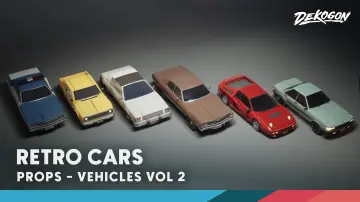
Building a period street scene, an apocalyptic city, or a horror-infused town often comes down to how convincingly the vehicles sit in the environment. Vehicles VOL.3 - Retro Cars (Low Poly) gives level designers and environment artists a set of prop cars aimed at 1970s and 1980s aesthetics, tailored for Unreal Engine workflows. The collection targets realistic AAA-quality visuals while staying mindful of performance budgets, making it a candidate for populating urban landscapes without requiring rigging or animation setup.
What sits inside the retro car collection
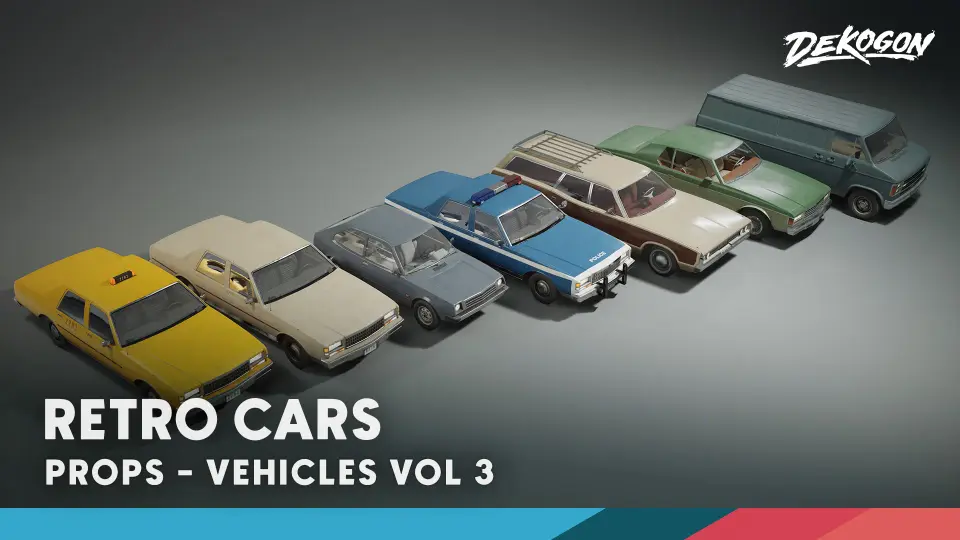
The pack contains five cars, each delivered with split meshes. Beyond the base five, the set includes a Police car variant and a Taxi car variant, broadening the range of scenarios a single pack can cover. Because these are prop assets, they carry no bones or animations. That distinction matters when planning scenes: these vehicles are intended for stationary placement, environmental dressing, or backdrop use rather than any form of driven or keyed movement.
Material setup and texturing pipeline
Every texture set uses 4K resolution, prioritizing high fidelity for close-range shots and detailed environment passes. A master material setup governs the majority of the included props and models. Rather than relying on isolated material instances for each vehicle, the master material exposes controls for roughness, albedo, normals, and additional parameters, letting artists push visual variation across the fleet without leaving the material editor.
The texture workflow uses channel-packed Roughness, Metalness, and Ambient Occlusion maps. Channel packing keeps the memory footprint tighter by combining data into single textures while still giving the shader access to each property. For scenes that need look development beyond the base assets, the pack includes a realistic Post Process setup and a Look Up Table. These additions help maintain a consistent visual tone across different lighting conditions and camera angles.
Tintable paint and custom branding
Avoiding legal issues with custom-made labels
Painted areas across the vehicles are fully tintable, which means a single car model can be recolored to fit different factions, neighborhoods, or time periods without authoring new textures. The tinting operates through the master material, so color shifts remain non-destructive and repeatable.
Every brand, label, and decal across the set was custom-made by the studio. This approach keeps the assets free of real-world trademarks and logos, eliminating a common clearance headache when distributing finished projects or working on commercial productions. The custom branding also means the visual identity of each vehicle exists solely within the pack, giving art directors a clean slate if they need the cars to feel generic or specific to a fictional universe.
Engine integration and Lumen support
All assets, maps, and materials were created entirely in Unreal Engine. The models are fully detailed from all sides, so they hold up in shots where a camera sweeps around a vehicle or when cars are placed in open lots visible from multiple angles. The pack supports Lumen for Unreal Engine 5.0 and later, aligning with modern global illumination pipelines. As confirmed by the 3DCGHUB editor notes, the asset functions across engine versions 5.1 through 5.8, covering the current generation of Unreal releases.
Fitting Vehicles VOL.3 into a low-poly retro project
The tags associated with this pack, Retro, Classic, 1970s, 1980s, Lowpoly, Realistic, City, World, Post, Apocalyptic, Horror, Open, Collectible, point to a broad but coherent set of use cases. A late-20th-century city street can use the base cars for parked traffic, while the Police and Taxi variants add implied civic infrastructure. Apocalyptic or horror environments benefit from the low-poly foundation combined with 4K detailing, since the cars can read as abandoned or forgotten without demanding excessive geometry overhead.
Because each vehicle is optimized for games and shaped by the same master material, scaling the number of cars across a large level stays manageable. Split meshes make it possible to swap out or hide sections of a vehicle where a scene calls for damage, customization, or performance culling. With no bones or animation data in the way, the assets drop directly into environment layers as static props, leaving the artist free to focus on placement, lighting, and post-processing.
Practical takeaway for scene assembly
Vehicles VOL.3 - Retro Cars (Low Poly) is best treated as a dressing kit for Unreal Engine environments that need period-accurate or genre-flexible cars without the overhead of riggable vehicles. The combination of 4K channel-packed textures, a unified master material, tintable paint, and custom branding gives artists enough surface control to push a fleet of five cars into many visual directions. For projects running Unreal 5.1 and above with Lumen enabled, the pack slots into the rendering pipeline without requiring additional configuration.
 Vehicles
 Vehicles
 Vehicles
 Vehicles