"c68a05d5e51405b3"{"id":"1000708","slug":"vehicles-vol-8-construction-low-poly","title":"Vehicles VOL.8 - Construction (Low Poly)","category":"Service \u0026 Commercial Vehicles","engine":"5.1+","assetVersion":"","engineVersion":"Engine Version: 5.1+","tag":"Service","accent":"blue","visual":"mech","summary":"Five low poly construction vehicles with split meshes, 4k textures, tintable paint, channel-packed masks, and Lumen support for Unreal Engine 5.0+.","platform":"Unreal Engine","publishedAt":"2026-07-24T02:01:37.218Z","updatedAt":"2026-07-24T02:01:37.218Z","sourceNotes":[],"fileContents":[],"compatibility":["Unreal Engine","Engine Version: 5.1+"],"featuredImage":{"alt":"Vehicles VOL.8 - Construction (Low Poly)","src":"/wp-content/uploads/published/2026/07/1bc037cfd4dd-22a5dc7d-32d4-46c5-a07d-b3c0b5646832-327eb923cb.webp"},"hasDownloadLink":true,"downloads":0,"terms":[{"taxonomy":"category","slug":"service-and-commercial-vehicles","name":"Service \u0026 Commercial Vehicles"}],"galleryImages":[{"src":"/wp-content/uploads/published/2026/07/06fdfbadade7-ffefc7e2-6218-405e-8c4e-0f1f465a80f1-c194765d3d.webp","alt":"Vehicles VOL.8 - Construction (Low Poly)"},{"src":"/wp-content/uploads/published/2026/07/c16ccabbdf62-912ea210-4f49-4f66-80f3-19132eabbed1-ceff6dfd01.webp","alt":"Vehicles VOL.8 - Construction (Low Poly)"},{"src":"/wp-content/uploads/published/2026/07/ccba005adb48-cbfb9aff-11cd-4323-9836-a7d954d0cc5c-f549cb3b12.webp","alt":"Vehicles VOL.8 - Construction (Low Poly)"},{"src":"/wp-content/uploads/published/2026/07/d3c513868b15-16128291-610d-44fc-a046-8f98e1d30c85-33891836ce.webp","alt":"Vehicles VOL.8 - Construction (Low Poly)"},{"src":"/wp-content/uploads/published/2026/07/1ab107268793-65f5bb80-ced1-4741-a0b8-d3ed9526448f-2c44cac63b.webp","alt":"Vehicles VOL.8 - Construction (Low Poly)"},{"src":"/wp-content/uploads/published/2026/07/7e296baddd0c-9edab3ea-bcd6-4971-aa2b-97b7c037b96c-ed81d6ff8d.webp","alt":"Vehicles VOL.8 - Construction (Low Poly)"},{"src":"/wp-content/uploads/published/2026/07/4131d63eb6cc-e5832ee4-ce77-4485-aae4-daeacbfadb5d-b4d3d91937.webp","alt":"Vehicles VOL.8 - Construction (Low Poly)"},{"src":"/wp-content/uploads/published/2026/07/8dc6bef9b237-0acc1a73-6901-458f-94a7-d5812a757601-690a5c310d.webp","alt":"Vehicles VOL.8 - Construction (Low Poly)"},{"src":"/wp-content/uploads/published/2026/07/aad8ded872f6-1efd0a35-4754-481c-aefb-58cb3d0a3441-afa03e3986.webp","alt":"Vehicles VOL.8 - Construction (Low Poly)"},{"src":"/wp-content/uploads/published/2026/07/47b653631d78-10a437eb-d827-499a-b480-58822dc96350-10bf2c3306.webp","alt":"Vehicles VOL.8 - Construction (Low Poly)"}],"accessPanel":{"kind":"resource","title":"Download this resource","eyebrow":"Free Download","message":"Log in or create a free account to start your download.","fileName":"Content.7z","safetyNote":"Resources are manually reviewed before listing to improve quality and reduce obvious risks.","actionLabel":"Download Free","resourceType":"Resource archive"},"contentHtml":"\u003ch2\u003eConstruction Vehicles as Static Props\u003c/h2\u003e\n\u003cp\u003eIn a real-time production workflow, Vehicles VOL.8 - Construction (Low Poly) places five construction vehicles directly into Unreal Engine scenes as static props rather than rigged, animation-ready machines. Every asset included is modeled with split meshes, giving teams the flexibility to populate construction sites, industrial yards, or service environments without dealing with skeletal rigs or bone structures. These are prop assets: they carry no bones and no animations, which keeps their footprint small and makes them straightforward to scatter across environments that need heavy machinery present as visual anchors rather than interactive units.\u003c/p\u003e\n\n\u003cp\u003eThe vehicle set spans the expected range of heavy equipment referenced by its tags, covering dig, haul, dump, and service operations. Specific equipment types include a bulldozer, dumpster, shovel, crane, and digger. Each model is fully detailed from all sides, so cameras can orbit or frame them from any angle without exposing flat geometry or missing detail on the far side. There is no front-facing bias, which matters when placing them in open environments or pulling them into background traffic for a construction scene.\u003c/p\u003e\n\n\u003ch2\u003eTexture Workflow and Material Controls\u003c/h2\u003e\n\u003cp\u003eTexture sets arrive at 4K resolution, targeted at realistic AAA-quality visuals and budget. The workflow relies on a master material setup that controls the majority of the props and models in the package. This centralization reduces the number of unique material instances needed, simplifying the technical overhead in scenes with multiple vehicles present at the same time.\u003c/p\u003e\n\n\n\u003cp\u003eLike many modern prop packs built for Unreal Engine, the materials expose additional controls for roughness, albedo, normals, and more. These parameters allow artists to adjust surface response without opening the texture files in an external editor. Roughness, metalness, and ambient occlusion maps are channel-packed, keeping the texture footprint efficient while preserving the individual control artists need when dialing in surface response across metal panels, paint, and worn mechanical parts.\u003c/p\u003e\n\n\u003ch3\u003eTintable Paint and Custom Branding\u003c/h3\u003e\n\u003cp\u003ePainted areas on the vehicles are all tintable, so a single vehicle mesh can be recolored to match different companies, factions, or environment palettes directly within the Material Editor. The creator notes that painted surfaces are specifically set up for this tinting workflow, which means color variation across a fleet does not require unique texture maps per vehicle variant.\u003c/p\u003e\n\n\n\u003cp\u003eEvery branding element and label in the pack is custom-made by the studio. This ensures the vehicles are free of legal issues related to third-party trademarks or real-world manufacturer logos, which matters for commercial projects where clearance and intellectual property ownership are part of the delivery requirements.\u003c/p\u003e\n\n\u003ch2\u003ePost-Processing, Lookup Tables, and Lumen Support\u003c/h2\u003e\n\n\u003cp\u003eThe pack includes a realistic post-processing setup and a Lookup Table (LUT) designed to achieve a specific visual style. These elements contribute to the final image quality by standardizing color grading and tonal response across the vehicles and their surrounding environment. The LUT and post-processing chain are part of what makes the assets read as AAA-quality during viewport rendering and final captures, rather than relying solely on raw model and texture fidelity.\u003c/p\u003e\n\n\n\u003cp\u003eThe vehicles support Lumen for Unreal Engine 5.0 and above. This compatibility allows the construction vehicles to participate in dynamic global illumination workflows, meaning they respond to bounced light and shadow changes in real-time without requiring baked lighting pre-passes. For teams working in modern Unreal Engine 5 pipelines, the assets behave correctly under Lumen lighting conditions, contributing reflected light and receiving dynamic shadows from surrounding geometry.\u003c/p\u003e\n\n\u003ch2\u003eWhere the Assets Fit in a Production Pipeline\u003c/h2\u003e\n\u003cp\u003eBecause these vehicles are optimized for games and built as low-poly props, they fit into scenes where performance and visual density both matter. The split-mesh approach gives environment artists control over how individual vehicle parts are loaded, culled, or arranged. A crane boom, a dump truck bed, or a shovel arm can be separated and handled as distinct components when needed for compositing or scene layout.\u003c/p\u003e\n\n\n\u003cp\u003eThese assets also pair visually with compatible modular environment sets, including \"Meridian 1988: Cedar Point School - Modular Environment (VOL 57).\" That compatibility makes them strong candidates for scenes that combine educational, municipal, or service-industry environments with functional outdoor equipment. Whether populating a background lot, lining a repair yard, or staging active dig sites alongside modular building exteriors, the construction vehicles integrate as static scene elements grounded by their custom labels, tintable paint, and full-geometry detailing.\u003c/p\u003e\n\n\u003cp\u003eTeams evaluating this pack get five prop-ready construction machines with 4K textures, channel-packed masks, a controlling master material, and Lumen support in Unreal Engine 5.0+, all without rigging overhead or legal branding concerns. The tintable paint and split meshes provide enough variation and control to adapt the vehicles across multiple scenes while maintaining a consistent material workflow.\u003c/p\u003e\n\n\u003ch2\u003eContinue Browsing Similar Packs\u003c/h2\u003e\n\u003cul\u003e\n\u003cli\u003e\u003ca href=\"https://3dcghub.com/vehicles-vol-1-small-rides-nanite-and-low-poly/\" title=\"Vehicles VOL.1 - Small Rides (Nanite and Low Poly)\"\u003eVehicles VOL.1 - Small Rides (Nanite and Low Poly)\u003c/a\u003e\u003c/li\u003e\n\u003cli\u003e\u003ca href=\"https://3dcghub.com/vehicles-vol-4-retro-cars-low-poly/\" title=\"Vehicles VOL.4 - Retro Cars (Low Poly)\"\u003eVehicles VOL.4 - Retro Cars (Low Poly)\u003c/a\u003e\u003c/li\u003e\n\u003cli\u003e\u003ca href=\"https://3dcghub.com/vehicles-vol-5-trucks-tractors-buses-low-poly/\" title=\"Vehicles VOL.5 - Trucks, Tractors, Buses (Low Poly)\"\u003eVehicles VOL.5 - Trucks, Tractors, Buses (Low Poly)\u003c/a\u003e\u003c/li\u003e\n\u003cli\u003e\u003ca href=\"https://3dcghub.com/vehicles-vol-3-retro-cars-low-poly/\" title=\"Vehicles VOL.3 - Retro Cars (Low Poly)\"\u003eVehicles VOL.3 - Retro Cars (Low Poly)\u003c/a\u003e\u003c/li\u003e\n\u003cli\u003e\u003ca href=\"https://3dcghub.com/vehicles-vol-2-retro-cars-low-poly/\" title=\"Vehicles VOL.2 - Retro Cars (Low Poly)\"\u003eVehicles VOL.2 - Retro Cars (Low Poly)\u003c/a\u003e\u003c/li\u003e\n\u003c/ul\u003e","contentTextLength":5593,"navigation":{"current":1295,"total":3860,"previous":{"id":"14433","slug":"rdlodtools-rd-tools-pro","title":"rdLODtools (rd Tools Pro)","category":"Engine Tools","platform":"Unreal Engine","updatedAt":"2026-07-24T02:13:03.808Z"},"next":{"id":"1000707","slug":"vehicles-vol-4-retro-cars-low-poly","title":"Vehicles VOL.4 - Retro Cars (Low Poly)","category":"Vehicles \u0026 Transportation","platform":"Unreal Engine","updatedAt":"2026-07-24T01:51:03.278Z"}},"relatedResources":[{"id":"1001797","slug":"city-bus","title":"City bus","category":"Service \u0026 Commercial Vehicles","engine":"5.0+","assetVersion":"","engineVersion":"Engine Version: 5.0+","tag":"Service","accent":"blue","visual":"city","summary":"A vintage low-poly City bus asset featuring Nanite support for Unreal Engine 5.0, UE 4.27 compatibility, 4K textures, and dynamic lighting behavior.","platform":"Unreal Engine","publishedAt":"2026-10-21T07:49:51.255Z","updatedAt":"2026-10-21T07:49:51.255Z","sourceNotes":[],"fileContents":[],"compatibility":["Unreal Engine","Engine Version: 5.0+"],"featuredImage":{"alt":"City bus","src":"/wp-content/uploads/published/2026/10/10f3adf7987f-13748bc2-20d6-4b21-b3d2-3d471aa22608-6f3d43709e.webp"},"hasDownloadLink":true,"downloads":1},{"id":"1000711","slug":"vehicles-vol-12-emergency-response-low-poly","title":"Vehicles VOL.12- Emergency Response (Low Poly)","category":"Service \u0026 Commercial Vehicles","engine":"5.1+","assetVersion":"","engineVersion":"Engine Version: 5.1+","tag":"Service","accent":"blue","visual":"mech","summary":"Seven emergency response vehicles with split meshes, 4K channel-packed textures, master material controls, Lumen support, and custom branding for Unreal Engine","platform":"Unreal Engine","publishedAt":"2026-07-24T02:26:51.479Z","updatedAt":"2026-07-24T02:26:51.479Z","sourceNotes":[],"fileContents":[],"compatibility":["Unreal Engine","Engine Version: 5.1+"],"featuredImage":{"alt":"Vehicles VOL.12- Emergency Response (Low Poly)","src":"/wp-content/uploads/published/2026/07/730427ce7704-1028ccea-5fa7-4469-9018-b9b7722bb7fb-d40c3a37b3.webp"},"hasDownloadLink":true,"downloads":1},{"id":"1000709","slug":"vehicles-vol-9-future-cars-low-poly","title":"Vehicles VOL.9- Future Cars (Low Poly)","category":"Cars \u0026 Trucks","engine":"5.3+","assetVersion":"","engineVersion":"Engine Version: 5.3+","tag":"Cars \u0026 Trucks","accent":"blue","visual":"mech","summary":"Seven futuristic low-poly car props with 4K textures, channel-packed maps, tintable paint, and Lumen support for Unreal Engine 5.0+.","platform":"Unreal Engine","publishedAt":"2026-07-24T02:11:02.648Z","updatedAt":"2026-10-21T04:23:37.954Z","sourceNotes":[],"fileContents":[],"compatibility":["Unreal Engine","Engine Version: 5.3+"],"featuredImage":{"alt":"Vehicles VOL.9- Future Cars (Low Poly)","src":"/wp-content/uploads/published/2026/07/1299c7959656-ce73ca95-e379-4b7d-9098-f38abd0ef20e-72885a4f92.webp"},"hasDownloadLink":true,"downloads":2}]}
Service
Vehicles VOL.8 - Construction (Low Poly)
Five low poly construction vehicles with split meshes, 4k textures, tintable paint, channel-packed masks, and Lumen support for Unreal Engine 5.0+.
In a real-time production workflow, Vehicles VOL.8 - Construction (Low Poly) places five construction vehicles directly into Unreal Engine scenes as static props rather than rigged, animation-ready machines. Every asset included is modeled with split meshes, giving teams the flexibility to populate construction sites, industrial yards, or service environments without dealing with skeletal rigs or bone structures. These are prop assets: they carry no bones and no animations, which keeps their footprint small and makes them straightforward to scatter across environments that need heavy machinery present as visual anchors rather than interactive units.
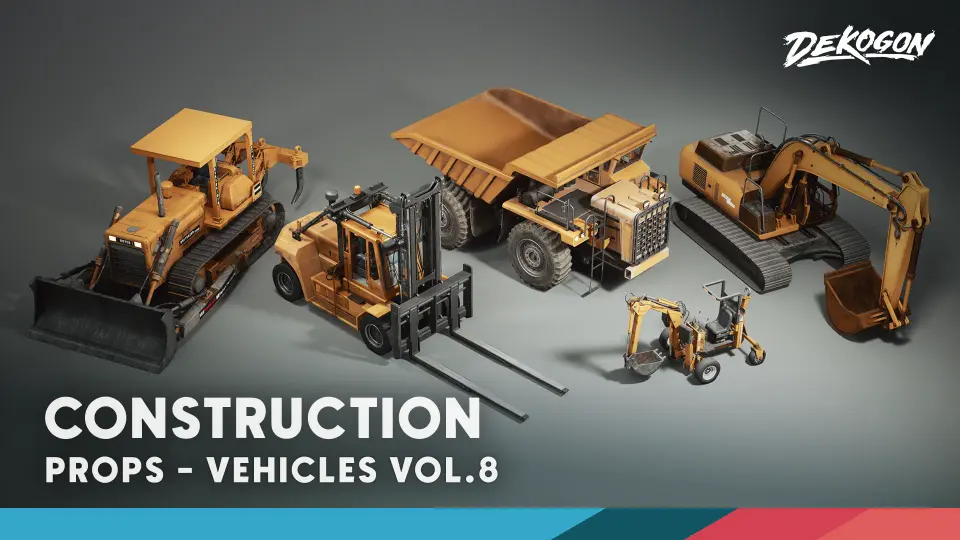
The vehicle set spans the expected range of heavy equipment referenced by its tags, covering dig, haul, dump, and service operations. Specific equipment types include a bulldozer, dumpster, shovel, crane, and digger. Each model is fully detailed from all sides, so cameras can orbit or frame them from any angle without exposing flat geometry or missing detail on the far side. There is no front-facing bias, which matters when placing them in open environments or pulling them into background traffic for a construction scene.
Texture Workflow and Material Controls
Texture sets arrive at 4K resolution, targeted at realistic AAA-quality visuals and budget. The workflow relies on a master material setup that controls the majority of the props and models in the package. This centralization reduces the number of unique material instances needed, simplifying the technical overhead in scenes with multiple vehicles present at the same time.
Like many modern prop packs built for Unreal Engine, the materials expose additional controls for roughness, albedo, normals, and more. These parameters allow artists to adjust surface response without opening the texture files in an external editor. Roughness, metalness, and ambient occlusion maps are channel-packed, keeping the texture footprint efficient while preserving the individual control artists need when dialing in surface response across metal panels, paint, and worn mechanical parts.
Tintable Paint and Custom Branding
Painted areas on the vehicles are all tintable, so a single vehicle mesh can be recolored to match different companies, factions, or environment palettes directly within the Material Editor. The creator notes that painted surfaces are specifically set up for this tinting workflow, which means color variation across a fleet does not require unique texture maps per vehicle variant.
Every branding element and label in the pack is custom-made by the studio. This ensures the vehicles are free of legal issues related to third-party trademarks or real-world manufacturer logos, which matters for commercial projects where clearance and intellectual property ownership are part of the delivery requirements.
Post-Processing, Lookup Tables, and Lumen Support
The pack includes a realistic post-processing setup and a Lookup Table (LUT) designed to achieve a specific visual style. These elements contribute to the final image quality by standardizing color grading and tonal response across the vehicles and their surrounding environment. The LUT and post-processing chain are part of what makes the assets read as AAA-quality during viewport rendering and final captures, rather than relying solely on raw model and texture fidelity.
The vehicles support Lumen for Unreal Engine 5.0 and above. This compatibility allows the construction vehicles to participate in dynamic global illumination workflows, meaning they respond to bounced light and shadow changes in real-time without requiring baked lighting pre-passes. For teams working in modern Unreal Engine 5 pipelines, the assets behave correctly under Lumen lighting conditions, contributing reflected light and receiving dynamic shadows from surrounding geometry.
Where the Assets Fit in a Production Pipeline
Because these vehicles are optimized for games and built as low-poly props, they fit into scenes where performance and visual density both matter. The split-mesh approach gives environment artists control over how individual vehicle parts are loaded, culled, or arranged. A crane boom, a dump truck bed, or a shovel arm can be separated and handled as distinct components when needed for compositing or scene layout.
These assets also pair visually with compatible modular environment sets, including "Meridian 1988: Cedar Point School - Modular Environment (VOL 57)." That compatibility makes them strong candidates for scenes that combine educational, municipal, or service-industry environments with functional outdoor equipment. Whether populating a background lot, lining a repair yard, or staging active dig sites alongside modular building exteriors, the construction vehicles integrate as static scene elements grounded by their custom labels, tintable paint, and full-geometry detailing.
Teams evaluating this pack get five prop-ready construction machines with 4K textures, channel-packed masks, a controlling master material, and Lumen support in Unreal Engine 5.0+, all without rigging overhead or legal branding concerns. The tintable paint and split meshes provide enough variation and control to adapt the vehicles across multiple scenes while maintaining a consistent material workflow.
 Service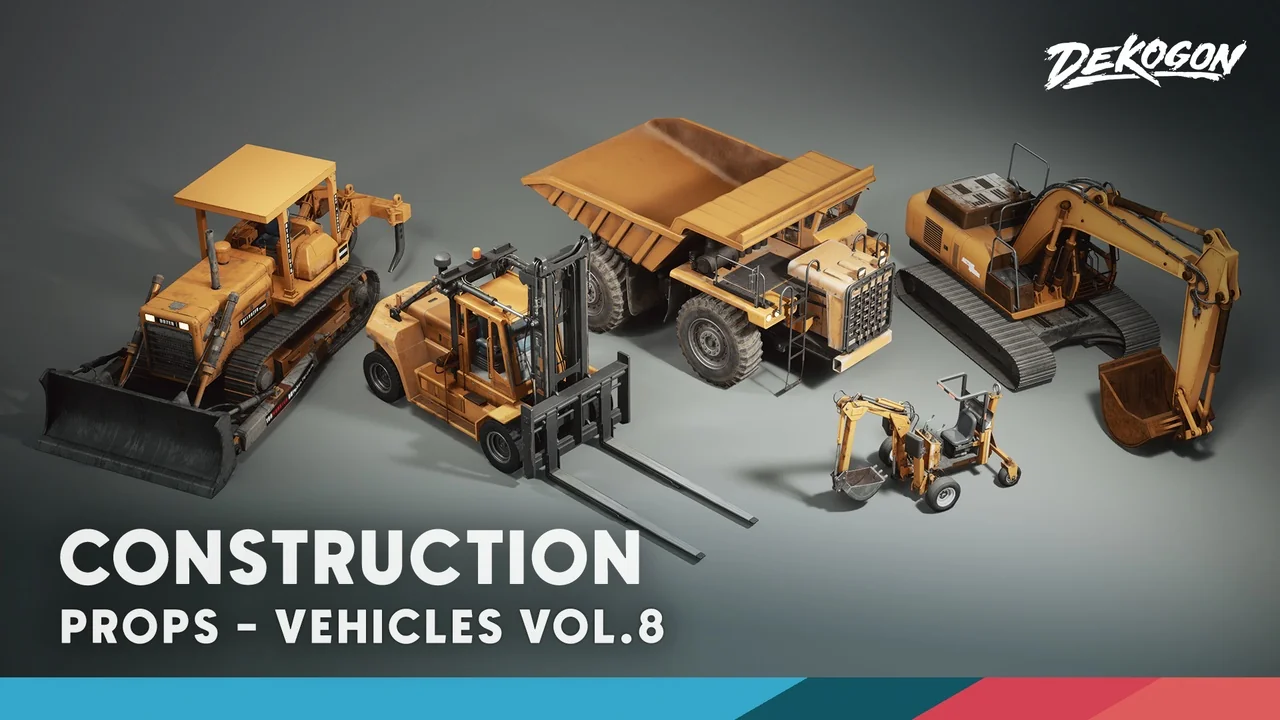
 Service
 Service
 Cars & Trucks