"c68a05d5e51405b3"{"id":"1000709","slug":"vehicles-vol-9-future-cars-low-poly","title":"Vehicles VOL.9- Future Cars (Low Poly)","category":"Cars \u0026 Trucks","engine":"5.3+","assetVersion":"","engineVersion":"Engine Version: 5.3+","tag":"Cars \u0026 Trucks","accent":"blue","visual":"mech","summary":"Seven futuristic low-poly car props with 4K textures, channel-packed maps, tintable paint, and Lumen support for Unreal Engine 5.0+.","platform":"Unreal Engine","publishedAt":"2026-07-24T02:11:02.648Z","updatedAt":"2026-10-21T04:23:37.954Z","sourceNotes":[],"fileContents":[],"compatibility":["Unreal Engine","Engine Version: 5.3+"],"featuredImage":{"alt":"Vehicles VOL.9- Future Cars (Low Poly)","src":"/wp-content/uploads/published/2026/07/1299c7959656-ce73ca95-e379-4b7d-9098-f38abd0ef20e-72885a4f92.webp"},"hasDownloadLink":true,"downloads":2,"terms":[{"taxonomy":"category","slug":"cars-and-trucks","name":"Cars \u0026 Trucks"}],"galleryImages":[{"src":"/wp-content/uploads/published/2026/07/d0bddd750c6a-91885388-e714-4ab8-9aeb-4b50c00f0002-e62d95893a.webp","alt":"Vehicles VOL.9- Future Cars (Low Poly)"},{"src":"/wp-content/uploads/published/2026/07/372c6b343117-105efb57-7253-4d72-838e-76f6f9e7d940-3266107e07.webp","alt":"Vehicles VOL.9- Future Cars (Low Poly)"},{"src":"/wp-content/uploads/published/2026/07/b0ef46ecc725-f3f353cd-6215-4e56-901f-b5f656864331-280b48b382.webp","alt":"Vehicles VOL.9- Future Cars (Low Poly)"},{"src":"/wp-content/uploads/published/2026/07/02bfcadf8e97-421d0324-e1e8-4780-8464-b48aed7708ef-1c95dbc7a6.webp","alt":"Vehicles VOL.9- Future Cars (Low Poly)"},{"src":"/wp-content/uploads/published/2026/07/349303453b08-a45b9725-9bbb-4561-8a09-bca3c4d0d066-afa2214833.webp","alt":"Vehicles VOL.9- Future Cars (Low Poly)"},{"src":"/wp-content/uploads/published/2026/07/b195fddf9d0e-ab4af328-a9de-46d7-9e4b-fc7359789429-920e756d45.webp","alt":"Vehicles VOL.9- Future Cars (Low Poly)"},{"src":"/wp-content/uploads/published/2026/07/ec84f1f4411d-ae2c168f-dfdd-4f36-8207-304562cbb8f9-87b51204b6.webp","alt":"Vehicles VOL.9- Future Cars (Low Poly)"},{"src":"/wp-content/uploads/published/2026/07/e0a3f34b533f-70323173-0915-482e-b029-80ca9a82c0e2-bd2263df0e.webp","alt":"Vehicles VOL.9- Future Cars (Low Poly)"},{"src":"/wp-content/uploads/published/2026/07/12fdeae1279d-26ddceeb-062b-454f-a72a-ee9818b999bf-e149d2ff42.webp","alt":"Vehicles VOL.9- Future Cars (Low Poly)"},{"src":"/wp-content/uploads/published/2026/07/623912ccf1b3-b12f12bb-df01-482b-8e8f-98f0c316c0b5-d4b11bcf2f.webp","alt":"Vehicles VOL.9- Future Cars (Low Poly)"}],"accessPanel":{"kind":"resource","title":"Download this resource","eyebrow":"Free Download","message":"Log in or create a free account to start your download.","fileName":"Content.7z","safetyNote":"Resources are manually reviewed before listing to improve quality and reduce obvious risks.","actionLabel":"Download Free","resourceType":"Resource archive"},"contentHtml":"\u003ch2\u003eSeven Future Cars Built as Split-Mesh Props\u003c/h2\u003e\n\u003cp\u003eVehicles VOL.9 - Future Cars (Low Poly) delivers seven car models constructed with split meshes, giving developers modular control over how each vehicle is assembled within a scene. The cars are classified as prop assets, which means they ship without bones or animations, so the package is intended for environmental placement, background dressing, or gameplay iteration where rigs are handled externally.\u003c/p\u003e\n\n\u003cp\u003eThe split-mesh approach matters for a few practical reasons. Developers can hide, swap, or reposition individual vehicle parts without opening a 3D modeling application. If a scene calls for a car with a missing door, a detached panel, or an exposed internal cavity, those components can be toggled at the actor level. This keeps iteration inside the engine and avoids round-tripping through external DCC tools.\u003c/p\u003e\n\n\u003ch2\u003eMaster Material and Channel-Packed Texture Workflow\u003c/h2\u003e\n\u003cp\u003eAll assets use a master material setup that governs the majority of the included props and models. Rather than relying on unique materials per vehicle, the package routes multiple cars through a shared material instance, which keeps draw calls manageable when several vehicles populate a single frame.\u003c/p\u003e\n\n\u003cp\u003eTexture sets are authored at 4K resolution, and the pack uses channel-packed masks for Roughness, Metalness, and Ambient Occlusion. This packing method keeps the three data channels inside a single texture file, reducing memory overhead while still feeding the master material with the values it needs for surface response.\u003c/p\u003e\n\n\u003cp\u003eBeyond the base channels, the material exposes additional controls for roughness, albedo, normals, and more. Artists can dial surface roughness up or down, shift base color values, or push normal detail without editing the source texture files. These controls apply across props tied to the master material, so changes propagate consistently.\u003c/p\u003e\n\n\u003ch2\u003eTintable Paint and Custom Branding\u003c/h2\u003e\n\u003cp\u003ePainted areas on every car are tintable, meaning a single vehicle can appear in multiple color variants without requiring separate texture maps. The tinting operates through the master material, so a developer can instance the material, pick a new color, and populate a row of the same car model in different hues.\u003c/p\u003e\n\n\u003cp\u003eAll branding and labels are custom-made by the studio, which removes any trademark or licensing concerns. Creators can drop the vehicles into commercial projects without worrying about real-world manufacturer logos, badge designs, or copyrighted decals appearing on the geometry.\u003c/p\u003e\n\n\u003ch2\u003eLumen Support and Post-Processing Readiness\u003c/h2\u003e\n\u003cp\u003eThe vehicles support Lumen for Unreal Engine 5.0 and later. Lumen-driven dynamic global illumination interacts with the car surfaces at runtime, so the vehicles respond to scene lighting changes without requiring baked lightmaps.\u003c/p\u003e\n\n\u003cp\u003eThe pack includes a realistic post-processing setup and a Lookup Table, giving developers a color-grading baseline. The LUT provides a starting point for tone and mood, and can be adjusted or replaced to match an existing project pipeline. The post-processing setup and LUT are presented as part of the package rather than a separate configuration step.\u003c/p\u003e\n\n\u003ch2\u003eModel Fidelity and Scene Integration\u003c/h2\u003e\n\u003cp\u003eEach asset is fully detailed from all sides, so the cars hold up when placed in open areas, parking lots, or street scenes where the camera orbits or the player walks around them. The geometry is built for realistic AAA-quality visuals while remaining optimized for games, balancing visual fidelity with performance budgets expected in interactive projects.\u003c/p\u003e\n\n\u003cp\u003eThe tag set associated with the package points toward several thematic contexts: post-apocalyptic, futuristic, cyber, Blade Runner, and technology. This range suggests the vehicles can fit into near-future urban environments, wasteland settings, or science-fiction scenes where civilian and transport vehicles share space with the environment art.\u003c/p\u003e\n\n\u003cp\u003eEditor compatibility notes indicate these vehicles work alongside Meridian 1988: Cedar Point School - Modular Environment (VOL 57), giving developers a confirmed pairing if they want to populate that modular environment with matching transport props.\u003c/p\u003e\n\n\u003ch2\u003eWhat the Package Is Set Up to Handle\u003c/h2\u003e\n\u003cp\u003eVehicles VOL.9 - Future Cars (Low Poly) is structured for developers and artists who need seven environmentally ready future-car props with split-mesh flexibility, 4K channel-packed textures, a shared master material with tinting controls, Lumen compatibility for Unreal Engine 5.0+, and custom branding that carries no legal flags. The post-processing setup and LUT provide an immediate visual baseline, while the prop-only classification clarifies that animation and rigging fall outside the package scope.\u003c/p\u003e\n\n\u003ch2\u003eExplore Similar Assets\u003c/h2\u003e\n\u003cul\u003e\n\u003cli\u003e\u003ca href=\"https://3dcghub.com/classic-sport-car-01-classic-sport-car-cars-vintage-vehicle-vehicles/\" title=\"Classic Sport Car 01 ( Classic Sport Car Cars Vintage Vehicle Vehicles )\"\u003eClassic Sport Car 01 ( Classic Sport Car Cars Vintage Vehicle Vehicles )\u003c/a\u003e\u003c/li\u003e\n\u003cli\u003e\u003ca href=\"https://3dcghub.com/classic-limousine-driveable-functional-classic-limousine-car-drivable/\" title=\"Classic Limousine / Driveable / Functional ( Classic Limousine Car Drivable )\"\u003eClassic Limousine / Driveable / Functional ( Classic Limousine Car Drivable )\u003c/a\u003e\u003c/li\u003e\n\u003cli\u003e\u003ca href=\"https://3dcghub.com/driveable-animated-construction-truck-02-driveable-construction-truck-truckk/\" title=\"Driveable / Animated Construction Truck 02 (Driveable Construction Truck Truckk)\"\u003eDriveable / Animated Construction Truck 02 (Driveable Construction Truck Truckk)\u003c/a\u003e\u003c/li\u003e\n\u003cli\u003e\u003ca href=\"https://3dcghub.com/driveable-animated-construction-truck-construction-truck-heavy-duty-3d-model/\" title=\"Driveable / Animated Construction Truck (Construction Truck Heavy Duty 3D Model)\"\u003eDriveable / Animated Construction Truck (Construction Truck Heavy Duty 3D Model)\u003c/a\u003e\u003c/li\u003e\n\u003cli\u003e\u003ca href=\"https://3dcghub.com/suv-01-driveable-animated-realistic/\" title=\"SUV 01 Driveable / Animated / Realistic\"\u003eSUV 01 Driveable / Animated / Realistic\u003c/a\u003e\u003c/li\u003e\n\u003c/ul\u003e","contentTextLength":5057,"navigation":{"current":144,"total":3860,"previous":{"id":"1001784","slug":"2-5d-platformer-game-template","title":"2.5D Platformer Game Template","category":"Platformer","platform":"Unreal Engine","updatedAt":"2026-10-21T07:37:22.413Z"},"next":{"id":"1000110","slug":"ultimate-water-shader-ue4-and-5","title":"Ultimate Water Shader UE4 and 5","category":"Nature \u0026 Terrain","platform":"Unreal Engine","updatedAt":"2026-10-21T04:23:33.864Z"}},"relatedResources":[{"id":"1001752","slug":"procedural-vehicles-van","title":"Procedural Vehicles - Van","category":"Cars \u0026 Trucks","engine":"5.0+","assetVersion":"","engineVersion":"Engine Version: 5.0+","tag":"Cars \u0026 Trucks","accent":"blue","visual":"mech","summary":"Explore the Procedural Vehicles - Van blueprint system, featuring Chaos vehicle rigging, procedural foliage painting, and deep material wear controls.","platform":"Unreal Engine","publishedAt":"2026-10-20T02:57:23.692Z","updatedAt":"2026-10-20T02:57:23.692Z","sourceNotes":[],"fileContents":[],"compatibility":["Unreal Engine","Engine Version: 5.0+"],"featuredImage":{"alt":"Procedural Vehicles - Van","src":"/wp-content/uploads/published/2026/10/6a141eba4fc1-0a1dc9e9-b18c-47c4-9097-02baab3b6bf6-84e7f8a7da.webp"},"hasDownloadLink":true,"downloads":0},{"id":"1001498","slug":"1980s-cars-pack","title":"1980s Cars Pack","category":"Cars \u0026 Trucks","engine":"5.0+","assetVersion":"","engineVersion":"Engine Version: 5.0+","tag":"Cars \u0026 Trucks","accent":"blue","visual":"mech","summary":"Examine the 1980s Cars Pack for Unreal Engine, featuring five driveable and static vehicle types, material controls, functional interiors, and lighting systems.","platform":"Unreal Engine","publishedAt":"2026-10-09T07:25:48.062Z","updatedAt":"2026-10-09T07:25:48.062Z","sourceNotes":[],"fileContents":[],"compatibility":["Unreal Engine","Engine Version: 5.0+"],"featuredImage":{"alt":"1980s Cars Pack","src":"/wp-content/uploads/published/2026/10/2b1634bd47f8-70e84585-9033-4f61-80b8-98e0a106b682-9257865be1.webp"},"hasDownloadLink":true,"downloads":0},{"id":"4970","slug":"classic-limousine-driveable-functional-classic-limousine-car-drivable","title":"Classic Limousine / Driveable / Functional ( Classic Limousine Car Drivable )","category":"Cars \u0026 Trucks","engine":"5.0+","assetVersion":"Engine version: 5.0+","engineVersion":"4.22","tag":"Cars \u0026 Trucks","accent":"blue","visual":"character","summary":"Enhance your project with a realistic, driveable classic limousine. Features interactive doors, a radio system, and fully customizable materials for Unreal Engi","platform":"Unreal Engine","publishedAt":"2026-02-14T17:13:04.000Z","updatedAt":"2026-04-19T15:57:02.000Z","sourceNotes":[],"fileContents":[],"compatibility":["Unreal Engine","Engine version: 5.0+"],"featuredImage":{"alt":"Classic Limousine / Driveable / Functional ( Classic Limousine Car Drivable )","src":"https://3dcghub.com/wp-content/uploads/2026/02/8ea3ba45-7619-4fc2-878e-c971c5834b84.webp"},"hasDownloadLink":true,"downloads":1}]}
Cars & Trucks
Vehicles VOL.9- Future Cars (Low Poly)
Seven futuristic low-poly car props with 4K textures, channel-packed maps, tintable paint, and Lumen support for Unreal Engine 5.0+.
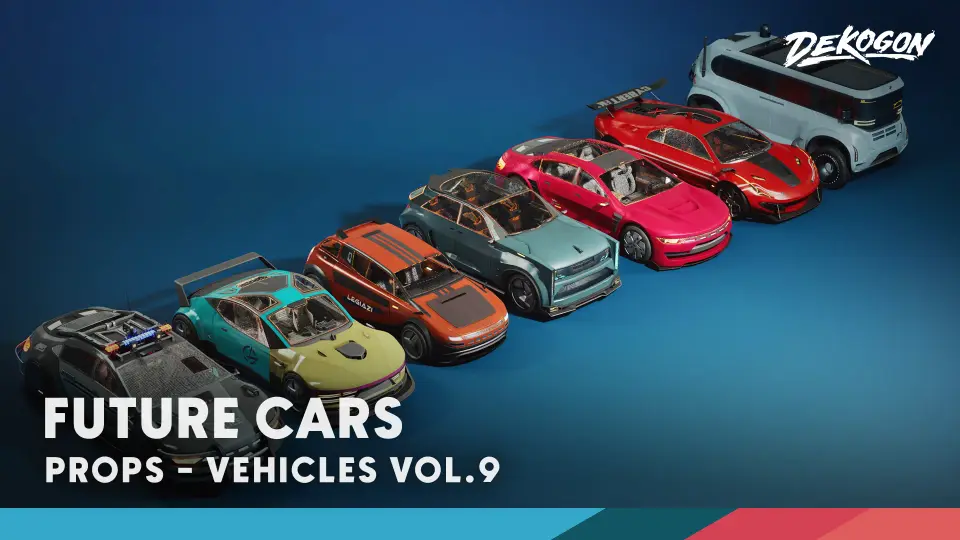
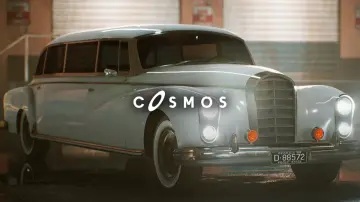
Vehicles VOL.9 - Future Cars (Low Poly) delivers seven car models constructed with split meshes, giving developers modular control over how each vehicle is assembled within a scene. The cars are classified as prop assets, which means they ship without bones or animations, so the package is intended for environmental placement, background dressing, or gameplay iteration where rigs are handled externally.
The split-mesh approach matters for a few practical reasons. Developers can hide, swap, or reposition individual vehicle parts without opening a 3D modeling application. If a scene calls for a car with a missing door, a detached panel, or an exposed internal cavity, those components can be toggled at the actor level. This keeps iteration inside the engine and avoids round-tripping through external DCC tools.
Master Material and Channel-Packed Texture Workflow
All assets use a master material setup that governs the majority of the included props and models. Rather than relying on unique materials per vehicle, the package routes multiple cars through a shared material instance, which keeps draw calls manageable when several vehicles populate a single frame.
Texture sets are authored at 4K resolution, and the pack uses channel-packed masks for Roughness, Metalness, and Ambient Occlusion. This packing method keeps the three data channels inside a single texture file, reducing memory overhead while still feeding the master material with the values it needs for surface response.
Beyond the base channels, the material exposes additional controls for roughness, albedo, normals, and more. Artists can dial surface roughness up or down, shift base color values, or push normal detail without editing the source texture files. These controls apply across props tied to the master material, so changes propagate consistently.
Tintable Paint and Custom Branding
Painted areas on every car are tintable, meaning a single vehicle can appear in multiple color variants without requiring separate texture maps. The tinting operates through the master material, so a developer can instance the material, pick a new color, and populate a row of the same car model in different hues.
All branding and labels are custom-made by the studio, which removes any trademark or licensing concerns. Creators can drop the vehicles into commercial projects without worrying about real-world manufacturer logos, badge designs, or copyrighted decals appearing on the geometry.
Lumen Support and Post-Processing Readiness
The vehicles support Lumen for Unreal Engine 5.0 and later. Lumen-driven dynamic global illumination interacts with the car surfaces at runtime, so the vehicles respond to scene lighting changes without requiring baked lightmaps.
The pack includes a realistic post-processing setup and a Lookup Table, giving developers a color-grading baseline. The LUT provides a starting point for tone and mood, and can be adjusted or replaced to match an existing project pipeline. The post-processing setup and LUT are presented as part of the package rather than a separate configuration step.
Model Fidelity and Scene Integration
Each asset is fully detailed from all sides, so the cars hold up when placed in open areas, parking lots, or street scenes where the camera orbits or the player walks around them. The geometry is built for realistic AAA-quality visuals while remaining optimized for games, balancing visual fidelity with performance budgets expected in interactive projects.
The tag set associated with the package points toward several thematic contexts: post-apocalyptic, futuristic, cyber, Blade Runner, and technology. This range suggests the vehicles can fit into near-future urban environments, wasteland settings, or science-fiction scenes where civilian and transport vehicles share space with the environment art.
Editor compatibility notes indicate these vehicles work alongside Meridian 1988: Cedar Point School - Modular Environment (VOL 57), giving developers a confirmed pairing if they want to populate that modular environment with matching transport props.
What the Package Is Set Up to Handle
Vehicles VOL.9 - Future Cars (Low Poly) is structured for developers and artists who need seven environmentally ready future-car props with split-mesh flexibility, 4K channel-packed textures, a shared master material with tinting controls, Lumen compatibility for Unreal Engine 5.0+, and custom branding that carries no legal flags. The post-processing setup and LUT provide an immediate visual baseline, while the prop-only classification clarifies that animation and rigging fall outside the package scope.
 Cars & Trucks
 Cars & Trucks
 Cars & Trucks
 Cars & Trucks