"c14ff6bd758dadb1"{"id":"1001752","slug":"procedural-vehicles-van","title":"Procedural Vehicles - Van","category":"Cars \u0026 Trucks","engine":"5.0+","assetVersion":"","engineVersion":"Engine Version: 5.0+","tag":"Cars \u0026 Trucks","accent":"blue","visual":"mech","summary":"Explore the Procedural Vehicles - Van blueprint system, featuring Chaos vehicle rigging, procedural foliage painting, and deep material wear controls.","platform":"Unreal Engine","publishedAt":"2026-10-20T02:57:23.692Z","updatedAt":"2026-10-20T02:57:23.692Z","sourceNotes":[],"fileContents":[],"compatibility":["Unreal Engine","Engine Version: 5.0+"],"featuredImage":{"alt":"Procedural Vehicles - Van","src":"/wp-content/uploads/published/2026/10/6a141eba4fc1-0a1dc9e9-b18c-47c4-9097-02baab3b6bf6-84e7f8a7da.webp"},"hasDownloadLink":true,"downloads":0,"terms":[{"taxonomy":"category","slug":"cars-and-trucks","name":"Cars \u0026 Trucks"}],"galleryImages":[{"src":"/wp-content/uploads/published/2026/10/e95463c53336-e41d864e-351d-4bf3-8c71-a68df03f533e-1f76d01286.webp","alt":"Procedural Vehicles - Van"},{"src":"/wp-content/uploads/published/2026/10/7400f58074e0-620ae2f9-bd2d-4ab4-a587-a24370d08d97-d5d3d653b0.webp","alt":"Procedural Vehicles - Van"},{"src":"/wp-content/uploads/published/2026/10/468ab14ec2e9-6ab3776e-0add-4ed7-81ec-d6ecb936bb78-0421e361a8.webp","alt":"Procedural Vehicles - Van"},{"src":"/wp-content/uploads/published/2026/10/d8b2d3d30cb4-442774f4-1ee3-4c9a-97b0-bb36eafceda9-c83d0ff880.webp","alt":"Procedural Vehicles - Van"},{"src":"/wp-content/uploads/published/2026/10/7e2cd0eb330d-6be34649-f328-45df-bf22-4018f098af98-c5c181f311.webp","alt":"Procedural Vehicles - Van"},{"src":"/wp-content/uploads/published/2026/10/1199d8e15785-693ade1e-2ec4-45d3-b547-8dcd16c721e4-607483db41.webp","alt":"Procedural Vehicles - Van"},{"src":"/wp-content/uploads/published/2026/10/36d2f1ae04a2-0afcc928-9aa2-417d-b651-745f1d801e4d-c0ec8835b1.webp","alt":"Procedural Vehicles - Van"},{"src":"/wp-content/uploads/published/2026/10/8e38389ca8ce-374d260b-0f7b-48d1-b429-992338c0d782-35bf2999a1.webp","alt":"Procedural Vehicles - Van"},{"src":"/wp-content/uploads/published/2026/10/87c76ec0ec73-f1f4bbe2-847d-4a0a-bb08-407bc552b082-26ba6f9027.webp","alt":"Procedural Vehicles - Van"}],"accessPanel":{"kind":"resource","title":"Download this resource","eyebrow":"Free Download","message":"Log in or create a free account to start your download.","fileName":"Procedural Vehicles - Van.7z","safetyNote":"Resources are manually reviewed before listing to improve quality and reduce obvious risks.","actionLabel":"Download Free","resourceType":"Resource archive"},"contentHtml":"\u003cp\u003ePopulating post-apocalyptic highways, overgrown urban backstreets, and rural compounds often requires a delicate balance between visual density and interactive gameplay. Placing static junk meshes can make a world feel stagnant, while setting up fully drivable, destructible cars across an expansive environment usually introduces steep technical hurdles. Procedural Vehicles - Van bridges that gap by offering a single framework capable of delivering everything from stationary, moss-covered roadside wrecks to fully operational, physics-driven getaway vans.\u003c/p\u003e\u003ch2\u003eRigging Architecture and Chaos Vehicles Implementation\u003c/h2\u003e\u003cp\u003eAt the center of the system is a fully rigged, multiplayer-ready drivable blueprint designed to interface directly with Epic Games' Chaos Vehicles system. Before driving the van in-editor or in standalone builds, projects require both the Chaos Vehicles and OpenXR plugins to be enabled followed by an editor restart. Once active, the van operates on a dedicated custom skeleton that exposes individual articulation points throughout the entire chassis.\u003c/p\u003e\u003cp\u003eMechanical articulation includes individual bones assigned to each of the four wheels, the driver and passenger doors, the hood, and the rear boot doors. In the cabin, the steering wheel and gear stick are rigged with dedicated joints, linking visual control inputs directly to steering and drive states. The interior remains functional beyond skeletal movement: drivers have access to operational instrument dials, including responsive odometer readouts and live RPM monitoring. On the tarmac, the underlying physics model handles complex vehicle dynamics such as wheel burnouts and dynamic tire mark decals directly tied to surface interaction.\u003c/p\u003e\u003ch2\u003eFoliage Tool Integration and Level Design Blueprints\u003c/h2\u003e\u003cp\u003eBeyond individual drivable instances, the package incorporates procedural level design utilities tailored for world building. Environmental artists can bypass the chore of manually placing hundreds of vehicle variants along roadsides by leveraging the vehicle's integration with the native Foliage Tools. This integration allows artists to paint scattered, randomized vans directly onto landscape terrain or static meshes just as they would paint trees, grass, or boulders.\u003c/p\u003e\u003cp\u003eTo iterate quickly without leaving the perspective viewport, the blueprints include dedicated in-editor utility buttons for instantaneous procedural regeneration. Clicking these regeneration triggers randomizes cosmetic configurations across selected instances on the fly. Furthermore, adapting the vehicle to existing gameplay frameworks is streamlined through drag-and-drop character controller switching, allowing teams to wire up their existing playable characters to the vehicle's entry, exit, and driving logic without deep code modifications.\u003c/p\u003e\u003ch2\u003eProcedural Wear, Texture Separation, and Interactive Destruction\u003c/h2\u003e\u003cp\u003eVisual customization is driven by roughly 100 exposed procedural parameters that dictate the vehicle's age, operational state, and aesthetic design. Rather than relying on static, baked textures for every variant, the master materials decouple surface base colors from weathering passes. Developers can change or recolor the vehicle body paint freely without inadvertently washing out or misaligning surface grime, dirt layers, or structural rust accumulation.\u003c/p\u003e\u003cp\u003eFor abandoned or apocalyptic settings, the van includes specialized shaders capable of generating realistic foliage and moss coverage directly over the body panels, glass, and wheels. Detail extends to normally hidden mechanical areas, offering fully modeled and textured engine bays, undercarriages, and customizable license plates. Interactivity extends into visual damage states through destructible components, allowing individual window panes and exterior mirrors to shatter under impact. Complementing the visual deformation, the vehicle includes integrated particle systems for dynamic tire smoke and exhaust fumes, backed by a comprehensive audio suite featuring dedicated engine loops, door slams, latch mechanics, and shattering glass sounds.\u003c/p\u003e\u003ch2\u003eSmart Actor Optimization and Draw-Call Management\u003c/h2\u003e\u003cp\u003eSpawning dozens or hundreds of interactive, fully rigged vehicles can easily overwhelm CPU game threads and GPU render pipelines if handled carelessly. To address scene performance in sprawling open worlds, the package employs a dedicated \"Smart Actor\" architecture. While parked, dormant, or sitting outside active player proximity, the vehicle blueprint throttles unnecessary background evaluations down to a near-zero idle processing cost.\u003c/p\u003e\u003cp\u003eRendering overhead is systematically managed through a mixture of dynamic meshes, instancing pipelines, and hand-modeled level of detail (LOD) hierarchies. Precise physical interactions are managed via custom hand-modeled collision meshes rather than costly auto-generated hulls. At extreme viewing distances where skeletal meshes and complex multi-material setups would cripple performance, the blueprint automatically substitutes the vehicle with a single draw-call proxy mesh. This optimization strategy enables scenes containing upwards of 1,500 interactive and static vehicle instances to maintain smooth 120 frames-per-second performance metrics in stress-tested environments.\u003c/p\u003e\u003ch2\u003eProject Suitability Across Open Worlds and Survival Scenarios\u003c/h2\u003e\u003cp\u003eBecause the van supports both replicated multiplayer driving physics and hyper-optimized ambient scattering, it operates cleanly across several genres. Survival projects benefit heavily from the vehicle's weathered presets, functional storage areas like the openable hood and boot, and destructible glass components. The vehicle's aesthetic flexibility also accommodates modern action titles, tactical sandbox shooters, and zombie survival projects that require drivable civilian transport alongside believable roadside wreckage.\u003c/p\u003e\n\n\u003ch2\u003eMore From The Same Workflow\u003c/h2\u003e\n\u003cul\u003e\n\u003cli\u003e\u003ca href=\"https://3dcghub.com/procedural-vehicles-sedan/\" title=\"Procedural Vehicles - Sedan\"\u003eProcedural Vehicles - Sedan\u003c/a\u003e\u003c/li\u003e\n\u003cli\u003e\u003ca href=\"https://3dcghub.com/easy-flight-model/\" title=\"Easy Flight Model\"\u003eEasy Flight Model\u003c/a\u003e\u003c/li\u003e\n\u003cli\u003e\u003ca href=\"https://3dcghub.com/1980s-cars-pack/\" title=\"1980s Cars Pack\"\u003e1980s Cars Pack\u003c/a\u003e\u003c/li\u003e\n\u003cli\u003e\u003ca href=\"https://3dcghub.com/cinematic-car-rig-ccr/\" title=\"Cinematic Car Rig (CCR)\"\u003eCinematic Car Rig (CCR)\u003c/a\u003e\u003c/li\u003e\n\u003cli\u003e\u003ca href=\"https://3dcghub.com/vehicles-vol-9-future-cars-low-poly/\" title=\"Vehicles VOL.9- Future Cars (Low Poly)\"\u003eVehicles VOL.9- Future Cars (Low Poly)\u003c/a\u003e\u003c/li\u003e\n\u003c/ul\u003e","contentTextLength":5992,"navigation":{"current":31,"total":3719,"previous":{"id":"1001753","slug":"realistic-sport-wheels-2-unreal-engine","title":"Realistic Sport Wheels 2 - Unreal Engine","category":"Cars \u0026 Trucks","platform":"Unreal Engine","updatedAt":"2026-10-20T02:58:25.840Z"},"next":{"id":"1001751","slug":"procedural-climbing-with-control-rig","title":"Procedural Climbing with Control Rig","category":"Gameplay Features","platform":"Unreal Engine","updatedAt":"2026-10-20T02:56:44.210Z"}},"relatedResources":[{"id":"1001254","slug":"procedural-vehicles-sedan","title":"Procedural Vehicles - Sedan","category":"Racing","engine":"5.0+","assetVersion":"","engineVersion":"Engine Version: 5.0+","tag":"Racing","accent":"blue","visual":"mech","summary":"Integrate drivable, destructible procedural sedans with Chaos physics, skeletal interior rigging, foliage tool painting, and single draw-call proxies.","platform":"Unreal Engine","publishedAt":"2026-09-23T15:44:32.894Z","updatedAt":"2026-09-23T15:44:32.894Z","sourceNotes":[],"fileContents":[],"compatibility":["Unreal Engine","Engine Version: 5.0+"],"featuredImage":{"alt":"Procedural Vehicles - Sedan","src":"/wp-content/uploads/published/2026/09/c41740f12313-412268c7-30f8-4828-9e69-2ba52862770a-04f9f1bdb3.webp"},"hasDownloadLink":true,"downloads":2},{"id":"15259","slug":"easy-flight-model","title":"Easy Flight Model","category":"Procedural Systems","engine":"5.4 - 5.8","assetVersion":"Asset Version: 3.23 - 3.34","engineVersion":"Engine version: 5.4 - 5.8","tag":"Procedural Systems","accent":"blue","visual":"city","summary":"Easy Flight Model provides a realistic framework for simulating fixed-wing aircraft and aerodynamic objects using physics impulses. It computes flight dynamics based on mass, velocity, and location.","platform":"Unreal Engine","publishedAt":"2026-03-12T08:25:55.000Z","updatedAt":"2026-09-04T15:23:00.546Z","sourceNotes":[],"fileContents":[],"compatibility":["Unreal Engine","Asset Version: 3.23 - 3.34","Engine version: 5.4 - 5.8"],"featuredImage":{"alt":"Easy Flight Model","src":"https://3dcghub.com/wp-content/uploads/2026/03/32989088-74c7-4cb2-a882-a51bae1bc416.webp"},"hasDownloadLink":true,"downloads":0},{"id":"1001498","slug":"1980s-cars-pack","title":"1980s Cars Pack","category":"Cars \u0026 Trucks","engine":"5.0+","assetVersion":"","engineVersion":"Engine Version: 5.0+","tag":"Cars \u0026 Trucks","accent":"blue","visual":"mech","summary":"Examine the 1980s Cars Pack for Unreal Engine, featuring five driveable and static vehicle types, material controls, functional interiors, and lighting systems.","platform":"Unreal Engine","publishedAt":"2026-10-09T07:25:48.062Z","updatedAt":"2026-10-09T07:25:48.062Z","sourceNotes":[],"fileContents":[],"compatibility":["Unreal Engine","Engine Version: 5.0+"],"featuredImage":{"alt":"1980s Cars Pack","src":"/wp-content/uploads/published/2026/10/2b1634bd47f8-70e84585-9033-4f61-80b8-98e0a106b682-9257865be1.webp"},"hasDownloadLink":true,"downloads":0}]}
Cars & Trucks
Procedural Vehicles - Van
Explore the Procedural Vehicles - Van blueprint system, featuring Chaos vehicle rigging, procedural foliage painting, and deep material wear controls.
Populating post-apocalyptic highways, overgrown urban backstreets, and rural compounds often requires a delicate balance between visual density and interactive gameplay. Placing static junk meshes can make a world feel stagnant, while setting up fully drivable, destructible cars across an expansive environment usually introduces steep technical hurdles. Procedural Vehicles - Van bridges that gap by offering a single framework capable of delivering everything from stationary, moss-covered roadside wrecks to fully operational, physics-driven getaway vans.
Rigging Architecture and Chaos Vehicles Implementation
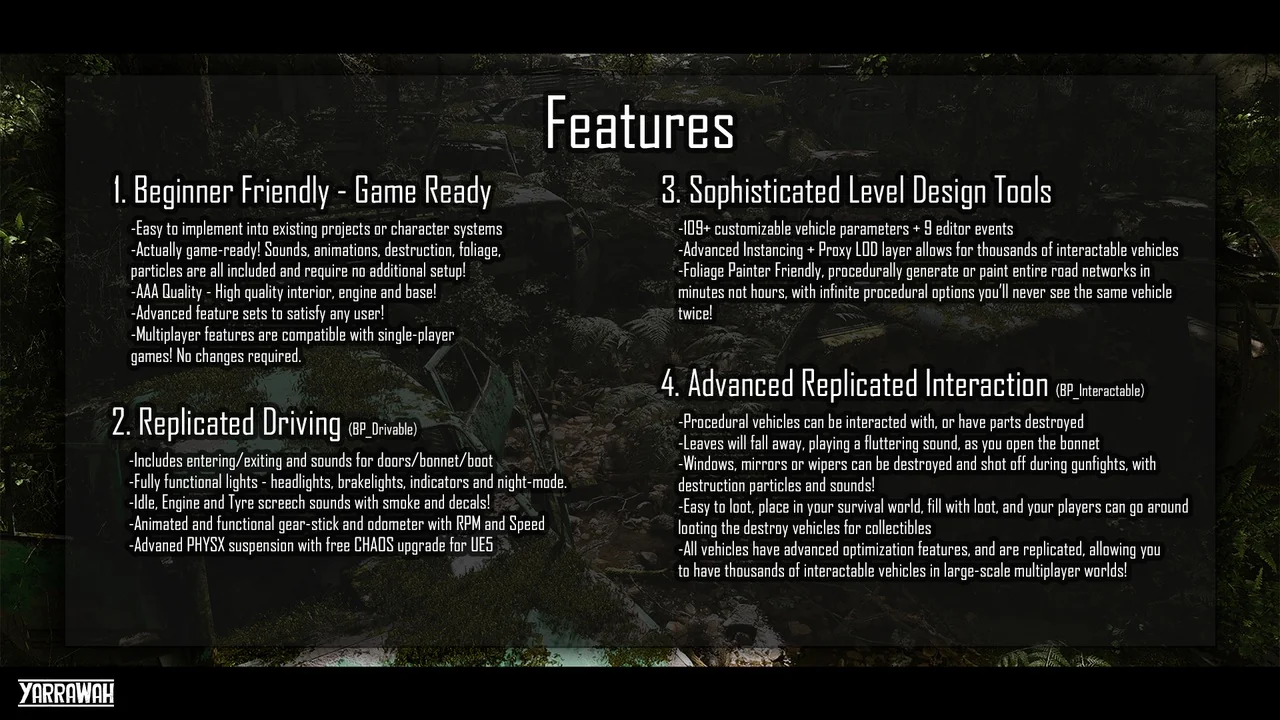
At the center of the system is a fully rigged, multiplayer-ready drivable blueprint designed to interface directly with Epic Games' Chaos Vehicles system. Before driving the van in-editor or in standalone builds, projects require both the Chaos Vehicles and OpenXR plugins to be enabled followed by an editor restart. Once active, the van operates on a dedicated custom skeleton that exposes individual articulation points throughout the entire chassis.
Mechanical articulation includes individual bones assigned to each of the four wheels, the driver and passenger doors, the hood, and the rear boot doors. In the cabin, the steering wheel and gear stick are rigged with dedicated joints, linking visual control inputs directly to steering and drive states. The interior remains functional beyond skeletal movement: drivers have access to operational instrument dials, including responsive odometer readouts and live RPM monitoring. On the tarmac, the underlying physics model handles complex vehicle dynamics such as wheel burnouts and dynamic tire mark decals directly tied to surface interaction.
Foliage Tool Integration and Level Design Blueprints
Beyond individual drivable instances, the package incorporates procedural level design utilities tailored for world building. Environmental artists can bypass the chore of manually placing hundreds of vehicle variants along roadsides by leveraging the vehicle's integration with the native Foliage Tools. This integration allows artists to paint scattered, randomized vans directly onto landscape terrain or static meshes just as they would paint trees, grass, or boulders.
To iterate quickly without leaving the perspective viewport, the blueprints include dedicated in-editor utility buttons for instantaneous procedural regeneration. Clicking these regeneration triggers randomizes cosmetic configurations across selected instances on the fly. Furthermore, adapting the vehicle to existing gameplay frameworks is streamlined through drag-and-drop character controller switching, allowing teams to wire up their existing playable characters to the vehicle's entry, exit, and driving logic without deep code modifications.
Procedural Wear, Texture Separation, and Interactive Destruction
Visual customization is driven by roughly 100 exposed procedural parameters that dictate the vehicle's age, operational state, and aesthetic design. Rather than relying on static, baked textures for every variant, the master materials decouple surface base colors from weathering passes. Developers can change or recolor the vehicle body paint freely without inadvertently washing out or misaligning surface grime, dirt layers, or structural rust accumulation.
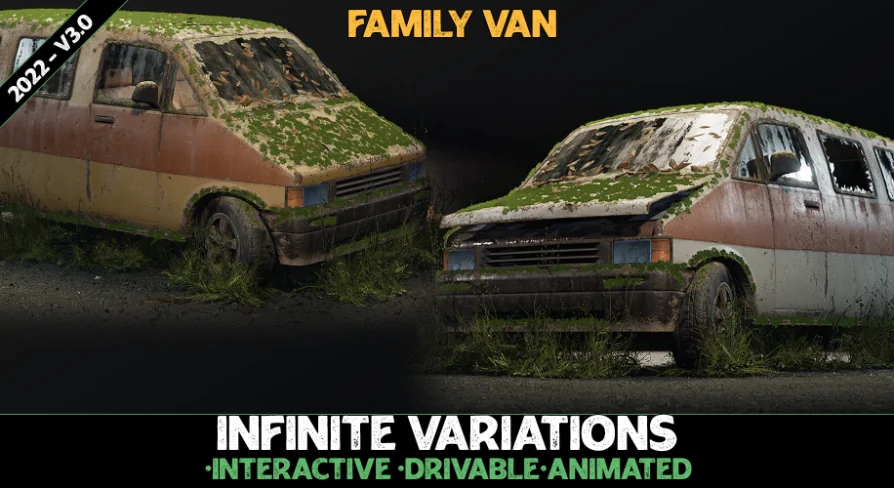
For abandoned or apocalyptic settings, the van includes specialized shaders capable of generating realistic foliage and moss coverage directly over the body panels, glass, and wheels. Detail extends to normally hidden mechanical areas, offering fully modeled and textured engine bays, undercarriages, and customizable license plates. Interactivity extends into visual damage states through destructible components, allowing individual window panes and exterior mirrors to shatter under impact. Complementing the visual deformation, the vehicle includes integrated particle systems for dynamic tire smoke and exhaust fumes, backed by a comprehensive audio suite featuring dedicated engine loops, door slams, latch mechanics, and shattering glass sounds.
Smart Actor Optimization and Draw-Call Management
Spawning dozens or hundreds of interactive, fully rigged vehicles can easily overwhelm CPU game threads and GPU render pipelines if handled carelessly. To address scene performance in sprawling open worlds, the package employs a dedicated "Smart Actor" architecture. While parked, dormant, or sitting outside active player proximity, the vehicle blueprint throttles unnecessary background evaluations down to a near-zero idle processing cost.
Rendering overhead is systematically managed through a mixture of dynamic meshes, instancing pipelines, and hand-modeled level of detail (LOD) hierarchies. Precise physical interactions are managed via custom hand-modeled collision meshes rather than costly auto-generated hulls. At extreme viewing distances where skeletal meshes and complex multi-material setups would cripple performance, the blueprint automatically substitutes the vehicle with a single draw-call proxy mesh. This optimization strategy enables scenes containing upwards of 1,500 interactive and static vehicle instances to maintain smooth 120 frames-per-second performance metrics in stress-tested environments.
Project Suitability Across Open Worlds and Survival Scenarios
Because the van supports both replicated multiplayer driving physics and hyper-optimized ambient scattering, it operates cleanly across several genres. Survival projects benefit heavily from the vehicle's weathered presets, functional storage areas like the openable hood and boot, and destructible glass components. The vehicle's aesthetic flexibility also accommodates modern action titles, tactical sandbox shooters, and zombie survival projects that require drivable civilian transport alongside believable roadside wreckage.
 Cars & Trucks
 Racing
 Procedural Systems
 Cars & Trucks