"1a0e4ac4dc71d030"{"id":"1001254","slug":"procedural-vehicles-sedan","title":"Procedural Vehicles - Sedan","category":"Racing","engine":"5.0+","assetVersion":"","engineVersion":"Engine Version: 5.0+","tag":"Racing","accent":"blue","visual":"mech","summary":"Integrate drivable, destructible procedural sedans with Chaos physics, skeletal interior rigging, foliage tool painting, and single draw-call proxies.","platform":"Unreal Engine","publishedAt":"2026-09-23T15:44:32.894Z","updatedAt":"2026-09-23T15:44:32.894Z","sourceNotes":[],"fileContents":[],"compatibility":["Unreal Engine","Engine Version: 5.0+"],"featuredImage":{"alt":"Procedural Vehicles - Sedan","src":"/wp-content/uploads/published/2026/09/c41740f12313-412268c7-30f8-4828-9e69-2ba52862770a-04f9f1bdb3.webp"},"hasDownloadLink":true,"downloads":0,"terms":[{"taxonomy":"category","slug":"racing","name":"Racing"}],"galleryImages":[{"src":"/wp-content/uploads/published/2026/09/a44821800af8-50ce2021-14f7-49bd-9d48-c95b67bacaa9-af09ee2508.webp","alt":"Procedural Vehicles - Sedan"},{"src":"/wp-content/uploads/published/2026/09/6945620ec46c-f47636cb-a1f9-496b-88cf-62dcac48fbb7-90d8cb22a0.webp","alt":"Procedural Vehicles - Sedan"},{"src":"/wp-content/uploads/published/2026/09/354e259ae701-2a70af96-8f4d-4830-bd2f-d282e0d8230a-2dbb6cfda4.webp","alt":"Procedural Vehicles - Sedan"},{"src":"/wp-content/uploads/published/2026/09/8b5799c4db38-8ebd8e90-27df-4a90-a136-f97488703c12-f17a36328e.webp","alt":"Procedural Vehicles - Sedan"},{"src":"/wp-content/uploads/published/2026/09/dc550b5fe424-61d61643-ebfa-485b-a5db-672e4f44517b-036d83995b.webp","alt":"Procedural Vehicles - Sedan"},{"src":"/wp-content/uploads/published/2026/09/1a48b1afb969-68aaf83c-2df5-4da2-96d5-c36441342083-7f9a8b210f.webp","alt":"Procedural Vehicles - Sedan"},{"src":"/wp-content/uploads/published/2026/09/eef60c259cb8-b992780e-816e-45c8-b8bd-075411aa0133-1680678e80.webp","alt":"Procedural Vehicles - Sedan"},{"src":"/wp-content/uploads/published/2026/09/e65f6b7d3d26-25b8c5c2-9a77-4e1e-b665-1ade6cb6e141-1688a00db8.webp","alt":"Procedural Vehicles - Sedan"},{"src":"/wp-content/uploads/published/2026/09/c9d06f829fca-80ebaf34-89f8-404d-934c-a0d21c632ea5-ef1eb9ff96.webp","alt":"Procedural Vehicles - Sedan"},{"src":"/wp-content/uploads/published/2026/09/95574d153a48-b4c932fb-5cd1-4b31-b00b-b5d522bfa919-e9b827169f.webp","alt":"Procedural Vehicles - Sedan"}],"accessPanel":{"kind":"resource","title":"Download this resource","eyebrow":"Free Download","message":"Log in or create a free account to start your download.","fileName":"Content.7z","safetyNote":"Resources are manually reviewed before listing to improve quality and reduce obvious risks.","actionLabel":"Download Free","resourceType":"Resource archive"},"contentHtml":"\u003ch2\u003ePlugin Initialization and Core Chaos Setup\u003c/h2\u003e\n\u003cp\u003eDeploying this vehicle package requires two project settings before opening the blueprints. Both the Chaos Vehicles and OpenXR plugins must be enabled in the project configuration, followed by a complete editor restart. Once initialized, the vehicle system leverages Chaos physics to manage active handling, suspension calculation, and wheel contact mechanics.\u003c/p\u003e\n\u003cp\u003eThe package is configured as a game-ready system intended to populate scenes within minutes rather than requiring manual physics tuning from scratch. It bridges the gap between static environmental props and playable machinery by delivering assets that can exist simultaneously as lightweight set dressing and fully functioning player transports.\u003c/p\u003e \u003ch2\u003eSkeletal Rigging and Drivable Blueprint Architecture\u003c/h2\u003e\n\u003cp\u003eAt the center of the vehicle is a multiplayer-ready drivable blueprint shaped by a specialized skeletal structure. Rather than relying on rigid static components, the custom skeleton isolates individual bones for mechanical parts. Dedicated bones control each wheel, all four passenger doors, the steering wheel, the gear stick, the hood, and the boot. This level of joint separation allows dynamic physical interaction, door opening sequences, and visual feedback tied directly to vehicle handling.\u003c/p\u003e\n\u003cp\u003eInside the cabin, the dashboard houses functional interior instrumentation, including a responsive odometer and RPM gauge that reflect engine load in real time. The underlying physics model extends beyond simple point-to-point traversal. Active vehicle mechanics incorporate high-stress states such as wheel burnouts and dynamic tire decal generation across drivable surfaces. Swapping character setups is handled through drag-and-drop controller switching, letting designers substitute different player pawn frameworks without rebuilding vehicle inputs.\u003c/p\u003e \u003ch2\u003eLevel Designer Controls and Foliage Tool Placement\u003c/h2\u003e\n\u003cp\u003ePlacing dozens or hundreds of vehicles throughout an environment typically creates severe production bottlenecks. This system addresses level dressing by integrating directly into the standard editor Foliage Tools. Designers can select the sedan and paint it across a landscape or urban mesh surface exactly like grass or trees. This approach makes it possible to scatter realistic traffic jams, roadside junkyards, or abandoned highway blockades across large terrains in a few brush strokes.\u003c/p\u003e\n\u003cp\u003eFor fine adjustments, the blueprints feature in-editor buttons for rapid regeneration. Clicking these regeneration tools re-rolls procedural attributes instantly, allowing level artists to shuffle visual combinations without adjusting dozens of sliders by hand. The workflow eliminates the need to duplicate multiple static mesh variations in the content browser simply to create visual diversity along a city block.\u003c/p\u003e \u003ch2\u003eProcedural Sedan Parameters and Surface Layering\u003c/h2\u003e\n\u003cp\u003eCustomization relies on approximately 100 exposed procedural parameters built into the material and mesh pipelines. Artists can adjust individual color passes and finishes through an advanced texture variation system. A primary feature of this shader setup is the separation of base coats from environmental weathering: users can alter the car body paint values freely without wiping out or misaligning the underlying rust, grime, and road dirt maps.\u003c/p\u003e\n\u003cp\u003eFor environmental storytelling, the parameters include dedicated controls for realistic foliage growth and moss coverage, grounding vehicles that have spent years exposed to the elements. The visual detail remains consistent across hidden areas, featuring fully textured engine bays, interior cabin upholstery, and complete undercarriage geometry. License plates are also fully customizable, allowing unique number combinations across different zones in a game world.\u003c/p\u003e \u003ch2\u003eSmart Actor Performance and Draw-Call Management\u003c/h2\u003e\n\u003cp\u003eRendering high-fidelity vehicles across an open scene can quickly degrade frame budgets. To manage overhead, the blueprint employs a proprietary Smart Actor architecture. When a vehicle is unoccupied, stationary, or out of direct gameplay range, its active simulation footprint drops to near-zero tick cost. The mesh presentation balances instanced and dynamic rendering paths depending on whether the sedan is behaving as a static background element or an active physics entity.\u003c/p\u003e\n\u003cp\u003eGeometry reduction is handled through a sequence of hand-made LOD steps rather than aggressive automated decimation. For extreme view distances, the system swaps to a single draw-call proxy mesh. This low-cost proxy allows wide-open vistas and sprawling post-apocalyptic horizons to render massive vehicular clusters without bottlenecking the GPU. In performance demonstrations, dense urban test environments have maintained 120 frames per second while processing over 1,500 active vehicle instances.\u003c/p\u003e \u003ch2\u003eDestruction Handling, Audio-Visual FX, and Project Handoff\u003c/h2\u003e\n\u003cp\u003eInteraction fidelity extends directly into damage states and environmental response. The sedan incorporates destructible components across fragile zones, allowing windows, side mirrors, and exterior accessories to shatter or detach under weapon fire or collisions. Physical contact is governed by custom hand-made collision meshes tailored to the vehicle body, preventing common clipping and penetration bugs during high-speed impacts.\u003c/p\u003e\n\u003cp\u003eAudiovisual feedback is fully integrated out of the box. The vehicle includes a complete suite of sound effects covering engine revs, gear shifts, glass impacts, and door latches. Visual effects include dynamic particle systems for running exhaust emissions and tire smoke tied to traction loss. Delivered alongside comprehensive PDF documentation, the system is designed to drop cleanly into active development pipelines, providing an out-of-the-box vehicular foundation for apocalyptic, urban, and modular survivor projects.\u003c/p\u003e\n\n\u003ch2\u003eMore From The Same Workflow\u003c/h2\u003e\n\u003cul\u003e\n\u003cli\u003e\u003ca href=\"https://3dcghub.com/easy-flight-model/\" title=\"Easy Flight Model\"\u003eEasy Flight Model\u003c/a\u003e\u003c/li\u003e\n\u003cli\u003e\u003ca href=\"https://3dcghub.com/cinematic-car-rig-ccr/\" title=\"Cinematic Car Rig (CCR)\"\u003eCinematic Car Rig (CCR)\u003c/a\u003e\u003c/li\u003e\n\u003cli\u003e\u003ca href=\"https://3dcghub.com/procedural-road-and-highway-tool-with-simple-vehicle-traffic/\" title=\"Procedural Road And Highway Tool With Simple Vehicle Traffic\"\u003eProcedural Road And Highway Tool With Simple Vehicle Traffic\u003c/a\u003e\u003c/li\u003e\n\u003cli\u003e\u003ca href=\"https://3dcghub.com/rkva-rigless-kinematic-vehicle-animation/\" title=\"RKVA Rigless Kinematic Vehicle Animation\"\u003eRKVA Rigless Kinematic Vehicle Animation\u003c/a\u003e\u003c/li\u003e\n\u003cli\u003e\u003ca href=\"https://3dcghub.com/renovate-vehicle-framework/\" title=\"Renovate: Vehicle Framework\"\u003eRenovate: Vehicle Framework\u003c/a\u003e\u003c/li\u003e\n\u003c/ul\u003e","contentTextLength":6039,"navigation":{"current":4,"total":3200,"previous":{"id":"1001255","slug":"modular-victorian-house","title":"Modular Victorian House","category":"Simulation","platform":"Unreal Engine","updatedAt":"2026-09-23T15:51:35.809Z"},"next":{"id":"1001253","slug":"turn-based-strategy-rpg-template","title":"Turn-Based Strategy RPG Template","category":"RPG","platform":"Unreal Engine","updatedAt":"2026-09-23T15:40:14.497Z"}},"relatedResources":[{"id":"15259","slug":"easy-flight-model","title":"Easy Flight Model","category":"Procedural Systems","engine":"5.4 - 5.8","assetVersion":"Asset Version: 3.23 - 3.34","engineVersion":"Engine version: 5.4 - 5.8","tag":"Procedural Systems","accent":"blue","visual":"city","summary":"Easy Flight Model provides a realistic framework for simulating fixed-wing aircraft and aerodynamic objects using physics impulses. It computes flight dynamics based on mass, velocity, and location.","platform":"Unreal Engine","publishedAt":"2026-03-12T08:25:55.000Z","updatedAt":"2026-09-04T15:23:00.546Z","sourceNotes":[],"fileContents":[],"compatibility":["Unreal Engine","Asset Version: 3.23 - 3.34","Engine version: 5.4 - 5.8"],"featuredImage":{"alt":"Easy Flight Model","src":"https://3dcghub.com/wp-content/uploads/2026/03/32989088-74c7-4cb2-a882-a51bae1bc416.webp"},"hasDownloadLink":true,"downloads":0},{"id":"11305","slug":"cinematic-car-rig-ccr","title":"Cinematic Car Rig (CCR)","category":"Procedural Systems","engine":"5.1+","assetVersion":"Engine version: 5.1+","engineVersion":"Asset Version:2.1","tag":"Procedural Systems","accent":"blue","visual":"audio","summary":"The Cinematic Car Rig (CCR) offers a flexible and editable solution for automotive animation in Unreal Engine, moving beyond the limitations of physics-based simulations.","platform":"Unreal Engine","publishedAt":"2026-03-04T17:31:47.000Z","updatedAt":"2026-04-19T15:48:13.000Z","sourceNotes":[],"fileContents":[],"compatibility":["Unreal Engine","Engine version: 5.1+","Asset Version: 2.1"],"featuredImage":{"alt":"Cinematic Car Rig (CCR)","src":"https://3dcghub.com/wp-content/uploads/2026/03/952ef1e7-0b7d-46cc-a5da-45f69af1cdee-1.webp"},"hasDownloadLink":true,"downloads":1},{"id":"1000546","slug":"procedural-road-and-highway-tool-with-simple-vehicle-traffic","title":"Procedural Road And Highway Tool With Simple Vehicle Traffic","category":"Procedural Systems","engine":"4.26+,5.0+","assetVersion":"","engineVersion":"Engine Version: 4.26+,5.0+","tag":"Procedural Systems","accent":"blue","visual":"mech","summary":"Unreal Engine Blueprint tool for procedural roads, highways, bridges, and train tracks with spline-based generation, landscape deformation, and traffic spawner.","platform":"Unreal Engine","publishedAt":"2026-07-15T04:13:04.435Z","updatedAt":"2026-07-15T04:13:04.435Z","sourceNotes":[],"fileContents":[],"compatibility":["Unreal Engine","Engine Version: 4.26+,5.0+"],"featuredImage":{"alt":"Procedural Road And Highway Tool With Simple Vehicle Traffic","src":"/wp-content/uploads/published/2026/07/6e7951f23e2f-2fe34f13-8299-4e88-821d-c7764035437a-ded20f5dd1.webp"},"hasDownloadLink":true,"downloads":0}]}
Racing
Procedural Vehicles - Sedan
Integrate drivable, destructible procedural sedans with Chaos physics, skeletal interior rigging, foliage tool painting, and single draw-call proxies.
Deploying this vehicle package requires two project settings before opening the blueprints. Both the Chaos Vehicles and OpenXR plugins must be enabled in the project configuration, followed by a complete editor restart. Once initialized, the vehicle system leverages Chaos physics to manage active handling, suspension calculation, and wheel contact mechanics.
The package is configured as a game-ready system intended to populate scenes within minutes rather than requiring manual physics tuning from scratch. It bridges the gap between static environmental props and playable machinery by delivering assets that can exist simultaneously as lightweight set dressing and fully functioning player transports.
Skeletal Rigging and Drivable Blueprint Architecture
At the center of the vehicle is a multiplayer-ready drivable blueprint shaped by a specialized skeletal structure. Rather than relying on rigid static components, the custom skeleton isolates individual bones for mechanical parts. Dedicated bones control each wheel, all four passenger doors, the steering wheel, the gear stick, the hood, and the boot. This level of joint separation allows dynamic physical interaction, door opening sequences, and visual feedback tied directly to vehicle handling.
Inside the cabin, the dashboard houses functional interior instrumentation, including a responsive odometer and RPM gauge that reflect engine load in real time. The underlying physics model extends beyond simple point-to-point traversal. Active vehicle mechanics incorporate high-stress states such as wheel burnouts and dynamic tire decal generation across drivable surfaces. Swapping character setups is handled through drag-and-drop controller switching, letting designers substitute different player pawn frameworks without rebuilding vehicle inputs.
Level Designer Controls and Foliage Tool Placement
Placing dozens or hundreds of vehicles throughout an environment typically creates severe production bottlenecks. This system addresses level dressing by integrating directly into the standard editor Foliage Tools. Designers can select the sedan and paint it across a landscape or urban mesh surface exactly like grass or trees. This approach makes it possible to scatter realistic traffic jams, roadside junkyards, or abandoned highway blockades across large terrains in a few brush strokes.
For fine adjustments, the blueprints feature in-editor buttons for rapid regeneration. Clicking these regeneration tools re-rolls procedural attributes instantly, allowing level artists to shuffle visual combinations without adjusting dozens of sliders by hand. The workflow eliminates the need to duplicate multiple static mesh variations in the content browser simply to create visual diversity along a city block.
Procedural Sedan Parameters and Surface Layering
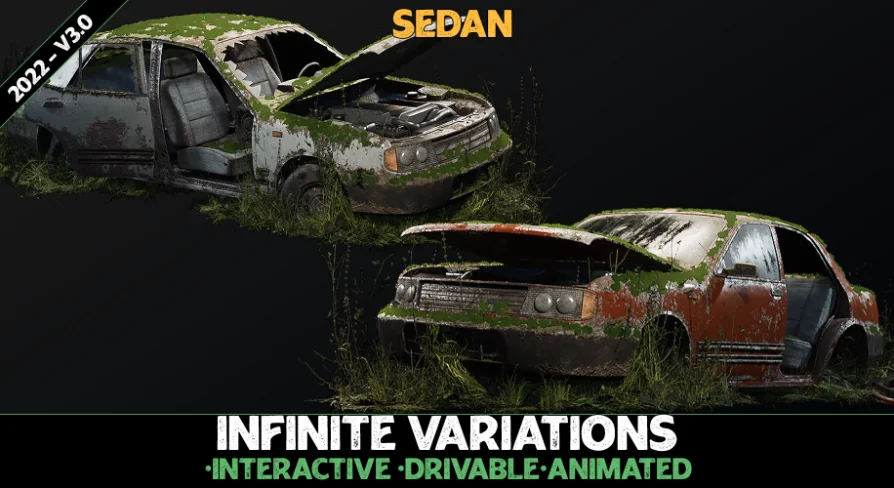
Customization relies on approximately 100 exposed procedural parameters built into the material and mesh pipelines. Artists can adjust individual color passes and finishes through an advanced texture variation system. A primary feature of this shader setup is the separation of base coats from environmental weathering: users can alter the car body paint values freely without wiping out or misaligning the underlying rust, grime, and road dirt maps.
For environmental storytelling, the parameters include dedicated controls for realistic foliage growth and moss coverage, grounding vehicles that have spent years exposed to the elements. The visual detail remains consistent across hidden areas, featuring fully textured engine bays, interior cabin upholstery, and complete undercarriage geometry. License plates are also fully customizable, allowing unique number combinations across different zones in a game world.
Smart Actor Performance and Draw-Call Management
Rendering high-fidelity vehicles across an open scene can quickly degrade frame budgets. To manage overhead, the blueprint employs a proprietary Smart Actor architecture. When a vehicle is unoccupied, stationary, or out of direct gameplay range, its active simulation footprint drops to near-zero tick cost. The mesh presentation balances instanced and dynamic rendering paths depending on whether the sedan is behaving as a static background element or an active physics entity.
Geometry reduction is handled through a sequence of hand-made LOD steps rather than aggressive automated decimation. For extreme view distances, the system swaps to a single draw-call proxy mesh. This low-cost proxy allows wide-open vistas and sprawling post-apocalyptic horizons to render massive vehicular clusters without bottlenecking the GPU. In performance demonstrations, dense urban test environments have maintained 120 frames per second while processing over 1,500 active vehicle instances.
Destruction Handling, Audio-Visual FX, and Project Handoff
Interaction fidelity extends directly into damage states and environmental response. The sedan incorporates destructible components across fragile zones, allowing windows, side mirrors, and exterior accessories to shatter or detach under weapon fire or collisions. Physical contact is governed by custom hand-made collision meshes tailored to the vehicle body, preventing common clipping and penetration bugs during high-speed impacts.
Audiovisual feedback is fully integrated out of the box. The vehicle includes a complete suite of sound effects covering engine revs, gear shifts, glass impacts, and door latches. Visual effects include dynamic particle systems for running exhaust emissions and tire smoke tied to traction loss. Delivered alongside comprehensive PDF documentation, the system is designed to drop cleanly into active development pipelines, providing an out-of-the-box vehicular foundation for apocalyptic, urban, and modular survivor projects.
 Racing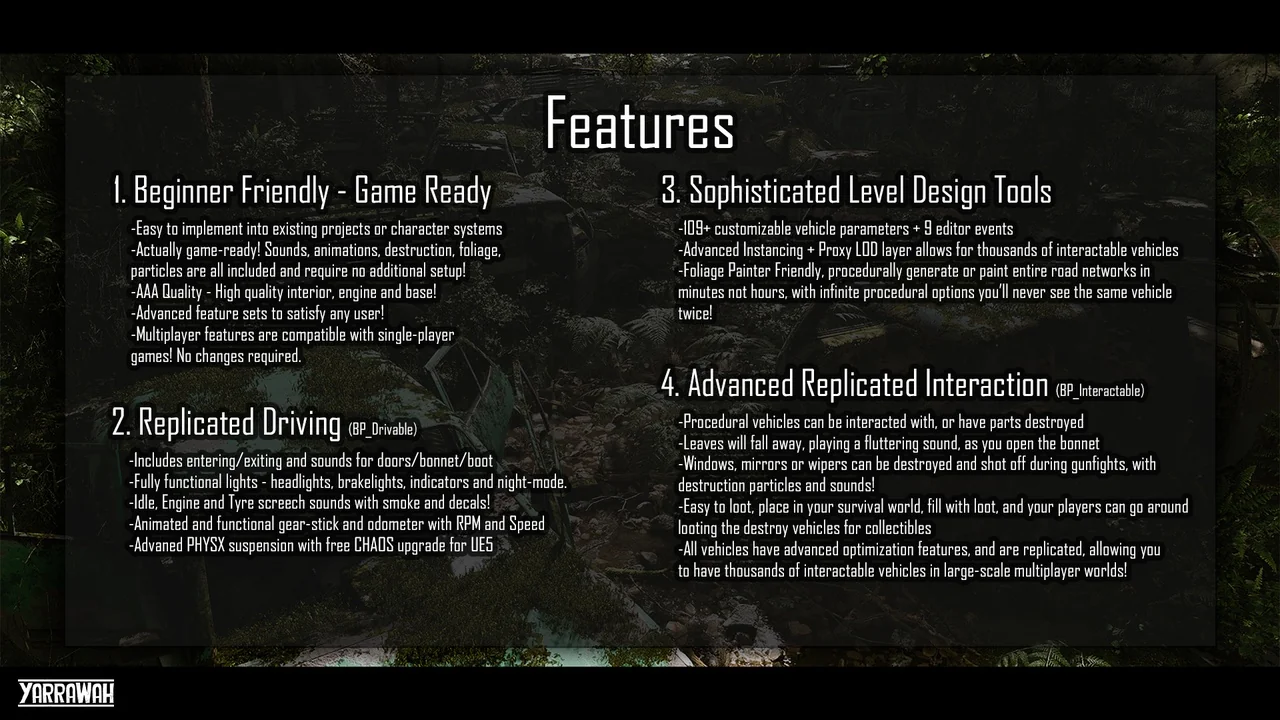
 Procedural Systems
 Procedural Systems
 Procedural Systems