"c68a05d5e51405b3"{"id":"1000666","slug":"rkva-rigless-kinematic-vehicle-animation","title":"RKVA Rigless Kinematic Vehicle Animation","category":"Animations","engine":"5.6","assetVersion":"Asset Version: 1.0.5b","engineVersion":"Engine Version: 5.6","tag":"Animations","accent":"blue","visual":"animation","summary":"A fully procedural, modular vehicle animation system using spline-based distance keyframing. Build cars, trucks, and bikes from static meshes with no rigging re","platform":"Unreal Engine","publishedAt":"2026-07-22T07:06:32.349Z","updatedAt":"2026-07-22T07:06:32.349Z","sourceNotes":[],"fileContents":[],"compatibility":["Unreal Engine","Asset Version: 1.0.5b","Engine Version: 5.6"],"featuredImage":{"alt":"RKVA Rigless Kinematic Vehicle Animation","src":"/wp-content/uploads/published/2026/07/a8d2547b5401-f5c2039a-f122-4a76-8e78-89e7a923f29d-08adddf779.webp"},"hasDownloadLink":true,"downloads":1,"terms":[{"taxonomy":"category","slug":"animations-tools-and-plugins","name":"Animations"}],"galleryImages":[{"src":"/wp-content/uploads/published/2026/07/1459f513bef3-3fa72bf3-1a14-4498-aab3-a9160328f2ee-bb6ea5d14f.webp","alt":"RKVA Rigless Kinematic Vehicle Animation"},{"src":"/wp-content/uploads/published/2026/07/bc294616e37b-39663e69-ce5d-4d7c-9e69-7e58d168becc-9028243484.webp","alt":"RKVA Rigless Kinematic Vehicle Animation"},{"src":"/wp-content/uploads/published/2026/07/de598e60c319-51e39dbf-e579-41ca-9115-ef9a6f32181f-61955739e7.webp","alt":"RKVA Rigless Kinematic Vehicle Animation"},{"src":"/wp-content/uploads/published/2026/07/5b74f7bcc947-7ee0b1c8-96cf-4f0d-bb46-dc5e8726df34-a8c9babb33.webp","alt":"RKVA Rigless Kinematic Vehicle Animation"},{"src":"/wp-content/uploads/published/2026/07/f82667e2bb0c-193ff80d-f9ee-4ee3-9c02-c9d65f94ebb3-402dde923b.webp","alt":"RKVA Rigless Kinematic Vehicle Animation"},{"src":"/wp-content/uploads/published/2026/07/eb0df69b1e9b-42d4429c-e14b-4075-8d2d-cda8e92b3e02-55fee730ce.webp","alt":"RKVA Rigless Kinematic Vehicle Animation"},{"src":"/wp-content/uploads/published/2026/07/5ab65cef61ec-dcfdd15e-7799-45de-9b5a-35d57aec88cf-638299527a.webp","alt":"RKVA Rigless Kinematic Vehicle Animation"},{"src":"/wp-content/uploads/published/2026/07/2fbbc35c30c4-d244fdd3-1960-4621-9521-9b4de3cb9757-e76a78a184.webp","alt":"RKVA Rigless Kinematic Vehicle Animation"},{"src":"/wp-content/uploads/published/2026/07/fda58eada1ba-949795be-0d60-4c0f-9575-9dcd889cbeda-00fcc4ce33.webp","alt":"RKVA Rigless Kinematic Vehicle Animation"},{"src":"/wp-content/uploads/published/2026/07/0f8ea29691e5-e6c11eea-ea3d-4665-894c-84c97d4eb98c-0424b4d3e9.webp","alt":"RKVA Rigless Kinematic Vehicle Animation"}],"accessPanel":{"kind":"resource","title":"Download this resource","eyebrow":"Free Download","message":"Log in or create a free account to start your download.","fileName":"5.6.7z","safetyNote":"Resources are manually reviewed before listing to improve quality and reduce obvious risks.","actionLabel":"Download Free","resourceType":"Resource archive"},"contentHtml":"\u003cp\u003eScenes that need vehicles rolling through predefined paths, parked in lots, or threading tight industrial corridors often run into a familiar wall. Physics-based vehicle systems can be unpredictable, and skeletal rigging takes time to set up. RKVA approaches the problem from the opposite direction by making the spline itself the authority. Animators keyframe a distance value along that spline, and the system calculates suspension, location, rotation, wheel rotation, and steering from that single input.\u003c/p\u003e \n\n\u003cp\u003eVehicles built this way always follow and conform to the spline. They do not drift or stray the way a physics body might after a poorly tuned collision. That predictability makes the system particularly useful for cinematic sequences, trailer shots, industrial visualizations, and any production where hero vehicles need to hit exact marks across repeated takes.\u003c/p\u003e \n\n\u003ch2\u003eHow Spline Distance Keyframing Works in RKVA\u003c/h2\u003e \n\u003cp\u003eThe core mechanic is simple to describe but broad in application. Instead of animating a vehicle transform directly, the user keyframes a distance value along a spline. The system reads that value and automatically derives the vehicle's position, rotation, wheel rotation, steering angle, and suspension behavior.\u003c/p\u003e \n\u003cp\u003eEvery derived channel is editable through keyframe modifier variables. This means the automatic calculation is a starting point, not a lock. Stylized movement can be pushed by adjusting those modifier values, giving animators room to exaggerate or tune the feel of a shot without rebuilding the rig.\u003c/p\u003e \n\u003cp\u003eBecause the spline governs the vehicle's path, the vehicle will always conform to it. This eliminates the drift problem common to physics solutions, where a vehicle can slowly wander off its intended route. The kinematic approach trades that unpredictability for precise, repeatable motion.\u003c/p\u003e \n\n\u003ch2\u003eStatic Mesh Workflow and Rigless Setup\u003c/h2\u003e \n\u003cp\u003eOne of the central appeals of RKVA is that it requires no pre-rigging. Vehicles can be assembled from static meshes. There is no need to build a skeletal rig, weight-paint wheels, or set up bone hierarchies before animation can begin. The creator describes the setup process as drag-and-drop with static meshes, and rigs or templates can be configured in minutes.\u003c/p\u003e \n\u003cp\u003eFor straightforward vehicles, this is enough to get moving. For more complex suspension configurations, the system provides special animation functions. These cover components like control arms and springs, allowing builders to replicate suspension geometry that goes beyond a simple wheel-on-axle arrangement.\u003c/p\u003e \n\u003cp\u003eRigid axle suspension is explicitly supported, which matters for trucks, heavy equipment, and any vehicle where the axle moves as a unit rather than each wheel operating independently. The suspension functions give the user control over how those components behave during compression and rebound.\u003c/p\u003e \n\n\u003ch2\u003eVehicle Types: Cars, Trucks, Buses, and Bikes\u003c/h2\u003e \n\u003cp\u003eRKVA is not limited to a single vehicle category. The system is built to handle cars, trucks, buses, and bikes. Each of these has fundamentally different suspension and steering characteristics, and the modular nature of the system is what allows it to span them.\u003c/p\u003e \n\u003cp\u003eMotorcycles present a specific challenge because their suspension components, particularly the front fork and rear shock, align along a diagonal line of compression rather than a purely vertical one. The system can align suspension components to accurately reflect that compression line. This means a bike built in RKVA can have its springs oriented correctly rather than faked with a vertical approximation.\u003c/p\u003e \n\u003cp\u003eBuses and trucks benefit from the rigid axle support mentioned earlier. Cars can use simpler suspension setups or more complex ones depending on the needs of the shot. The system does not enforce a single vehicle archetype.\u003c/p\u003e \n\n\u003ch2\u003eRuntime and Editor Animation Support\u003c/h2\u003e \n\u003cp\u003eRKVA supports animation changes both during runtime and in the editor. This is a meaningful distinction. Editor-side animation is standard for cinematic workflows where an animator sets keys, scrubs the timeline, and iterates. Runtime support means vehicle motion can be responsive to game logic or user input while the application is running.\u003c/p\u003e \n\u003cp\u003eFor interactive projects, this opens the possibility of vehicles that adjust their behavior based on conditions in the scene. The procedural nature of the system means the vehicle's response is always calculated from current inputs rather than played back from a pre-baked sequence.\u003c/p\u003e \n\n\u003ch2\u003eDrive Mode Without a Physics System\u003c/h2\u003e \n\u003cp\u003eRKVA includes a drive mode, which is notable because the system is explicitly not a physics solution. The question of how a non-physics system can support driving is answered by the kinematic core. Driving functionality is baked into the system through the kinematics, and enabling it requires very little modification from the animation setup.\u003c/p\u003e \n\u003cp\u003eThis drive mode comes with two clear limitations. It only works on continuous surfaces, and it does not have collision. These constraints define where drive mode is practical. It is suited for flat, uninterrupted ground where the vehicle does not need to react to obstacles or terrain deviations. It is not a substitute for a full physics-based driving simulator.\u003c/p\u003e \n\u003cp\u003eFor scenes where a vehicle needs to move under user or AI control across a clean surface, drive mode provides that capability without leaving the kinematic framework. For scenes with complex terrain, obstacles, or the need for collision response, the spline-based animation mode remains the primary tool.\u003c/p\u003e \n\n\u003ch2\u003eWho Benefits Most from RKVA\u003c/h2\u003e \n\u003cp\u003eRKVA is built for creators who need precise vehicle motion without the overhead of skeletal rigging or the unpredictability of physics simulation. Cinematic animators working on trailers, cutscenes, or visualization sequences can keyframe vehicles along splines with full control over suspension and steering modifier variables.\u003c/p\u003e \n\u003cp\u003eInteractive developers who need vehicles to follow dependable paths at runtime, or who want a lightweight drive mode on continuous surfaces, can use the procedural core without introducing a full physics layer. Teams working across automotive, industrial, and general vehicle categories can build cars, trucks, buses, and bikes using the same modular system, adjusting suspension complexity as the shot demands.\u003c/p\u003e \n\u003cp\u003eThe rigless, static-mesh workflow makes it practical for solo developers and small teams without a dedicated rigger. The drag-and-drop setup, combined with special animation functions for control arms and springs, gives enough depth for detailed suspension work when needed. Version 1.0.5 is the current release, with a basic template pack and documentation available for reference.\u003c/p\u003e\n\n\u003ch2\u003eExplore Similar Assets\u003c/h2\u003e\n\u003cul\u003e\n\u003cli\u003e\u003ca href=\"https://3dcghub.com/r-tune-vehicle-physics-2-0-vehicle-system-for-games-animation/\" title=\"R-Tune Vehicle Physics 2.0 - Vehicle System for Games \u0026amp; Animation\"\u003eR-Tune Vehicle Physics 2.0 - Vehicle System for Games \u0026amp; Animation\u003c/a\u003e\u003c/li\u003e\n\u003cli\u003e\u003ca href=\"https://3dcghub.com/driveable-animated-construction-truck-construction-truck-heavy-duty-3d-model/\" title=\"Driveable / Animated Construction Truck (Construction Truck Heavy Duty 3D Model)\"\u003eDriveable / Animated Construction Truck (Construction Truck Heavy Duty 3D Model)\u003c/a\u003e\u003c/li\u003e\n\u003cli\u003e\u003ca href=\"https://3dcghub.com/suv-01-driveable-animated-realistic/\" title=\"SUV 01 Driveable / Animated / Realistic\"\u003eSUV 01 Driveable / Animated / Realistic\u003c/a\u003e\u003c/li\u003e\n\u003cli\u003e\u003ca href=\"https://3dcghub.com/advanced-fuel-system-multiplayer-vehicle-addon/\" title=\"Advanced Fuel System: Multiplayer Vehicle Addon\"\u003eAdvanced Fuel System: Multiplayer Vehicle Addon\u003c/a\u003e\u003c/li\u003e\n\u003cli\u003e\u003ca href=\"https://3dcghub.com/cinematic-car-rig-ccr/\" title=\"Cinematic Car Rig (CCR)\"\u003eCinematic Car Rig (CCR)\u003c/a\u003e\u003c/li\u003e\n\u003c/ul\u003e","contentTextLength":6926,"navigation":{"current":1339,"total":3860,"previous":{"id":"1000667","slug":"rome-empire-character-pack","title":"Rome Empire Character Pack","category":"Characters \u0026 Creatures","platform":"Unreal Engine","updatedAt":"2026-07-22T07:13:03.567Z"},"next":{"id":"1000665","slug":"restaurant-vol-3-dining-decor-nanite-and-low-poly","title":"Restaurant VOL.3 - Dining Decor (Nanite and Low Poly)","category":"Food \u0026 Drink","platform":"Unreal Engine","updatedAt":"2026-07-22T06:58:56.056Z"}},"relatedResources":[{"id":"11305","slug":"cinematic-car-rig-ccr","title":"Cinematic Car Rig (CCR)","category":"Procedural Systems","engine":"5.1+","assetVersion":"Engine version: 5.1+","engineVersion":"Asset Version:2.1","tag":"Procedural Systems","accent":"blue","visual":"audio","summary":"The Cinematic Car Rig (CCR) offers a flexible and editable solution for automotive animation in Unreal Engine, moving beyond the limitations of physics-based simulations.","platform":"Unreal Engine","publishedAt":"2026-03-04T17:31:47.000Z","updatedAt":"2026-04-19T15:48:13.000Z","sourceNotes":[],"fileContents":[],"compatibility":["Unreal Engine","Engine version: 5.1+","Asset Version: 2.1"],"featuredImage":{"alt":"Cinematic Car Rig (CCR)","src":"https://3dcghub.com/wp-content/uploads/2026/03/952ef1e7-0b7d-46cc-a5da-45f69af1cdee-1.webp"},"hasDownloadLink":true,"downloads":2},{"id":"14404","slug":"r-tune-vehicle-physics-2-0-vehicle-system-for-games-animation","title":"R-Tune Vehicle Physics 2.0 - Vehicle System for Games \u0026 Animation","category":"Engine Tools","engine":"5.5 - 5.6","assetVersion":"Engine version: 5.5 - 5.6","engineVersion":"Asset Version:1.3.2 - 2.0","tag":"Engine Tools","accent":"blue","visual":"animation","summary":"Discover R-Tune Vehicle Physics 2.0, a powerful and flexible vehicle system built from scratch in C++ for Unreal Engine 5. This system simplifies vehicle creation using static meshes and offers frame-rate independent physics for professional game development.","platform":"Unreal Engine","publishedAt":"2026-03-11T17:55:23.000Z","updatedAt":"2026-04-19T15:45:47.000Z","sourceNotes":[],"fileContents":[],"compatibility":["Unreal Engine","Engine version: 5.5 - 5.6","Asset Version: 1.3.2 - 2.0"],"featuredImage":{"alt":"R-Tune Vehicle Physics 2.0 - Vehicle System for Games \u0026 Animation","src":"https://3dcghub.com/wp-content/uploads/2026/03/402ca51c-6e8f-4369-b575-12014c2be5a0.webp"},"hasDownloadLink":true,"downloads":1},{"id":"5022","slug":"driveable-animated-construction-truck-construction-truck-heavy-duty-3d-model","title":"Driveable / Animated Construction Truck (Construction Truck Heavy Duty 3D Model)","category":"Cars \u0026 Trucks","engine":"5.4+","assetVersion":"Engine version: 5.4+","engineVersion":"4.19","tag":"Cars \u0026 Trucks","accent":"blue","visual":"city","summary":"Enhance your game with this high-quality, driveable construction truck asset. Features include rigging, animations, and customizable dirty/clean materials.","platform":"Unreal Engine","publishedAt":"2026-02-14T17:23:34.000Z","updatedAt":"2026-04-19T15:57:02.000Z","sourceNotes":[],"fileContents":[],"compatibility":["Unreal Engine","Engine version: 5.4+"],"featuredImage":{"alt":"Driveable / Animated Construction Truck (Construction Truck Heavy Duty 3D Model)","src":"https://3dcghub.com/wp-content/uploads/2026/02/27feb049-79ef-4288-aeb2-93b532ca5153.webp"},"hasDownloadLink":true,"downloads":0}]}
Animations
RKVA Rigless Kinematic Vehicle Animation
A fully procedural, modular vehicle animation system using spline-based distance keyframing. Build cars, trucks, and bikes from static meshes with no rigging re
Scenes that need vehicles rolling through predefined paths, parked in lots, or threading tight industrial corridors often run into a familiar wall. Physics-based vehicle systems can be unpredictable, and skeletal rigging takes time to set up. RKVA approaches the problem from the opposite direction by making the spline itself the authority. Animators keyframe a distance value along that spline, and the system calculates suspension, location, rotation, wheel rotation, and steering from that single input.
Vehicles built this way always follow and conform to the spline. They do not drift or stray the way a physics body might after a poorly tuned collision. That predictability makes the system particularly useful for cinematic sequences, trailer shots, industrial visualizations, and any production where hero vehicles need to hit exact marks across repeated takes.
How Spline Distance Keyframing Works in RKVA
The core mechanic is simple to describe but broad in application. Instead of animating a vehicle transform directly, the user keyframes a distance value along a spline. The system reads that value and automatically derives the vehicle's position, rotation, wheel rotation, steering angle, and suspension behavior.
Every derived channel is editable through keyframe modifier variables. This means the automatic calculation is a starting point, not a lock. Stylized movement can be pushed by adjusting those modifier values, giving animators room to exaggerate or tune the feel of a shot without rebuilding the rig.
Because the spline governs the vehicle's path, the vehicle will always conform to it. This eliminates the drift problem common to physics solutions, where a vehicle can slowly wander off its intended route. The kinematic approach trades that unpredictability for precise, repeatable motion.
Static Mesh Workflow and Rigless Setup
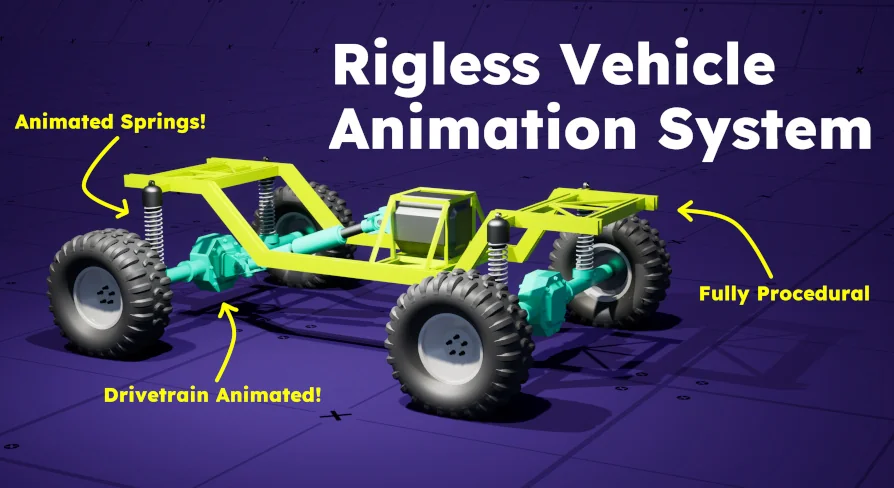
One of the central appeals of RKVA is that it requires no pre-rigging. Vehicles can be assembled from static meshes. There is no need to build a skeletal rig, weight-paint wheels, or set up bone hierarchies before animation can begin. The creator describes the setup process as drag-and-drop with static meshes, and rigs or templates can be configured in minutes.
For straightforward vehicles, this is enough to get moving. For more complex suspension configurations, the system provides special animation functions. These cover components like control arms and springs, allowing builders to replicate suspension geometry that goes beyond a simple wheel-on-axle arrangement.
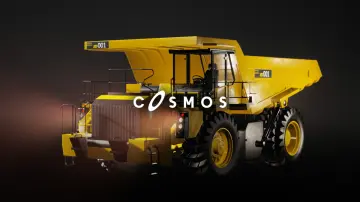
Rigid axle suspension is explicitly supported, which matters for trucks, heavy equipment, and any vehicle where the axle moves as a unit rather than each wheel operating independently. The suspension functions give the user control over how those components behave during compression and rebound.
Vehicle Types: Cars, Trucks, Buses, and Bikes
RKVA is not limited to a single vehicle category. The system is built to handle cars, trucks, buses, and bikes. Each of these has fundamentally different suspension and steering characteristics, and the modular nature of the system is what allows it to span them.
Motorcycles present a specific challenge because their suspension components, particularly the front fork and rear shock, align along a diagonal line of compression rather than a purely vertical one. The system can align suspension components to accurately reflect that compression line. This means a bike built in RKVA can have its springs oriented correctly rather than faked with a vertical approximation.
Buses and trucks benefit from the rigid axle support mentioned earlier. Cars can use simpler suspension setups or more complex ones depending on the needs of the shot. The system does not enforce a single vehicle archetype.
Runtime and Editor Animation Support
RKVA supports animation changes both during runtime and in the editor. This is a meaningful distinction. Editor-side animation is standard for cinematic workflows where an animator sets keys, scrubs the timeline, and iterates. Runtime support means vehicle motion can be responsive to game logic or user input while the application is running.
For interactive projects, this opens the possibility of vehicles that adjust their behavior based on conditions in the scene. The procedural nature of the system means the vehicle's response is always calculated from current inputs rather than played back from a pre-baked sequence.
Drive Mode Without a Physics System
RKVA includes a drive mode, which is notable because the system is explicitly not a physics solution. The question of how a non-physics system can support driving is answered by the kinematic core. Driving functionality is baked into the system through the kinematics, and enabling it requires very little modification from the animation setup.
This drive mode comes with two clear limitations. It only works on continuous surfaces, and it does not have collision. These constraints define where drive mode is practical. It is suited for flat, uninterrupted ground where the vehicle does not need to react to obstacles or terrain deviations. It is not a substitute for a full physics-based driving simulator.
For scenes where a vehicle needs to move under user or AI control across a clean surface, drive mode provides that capability without leaving the kinematic framework. For scenes with complex terrain, obstacles, or the need for collision response, the spline-based animation mode remains the primary tool.
Who Benefits Most from RKVA
RKVA is built for creators who need precise vehicle motion without the overhead of skeletal rigging or the unpredictability of physics simulation. Cinematic animators working on trailers, cutscenes, or visualization sequences can keyframe vehicles along splines with full control over suspension and steering modifier variables.
Interactive developers who need vehicles to follow dependable paths at runtime, or who want a lightweight drive mode on continuous surfaces, can use the procedural core without introducing a full physics layer. Teams working across automotive, industrial, and general vehicle categories can build cars, trucks, buses, and bikes using the same modular system, adjusting suspension complexity as the shot demands.
The rigless, static-mesh workflow makes it practical for solo developers and small teams without a dedicated rigger. The drag-and-drop setup, combined with special animation functions for control arms and springs, gives enough depth for detailed suspension work when needed. Version 1.0.5 is the current release, with a basic template pack and documentation available for reference.
 Animations
 Procedural Systems
 Engine Tools
 Cars & Trucks