"7977b3847c3127c7"{"id":"1000398","slug":"renovate-vehicle-framework","title":"Renovate: Vehicle Framework","category":"Racing","engine":"5.3+","assetVersion":"","engineVersion":"Engine Version: 5.3+","tag":"Racing","accent":"blue","visual":"mech","summary":"A comprehensive vehicle system featuring realistic physics, racing mechanics, modular customization, and native character integration for Unreal Engine projects","platform":"Unreal Engine","publishedAt":"2026-07-07T15:36:06.344Z","updatedAt":"2026-07-07T15:36:06.344Z","sourceNotes":[],"fileContents":[],"compatibility":["Unreal Engine","Engine Version: 5.3+"],"featuredImage":{"alt":"Renovate: Vehicle Framework","src":"/wp-content/uploads/published/2026/07/77997604f9b6-d610b20a-82bf-4f8b-bf46-43c5114e0798-1f9b5174b2.webp"},"hasDownloadLink":true,"downloads":1,"terms":[{"taxonomy":"category","slug":"racing","name":"Racing"}],"galleryImages":[{"src":"/wp-content/uploads/published/2026/07/b8358db04b63-03881250-d67a-48b9-83d9-7ea1df6e2c9d-1aa56677a6.webp","alt":"Renovate: Vehicle Framework"},{"src":"/wp-content/uploads/published/2026/07/597a63a42bcc-4d3bb8b6-5b11-4e19-96d0-869e11b2a019-85a2c59b68.webp","alt":"Renovate: Vehicle Framework"},{"src":"/wp-content/uploads/published/2026/07/40166a3c0c4c-e15b386c-7ea1-4400-b5b0-8d091cf6b85d-97bcb39e93.webp","alt":"Renovate: Vehicle Framework"},{"src":"/wp-content/uploads/published/2026/07/9d14cf52b102-a9440009-2315-437a-9878-b43cfa22654d-b2232fd4c4.webp","alt":"Renovate: Vehicle Framework"},{"src":"/wp-content/uploads/published/2026/07/265c9bbcb9cb-23ee4c34-a9c4-41a4-8232-7eb778b4a98a-0f25abed3f.webp","alt":"Renovate: Vehicle Framework"},{"src":"/wp-content/uploads/published/2026/07/9bc3fd5af680-2e8b3917-d3ff-4d0a-a709-1a3d4fdf97c1-b5325df6d7.webp","alt":"Renovate: Vehicle Framework"},{"src":"/wp-content/uploads/published/2026/07/f79e85ef02a1-f1e13a27-9554-49b1-b641-5323aaa9dfa0-3480aa91c0.webp","alt":"Renovate: Vehicle Framework"},{"src":"/wp-content/uploads/published/2026/07/fcdcfd90e127-c591a9ae-af63-40a5-9862-dc5444585d57-bfb14a5534.webp","alt":"Renovate: Vehicle Framework"},{"src":"/wp-content/uploads/published/2026/07/89362511c05d-cae91ebf-c8eb-41a2-8fe0-267d6f95cbe6-8cca0293c0.webp","alt":"Renovate: Vehicle Framework"},{"src":"/wp-content/uploads/published/2026/07/5be19bcfc160-3efc1f4c-4dc1-433e-a1e5-e04e89a4e99f-fd1adb3269.webp","alt":"Renovate: Vehicle Framework"}],"accessPanel":{"kind":"resource","title":"Download this resource","eyebrow":"Free Download","message":"Log in or create a free account to start your download.","fileName":"RenovateVehicleFramework.7z","safetyNote":"Resources are manually reviewed before listing to improve quality and reduce obvious risks.","actionLabel":"Download Free","resourceType":"Resource archive"},"contentHtml":"\u003cp\u003eImplementing Renovate: Vehicle Framework v1.5 begins with its foundational reliance on Epic's industry-standard physics systems. By utilizing the ChaosVehiclePlugin alongside PhysXVehicles, developers can establish a stable, realistic physics baseline for their automotive projects. The setup process is streamlined for character integration, offering native compatibility with characters built on the Advanced Locomotion System (ALS). For combat-oriented or RPG projects, the framework is also easily integrable with the Ascent Combat Framework (ACF). Developers can immediately start testing their driving logic within a provided Stylized Template Environment, choosing from six distinct vehicle templates to establish the handling and scale of their fleet.\u003c/p\u003e \u003ch2\u003eRigging and Physics Customization in the Framework\u003c/h2\u003e\n\u003cp\u003eOnce the baseline vehicle is spawned in the engine, developers can delve into the Advanced Rig provided by the system. This rig supports complex physical interactions, most notably brokable constraints equipped with thresholded auto-opening. This specific feature allows vehicle parts, such as doors or hoods, to react dynamically to physical stress, swinging open automatically when impact forces exceed predefined thresholds. The realistic physics simulation extends to the ground beneath the tires, utilizing specific physics materials designed to simulate different levels of friction across varied terrain.\u003c/p\u003e \u003ch2\u003eDriving Mechanics and Control Systems\u003c/h2\u003e\n\u003cp\u003eThe driving experience is governed by a suite of interconnected gameplay mechanics that dictate vehicle performance and survival. Vehicles are equipped with active fuel, health, and turbo systems. As fuel depletes, the engine physically reacts; the vehicle will sputter for a while when out of gas, giving players a brief mechanical warning before coming to a complete halt. During high-speed maneuvers, a smart automatic downshift system manages the gear transitions to maintain optimal engine RPM. If a maneuver goes wrong and a vehicle ends up on its roof, a safe roll mechanic provides the ability to flip the car back onto its wheels, ensuring gameplay is not permanently interrupted by a single crash.\u003c/p\u003e \u003ch2\u003eCharacter Integration and In-Car Animations\u003c/h2\u003e\n\u003cp\u003eIntegrating characters into the vehicles involves a robust set of driver and passenger systems. The framework includes an InCar AnimSet, providing 18 specific animations and a dedicated Animation Blueprint to handle steering, shifting, and idle movements. Characters utilize an IK system combined with passenger replication to ensure hands and feet align correctly with the vehicle's interior controls across a network. The system supports left-hand drive configurations and allows for seamless transitions between a true first-person perspective from behind the wheel and a traditional third-person view. In the event of a catastrophic crash or specific gameplay triggers, the framework supports character ragdoll physics, throwing the driver or passengers into a physically simulated state.\u003c/p\u003e \u003ch2\u003eStyling Vehicles with Master Materials and Palettes\u003c/h2\u003e\n\u003cp\u003eVisual customization is handled through a comprehensive Color Palette System that allows players or developers to change, save, and load specific vehicle colors at runtime. The framework includes 10 premade color palettes to accelerate the styling process. The overarching visual fidelity is controlled by a Master Material equipped with precise PBR controls, Fresnel adjustments, and Ambient Occlusion (AO) overlays. Beyond the exterior paint, the framework includes detailed internal and external animations, such as moving dashboard needles that react to speed and RPM, and a spinning engine fan animation. Emissive materials are tied directly to the vehicle's lighting systems, illuminating headlights and taillights dynamically based on player input or environmental conditions.\u003c/p\u003e \u003ch2\u003eConfiguring the Racing System and Gameplay Loops\u003c/h2\u003e\n\u003cp\u003eFor developers building competitive game modes, the framework includes a complete Racing System. This system tracks high scores for races and utilizes a drift points calculation mechanic to reward players for sustained slides around corners. The racing environment can be populated with AI opponents to challenge the player, or configured for local multiplayer sessions. To build out the tracks and surrounding world, developers can utilize five circuit spline meshes and 21 environmental static meshes. The world can be further populated using specialized blueprints, including a Crowd Blueprint to simulate trackside spectators and a Gas Station Blueprint to interact with the vehicle's active fuel system.\u003c/p\u003e \u003ch2\u003eCameras, User Interfaces, and Production Readiness\u003c/h2\u003e\n\u003cp\u003eCamera behavior is managed by a Smart Camera Manager designed to handle the fast-paced movement of vehicles. It includes specific controls for third-person (TPP) camera distance and TPP camera inversion, allowing players to customize their trailing view. The player experience is further supported by a complete user interface that features automatic control device recognition, swapping out input prompts based on what peripheral the player is using. This UI is constructed using 12 provided UI textures and a massive library of 201 control icons provided by MentalCheckpoint.\u003c/p\u003e\n\u003cp\u003eTo enhance the physical feedback of the vehicles, the framework triggers specific audio and visual effects based on gameplay states. It relies on five distinct particle systems to generate hit particles upon impact, tire marks and smoke during drifts or hard braking, and engine smoke when the vehicle's health is compromised. The audio landscape is fleshed out with 32 sounds and 3 sound cues. The entire framework is designed to be cinematic friendly, allowing developers to record complex driving actions and crashes directly using the engine's TakeRecorder. For long-term project maintenance and scalability, the underlying logic is built with extensive commented code, ensuring teams can modify and expand the systems efficiently as production demands.\u003c/p\u003e\n\n\u003ch2\u003eExplore Similar Assets\u003c/h2\u003e\n\u003cul\u003e\n\u003cli\u003e\u003ca href=\"https://3dcghub.com/drivable-cars-basic-vehicle-system/\" title=\"Drivable Cars: Basic Vehicle System\"\u003eDrivable Cars: Basic Vehicle System\u003c/a\u003e\u003c/li\u003e\n\u003cli\u003e\u003ca href=\"https://3dcghub.com/hoverbike-system/\" title=\"Hoverbike System\"\u003eHoverbike System\u003c/a\u003e\u003c/li\u003e\n\u003cli\u003e\u003ca href=\"https://3dcghub.com/real-shape-shifting-mesh-morph-system/\" title=\"Real Shape Shifting - Mesh Morph System\"\u003eReal Shape Shifting - Mesh Morph System\u003c/a\u003e\u003c/li\u003e\n\u003cli\u003e\u003ca href=\"https://3dcghub.com/easy-flight-model/\" title=\"Easy Flight Model\"\u003eEasy Flight Model\u003c/a\u003e\u003c/li\u003e\n\u003cli\u003e\u003ca href=\"https://3dcghub.com/modern-rpg-bundle-v7-0-1/\" title=\"Modern RPG BUNDLE v7.0.1\"\u003eModern RPG BUNDLE v7.0.1\u003c/a\u003e\u003c/li\u003e\n\u003c/ul\u003e","contentTextLength":6145,"navigation":{"current":1251,"total":3510,"previous":{"id":"1000399","slug":"robot-13","title":"Robot 13","category":"Mechanical \u0026 Robots","platform":"Unreal Engine","updatedAt":"2026-07-07T15:42:38.985Z"},"next":{"id":"1000397","slug":"realistic-rabbit","title":"Realistic Rabbit","category":"Characters \u0026 Creatures","platform":"Unreal Engine","updatedAt":"2026-07-07T15:27:45.915Z"}},"relatedResources":[{"id":"1001254","slug":"procedural-vehicles-sedan","title":"Procedural Vehicles - Sedan","category":"Racing","engine":"5.0+","assetVersion":"","engineVersion":"Engine Version: 5.0+","tag":"Racing","accent":"blue","visual":"mech","summary":"Integrate drivable, destructible procedural sedans with Chaos physics, skeletal interior rigging, foliage tool painting, and single draw-call proxies.","platform":"Unreal Engine","publishedAt":"2026-09-23T15:44:32.894Z","updatedAt":"2026-09-23T15:44:32.894Z","sourceNotes":[],"fileContents":[],"compatibility":["Unreal Engine","Engine Version: 5.0+"],"featuredImage":{"alt":"Procedural Vehicles - Sedan","src":"/wp-content/uploads/published/2026/09/c41740f12313-412268c7-30f8-4828-9e69-2ba52862770a-04f9f1bdb3.webp"},"hasDownloadLink":true,"downloads":2},{"id":"5005","slug":"drivable-cars-basic-vehicle-system","title":"Drivable Cars: Basic Vehicle System","category":"Cars \u0026 Trucks","engine":"5.0+","assetVersion":"Engine version: 5.0+","engineVersion":"4.16","tag":"Cars \u0026 Trucks","accent":"blue","visual":"luts","summary":"Build your game's vehicle mechanics with this basic drivable cars framework for UE5. Includes 3 rigged models, interactive dashboards, and core driving physics.","platform":"Unreal Engine","publishedAt":"2026-02-14T17:20:23.000Z","updatedAt":"2026-04-19T15:57:02.000Z","sourceNotes":[],"fileContents":[],"compatibility":["Unreal Engine"],"featuredImage":{"alt":"Drivable Cars: Basic Vehicle System","src":"https://3dcghub.com/wp-content/uploads/2026/02/7d41473f-b8d1-438e-a409-2a0f1d6337fb.webp"},"hasDownloadLink":true,"downloads":1},{"id":"5131","slug":"hoverbike-system","title":"Hoverbike System","category":"Vehicles \u0026 Transportation","engine":"4.26+,5.0+","assetVersion":"Engine version: 4.26+,5.0+","engineVersion":"4.12","tag":"Vehicles","accent":"blue","visual":"city","summary":"Build futuristic racing games with the Hoverbike System for Unreal Engine. Includes advanced physics, modular materials, and a custom rider Blueprint framework.","platform":"Unreal Engine","publishedAt":"2026-02-14T17:49:31.000Z","updatedAt":"2026-04-19T15:57:01.000Z","sourceNotes":[],"fileContents":[],"compatibility":["Unreal Engine"],"featuredImage":{"alt":"Hoverbike System","src":"https://3dcghub.com/wp-content/uploads/2026/02/c6aeffca-45e5-4c56-add9-9b3ec46b75b6.webp"},"hasDownloadLink":true,"downloads":0}]}
Racing
Renovate: Vehicle Framework
A comprehensive vehicle system featuring realistic physics, racing mechanics, modular customization, and native character integration for Unreal Engine projects
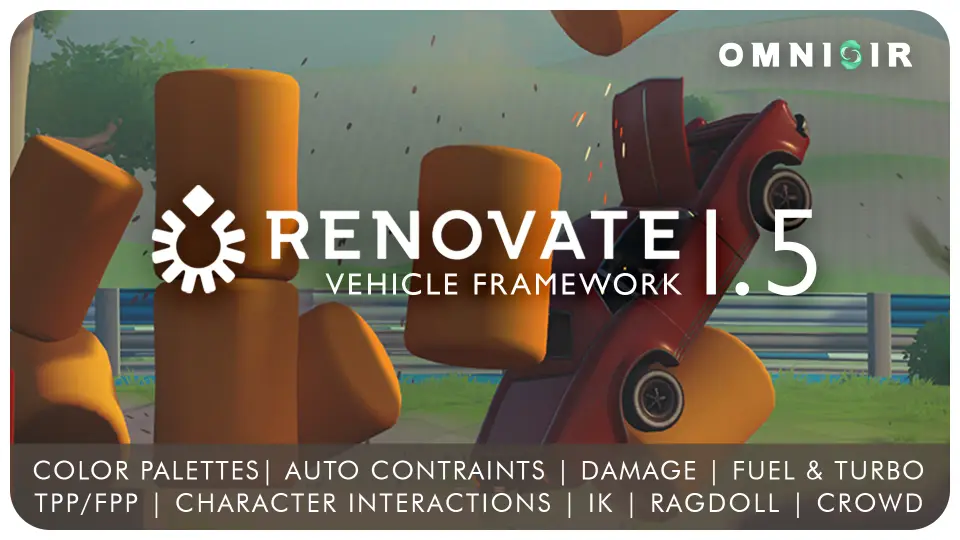
Implementing Renovate: Vehicle Framework v1.5 begins with its foundational reliance on Epic's industry-standard physics systems. By utilizing the ChaosVehiclePlugin alongside PhysXVehicles, developers can establish a stable, realistic physics baseline for their automotive projects. The setup process is streamlined for character integration, offering native compatibility with characters built on the Advanced Locomotion System (ALS). For combat-oriented or RPG projects, the framework is also easily integrable with the Ascent Combat Framework (ACF). Developers can immediately start testing their driving logic within a provided Stylized Template Environment, choosing from six distinct vehicle templates to establish the handling and scale of their fleet.
Rigging and Physics Customization in the Framework
Once the baseline vehicle is spawned in the engine, developers can delve into the Advanced Rig provided by the system. This rig supports complex physical interactions, most notably brokable constraints equipped with thresholded auto-opening. This specific feature allows vehicle parts, such as doors or hoods, to react dynamically to physical stress, swinging open automatically when impact forces exceed predefined thresholds. The realistic physics simulation extends to the ground beneath the tires, utilizing specific physics materials designed to simulate different levels of friction across varied terrain.
Driving Mechanics and Control Systems
The driving experience is governed by a suite of interconnected gameplay mechanics that dictate vehicle performance and survival. Vehicles are equipped with active fuel, health, and turbo systems. As fuel depletes, the engine physically reacts; the vehicle will sputter for a while when out of gas, giving players a brief mechanical warning before coming to a complete halt. During high-speed maneuvers, a smart automatic downshift system manages the gear transitions to maintain optimal engine RPM. If a maneuver goes wrong and a vehicle ends up on its roof, a safe roll mechanic provides the ability to flip the car back onto its wheels, ensuring gameplay is not permanently interrupted by a single crash.
Character Integration and In-Car Animations
Integrating characters into the vehicles involves a robust set of driver and passenger systems. The framework includes an InCar AnimSet, providing 18 specific animations and a dedicated Animation Blueprint to handle steering, shifting, and idle movements. Characters utilize an IK system combined with passenger replication to ensure hands and feet align correctly with the vehicle's interior controls across a network. The system supports left-hand drive configurations and allows for seamless transitions between a true first-person perspective from behind the wheel and a traditional third-person view. In the event of a catastrophic crash or specific gameplay triggers, the framework supports character ragdoll physics, throwing the driver or passengers into a physically simulated state.
Styling Vehicles with Master Materials and Palettes
Visual customization is handled through a comprehensive Color Palette System that allows players or developers to change, save, and load specific vehicle colors at runtime. The framework includes 10 premade color palettes to accelerate the styling process. The overarching visual fidelity is controlled by a Master Material equipped with precise PBR controls, Fresnel adjustments, and Ambient Occlusion (AO) overlays. Beyond the exterior paint, the framework includes detailed internal and external animations, such as moving dashboard needles that react to speed and RPM, and a spinning engine fan animation. Emissive materials are tied directly to the vehicle's lighting systems, illuminating headlights and taillights dynamically based on player input or environmental conditions.
Configuring the Racing System and Gameplay Loops
For developers building competitive game modes, the framework includes a complete Racing System. This system tracks high scores for races and utilizes a drift points calculation mechanic to reward players for sustained slides around corners. The racing environment can be populated with AI opponents to challenge the player, or configured for local multiplayer sessions. To build out the tracks and surrounding world, developers can utilize five circuit spline meshes and 21 environmental static meshes. The world can be further populated using specialized blueprints, including a Crowd Blueprint to simulate trackside spectators and a Gas Station Blueprint to interact with the vehicle's active fuel system.
Cameras, User Interfaces, and Production Readiness
Camera behavior is managed by a Smart Camera Manager designed to handle the fast-paced movement of vehicles. It includes specific controls for third-person (TPP) camera distance and TPP camera inversion, allowing players to customize their trailing view. The player experience is further supported by a complete user interface that features automatic control device recognition, swapping out input prompts based on what peripheral the player is using. This UI is constructed using 12 provided UI textures and a massive library of 201 control icons provided by MentalCheckpoint.
To enhance the physical feedback of the vehicles, the framework triggers specific audio and visual effects based on gameplay states. It relies on five distinct particle systems to generate hit particles upon impact, tire marks and smoke during drifts or hard braking, and engine smoke when the vehicle's health is compromised. The audio landscape is fleshed out with 32 sounds and 3 sound cues. The entire framework is designed to be cinematic friendly, allowing developers to record complex driving actions and crashes directly using the engine's TakeRecorder. For long-term project maintenance and scalability, the underlying logic is built with extensive commented code, ensuring teams can modify and expand the systems efficiently as production demands.
 Racing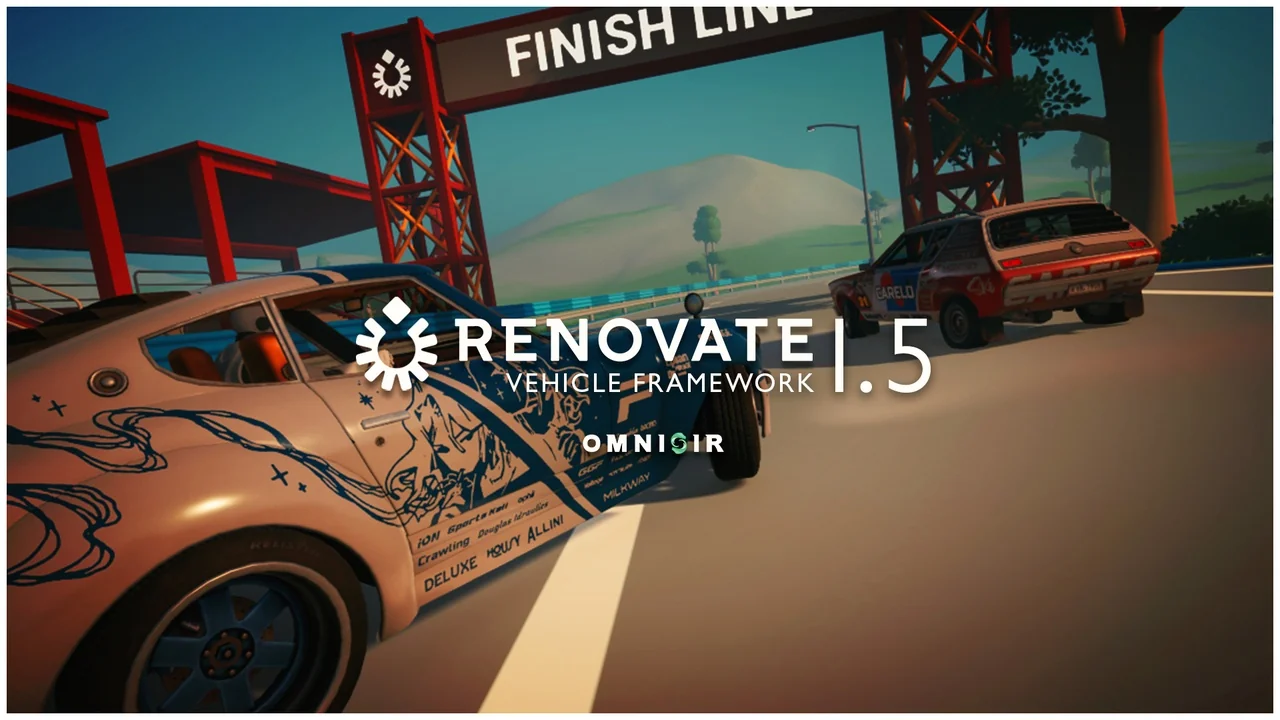
 Racing
 Cars & Trucks
 Vehicles