"c14ff6bd758dadb1"{"id":"1001751","slug":"procedural-climbing-with-control-rig","title":"Procedural Climbing with Control Rig","category":"Gameplay Features","engine":"5.4+","assetVersion":"","engineVersion":"Engine Version: 5.4+","tag":"Gameplay Features","accent":"blue","visual":"mech","summary":"Explore Procedural Climbing with Control Rig, an animation-free climbing system built entirely in Blueprints using Full Body IK in Unreal Engine.","platform":"Unreal Engine","publishedAt":"2026-10-20T02:56:44.210Z","updatedAt":"2026-10-20T02:56:44.210Z","sourceNotes":[],"fileContents":[],"compatibility":["Unreal Engine","Engine Version: 5.4+"],"featuredImage":{"alt":"Procedural Climbing with Control Rig","src":"/wp-content/uploads/published/2026/10/cd95fe573438-221256f7-22ff-4c02-8995-df4bcf97c4c0-e2111d1953.webp"},"hasDownloadLink":true,"downloads":0,"terms":[{"taxonomy":"category","slug":"gameplay-features","name":"Gameplay Features"}],"galleryImages":[{"src":"/wp-content/uploads/published/2026/10/933b461f6118-251087fb-881d-4b9d-9e13-3a526ef287b3-e1a47158c0.webp","alt":"Procedural Climbing with Control Rig"},{"src":"/wp-content/uploads/published/2026/10/cf390cf39359-37e00a6a-0bd5-4c12-bf38-41754dddfd17-0ddede8091.webp","alt":"Procedural Climbing with Control Rig"},{"src":"/wp-content/uploads/published/2026/10/474bff3930c2-986276d7-bcf6-4eab-b768-8ba43065c733-83128754ff.webp","alt":"Procedural Climbing with Control Rig"},{"src":"/wp-content/uploads/published/2026/10/a8eb2b46852f-7c47c2d7-7adf-4bd7-82e2-5c5c0c5f15e4-6bdbe3f8db.webp","alt":"Procedural Climbing with Control Rig"},{"src":"/wp-content/uploads/published/2026/10/51a26ff026b7-64b58539-6cdf-42a2-a597-64011cd8b558-d8bd3fe975.webp","alt":"Procedural Climbing with Control Rig"},{"src":"/wp-content/uploads/published/2026/10/1ebc20db73e9-8b13a169-0177-45df-9668-5a4ad7a0d957-2ce7d89714.webp","alt":"Procedural Climbing with Control Rig"},{"src":"/wp-content/uploads/published/2026/10/1319611338e6-489d7dc4-9954-469e-93b3-604c74efe854-e1ff9a955e.webp","alt":"Procedural Climbing with Control Rig"},{"src":"/wp-content/uploads/published/2026/10/4d706a74c6da-4bdaaa1a-de96-4dff-9c91-3a64bcc19501-4559409741.webp","alt":"Procedural Climbing with Control Rig"},{"src":"/wp-content/uploads/published/2026/10/03c754dee2f6-99ccefd7-587f-445e-b29b-ff3171e48ade-6298a3eeae.webp","alt":"Procedural Climbing with Control Rig"}],"accessPanel":{"kind":"resource","title":"Download this resource","eyebrow":"Free Download","message":"Log in or create a free account to start your download.","fileName":"Content.7z","safetyNote":"Resources are manually reviewed before listing to improve quality and reduce obvious risks.","actionLabel":"Download Free","resourceType":"Resource archive"},"contentHtml":"\u003cp\u003eWhen a character approaches an uneven rock face or a curved architectural wall, standard traversal frameworks usually search for tagged climb nodes or predetermined ledge meshes. Procedural Climbing with Control Rig takes a different technical route by discarding authored animation clips entirely. Instead of blending between pre-baked hand plants, idle hangs, and shimmy cycles, the system computes full body placement dynamically through Full Body IK logic. The character reacts directly to the contours of world geometry, positioning limbs and torso according to the immediate physical forms in the environment.\u003c/p\u003e \u003ch2\u003eEliminating Keyframe Animations with Full Body IK and Control Rig Logic\u003c/h2\u003e\n\u003cp\u003eTraditional climbing systems demand extensive animation libraries. A production typically requires separate animations for hanging, bracing, cornering around convex edges, reaching into crevices, and transitioning between differing handholds. Procedural Climbing with Control Rig bypasses this requirement by shifting the workload onto procedural bone solving within Unreal Engine's Control Rig.\u003c/p\u003e \u003cp\u003eBy relying completely on Full Body IK (FBIK), the rig identifies contact surfaces and solves the entire skeletal hierarchy in real time. The solver places hands, feet, pelvis, and spine based on surface targets rather than playback time on an animation track. This zero-animation approach produces lifelike, organic climbing postures that change continuously as the player navigates across varying geometry. Because the body reacts mathematically to collision contacts rather than cycling through looping keyframes, the character avoids the rigid, repetitive poses typical of canned climbing sets.\u003c/p\u003e \u003ch2\u003eThe Tripartite Blueprint Architecture\u003c/h2\u003e\n\u003cp\u003eThe system is organized into three distinct operational assets, avoiding compiled code completely in favor of a pure Blueprint workflow. Developers can inspect, modify, and extend the system without maintaining C++ codebases or compiling external dependencies.\u003c/p\u003e \u003cp\u003eThe primary movement calculations run through a dedicated Character Blueprint. This Blueprint manages the character's movement across world actors, detecting surfaces in the scene, evaluating spatial relationships between the character and surrounding geometry, and coordinating continuous positioning as inputs steer the character over the surface.\u003c/p\u003e \u003cp\u003eData from the movement framework flows directly into an Animation Blueprint. This asset references variables established in the default Third Person Character provided by Unreal Engine. By relying on variables familiar from the standard third-person template, the Animation Blueprint interfaces cleanly with standard player input, velocity tracking, and movement state variables, feeding these values downstream to the rig.\u003c/p\u003e \u003cp\u003eThe final layer is the Control Rig itself. Receiving inputs from the Character Blueprint and the Animation Blueprint, the Control Rig calculates limb reaches, foot bracing, and torso orientation. The rig applies the Full Body IK solver directly to the skeletal structure, translating mathematical contact positions into believable character poses frame by frame.\u003c/p\u003e \u003ch2\u003eSurface Geometry Rules: Rounded Edges and 100-Degree Limits\u003c/h2\u003e\n\u003cp\u003eBecause the system solves poses procedurally against collision shapes, the quality of the visual result depends directly on the configuration of the climbing surface. The solver adapts exceptionally well to organic, sweeping surfaces, making it a reliable option for natural environs like cliffs, bluffs, boulders, and smoothed terrain features.\u003c/p\u003e \u003cp\u003eThe Full Body IK logic operates most reliably under specific geometric parameters:\u003c/p\u003e\n\u003cul\u003e \u003cli\u003e\u003cstrong\u003eRounded edges and fillets:\u003c/strong\u003e The solver easily steps around gentle contours, providing fluid movement transitions across curving walls and rounded ledges.\u003c/li\u003e \u003cli\u003e\u003cstrong\u003eObtuse surface angles:\u003c/strong\u003e Angles wider than 90 degrees allow the Full Body IK nodes to maintain realistic limb extensions without pinching joints or forcing hyper-rotations on the spine.\u003c/li\u003e \u003cli\u003e\u003cstrong\u003eAbsence of deep cavities:\u003c/strong\u003e Continuous, unbroken geometry allows surface traces to return predictable contact targets for all limbs simultaneously.\u003c/li\u003e\n\u003c/ul\u003e \u003cp\u003eConversely, abrupt geometric irregularities will compromise the solver. Sharp acute corners—specifically angles tighter than 100 degrees—break the natural reach limits of the solver, generating unnatural joint snapping or inverted bone transforms. Spikes protruding from the mesh disrupt the placement logic, leaving hands and feet unable to find coherent contact planes. Similarly, holes, deep cracks, and severe crevices cause limbs to penetrate the mesh or reach into occluded internal spaces, resulting in broken character silhouettes. Keeping terrain geometry continuous and softly beveled maintains solver stability.\u003c/p\u003e \u003ch2\u003eRapid Level Design and Educational Rig Construction\u003c/h2\u003e\n\u003cp\u003eIn iterative level construction, rigid climbing setups slow down blocking and white-boxing. Designers often have to align static meshes with precision so that snapping markers match animation roots, or they must manually place climbing volumes over every climbable ledge. Procedural Climbing with Control Rig removes this overhead during early and intermediate world design. Level designers can sculpt landscape geometry, adjust procedural rock formations, and test traversable spaces immediately, trusting the Full Body IK to resolve character contact across any face that satisfies the angle constraints.\u003c/p\u003e \u003cp\u003eBeyond its utility during spatial blockouts, the asset is structured as an educational tool for technical animators and technical designers looking to understand Control Rig. The node graphs contain thorough inline comments breaking down how traces, vectors, and transforms translate into solver inputs. The developer has also implemented multiple alternate methods within the graphs, documenting different structural approaches to solve procedural climbing challenges. This lets teams compare alternative procedural approaches side by side within the same graph structure.\u003c/p\u003e \u003ch2\u003eIntegration and Character Compatibility\u003c/h2\u003e\n\u003cp\u003eThe package is configured with native compatibility for ProtoRobo, allowing developers working with that asset base to integrate the procedural locomotion framework without rebuilding bone mappings from scratch. Because the entire pipeline builds on the standard Third Person Character variables and uses zero compiled code, teams can adopt the Blueprints into existing projects without restructuring their underlying gameplay architecture, provided the target skeletal hierarchy maps correctly to the Full Body IK solver chains.\u003c/p\u003e\n\n\u003ch2\u003eRelated Resources Worth Checking\u003c/h2\u003e\n\u003cul\u003e\n\u003cli\u003e\u003ca href=\"https://3dcghub.com/cine-cam/\" title=\"Cine Cam\"\u003eCine Cam\u003c/a\u003e\u003c/li\u003e\n\u003cli\u003e\u003ca href=\"https://3dcghub.com/ultimate-character-customization/\" title=\"Ultimate Character Customization\"\u003eUltimate Character Customization\u003c/a\u003e\u003c/li\u003e\n\u003cli\u003e\u003ca href=\"https://3dcghub.com/advanced-ladder-climbing-system/\" title=\"Advanced Ladder Climbing System\"\u003eAdvanced Ladder Climbing System\u003c/a\u003e\u003c/li\u003e\n\u003cli\u003e\u003ca href=\"https://3dcghub.com/decal-forge-v1-1-procedural-decal-generator/\" title=\"Decal Forge v1.1 - Procedural Decal Generator\"\u003eDecal Forge v1.1 - Procedural Decal Generator\u003c/a\u003e\u003c/li\u003e\n\u003cli\u003e\u003ca href=\"https://3dcghub.com/climb-and-vaulting-component-v2/\" title=\"Climb and Vaulting Component V2\"\u003eClimb and Vaulting Component V2\u003c/a\u003e\u003c/li\u003e\n\u003c/ul\u003e","contentTextLength":6700,"navigation":{"current":32,"total":3719,"previous":{"id":"1001752","slug":"procedural-vehicles-van","title":"Procedural Vehicles - Van","category":"Cars \u0026 Trucks","platform":"Unreal Engine","updatedAt":"2026-10-20T02:57:23.692Z"},"next":{"id":"1001750","slug":"people-working","title":"People Working","category":"Variety","platform":"Unreal Engine","updatedAt":"2026-10-20T02:55:41.935Z"}},"relatedResources":[{"id":"1001299","slug":"cine-cam","title":"Cine Cam","category":"Gameplay Features","engine":"5.0+","assetVersion":"","engineVersion":"Engine Version: 5.0+","tag":"Gameplay Features","accent":"blue","visual":"mech","summary":"Explore Cine Cam for Unreal Engine 5, a runtime virtual camera rig featuring four focus modes, aperture control, customizable keybindings, and smooth movement.","platform":"Unreal Engine","publishedAt":"2026-10-02T06:01:01.399Z","updatedAt":"2026-10-02T06:01:01.399Z","sourceNotes":[],"fileContents":[],"compatibility":["Unreal Engine","Engine Version: 5.0+"],"featuredImage":{"alt":"Cine Cam","src":"/wp-content/uploads/published/2026/10/a8f5ad26ef61-c8a95d6e-4c3e-4721-b9bf-9c2e603902c7-ed5f883bed.webp"},"hasDownloadLink":true,"downloads":0},{"id":"1001023","slug":"ultimate-character-customization","title":"Ultimate Character Customization","category":"Gameplay Features","engine":"5.1+","assetVersion":"","engineVersion":"Engine Version: 5.1+","tag":"Gameplay Features","accent":"blue","visual":"character","summary":"A blueprint-driven character customization system that works with modular and single meshes, uses data tables for widgets, GUID-based saving, and a control rig","platform":"Unreal Engine","publishedAt":"2026-08-23T05:28:06.853Z","updatedAt":"2026-08-23T05:28:06.853Z","sourceNotes":[],"fileContents":[],"compatibility":["Unreal Engine","Engine Version: 5.1+"],"featuredImage":{"alt":"Ultimate Character Customization","src":"/wp-content/uploads/published/2026/08/8b4963c7b4d3-6efa6ff7-2fc9-4699-a6b7-6068455ff61b-cf538c296f.webp"},"hasDownloadLink":true,"downloads":1},{"id":"1001032","slug":"action-adventure-movement-system","title":"Action-Adventure Movement System","category":"Gameplay Features","engine":"5.3+","assetVersion":"Asset Version: 1.3.3","engineVersion":"Engine Version: 5.3+","tag":"Gameplay Features","accent":"blue","visual":"mech","summary":"A 100% Blueprint Unreal Engine framework with 475+ animations covering parkour, climbing, swimming, grappling, ropes, rail grinding, interactions, and multiplay","platform":"Unreal Engine","publishedAt":"2026-08-23T13:56:31.671Z","updatedAt":"2026-08-23T13:56:31.671Z","sourceNotes":[],"fileContents":[],"compatibility":["Unreal Engine","Asset Version: 1.3.3","Engine Version: 5.3+"],"featuredImage":{"alt":"Action-Adventure Movement System","src":"/wp-content/uploads/published/2026/08/f6ca4747d539-f55a9c3a-5939-4fc7-b9c9-20258a3197bf-86a0ba7a37.webp"},"hasDownloadLink":true,"downloads":12}]}
Gameplay Features
Procedural Climbing with Control Rig
Explore Procedural Climbing with Control Rig, an animation-free climbing system built entirely in Blueprints using Full Body IK in Unreal Engine.
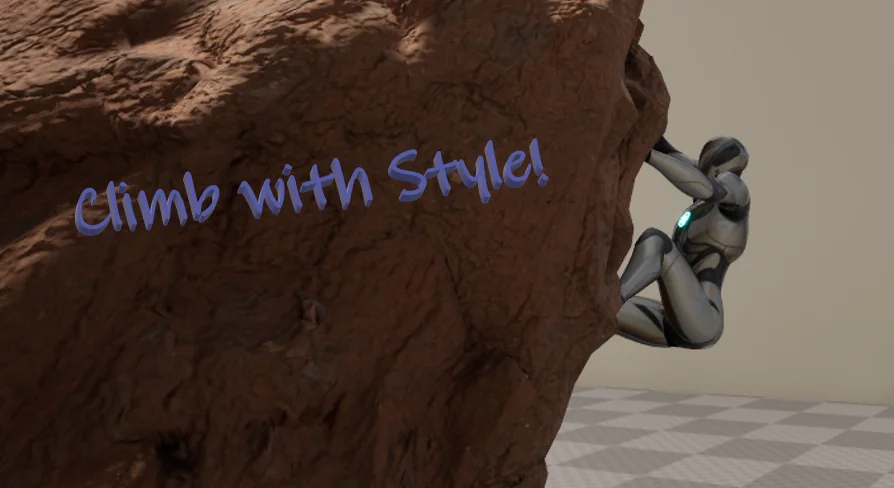
When a character approaches an uneven rock face or a curved architectural wall, standard traversal frameworks usually search for tagged climb nodes or predetermined ledge meshes. Procedural Climbing with Control Rig takes a different technical route by discarding authored animation clips entirely. Instead of blending between pre-baked hand plants, idle hangs, and shimmy cycles, the system computes full body placement dynamically through Full Body IK logic. The character reacts directly to the contours of world geometry, positioning limbs and torso according to the immediate physical forms in the environment.
Eliminating Keyframe Animations with Full Body IK and Control Rig Logic
Traditional climbing systems demand extensive animation libraries. A production typically requires separate animations for hanging, bracing, cornering around convex edges, reaching into crevices, and transitioning between differing handholds. Procedural Climbing with Control Rig bypasses this requirement by shifting the workload onto procedural bone solving within Unreal Engine's Control Rig.
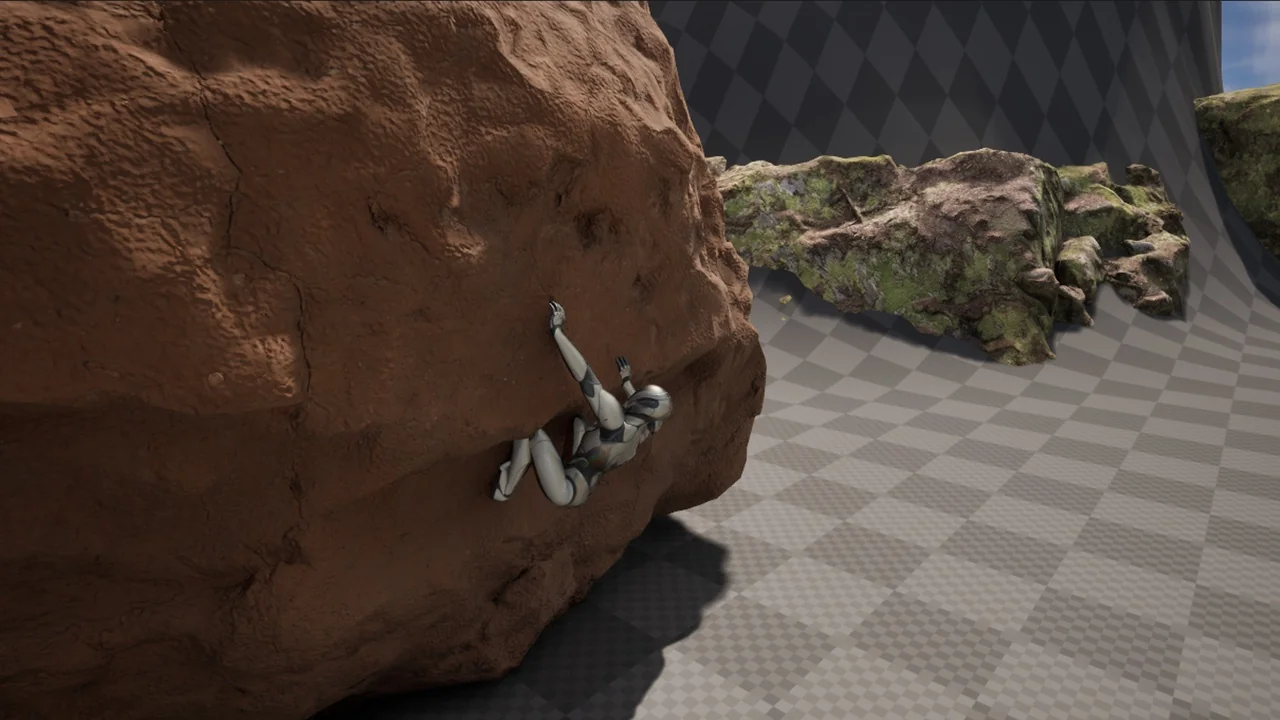
By relying completely on Full Body IK (FBIK), the rig identifies contact surfaces and solves the entire skeletal hierarchy in real time. The solver places hands, feet, pelvis, and spine based on surface targets rather than playback time on an animation track. This zero-animation approach produces lifelike, organic climbing postures that change continuously as the player navigates across varying geometry. Because the body reacts mathematically to collision contacts rather than cycling through looping keyframes, the character avoids the rigid, repetitive poses typical of canned climbing sets.
The Tripartite Blueprint Architecture
The system is organized into three distinct operational assets, avoiding compiled code completely in favor of a pure Blueprint workflow. Developers can inspect, modify, and extend the system without maintaining C++ codebases or compiling external dependencies.
The primary movement calculations run through a dedicated Character Blueprint. This Blueprint manages the character's movement across world actors, detecting surfaces in the scene, evaluating spatial relationships between the character and surrounding geometry, and coordinating continuous positioning as inputs steer the character over the surface.
Data from the movement framework flows directly into an Animation Blueprint. This asset references variables established in the default Third Person Character provided by Unreal Engine. By relying on variables familiar from the standard third-person template, the Animation Blueprint interfaces cleanly with standard player input, velocity tracking, and movement state variables, feeding these values downstream to the rig.
The final layer is the Control Rig itself. Receiving inputs from the Character Blueprint and the Animation Blueprint, the Control Rig calculates limb reaches, foot bracing, and torso orientation. The rig applies the Full Body IK solver directly to the skeletal structure, translating mathematical contact positions into believable character poses frame by frame.
Surface Geometry Rules: Rounded Edges and 100-Degree Limits
Because the system solves poses procedurally against collision shapes, the quality of the visual result depends directly on the configuration of the climbing surface. The solver adapts exceptionally well to organic, sweeping surfaces, making it a reliable option for natural environs like cliffs, bluffs, boulders, and smoothed terrain features.
The Full Body IK logic operates most reliably under specific geometric parameters:
Rounded edges and fillets: The solver easily steps around gentle contours, providing fluid movement transitions across curving walls and rounded ledges.
Obtuse surface angles: Angles wider than 90 degrees allow the Full Body IK nodes to maintain realistic limb extensions without pinching joints or forcing hyper-rotations on the spine.
Absence of deep cavities: Continuous, unbroken geometry allows surface traces to return predictable contact targets for all limbs simultaneously.
Conversely, abrupt geometric irregularities will compromise the solver. Sharp acute corners—specifically angles tighter than 100 degrees—break the natural reach limits of the solver, generating unnatural joint snapping or inverted bone transforms. Spikes protruding from the mesh disrupt the placement logic, leaving hands and feet unable to find coherent contact planes. Similarly, holes, deep cracks, and severe crevices cause limbs to penetrate the mesh or reach into occluded internal spaces, resulting in broken character silhouettes. Keeping terrain geometry continuous and softly beveled maintains solver stability.
Rapid Level Design and Educational Rig Construction
In iterative level construction, rigid climbing setups slow down blocking and white-boxing. Designers often have to align static meshes with precision so that snapping markers match animation roots, or they must manually place climbing volumes over every climbable ledge. Procedural Climbing with Control Rig removes this overhead during early and intermediate world design. Level designers can sculpt landscape geometry, adjust procedural rock formations, and test traversable spaces immediately, trusting the Full Body IK to resolve character contact across any face that satisfies the angle constraints.
Beyond its utility during spatial blockouts, the asset is structured as an educational tool for technical animators and technical designers looking to understand Control Rig. The node graphs contain thorough inline comments breaking down how traces, vectors, and transforms translate into solver inputs. The developer has also implemented multiple alternate methods within the graphs, documenting different structural approaches to solve procedural climbing challenges. This lets teams compare alternative procedural approaches side by side within the same graph structure.
Integration and Character Compatibility
The package is configured with native compatibility for ProtoRobo, allowing developers working with that asset base to integrate the procedural locomotion framework without rebuilding bone mappings from scratch. Because the entire pipeline builds on the standard Third Person Character variables and uses zero compiled code, teams can adopt the Blueprints into existing projects without restructuring their underlying gameplay architecture, provided the target skeletal hierarchy maps correctly to the Full Body IK solver chains.
 Gameplay Features
 Gameplay Features
 Gameplay Features
 Gameplay Features