"c14ff6bd758dadb1"{"id":"1001074","slug":"advanced-ladder-climbing-system","title":"Advanced Ladder Climbing System","category":"Gameplay Features","engine":"5.0+","assetVersion":"","engineVersion":"Engine Version: 5.0+","tag":"Gameplay Features","accent":"blue","visual":"mech","summary":"Advanced multiplayer ladder climbing system for UE5 with replicated Blueprint logic, slow/fast climbing, ladder sliding, and five modular ladders.","platform":"Unreal Engine","publishedAt":"2026-09-04T14:25:31.912Z","updatedAt":"2026-09-04T14:25:31.912Z","sourceNotes":[],"fileContents":[],"compatibility":["Unreal Engine","Engine Version: 5.0+"],"featuredImage":{"alt":"Advanced Ladder Climbing System","src":"/wp-content/uploads/published/2026/09/59ffeb900e40-b4243caa-17bb-4ac3-b6ec-e0814dffd788-1a4d44bd68.webp"},"hasDownloadLink":true,"downloads":4,"terms":[{"taxonomy":"category","slug":"gameplay-features","name":"Gameplay Features"}],"galleryImages":[{"src":"/wp-content/uploads/published/2026/09/6041322746d8-e099b0f8-e85d-4b91-8b72-eb8783ac11eb-daa1e03af3.webp","alt":"Advanced Ladder Climbing System"},{"src":"/wp-content/uploads/published/2026/09/c353ef0051a9-cc8cedef-3876-4292-868d-f40370064cb8-a2ef1d421e.webp","alt":"Advanced Ladder Climbing System"},{"src":"/wp-content/uploads/published/2026/09/ac581d84e83b-0f871306-672a-4969-b59a-b135d14f90bb-699365c8f6.webp","alt":"Advanced Ladder Climbing System"},{"src":"/wp-content/uploads/published/2026/09/865d73073560-3016a531-d7d1-45e8-86e0-8922e5f5dcd3-42e38e14a9.webp","alt":"Advanced Ladder Climbing System"},{"src":"/wp-content/uploads/published/2026/09/445e3b49ef2f-7a1242d3-16f8-4c25-8f56-7081f7fcd983-1251d9efd0.webp","alt":"Advanced Ladder Climbing System"},{"src":"/wp-content/uploads/published/2026/09/12e96fc8ec79-b9166da1-523d-4a66-9708-be6c2e925531-47acdf242d.webp","alt":"Advanced Ladder Climbing System"},{"src":"/wp-content/uploads/published/2026/09/e0a7bb0d8ac1-31f060ba-2fff-44b7-964d-89dc8babc8e2-d92346d04f.webp","alt":"Advanced Ladder Climbing System"},{"src":"/wp-content/uploads/published/2026/09/54f5a40e2804-8c61ae1f-f78a-40ac-89c2-ae4a2a298c66-671bdef1c6.webp","alt":"Advanced Ladder Climbing System"},{"src":"/wp-content/uploads/published/2026/09/6ca4c140f651-1824ec50-8aff-45d0-8e01-645c58aa8ac6-0a53ab3160.webp","alt":"Advanced Ladder Climbing System"},{"src":"/wp-content/uploads/published/2026/09/dfa654abc93c-c9ebe9fe-dbf3-4bb1-861a-7e766845e4f2-8ed5d63ba2.webp","alt":"Advanced Ladder Climbing System"}],"accessPanel":{"kind":"resource","title":"Download this resource","eyebrow":"Free Download","message":"Log in or create a free account to start your download.","fileName":"Advanced Ladder Climbing System v1.1.3.7z","safetyNote":"Resources are manually reviewed before listing to improve quality and reduce obvious risks.","actionLabel":"Download Free","resourceType":"Resource archive"},"contentHtml":"\u003cp\u003eVertical routes often turn a good multiplayer level into a frustrating one. When players need to reach a rooftop, cross a mezzanine, or move down into a lower zone, ladders are the simplest path, but their interactions are frequently stiff and indifferent to what is happening around them. The Advanced Ladder Climbing System takes a different approach by combining replicated Blueprint logic with meaningful movement choices: slow and fast climbing, ladder sliding, idle hand states, and jump-catch entry animations. It also includes five modular ladders that can populate a scene without forcing a designer to build the same climb again and again. For teams using Unreal Engine 5, version 5.2+ represents the full UE5 integration path, and the system’s first-person and third-person demos make its behavior easier to judge up front.\u003c/p\u003e \u003ch2\u003eA Multiplayer Blueprint That Replicates the Climb\u003c/h2\u003e\n\u003cp\u003eThe system carries the tags \"Replicated,\" \"Multiplayer,\" \"Ladder,\" and \"Blueprint,\" and those four words shape what it is. This is not a simple ladder animation that only works in a single-player context. Because the tag list says replicated, the climb logic needs to stay in sync between clients. That is why the patch trail includes a specific \"Client Collision hotfix\" in v1.1.3. Ladder climbing seems like a small interaction, but when two players approach the same ladder from different angles, small collision or transform mismatches can cause visible snapping or client prediction errors.\u003c/p\u003e\n\u003cp\u003eBeing Blueprint-driven matters for Unreal developers who build their character logic inside the editor. Rather than jumping through a C++ codebase, the climbing logic fits the same visual scripting style used by many modern UE5 projects. The listing also stresses that the system can be integrated into any project in minutes, which is a direct nod to teams that do not want to spend a week tuning a ladder interaction. The quick integration is supported by more than a code drop: documentation, asset integration tutorials, and a roadmap are available alongside the system.\u003c/p\u003e \u003ch2\u003eSlow Climbs, Fast Climbs, and the Slide Down\u003c/h2\u003e\n\u003cp\u003eThe core movement vocabulary is straightforward: \"Slow/Fast climbing movements,\" \"Ladder Sliding,\" and \"Left/Right hand Idle.\" A two-speed climb already gives the player agency in a space that rarely allows for expressive movement. Slow climbing likely fits contexts where the player is being cautious, while fast climbing keeps the pacing up when enemies are close or when the ladder is part of a speedier path. The exact input that switches between the two speeds is not listed but having both states inside one system makes level design richer than a single monotone ascent.\u003c/p\u003e\n\u003cp\u003eLadder sliding sits on the other side of the interaction. Instead of playing the climb animation in reverse, the character can slide downward, which is a useful tool for dropping out of a route quickly. The left/right hand idle is another subtle touch: when a player stops on a ladder, the hands can settle in alternate positions rather than locking into a perfectly mirrored pose. These details reduce the stiffness that plagues many ladder systems, and they were refined early in the patch history. V1.0.1 adjusted idle animation and trace length, v1.0.2 focused on slide-down animation tweaks, and v1.0.3 added jump grab and speed enter animations. That third update is particularly important because it lets the ladder interaction begin with momentum instead of a full stop. The ability to jump at a ladder and grab onto it bridges the gap between a running jump and the climb state, making the whole transition feel less like a scripted door.\u003c/p\u003e \u003ch2\u003eFive Modular Ladders and the Layout Possibilities\u003c/h2\u003e\n\u003cp\u003eGameplay systems always meet the world somewhere, and the Advanced Ladder Climbing System brings its own world-building pieces: \"5 different Modular Ladders.\" Having five ladder variants gives level designers a kit beyond one prop. A tall industrial shaft, a short maintenance route, and a wide pick-up point may each call for a different geometry, and a collection of modular ladders means those structures can be assembled from sections. This also helps match the visual rhythm of a level: a designer can repeat one style of ladder without copy-pasting the exact same model for every climbable surface.\u003c/p\u003e\n\u003cp\u003eBecause system itself is structured through climbing movement rather than static props, the presence of modular ladders suggests a close relation between the environmental asset and the interaction logic. In a Blueprint-oriented project, those ladders could be placed and wired to the same replicated climb behavior, though the available source details do not specify how much setup each ladder piece requires. What is clear is that the pack does not force teams to source a separate ladder mesh from a different library when they want to start prototyping.\u003c/p\u003e \u003ch2\u003eFirst-Person and Third-Person Demo Rooms\u003c/h2\u003e\n\u003cp\u003eThe development of the system was not limited to one camera view. Version 1.1.0 added \"FP and FP + TP Combined Character/Animation support,\" and the corresponding demo projects are available for both TPP and FPP. That is a meaningful range for a climbing asset because first-person and third-present ladders read very differently on screen. In third person, the entire body animates across the rungs; in first person, the camera has to communicate the climb through world motion and hand placement. The presence of a TPP showcase video and separate demo downloads gives studios a quick way to inspect both perspectives before deciding whether the behavior fits their character setup.\u003c/p\u003e\n\u003cp\u003eThe documentation, asset integration tutorials, and roadmap located alongside the demo links complete the package. Tutorials that walk through implementation can save a developer from tracing through graphs and animations on their own. Documentation serves as a reference for the specific replication and speed variables later during production. And a roadmap indicates that the author may continue to add features beyond the versions listed in the patch notes, though the future direction is not spelled out.\u003c/p\u003e \u003ch2\u003eReading the Patch Notes as a Production Signal\u003c/h2\u003e\n\u003cp\u003eThe patch history of the Advanced Ladder Climbing System is short but informative. V1.0.0 marks the launch. V1.0.1 adjusts trace length and idle animations. V1.0.2 smooths slide-down animations. V1.0.3 introduces jump grab and speed enter animations. V1.1.0 adds first-person and combined first-/third-person support. V1.1.2 is a small hotfix, and v1.1.3 addresses a client collision issue. Several of these releases appear to have been spaced days apart, suggesting the developer was responding to user feedback rapidly during the initial weeks after launch.\u003c/p\u003e\n\u003cp\u003eFor a multiplayer-focused system, the client collision fix at v1.1.3 is the most telling entry. Networking bugs around collision can stay hidden for a long time because they only manifest when multiple clients predict or update the ladder state at different times. The fact that the fix is called out in the patch notes gives potential users a practical signal: the climbing system is maintained with multiplayer scenarios in mind, not just polished as a single-player animation package.\u003c/p\u003e\n\u003cp\u003eWhen a team needs a ladder mechanism that can handle replicated gameplay, different ascent speeds, descending slides, and modular environment pieces in one package, the Advanced Ladder Climbing System lines up with all of those requirements. Combined with the UE5 integration path and the supporting tutorials, it is an asset built to be placed into a broader workflow rather than bolted on as a one-off animation. That leaves a climbing system that treats ladders as something players can move with, not just a vertical delay between two rooms.\u003c/p\u003e\n\n\u003ch2\u003eContinue Browsing Similar Packs\u003c/h2\u003e\n\u003cul\u003e\n\u003cli\u003e\u003ca href=\"https://3dcghub.com/action-adventure-movement-system/\" title=\"Action-Adventure Movement System\"\u003eAction-Adventure Movement System\u003c/a\u003e\u003c/li\u003e\n\u003cli\u003e\u003ca href=\"https://3dcghub.com/dynamic-parkour-trace-system/\" title=\"Dynamic Parkour Trace System\"\u003eDynamic Parkour Trace System\u003c/a\u003e\u003c/li\u003e\n\u003cli\u003e\u003ca href=\"https://3dcghub.com/gbwflowmove-high-speed-movement-system-multiplayer-ready/\" title=\"GBWFlowMove - High-speed Movement system, Multiplayer Ready!\"\u003eGBWFlowMove - High-speed Movement system, Multiplayer Ready!\u003c/a\u003e\u003c/li\u003e\n\u003cli\u003e\u003ca href=\"https://3dcghub.com/basic-locomotion-system-replicated/\" title=\"Basic Locomotion System (REPLICATED)\"\u003eBasic Locomotion System (REPLICATED)\u003c/a\u003e\u003c/li\u003e\n\u003cli\u003e\u003ca href=\"https://3dcghub.com/hyper-time-manager-system-v4/\" title=\"Hyper Time Manager System v4\"\u003eHyper Time Manager System v4\u003c/a\u003e\u003c/li\u003e\n\u003c/ul\u003e","contentTextLength":7936,"navigation":{"current":756,"total":3719,"previous":{"id":"1001075","slug":"alpine-mountains-villa","title":"Alpine Mountains Villa","category":"Towns \u0026 Villages","platform":"Unreal Engine","updatedAt":"2026-09-04T14:37:49.702Z"},"next":{"id":"1001073","slug":"wave-spawning-system","title":"Wave Spawning System","category":"Gameplay Features","platform":"Unreal Engine","updatedAt":"2026-09-03T17:33:32.619Z"}},"relatedResources":[{"id":"1001117","slug":"open-world-locomotion-system","title":"Open World Locomotion System","category":"Gameplay Features","engine":"5.5+","assetVersion":"","engineVersion":"Engine Version: 5.5+","tag":"Gameplay Features","accent":"blue","visual":"animation","summary":"Unreal Engine asset providing a modular traversal system—dynamic climbing, ledge and ladder movement, vaulting, ground states, gliding, skydiving, and swimming.","platform":"Unreal Engine","publishedAt":"2026-09-07T12:46:04.945Z","updatedAt":"2026-09-07T12:46:04.945Z","sourceNotes":[],"fileContents":[],"compatibility":["Unreal Engine","Engine Version: 5.5+"],"featuredImage":{"alt":"Open World Locomotion System","src":"/wp-content/uploads/published/2026/09/07540a2a5f5f-0da0244c-d992-45ec-8019-81f190296c97-48c7de02be.webp"},"hasDownloadLink":true,"downloads":2},{"id":"1001032","slug":"action-adventure-movement-system","title":"Action-Adventure Movement System","category":"Gameplay Features","engine":"5.3+","assetVersion":"Asset Version: 1.3.3","engineVersion":"Engine Version: 5.3+","tag":"Gameplay Features","accent":"blue","visual":"mech","summary":"A 100% Blueprint Unreal Engine framework with 475+ animations covering parkour, climbing, swimming, grappling, ropes, rail grinding, interactions, and multiplay","platform":"Unreal Engine","publishedAt":"2026-08-23T13:56:31.671Z","updatedAt":"2026-08-23T13:56:31.671Z","sourceNotes":[],"fileContents":[],"compatibility":["Unreal Engine","Asset Version: 1.3.3","Engine Version: 5.3+"],"featuredImage":{"alt":"Action-Adventure Movement System","src":"/wp-content/uploads/published/2026/08/f6ca4747d539-f55a9c3a-5939-4fc7-b9c9-20258a3197bf-86a0ba7a37.webp"},"hasDownloadLink":true,"downloads":12},{"id":"1001751","slug":"procedural-climbing-with-control-rig","title":"Procedural Climbing with Control Rig","category":"Gameplay Features","engine":"5.4+","assetVersion":"","engineVersion":"Engine Version: 5.4+","tag":"Gameplay Features","accent":"blue","visual":"mech","summary":"Explore Procedural Climbing with Control Rig, an animation-free climbing system built entirely in Blueprints using Full Body IK in Unreal Engine.","platform":"Unreal Engine","publishedAt":"2026-10-20T02:56:44.210Z","updatedAt":"2026-10-20T02:56:44.210Z","sourceNotes":[],"fileContents":[],"compatibility":["Unreal Engine","Engine Version: 5.4+"],"featuredImage":{"alt":"Procedural Climbing with Control Rig","src":"/wp-content/uploads/published/2026/10/cd95fe573438-221256f7-22ff-4c02-8995-df4bcf97c4c0-e2111d1953.webp"},"hasDownloadLink":true,"downloads":0}]}
Gameplay Features
Advanced Ladder Climbing System
Advanced multiplayer ladder climbing system for UE5 with replicated Blueprint logic, slow/fast climbing, ladder sliding, and five modular ladders.
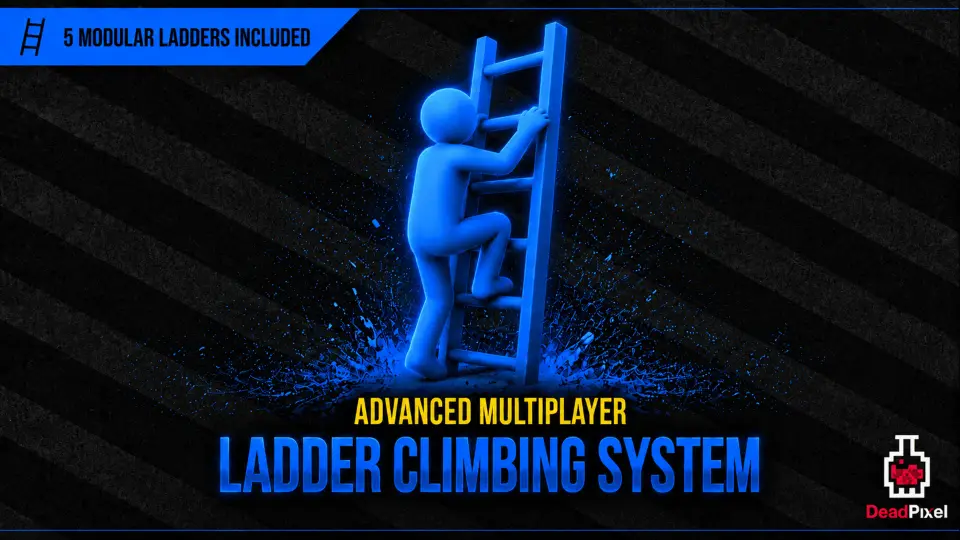
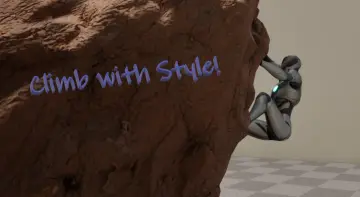
Vertical routes often turn a good multiplayer level into a frustrating one. When players need to reach a rooftop, cross a mezzanine, or move down into a lower zone, ladders are the simplest path, but their interactions are frequently stiff and indifferent to what is happening around them. The Advanced Ladder Climbing System takes a different approach by combining replicated Blueprint logic with meaningful movement choices: slow and fast climbing, ladder sliding, idle hand states, and jump-catch entry animations. It also includes five modular ladders that can populate a scene without forcing a designer to build the same climb again and again. For teams using Unreal Engine 5, version 5.2+ represents the full UE5 integration path, and the system’s first-person and third-person demos make its behavior easier to judge up front.
A Multiplayer Blueprint That Replicates the Climb
The system carries the tags "Replicated," "Multiplayer," "Ladder," and "Blueprint," and those four words shape what it is. This is not a simple ladder animation that only works in a single-player context. Because the tag list says replicated, the climb logic needs to stay in sync between clients. That is why the patch trail includes a specific "Client Collision hotfix" in v1.1.3. Ladder climbing seems like a small interaction, but when two players approach the same ladder from different angles, small collision or transform mismatches can cause visible snapping or client prediction errors.
Being Blueprint-driven matters for Unreal developers who build their character logic inside the editor. Rather than jumping through a C++ codebase, the climbing logic fits the same visual scripting style used by many modern UE5 projects. The listing also stresses that the system can be integrated into any project in minutes, which is a direct nod to teams that do not want to spend a week tuning a ladder interaction. The quick integration is supported by more than a code drop: documentation, asset integration tutorials, and a roadmap are available alongside the system.
Slow Climbs, Fast Climbs, and the Slide Down
The core movement vocabulary is straightforward: "Slow/Fast climbing movements," "Ladder Sliding," and "Left/Right hand Idle." A two-speed climb already gives the player agency in a space that rarely allows for expressive movement. Slow climbing likely fits contexts where the player is being cautious, while fast climbing keeps the pacing up when enemies are close or when the ladder is part of a speedier path. The exact input that switches between the two speeds is not listed but having both states inside one system makes level design richer than a single monotone ascent.
Ladder sliding sits on the other side of the interaction. Instead of playing the climb animation in reverse, the character can slide downward, which is a useful tool for dropping out of a route quickly. The left/right hand idle is another subtle touch: when a player stops on a ladder, the hands can settle in alternate positions rather than locking into a perfectly mirrored pose. These details reduce the stiffness that plagues many ladder systems, and they were refined early in the patch history. V1.0.1 adjusted idle animation and trace length, v1.0.2 focused on slide-down animation tweaks, and v1.0.3 added jump grab and speed enter animations. That third update is particularly important because it lets the ladder interaction begin with momentum instead of a full stop. The ability to jump at a ladder and grab onto it bridges the gap between a running jump and the climb state, making the whole transition feel less like a scripted door.
Five Modular Ladders and the Layout Possibilities
Gameplay systems always meet the world somewhere, and the Advanced Ladder Climbing System brings its own world-building pieces: "5 different Modular Ladders." Having five ladder variants gives level designers a kit beyond one prop. A tall industrial shaft, a short maintenance route, and a wide pick-up point may each call for a different geometry, and a collection of modular ladders means those structures can be assembled from sections. This also helps match the visual rhythm of a level: a designer can repeat one style of ladder without copy-pasting the exact same model for every climbable surface.
Because system itself is structured through climbing movement rather than static props, the presence of modular ladders suggests a close relation between the environmental asset and the interaction logic. In a Blueprint-oriented project, those ladders could be placed and wired to the same replicated climb behavior, though the available source details do not specify how much setup each ladder piece requires. What is clear is that the pack does not force teams to source a separate ladder mesh from a different library when they want to start prototyping.
First-Person and Third-Person Demo Rooms
The development of the system was not limited to one camera view. Version 1.1.0 added "FP and FP + TP Combined Character/Animation support," and the corresponding demo projects are available for both TPP and FPP. That is a meaningful range for a climbing asset because first-person and third-present ladders read very differently on screen. In third person, the entire body animates across the rungs; in first person, the camera has to communicate the climb through world motion and hand placement. The presence of a TPP showcase video and separate demo downloads gives studios a quick way to inspect both perspectives before deciding whether the behavior fits their character setup.
The documentation, asset integration tutorials, and roadmap located alongside the demo links complete the package. Tutorials that walk through implementation can save a developer from tracing through graphs and animations on their own. Documentation serves as a reference for the specific replication and speed variables later during production. And a roadmap indicates that the author may continue to add features beyond the versions listed in the patch notes, though the future direction is not spelled out.
Reading the Patch Notes as a Production Signal
The patch history of the Advanced Ladder Climbing System is short but informative. V1.0.0 marks the launch. V1.0.1 adjusts trace length and idle animations. V1.0.2 smooths slide-down animations. V1.0.3 introduces jump grab and speed enter animations. V1.1.0 adds first-person and combined first-/third-person support. V1.1.2 is a small hotfix, and v1.1.3 addresses a client collision issue. Several of these releases appear to have been spaced days apart, suggesting the developer was responding to user feedback rapidly during the initial weeks after launch.
For a multiplayer-focused system, the client collision fix at v1.1.3 is the most telling entry. Networking bugs around collision can stay hidden for a long time because they only manifest when multiple clients predict or update the ladder state at different times. The fact that the fix is called out in the patch notes gives potential users a practical signal: the climbing system is maintained with multiplayer scenarios in mind, not just polished as a single-player animation package.
When a team needs a ladder mechanism that can handle replicated gameplay, different ascent speeds, descending slides, and modular environment pieces in one package, the Advanced Ladder Climbing System lines up with all of those requirements. Combined with the UE5 integration path and the supporting tutorials, it is an asset built to be placed into a broader workflow rather than bolted on as a one-off animation. That leaves a climbing system that treats ladders as something players can move with, not just a vertical delay between two rooms.
 Gameplay Features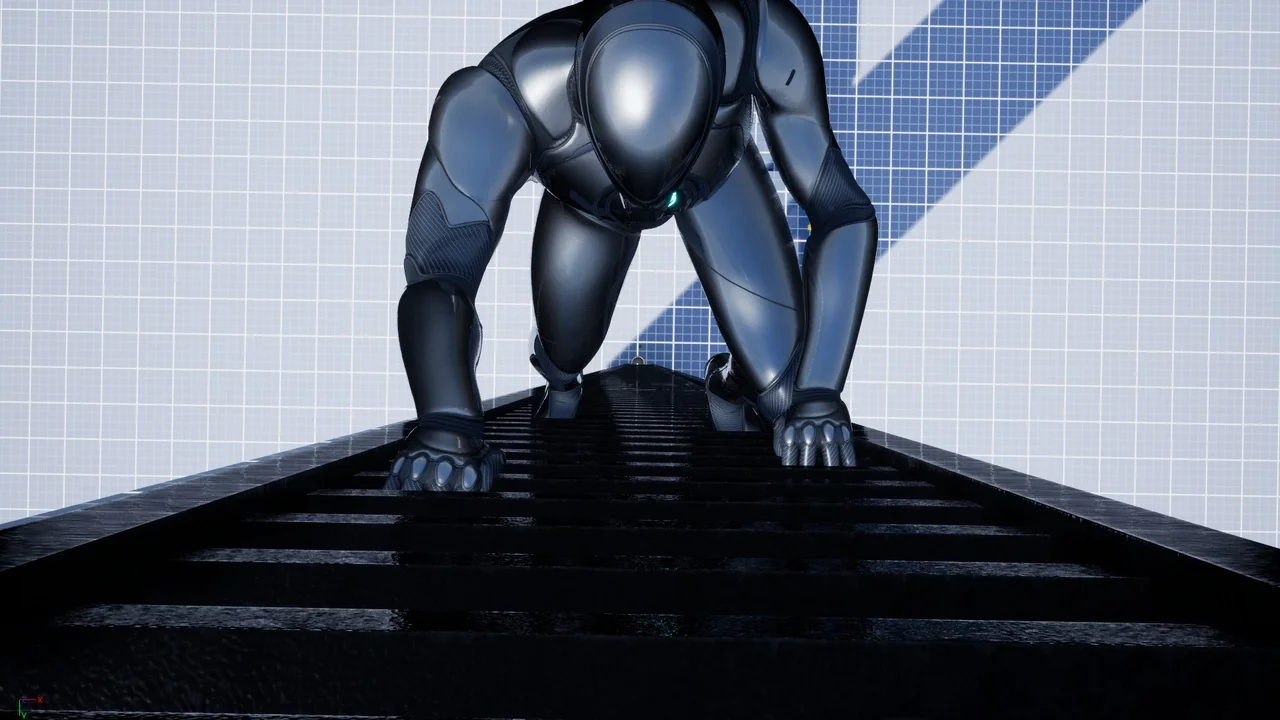
 Gameplay Features
 Gameplay Features
 Gameplay Features