"c68a05d5e51405b3"{"id":"1001117","slug":"open-world-locomotion-system","title":"Open World Locomotion System","category":"Gameplay Features","engine":"5.5+","assetVersion":"","engineVersion":"Engine Version: 5.5+","tag":"Gameplay Features","accent":"blue","visual":"animation","summary":"Unreal Engine asset providing a modular traversal system—dynamic climbing, ledge and ladder movement, vaulting, ground states, gliding, skydiving, and swimming.","platform":"Unreal Engine","publishedAt":"2026-09-07T12:46:04.945Z","updatedAt":"2026-09-07T12:46:04.945Z","sourceNotes":[],"fileContents":[],"compatibility":["Unreal Engine","Engine Version: 5.5+"],"featuredImage":{"alt":"Open World Locomotion System","src":"/wp-content/uploads/published/2026/09/07540a2a5f5f-0da0244c-d992-45ec-8019-81f190296c97-48c7de02be.webp"},"hasDownloadLink":true,"downloads":2,"terms":[{"taxonomy":"category","slug":"gameplay-features","name":"Gameplay Features"}],"galleryImages":[{"src":"/wp-content/uploads/published/2026/09/a1448124b672-c7e04a5c-2f06-4ff0-a495-2ad0eb610b01-e86c939937.webp","alt":"Open World Locomotion System"},{"src":"/wp-content/uploads/published/2026/09/de8758198147-1c8c7bc5-4ad7-4778-8e16-5b1ce7e3effa-c383285767.webp","alt":"Open World Locomotion System"},{"src":"/wp-content/uploads/published/2026/09/8c7be79828d4-c7db435e-09d3-4cd2-a7c4-30ae08995555-bac585c024.webp","alt":"Open World Locomotion System"},{"src":"/wp-content/uploads/published/2026/09/657a1291ad38-77ba5d1a-bde1-4b4f-a37b-710128d799e6-488ac110a7.webp","alt":"Open World Locomotion System"},{"src":"/wp-content/uploads/published/2026/09/c9f96a894e71-e7cee4ee-1891-4d8a-895f-2f6e7b6a55f4-9023d76902.webp","alt":"Open World Locomotion System"},{"src":"/wp-content/uploads/published/2026/09/3140f1a993fe-77063814-4a7c-43de-8844-1f43769e2d58-7b39d4b800.webp","alt":"Open World Locomotion System"},{"src":"/wp-content/uploads/published/2026/09/6455c1ea599b-04d12490-d503-4018-91a5-a6e341bc9fbc-a39d270497.webp","alt":"Open World Locomotion System"},{"src":"/wp-content/uploads/published/2026/09/8bed91401eed-ebe43d63-718b-4095-90cb-f977d901bb16-155943106a.webp","alt":"Open World Locomotion System"},{"src":"/wp-content/uploads/published/2026/09/1d7bec11ac33-38ffd92c-4044-43d5-ab1b-268f455e7525-c78d62ab20.webp","alt":"Open World Locomotion System"},{"src":"/wp-content/uploads/published/2026/09/8e65c29a3fa9-0229a88c-6994-4958-81a3-6971bc371dd0-91e4225b7d.webp","alt":"Open World Locomotion System"}],"accessPanel":{"kind":"resource","title":"Download this resource","eyebrow":"Free Download","message":"Log in or create a free account to start your download.","fileName":"OpenWorldLocomotion.7z","safetyNote":"Resources are manually reviewed before listing to improve quality and reduce obvious risks.","actionLabel":"Download Free","resourceType":"Resource archive"},"contentHtml":"\u003ch2\u003eOpen World Locomotion: A Set of Movement Answers for Rough Terrain\u003c/h2\u003e\n\u003cp\u003eAn open world is rarely a flat walking sim. Terrain passes through rocky walls, rooftops, moving structures, ladders, ledges, and waterways. The Open World Locomotion System responds to those variations by providing a modular Unreal Engine asset for versatile and sophisticated movement. Instead of isolating traversal into separate mechanics, it lines up climbing, ledge control, vaulting, ground states, gliding, skydiving and swimming under one system.\u003c/p\u003e\n\u003cp\u003eThe modular approach is reflected in its intended workflow. The system can be integrated into existing projects or customized to specific gameplay requirements. It can play a role both in realistic third-person productions and in titles that lean on mobility-heavy mechanics, because the movement suite is meant to be adjusted, not taken as a fixed template.\u003c/p\u003e\n\u003ch2\u003eDynamic Climbing Across Any Surface, With a Multiplayer Caveat\u003c/h2\u003e\n\u003cp\u003eThe main climbing system lets characters just climb any surface. That includes moving platforms and objects, as well as skeletal meshes such as creature characters or animated geometry. One important limitation: climbing on skeletal meshes is not supported in multiplayer. That leaves single-player games free to use it for boss-scale creatures, while co-op projects may need to use a separate probe for player-hostile bodies.\u003c/p\u003e\n\u003cp\u003eA manual/automatic climbing toggle handles how that interaction begins. Automatic climbing sets the character to grab onto surfaces as soon as they touch them. Manual climbing requires the player to input it. This choice changes how level designers use walls and ceilings, and it can be swapped based on the target feel of the game.\u003c/p\u003e\n\u003ch2\u003eLedge Decisions and Ladder Movement\u003c/h2\u003e\n\u003cp\u003eOnce a character reaches an apex, the ledge climbing feature steps in. They can climb up onto the ledge, climb back down, or continue onward along the ledge. The action can be triggered by a variable or by placing a collision box in the level, meaning the exact interaction point can be laid out in the scene. This is an important feature for open-world outposts where a ledge is both a path and a perch.\u003c/p\u003e\n\u003cp\u003eDirectional jump and jump off give the player a way to leave a climbing surface along a specified vector, and ladder movement is present as a separate mode for obvious vertical routes. Because directional jump is part of the loop, a player does not have to reach a safe spot on the ground before leaving a climb.\u003c/p\u003e\n\u003ch2\u003eVaulting With Context-Aware Transitions Around Obstacles\u003c/h2\u003e\n\u003cp\u003eThe vaulting system handles the mid-range structural movements that aren't full climbs. It allows a character to climb onto objects, vault over obstacles, climb down when adjacent to a ledge, or drop to the lower floor from a lofty ledge. This is built for smooth and context-aware action changes. Whether the player expects to get over a chest-high wall, onto a stack of crates, or down the side of a ruined tower, the controller selects from those transitions without requiring a special keymapped input for each direction.\u003c/p\u003e\n\u003ch2\u003eGround Movement With Rolling, Sliding, and an Animation Overlay\u003c/h2\u003e\n\u003cp\u003eThe ground side uses eight-directional movement. Four movement states are defined: Sprint, Run, Walk, and Crouch. For more sudden shifts, rolling and sliding are included as traversal mechanics. Rolling can cover lateral distance off a drop or dodge-based movement. Sliding provides a way to move forward under low obstacles or terminate a sprint into a crouched glide.\u003c/p\u003e\n\u003cp\u003eAn animation overlay system contributes motion for upper-body actions. A character can carry a rifle or a crate while the lower body stays in sprint, run, walk, or crouch movement. The overlay blends the actions, so posture does not have to be interrupted when the hero does something with their hands.\u003c/p\u003e\n\u003ch2\u003eGliding and Swimming in the Open Air and Underwater Space\u003c/h2\u003e\n\u003cp\u003eFor vertical space above the ground, a gliding system comes with a rigged and animated glider. That glider reacts while deployed, making the gameplay animation part of the asset, not a placeholder. Skydiving mechanics add high-altitude free-fall and descent capability, so open sky regions can be flown across without drifting to the ground unobstructed.\u003c/p\u003e\n\u003cp\u003eThe water systems cover both surfaces and inside the water. Transitions between the two are available, and the developer can lock the player to the water surface if necessary. This allows a section of lake to demand swimming distance, yet keeps the player from diving where the game expects them to swim across safely.\u003c/p\u003e\n\u003ch2\u003eInstall Capsule Trace Rotation Before Migrating Files\u003c/h2\u003e\n\u003cp\u003eThere's a specific installation step for the asset. It requires the free Capsule Trace Rotation plugin. The plugin must be enabled in the project's list before the Open World Locomotion files are migrated over. If that plugin is missing or not marked active, the movement systems may not work as intended.\u003c/p\u003e\n\u003cp\u003eAfter the plugin is enabled, the modular feature set follows a straightforward path. Each system can sit inside the same controller, but because it's modular, a team can take out the parts they don't need. Climbing, ledge movement, vaulting, ladder movement, ground states, the overlay functions, the glider, and swimming are all available to match the traversal vocabulary of the specific project.\u003c/p\u003e\n\n\u003ch2\u003eContinue Browsing Similar Packs\u003c/h2\u003e\n\u003cul\u003e\n\u003cli\u003e\u003ca href=\"https://3dcghub.com/open-world-audio-system/\" title=\"Open World Audio System\"\u003eOpen World Audio System\u003c/a\u003e\u003c/li\u003e\n\u003cli\u003e\u003ca href=\"https://3dcghub.com/open-world-ai-spawn-system/\" title=\"Open World AI Spawn System\"\u003eOpen World AI Spawn System\u003c/a\u003e\u003c/li\u003e\n\u003cli\u003e\u003ca href=\"https://3dcghub.com/city-traffic-pro/\" title=\"City Traffic Pro\"\u003eCity Traffic Pro\u003c/a\u003e\u003c/li\u003e\n\u003cli\u003e\u003ca href=\"https://3dcghub.com/open-world-ai-multiplayer-spawn-system/\" title=\"Open World AI Multiplayer Spawn System\"\u003eOpen World AI Multiplayer Spawn System\u003c/a\u003e\u003c/li\u003e\n\u003cli\u003e\u003ca href=\"https://3dcghub.com/advanced-locomotion-component-v2-4/\" title=\"Advanced Locomotion Component v2.4\"\u003eAdvanced Locomotion Component v2.4\u003c/a\u003e\u003c/li\u003e\n\u003c/ul\u003e","contentTextLength":5443,"navigation":{"current":858,"total":3860,"previous":{"id":"1001118","slug":"pcg-geometry-decals","title":"PCG Geometry Decals","category":"Procedural Systems","platform":"Unreal Engine","updatedAt":"2026-09-07T12:52:22.101Z"},"next":{"id":"1001116","slug":"natural-movement-ai-smoothing-system","title":"Natural Movement - AI Smoothing System","category":"Gameplay Features","platform":"Unreal Engine","updatedAt":"2026-09-07T12:42:25.716Z"}},"relatedResources":[{"id":"1000860","slug":"open-world-audio-system","title":"Open World Audio System","category":"Gameplay Features","engine":"5.1+","assetVersion":"","engineVersion":"Engine Version: 5.1+","tag":"Gameplay Features","accent":"blue","visual":"audio","summary":"A Blueprint-only sound manager for open worlds, handling ambient playback, time-of-day blends, per-area settings, and combat music switching.","platform":"Unreal Engine","publishedAt":"2026-08-05T06:24:43.389Z","updatedAt":"2026-08-05T06:24:43.389Z","sourceNotes":[],"fileContents":[],"compatibility":["Audio","Engine Version: 5.1+"],"featuredImage":{"alt":"Open World Audio System","src":"/wp-content/uploads/published/2026/08/e702f4a097d4-5e11b5ac-fb1b-4073-afc5-5c15b0aa166f-7b19adbae8.webp"},"hasDownloadLink":true,"downloads":1},{"id":"10667","slug":"city-traffic-pro","title":"City Traffic Pro","category":"Gameplay Features","engine":"5.6+","assetVersion":"Engine version: 5.6+","engineVersion":"5.2","tag":"Gameplay Features","accent":"blue","visual":"city","summary":"City Traffic Pro is a complete, flexible, and performance-optimized traffic AI system designed for Unreal Engine 5. It enables developers to simulate realistic vehicle movement, complex intersections, and dynamic traffic flow for open-world projects.","platform":"Unreal Engine","publishedAt":"2026-03-03T15:55:56.000Z","updatedAt":"2026-04-19T15:49:57.000Z","sourceNotes":[],"fileContents":[],"compatibility":["Unreal Engine","Engine version: 5.6+"],"featuredImage":{"alt":"City Traffic Pro","src":"https://3dcghub.com/wp-content/uploads/2026/03/22b9385f-dac3-476f-9d6b-1d02dd1b4a6c.webp"},"hasDownloadLink":true,"downloads":4},{"id":"11034","slug":"open-world-ai-spawn-system","title":"Open World AI Spawn System","category":"Gameplay Features","engine":"5.0+","assetVersion":"Engine version: 5.0+","engineVersion":"4.17","tag":"Gameplay Features","accent":"blue","visual":"luts","summary":"Manage large-scale environments efficiently with this distance-based spawning solution. This system replaces complex trigger box setups with a streamlined Blueprint approach.","platform":"Unreal Engine","publishedAt":"2026-03-03T16:45:30.000Z","updatedAt":"2026-04-19T15:49:51.000Z","sourceNotes":[],"fileContents":[],"compatibility":["Unreal Engine","Engine version: 5.0+"],"featuredImage":{"alt":"Open World AI Spawn System","src":"https://3dcghub.com/wp-content/uploads/2026/03/0420256b-a6c6-42f9-9432-86d4eb46c9ac.webp"},"hasDownloadLink":true,"downloads":0}]}
Gameplay Features
Open World Locomotion System
Unreal Engine asset providing a modular traversal system—dynamic climbing, ledge and ladder movement, vaulting, ground states, gliding, skydiving, and swimming.
Open World Locomotion: A Set of Movement Answers for Rough Terrain
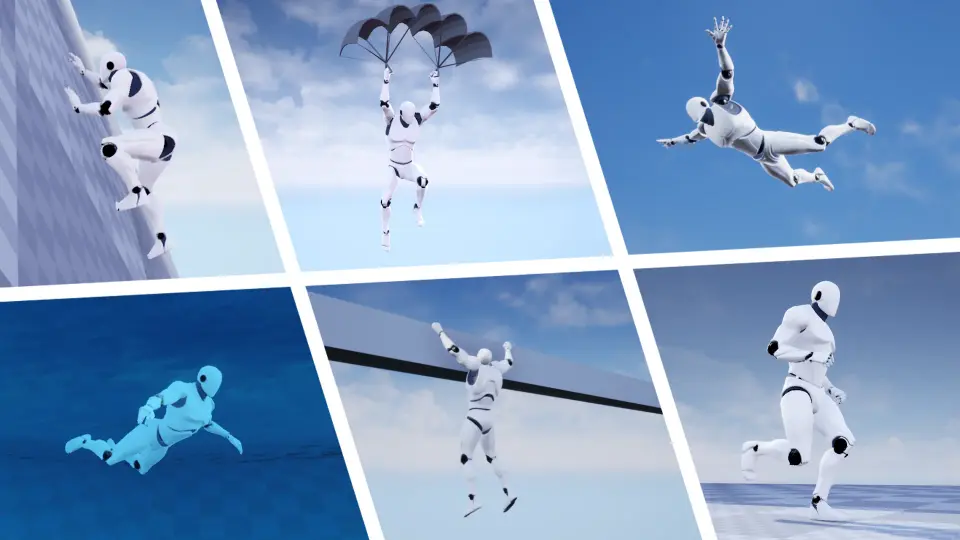
An open world is rarely a flat walking sim. Terrain passes through rocky walls, rooftops, moving structures, ladders, ledges, and waterways. The Open World Locomotion System responds to those variations by providing a modular Unreal Engine asset for versatile and sophisticated movement. Instead of isolating traversal into separate mechanics, it lines up climbing, ledge control, vaulting, ground states, gliding, skydiving and swimming under one system.
The modular approach is reflected in its intended workflow. The system can be integrated into existing projects or customized to specific gameplay requirements. It can play a role both in realistic third-person productions and in titles that lean on mobility-heavy mechanics, because the movement suite is meant to be adjusted, not taken as a fixed template.
Dynamic Climbing Across Any Surface, With a Multiplayer Caveat
The main climbing system lets characters just climb any surface. That includes moving platforms and objects, as well as skeletal meshes such as creature characters or animated geometry. One important limitation: climbing on skeletal meshes is not supported in multiplayer. That leaves single-player games free to use it for boss-scale creatures, while co-op projects may need to use a separate probe for player-hostile bodies.
A manual/automatic climbing toggle handles how that interaction begins. Automatic climbing sets the character to grab onto surfaces as soon as they touch them. Manual climbing requires the player to input it. This choice changes how level designers use walls and ceilings, and it can be swapped based on the target feel of the game.
Ledge Decisions and Ladder Movement
Once a character reaches an apex, the ledge climbing feature steps in. They can climb up onto the ledge, climb back down, or continue onward along the ledge. The action can be triggered by a variable or by placing a collision box in the level, meaning the exact interaction point can be laid out in the scene. This is an important feature for open-world outposts where a ledge is both a path and a perch.
Directional jump and jump off give the player a way to leave a climbing surface along a specified vector, and ladder movement is present as a separate mode for obvious vertical routes. Because directional jump is part of the loop, a player does not have to reach a safe spot on the ground before leaving a climb.
Vaulting With Context-Aware Transitions Around Obstacles
The vaulting system handles the mid-range structural movements that aren't full climbs. It allows a character to climb onto objects, vault over obstacles, climb down when adjacent to a ledge, or drop to the lower floor from a lofty ledge. This is built for smooth and context-aware action changes. Whether the player expects to get over a chest-high wall, onto a stack of crates, or down the side of a ruined tower, the controller selects from those transitions without requiring a special keymapped input for each direction.
Ground Movement With Rolling, Sliding, and an Animation Overlay
The ground side uses eight-directional movement. Four movement states are defined: Sprint, Run, Walk, and Crouch. For more sudden shifts, rolling and sliding are included as traversal mechanics. Rolling can cover lateral distance off a drop or dodge-based movement. Sliding provides a way to move forward under low obstacles or terminate a sprint into a crouched glide.
An animation overlay system contributes motion for upper-body actions. A character can carry a rifle or a crate while the lower body stays in sprint, run, walk, or crouch movement. The overlay blends the actions, so posture does not have to be interrupted when the hero does something with their hands.
Gliding and Swimming in the Open Air and Underwater Space
For vertical space above the ground, a gliding system comes with a rigged and animated glider. That glider reacts while deployed, making the gameplay animation part of the asset, not a placeholder. Skydiving mechanics add high-altitude free-fall and descent capability, so open sky regions can be flown across without drifting to the ground unobstructed.
The water systems cover both surfaces and inside the water. Transitions between the two are available, and the developer can lock the player to the water surface if necessary. This allows a section of lake to demand swimming distance, yet keeps the player from diving where the game expects them to swim across safely.
Install Capsule Trace Rotation Before Migrating Files
There's a specific installation step for the asset. It requires the free Capsule Trace Rotation plugin. The plugin must be enabled in the project's list before the Open World Locomotion files are migrated over. If that plugin is missing or not marked active, the movement systems may not work as intended.
After the plugin is enabled, the modular feature set follows a straightforward path. Each system can sit inside the same controller, but because it's modular, a team can take out the parts they don't need. Climbing, ledge movement, vaulting, ladder movement, ground states, the overlay functions, the glider, and swimming are all available to match the traversal vocabulary of the specific project.
 Gameplay Features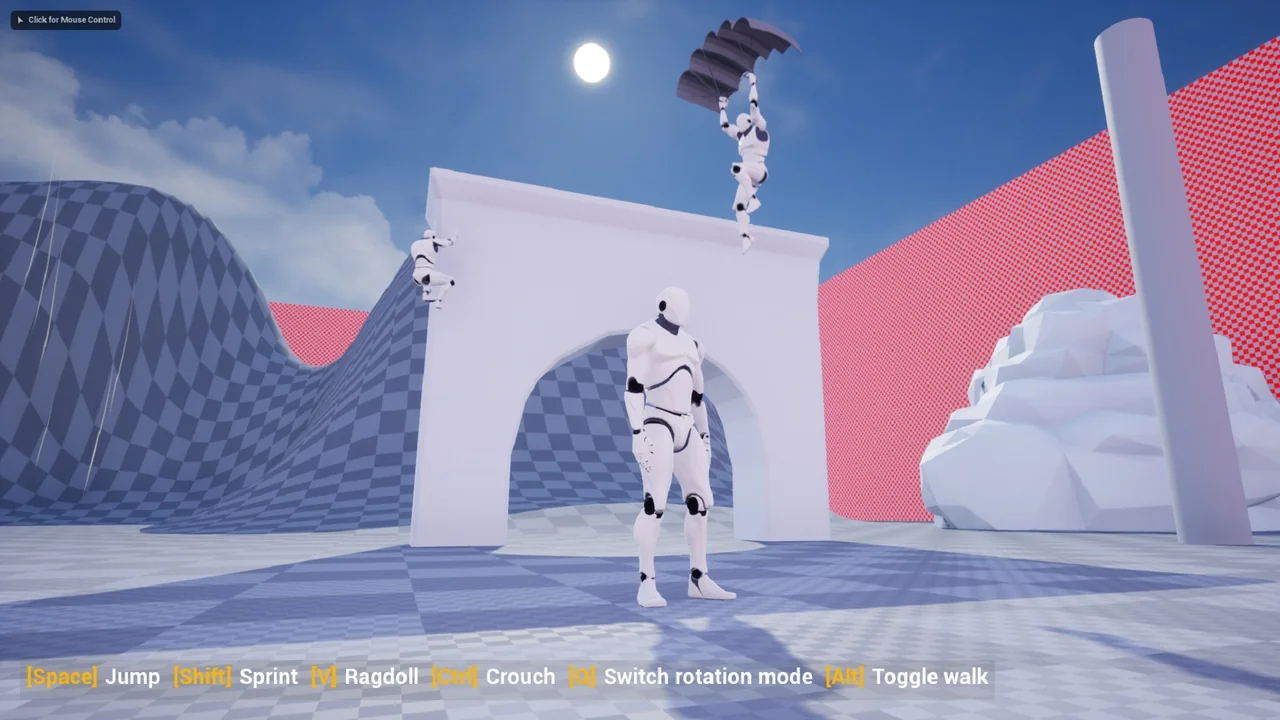
 Gameplay Features
 Gameplay Features
 Gameplay Features