"4481da9c895ef786"{"id":"1000980","slug":"basic-locomotion-system-replicated","title":"Basic Locomotion System (REPLICATED)","category":"Gameplay Features","engine":"5.0+","assetVersion":"","engineVersion":"Engine Version: 5.0+","tag":"Gameplay Features","accent":"blue","visual":"animation","summary":"A ground-up locomotion system for the UE5 Skeleton using Lyra animations, built as a simple third-person template with MetaHuman integration and multiplayer inv","platform":"Unreal Engine","publishedAt":"2026-08-18T05:57:51.717Z","updatedAt":"2026-08-18T05:57:51.717Z","sourceNotes":[],"fileContents":[],"compatibility":["Unreal Engine","Engine Version: 5.0+"],"featuredImage":{"alt":"Basic Locomotion System (REPLICATED)","src":"/wp-content/uploads/published/2026/08/497370037da8-24315aeb-c8a9-4077-aa37-d1119fdcf17d-0970e54182.webp"},"hasDownloadLink":true,"downloads":2,"terms":[{"taxonomy":"category","slug":"gameplay-features","name":"Gameplay Features"}],"galleryImages":[{"src":"/wp-content/uploads/published/2026/08/d44647ff5e09-b5fa2fb2-af26-425b-9b97-9cd5b59d7038-4881593e4a.webp","alt":"Basic Locomotion System (REPLICATED)"},{"src":"/wp-content/uploads/published/2026/08/43f626e4b4dc-4ad05842-1ca9-40cc-868f-e1380ad2e8a6-61f7690cdf.webp","alt":"Basic Locomotion System (REPLICATED)"},{"src":"/wp-content/uploads/published/2026/08/6eca8238dfa6-48d17b4b-1c9f-4b90-8e3a-aa89d428ef03-275577f7cd.webp","alt":"Basic Locomotion System (REPLICATED)"},{"src":"/wp-content/uploads/published/2026/08/358018dafb82-d6afb008-f2ab-41c6-97b8-0f87976191e1-1cc74ea686.webp","alt":"Basic Locomotion System (REPLICATED)"},{"src":"/wp-content/uploads/published/2026/08/0211e5ea685a-93b04568-bd43-4521-a936-385c35fcafe1-c1a88f8563.webp","alt":"Basic Locomotion System (REPLICATED)"},{"src":"/wp-content/uploads/published/2026/08/0dd2ab0a50e9-416713a8-027f-4139-8a27-bf46d13dcb09-98276e51aa.webp","alt":"Basic Locomotion System (REPLICATED)"},{"src":"/wp-content/uploads/published/2026/08/9d28ebecc17b-9e0c2462-d9a9-4d12-a8eb-455254e11edd-75839ccfa6.webp","alt":"Basic Locomotion System (REPLICATED)"}],"accessPanel":{"kind":"resource","title":"Download this resource","eyebrow":"Free Download","message":"Log in or create a free account to start your download.","fileName":"BasicLocomotionSystem.7z","safetyNote":"Resources are manually reviewed before listing to improve quality and reduce obvious risks.","actionLabel":"Download Free","resourceType":"Resource archive"},"contentHtml":"\u003cp\u003eIn a third-person game, nothing ruins immersion faster than a character that slides, snaps, or floats across the ground. Basic Locomotion System (REPLICATED) directly targets that problem with a locomotion set built for the UE5 Skeleton, taking Lyra animations as a starting point and reworking them from scratch. That leaves a movement foundation that feels cohesive rather than stitched together.\u003c/p\u003e\u003cp\u003eThe developer describes it as a system meant to be used as a Third Person Template. That framing matters because it shapes how you approach the asset: this is not a glorified animation pack to drop into any project, but a functional movement layer you can build a game around. Its simplicity is a selling point, and the tag list spells out the intended audience: System, Beginner, MetaHuman, Blueprint, Movement, Character.\u003c/p\u003e\u003ch2\u003eReworking Lyra Animations for the UE5 Skeleton\u003c/h2\u003e\u003cp\u003eThe animation source here is Lyra, Epic’s sample project known for polished shooter movement. But instead of copying Lyra’s character blueprint wholesale, the developer rebuilt the locomotion logic from zero. That distinction is evident from the product description: “made from scratch using lyra animations for the UE5 Skeleton.” So while the raw animation clips and poses originate from Lyra, the blend spaces, state machine, and root motion handling are custom work tailored specifically to the UE5 Skeleton.\u003c/p\u003e\u003cp\u003eSettling on the UE5 Skeleton is a practical choice for many developers. It is the default skeleton for Unreal Engine 5 projects, so the system can attach to most character meshes without retargeting. It also means the system inherits the natural proportions and foot placement of Epic’s standard humanoid rig, making it a safe baseline for prototyping. The videos confirm this: one preview runs in a default third-person setup, another in a custom project, and older footage shows it moving through a city crowd sample.\u003c/p\u003e\u003ch2\u003eA Blueprint-Friendly Third-Person Base\u003c/h2\u003e\u003cp\u003eRather than requiring a deep C++ pipeline, the system leans on Blueprints. The tag list explicitly includes Blueprint and Movement, which tells you the core logic is exposed and editable in the visual scripting layer. For beginner teams, that is a major advantage. You can open the character blueprint, trace the movement flow, and adjust any value without recompiling engine code.\u003c/p\u003e\u003cp\u003eThe overall design philosophy is simple implementations. That shows in how the system is structured around core locomotion fundamentals: idle, walk, run, jump, and the transitions between them. The intention is to give developers a very good base for game development, something that already feels right in motion but leaves room to layer on abilities, attacks, or interaction systems. The tag “System” further reinforces the idea that this is not a one-shot animation demo but an actual framework you extend.\u003c/p\u003e\u003ch2\u003eMetaHuman Footage and the Video Previews\u003c/h2\u003e\u003cp\u003eMetaHuman integration is not just a passing mention. There are two dedicated videos: one showing MetaHuman integration and another showing MetaHuman replacement. The integration video demonstrates how the system can drive a MetaHuman character, while the replacement video likely shows substituting the default mesh with a MetaHuman rig. For teams planning high-fidelity cinematics or narrative games, that compatibility removes a common hurdle where custom locomotion systems break with MetaHuman skeletons.\u003c/p\u003e\u003cp\u003eThe full video lineup includes a 2.0 preview, a 2.0 custom-project preview, an older 1.0 preview, and a 1.0 city crowd sample. The existence of multiple versions suggests the system has been iterated on. The 2.0 preview may show improved transitions, new poses, or a broader movement set, while the custom-project preview demonstrates how it behaves in environments different from Epic’s default GAS playground. The city crowd sample from the old version hints that the system can handle populated scenes, making it relevant for AI-driven crowds or NPC background characters.\u003c/p\u003e\u003ch2\u003eDocumentation, Breakdowns, and a Discord Channel\u003c/h2\u003e\u003cp\u003eFor teams that want to understand the system before adopting it, the developer provides supporting material. A full breakdown playlist walks through the mechanics in detail, covering how the locomotion logic is assembled. There is also documentation hosted externally, which likely explains setup, skeleton requirements, and how to replace or integrate characters. That documentation is valuable because it cuts down the guesswork when you are adapting the system to a custom project.\u003c/p\u003e\u003cp\u003eThe Discord channel is another direct support line. Instead of relying solely on forum threads or sparse comments, you can ask questions in a live community space. That kind of touchpoint matters for an asset that sits at the heart of character movement; a small configuration detail can ruin the feel, and real-time help accelerates troubleshooting.\u003c/p\u003e\u003ch2\u003eFitting the System Into a Gameplay Pipeline\u003c/h2\u003e\u003cp\u003eCompatibility with multiplayer inventory systems. That sets this locomotion system apart from a purely single-player template. If your project already handles multiplayer inventory through a separate framework, this movement layer can sit alongside it without immediate conflict. For teams prototyping survival games, multiplayer co-op, or inventory-driven RPGs, the combination lowers the barrier to entry.\u003c/p\u003e\u003cp\u003eWhere does Basic Locomotion System (REPLICATED) fit best? It is a strong starting block for third-person projects that need reliable, tunable movement on the UE5 Skeleton. Its Lyra-derived animations give it a polished, modern feel, while the Blueprint-driven simplicity keeps it accessible. The MetaHuman videos prove it can scale up to high-fidelity characters, and the multiplayer inventory note broadens its reach into networked gameplay. For a developer who wants to skip the tedious locomotion plumbing and get straight to game mechanics, this system delivers a solid floor to build on.\u003c/p\u003e\n\n\u003ch2\u003eRelated Resources Worth Checking\u003c/h2\u003e\n\u003cul\u003e\n\u003cli\u003e\u003ca href=\"https://3dcghub.com/teleportation-and-portal/\" title=\"Teleportation and Portal\"\u003eTeleportation and Portal\u003c/a\u003e\u003c/li\u003e\n\u003cli\u003e\u003ca href=\"https://3dcghub.com/replicated-interaction-kit-vol-1-switch-valve-chain-etc/\" title=\"Replicated Interaction Kit Vol 1 (Switch, Valve, Chain etc.)\"\u003eReplicated Interaction Kit Vol 1 (Switch, Valve, Chain etc.)\u003c/a\u003e\u003c/li\u003e\n\u003cli\u003e\u003ca href=\"https://3dcghub.com/basic-interaction-widgets-and-notes/\" title=\"Basic Interaction, Widgets \u0026amp; Notes\"\u003eBasic Interaction, Widgets \u0026amp; Notes\u003c/a\u003e\u003c/li\u003e\n\u003cli\u003e\u003ca href=\"https://3dcghub.com/hyper-outliner-and-symbol-system-v4/\" title=\"Hyper Outliner and Symbol System v4\"\u003eHyper Outliner and Symbol System v4\u003c/a\u003e\u003c/li\u003e\n\u003cli\u003e\u003ca href=\"https://3dcghub.com/dismemberment-kit-v2/\" title=\"Dismemberment Kit V2\"\u003eDismemberment Kit V2\u003c/a\u003e\u003c/li\u003e\n\u003c/ul\u003e","contentTextLength":6103,"navigation":{"current":402,"total":3269,"previous":{"id":"1000981","slug":"cheng-yi-chinese-warrior-girl","title":"Cheng Yi - Chinese Warrior Girl","category":"Humans","platform":"Unreal Engine","updatedAt":"2026-08-18T06:02:39.060Z"},"next":{"id":"1000979","slug":"barricades-pack","title":"Barricades Pack","category":"Trashyard","platform":"Unreal Engine","updatedAt":"2026-08-18T05:55:25.363Z"}},"relatedResources":[{"id":"27841","slug":"teleportation-and-portal","title":"Teleportation and Portal","category":"Gameplay Features","engine":"5.0+","assetVersion":"Engine version: 5.0+","engineVersion":"4.22","tag":"Gameplay Features","accent":"blue","visual":"mech","summary":"Teleportation and Portal centers on one clear job: moving characters through portals without manual friction. Its strongest practical angle is online multiplayer, with a replicated, customizable, and automatic setup backed by Blueprint, Niagara, particles,...","platform":"Unreal Engine","publishedAt":"2026-04-29T10:56:20.000Z","updatedAt":"2026-04-29T10:56:21.000Z","sourceNotes":[],"fileContents":[],"compatibility":["Unreal Engine","Engine version: 5.0+"],"featuredImage":{"alt":"Teleportation and Portal","src":"https://3dcghub.com/wp-content/uploads/2026/04/b75b5cbdd2e1_e4771e4d-77b5-48e2-8b4f-31654a1f53e7.webp"},"hasDownloadLink":true,"downloads":0},{"id":"1000664","slug":"replicated-interaction-kit-vol-1-switch-valve-chain-etc","title":"Replicated Interaction Kit Vol 1 (Switch, Valve, Chain etc.)","category":"Gameplay Features","engine":"5.1+","assetVersion":"","engineVersion":"Engine Version: 5.1+","tag":"Gameplay Features","accent":"blue","visual":"mech","summary":"A network-replicated interaction blueprint kit for Unreal Engine featuring switches, valves, and chains with multiplayer support, TPP/FPP integration, and custo","platform":"Unreal Engine","publishedAt":"2026-07-22T06:49:04.419Z","updatedAt":"2026-07-22T06:49:04.419Z","sourceNotes":[],"fileContents":[],"compatibility":["Unreal Engine","Engine Version: 5.1+"],"featuredImage":{"alt":"Replicated Interaction Kit Vol 1 (Switch, Valve, Chain etc.)","src":"/wp-content/uploads/published/2026/07/4a0398ea3371-dad15c4a-ea6d-4b44-9559-c441b78887dd-085fe54a93.webp"},"hasDownloadLink":true,"downloads":1},{"id":"1000726","slug":"basic-interaction-widgets-and-notes","title":"Basic Interaction, Widgets \u0026 Notes","category":"Gameplay Features","engine":"5.0+","assetVersion":"","engineVersion":"Engine Version: 5.0+","tag":"Gameplay Features","accent":"blue","visual":"mech","summary":"A blueprint-based Unreal Engine interaction system with press and hold widgets, example actors, and network replication for gameplay scenes.","platform":"Unreal Engine","publishedAt":"2026-07-26T15:33:40.078Z","updatedAt":"2026-07-26T15:33:40.078Z","sourceNotes":[],"fileContents":[],"compatibility":["Unreal Engine","Engine Version: 5.0+"],"featuredImage":{"alt":"Basic Interaction, Widgets \u0026 Notes","src":"/wp-content/uploads/published/2026/07/a7232b4177d4-876727ec-4e15-4101-936f-eea050f73e2e-c57e0b2af6.webp"},"hasDownloadLink":true,"downloads":0}]}
Gameplay Features
Basic Locomotion System (REPLICATED)
A ground-up locomotion system for the UE5 Skeleton using Lyra animations, built as a simple third-person template with MetaHuman integration and multiplayer inv
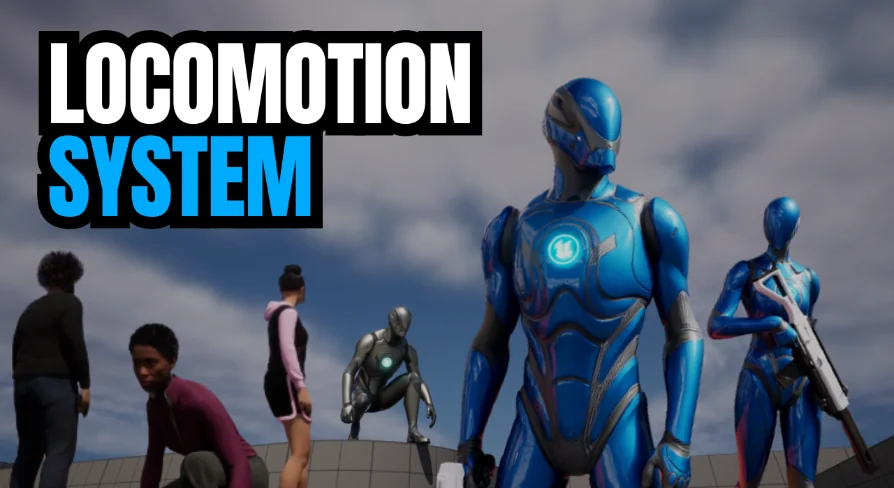
In a third-person game, nothing ruins immersion faster than a character that slides, snaps, or floats across the ground. Basic Locomotion System (REPLICATED) directly targets that problem with a locomotion set built for the UE5 Skeleton, taking Lyra animations as a starting point and reworking them from scratch. That leaves a movement foundation that feels cohesive rather than stitched together.
The developer describes it as a system meant to be used as a Third Person Template. That framing matters because it shapes how you approach the asset: this is not a glorified animation pack to drop into any project, but a functional movement layer you can build a game around. Its simplicity is a selling point, and the tag list spells out the intended audience: System, Beginner, MetaHuman, Blueprint, Movement, Character.
Reworking Lyra Animations for the UE5 Skeleton
The animation source here is Lyra, Epic’s sample project known for polished shooter movement. But instead of copying Lyra’s character blueprint wholesale, the developer rebuilt the locomotion logic from zero. That distinction is evident from the product description: “made from scratch using lyra animations for the UE5 Skeleton.” So while the raw animation clips and poses originate from Lyra, the blend spaces, state machine, and root motion handling are custom work tailored specifically to the UE5 Skeleton.
Settling on the UE5 Skeleton is a practical choice for many developers. It is the default skeleton for Unreal Engine 5 projects, so the system can attach to most character meshes without retargeting. It also means the system inherits the natural proportions and foot placement of Epic’s standard humanoid rig, making it a safe baseline for prototyping. The videos confirm this: one preview runs in a default third-person setup, another in a custom project, and older footage shows it moving through a city crowd sample.
A Blueprint-Friendly Third-Person Base
Rather than requiring a deep C++ pipeline, the system leans on Blueprints. The tag list explicitly includes Blueprint and Movement, which tells you the core logic is exposed and editable in the visual scripting layer. For beginner teams, that is a major advantage. You can open the character blueprint, trace the movement flow, and adjust any value without recompiling engine code.
The overall design philosophy is simple implementations. That shows in how the system is structured around core locomotion fundamentals: idle, walk, run, jump, and the transitions between them. The intention is to give developers a very good base for game development, something that already feels right in motion but leaves room to layer on abilities, attacks, or interaction systems. The tag “System” further reinforces the idea that this is not a one-shot animation demo but an actual framework you extend.
MetaHuman Footage and the Video Previews
MetaHuman integration is not just a passing mention. There are two dedicated videos: one showing MetaHuman integration and another showing MetaHuman replacement. The integration video demonstrates how the system can drive a MetaHuman character, while the replacement video likely shows substituting the default mesh with a MetaHuman rig. For teams planning high-fidelity cinematics or narrative games, that compatibility removes a common hurdle where custom locomotion systems break with MetaHuman skeletons.
The full video lineup includes a 2.0 preview, a 2.0 custom-project preview, an older 1.0 preview, and a 1.0 city crowd sample. The existence of multiple versions suggests the system has been iterated on. The 2.0 preview may show improved transitions, new poses, or a broader movement set, while the custom-project preview demonstrates how it behaves in environments different from Epic’s default GAS playground. The city crowd sample from the old version hints that the system can handle populated scenes, making it relevant for AI-driven crowds or NPC background characters.
Documentation, Breakdowns, and a Discord Channel
For teams that want to understand the system before adopting it, the developer provides supporting material. A full breakdown playlist walks through the mechanics in detail, covering how the locomotion logic is assembled. There is also documentation hosted externally, which likely explains setup, skeleton requirements, and how to replace or integrate characters. That documentation is valuable because it cuts down the guesswork when you are adapting the system to a custom project.
The Discord channel is another direct support line. Instead of relying solely on forum threads or sparse comments, you can ask questions in a live community space. That kind of touchpoint matters for an asset that sits at the heart of character movement; a small configuration detail can ruin the feel, and real-time help accelerates troubleshooting.
Fitting the System Into a Gameplay Pipeline
Compatibility with multiplayer inventory systems. That sets this locomotion system apart from a purely single-player template. If your project already handles multiplayer inventory through a separate framework, this movement layer can sit alongside it without immediate conflict. For teams prototyping survival games, multiplayer co-op, or inventory-driven RPGs, the combination lowers the barrier to entry.
Where does Basic Locomotion System (REPLICATED) fit best? It is a strong starting block for third-person projects that need reliable, tunable movement on the UE5 Skeleton. Its Lyra-derived animations give it a polished, modern feel, while the Blueprint-driven simplicity keeps it accessible. The MetaHuman videos prove it can scale up to high-fidelity characters, and the multiplayer inventory note broadens its reach into networked gameplay. For a developer who wants to skip the tedious locomotion plumbing and get straight to game mechanics, this system delivers a solid floor to build on.
 Gameplay Features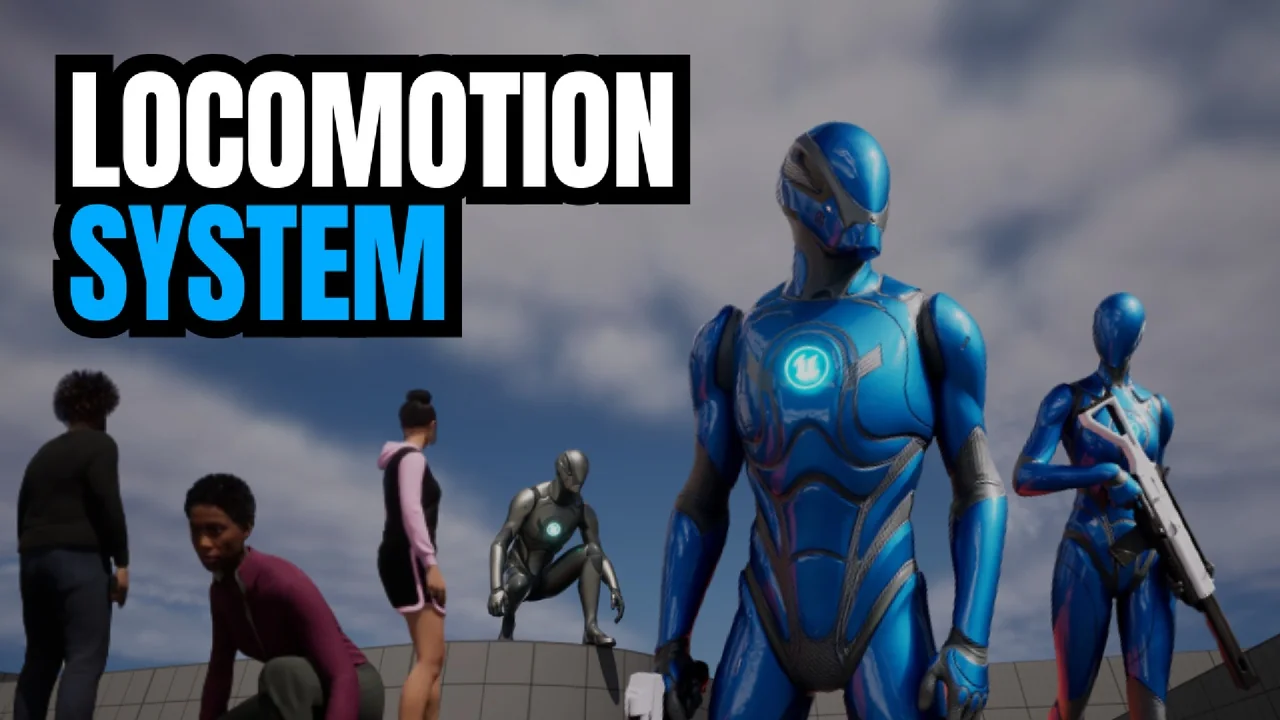
 Gameplay Features
 Gameplay Features
 Gameplay Features