"efaa631e936fd3ee"{"id":"1002125","slug":"multiplayer-gravity-gun","title":"Multiplayer Gravity Gun","category":"Gameplay Features","engine":"5.3+","assetVersion":"","engineVersion":"Engine Version: 5.3+","tag":"Gameplay Features","accent":"blue","visual":"mech","summary":"Explore the Multiplayer Gravity Gun Blueprint template, featuring replicated dual-beam physics manipulation, mouse wheel distance control, and sound replication","platform":"Unreal Engine","publishedAt":"2026-10-29T09:05:24.427Z","updatedAt":"2026-10-29T09:05:24.427Z","sourceNotes":[],"fileContents":[],"compatibility":["Unreal Engine","Engine Version: 5.3+"],"featuredImage":{"alt":"Multiplayer Gravity Gun","src":"/wp-content/uploads/published/2026/10/9fa1b1893a83-f38a0201-cd4c-4164-9945-6e296aa6e5ea-9706b84c8e.webp"},"hasDownloadLink":true,"downloads":0,"terms":[{"taxonomy":"category","slug":"gameplay-features","name":"Gameplay Features"}],"galleryImages":[{"src":"/wp-content/uploads/published/2026/10/381616eda099-ee9789cd-79d6-4cfc-86ae-e3b9dd599bff-be900ae0e2.webp","alt":"Multiplayer Gravity Gun"},{"src":"/wp-content/uploads/published/2026/10/6839e499ac34-f4d3d736-4e9d-49b8-85f8-40c3020acaa1-49046366c2.webp","alt":"Multiplayer Gravity Gun"},{"src":"/wp-content/uploads/published/2026/10/c9d5bbccd9af-c5aca147-3355-46a4-a381-7703eb85f468-d477e5ef1a.webp","alt":"Multiplayer Gravity Gun"},{"src":"/wp-content/uploads/published/2026/10/d7d07fa39dd1-0f341f91-7b27-4ff6-a2f9-0e9fe0b076e2-af79653234.webp","alt":"Multiplayer Gravity Gun"}],"accessPanel":{"kind":"resource","title":"Download this resource","eyebrow":"Free Download","message":"Log in or create a free account to start your download.","fileName":"Multiplayer Gravity Gun.7z","safetyNote":"Resources are manually reviewed before listing to improve quality and reduce obvious risks.","actionLabel":"Download Free","resourceType":"Resource archive"},"contentHtml":"\u003ch2\u003eDual-Laser Dynamics and Network-Replicated Physics\u003c/h2\u003e\u003cp\u003eAiming a beam at a physics prop, pulling it across an arena, and launching it across the map requires tight synchronization across clients. The Multiplayer Gravity Gun template, tagged as a Blueprint and railgun system, establishes this behavior by separating object interaction into distinct push and pull states. A blue laser handles attraction, locking onto target objects and reeling them toward the character. Conversely, a red laser acts as an active repellent, imparting impulse forces to push or blast targets away from the barrel.\u003c/p\u003e\u003cp\u003eBecause physics objects in multiplayer environments are notoriously prone to desynchronization, the template establishes full network replication across all core components. The replication layer covers the visible lasers, player characters, character animations, object interactions, and the accompanying sounds. When a client fires the blue beam to pull an item, the beam effect, character posture, physics movement, and audio feedback are shared identically across the server and remote observers, preventing discrepancies between what the active player sees and what opponents track in the game world.\u003c/p\u003e\u003ch2\u003eControlling Hold Distance with the Mouse Wheel\u003c/h2\u003e\u003cp\u003eGrabbing an object at a fixed offset often creates spatial conflicts when navigating tight doorways or aiming over barricades. To resolve this, the template introduces mouse wheel distance control specifically active during blue laser manipulation. While the attraction beam is engaged, rolling the mouse wheel adjusts the distance between the character and the captured target along the line of sight.\u003c/p\u003e\u003cp\u003eThis mechanic changes how players position objects in real time. Rather than remaining locked at a static hold distance, an object can be reeled in close to shield incoming attacks or extended outward to clear low obstacles and navigate around teammates. Because object interactions and positions are networked, this real-time distance manipulation propagates continuously across the server, ensuring that all participants observe the exact spacing of the held item relative to the holding character.\u003c/p\u003e\u003ch2\u003eReplicating Characters, Animations, and Audio Traces\u003c/h2\u003e\u003cp\u003eIn a networked action game, visual and auditory communication between clients is essential for readability. The Multiplayer Gravity Gun template guarantees that every state change triggers corresponding updates across the entire player group. Character animations are explicitly synchronized, so when a player readies the weapon, catches a crate, or fires a repelling blast, the third-person animation reflects the exact action seen from the first-person view.\u003c/p\u003e\u003cp\u003eSound effects are similarly synchronized across the network. Activating the attraction beam, repelling a heavy prop with the red laser, or adjusting hold distances produces audio cues that emit locally and across client proxies. Coupled with visual laser replication, these auditory triggers provide clear spatial awareness, enabling players to react instantly when an opponent prepares a high-speed projectile throw or maneuvers cover nearby.\u003c/p\u003e\u003ch2\u003eBlueprint Architecture and Railgun Implementation\u003c/h2\u003e\u003cp\u003eStructured entirely as a Blueprint template, the system allows developers to inspect, modify, and extend the physics manipulation logic directly without needing lower-level codebase alterations. The railgun designation points to a clean, instantaneous trace setup that aligns with projectile launching and beam-based physics tracking. Handling the dual blue and red laser logic through Blueprints makes it straightforward to adjust impulse forces, change beam styling, or modify pull speeds.\u003c/p\u003e\u003cp\u003eThe Blueprint logic cleanly binds the mouse wheel input into the holding calculations, updating the target offset vector dynamically while the attraction state remains active. Because the interaction calculations reside within a networked Blueprint framework, integrating custom game rules—such as restricting which physics classes the blue beam can target or modifying the throw velocity of the red beam—can be executed without breaking existing replication pathways.\u003c/p\u003e\u003ch2\u003eMegapack Integration and Practical Production Context\u003c/h2\u003e\u003cp\u003eDesigned with compatibility for the Wecomfrom Megapack, the template easily drops into broader asset environments that utilize shared structural conventions. Integrating physics-driven mechanics into an existing multiplayer title often introduces edge cases involving collision desynchronization and mismatched player animation states. By providing unified handling of laser rendering, character rigs, physics manipulation, and sound cues out of the box, the system minimizes boilerplate networking tasks.\u003c/p\u003e\u003cp\u003eFor teams developing cooperative puzzle mechanics, arena combat modes, or physics-heavy shooter prototypes, having synchronized attraction and repulsion mechanics ready from the start establishes a dependable foundation. The inclusion of responsive distance adjustment ensures that interacting with world geometry feels fluid rather than rigid, giving designers an operational framework for interactive physics gameplay.\u003c/p\u003e\n\n\u003ch2\u003eRelated Resources Worth Checking\u003c/h2\u003e\n\u003cul\u003e\n\u003cli\u003e\u003ca href=\"https://3dcghub.com/mgt-multiplayer-gravity-template/\" title=\"MGT Multiplayer Gravity Template\"\u003eMGT Multiplayer Gravity Template\u003c/a\u003e\u003c/li\u003e\n\u003cli\u003e\u003ca href=\"https://3dcghub.com/advanced-ladder-climbing-system/\" title=\"Advanced Ladder Climbing System\"\u003eAdvanced Ladder Climbing System\u003c/a\u003e\u003c/li\u003e\n\u003cli\u003e\u003ca href=\"https://3dcghub.com/multiverse/\" title=\"Multiverse\"\u003eMultiverse\u003c/a\u003e\u003c/li\u003e\n\u003cli\u003e\u003ca href=\"https://3dcghub.com/gui-with-multiplayer/\" title=\"GUI with Multiplayer\"\u003eGUI with Multiplayer\u003c/a\u003e\u003c/li\u003e\n\u003cli\u003e\u003ca href=\"https://3dcghub.com/custom-loot-box/\" title=\"Custom Loot Box\"\u003eCustom Loot Box\u003c/a\u003e\u003c/li\u003e\n\u003c/ul\u003e","contentTextLength":5243,"navigation":{"current":159,"total":4209,"previous":{"id":"1002126","slug":"multiplayer-topdown-kit","title":"Multiplayer TopDown Kit","category":"Action-Adventure","platform":"Unreal Engine","updatedAt":"2026-10-29T09:06:01.569Z"},"next":{"id":"1002124","slug":"multiplayer-fps-procedural-animation-toolkit","title":"Multiplayer FPS Procedural Animation Toolkit","category":"Network \u0026 Multiplayer","platform":"Unreal Engine","updatedAt":"2026-10-29T09:04:51.154Z"}},"relatedResources":[{"id":"1000238","slug":"mgt-multiplayer-gravity-template","title":"MGT Multiplayer Gravity Template","category":"Gameplay Features","engine":"5.3+","assetVersion":"","engineVersion":"Engine Version: 5.3+","tag":"Gameplay Features","accent":"blue","visual":"mech","summary":"A dynamic gravity system for Unreal Engine utilizing the native character movement component to support full multiplayer replication for players, objects, and A","platform":"Unreal Engine","publishedAt":"2026-06-30T18:11:03.499Z","updatedAt":"2026-06-30T18:11:03.499Z","sourceNotes":[],"fileContents":[],"compatibility":["Unreal Engine","Engine Version: 5.3+"],"featuredImage":{"alt":"MGT Multiplayer Gravity Template","src":"/wp-content/uploads/published/2026/06/3e9b12a8f9cc-951e39e8-6c7b-4772-975c-e63141c701c5-5cf67fa1da.webp"},"hasDownloadLink":true,"downloads":0},{"id":"1002144","slug":"plug-and-play-shooter-ai","title":"Plug and Play Shooter AI","category":"Gameplay Features","engine":"5.1+","assetVersion":"","engineVersion":"Engine Version: 5.1+","tag":"Gameplay Features","accent":"blue","visual":"mech","summary":"Explore Plug and Play Shooter AI, an easy-to-use combat AI system featuring multiplayer replication, 8 behaviors, sensory detection, and team battle mechanics.","platform":"Unreal Engine","publishedAt":"2026-10-29T09:49:02.781Z","updatedAt":"2026-10-29T09:49:02.781Z","sourceNotes":[],"fileContents":[],"compatibility":["Unreal Engine","Engine Version: 5.1+"],"featuredImage":{"alt":"Plug and Play Shooter AI","src":"/wp-content/uploads/published/2026/10/3949e381120d-eef9a93f-524d-4da1-b202-cfd3acc825b0-d4f0dde1a7.webp"},"hasDownloadLink":true,"downloads":0},{"id":"1001074","slug":"advanced-ladder-climbing-system","title":"Advanced Ladder Climbing System","category":"Gameplay Features","engine":"5.0+","assetVersion":"","engineVersion":"Engine Version: 5.0+","tag":"Gameplay Features","accent":"blue","visual":"mech","summary":"Advanced multiplayer ladder climbing system for UE5 with replicated Blueprint logic, slow/fast climbing, ladder sliding, and five modular ladders.","platform":"Unreal Engine","publishedAt":"2026-09-04T14:25:31.912Z","updatedAt":"2026-09-04T14:25:31.912Z","sourceNotes":[],"fileContents":[],"compatibility":["Unreal Engine","Engine Version: 5.0+"],"featuredImage":{"alt":"Advanced Ladder Climbing System","src":"/wp-content/uploads/published/2026/09/59ffeb900e40-b4243caa-17bb-4ac3-b6ec-e0814dffd788-1a4d44bd68.webp"},"hasDownloadLink":true,"downloads":4}]}
Gameplay Features
Multiplayer Gravity Gun
Explore the Multiplayer Gravity Gun Blueprint template, featuring replicated dual-beam physics manipulation, mouse wheel distance control, and sound replication
Dual-Laser Dynamics and Network-Replicated Physics
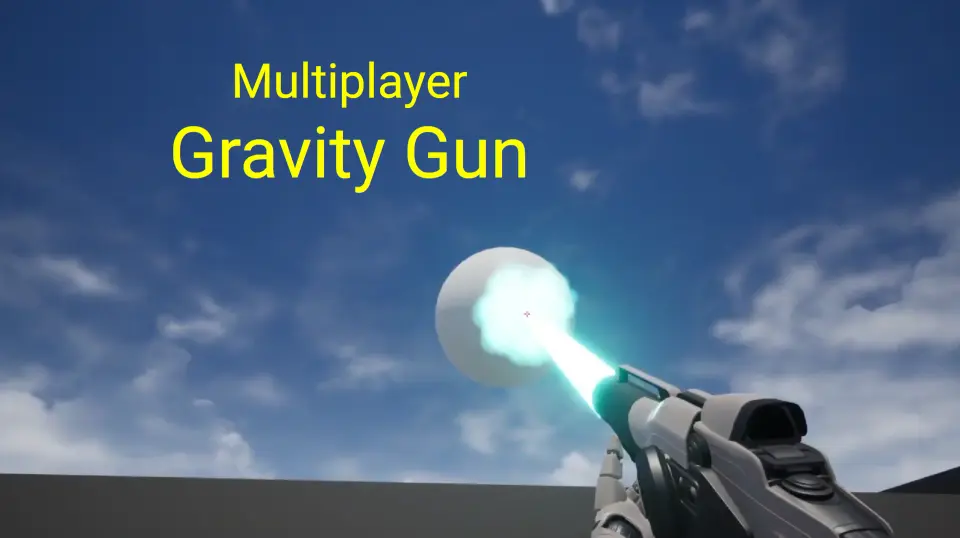
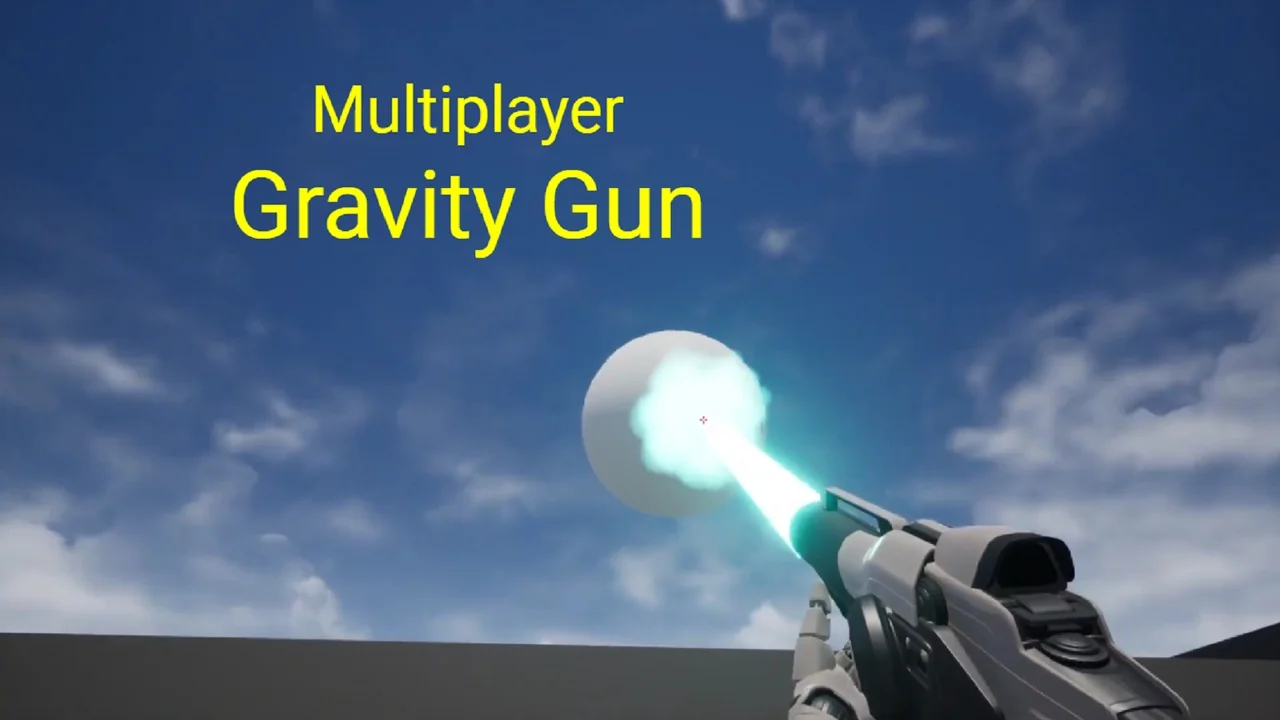
Aiming a beam at a physics prop, pulling it across an arena, and launching it across the map requires tight synchronization across clients. The Multiplayer Gravity Gun template, tagged as a Blueprint and railgun system, establishes this behavior by separating object interaction into distinct push and pull states. A blue laser handles attraction, locking onto target objects and reeling them toward the character. Conversely, a red laser acts as an active repellent, imparting impulse forces to push or blast targets away from the barrel.
Because physics objects in multiplayer environments are notoriously prone to desynchronization, the template establishes full network replication across all core components. The replication layer covers the visible lasers, player characters, character animations, object interactions, and the accompanying sounds. When a client fires the blue beam to pull an item, the beam effect, character posture, physics movement, and audio feedback are shared identically across the server and remote observers, preventing discrepancies between what the active player sees and what opponents track in the game world.
Controlling Hold Distance with the Mouse Wheel
Grabbing an object at a fixed offset often creates spatial conflicts when navigating tight doorways or aiming over barricades. To resolve this, the template introduces mouse wheel distance control specifically active during blue laser manipulation. While the attraction beam is engaged, rolling the mouse wheel adjusts the distance between the character and the captured target along the line of sight.
This mechanic changes how players position objects in real time. Rather than remaining locked at a static hold distance, an object can be reeled in close to shield incoming attacks or extended outward to clear low obstacles and navigate around teammates. Because object interactions and positions are networked, this real-time distance manipulation propagates continuously across the server, ensuring that all participants observe the exact spacing of the held item relative to the holding character.
Replicating Characters, Animations, and Audio Traces
In a networked action game, visual and auditory communication between clients is essential for readability. The Multiplayer Gravity Gun template guarantees that every state change triggers corresponding updates across the entire player group. Character animations are explicitly synchronized, so when a player readies the weapon, catches a crate, or fires a repelling blast, the third-person animation reflects the exact action seen from the first-person view.
Sound effects are similarly synchronized across the network. Activating the attraction beam, repelling a heavy prop with the red laser, or adjusting hold distances produces audio cues that emit locally and across client proxies. Coupled with visual laser replication, these auditory triggers provide clear spatial awareness, enabling players to react instantly when an opponent prepares a high-speed projectile throw or maneuvers cover nearby.
Blueprint Architecture and Railgun Implementation
Structured entirely as a Blueprint template, the system allows developers to inspect, modify, and extend the physics manipulation logic directly without needing lower-level codebase alterations. The railgun designation points to a clean, instantaneous trace setup that aligns with projectile launching and beam-based physics tracking. Handling the dual blue and red laser logic through Blueprints makes it straightforward to adjust impulse forces, change beam styling, or modify pull speeds.
The Blueprint logic cleanly binds the mouse wheel input into the holding calculations, updating the target offset vector dynamically while the attraction state remains active. Because the interaction calculations reside within a networked Blueprint framework, integrating custom game rules—such as restricting which physics classes the blue beam can target or modifying the throw velocity of the red beam—can be executed without breaking existing replication pathways.
Megapack Integration and Practical Production Context
Designed with compatibility for the Wecomfrom Megapack, the template easily drops into broader asset environments that utilize shared structural conventions. Integrating physics-driven mechanics into an existing multiplayer title often introduces edge cases involving collision desynchronization and mismatched player animation states. By providing unified handling of laser rendering, character rigs, physics manipulation, and sound cues out of the box, the system minimizes boilerplate networking tasks.
For teams developing cooperative puzzle mechanics, arena combat modes, or physics-heavy shooter prototypes, having synchronized attraction and repulsion mechanics ready from the start establishes a dependable foundation. The inclusion of responsive distance adjustment ensures that interacting with world geometry feels fluid rather than rigid, giving designers an operational framework for interactive physics gameplay.
 Gameplay Features
 Gameplay Features
 Gameplay Features
 Gameplay Features