"efaa631e936fd3ee"{"id":"1002126","slug":"multiplayer-topdown-kit","title":"Multiplayer TopDown Kit","category":"Action-Adventure","engine":"4.26+,5.0+","assetVersion":"","engineVersion":"Engine Version: 4.26+,5.0+","tag":"Action-Adventure","accent":"blue","visual":"mech","summary":"Explore the Multiplayer TopDown Kit, featuring networked click-to-move input, light radius fog of war, session management, and replicated AI combat.","platform":"Unreal Engine","publishedAt":"2026-10-29T09:06:01.569Z","updatedAt":"2026-10-29T09:06:01.569Z","sourceNotes":[],"fileContents":[],"compatibility":["Unreal Engine","Engine Version: 4.26+,5.0+"],"featuredImage":{"alt":"Multiplayer TopDown Kit","src":"/wp-content/uploads/published/2026/10/c896ee074002-faaafb57-a48b-451a-9b09-761c436c6971-bf7b388b98.webp"},"hasDownloadLink":true,"downloads":0,"terms":[{"taxonomy":"category","slug":"action-adventure","name":"Action-Adventure"}],"galleryImages":[{"src":"/wp-content/uploads/published/2026/10/4d035031a3cc-4de55c68-379b-4307-aed9-066c9f2bb65b-97dab1e568.webp","alt":"Multiplayer TopDown Kit"},{"src":"/wp-content/uploads/published/2026/10/d8ce075f03ec-dab73f88-c572-4c94-a39a-86ad1c7c4e3a-6034d5297e.webp","alt":"Multiplayer TopDown Kit"},{"src":"/wp-content/uploads/published/2026/10/bc482778fe8e-c73cc1ff-8819-49d2-9bb1-002ddf073c04-4cc8a3b975.webp","alt":"Multiplayer TopDown Kit"},{"src":"/wp-content/uploads/published/2026/10/23558208e007-521454b0-3fbc-4633-9700-52e461621dcf-b7c07eb794.webp","alt":"Multiplayer TopDown Kit"}],"accessPanel":{"kind":"resource","title":"Download this resource","eyebrow":"Free Download","message":"Log in or create a free account to start your download.","fileName":"Content.7z","safetyNote":"Resources are manually reviewed before listing to improve quality and reduce obvious risks.","actionLabel":"Download Free","resourceType":"Resource archive"},"contentHtml":"\u003ch2\u003eSolving the Core Networked Click to Move Architecture\u003c/h2\u003e\u003cp\u003eBuilding responsive top-down movement that synchronizes reliably across client and server connections represents a classic engineering bottleneck in isometric development.\u003c/p\u003e\u003cp\u003eThe Multiplayer TopDown Kit resolves this fundamental hurdle by delivering a fully networked click-to-move input system designed specifically for action gameplay. Clean, efficient, and easy to follow Blueprint code powers the core logic, ensuring that player movement commands communicate seamlessly across the network. Both single-player and multiplayer modes are one hundred percent supported directly out of the box, allowing gameplay logic to remain uniform regardless of network context. Rather than rebuilding input interpretation or authority validation when moving from local offline tests to online sessions, developers have a unified foundation that handles player directional commands smoothly.\u003c/p\u003e\u003ch2\u003eManaging Game States from Startup to Multiplayer Sessions\u003c/h2\u003e\u003cp\u003eSession creation, match discovery, and state switching frequently consume weeks of foundational work before core mechanics can be evaluated.\u003c/p\u003e\u003cp\u003eTo remove this front-end friction, the kit includes a dedicated UI template wired directly to core game states, guiding the player journey through Startup, Main Menu, Multiplayer Menu, and active Playing environments. Underlying network session functions handle the technical workload of creating, finding, and joining matches over the network. This structured state flow means client-server connections can be established, tested, and stressed immediately without requiring a bespoke matchmaking shell or external session-handling wrappers during early development cycles.\u003c/p\u003e\u003ch2\u003eEnvironmental Visibility with Light Radius Fog of War\u003c/h2\u003e\u003cp\u003eTop-down presentation relies heavily on deliberate vision limits to build atmospheric tension and guide exploration.\u003c/p\u003e\u003cp\u003eA light radius based fog of war system is embedded into the environment, shaping how players uncover the map as they navigate top-down or isometric spaces. By tying visibility directly to an illuminated perimeter around the player pawn, unrevealed terrain and distant threats remain concealed until approached. This creates an immediate visual framework suitable for dungeon exploration, tactical positioning, and territory control, giving level designers a direct gameplay mechanism to control information flow and surprise encounters across single-player journeys or cooperative multiplayer runs.\u003c/p\u003e\u003ch2\u003eFire Spells, Destructibles, and Target Interactions\u003c/h2\u003e\u003cp\u003eEstablishing clear boundaries between combat logic, player attributes, and environmental responses helps avoid messy gameplay scripting.\u003c/p\u003e\u003cp\u003eRather than packaging an overbuilt or rigid combat system, the kit focuses on a clean demonstration of entity interaction through an example fire spell. This functional example illustrates how network authority arbitrates contact between players, non-player characters, world objects, and destructibles. Players interact with physical entities that can be manipulated, attacked, and ultimately broken down. Synchronized alongside these interactions is full player stat replication for core health and mana pools, validating that resource expenditures and damage events register authoritatively across all connected clients.\u003c/p\u003e\u003ch2\u003eStress Testing Encounters with 64+ AI Zombie Swarms\u003c/h2\u003e\u003cp\u003eEvaluating server performance and replication stability demands dense enemy populations running continuous pathfinding and engagement routines.\u003c/p\u003e\u003cp\u003eThe framework incorporates basic enemy artificial intelligence equipped with distinct AI states and functional melee attacks, populated by swarms featuring more than sixty-four AI zombies at once. This volume allows developers to evaluate immediate AI behaviors, path navigation, targeting loops, and network replication under substantial load. Watching large groups of hostile units acquire targets, execute melee swings, and react to incoming spell damage provides immediate validation of the server's ability to coordinate mass encounters without desynchronization.\u003c/p\u003e\u003ch2\u003eAdapting the Foundation for Action RPGs and RTS Prototypes\u003c/h2\u003e\u003cp\u003eA solid gameplay template should accelerate production without boxing developers into a single rigid genre implementation.\u003c/p\u003e\u003cp\u003eWhile immediately tailored for action RPG prototyping, the underlying click-to-move control scheme and responsive network code make the kit an adaptable base for MOBA or RTS style gameplay experiments with minor adjustments. Furthermore, compatibility with the Action RPG Inventory System enables teams to integrate deeper character progression, gear management, and itemization into the existing networked movement and interactive object loops. Whether utilized as a testbed for isometric combat timing or as the starting point for tactical multiplayer skirmishes, it provides an organized architectural launchpad.\u003c/p\u003e\n\n\u003ch2\u003eExplore Similar Assets\u003c/h2\u003e\n\u003cul\u003e\n\u003cli\u003e\u003ca href=\"https://3dcghub.com/thief-simulator-starter-kit/\" title=\"Thief Simulator Starter Kit\"\u003eThief Simulator Starter Kit\u003c/a\u003e\u003c/li\u003e\n\u003cli\u003e\u003ca href=\"https://3dcghub.com/cooperative-horror/\" title=\"Cooperative Horror\"\u003eCooperative Horror\u003c/a\u003e\u003c/li\u003e\n\u003cli\u003e\u003ca href=\"https://3dcghub.com/definitive-fps-kit/\" title=\"DEFINITIVE FPS KIT\"\u003eDEFINITIVE FPS KIT\u003c/a\u003e\u003c/li\u003e\n\u003cli\u003e\u003ca href=\"https://3dcghub.com/multiplayer-ragdoll/\" title=\"Multiplayer Ragdoll\"\u003eMultiplayer Ragdoll\u003c/a\u003e\u003c/li\u003e\n\u003cli\u003e\u003ca href=\"https://3dcghub.com/asymmetric-multiplayer-horror/\" title=\"Asymmetric Multiplayer Horror\"\u003eAsymmetric Multiplayer Horror\u003c/a\u003e\u003c/li\u003e\n\u003c/ul\u003e","contentTextLength":4989,"navigation":{"current":158,"total":4209,"previous":{"id":"1002127","slug":"music-player-advanced","title":"Music Player Advanced","category":"Widgets \u0026 Controls","platform":"Unreal Engine","updatedAt":"2026-10-29T09:07:27.487Z"},"next":{"id":"1002125","slug":"multiplayer-gravity-gun","title":"Multiplayer Gravity Gun","category":"Gameplay Features","platform":"Unreal Engine","updatedAt":"2026-10-29T09:05:24.427Z"}},"relatedResources":[{"id":"11678","slug":"thief-simulator-starter-kit","title":"Thief Simulator Starter Kit","category":"Action-Adventure","engine":"5.6+","assetVersion":"Engine version: 5.6+","engineVersion":"5.5","tag":"Action-Adventure","accent":"blue","visual":"luts","summary":"The Thief Simulator Starter Kit provides a fundamental framework for building immersive stealth and simulation games. It includes support for multiplayer, first-person perspectives, and cooperative gameplay.","platform":"Unreal Engine","publishedAt":"2026-03-05T18:14:02.000Z","updatedAt":"2026-04-19T15:48:08.000Z","sourceNotes":[],"fileContents":[],"compatibility":["Unreal Engine","Engine version: 5.6+"],"featuredImage":{"alt":"Thief Simulator Starter Kit","src":"https://3dcghub.com/wp-content/uploads/2026/03/cc4d8d18-0c62-4639-ac9a-c32d8ee52c4b.webp"},"hasDownloadLink":true,"downloads":0},{"id":"1001990","slug":"cooperative-horror","title":"Cooperative Horror","category":"Action-Adventure","engine":"5.1+","assetVersion":"","engineVersion":"Engine Version: 5.1+","tag":"Action-Adventure","accent":"blue","visual":"mech","summary":"Examine the Cooperative Horror multiplayer Unreal Engine template, featuring 1-4 player co-op, AI ghosts, altar objectives, and dedicated server support.","platform":"Unreal Engine","publishedAt":"2026-10-26T12:09:35.259Z","updatedAt":"2026-10-26T12:09:35.259Z","sourceNotes":[],"fileContents":[],"compatibility":["Unreal Engine","Engine Version: 5.1+"],"featuredImage":{"alt":"Cooperative Horror","src":"/wp-content/uploads/published/2026/10/55ed249c0436-4e0f0b5d-36eb-4ab0-864f-fb33ff943e2b-dbe793dbb1.webp"},"hasDownloadLink":true,"downloads":0},{"id":"11974","slug":"definitive-fps-kit","title":"DEFINITIVE FPS KIT","category":"Shooter","engine":"5.5+","assetVersion":"Asset Version: 0.0.3","engineVersion":"Engine version: 5.5+","tag":"Shooter","accent":"blue","visual":"luts","summary":"The DEFINITIVE FPS KIT provides a solid foundation for creating professional first-person shooters. It features high-quality animations, customizable loadouts, and diverse game modes like round-based zombies and multiplayer.","platform":"Unreal Engine","publishedAt":"2026-03-06T16:27:47.000Z","updatedAt":"2026-10-16T06:54:06.998Z","sourceNotes":[],"fileContents":[],"compatibility":["Unreal Engine","Asset Version: 0.0.3","Engine version: 5.5+"],"featuredImage":{"alt":"DEFINITIVE FPS KIT","src":"https://3dcghub.com/wp-content/uploads/2026/03/6ad028e1-885c-4980-aa89-7ecea094d867.webp"},"hasDownloadLink":true,"downloads":24}]}
Action-Adventure
Multiplayer TopDown Kit
Explore the Multiplayer TopDown Kit, featuring networked click-to-move input, light radius fog of war, session management, and replicated AI combat.
Solving the Core Networked Click to Move Architecture
Building responsive top-down movement that synchronizes reliably across client and server connections represents a classic engineering bottleneck in isometric development.
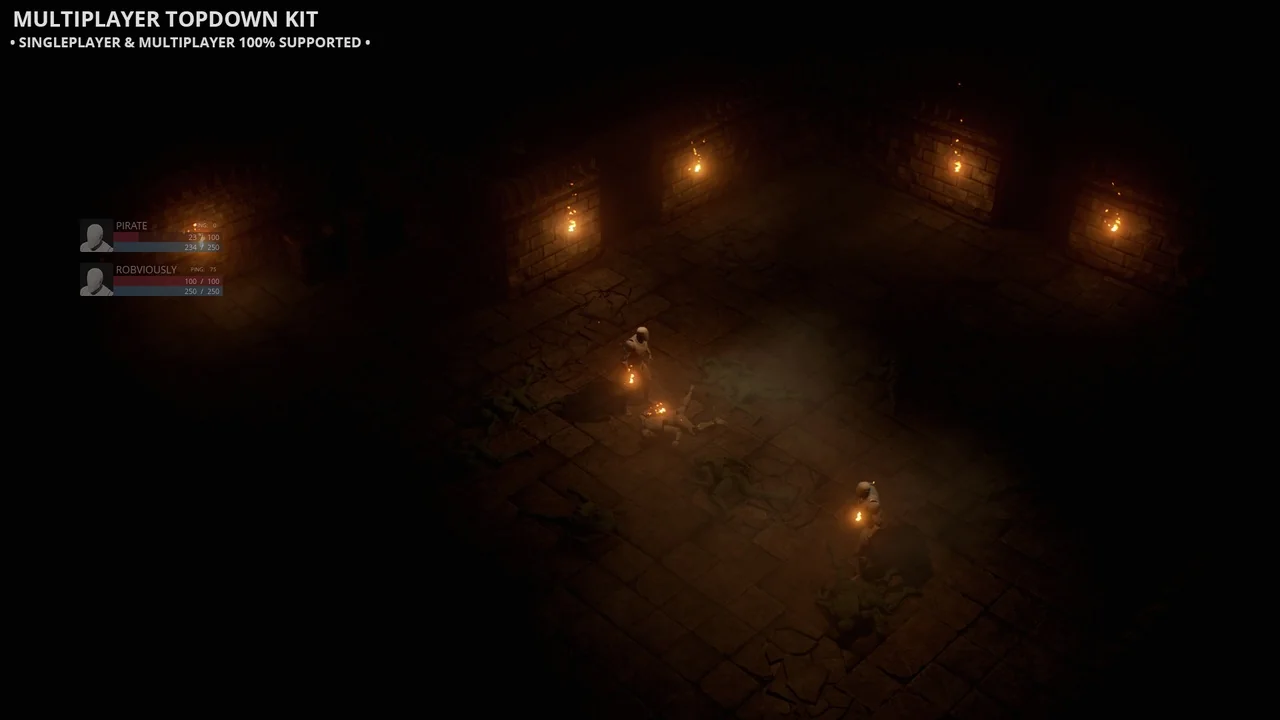
The Multiplayer TopDown Kit resolves this fundamental hurdle by delivering a fully networked click-to-move input system designed specifically for action gameplay. Clean, efficient, and easy to follow Blueprint code powers the core logic, ensuring that player movement commands communicate seamlessly across the network. Both single-player and multiplayer modes are one hundred percent supported directly out of the box, allowing gameplay logic to remain uniform regardless of network context. Rather than rebuilding input interpretation or authority validation when moving from local offline tests to online sessions, developers have a unified foundation that handles player directional commands smoothly.
Managing Game States from Startup to Multiplayer Sessions
Session creation, match discovery, and state switching frequently consume weeks of foundational work before core mechanics can be evaluated.
To remove this front-end friction, the kit includes a dedicated UI template wired directly to core game states, guiding the player journey through Startup, Main Menu, Multiplayer Menu, and active Playing environments. Underlying network session functions handle the technical workload of creating, finding, and joining matches over the network. This structured state flow means client-server connections can be established, tested, and stressed immediately without requiring a bespoke matchmaking shell or external session-handling wrappers during early development cycles.
Environmental Visibility with Light Radius Fog of War
Top-down presentation relies heavily on deliberate vision limits to build atmospheric tension and guide exploration.
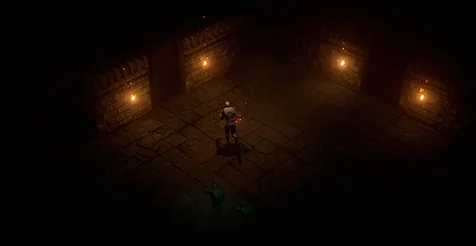
A light radius based fog of war system is embedded into the environment, shaping how players uncover the map as they navigate top-down or isometric spaces. By tying visibility directly to an illuminated perimeter around the player pawn, unrevealed terrain and distant threats remain concealed until approached. This creates an immediate visual framework suitable for dungeon exploration, tactical positioning, and territory control, giving level designers a direct gameplay mechanism to control information flow and surprise encounters across single-player journeys or cooperative multiplayer runs.
Fire Spells, Destructibles, and Target Interactions
Establishing clear boundaries between combat logic, player attributes, and environmental responses helps avoid messy gameplay scripting.
Rather than packaging an overbuilt or rigid combat system, the kit focuses on a clean demonstration of entity interaction through an example fire spell. This functional example illustrates how network authority arbitrates contact between players, non-player characters, world objects, and destructibles. Players interact with physical entities that can be manipulated, attacked, and ultimately broken down. Synchronized alongside these interactions is full player stat replication for core health and mana pools, validating that resource expenditures and damage events register authoritatively across all connected clients.
Stress Testing Encounters with 64+ AI Zombie Swarms
Evaluating server performance and replication stability demands dense enemy populations running continuous pathfinding and engagement routines.
The framework incorporates basic enemy artificial intelligence equipped with distinct AI states and functional melee attacks, populated by swarms featuring more than sixty-four AI zombies at once. This volume allows developers to evaluate immediate AI behaviors, path navigation, targeting loops, and network replication under substantial load. Watching large groups of hostile units acquire targets, execute melee swings, and react to incoming spell damage provides immediate validation of the server's ability to coordinate mass encounters without desynchronization.
Adapting the Foundation for Action RPGs and RTS Prototypes
A solid gameplay template should accelerate production without boxing developers into a single rigid genre implementation.
While immediately tailored for action RPG prototyping, the underlying click-to-move control scheme and responsive network code make the kit an adaptable base for MOBA or RTS style gameplay experiments with minor adjustments. Furthermore, compatibility with the Action RPG Inventory System enables teams to integrate deeper character progression, gear management, and itemization into the existing networked movement and interactive object loops. Whether utilized as a testbed for isometric combat timing or as the starting point for tactical multiplayer skirmishes, it provides an organized architectural launchpad.
 Action-Adventure
 Action-Adventure
 Action-Adventure
 Shooter