"031373f479d9561a"{"id":"1000238","slug":"mgt-multiplayer-gravity-template","title":"MGT Multiplayer Gravity Template","category":"Gameplay Features","engine":"5.3+","assetVersion":"","engineVersion":"Engine Version: 5.3+","tag":"Gameplay Features","accent":"blue","visual":"mech","summary":"A dynamic gravity system for Unreal Engine utilizing the native character movement component to support full multiplayer replication for players, objects, and A","platform":"Unreal Engine","publishedAt":"2026-06-30T18:11:03.499Z","updatedAt":"2026-06-30T18:11:03.499Z","sourceNotes":[],"fileContents":[],"compatibility":["Unreal Engine","Engine Version: 5.3+"],"featuredImage":{"alt":"MGT Multiplayer Gravity Template","src":"/wp-content/uploads/published/2026/06/3e9b12a8f9cc-951e39e8-6c7b-4772-975c-e63141c701c5-5cf67fa1da.webp"},"hasDownloadLink":true,"downloads":0,"terms":[{"taxonomy":"category","slug":"gameplay-features","name":"Gameplay Features"}],"galleryImages":[{"src":"/wp-content/uploads/published/2026/06/557462b9365a-89420585-f85f-438c-a1eb-c0a7762c6172-a96959bbab.webp","alt":"MGT Multiplayer Gravity Template"},{"src":"/wp-content/uploads/published/2026/06/0741d36eeff0-c1179893-5336-424b-8b41-9e2fbb467e11-6fad37dff7.webp","alt":"MGT Multiplayer Gravity Template"},{"src":"/wp-content/uploads/published/2026/06/fc1a90d2cb7a-237319d8-59d2-4724-86c8-1531d143f023-02e913d941.webp","alt":"MGT Multiplayer Gravity Template"},{"src":"/wp-content/uploads/published/2026/06/c82038f45270-c25aabb0-499a-4607-bea3-64762d14123b-97507ecb7d.webp","alt":"MGT Multiplayer Gravity Template"},{"src":"/wp-content/uploads/published/2026/06/f452ac0c053a-26817208-2761-462d-afed-8be248e492b8-eac5ae41f9.webp","alt":"MGT Multiplayer Gravity Template"},{"src":"/wp-content/uploads/published/2026/06/7e588a860d23-995a421b-9d95-4fb8-b64d-9c3f755ca09e-63226fbd1e.webp","alt":"MGT Multiplayer Gravity Template"},{"src":"/wp-content/uploads/published/2026/06/68eb21ce2e2e-a8ad1e85-44a8-4980-a318-e8a5bf600c62-98133da41e.webp","alt":"MGT Multiplayer Gravity Template"},{"src":"/wp-content/uploads/published/2026/06/a552bc44fe6d-90598255-0300-4116-9666-c48fef97deb9-3c76061edd.webp","alt":"MGT Multiplayer Gravity Template"},{"src":"/wp-content/uploads/published/2026/06/8a47b5fe57d0-812ab069-f0a8-4363-baa5-e6efd6d7e93a-a0c5d17a8b.webp","alt":"MGT Multiplayer Gravity Template"},{"src":"/wp-content/uploads/published/2026/06/f4f5a8c6602f-5f3a7013-5704-4f0e-8352-2c97dcc782a1-9ef6a138e4.webp","alt":"MGT Multiplayer Gravity Template"}],"accessPanel":{"kind":"resource","title":"Download this resource","eyebrow":"Free Download","message":"Log in or create a free account to start your download.","fileName":"MGTMultiplayerGravityTemp.7z","safetyNote":"Resources are manually reviewed before listing to improve quality and reduce obvious risks.","actionLabel":"Download Free","resourceType":"Resource archive"},"contentHtml":"\u003cp\u003eWhen building networked games that involve varied planetary surfaces, moving starships, or spherical worlds, handling gravity correctly across a server is notoriously difficult. Players navigating a spherical planet or walking on the ceiling of a moving vessel often experience intense lag or jitter. The MGT Multiplayer Gravity Template is a dynamic gravity system for Unreal Engine built specifically to solve these replication challenges. It provides real multiplayer dynamic gravity for players, physical objects, AI bots, and spaceships, allowing complex interactions to sync seamlessly across different clients.\u003c/p\u003e \u003ch2\u003eRelying on the Native Character Movement Component\u003c/h2\u003e \u003cp\u003eThe core architectural advantage of this template lies in how it handles the player character over a network. Unlike other altered gravity systems that struggle to support replication in multiplayer environments, MGT does not turn the player into a physical object. Forcing a character to act as a physics object often breaks standard network smoothing and movement logic.\u003c/p\u003e \u003cp\u003eInstead, this system relies directly on Unreal Engine's native character movement component. Using the standard movement component allows the template to benefit from all the native prediction systems designed and optimized by Epic Games. By keeping these prediction systems intact, the template limits multiplayer lag as much as possible, ensuring that a player’s movement across uneven or inverted surfaces remains smooth for everyone connected to the server. This architecture is an evolution of the mechanics originally developed for the game Galactic Goal, bringing a more advanced, network-ready implementation to new projects.\u003c/p\u003e \u003ch2\u003eMultiplayer Replication for Physical Objects and AI Bots\u003c/h2\u003e \u003cp\u003eGravity in a networked environment must affect more than just the player character to create a convincing world. The template ensures that dynamic gravity applies accurately to physical objects and AI bots across the server. If a player pushes a crate across the floor of a shifting spacecraft, all other players will see that object moving and settling in the exact same place.\u003c/p\u003e \u003cp\u003eThis localized gravity behavior allows developers to set up highly specific environments. For example, one player can be running along the surface of a cylinder while another player navigates a cone-shaped gravity field in the same level. The template also includes an AI bot navigation system demo, proving that computer-controlled characters can accurately pathfind and traverse these dynamic gravity fields alongside human players.\u003c/p\u003e \u003ch2\u003ePlanetary, Ring World, and Starship Gravity\u003c/h2\u003e \u003cp\u003eThe system provides multiple environmental applications for directional and dynamic gravity. Developers can implement standard directional gravity, planet-based gravity for spherical worlds, or specialized layouts like Ring World Gravity. Because the gravity calculations remain stable in multiplayer, the template has been successfully used to prototype expansive, planet-hopping mechanics. In one instance, a community developer utilized the template to recreate a Starfield-like planetary gravity system in just 48 hours.\u003c/p\u003e \u003cp\u003eFor vehicles and moving platforms, the template includes a Starship Gravity system. Currently in beta, this feature allows players to walk around inside a moving spaceship while the ship itself travels through a level. Insights from the developer community regarding the deep workings of Unreal Engine helped refine this feature, allowing the system to provide highly accurate, replicated starship gravity over a network. A video tutorial is provided within the project files to help developers reproduce the starship gravity setup in their own levels.\u003c/p\u003e \u003ch2\u003eCamera Modes and Animation Integrity\u003c/h2\u003e \u003cp\u003eShifting gravity angles can easily break character animations or camera orientations if not handled properly. The template natively supports complex character animations under altered gravity conditions. Characters can perform side steps, run diagonally, and transition between movement states without their animations breaking or clipping inappropriately due to the shifting gravity vectors.\u003c/p\u003e \u003cp\u003eTo support different game genres, the system includes four distinct camera modes. Developers can utilize a standard Third Person View, or switch to an FPS View. The FPS mode is currently in beta and requires Unreal Engine 5.1 or later to function correctly.\u003c/p\u003e \u003ch2\u003eExperimental Landscape and Voxel Integrations\u003c/h2\u003e \u003cp\u003eFor developers building massive procedural or voxel-based worlds, the template includes experimental integrations for popular world-building plugins. There is a beta implementation for MGT combined with Worldscape, as well as an alpha implementation for integrating MGT with the Voxel Plugin.\u003c/p\u003e \u003cp\u003eBecause these terrain systems handle collision and surface generation differently than standard static meshes, integrating dynamic multiplayer gravity requires specific workflows. Developers looking to use Worldscape or the Voxel Plugin alongside this gravity template are provided with dedicated video tutorials to guide them through the experimental setup process.\u003c/p\u003e \u003cp\u003eIntegrating replicated gravity into a project often requires careful adjustments based on the specific needs of the game. By maintaining the native character movement component and ensuring that physical objects and AI bots respect local gravity fields simultaneously, this template provides a highly optimized foundation for complex, multi-directional multiplayer environments.\u003c/p\u003e\n\n\u003ch2\u003eContinue Browsing Similar Packs\u003c/h2\u003e\n\u003cul\u003e\n\u003cli\u003e\u003ca href=\"https://3dcghub.com/universal-shooting-game-template-and-framework/\" title=\"Universal Shooting Game Template and Framework\"\u003eUniversal Shooting Game Template and Framework\u003c/a\u003e\u003c/li\u003e\n\u003cli\u003e\u003ca href=\"https://3dcghub.com/the-flashlight-toolkit/\" title=\"The Flashlight Toolkit\"\u003eThe Flashlight Toolkit\u003c/a\u003e\u003c/li\u003e\n\u003cli\u003e\u003ca href=\"https://3dcghub.com/advanced-framework-vr-mobile-desktop/\" title=\"Advanced Framework - VR, Mobile \u0026amp; Desktop\"\u003eAdvanced Framework - VR, Mobile \u0026amp; Desktop\u003c/a\u003e\u003c/li\u003e\n\u003cli\u003e\u003ca href=\"https://3dcghub.com/true-fighting-game-engine/\" title=\"TRUE Fighting Game Engine\"\u003eTRUE Fighting Game Engine\u003c/a\u003e\u003c/li\u003e\n\u003cli\u003e\u003ca href=\"https://3dcghub.com/teleportation-and-portal/\" title=\"Teleportation and Portal\"\u003eTeleportation and Portal\u003c/a\u003e\u003c/li\u003e\n\u003c/ul\u003e","contentTextLength":5640,"navigation":{"current":1111,"total":3223,"previous":{"id":"1000239","slug":"starsphere","title":"StarSphere","category":"Procedural Systems","platform":"Unreal Engine","updatedAt":"2026-06-30T18:21:56.068Z"},"next":{"id":"1000237","slug":"unreal-engine-5-for-absolute-beginners-build-subway-surfers","title":"Unreal Engine 5 for Absolute Beginners: Build Subway Surfers","category":"Unreal Engine","platform":"Unreal Engine","updatedAt":"2026-06-29T10:37:54.187Z"}},"relatedResources":[{"id":"11162","slug":"the-flashlight-toolkit","title":"The Flashlight Toolkit","category":"Gameplay Features","engine":"5.2+","assetVersion":"Engine version: 5.2+","engineVersion":"4.27","tag":"Gameplay Features","accent":"blue","visual":"mech","summary":"Add professional lighting mechanics to your project in minutes with this beginner-friendly system. It features net replication, an inventory manager, and full blueprint support.","platform":"Unreal Engine","publishedAt":"2026-03-03T17:02:40.000Z","updatedAt":"2026-04-19T15:48:15.000Z","sourceNotes":[],"fileContents":[],"compatibility":["Unreal Engine","Engine version: 5.2+"],"featuredImage":{"alt":"The Flashlight Toolkit","src":"https://3dcghub.com/wp-content/uploads/2026/03/2118b25e-a01e-49b5-b831-66eb5803d44a.webp"},"hasDownloadLink":true,"downloads":0},{"id":"11176","slug":"universal-shooting-game-template-and-framework","title":"Universal Shooting Game Template and Framework","category":"Gameplay Features","engine":"5.1+","assetVersion":"Engine version: 5.1+","engineVersion":"5.1","tag":"Gameplay Features","accent":"blue","visual":"character","summary":"A comprehensive, blueprint-only framework designed for creating shooting games with independent modules and multiplayer support. It features integrated AI, weapon systems, and character customization tools.","platform":"Unreal Engine","publishedAt":"2026-03-03T17:04:56.000Z","updatedAt":"2026-04-19T15:48:15.000Z","sourceNotes":[],"fileContents":[],"compatibility":["Unreal Engine","Engine version: 5.1+"],"featuredImage":{"alt":"Universal Shooting Game Template and Framework","src":"https://3dcghub.com/wp-content/uploads/2026/03/809586c9-06d5-4b25-8d10-adc2975bbd96.webp"},"hasDownloadLink":true,"downloads":0},{"id":"1001035","slug":"hyper-time-manager-system-v4","title":"Hyper Time Manager System v4","category":"Gameplay Features","engine":"5.7+","assetVersion":"Asset Version: v4","engineVersion":"Engine Version: 5.7+","tag":"Gameplay Features","accent":"blue","visual":"mech","summary":"Hyper Time Manager System v4 centralizes in-game time in the GameState, syncing NPC schedules, day-night cycles, and world events with Blueprint, multiplayer-re","platform":"Unreal Engine","publishedAt":"2026-08-25T11:24:46.098Z","updatedAt":"2026-08-25T11:24:46.098Z","sourceNotes":[],"fileContents":[],"compatibility":["Unreal Engine","Asset Version: v4","Engine Version: 5.7+"],"featuredImage":{"alt":"Hyper Time Manager System v4","src":"/wp-content/uploads/published/2026/08/0c6d2b9b85f3-d2a03156-4b13-4068-b29a-47eca06cd2d2-7cea1ff9c1.webp"},"hasDownloadLink":true,"downloads":2}]}
Gameplay Features
MGT Multiplayer Gravity Template
A dynamic gravity system for Unreal Engine utilizing the native character movement component to support full multiplayer replication for players, objects, and A
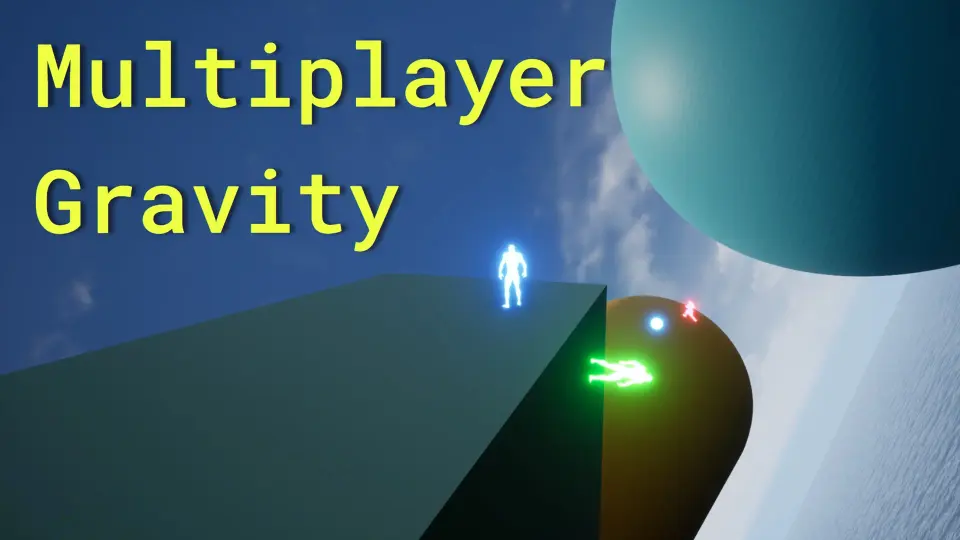
When building networked games that involve varied planetary surfaces, moving starships, or spherical worlds, handling gravity correctly across a server is notoriously difficult. Players navigating a spherical planet or walking on the ceiling of a moving vessel often experience intense lag or jitter. The MGT Multiplayer Gravity Template is a dynamic gravity system for Unreal Engine built specifically to solve these replication challenges. It provides real multiplayer dynamic gravity for players, physical objects, AI bots, and spaceships, allowing complex interactions to sync seamlessly across different clients.
Relying on the Native Character Movement Component
The core architectural advantage of this template lies in how it handles the player character over a network. Unlike other altered gravity systems that struggle to support replication in multiplayer environments, MGT does not turn the player into a physical object. Forcing a character to act as a physics object often breaks standard network smoothing and movement logic.
Instead, this system relies directly on Unreal Engine's native character movement component. Using the standard movement component allows the template to benefit from all the native prediction systems designed and optimized by Epic Games. By keeping these prediction systems intact, the template limits multiplayer lag as much as possible, ensuring that a player’s movement across uneven or inverted surfaces remains smooth for everyone connected to the server. This architecture is an evolution of the mechanics originally developed for the game Galactic Goal, bringing a more advanced, network-ready implementation to new projects.
Multiplayer Replication for Physical Objects and AI Bots
Gravity in a networked environment must affect more than just the player character to create a convincing world. The template ensures that dynamic gravity applies accurately to physical objects and AI bots across the server. If a player pushes a crate across the floor of a shifting spacecraft, all other players will see that object moving and settling in the exact same place.
This localized gravity behavior allows developers to set up highly specific environments. For example, one player can be running along the surface of a cylinder while another player navigates a cone-shaped gravity field in the same level. The template also includes an AI bot navigation system demo, proving that computer-controlled characters can accurately pathfind and traverse these dynamic gravity fields alongside human players.
Planetary, Ring World, and Starship Gravity
The system provides multiple environmental applications for directional and dynamic gravity. Developers can implement standard directional gravity, planet-based gravity for spherical worlds, or specialized layouts like Ring World Gravity. Because the gravity calculations remain stable in multiplayer, the template has been successfully used to prototype expansive, planet-hopping mechanics. In one instance, a community developer utilized the template to recreate a Starfield-like planetary gravity system in just 48 hours.
For vehicles and moving platforms, the template includes a Starship Gravity system. Currently in beta, this feature allows players to walk around inside a moving spaceship while the ship itself travels through a level. Insights from the developer community regarding the deep workings of Unreal Engine helped refine this feature, allowing the system to provide highly accurate, replicated starship gravity over a network. A video tutorial is provided within the project files to help developers reproduce the starship gravity setup in their own levels.
Camera Modes and Animation Integrity
Shifting gravity angles can easily break character animations or camera orientations if not handled properly. The template natively supports complex character animations under altered gravity conditions. Characters can perform side steps, run diagonally, and transition between movement states without their animations breaking or clipping inappropriately due to the shifting gravity vectors.
To support different game genres, the system includes four distinct camera modes. Developers can utilize a standard Third Person View, or switch to an FPS View. The FPS mode is currently in beta and requires Unreal Engine 5.1 or later to function correctly.
Experimental Landscape and Voxel Integrations
For developers building massive procedural or voxel-based worlds, the template includes experimental integrations for popular world-building plugins. There is a beta implementation for MGT combined with Worldscape, as well as an alpha implementation for integrating MGT with the Voxel Plugin.
Because these terrain systems handle collision and surface generation differently than standard static meshes, integrating dynamic multiplayer gravity requires specific workflows. Developers looking to use Worldscape or the Voxel Plugin alongside this gravity template are provided with dedicated video tutorials to guide them through the experimental setup process.
Integrating replicated gravity into a project often requires careful adjustments based on the specific needs of the game. By maintaining the native character movement component and ensuring that physical objects and AI bots respect local gravity fields simultaneously, this template provides a highly optimized foundation for complex, multi-directional multiplayer environments.
 Gameplay Features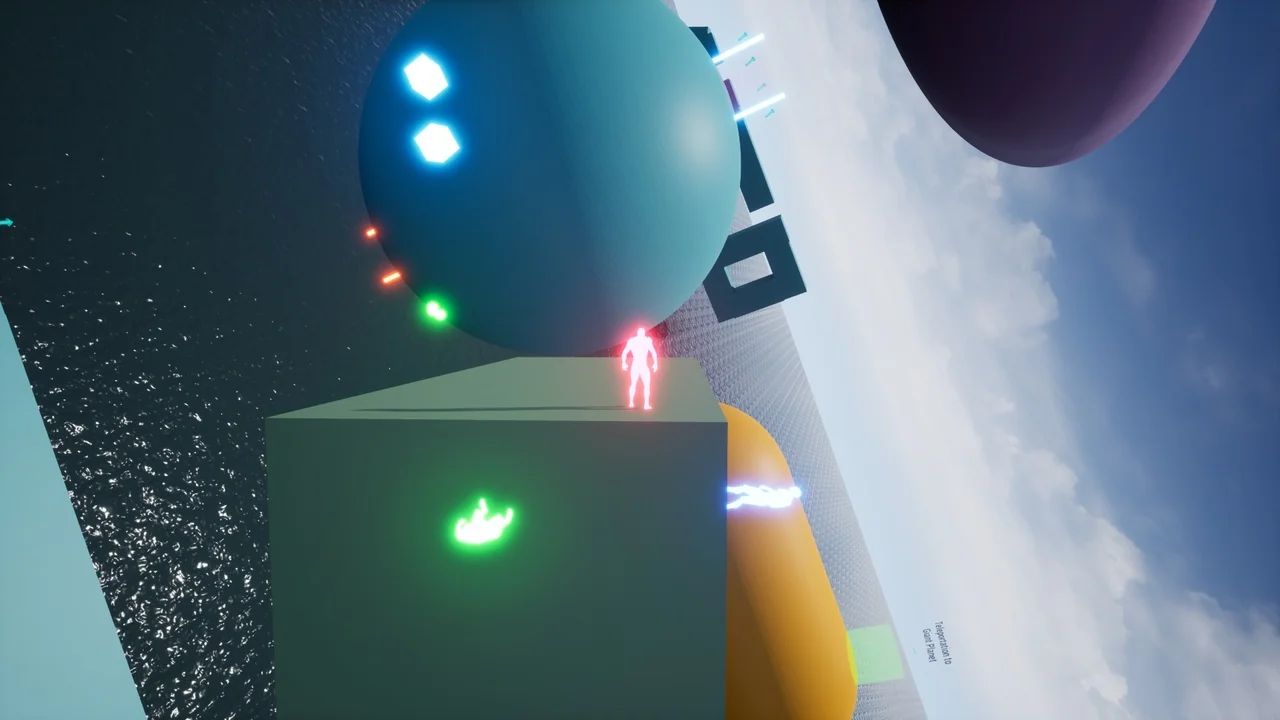
 Gameplay Features
 Gameplay Features
 Gameplay Features