"efaa631e936fd3ee"{"id":"1002144","slug":"plug-and-play-shooter-ai","title":"Plug and Play Shooter AI","category":"Gameplay Features","engine":"5.1+","assetVersion":"","engineVersion":"Engine Version: 5.1+","tag":"Gameplay Features","accent":"blue","visual":"mech","summary":"Explore Plug and Play Shooter AI, an easy-to-use combat AI system featuring multiplayer replication, 8 behaviors, sensory detection, and team battle mechanics.","platform":"Unreal Engine","publishedAt":"2026-10-29T09:49:02.781Z","updatedAt":"2026-10-29T09:49:02.781Z","sourceNotes":[],"fileContents":[],"compatibility":["Unreal Engine","Engine Version: 5.1+"],"featuredImage":{"alt":"Plug and Play Shooter AI","src":"/wp-content/uploads/published/2026/10/3949e381120d-eef9a93f-524d-4da1-b202-cfd3acc825b0-d4f0dde1a7.webp"},"hasDownloadLink":true,"downloads":0,"terms":[{"taxonomy":"category","slug":"gameplay-features","name":"Gameplay Features"}],"galleryImages":[{"src":"/wp-content/uploads/published/2026/10/159867de2934-a43136b6-4e69-45ca-8de8-299121aabf42-f5ac6721a4.webp","alt":"Plug and Play Shooter AI"},{"src":"/wp-content/uploads/published/2026/10/28b74c3e907c-bedbbcd9-e41f-476f-a1ee-67fd6e917d90-da8510080d.webp","alt":"Plug and Play Shooter AI"},{"src":"/wp-content/uploads/published/2026/10/4a5a6e6adcc6-1c105e0e-16a4-412d-85f4-528b76670ff4-29b4043c99.webp","alt":"Plug and Play Shooter AI"},{"src":"/wp-content/uploads/published/2026/10/e60aca7d4fbf-925fb8fb-8450-45f3-b823-d2468ee8545a-eb8a0a3b96.webp","alt":"Plug and Play Shooter AI"},{"src":"/wp-content/uploads/published/2026/10/51c680453398-9ac90fcc-a49e-45cf-93c3-d2140a35b352-caed44d771.webp","alt":"Plug and Play Shooter AI"}],"accessPanel":{"kind":"resource","title":"Download this resource","eyebrow":"Free Download","message":"Log in or create a free account to start your download.","fileName":"Content.7z","safetyNote":"Resources are manually reviewed before listing to improve quality and reduce obvious risks.","actionLabel":"Download Free","resourceType":"Resource archive"},"contentHtml":"\u003cp\u003eA responsive combat encounter requires non-player characters to evaluate their environment, detect potential threats, and react with appropriate tactical movement. Plug and Play Shooter AI establishes an immediate operational framework for combatants in both singleplayer campaigns and networked multiplayer sessions. Constructed entirely with Blueprints, the package eliminates extensive custom programming by supplying functional firearm-wielding combatants out of the box, allowing developers to integrate reactive enemies and friendly allies into levels within minutes.\u003c/p\u003e \u003ch2\u003eEight Core Behaviors Driving Shooter AI Logic\u003c/h2\u003e\n\u003cp\u003eCombat pacing hinges on state changes. Characters that simply charge in straight lines fail to create dynamic gameplay. This system incorporates eight distinct behavior modes, allowing creators to tailor how individual non-player characters patrol corridors, guard objectives, or react when engaged by gunfire.\u003c/p\u003e \u003cp\u003eAt the baseline level, units can remain in an Idle state to hold fixed defensive posts or monitor critical doorways. When broader map presence is required, the standard Roam state directs characters to navigate freely across walkable surfaces. For environments with known hostiles, Roam Aggressive modifies this wandering routine by prioritizing active weapon posture and immediate target acquisition over passive movement.\u003c/p\u003e \u003cp\u003eControlled navigation relies on the dedicated Patrol system. Using standard Patrol mode, non-player combatants traverse predefined patrol routes to secure perimeters. Switching to Patrol Aggressive instructs the AI to maintain a heightened combat posture along those identical paths, ensuring sentries do not drop their guard while moving between waypoints.\u003c/p\u003e \u003cp\u003eDirect combat interactions run on dynamic pursuit and evasion states. The Follow routine binds an agent to a specific friendly actor, functioning effectively for squad members or VIP protection missions. When overwhelmed or suffering critical damage, units can transition into the Flee behavior to break line of sight and retreat from active firefights. Once threats are identified and engaged, the Chase and Attack loop takes precedence, driving the AI to pursue moving targets, acquire firing positions, and discharge their rifles against designated hostiles.\u003c/p\u003e \u003ch2\u003eSensory Detection Through AI Sight and AI Hearing\u003c/h2\u003e\n\u003cp\u003eBehavior transitions only occur when an agent perceives a relevant change in the environment. Rather than relying on unnatural omniscient awareness, Plug and Play Shooter AI governs spatial interaction through dedicated AI Sight and AI Hearing systems.\u003c/p\u003e \u003cp\u003eThe visual detection model continuously scans for opposing units within a defined vision cone and sight range. Once an opponent breaks cover, the sighting mechanism triggers the transition out of passive states like Roam or Patrol and forces the AI into combat engagement. Environmental occlusions naturally block line of sight, enabling stealth gameplay where players can slip past sentries undetected.\u003c/p\u003e \u003cp\u003eComplementing visual awareness, auditory perception responds to acoustic events in the scene. Gunfire, rapid movement, and loud physical collisions produce sound cues that alert nearby units. When hearing detects an anomalous noise, combatants can break away from their regular movement loops to investigate the disturbance, creating tactical opportunities for players to create audible distractions or draw guards away from reinforced choke points.\u003c/p\u003e \u003ch2\u003eAI Teams and AI Battles Across Networked Matches\u003c/h2\u003e\n\u003cp\u003eExpanding combat encounters beyond basic player-versus-environment skirmishes requires faction alignment. The system features built-in support for AI Teams and AI Battles, allowing distinct non-player groups to wage war against one another alongside human participants. Assigning team identifiers to units dictates friend-or-foe recognition, ensuring characters bypass squad members to focus their weapon fire directly on opposing factions.\u003c/p\u003e \u003cp\u003eNetwork synchronization is fully accounted for through multiplayer support and character replication. Because the system is built with replication considerations from the ground up, agent positions, rotation, sensory alerts, weapon fire, and health updates stay consistent between server and client instances. This native replication makes the package functional not only for standard team deathmatch scenarios but also for asymmetric multiplayer horror environments where human survivors contend with persistent, server-authoritative adversaries wandering the darkness.\u003c/p\u003e \u003ch2\u003eSimple Health, Damage Handling, and the Dead Ragdoll System\u003c/h2\u003e\n\u003cp\u003eA shooter AI framework must reliably register ballistic impacts and manage character termination. Built into this system is a simple health and damage pipeline designed to interface directly with weapon strikes, whether dealing with single-shot rifle rounds or sustained automatic fire.\u003c/p\u003e \u003cp\u003eWhen an agent takes damage, the health calculation updates instantly, capable of driving state adaptations such as prompting a unit to flee or immediately retaliating against the damage source. Once health points reach zero, the standard animation state immediately yields to the Dead Ragdoll System. The skeletal mesh converts directly from kinematic animation to physical simulation, collapsing naturally against obstacles, stairs, and uneven terrain without frozen poses or awkward mid-air animation locks.\u003c/p\u003e \u003ch2\u003eBlueprint Workflow and Deployment Considerations\u003c/h2\u003e\n\u003cp\u003eBecause the logic is engineered as a standalone, self-contained AI asset, developers can drop these shooter agents into existing projects without navigating deep external framework dependencies. It is important to note that the package is designed independently, meaning compatibility with other separate AI assets produced by the developer has not been tested prior to deployment.\u003c/p\u003e \u003cp\u003eThe entire structure is accessible through visual scripting Blueprints, allowing game teams to inspect node chains, adjust detection radii, tune weapon rates of fire, and assign team affiliations without compiling native code. Teams building singleplayer military encounters, cooperative survival wave modes, or asymmetric horror experiences can use the system as a turnkey foundation to populate levels with capable, reactive riflemen that see, hear, navigate, and engage targets autonomously.\u003c/p\u003e\n\n\u003ch2\u003eExplore Similar Assets\u003c/h2\u003e\n\u003cul\u003e\n\u003cli\u003e\u003ca href=\"https://3dcghub.com/ai-shooter/\" title=\"AI Shooter\"\u003eAI Shooter\u003c/a\u003e\u003c/li\u003e\n\u003cli\u003e\u003ca href=\"https://3dcghub.com/dismemberment-kit-v2/\" title=\"Dismemberment Kit V2\"\u003eDismemberment Kit V2\u003c/a\u003e\u003c/li\u003e\n\u003cli\u003e\u003ca href=\"https://3dcghub.com/multiplayer-shooter-template-with-ai/\" title=\"Multiplayer Shooter Template With AI\"\u003eMultiplayer Shooter Template With AI\u003c/a\u003e\u003c/li\u003e\n\u003cli\u003e\u003ca href=\"https://3dcghub.com/true-fighting-game-engine/\" title=\"TRUE Fighting Game Engine\"\u003eTRUE Fighting Game Engine\u003c/a\u003e\u003c/li\u003e\n\u003cli\u003e\u003ca href=\"https://3dcghub.com/universal-shooting-game-template-and-framework/\" title=\"Universal Shooting Game Template and Framework\"\u003eUniversal Shooting Game Template and Framework\u003c/a\u003e\u003c/li\u003e\n\u003c/ul\u003e","contentTextLength":6440,"navigation":{"current":140,"total":4209,"previous":{"id":"1002145","slug":"police-radio-vol-1","title":"Police Radio Vol.1","category":"Sound Effects","platform":"Unreal Engine","updatedAt":"2026-10-29T09:50:37.560Z"},"next":{"id":"1002143","slug":"play-services-goodies","title":"Play Services Goodies","category":"Engine Tools","platform":"Unreal Engine","updatedAt":"2026-10-29T09:48:26.940Z"}},"relatedResources":[{"id":"1000936","slug":"ai-shooter","title":"AI Shooter","category":"Gameplay Features","engine":"5.3+","assetVersion":"","engineVersion":"Engine Version: 5.3+","tag":"Gameplay Features","accent":"blue","visual":"mech","summary":"AI Shooter is a starter pack for shooting-game AI, covering patrolling, flanking, cover seeking, sight, hearing, damage, and touch behaviors.","platform":"Unreal Engine","publishedAt":"2026-08-10T02:47:39.341Z","updatedAt":"2026-08-10T02:47:39.341Z","sourceNotes":[],"fileContents":[],"compatibility":["Unreal Engine","Engine Version: 5.3+"],"featuredImage":{"alt":"AI Shooter","src":"/wp-content/uploads/published/2026/08/4b2c0a56342a-043d1833-9b88-46a2-9b9f-3c2f0a0dc80a-2bfb059ea5.webp"},"hasDownloadLink":true,"downloads":1},{"id":"10714","slug":"dismemberment-kit-v2","title":"Dismemberment Kit V2","category":"Gameplay Features","engine":"5.3+","assetVersion":"Engine version: 5.3+","engineVersion":"4.27","tag":"Gameplay Features","accent":"blue","visual":"character","summary":"Dismemberment Kit V2 provides a streamlined, plug-and-play solution for adding realistic gore to your characters. This fully replicated component allows for quick mesh swapping and animation integration.","platform":"Unreal Engine","publishedAt":"2026-03-03T16:02:30.000Z","updatedAt":"2026-04-19T15:49:56.000Z","sourceNotes":[],"fileContents":[],"compatibility":["Unreal Engine","Engine version: 5.3+"],"featuredImage":{"alt":"Dismemberment Kit V2","src":"https://3dcghub.com/wp-content/uploads/2026/03/b9cd95a1-bf2a-4ab7-8393-7b2f8b103bd9.webp"},"hasDownloadLink":true,"downloads":7},{"id":"1001143","slug":"multiplayer-shooter-template-with-ai","title":"Multiplayer Shooter Template With AI","category":"Weapons \u0026 Combat","engine":"5.0+","assetVersion":"","engineVersion":"Engine Version: 5.0+","tag":"Weapons \u0026 Combat","accent":"blue","visual":"mech","summary":"Multiplayer Shooter Template With AI delivers full network replication, custom sensory AI, dynamic radar capture, and direct MetaHuman skeleton compatibility.","platform":"Unreal Engine","publishedAt":"2026-09-09T05:42:58.481Z","updatedAt":"2026-09-09T05:42:58.481Z","sourceNotes":[],"fileContents":[],"compatibility":["Unreal Engine","Engine Version: 5.0+"],"featuredImage":{"alt":"Multiplayer Shooter Template With AI","src":"/wp-content/uploads/published/2026/09/f9ce64bcb73f-d891bb99-f96d-4bc3-b423-edb9bcc0bf46-4cce92b723.webp"},"hasDownloadLink":true,"downloads":0}]}
Gameplay Features
Plug and Play Shooter AI
Explore Plug and Play Shooter AI, an easy-to-use combat AI system featuring multiplayer replication, 8 behaviors, sensory detection, and team battle mechanics.
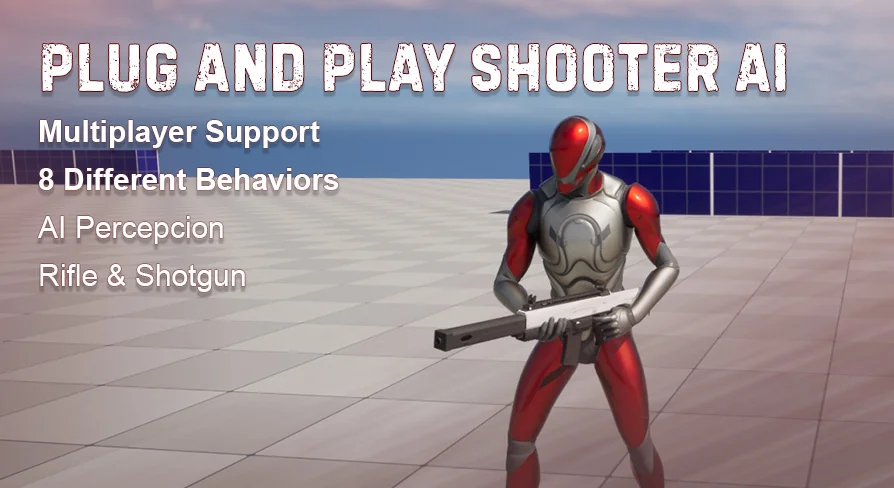
A responsive combat encounter requires non-player characters to evaluate their environment, detect potential threats, and react with appropriate tactical movement. Plug and Play Shooter AI establishes an immediate operational framework for combatants in both singleplayer campaigns and networked multiplayer sessions. Constructed entirely with Blueprints, the package eliminates extensive custom programming by supplying functional firearm-wielding combatants out of the box, allowing developers to integrate reactive enemies and friendly allies into levels within minutes.
Eight Core Behaviors Driving Shooter AI Logic
Combat pacing hinges on state changes. Characters that simply charge in straight lines fail to create dynamic gameplay. This system incorporates eight distinct behavior modes, allowing creators to tailor how individual non-player characters patrol corridors, guard objectives, or react when engaged by gunfire.
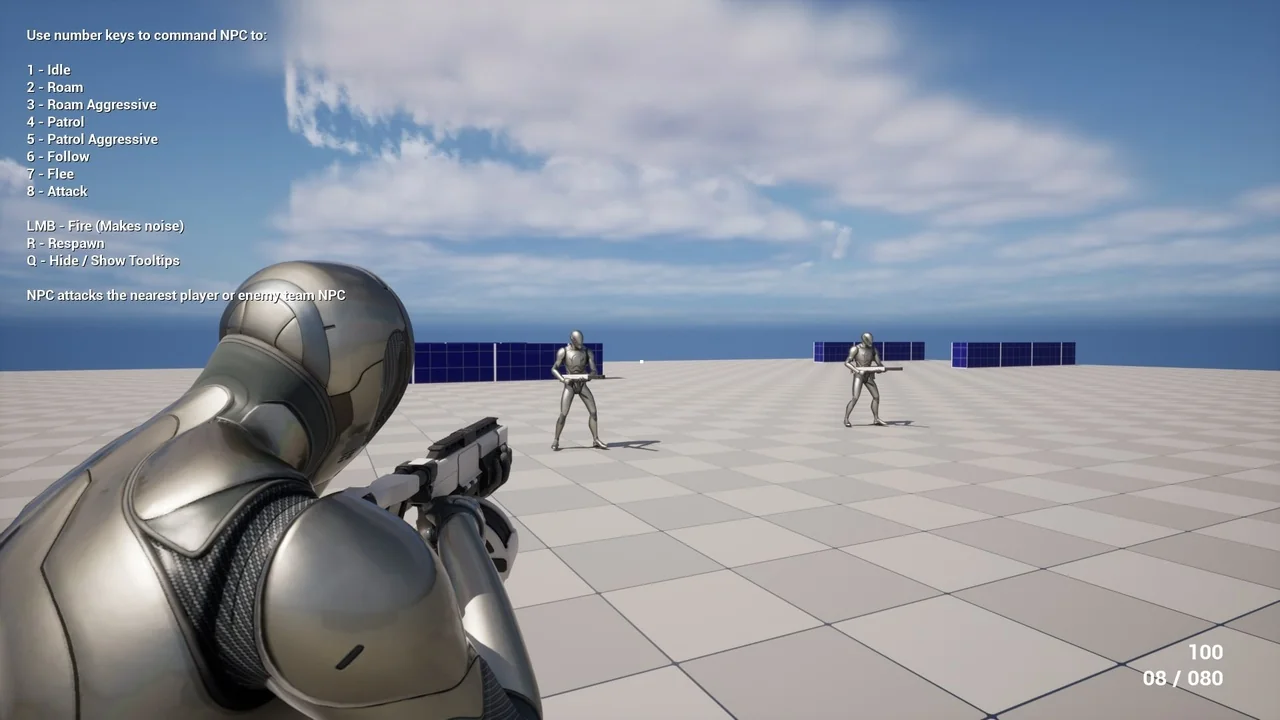
At the baseline level, units can remain in an Idle state to hold fixed defensive posts or monitor critical doorways. When broader map presence is required, the standard Roam state directs characters to navigate freely across walkable surfaces. For environments with known hostiles, Roam Aggressive modifies this wandering routine by prioritizing active weapon posture and immediate target acquisition over passive movement.
Controlled navigation relies on the dedicated Patrol system. Using standard Patrol mode, non-player combatants traverse predefined patrol routes to secure perimeters. Switching to Patrol Aggressive instructs the AI to maintain a heightened combat posture along those identical paths, ensuring sentries do not drop their guard while moving between waypoints.
Direct combat interactions run on dynamic pursuit and evasion states. The Follow routine binds an agent to a specific friendly actor, functioning effectively for squad members or VIP protection missions. When overwhelmed or suffering critical damage, units can transition into the Flee behavior to break line of sight and retreat from active firefights. Once threats are identified and engaged, the Chase and Attack loop takes precedence, driving the AI to pursue moving targets, acquire firing positions, and discharge their rifles against designated hostiles.
Sensory Detection Through AI Sight and AI Hearing
Behavior transitions only occur when an agent perceives a relevant change in the environment. Rather than relying on unnatural omniscient awareness, Plug and Play Shooter AI governs spatial interaction through dedicated AI Sight and AI Hearing systems.
The visual detection model continuously scans for opposing units within a defined vision cone and sight range. Once an opponent breaks cover, the sighting mechanism triggers the transition out of passive states like Roam or Patrol and forces the AI into combat engagement. Environmental occlusions naturally block line of sight, enabling stealth gameplay where players can slip past sentries undetected.
Complementing visual awareness, auditory perception responds to acoustic events in the scene. Gunfire, rapid movement, and loud physical collisions produce sound cues that alert nearby units. When hearing detects an anomalous noise, combatants can break away from their regular movement loops to investigate the disturbance, creating tactical opportunities for players to create audible distractions or draw guards away from reinforced choke points.
AI Teams and AI Battles Across Networked Matches
Expanding combat encounters beyond basic player-versus-environment skirmishes requires faction alignment. The system features built-in support for AI Teams and AI Battles, allowing distinct non-player groups to wage war against one another alongside human participants. Assigning team identifiers to units dictates friend-or-foe recognition, ensuring characters bypass squad members to focus their weapon fire directly on opposing factions.
Network synchronization is fully accounted for through multiplayer support and character replication. Because the system is built with replication considerations from the ground up, agent positions, rotation, sensory alerts, weapon fire, and health updates stay consistent between server and client instances. This native replication makes the package functional not only for standard team deathmatch scenarios but also for asymmetric multiplayer horror environments where human survivors contend with persistent, server-authoritative adversaries wandering the darkness.
Simple Health, Damage Handling, and the Dead Ragdoll System
A shooter AI framework must reliably register ballistic impacts and manage character termination. Built into this system is a simple health and damage pipeline designed to interface directly with weapon strikes, whether dealing with single-shot rifle rounds or sustained automatic fire.
When an agent takes damage, the health calculation updates instantly, capable of driving state adaptations such as prompting a unit to flee or immediately retaliating against the damage source. Once health points reach zero, the standard animation state immediately yields to the Dead Ragdoll System. The skeletal mesh converts directly from kinematic animation to physical simulation, collapsing naturally against obstacles, stairs, and uneven terrain without frozen poses or awkward mid-air animation locks.
Blueprint Workflow and Deployment Considerations
Because the logic is engineered as a standalone, self-contained AI asset, developers can drop these shooter agents into existing projects without navigating deep external framework dependencies. It is important to note that the package is designed independently, meaning compatibility with other separate AI assets produced by the developer has not been tested prior to deployment.
The entire structure is accessible through visual scripting Blueprints, allowing game teams to inspect node chains, adjust detection radii, tune weapon rates of fire, and assign team affiliations without compiling native code. Teams building singleplayer military encounters, cooperative survival wave modes, or asymmetric horror experiences can use the system as a turnkey foundation to populate levels with capable, reactive riflemen that see, hear, navigate, and engage targets autonomously.
 Gameplay Features
 Gameplay Features
 Gameplay Features
 Weapons & Combat