"7e6fc58c410f2894"{"id":"1000460","slug":"gbwflowmove-high-speed-movement-system-multiplayer-ready","title":"GBWFlowMove - High-speed Movement system, Multiplayer Ready!","category":"Gameplay Features","engine":"5.2","assetVersion":"Asset Version: 1.0","engineVersion":"Engine Version: 5.2","tag":"Gameplay Features","accent":"blue","visual":"mech","summary":"A C++ movement framework for Unreal Engine with multiplayer replication, parkour mechanics, climbing, sliding, and extensible blueprint support.","platform":"Unreal Engine","publishedAt":"2026-07-11T04:57:21.385Z","updatedAt":"2026-07-11T04:57:21.385Z","sourceNotes":[],"fileContents":[],"compatibility":["Unreal Engine","Asset Version: 1.0","Engine Version: 5.2"],"featuredImage":{"alt":"GBWFlowMove - High-speed Movement system, Multiplayer Ready!","src":"/wp-content/uploads/published/2026/07/4f5f17a6c2cd-1b507f9b-a941-4800-93c3-ab80dacc2004-1e6289d538.webp"},"hasDownloadLink":true,"downloads":0,"terms":[{"taxonomy":"category","slug":"gameplay-features-tools-and-plugins","name":"Gameplay Features"}],"galleryImages":[{"src":"/wp-content/uploads/published/2026/07/ab1afb968e04-5feb43a7-6d74-4d64-ad96-b0abefd11665-f048a70346.webp","alt":"GBWFlowMove - High-speed Movement system, Multiplayer Ready!"},{"src":"/wp-content/uploads/published/2026/07/48f572e811a7-663d7b76-3028-4ac5-84b8-53afc1848957-83e4392e23.webp","alt":"GBWFlowMove - High-speed Movement system, Multiplayer Ready!"},{"src":"/wp-content/uploads/published/2026/07/ee922eccdc27-21b47da9-7800-44c7-b6ab-719649c2addc-2f9e211ed3.webp","alt":"GBWFlowMove - High-speed Movement system, Multiplayer Ready!"},{"src":"/wp-content/uploads/published/2026/07/9d398b7fb832-67725440-57f5-4a57-8adf-15e0846833e5-c2cc8e8a18.webp","alt":"GBWFlowMove - High-speed Movement system, Multiplayer Ready!"},{"src":"/wp-content/uploads/published/2026/07/5287f329318a-9c56844c-eeb4-42d9-838d-3dcc17611fc4-5899c5221a.webp","alt":"GBWFlowMove - High-speed Movement system, Multiplayer Ready!"},{"src":"/wp-content/uploads/published/2026/07/581672f8dd5a-34359228-a8f1-474b-9940-74b321d93f59-9ea161d059.webp","alt":"GBWFlowMove - High-speed Movement system, Multiplayer Ready!"},{"src":"/wp-content/uploads/published/2026/07/e932d74dfc78-bef6d38c-3c25-4872-b860-88ac63cc9817-6ab6ad3919.webp","alt":"GBWFlowMove - High-speed Movement system, Multiplayer Ready!"},{"src":"/wp-content/uploads/published/2026/07/9a4a43498811-eed6bf7a-2603-4727-ac6d-eb45078411b2-5fae83d808.webp","alt":"GBWFlowMove - High-speed Movement system, Multiplayer Ready!"},{"src":"/wp-content/uploads/published/2026/07/1f0ffe8fbe35-08626065-3c5c-471c-811f-138785e155da-b739e8f67a.webp","alt":"GBWFlowMove - High-speed Movement system, Multiplayer Ready!"},{"src":"/wp-content/uploads/published/2026/07/f6ed6476c46a-477ee4ac-8a6a-4e5f-be67-1134af5c3406-a9b1c39156.webp","alt":"GBWFlowMove - High-speed Movement system, Multiplayer Ready!"}],"accessPanel":{"kind":"resource","title":"Download this resource","eyebrow":"Free Download","message":"Log in or create a free account to start your download.","fileName":"5.2,v1.0.7z","safetyNote":"Resources are manually reviewed before listing to improve quality and reduce obvious risks.","actionLabel":"Download Free","resourceType":"Resource archive"},"contentHtml":"\u003cp\u003eCharacters in games often get stuck on obstacles or move in rigid, pre-programmed ways. GBWFlowMove is a movement system built to solve this by letting characters run through almost any scene while automatically overcoming terrain.\u003c/p\u003e\u003cp\u003eThe system handles expressive movement types out of the box. Characters can dodge, sprint, climb, slide, pedal along walls, glide, and perform targeted qualitative movement toward specific points. The goal is high-speed, fluid traversal that adapts to the environment without manual intervention.\u003c/p\u003e\u003ch2\u003eWhat FlowMove Actually Is\u003c/h2\u003e\u003cp\u003eGBWFlowMove is fully implemented in C++ and works in both C++ and Blueprint. It is not just a set of movement states; it is a framework made for extension.\u003c/p\u003e\u003cp\u003eBy inheriting from the base classes provided by the system, developers can customize Perceptrons, Move controls, and runtime scripting logic. Every customization path works in both C++ and Blueprint, so teams are not locked into a single workflow.\u003c/p\u003e\u003ch3\u003eHow FlowMove Differs From Other Movement Systems\u003c/h3\u003e\u003cp\u003eMost movement systems on the market predefine a character's movement states. Under those systems, a developer's only real option is replacing assets within those restricted states. FlowMove takes a different approach by exposing a framework where new movement logic can be built from the ground up.\u003c/p\u003e\u003cp\u003eAnother key distinction is that many existing systems are based on animation blueprints. That creates a problem: integrating them means modifying your own animation system to fit. FlowMove avoids that dependency, so the animation system does not need to be reworked to use it.\u003c/p\u003e\u003ch2\u003eMultiplayer Replication Without the Headache\u003c/h2\u003e\u003cp\u003eNetwork replication is one of the hardest parts of building multiplayer movement. FlowMove nearly eliminates the need to think about complex replication issues. The framework handles that layer, freeing developers to focus on game logic rather than synchronization code.\u003c/p\u003e\u003cp\u003eBecause the system is tagged as replicated and multiplayer-ready, it is built from the ground up to work in networked environments. The base classes manage the underlying replication so custom movement extensions do not require writing network code from scratch.\u003c/p\u003e\u003ch2\u003eExtending FlowMove Through Base Class Inheritance\u003c/h2\u003e\u003cp\u003eThe framework is structured around inheritable base classes. A developer who wants custom Perceptrons, custom Move control behavior, or new runtime scripting logic can subclass the provided classes and override or extend the relevant functions.\u003c/p\u003e\u003cp\u003eEvery customization path is available in both C++ and Blueprint. This means a developer working entirely in Blueprint can still tap into the framework's extensibility without dropping into C++. A team mixing both languages can divide work between programmers using C++ and designers using Blueprint without hitting a wall in the movement system.\u003c/p\u003e\u003ch3\u003ePerceptrons and Move Control\u003c/h3\u003e\u003cp\u003ePerceptrons in FlowMove serve as the environmental and contextual awareness layer that feeds movement decisions. Because they are customizable through inheritance, a developer can change how the character detects surfaces, edge cases, or traversal opportunities without rewriting the entire movement stack.\u003c/p\u003e\u003cp\u003eMove control governs how the character physically responds. Customizing it lets a project define its own rules for sprinting, climbing, dodging, and gliding, all within the same framework. Runtime scripting logic ties those layers together, letting behavior change dynamically during gameplay.\u003c/p\u003e\u003ch2\u003eProjects and Scenes That Fit the System\u003c/h2\u003e\u003cp\u003eFlowMove targets games where fast, expressive movement through varied terrain matters. A parkour game with dense urban geometry, an action game with vertical combat, or an adventure game requiring climbing and gliding traversal would all fit the system's strengths.\u003c/p\u003e\u003cp\u003eBecause the character automatically overcomes obstacles, FlowMove is useful in any scene with complex level design. The system is built to let players run through almost any environment the designer creates.\u003c/p\u003e\u003ch2\u003eWhat the Package Does Not Include\u003c/h2\u003e\u003cp\u003eThe product does not include the character and scenery assets shown in the demonstration materials. Developers need to provide their own characters and environmental art. What FlowMove delivers is the movement framework and logic, not a visual content pack.\u003c/p\u003e\u003cp\u003eA playable demo is available for those who want to try the system before committing. Documentation and tutorials are also provided, covering setup and extension. Support is available through community channels where the developer can answer questions. The developer also offers another asset called GBWGame alongside this one.\u003c/p\u003e\u003ch2\u003eWho Benefits From FlowMove\u003c/h2\u003e\u003cp\u003eTeams building a multiplayer Unreal Engine game where movement is a central mechanic will get the most from FlowMove. The framework handles replication and exposes an extensible base so a project can define its own traversal style rather than swapping assets inside fixed states.\u003c/p\u003e\u003cp\u003eSolo developers who want a movement system they can grow over time also fit the target profile. Because Blueprint support matches C++ support for all customization paths, a developer who does not write C++ can still build custom Perceptrons, Move controls, and runtime scripting logic. That makes FlowMove suitable for creators who need depth without a programming-heavy workflow.\u003c/p\u003e\n\n\u003ch2\u003eMore From The Same Workflow\u003c/h2\u003e\n\u003cul\u003e\n\u003cli\u003e\u003ca href=\"https://3dcghub.com/ultimate-gameplay-camera/\" title=\"Ultimate Gameplay Camera\"\u003eUltimate Gameplay Camera\u003c/a\u003e\u003c/li\u003e\n\u003cli\u003e\u003ca href=\"https://3dcghub.com/path-follow/\" title=\"Path Follow\"\u003ePath Follow\u003c/a\u003e\u003c/li\u003e\n\u003cli\u003e\u003ca href=\"https://3dcghub.com/mgt-multiplayer-gravity-template/\" title=\"MGT Multiplayer Gravity Template\"\u003eMGT Multiplayer Gravity Template\u003c/a\u003e\u003c/li\u003e\n\u003cli\u003e\u003ca href=\"https://3dcghub.com/advanced-framework-vr-mobile-desktop/\" title=\"Advanced Framework - VR, Mobile \u0026amp; Desktop\"\u003eAdvanced Framework - VR, Mobile \u0026amp; Desktop\u003c/a\u003e\u003c/li\u003e\n\u003cli\u003e\u003ca href=\"https://3dcghub.com/fire-chat-pro-groups-pms-proximity-and-world-chat-with-adjustable-range/\" title=\"Fire Chat PRO – Groups, PMs, Proximity and World Chat with adjustable range\"\u003eFire Chat PRO – Groups, PMs, Proximity and World Chat with adjustable range\u003c/a\u003e\u003c/li\u003e\n\u003c/ul\u003e","contentTextLength":5474,"navigation":{"current":1299,"total":3618,"previous":{"id":"15266","slug":"global-world-optimization-framework-pro-max-high-performance-for-large-worlds","title":"Global World Optimization Framework PRO MAX - High Performance for Large Worlds","category":"Procedural Systems","platform":"Unreal Engine","updatedAt":"2026-07-11T05:24:34.488Z"},"next":{"id":"1000459","slug":"fighter-drone","title":"Fighter Drone","category":"Characters \u0026 Creatures","platform":"Unreal Engine","updatedAt":"2026-07-11T04:47:57.511Z"}},"relatedResources":[{"id":"14999","slug":"customizable-interaction-plugin","title":"Customizable Interaction Plugin","category":"Gameplay Features","engine":"5.2 - 5.7","assetVersion":"Asset Version:1.0.1 - 2.0.4","engineVersion":"Engine version: 5.2 - 5.7","tag":"Gameplay Features","accent":"blue","visual":"character","summary":"The Customizable Interaction Plugin is a high-performance C++ tool designed for easy implementation. It features various interaction modes, detection settings, and full network replication.","platform":"Unreal Engine","publishedAt":"2026-03-12T07:22:15.000Z","updatedAt":"2026-09-30T04:21:56.258Z","sourceNotes":[],"fileContents":[],"compatibility":["Unreal Engine","Asset Version:1.0.1 - 2.0.4","Engine version: 5.2 - 5.7"],"featuredImage":{"alt":"Customizable Interaction Plugin","src":"https://3dcghub.com/wp-content/uploads/2026/03/61633308-c75d-4c5d-99bd-54efe2e0d535.webp"},"hasDownloadLink":true,"downloads":3},{"id":"15108","slug":"ultimate-gameplay-camera","title":"Ultimate Gameplay Camera","category":"Gameplay Features","engine":"5.3 - 5.5","assetVersion":"Engine version: 5.3 - 5.5","engineVersion":"Asset Version:1.3","tag":"Gameplay Features","accent":"blue","visual":"audio","summary":"The Ultimate Gameplay Camera provides a professional-grade, dynamic third-person camera system for Unreal Engine. It features smooth movement, multiplayer replication, and extensive customization options without requiring C++ knowledge.","platform":"Unreal Engine","publishedAt":"2026-03-12T07:52:43.000Z","updatedAt":"2026-04-19T15:45:35.000Z","sourceNotes":[],"fileContents":[],"compatibility":["Unreal Engine","Engine version: 5.3 - 5.5","Asset Version: 1.3"],"featuredImage":{"alt":"Ultimate Gameplay Camera","src":"https://3dcghub.com/wp-content/uploads/2026/03/89e2406f-10ab-4f8a-97aa-fa74ad5bc513.webp"},"hasDownloadLink":true,"downloads":1},{"id":"15069","slug":"path-follow","title":"Path Follow","category":"Gameplay Features","engine":"5.6 - 5.7","assetVersion":"Engine version: 5.6 - 5.7","engineVersion":"Asset Version:1.1","tag":"Gameplay Features","accent":"blue","visual":"luts","summary":"Path Follow provides developers with complete control over actor movement along spline paths in Unreal Engine 4. This versatile tool supports event triggers, runtime speed adjustments, and seamless VR and mobile integration.","platform":"Unreal Engine","publishedAt":"2026-03-12T07:42:28.000Z","updatedAt":"2026-04-19T15:45:35.000Z","sourceNotes":[],"fileContents":[],"compatibility":["Unreal Engine","Engine version: 5.6 - 5.7","Asset Version: 1.1"],"featuredImage":{"alt":"Path Follow","src":"https://3dcghub.com/wp-content/uploads/2026/03/9185d0b2-142e-484c-83cc-afe1bd97960a.webp"},"hasDownloadLink":true,"downloads":1}]}
Gameplay Features
GBWFlowMove - High-speed Movement system, Multiplayer Ready!
A C++ movement framework for Unreal Engine with multiplayer replication, parkour mechanics, climbing, sliding, and extensible blueprint support.
Characters in games often get stuck on obstacles or move in rigid, pre-programmed ways. GBWFlowMove is a movement system built to solve this by letting characters run through almost any scene while automatically overcoming terrain.
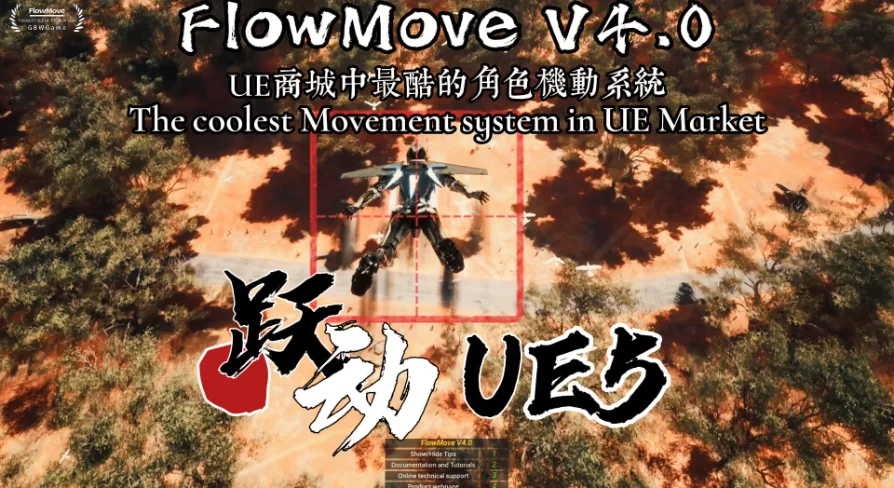
The system handles expressive movement types out of the box. Characters can dodge, sprint, climb, slide, pedal along walls, glide, and perform targeted qualitative movement toward specific points. The goal is high-speed, fluid traversal that adapts to the environment without manual intervention.
What FlowMove Actually Is
GBWFlowMove is fully implemented in C++ and works in both C++ and Blueprint. It is not just a set of movement states; it is a framework made for extension.
By inheriting from the base classes provided by the system, developers can customize Perceptrons, Move controls, and runtime scripting logic. Every customization path works in both C++ and Blueprint, so teams are not locked into a single workflow.
How FlowMove Differs From Other Movement Systems
Most movement systems on the market predefine a character's movement states. Under those systems, a developer's only real option is replacing assets within those restricted states. FlowMove takes a different approach by exposing a framework where new movement logic can be built from the ground up.
Another key distinction is that many existing systems are based on animation blueprints. That creates a problem: integrating them means modifying your own animation system to fit. FlowMove avoids that dependency, so the animation system does not need to be reworked to use it.
Multiplayer Replication Without the Headache
Network replication is one of the hardest parts of building multiplayer movement. FlowMove nearly eliminates the need to think about complex replication issues. The framework handles that layer, freeing developers to focus on game logic rather than synchronization code.
Because the system is tagged as replicated and multiplayer-ready, it is built from the ground up to work in networked environments. The base classes manage the underlying replication so custom movement extensions do not require writing network code from scratch.
Extending FlowMove Through Base Class Inheritance
The framework is structured around inheritable base classes. A developer who wants custom Perceptrons, custom Move control behavior, or new runtime scripting logic can subclass the provided classes and override or extend the relevant functions.
Every customization path is available in both C++ and Blueprint. This means a developer working entirely in Blueprint can still tap into the framework's extensibility without dropping into C++. A team mixing both languages can divide work between programmers using C++ and designers using Blueprint without hitting a wall in the movement system.
Perceptrons and Move Control
Perceptrons in FlowMove serve as the environmental and contextual awareness layer that feeds movement decisions. Because they are customizable through inheritance, a developer can change how the character detects surfaces, edge cases, or traversal opportunities without rewriting the entire movement stack.
Move control governs how the character physically responds. Customizing it lets a project define its own rules for sprinting, climbing, dodging, and gliding, all within the same framework. Runtime scripting logic ties those layers together, letting behavior change dynamically during gameplay.
Projects and Scenes That Fit the System
FlowMove targets games where fast, expressive movement through varied terrain matters. A parkour game with dense urban geometry, an action game with vertical combat, or an adventure game requiring climbing and gliding traversal would all fit the system's strengths.
Because the character automatically overcomes obstacles, FlowMove is useful in any scene with complex level design. The system is built to let players run through almost any environment the designer creates.
What the Package Does Not Include
The product does not include the character and scenery assets shown in the demonstration materials. Developers need to provide their own characters and environmental art. What FlowMove delivers is the movement framework and logic, not a visual content pack.
A playable demo is available for those who want to try the system before committing. Documentation and tutorials are also provided, covering setup and extension. Support is available through community channels where the developer can answer questions. The developer also offers another asset called GBWGame alongside this one.
Who Benefits From FlowMove
Teams building a multiplayer Unreal Engine game where movement is a central mechanic will get the most from FlowMove. The framework handles replication and exposes an extensible base so a project can define its own traversal style rather than swapping assets inside fixed states.
Solo developers who want a movement system they can grow over time also fit the target profile. Because Blueprint support matches C++ support for all customization paths, a developer who does not write C++ can still build custom Perceptrons, Move controls, and runtime scripting logic. That makes FlowMove suitable for creators who need depth without a programming-heavy workflow.
 Gameplay Features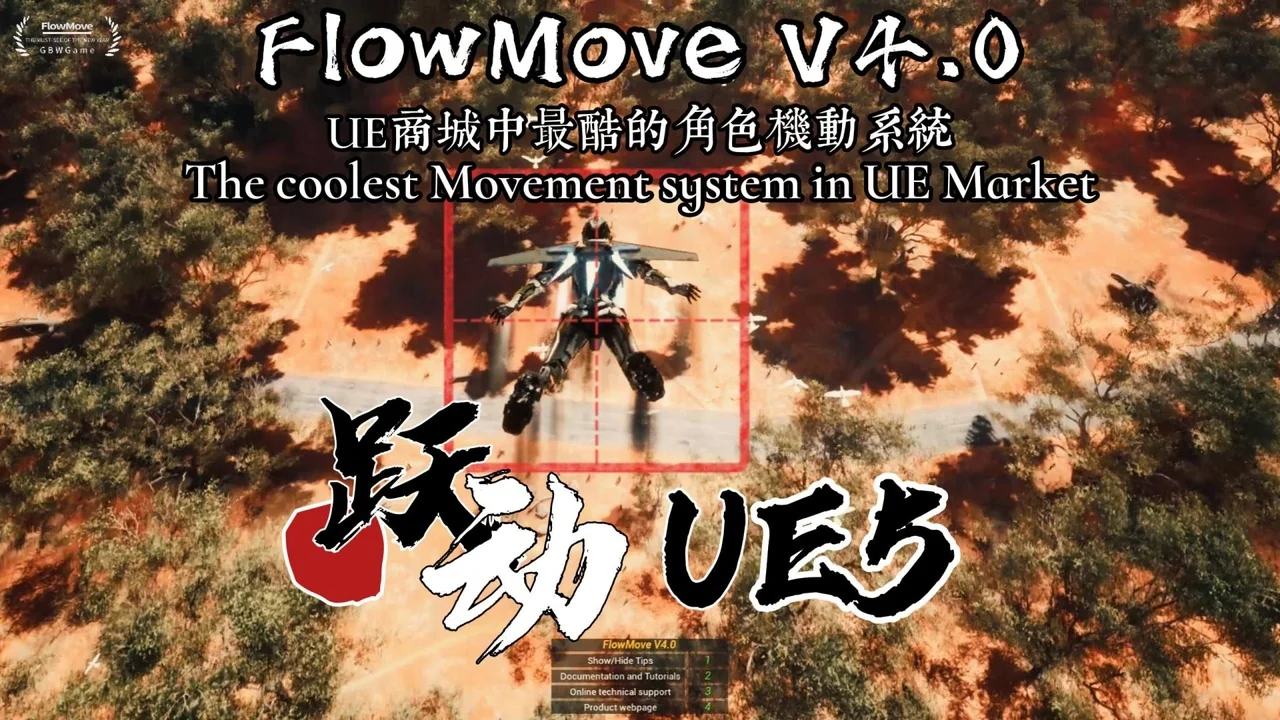
 Gameplay Features
 Gameplay Features
 Gameplay Features