"ddd0e3fb95b0aec2"{"id":"1001035","slug":"hyper-time-manager-system-v4","title":"Hyper Time Manager System v4","category":"Gameplay Features","engine":"5.7+","assetVersion":"Asset Version: v4","engineVersion":"Engine Version: 5.7+","tag":"Gameplay Features","accent":"blue","visual":"mech","summary":"Hyper Time Manager System v4 centralizes in-game time in the GameState, syncing NPC schedules, day-night cycles, and world events with Blueprint, multiplayer-re","platform":"Unreal Engine","publishedAt":"2026-08-25T11:24:46.098Z","updatedAt":"2026-08-25T11:24:46.098Z","sourceNotes":[],"fileContents":[],"compatibility":["Unreal Engine","Asset Version: v4","Engine Version: 5.7+"],"featuredImage":{"alt":"Hyper Time Manager System v4","src":"/wp-content/uploads/published/2026/08/0c6d2b9b85f3-d2a03156-4b13-4068-b29a-47eca06cd2d2-7cea1ff9c1.webp"},"hasDownloadLink":true,"downloads":2,"terms":[{"taxonomy":"category","slug":"gameplay-features","name":"Gameplay Features"}],"galleryImages":[{"src":"/wp-content/uploads/published/2026/08/ec66ee02de32-135c0bd1-4642-4a9a-9427-f8f9351060db-fdc36c567a.webp","alt":"Hyper Time Manager System v4"},{"src":"/wp-content/uploads/published/2026/08/538f834c9f77-7149db5a-d577-487c-93b9-380f525491ca-d673d5bfbd.webp","alt":"Hyper Time Manager System v4"},{"src":"/wp-content/uploads/published/2026/08/710ff53da446-51c67d3e-ca4a-4656-a215-666cb6ab62ba-1c84efafb6.webp","alt":"Hyper Time Manager System v4"},{"src":"/wp-content/uploads/published/2026/08/2a8c77b71a4d-1d184fdf-4ea1-4e46-a0b4-7c9a2589edc2-862d28a349.webp","alt":"Hyper Time Manager System v4"}],"accessPanel":{"kind":"resource","title":"Download this resource","eyebrow":"Free Download","message":"Log in or create a free account to start your download.","fileName":"HyperTime.7z","safetyNote":"Resources are manually reviewed before listing to improve quality and reduce obvious risks.","actionLabel":"Download Free","resourceType":"Resource archive"},"contentHtml":"\u003cp\u003eAt the center of the Hyper Time Manager System v4 is a single clock that every other system can trust. The time authority lives in the GameState, so NPC schedules, day-night cycles, quest triggers, and world events all read from the same source of truth. When that time changes, every listening system reacts at the same moment, which keeps a living world from drifting into contradictions.\u003c/p\u003e \u003cp\u003eThe system was built to give developers full control over in-game time without requiring a bespoke solution for each feature. Instead of wiring each gameplay mechanic to its own timer, the Hyper Time Manager provides one synchronized foundation that other modules can bind to. It is 100% Blueprint, multiplayer-ready, modular, and fully customizable, making it appropriate for projects that want to iterate quickly without sacrificing consistency.\u003c/p\u003e \u003ch2\u003eA Single Time Authority in the GameState\u003c/h2\u003e \u003cp\u003eStoring time centrally in the GameState is the core architectural decision behind this system. Because the GameState is replicated and shared across clients, every player sees the same current time. Systems that need to stay in sync — from quests to environment changes — can bind directly to this authority rather than maintaining separate local timers that might disagree.\u003c/p\u003e \u003cp\u003eThis matters most in multiplayer projects where small timing differences become visible. A quest that is supposed to unlock at sunset, an NPC that should leave their post at a specific hour, or a world event that resets at dawn all benefit from a single, authoritative clock. The developer designed the system so that all connected systems stay perfectly in sync by default.\u003c/p\u003e \u003ch2\u003eLetting Players Skip Time by Interacting with Objects\u003c/h2\u003e \u003cp\u003eThe Hyper Time Manager System v4 introduces interactive time manipulation as a direct gameplay feature. Players can skip time by interacting with objects like beds, advancing the world clock to a specific hour. This gives designers a clear way to let players control pacing and immersion without breaking the synchronization of other systems.\u003c/p\u003e \u003cp\u003eFor example, a survival game might use a bed to fast-forward to morning, triggering the day-night cycle to update, NPC schedules to progress, and environment changes to occur exactly when they should. The interaction hooks into the central authority, so the skipped time ripples through every connected system automatically.\u003c/p\u003e \u003cp\u003eThis is not a simple cinematic fade to black. The system is built to advance time in a way that keeps gameplay mechanics continuous, making it a practical tool for pacing.\u003c/p\u003e \u003ch2\u003eTime Zones, Non-Linear Timelines, and Custom Scales\u003c/h2\u003e \u003cp\u003eBeyond a straight linear clock, the system supports advanced time management features. Developers can define non-linear timelines, which is useful when a world’s passage of time should not behave like a real 24-hour cycle. Custom time scales allow portions of the game to run faster or slower, enabling dramatic time-of-day shifts or prolonged dusk periods.\u003c/p\u003e \u003cp\u003eDynamic schedules for time-based events can be based on these variable timelines. Instead of hardcoding a specific hour, an event can be tied to a schedule that respects the current time scale and timeline definition. This flexibility makes the system suitable for strategy games that compress time, RPGs that use narrative time jumps, and simulations that need day cycles to match gameplay pace.\u003c/p\u003e \u003cp\u003eThe system also allows unique time zones to be assigned to different regions of the world. This creates gameplay contrast between areas — one region might be locked in a long winter night while another experiences midday. The time-zone system is made for added realism as well as deliberate mechanical differences between zones.\u003c/p\u003e \u003ch2\u003eConnecting Dispatchers to NPC Routines and Environment Changes\u003c/h2\u003e \u003cp\u003eIntegration with existing gameplay logic is handled through flexible dispatchers. These dispatchers let developers connect the Hyper Time Manager to their own systems — day-night cycles, NPC routines, environment changes, and more. Rather than forcing a particular architecture, the system exposes events that other Blueprints can listen to and respond to in their own way.\u003c/p\u003e \u003cp\u003eFor NPC schedules, this means a character can react to the time of day without constantly polling the clock. For environment changes, lighting, foliage, or weather can be triggered when the central authority crosses configured thresholds. Quest designers can also use time as a condition, allowing objectives to activate only during specific windows.\u003c/p\u003e \u003cp\u003eBecause the integration layer is dispatcher-based, it works cleanly across different project sizes. A small adventure game might only use the day-night cycle, while a larger open-world project can feed time data into dozens of independent subsystems.\u003c/p\u003e \u003ch2\u003eStandalone or Stacked with Other Hyper Modules\u003c/h2\u003e \u003cp\u003eThe Hyper Time Manager System v4 is designed to fit a range of projects, from RPGs and survival games to open worlds, adventures, co-op PvE, and story-driven experiences. It can be used standalone, directly inside a game that only needs reliable time management. It can also be combined with MST Pro and other Hyper modules to expand a project with additional ready-made systems.\u003c/p\u003e \u003cp\u003eThe same system is included in the Dynamic Weather \u0026amp; Sky system, which suggests tight integration with weather-based lighting and environmental effects. For developers who already use Hyper modules, the Time Manager slots into a broader modular ecosystem. For those who are new to Hyper, it works as a standalone foundation for time-aware gameplay.\u003c/p\u003e \u003cp\u003eAll Hyper modules are described as plug-and-play, and the Time Manager follows that pattern. The Blueprints are clear and well-organized, designed to scale from simple projects to complex professional games. The system is also multiplayer-ready, so the synchronization logic is built with replication in mind from the start.\u003c/p\u003e \u003ch2\u003eBuilt on 50,000 Hours of Unreal Development\u003c/h2\u003e \u003cp\u003eThe Hyper Time Manager is not an isolated utility. It is part of the larger Hyper system, which the developer states is built on over 50,000 hours of real-world Unreal Engine development. That foundation is meant to provide a proven starting point that scales easily as projects grow in ambition.\u003c/p\u003e \u003cp\u003eThe developer, Eric, is Company Lead at Games by Hyper. After working in IT and cybersecurity leadership roles, he transitioned to game development and now teaches Game Development in Amsterdam while managing a community of over 4,000 developers. His stated goal is to provide modular, professional-quality systems for indie creators and hobbyists.\u003c/p\u003e \u003cp\u003eFor teams evaluating the Hyper Time Manager System v4, the strongest takeaway is the GameState-based authority and the flexibility built into its time-manipulation tools. It removes the guesswork from keeping time-driven systems synchronized, while still giving developers the freedom to define timelines, time zones, and schedules that match their specific game design. Whether it is a small story-driven adventure or a large multiplayer survival project, the system provides a clock that the whole world can follow.\u003c/p\u003e\n\n\u003ch2\u003eExplore Similar Assets\u003c/h2\u003e\n\u003cul\u003e\n\u003cli\u003e\u003ca href=\"https://3dcghub.com/hyper-scalable-interaction-system-v4/\" title=\"Hyper Scalable Interaction System v4\"\u003eHyper Scalable Interaction System v4\u003c/a\u003e\u003c/li\u003e\n\u003cli\u003e\u003ca href=\"https://3dcghub.com/hyper-outliner-and-symbol-system-v4/\" title=\"Hyper Outliner and Symbol System v4\"\u003eHyper Outliner and Symbol System v4\u003c/a\u003e\u003c/li\u003e\n\u003cli\u003e\u003ca href=\"https://3dcghub.com/the-flashlight-toolkit/\" title=\"The Flashlight Toolkit\"\u003eThe Flashlight Toolkit\u003c/a\u003e\u003c/li\u003e\n\u003cli\u003e\u003ca href=\"https://3dcghub.com/time-system/\" title=\"Time System\"\u003eTime System\u003c/a\u003e\u003c/li\u003e\n\u003cli\u003e\u003ca href=\"https://3dcghub.com/hyper-menu-and-gamepad-system-v4-commonui/\" title=\"Hyper Menu and Gamepad System v4 [CommonUI]\"\u003eHyper Menu and Gamepad System v4 [CommonUI]\u003c/a\u003e\u003c/li\u003e\n\u003c/ul\u003e","contentTextLength":7186,"navigation":{"current":587,"total":3511,"previous":{"id":"1001036","slug":"35-ar-vr-northeastern-us-plants-and-ecosystems","title":"35 AR VR Northeastern US Plants and Ecosystems","category":"Forest \u0026 Jungle","platform":"Unreal Engine","updatedAt":"2026-08-27T09:14:52.711Z"},"next":{"id":"1001034","slug":"hyper-scalable-interaction-system-v4","title":"Hyper Scalable Interaction System v4","category":"Gameplay Features","platform":"Unreal Engine","updatedAt":"2026-08-25T11:18:18.819Z"}},"relatedResources":[{"id":"1001034","slug":"hyper-scalable-interaction-system-v4","title":"Hyper Scalable Interaction System v4","category":"Gameplay Features","engine":"5.7+","assetVersion":"Asset Version: v4","engineVersion":"Engine Version: 5.7+","tag":"Gameplay Features","accent":"blue","visual":"mech","summary":"Plug-and-play interaction for any Unreal Engine actor with prompts, progress bars, conditions, and network replication for Adventure, RPG, Co-op, and Simulation","platform":"Unreal Engine","publishedAt":"2026-08-25T11:18:18.819Z","updatedAt":"2026-08-25T11:18:18.819Z","sourceNotes":[],"fileContents":[],"compatibility":["Unreal Engine","Asset Version: v4","Engine Version: 5.7+"],"featuredImage":{"alt":"Hyper Scalable Interaction System v4","src":"/wp-content/uploads/published/2026/08/7bc00c753bb2-66597fe3-a933-47a3-b023-6e95ce537263-e5174f5999.webp"},"hasDownloadLink":true,"downloads":1},{"id":"1000705","slug":"hyper-outliner-and-symbol-system-v4","title":"Hyper Outliner and Symbol System v4","category":"Gameplay Features","engine":"5.0+","assetVersion":"Asset Version: v4","engineVersion":"Engine Version: 5.0+","tag":"Gameplay Features","accent":"blue","visual":"mech","summary":"A fully replicated Unreal Engine outline and symbol system for multiplayer games. Attach colored outlines and quest symbols to any actor with no code needed.","platform":"Unreal Engine","publishedAt":"2026-07-24T01:34:23.942Z","updatedAt":"2026-07-24T01:34:23.942Z","sourceNotes":[],"fileContents":[],"compatibility":["Unreal Engine","Asset Version: v4","Engine Version: 5.0+"],"featuredImage":{"alt":"Hyper Outliner and Symbol System v4","src":"/wp-content/uploads/published/2026/07/845c3d6251d1-155e2be8-d517-47c2-8082-3009d481e506-6f0111c465.webp"},"hasDownloadLink":true,"downloads":1},{"id":"11162","slug":"the-flashlight-toolkit","title":"The Flashlight Toolkit","category":"Gameplay Features","engine":"5.2+","assetVersion":"Engine version: 5.2+","engineVersion":"4.27","tag":"Gameplay Features","accent":"blue","visual":"mech","summary":"Add professional lighting mechanics to your project in minutes with this beginner-friendly system. It features net replication, an inventory manager, and full blueprint support.","platform":"Unreal Engine","publishedAt":"2026-03-03T17:02:40.000Z","updatedAt":"2026-04-19T15:48:15.000Z","sourceNotes":[],"fileContents":[],"compatibility":["Unreal Engine","Engine version: 5.2+"],"featuredImage":{"alt":"The Flashlight Toolkit","src":"https://3dcghub.com/wp-content/uploads/2026/03/2118b25e-a01e-49b5-b831-66eb5803d44a.webp"},"hasDownloadLink":true,"downloads":0}]}
Gameplay Features
Hyper Time Manager System v4
Hyper Time Manager System v4 centralizes in-game time in the GameState, syncing NPC schedules, day-night cycles, and world events with Blueprint, multiplayer-re
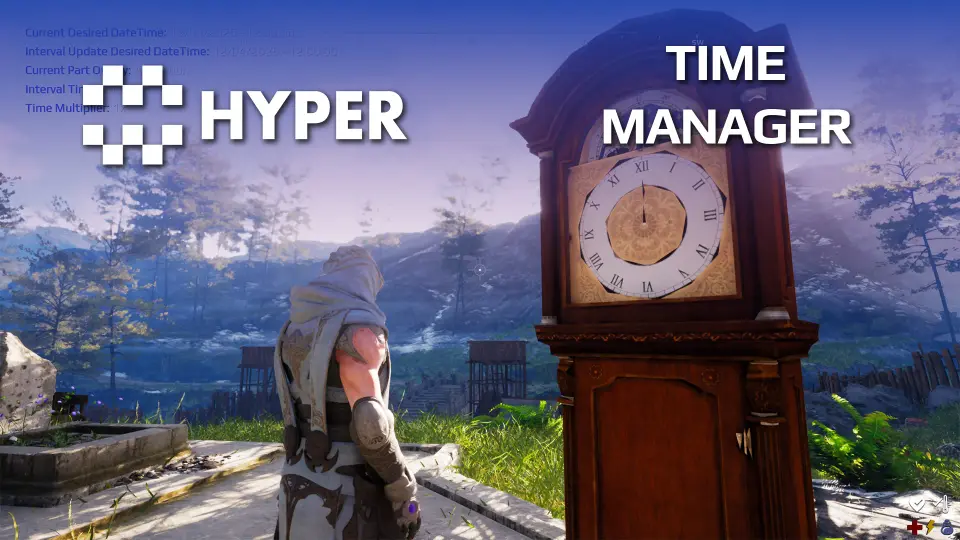
At the center of the Hyper Time Manager System v4 is a single clock that every other system can trust. The time authority lives in the GameState, so NPC schedules, day-night cycles, quest triggers, and world events all read from the same source of truth. When that time changes, every listening system reacts at the same moment, which keeps a living world from drifting into contradictions.
The system was built to give developers full control over in-game time without requiring a bespoke solution for each feature. Instead of wiring each gameplay mechanic to its own timer, the Hyper Time Manager provides one synchronized foundation that other modules can bind to. It is 100% Blueprint, multiplayer-ready, modular, and fully customizable, making it appropriate for projects that want to iterate quickly without sacrificing consistency.
A Single Time Authority in the GameState
Storing time centrally in the GameState is the core architectural decision behind this system. Because the GameState is replicated and shared across clients, every player sees the same current time. Systems that need to stay in sync — from quests to environment changes — can bind directly to this authority rather than maintaining separate local timers that might disagree.
This matters most in multiplayer projects where small timing differences become visible. A quest that is supposed to unlock at sunset, an NPC that should leave their post at a specific hour, or a world event that resets at dawn all benefit from a single, authoritative clock. The developer designed the system so that all connected systems stay perfectly in sync by default.
Letting Players Skip Time by Interacting with Objects
The Hyper Time Manager System v4 introduces interactive time manipulation as a direct gameplay feature. Players can skip time by interacting with objects like beds, advancing the world clock to a specific hour. This gives designers a clear way to let players control pacing and immersion without breaking the synchronization of other systems.
For example, a survival game might use a bed to fast-forward to morning, triggering the day-night cycle to update, NPC schedules to progress, and environment changes to occur exactly when they should. The interaction hooks into the central authority, so the skipped time ripples through every connected system automatically.
This is not a simple cinematic fade to black. The system is built to advance time in a way that keeps gameplay mechanics continuous, making it a practical tool for pacing.
Time Zones, Non-Linear Timelines, and Custom Scales
Beyond a straight linear clock, the system supports advanced time management features. Developers can define non-linear timelines, which is useful when a world’s passage of time should not behave like a real 24-hour cycle. Custom time scales allow portions of the game to run faster or slower, enabling dramatic time-of-day shifts or prolonged dusk periods.
Dynamic schedules for time-based events can be based on these variable timelines. Instead of hardcoding a specific hour, an event can be tied to a schedule that respects the current time scale and timeline definition. This flexibility makes the system suitable for strategy games that compress time, RPGs that use narrative time jumps, and simulations that need day cycles to match gameplay pace.
The system also allows unique time zones to be assigned to different regions of the world. This creates gameplay contrast between areas — one region might be locked in a long winter night while another experiences midday. The time-zone system is made for added realism as well as deliberate mechanical differences between zones.
Connecting Dispatchers to NPC Routines and Environment Changes
Integration with existing gameplay logic is handled through flexible dispatchers. These dispatchers let developers connect the Hyper Time Manager to their own systems — day-night cycles, NPC routines, environment changes, and more. Rather than forcing a particular architecture, the system exposes events that other Blueprints can listen to and respond to in their own way.
For NPC schedules, this means a character can react to the time of day without constantly polling the clock. For environment changes, lighting, foliage, or weather can be triggered when the central authority crosses configured thresholds. Quest designers can also use time as a condition, allowing objectives to activate only during specific windows.
Because the integration layer is dispatcher-based, it works cleanly across different project sizes. A small adventure game might only use the day-night cycle, while a larger open-world project can feed time data into dozens of independent subsystems.
Standalone or Stacked with Other Hyper Modules
The Hyper Time Manager System v4 is designed to fit a range of projects, from RPGs and survival games to open worlds, adventures, co-op PvE, and story-driven experiences. It can be used standalone, directly inside a game that only needs reliable time management. It can also be combined with MST Pro and other Hyper modules to expand a project with additional ready-made systems.
The same system is included in the Dynamic Weather & Sky system, which suggests tight integration with weather-based lighting and environmental effects. For developers who already use Hyper modules, the Time Manager slots into a broader modular ecosystem. For those who are new to Hyper, it works as a standalone foundation for time-aware gameplay.
All Hyper modules are described as plug-and-play, and the Time Manager follows that pattern. The Blueprints are clear and well-organized, designed to scale from simple projects to complex professional games. The system is also multiplayer-ready, so the synchronization logic is built with replication in mind from the start.
Built on 50,000 Hours of Unreal Development
The Hyper Time Manager is not an isolated utility. It is part of the larger Hyper system, which the developer states is built on over 50,000 hours of real-world Unreal Engine development. That foundation is meant to provide a proven starting point that scales easily as projects grow in ambition.
The developer, Eric, is Company Lead at Games by Hyper. After working in IT and cybersecurity leadership roles, he transitioned to game development and now teaches Game Development in Amsterdam while managing a community of over 4,000 developers. His stated goal is to provide modular, professional-quality systems for indie creators and hobbyists.
For teams evaluating the Hyper Time Manager System v4, the strongest takeaway is the GameState-based authority and the flexibility built into its time-manipulation tools. It removes the guesswork from keeping time-driven systems synchronized, while still giving developers the freedom to define timelines, time zones, and schedules that match their specific game design. Whether it is a small story-driven adventure or a large multiplayer survival project, the system provides a clock that the whole world can follow.
 Gameplay Features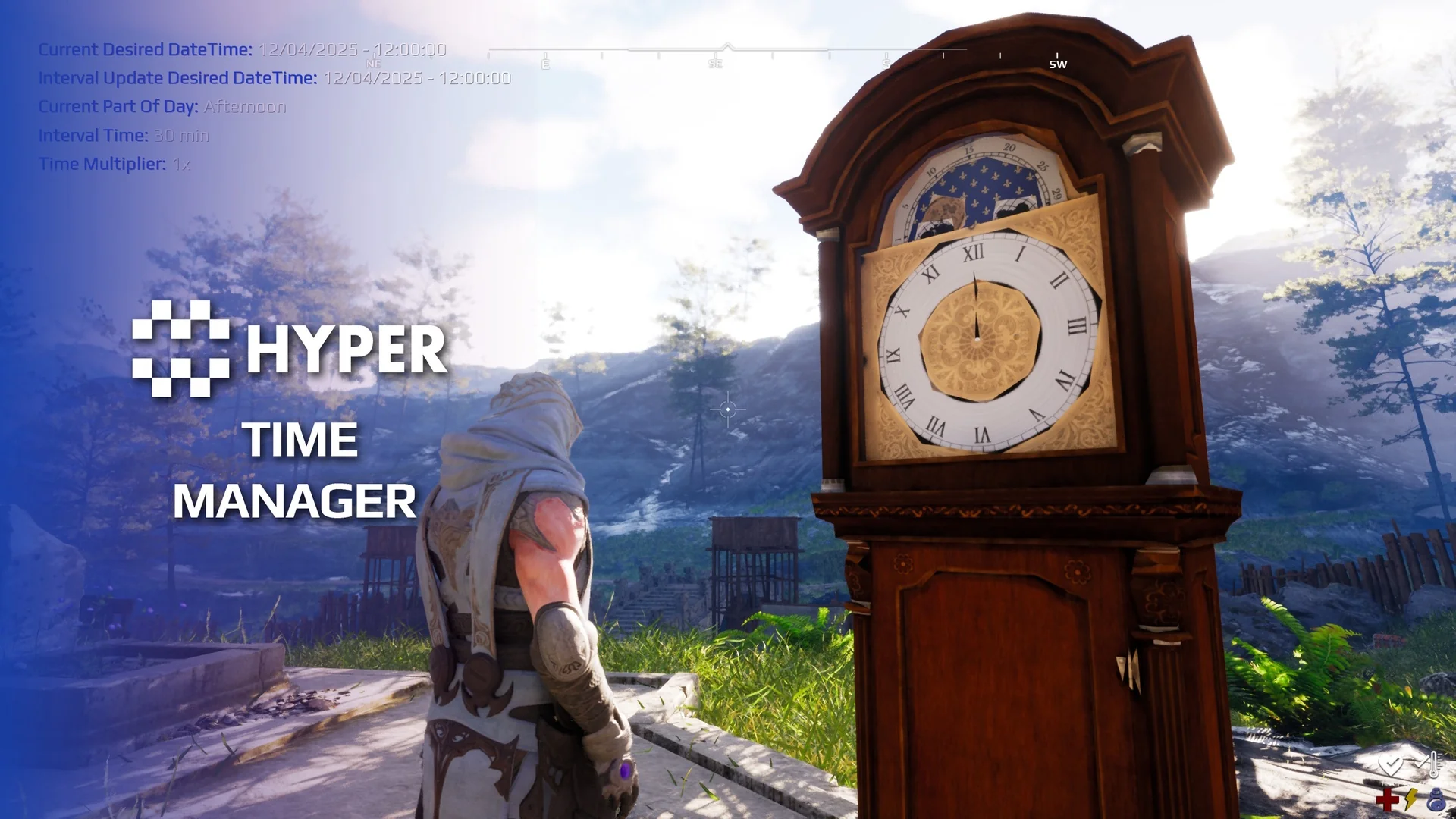
 Gameplay Features
 Gameplay Features
 Gameplay Features