"c68a05d5e51405b3"{"id":"1000500","slug":"climb-and-vaulting-component-v2","title":"Climb and Vaulting Component V2","category":"Gameplay Features","engine":"5.2+","assetVersion":"Asset Version: 2.0.5","engineVersion":"Engine Version: 5.2+","tag":"Gameplay Features","accent":"blue","visual":"mech","summary":"Climb and Vaulting Component V2 adds climbing and vaulting to TPP or FPP games using 60 animations, foot IK, and motion warping for Unreal Engine 4.23-5.8.","platform":"Unreal Engine","publishedAt":"2026-07-13T09:33:50.073Z","updatedAt":"2026-07-13T09:33:50.073Z","sourceNotes":[],"fileContents":[],"compatibility":["Unreal Engine","Asset Version: 2.0.5","Engine Version: 5.2+"],"featuredImage":{"alt":"Climb and Vaulting Component V2","src":"/wp-content/uploads/published/2026/07/8dd8cc56ed5e-cc524058-0625-412b-8871-42b937f0ea80-c186bbcecb.webp"},"hasDownloadLink":true,"downloads":2,"terms":[{"taxonomy":"category","slug":"gameplay-features","name":"Gameplay Features"}],"galleryImages":[{"src":"/wp-content/uploads/published/2026/07/7643dd9e8e2f-db624662-4c34-454b-aa78-16acfa1af44b-5110159fb2.webp","alt":"Climb and Vaulting Component V2"},{"src":"/wp-content/uploads/published/2026/07/c428596282c5-4dda6801-674f-4fbe-acd2-c3b67c8eb451-ba0176ea3d.webp","alt":"Climb and Vaulting Component V2"},{"src":"/wp-content/uploads/published/2026/07/0bdced30e649-b9f9484b-7a07-4f85-9c4c-d3856003c0cb-05f18c8f85.webp","alt":"Climb and Vaulting Component V2"},{"src":"/wp-content/uploads/published/2026/07/7142ce094b2c-b6cebf6c-c318-49bf-b35f-18dcf65c7dd8-fee226620f.webp","alt":"Climb and Vaulting Component V2"},{"src":"/wp-content/uploads/published/2026/07/63c9e12db976-59826451-8f20-424c-8154-4be2aa5e698d-fa458bafdf.webp","alt":"Climb and Vaulting Component V2"},{"src":"/wp-content/uploads/published/2026/07/339d51b35b44-4ad3fc06-6588-41eb-9dcd-f4bc5b25451a-116d2160f9.webp","alt":"Climb and Vaulting Component V2"},{"src":"/wp-content/uploads/published/2026/07/77ed52a4e2bb-0636f975-e018-458e-9517-6517c0c872c1-fae1f971a2.webp","alt":"Climb and Vaulting Component V2"},{"src":"/wp-content/uploads/published/2026/07/214dc50470f1-6e783163-634a-416e-a493-bf429ad18f8a-6af9ac346d.webp","alt":"Climb and Vaulting Component V2"},{"src":"/wp-content/uploads/published/2026/07/ac2edea8abe3-57b2b59a-a7a9-4c60-9afd-37cefe623cad-0ef2c6b52e.webp","alt":"Climb and Vaulting Component V2"},{"src":"/wp-content/uploads/published/2026/07/1909001b34a7-f3ce1216-6e7a-451e-ac0a-fd637110611e-54c8af84b3.webp","alt":"Climb and Vaulting Component V2"}],"accessPanel":{"kind":"resource","title":"Download this resource","eyebrow":"Free Download","message":"Log in or create a free account to start your download.","fileName":"ClimbandVaultingComponent.7z","safetyNote":"Resources are manually reviewed before listing to improve quality and reduce obvious risks.","actionLabel":"Download Free","resourceType":"Resource archive"},"contentHtml":"\u003ch2\u003eFive-Minute Integration for TPP and FPP Titles\u003c/h2\u003e\n\u003cp\u003eThe setup path for Climb and Vaulting Component V2 is shaped by speed. A developer can drop the component into an existing third-person or first-person project and have functional climbing, mantling, and vaulting active in under five minutes. The system operates as a Blueprint-based component, making it accessible for integration without requiring a full rewrite of an existing character movement framework. This fast implementation applies whether the game relies on a third-person perspective camera that showcases the full body during traversal or a first-person setup where the visible animation set shifts accordingly. The component is tagged for use across parkour-style gameplay scenarios, wall-running, and general climbing encounters.\u003c/p\u003e\n\u003cp\u003eBecause the system is component-driven, it slots into an existing character Blueprint rather than replacing the core pawn logic. This allows development teams to layer traversal mechanics on top of established movement, collision, and camera systems without structural conflicts arising from the addition.\u003c/p\u003e \u003ch2\u003eAnimation Coverage: 60 Combined Clips Across Perspectives\u003c/h2\u003e\n\u003cp\u003eThe package ships with a total of 60 animations when combining the third-person and first-person sets. The animation library covers several distinct locomotion states required for smooth environmental traversal. There are over 20 specific animations handling idle and moving climbs, ensuring a character transitions correctly whether they approach a ledge from a static position or while sprinting. Vaulting animations correlate directly with these movement states to provide fluid motion over obstacles.\u003c/p\u003e\n\u003cp\u003eBeyond the primary climbing and vaulting loops, the system includes multiple animations tailored to different falling distances. This addresses a gameplay scenario where a character drops from varying heights, requiring distinct landing or falling states to react accurately to the distance fallen. The inclusion of these specific landing variations prevents repetitive or contextually incorrect animations from triggering when a player drops from a short ledge versus a high wall.\u003c/p\u003e \u003ch3\u003eFoot IK and Motion Warping in UE5.3+\u003c/h3\u003e\n\u003cp\u003eThe component utilizes a Foot Inverse Kinematics (IK) system. FootIK adjusts the character's feet to align with the surface geometry of the environment, planting steps accurately on uneven ledges, rocky surfaces, or stair edges during a climb. This system works in tandem with the provided climb and vault animations to keep the character grounded in the virtual space.\u003c/p\u003e\n\u003cp\u003eFor Unreal Engine 5.3 and newer, the component integrates Motion Warping. This feature allows the engine to dynamically adjust the root motion of specific animations to match the physical environment. When a character reaches for a ledge or vaults over an obstacle, Motion Warping aligns the animation's start and end points with the actual mesh geometry in the world, reducing float or misalignment. A dedicated UE5 Motion Warping demonstration is available to showcase how this specific technical integration functions within a live environment.\u003c/p\u003e \u003ch2\u003eEngine Compatibility and DocumentationSupport\u003c/h2\u003e\n\u003cp\u003eClimb and Vaulting Component V2 supports Unreal Engine versions 4.23 through 4.27, as well as versions 5.0 through 5.8. The developer maintains two separate documentation tracks to account for the architectural differences between engine generations. Documentation for version 2.0.1 covers the UE5.0+ implementation, while documentation for version 1.4.1 covers the legacy UE4.23-4.27 integration.\u003c/p\u003e\n\u003cp\u003eThe update history displays continuous maintenance for the asset. Patch notes trace back to early 2022, with version 1.3.0 updates rolling out in April, followed by version 1.4.0 and v2.0.0 updates in July of the same year. Version 2.0.8, the most recent cited patch, was released on January 13, 2024. This track record indicates ongoing refinement over a multi-year development cycle, punctuated by specific showcases for different engine versions and features, including an ALSv4 integrated showcase demonstrating replicated gameplay.\u003c/p\u003e \u003ch3\u003eAsset Integration Tutorials and ALS Integration\u003c/h3\u003e\n\u003cp\u003eFor teams needing to see the implementation logic visually, asset integration tutorials are provided. These tutorials walk through the setup process for attaching the component to a custom character. The system has also been showcased integrated with ALS (Advanced Locomotion System) version 4. A specific showcase video demonstrates the component functioning within a replicated network environment on Unreal Engine 4, confirming that the traversal mechanics operate with server-client synchronization.\u003c/p\u003e \u003ch2\u003eProject Fit and Production Readiness\u003c/h2\u003e\n\u003cp\u003eClimb and Vaulting Component V2 is intended for game developers building action-oriented gameplay where environmental traversal is a core mechanic. Third-person action titles, first-person parkour games, and survival projects requiring mantling and climbing will find the most immediate use for the provided animation sets and component logic. The reliance on Blueprint architecture makes it suitable for technical designers and gameplay engineers who need to prototype or ship traversal mechanics without authoring custom state machines from scratch.\u003c/p\u003e\n\u003cp\u003eThe package requires Unreal Engine 4.23 at a minimum and scales up to the 5.8 releases. With dedicated documentation for both the UE4 and UE5 pipelines, alongside an active patch history that brought the system up to version 2.0.8 in 2024, the component serves teams working across legacy and current-generation Unreal projects. The availability of separate FPP and TPP demo builds allows developers to evaluate the animation weighting, FootIK behavior, and Motion Warping integration within the exact perspective their project requires before committing to full implementation.\u003c/p\u003e\n\n\u003ch2\u003eRelated Resources Worth Checking\u003c/h2\u003e\n\u003cul\u003e\n\u003cli\u003e\u003ca href=\"https://3dcghub.com/dismemberment-kit-v2/\" title=\"Dismemberment Kit V2\"\u003eDismemberment Kit V2\u003c/a\u003e\u003c/li\u003e\n\u003cli\u003e\u003ca href=\"https://3dcghub.com/hyper-basic-pcg-forest-v2/\" title=\"Hyper Basic PCG Forest v2\"\u003eHyper Basic PCG Forest v2\u003c/a\u003e\u003c/li\u003e\n\u003cli\u003e\u003ca href=\"https://3dcghub.com/customizable-bodycam-component/\" title=\"Customizable Bodycam Component\"\u003eCustomizable Bodycam Component\u003c/a\u003e\u003c/li\u003e\n\u003cli\u003e\u003ca href=\"https://3dcghub.com/gaming-health-widget/\" title=\"Gaming Health Widget\"\u003eGaming Health Widget\u003c/a\u003e\u003c/li\u003e\n\u003cli\u003e\u003ca href=\"https://3dcghub.com/vehicles-gravity-template-vgt/\" title=\"Vehicles Gravity Template - VGT\"\u003eVehicles Gravity Template - VGT\u003c/a\u003e\u003c/li\u003e\n\u003c/ul\u003e","contentTextLength":5963,"navigation":{"current":1509,"total":3860,"previous":{"id":"1000501","slug":"cyberpunk-futuristic-structures-set-cyberpunk-pack-21-assets-futuristic","title":"Cyberpunk / Futuristic Structures Set ( Cyberpunk Pack 21 Assets Futuristic )","category":"Buildings \u0026 Architecture","platform":"Unreal Engine","updatedAt":"2026-07-13T09:39:38.707Z"},"next":{"id":"1000499","slug":"castle-windows-pack","title":"Castle Windows Pack","category":"Buildings \u0026 Architecture","platform":"Unreal Engine","updatedAt":"2026-07-13T09:27:51.037Z"}},"relatedResources":[{"id":"1001041","slug":"advanced-locomotion-component-v2-4","title":"Advanced Locomotion Component v2.4","category":"Gameplay Features","engine":"5.3+","assetVersion":"Asset Version: 2.4","engineVersion":"Engine Version: 5.3+","tag":"Gameplay Features","accent":"blue","visual":"animation","summary":"Advanced Locomotion Component v2.4 replaces complex ABP editing with DataTable-driven animation config, adds UE5 features like Distance Matching and Pose Warpin","platform":"Unreal Engine","publishedAt":"2026-08-27T10:43:05.017Z","updatedAt":"2026-08-27T10:43:05.017Z","sourceNotes":[],"fileContents":[],"compatibility":["Unreal Engine","Asset Version: 2.4","Engine Version: 5.3+"],"featuredImage":{"alt":"Advanced Locomotion Component v2.4","src":"/wp-content/uploads/published/2026/08/43450a572549-4a5891bf-a976-4a63-93e2-5f1d81294a8a-74689cbc73.webp"},"hasDownloadLink":true,"downloads":7},{"id":"10714","slug":"dismemberment-kit-v2","title":"Dismemberment Kit V2","category":"Gameplay Features","engine":"5.3+","assetVersion":"Engine version: 5.3+","engineVersion":"4.27","tag":"Gameplay Features","accent":"blue","visual":"character","summary":"Dismemberment Kit V2 provides a streamlined, plug-and-play solution for adding realistic gore to your characters. This fully replicated component allows for quick mesh swapping and animation integration.","platform":"Unreal Engine","publishedAt":"2026-03-03T16:02:30.000Z","updatedAt":"2026-04-19T15:49:56.000Z","sourceNotes":[],"fileContents":[],"compatibility":["Unreal Engine","Engine version: 5.3+"],"featuredImage":{"alt":"Dismemberment Kit V2","src":"https://3dcghub.com/wp-content/uploads/2026/03/b9cd95a1-bf2a-4ab7-8393-7b2f8b103bd9.webp"},"hasDownloadLink":true,"downloads":6},{"id":"1001308","slug":"voyager-cover-system","title":"Voyager: Cover System","category":"Gameplay Features","engine":"5.5+","assetVersion":"","engineVersion":"Engine Version: 5.5+","tag":"Gameplay Features","accent":"blue","visual":"mech","summary":"Explore Voyager: Cover System, a 100% Blueprint TPS template with automatic cover detection, Data Asset animations, and modular gameplay components.","platform":"Unreal Engine","publishedAt":"2026-10-02T06:21:52.066Z","updatedAt":"2026-10-02T06:21:52.066Z","sourceNotes":[],"fileContents":[],"compatibility":["Unreal Engine","Engine Version: 5.5+"],"featuredImage":{"alt":"Voyager: Cover System","src":"/wp-content/uploads/published/2026/10/beaf349d95bd-de542065-7c38-4c5e-816c-93c284e8cfde-5069b8b183.webp"},"hasDownloadLink":true,"downloads":1}]}
Gameplay Features
Climb and Vaulting Component V2
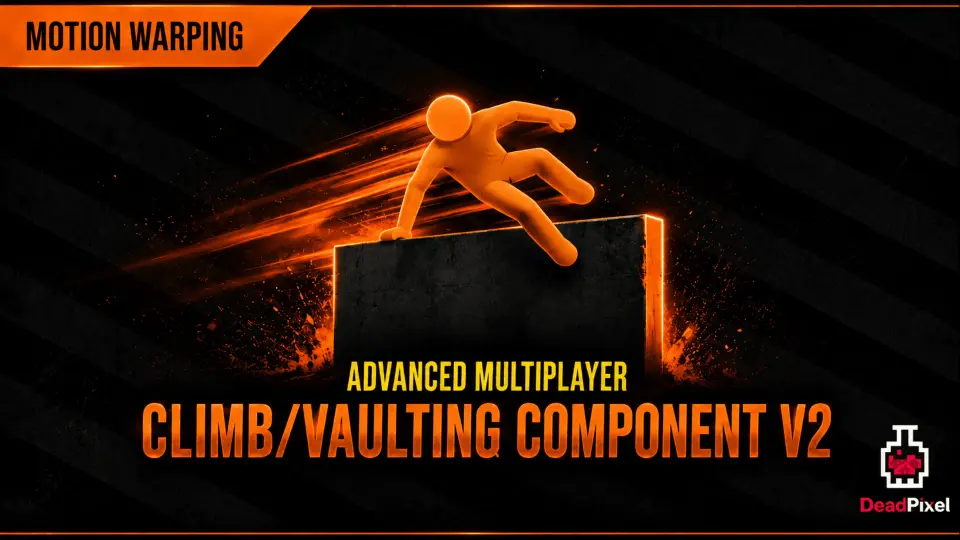
Climb and Vaulting Component V2 adds climbing and vaulting to TPP or FPP games using 60 animations, foot IK, and motion warping for Unreal Engine 4.23-5.8.
The setup path for Climb and Vaulting Component V2 is shaped by speed. A developer can drop the component into an existing third-person or first-person project and have functional climbing, mantling, and vaulting active in under five minutes. The system operates as a Blueprint-based component, making it accessible for integration without requiring a full rewrite of an existing character movement framework. This fast implementation applies whether the game relies on a third-person perspective camera that showcases the full body during traversal or a first-person setup where the visible animation set shifts accordingly. The component is tagged for use across parkour-style gameplay scenarios, wall-running, and general climbing encounters.
Because the system is component-driven, it slots into an existing character Blueprint rather than replacing the core pawn logic. This allows development teams to layer traversal mechanics on top of established movement, collision, and camera systems without structural conflicts arising from the addition.
Animation Coverage: 60 Combined Clips Across Perspectives
The package ships with a total of 60 animations when combining the third-person and first-person sets. The animation library covers several distinct locomotion states required for smooth environmental traversal. There are over 20 specific animations handling idle and moving climbs, ensuring a character transitions correctly whether they approach a ledge from a static position or while sprinting. Vaulting animations correlate directly with these movement states to provide fluid motion over obstacles.
Beyond the primary climbing and vaulting loops, the system includes multiple animations tailored to different falling distances. This addresses a gameplay scenario where a character drops from varying heights, requiring distinct landing or falling states to react accurately to the distance fallen. The inclusion of these specific landing variations prevents repetitive or contextually incorrect animations from triggering when a player drops from a short ledge versus a high wall.
Foot IK and Motion Warping in UE5.3+
The component utilizes a Foot Inverse Kinematics (IK) system. FootIK adjusts the character's feet to align with the surface geometry of the environment, planting steps accurately on uneven ledges, rocky surfaces, or stair edges during a climb. This system works in tandem with the provided climb and vault animations to keep the character grounded in the virtual space.
For Unreal Engine 5.3 and newer, the component integrates Motion Warping. This feature allows the engine to dynamically adjust the root motion of specific animations to match the physical environment. When a character reaches for a ledge or vaults over an obstacle, Motion Warping aligns the animation's start and end points with the actual mesh geometry in the world, reducing float or misalignment. A dedicated UE5 Motion Warping demonstration is available to showcase how this specific technical integration functions within a live environment.
Engine Compatibility and DocumentationSupport
Climb and Vaulting Component V2 supports Unreal Engine versions 4.23 through 4.27, as well as versions 5.0 through 5.8. The developer maintains two separate documentation tracks to account for the architectural differences between engine generations. Documentation for version 2.0.1 covers the UE5.0+ implementation, while documentation for version 1.4.1 covers the legacy UE4.23-4.27 integration.
The update history displays continuous maintenance for the asset. Patch notes trace back to early 2022, with version 1.3.0 updates rolling out in April, followed by version 1.4.0 and v2.0.0 updates in July of the same year. Version 2.0.8, the most recent cited patch, was released on January 13, 2024. This track record indicates ongoing refinement over a multi-year development cycle, punctuated by specific showcases for different engine versions and features, including an ALSv4 integrated showcase demonstrating replicated gameplay.
Asset Integration Tutorials and ALS Integration
For teams needing to see the implementation logic visually, asset integration tutorials are provided. These tutorials walk through the setup process for attaching the component to a custom character. The system has also been showcased integrated with ALS (Advanced Locomotion System) version 4. A specific showcase video demonstrates the component functioning within a replicated network environment on Unreal Engine 4, confirming that the traversal mechanics operate with server-client synchronization.
Project Fit and Production Readiness
Climb and Vaulting Component V2 is intended for game developers building action-oriented gameplay where environmental traversal is a core mechanic. Third-person action titles, first-person parkour games, and survival projects requiring mantling and climbing will find the most immediate use for the provided animation sets and component logic. The reliance on Blueprint architecture makes it suitable for technical designers and gameplay engineers who need to prototype or ship traversal mechanics without authoring custom state machines from scratch.
The package requires Unreal Engine 4.23 at a minimum and scales up to the 5.8 releases. With dedicated documentation for both the UE4 and UE5 pipelines, alongside an active patch history that brought the system up to version 2.0.8 in 2024, the component serves teams working across legacy and current-generation Unreal projects. The availability of separate FPP and TPP demo builds allows developers to evaluate the animation weighting, FootIK behavior, and Motion Warping integration within the exact perspective their project requires before committing to full implementation.
 Gameplay Features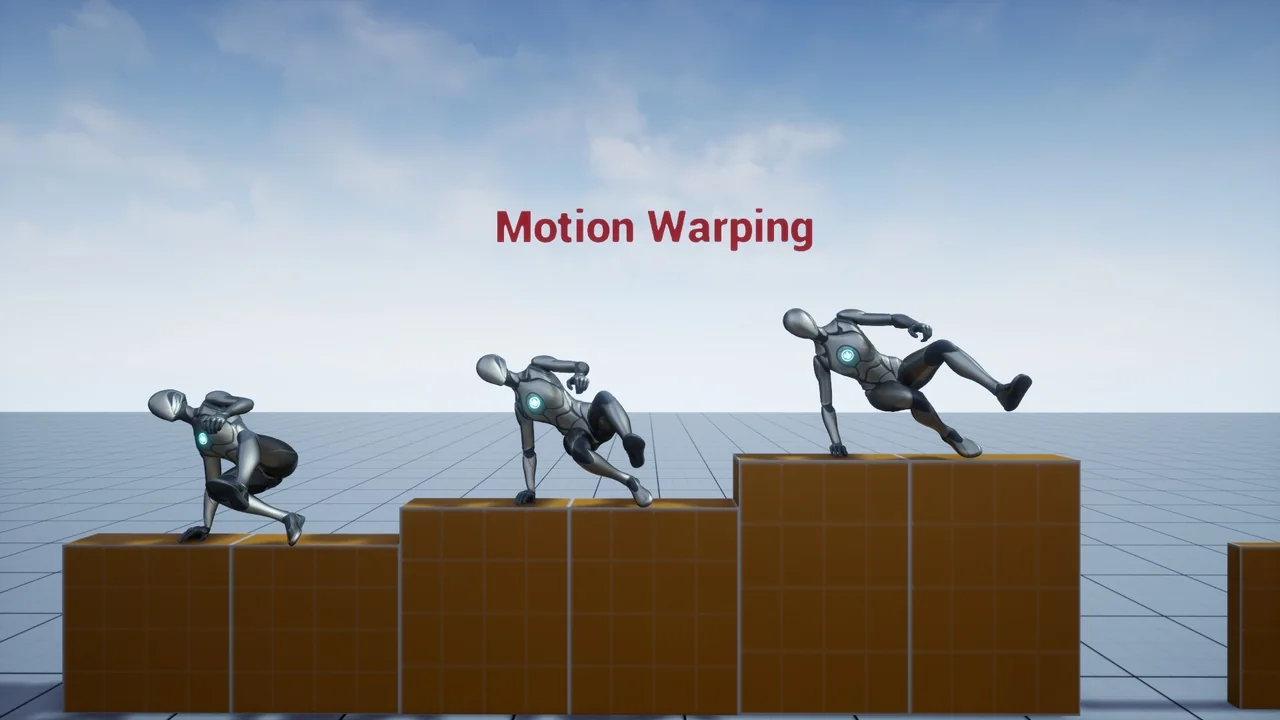
 Gameplay Features
 Gameplay Features
 Gameplay Features