"ddd0e3fb95b0aec2"{"id":"1000048","slug":"customizable-bodycam-component","title":"Customizable Bodycam Component","category":"Gameplay Features","engine":"5.1+","assetVersion":"","engineVersion":"5.1+","tag":"Gameplay Features","accent":"blue","visual":"mech","summary":"A Blueprint-driven camera component designed to deliver photorealistic, character-mirrored motion, exposed material parameters, and customizable VHS effects.","platform":"Unreal Engine","publishedAt":"2026-05-22T11:03:34.875Z","updatedAt":"2026-05-22T11:03:34.875Z","sourceNotes":[],"fileContents":[],"compatibility":["Unreal Engine","Engine version: 5.1+"],"featuredImage":{"alt":"Customizable Bodycam Component","src":"/wp-content/uploads/published/2026/05/a8f60f9cccc0-8a5f4ac1-11c7-49f2-9fb6-a21c09403ba4-65699f7637.webp"},"hasDownloadLink":true,"downloads":4,"terms":[{"taxonomy":"category","slug":"gameplay-features","name":"Gameplay Features"}],"galleryImages":[{"src":"/wp-content/uploads/published/2026/05/96da1f91b2ee-4ac24136-1245-4abd-b2a0-a3ebf58606c7-82f9dbc251.webp","alt":"Customizable Bodycam Component"},{"src":"/wp-content/uploads/published/2026/05/e07661db8797-3529e0ee-9e03-404a-96f7-ef6823e5f7ff-30c55bcefc.webp","alt":"Customizable Bodycam Component"},{"src":"/wp-content/uploads/published/2026/05/f476e9822991-a68d93fb-8dbe-4328-87f8-0fe286015953-3c020a25a7.webp","alt":"Customizable Bodycam Component"},{"src":"/wp-content/uploads/published/2026/05/15ca5d84f15a-d6dfc985-351f-4b7d-ab37-29dfdc4910bd-28c102a995.webp","alt":"Customizable Bodycam Component"},{"src":"/wp-content/uploads/published/2026/05/448d98f1e4b2-c409f49d-2547-4140-9f4a-062b3c1f36bb-82f1c5c6d6.webp","alt":"Customizable Bodycam Component"},{"src":"/wp-content/uploads/published/2026/05/c888fcf547af-05a8007e-229d-4462-873b-2420d3ec3983-5fe99df3a0.webp","alt":"Customizable Bodycam Component"},{"src":"/wp-content/uploads/published/2026/05/d2b96e2685d8-99e317cf-edcd-46c4-ba07-67ebfa369338-04da7291a5.webp","alt":"Customizable Bodycam Component"}],"accessPanel":{"kind":"resource","title":"Access this resource","eyebrow":"Free Download","message":"Log in or create a free account to start your download.","fileName":"Content.7z","safetyNote":"Resources are manually reviewed before listing to improve quality and reduce obvious risks.","actionLabel":"Download Free","resourceType":"Resource archive"},"contentHtml":"\u003cp\u003eThe Customizable Bodycam Component is a Blueprint-driven system structured to replicate the physical behavior and visual artifacts of a real-world, body-worn camera. Rather than relying on a traditional, static first-person viewpoint, this setup is designed to offer a truly immersive and realistic bodycam feeling. It achieves this by shifting the camera's behavior from a floating perspective to a grounded physical object that reacts dynamically to the environment and the player's inputs. The core package centers on combining character-driven camera motion with an extensive suite of post-processing controls, allowing developers to shape the exact visual output of their project.\u003c/p\u003e \u003ch2\u003eLifelike Motion and Character Mirroring\u003c/h2\u003e \u003cp\u003eAt the center of a photorealistic bodycam experience is the way the camera handles movement. A standard first-person camera typically provides a smooth, stabilized view that prioritizes gameplay clarity over physical realism. The Customizable Bodycam Component diverges from this by providing seamless and lifelike motion that mirrors your character's every move. This means the camera inherits the physical momentum, shifts, and adjustments of the character model it is attached to.\u003c/p\u003e \u003cp\u003eTranslating character locomotion directly into camera motion grounds the player in the physical space of the game. When the character moves, the camera responds accordingly, creating the distinctive, slightly erratic viewpoint associated with tactical body-worn recording devices. This mirroring effect ensures that the camera feels like a tangible piece of equipment mounted on a moving body, rather than a disembodied lens. The focus on seamless motion ensures that while the camera accurately reflects physical movement, it maintains a playable and continuous visual flow.\u003c/p\u003e \u003ch2\u003eExposed Material Parameters and Color Grading\u003c/h2\u003e \u003cp\u003eAchieving a photorealistic camera style requires precise control over the final render. The component unlocks the power of exposed material parameters to fine-tune every aspect of the camera's appearance. By exposing these parameters directly, developers can adjust the visual characteristics of the camera feed without needing to rebuild underlying materials from scratch.\u003c/p\u003e \u003cp\u003eThese material controls extend heavily into color grading and post-processing effects. Color grading allows developers to manipulate the atmospheric tone of the camera feed, shifting from the harsh, high-contrast lighting of a tactical police camera to the washed-out, desaturated look of older recording equipment. Post-processing effects can be layered to degrade or enhance the image quality to match the exact look you desire. By relying on exposed parameters, the system supports rapid iteration, allowing environment artists and designers to test different visual treatments in real time until the camera perfectly matches the project's aesthetic direction.\u003c/p\u003e \u003ch2\u003eFound Footage Mechanics and VHS Overlays\u003c/h2\u003e \u003cp\u003eBeyond modern tactical aesthetics, the component is heavily tailored toward the found footage genre. It includes a highly customizable VHS effect that serves as the foundation for a found footage-inspired game mechanic. This specific aesthetic relies on visual degradation, tracking artifacts, and screen-space elements to convince the player they are watching a recorded tape or an analog live feed.\u003c/p\u003e \u003cp\u003eTo support this, the system allows developers to integrate VHS overlays and effects with many settings. These overlays can be used to add timecodes, battery indicators, recording icons, or tracking static directly to the screen. The ability to personalize your bodycam frame gives developers the freedom to create a unique touch for their specific game. Instead of relying on a generic, one-size-fits-all overlay, the framing and visual noise can be adjusted to fit the exact era and style of the in-game recording device. This flexibility ensures that the VHS elements feel like an integrated part of the game's mechanics rather than a superficial screen filter.\u003c/p\u003e \u003ch2\u003eBlueprint Setup and Technical Workflow\u003c/h2\u003e \u003cp\u003eIntegrating a custom camera system that relies on character mirroring and complex post-processing can often introduce heavy technical overhead. The Customizable Bodycam Component is built entirely as a Blueprint system with a user-friendly setup designed to bypass these workflow bottlenecks. The architecture is organized so that setup is a breeze, ensuring developers can focus on their own creative vision without having to struggle with the technicalities of camera attachment and material rendering.\u003c/p\u003e \u003cp\u003eThe system is packed with lots of customization settings accessible through the Blueprint interface. This approach allows developers of varying technical backgrounds to drop the component into a project and immediately begin tweaking the motion scaling, color grading, and VHS overlays. Because the system handles the complex logic of mirroring the character's movement and applying the layered post-processing effects under the hood, the developer is left with a clean interface dedicated purely to visual and behavioral adjustments.\u003c/p\u003e \u003cp\u003eUltimately, the Customizable Bodycam Component is built to handle the heavy lifting of immersive camera design. By fusing character-mirrored motion with a deep library of exposed post-processing and VHS settings, it provides a stable, highly adjustable foundation for any project requiring a photorealistic, grounded perspective.\u003c/p\u003e\n\n\u003ch2\u003eRelated Resources Worth Checking\u003c/h2\u003e\n\u003cul\u003e\n\u003cli\u003e\u003ca href=\"https://3dcghub.com/teleportation-and-portal/\" title=\"Teleportation and Portal\"\u003eTeleportation and Portal\u003c/a\u003e\u003c/li\u003e\n\u003cli\u003e\u003ca href=\"https://3dcghub.com/gaming-health-widget/\" title=\"Gaming Health Widget\"\u003eGaming Health Widget\u003c/a\u003e\u003c/li\u003e\n\u003cli\u003e\u003ca href=\"https://3dcghub.com/dismemberment-kit-v2/\" title=\"Dismemberment Kit V2\"\u003eDismemberment Kit V2\u003c/a\u003e\u003c/li\u003e\n\u003cli\u003e\u003ca href=\"https://3dcghub.com/cinematic-cutscene-system/\" title=\"Cinematic Cutscene System\"\u003eCinematic Cutscene System\u003c/a\u003e\u003c/li\u003e\n\u003cli\u003e\u003ca href=\"https://3dcghub.com/dot-matrix-shader-pack/\" title=\"Dot Matrix Shader Pack\"\u003eDot Matrix Shader Pack\u003c/a\u003e\u003c/li\u003e\n\u003c/ul\u003e","contentTextLength":5533,"navigation":{"current":1608,"total":3511,"previous":{"id":"1000049","slug":"cyberpunk-port-city-environment-cyberpunk-port-city-cyber-cyperpunk-port-3d","title":"Cyberpunk Port City Environment ( Cyberpunk Port City Cyber Cyperpunk Port 3D )","category":"Cyberpunk","platform":"Unreal Engine","updatedAt":"2026-05-22T11:25:19.066Z"},"next":{"id":"1000047","slug":"crystals-and-crafting-environment-house-crafting-medieval-medieval-3d-old-3d","title":"Crystals and Crafting Environment ( House Crafting Medieval Medieval 3D Old 3D )","category":"Towns \u0026 Villages","platform":"Unreal Engine","updatedAt":"2026-05-22T10:59:33.907Z"}},"relatedResources":[{"id":"27841","slug":"teleportation-and-portal","title":"Teleportation and Portal","category":"Gameplay Features","engine":"5.0+","assetVersion":"Engine version: 5.0+","engineVersion":"4.22","tag":"Gameplay Features","accent":"blue","visual":"mech","summary":"Teleportation and Portal centers on one clear job: moving characters through portals without manual friction. Its strongest practical angle is online multiplayer, with a replicated, customizable, and automatic setup backed by Blueprint, Niagara, particles,...","platform":"Unreal Engine","publishedAt":"2026-04-29T10:56:20.000Z","updatedAt":"2026-04-29T10:56:21.000Z","sourceNotes":[],"fileContents":[],"compatibility":["Unreal Engine","Engine version: 5.0+"],"featuredImage":{"alt":"Teleportation and Portal","src":"https://3dcghub.com/wp-content/uploads/2026/04/b75b5cbdd2e1_e4771e4d-77b5-48e2-8b4f-31654a1f53e7.webp"},"hasDownloadLink":true,"downloads":0},{"id":"10870","slug":"gaming-health-widget","title":"Gaming Health Widget","category":"Gameplay Features","engine":"5.6+","assetVersion":"Engine version: 5.6+","engineVersion":"4.24","tag":"Gameplay Features","accent":"blue","visual":"mech","summary":"Enhance your project's user interface with this versatile Gaming Health Widget. It features customizable health, mana, and shield components alongside a flexible experience system.","platform":"Unreal Engine","publishedAt":"2026-03-03T16:25:16.000Z","updatedAt":"2026-04-19T15:49:55.000Z","sourceNotes":[],"fileContents":[],"compatibility":["Unreal Engine","Engine version: 5.6+"],"featuredImage":{"alt":"Gaming Health Widget","src":"https://3dcghub.com/wp-content/uploads/2026/03/2c18a22e-1205-4b81-8dde-2e2c752274c7.webp"},"hasDownloadLink":true,"downloads":0},{"id":"1000832","slug":"get-away-system","title":"Get Away System","category":"Gameplay Features","engine":"5.5+","assetVersion":"","engineVersion":"Engine Version: 5.5+","tag":"Gameplay Features","accent":"blue","visual":"mech","summary":"Blueprint-based escape ability component for Unreal Engine. Fully customizable dash mechanic with placeholder animations, built entirely in Blueprints for quick","platform":"Unreal Engine","publishedAt":"2026-08-03T12:46:53.642Z","updatedAt":"2026-08-03T12:46:53.642Z","sourceNotes":[],"fileContents":[],"compatibility":["Unreal Engine","Engine Version: 5.5+"],"featuredImage":{"alt":"Get Away System","src":"/wp-content/uploads/published/2026/08/9c82047dd0b2-60671276-f89b-4f99-8f22-059914dab44c-646d0a5631.webp"},"hasDownloadLink":true,"downloads":0}]}
Gameplay Features
Customizable Bodycam Component
A Blueprint-driven camera component designed to deliver photorealistic, character-mirrored motion, exposed material parameters, and customizable VHS effects.
The Customizable Bodycam Component is a Blueprint-driven system structured to replicate the physical behavior and visual artifacts of a real-world, body-worn camera. Rather than relying on a traditional, static first-person viewpoint, this setup is designed to offer a truly immersive and realistic bodycam feeling. It achieves this by shifting the camera's behavior from a floating perspective to a grounded physical object that reacts dynamically to the environment and the player's inputs. The core package centers on combining character-driven camera motion with an extensive suite of post-processing controls, allowing developers to shape the exact visual output of their project.
Lifelike Motion and Character Mirroring
At the center of a photorealistic bodycam experience is the way the camera handles movement. A standard first-person camera typically provides a smooth, stabilized view that prioritizes gameplay clarity over physical realism. The Customizable Bodycam Component diverges from this by providing seamless and lifelike motion that mirrors your character's every move. This means the camera inherits the physical momentum, shifts, and adjustments of the character model it is attached to.
Translating character locomotion directly into camera motion grounds the player in the physical space of the game. When the character moves, the camera responds accordingly, creating the distinctive, slightly erratic viewpoint associated with tactical body-worn recording devices. This mirroring effect ensures that the camera feels like a tangible piece of equipment mounted on a moving body, rather than a disembodied lens. The focus on seamless motion ensures that while the camera accurately reflects physical movement, it maintains a playable and continuous visual flow.
Exposed Material Parameters and Color Grading
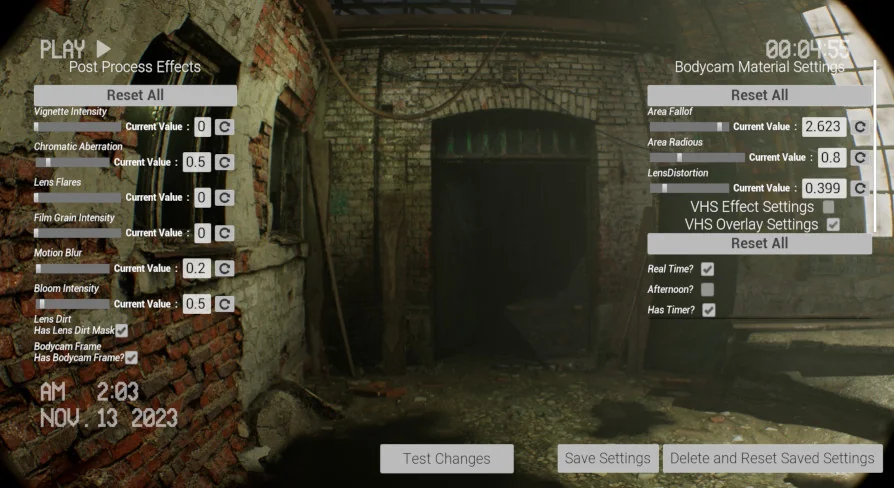
Achieving a photorealistic camera style requires precise control over the final render. The component unlocks the power of exposed material parameters to fine-tune every aspect of the camera's appearance. By exposing these parameters directly, developers can adjust the visual characteristics of the camera feed without needing to rebuild underlying materials from scratch.
These material controls extend heavily into color grading and post-processing effects. Color grading allows developers to manipulate the atmospheric tone of the camera feed, shifting from the harsh, high-contrast lighting of a tactical police camera to the washed-out, desaturated look of older recording equipment. Post-processing effects can be layered to degrade or enhance the image quality to match the exact look you desire. By relying on exposed parameters, the system supports rapid iteration, allowing environment artists and designers to test different visual treatments in real time until the camera perfectly matches the project's aesthetic direction.
Found Footage Mechanics and VHS Overlays
Beyond modern tactical aesthetics, the component is heavily tailored toward the found footage genre. It includes a highly customizable VHS effect that serves as the foundation for a found footage-inspired game mechanic. This specific aesthetic relies on visual degradation, tracking artifacts, and screen-space elements to convince the player they are watching a recorded tape or an analog live feed.
To support this, the system allows developers to integrate VHS overlays and effects with many settings. These overlays can be used to add timecodes, battery indicators, recording icons, or tracking static directly to the screen. The ability to personalize your bodycam frame gives developers the freedom to create a unique touch for their specific game. Instead of relying on a generic, one-size-fits-all overlay, the framing and visual noise can be adjusted to fit the exact era and style of the in-game recording device. This flexibility ensures that the VHS elements feel like an integrated part of the game's mechanics rather than a superficial screen filter.
Blueprint Setup and Technical Workflow
Integrating a custom camera system that relies on character mirroring and complex post-processing can often introduce heavy technical overhead. The Customizable Bodycam Component is built entirely as a Blueprint system with a user-friendly setup designed to bypass these workflow bottlenecks. The architecture is organized so that setup is a breeze, ensuring developers can focus on their own creative vision without having to struggle with the technicalities of camera attachment and material rendering.
The system is packed with lots of customization settings accessible through the Blueprint interface. This approach allows developers of varying technical backgrounds to drop the component into a project and immediately begin tweaking the motion scaling, color grading, and VHS overlays. Because the system handles the complex logic of mirroring the character's movement and applying the layered post-processing effects under the hood, the developer is left with a clean interface dedicated purely to visual and behavioral adjustments.
Ultimately, the Customizable Bodycam Component is built to handle the heavy lifting of immersive camera design. By fusing character-mirrored motion with a deep library of exposed post-processing and VHS settings, it provides a stable, highly adjustable foundation for any project requiring a photorealistic, grounded perspective.
 Gameplay Features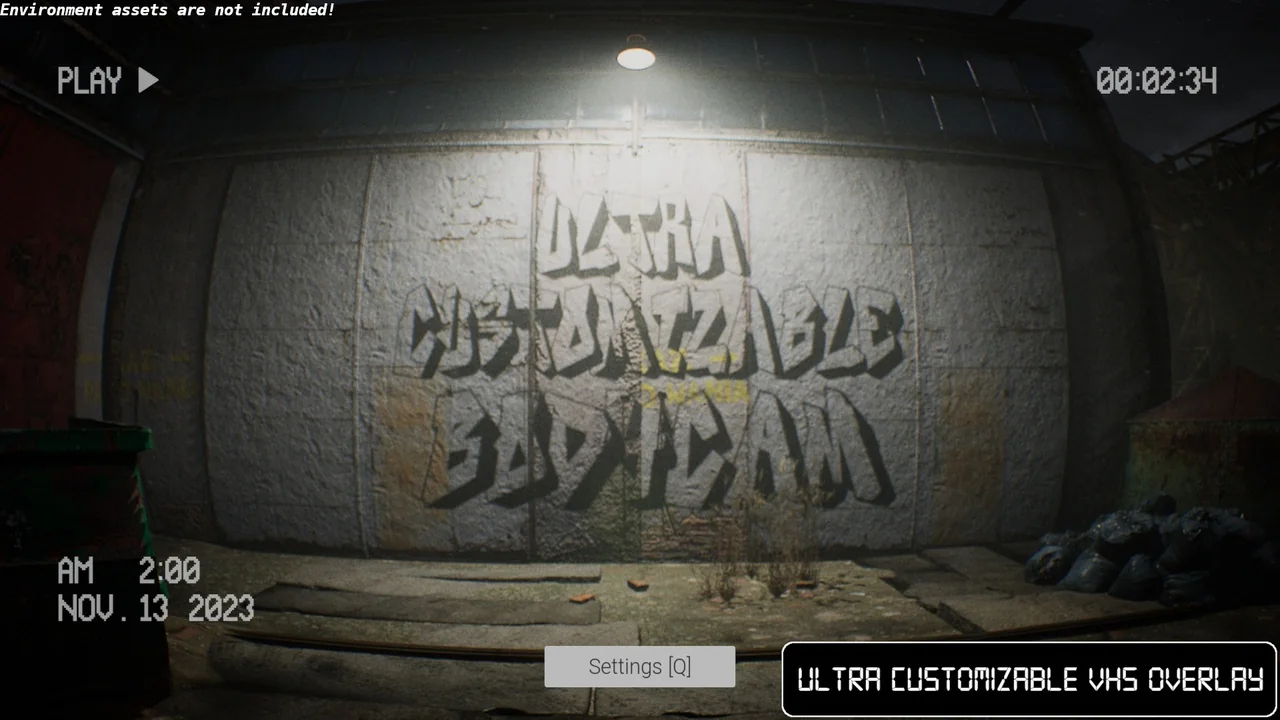
 Gameplay Features
 Gameplay Features
 Gameplay Features