"c68a05d5e51405b3"{"id":"1001898","slug":"modern-survival-horror-framework","title":"Modern Survival Horror Framework","category":"Action-Adventure","engine":"5.8+","assetVersion":"","engineVersion":"Engine Version: 5.8+","tag":"Action-Adventure","accent":"blue","visual":"mech","summary":"An Unreal Engine framework featuring Motion Matching locomotion, grid inventory, enemy AI, and modular systems for third-person survival horror games.","platform":"Unreal Engine","publishedAt":"2026-10-22T11:37:21.304Z","updatedAt":"2026-10-22T11:37:21.304Z","sourceNotes":[],"fileContents":[],"compatibility":["Unreal Engine","Engine Version: 5.8+"],"featuredImage":{"alt":"Modern Survival Horror Framework","src":"/wp-content/uploads/published/2026/10/77d0793bac37-ebd2bece-1fbf-4d5a-b1a7-cc8dd57631eb-fcf413f24e.webp"},"hasDownloadLink":true,"downloads":0,"terms":[{"taxonomy":"category","slug":"action-adventure","name":"Action-Adventure"}],"galleryImages":[{"src":"/wp-content/uploads/published/2026/10/865fc6d6af1f-8ca9c98f-5dab-4dbc-95b1-3f5713daecb3-854bc7805f.webp","alt":"Modern Survival Horror Framework"},{"src":"/wp-content/uploads/published/2026/10/186909888da0-8f7b5aaa-c7d5-4a97-93ee-ca6535543251-b9656f64af.webp","alt":"Modern Survival Horror Framework"},{"src":"/wp-content/uploads/published/2026/10/7b6059894c4f-dbeb2c3c-e3b8-4571-ac53-b4ebc38a1c4a-1b321f8e20.webp","alt":"Modern Survival Horror Framework"},{"src":"/wp-content/uploads/published/2026/10/ad1bf8f438bb-efa9ff1c-6d75-42a7-a74c-e28ecfebef44-f104d5456b.webp","alt":"Modern Survival Horror Framework"},{"src":"/wp-content/uploads/published/2026/10/ecadc63b712b-6d7fd972-78c1-4de2-9b4f-1232c6771fd9-ce25c67eb9.webp","alt":"Modern Survival Horror Framework"},{"src":"/wp-content/uploads/published/2026/10/2d37755e5b18-36343270-f200-4c8f-8268-d18a07a7c7d9-e7c635dbfd.webp","alt":"Modern Survival Horror Framework"},{"src":"/wp-content/uploads/published/2026/10/32f4d7456e34-1011e346-5b5f-4e3b-8926-5c6c08a123f6-34194978ff.webp","alt":"Modern Survival Horror Framework"},{"src":"/wp-content/uploads/published/2026/10/d007bb626461-84c0f105-23bc-4cf1-92f0-72322fae4aaf-514841ca26.webp","alt":"Modern Survival Horror Framework"},{"src":"/wp-content/uploads/published/2026/10/9a516ad1908a-cd23ae0a-05d1-40ab-81d6-de0b009e1ec1-31b91e8b52.webp","alt":"Modern Survival Horror Framework"},{"src":"/wp-content/uploads/published/2026/10/35202224e5ae-54e76cb9-20ae-45d2-a846-078e9dafc11a-bdcb481e82.webp","alt":"Modern Survival Horror Framework"}],"accessPanel":{"kind":"resource","title":"Download this resource","eyebrow":"Free Download","message":"Log in or create a free account to start your download.","fileName":"Modern Survival Horror Framework.7z","safetyNote":"Resources are manually reviewed before listing to improve quality and reduce obvious risks.","actionLabel":"Download Free","resourceType":"Resource archive"},"contentHtml":"\u003cp\u003eConstructing a survival horror title often requires synchronizing disparate, mechanically dense systems: responsive over-the-shoulder movement, spatially constrained inventory management, environmental problem-solving, and reactive adversary behaviors. Modern Survival Horror Framework addresses this foundational hurdle by delivering an integrated, modular architecture in Unreal Engine. Built for scalability and long-term production, the package establishes the core mechanical baseline required to build modern survival horror experiences without demanding that individual sub-systems be pieced together from scratch.\u003c/p\u003e \u003ch2\u003eOver-the-Shoulder Locomotion and Modified GASP Motion Matching\u003c/h2\u003e\n\u003cp\u003eCharacter handling is anchored by a third-person over-the-shoulder camera configuration, referencing contemporary survival horror design standards. Locomotion is driven by a modified GASP Motion Matching setup, delivering natural transitions between movement states while maintaining the deliberate, grounded pacing essential to horror gameplay.\u003c/p\u003e\n\u003cp\u003eCharacter support extends natively to both standard Unreal Engine 5 skeletons and MetaHuman skeletons for third-person characters. Control handling includes full support for both Xbox gamepads and keyboards across gameplay and user interfaces, supported by automatic input detection. Traversal capabilities also expand beyond standard running and walking, providing functional ladder climbing mechanics and narrow space traversal animations to handle tight corridors, squeeze-through gaps, and vertical level design.\u003c/p\u003e \u003ch2\u003eGrid Inventory Mechanics, Storage Boxes, and Inspection\u003c/h2\u003e\n\u003cp\u003eResource management follows an advanced slot-based grid inventory layout, accommodating multi-slot items that occupy variable rectangular footprints on the grid. Players must organize their supplies directly within the spatial limits of the container. Inventory capacity is not fixed indefinitely; it integrates with an inventory expansion system that upgrades carrying space through backpack pickups discovered in the environment.\u003c/p\u003e\n\u003cp\u003eItems can be examined through an inspection system that handles both readable text documents and inspectable 3D objects, allowing items to be manipulated and rotated in a dedicated view. Surplus resources can be managed through a fully featured storage box system, giving players a secure hub to offload ammunition, healing items, and mission items. When picking up or manipulating objects in the environment, context-aware interactions evaluate the player focus vector to display appropriate prompts automatically.\u003c/p\u003e \u003ch2\u003eEnvironmental Interaction, Door States, and Lock Mechanisms\u003c/h2\u003e\n\u003cp\u003eNavigation and spatial progression rely heavily on gating and room traversal. The framework features an advanced door system capable of managing multiple door states, ranging from unlocked swing states to obstructed passages. Securing these paths are multiple lock mechanisms that support physical keys, electronic keycards, numerical passcodes, and physical chains, allowing designers to assemble varied progression puzzles across a layout.\u003c/p\u003e\n\u003cp\u003eEnvironment interactions extend to physical fixtures and destructible objects. Characters can open drawers and weapon lockers to find supplies, or shatter breakable crates that hook into an integrated item drop pipeline. Exploration is complemented by an advanced in-game map system equipped with progression tracking, helping players register cleared spaces and unresolved obstacles as they explore. Level progression and character state are recorded reliably through an advanced save and load system, while acoustic pacing is maintained by a location-based music system with smooth dynamic transitions.\u003c/p\u003e \u003ch2\u003eCombat Arsenal, Merchant Integration, and Enemy AI Senses\u003c/h2\u003e\n\u003cp\u003eThe combat toolkit comes configured with four primary weapons: a pipe for close-range melee, alongside a pistol, a rifle, and a shotgun for ranged encounters. Aiming precision is supported by an integrated laser sight system, and illumination in dark zones is managed through a flexible flashlight system that can be configured as either a handheld light or a chest-mounted unit.\u003c/p\u003e\n\u003cp\u003eAdversaries operate on a comprehensive Enemy AI framework structured through specific perception routines, including visual line-of-sight and auditory hearing ranges. AI agents cycle through distinct behavioral loops for roaming, patrolling, hearing sound disturbances, direct vision acquisition, chasing the player, and executing attacks. Close encounters include a specialized zombie grab and bite system with a quick-time event mechanic, though developers must supply their own animations for the bite sequence. Safe areas or intermediate checkpoints can feature an advanced Merchant system, facilitating commerce and resource trades between encounters.\u003c/p\u003e \u003ch2\u003eFirst-Person Mode Separation and Implementation Scope\u003c/h2\u003e\n\u003cp\u003eWhile structured primarily around a third-person experience, the framework also includes an optional standalone first-person configuration introduced as a post-launch update. This first-person mode is not an automated runtime camera switch; rather, it exists as a separate, dedicated gameplay mode engineered specifically with its own distinct interaction handling, camera behaviors, and interface tuning tailored to first-person horror design.\u003c/p\u003e\n\u003cp\u003eThe framework is currently in active development under an Early Access model, with core gameplay, menus, and option systems fully operational alongside ongoing refinements to modularity and architectural depth. For development teams constructing single-perspective projects, testing either the third-person or first-person gameplay configurations establishes a reliable baseline for character pacing, inventory layout, and enemy encounters before scaling up custom level and narrative production.\u003c/p\u003e\n\n\u003ch2\u003eContinue Browsing Similar Packs\u003c/h2\u003e\n\u003cul\u003e\n\u003cli\u003e\u003ca href=\"https://3dcghub.com/hyper-multiplayer-survival-template-pro-mst-v4/\" title=\"Hyper Multiplayer Survival Template Pro [MST] V4\"\u003eHyper Multiplayer Survival Template Pro [MST] V4\u003c/a\u003e\u003c/li\u003e\n\u003cli\u003e\u003ca href=\"https://3dcghub.com/advanced-survival-horror/\" title=\"Advanced Survival Horror\"\u003eAdvanced Survival Horror\u003c/a\u003e\u003c/li\u003e\n\u003cli\u003e\u003ca href=\"https://3dcghub.com/classic-survival-horror-framework-v2/\" title=\"Classic Survival Horror Framework V2\"\u003eClassic Survival Horror Framework V2\u003c/a\u003e\u003c/li\u003e\n\u003cli\u003e\u003ca href=\"https://3dcghub.com/horror-engine-se/\" title=\"Horror Engine SE\"\u003eHorror Engine SE\u003c/a\u003e\u003c/li\u003e\n\u003cli\u003e\u003ca href=\"https://3dcghub.com/hyper-multiplayer-survival-template-plus-mst-v4/\" title=\"Hyper Multiplayer Survival Template Plus [MST] v4\"\u003eHyper Multiplayer Survival Template Plus [MST] v4\u003c/a\u003e\u003c/li\u003e\n\u003c/ul\u003e","contentTextLength":5959,"navigation":{"current":27,"total":3860,"previous":{"id":"1001899","slug":"modular-drums-pack","title":"Modular Drums Pack","category":"Musical","platform":"Unreal Engine","updatedAt":"2026-10-22T11:38:03.294Z"},"next":{"id":"1001897","slug":"modern-kitchen-pack","title":"Modern Kitchen Pack","category":"Buildings \u0026 Architecture","platform":"Unreal Engine","updatedAt":"2026-10-22T11:36:23.933Z"}},"relatedResources":[{"id":"1001152","slug":"hyper-multiplayer-survival-template-pro-mst-v4","title":"Hyper Multiplayer Survival Template Pro [MST] V4","category":"Action-Adventure","engine":"5.3+","assetVersion":"","engineVersion":"Engine Version: 5.3+","tag":"Action-Adventure","accent":"blue","visual":"mech","summary":"Explore Hyper Multiplayer Survival Template Pro [MST] V4, a fully replicated Unreal Engine framework for open-world, co-op PvE, and survival projects.","platform":"Unreal Engine","publishedAt":"2026-09-10T17:56:18.119Z","updatedAt":"2026-09-10T17:56:18.119Z","sourceNotes":[],"fileContents":[],"compatibility":["Unreal Engine","Engine Version: 5.3+"],"featuredImage":{"alt":"Hyper Multiplayer Survival Template Pro [MST] V4","src":"/wp-content/uploads/published/2026/09/6060550226b8-0f2946eb-0653-4ed7-a160-e35859e9e5e9-61232ad933.webp"},"hasDownloadLink":true,"downloads":8},{"id":"1001786","slug":"advanced-survival-horror","title":"Advanced Survival Horror","category":"Action-Adventure","engine":"5.4+","assetVersion":"","engineVersion":"Engine Version: 5.4+","tag":"Action-Adventure","accent":"blue","visual":"mech","summary":"A comprehensive breakdown of the Advanced Survival Horror template, covering its Blueprint mechanics, puzzles, inventory, combat, and traversal systems.","platform":"Unreal Engine","publishedAt":"2026-10-21T07:39:38.733Z","updatedAt":"2026-10-21T07:39:38.733Z","sourceNotes":[],"fileContents":[],"compatibility":["Unreal Engine","Engine Version: 5.4+"],"featuredImage":{"alt":"Advanced Survival Horror","src":"/wp-content/uploads/published/2026/10/05196d52fc48-bef95558-8d8c-4c14-a9d6-5eca2b82646d-ed3a16f175.webp"},"hasDownloadLink":true,"downloads":0},{"id":"1001684","slug":"classic-survival-horror-framework-v2","title":"Classic Survival Horror Framework V2","category":"Action-Adventure","engine":"5.5+","assetVersion":"","engineVersion":"Engine Version: 5.5+","tag":"Action-Adventure","accent":"blue","visual":"mech","summary":"Explore Classic Survival Horror Framework V2, featuring modular Blueprints, MetaHuman skeleton support, flamethrower mechanics, and gamepad UI controls.","platform":"Unreal Engine","publishedAt":"2026-10-14T08:57:28.447Z","updatedAt":"2026-10-14T08:57:28.447Z","sourceNotes":[],"fileContents":[],"compatibility":["Unreal Engine","Engine Version: 5.5+"],"featuredImage":{"alt":"Classic Survival Horror Framework V2","src":"/wp-content/uploads/published/2026/10/69738cdc2258-dd330e3c-bd74-4bde-bfbe-52537e5c8b9a-4db5930fa5.webp"},"hasDownloadLink":true,"downloads":0}]}
Action-Adventure
Modern Survival Horror Framework
An Unreal Engine framework featuring Motion Matching locomotion, grid inventory, enemy AI, and modular systems for third-person survival horror games.
Constructing a survival horror title often requires synchronizing disparate, mechanically dense systems: responsive over-the-shoulder movement, spatially constrained inventory management, environmental problem-solving, and reactive adversary behaviors. Modern Survival Horror Framework addresses this foundational hurdle by delivering an integrated, modular architecture in Unreal Engine. Built for scalability and long-term production, the package establishes the core mechanical baseline required to build modern survival horror experiences without demanding that individual sub-systems be pieced together from scratch.
Over-the-Shoulder Locomotion and Modified GASP Motion Matching
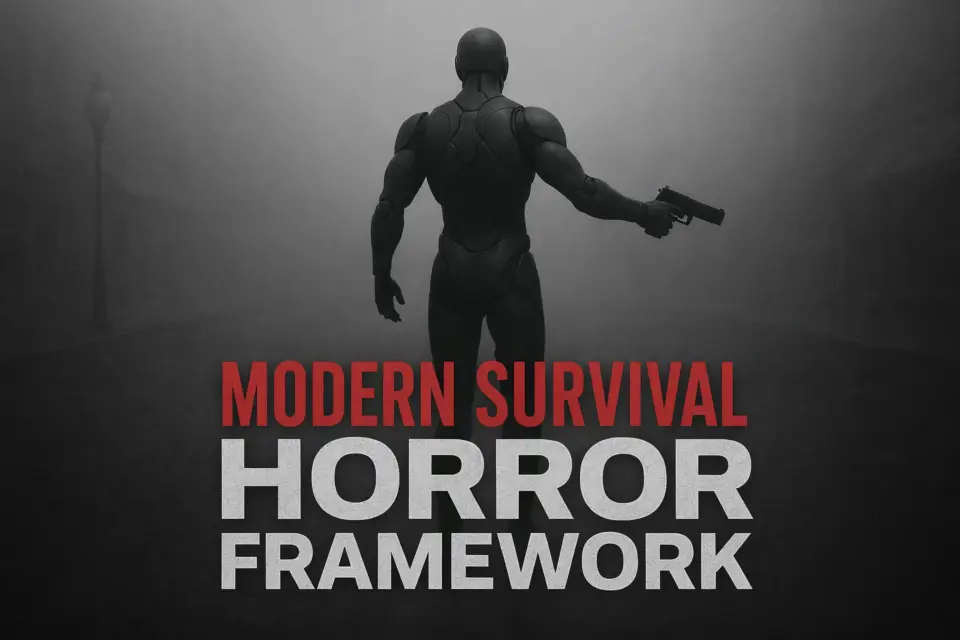
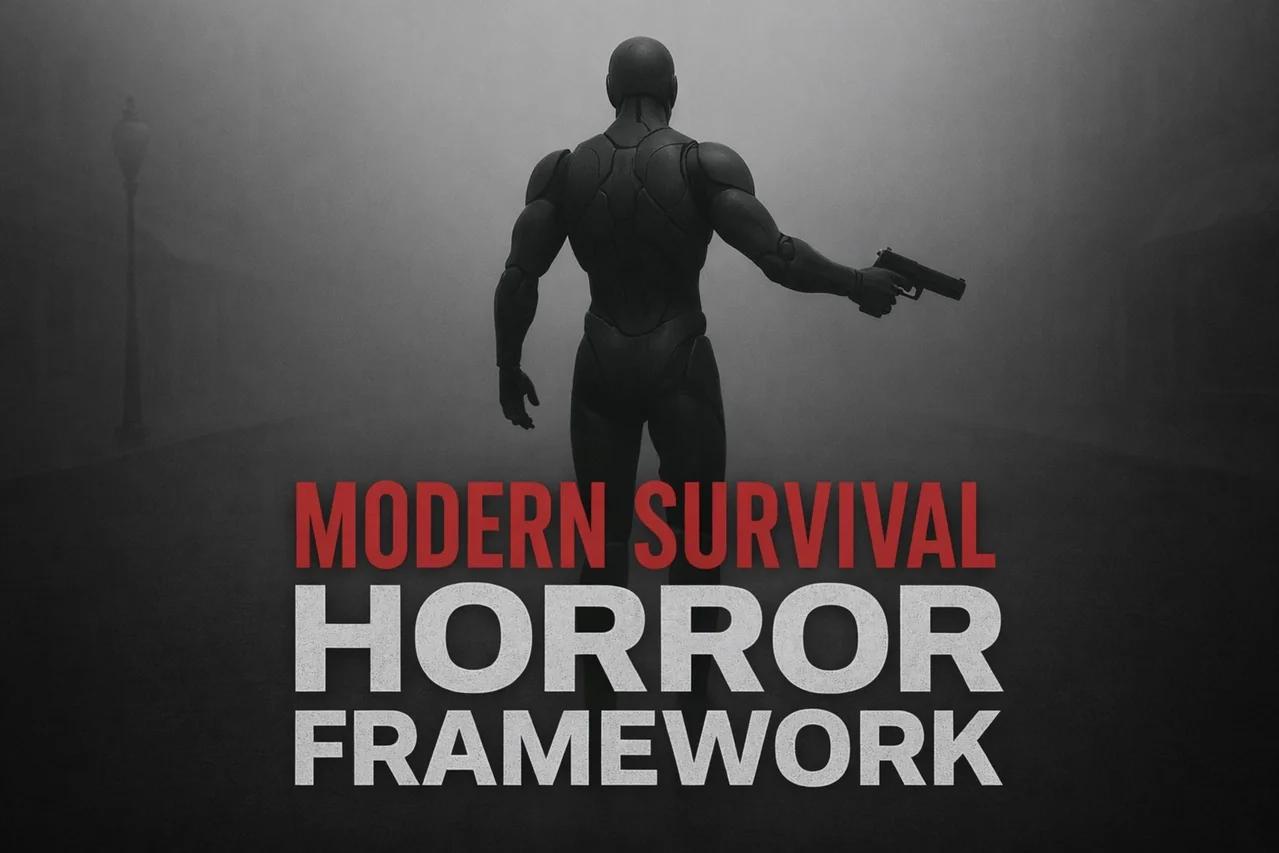
Character handling is anchored by a third-person over-the-shoulder camera configuration, referencing contemporary survival horror design standards. Locomotion is driven by a modified GASP Motion Matching setup, delivering natural transitions between movement states while maintaining the deliberate, grounded pacing essential to horror gameplay.
Character support extends natively to both standard Unreal Engine 5 skeletons and MetaHuman skeletons for third-person characters. Control handling includes full support for both Xbox gamepads and keyboards across gameplay and user interfaces, supported by automatic input detection. Traversal capabilities also expand beyond standard running and walking, providing functional ladder climbing mechanics and narrow space traversal animations to handle tight corridors, squeeze-through gaps, and vertical level design.
Grid Inventory Mechanics, Storage Boxes, and Inspection
Resource management follows an advanced slot-based grid inventory layout, accommodating multi-slot items that occupy variable rectangular footprints on the grid. Players must organize their supplies directly within the spatial limits of the container. Inventory capacity is not fixed indefinitely; it integrates with an inventory expansion system that upgrades carrying space through backpack pickups discovered in the environment.
Items can be examined through an inspection system that handles both readable text documents and inspectable 3D objects, allowing items to be manipulated and rotated in a dedicated view. Surplus resources can be managed through a fully featured storage box system, giving players a secure hub to offload ammunition, healing items, and mission items. When picking up or manipulating objects in the environment, context-aware interactions evaluate the player focus vector to display appropriate prompts automatically.
Environmental Interaction, Door States, and Lock Mechanisms
Navigation and spatial progression rely heavily on gating and room traversal. The framework features an advanced door system capable of managing multiple door states, ranging from unlocked swing states to obstructed passages. Securing these paths are multiple lock mechanisms that support physical keys, electronic keycards, numerical passcodes, and physical chains, allowing designers to assemble varied progression puzzles across a layout.
Environment interactions extend to physical fixtures and destructible objects. Characters can open drawers and weapon lockers to find supplies, or shatter breakable crates that hook into an integrated item drop pipeline. Exploration is complemented by an advanced in-game map system equipped with progression tracking, helping players register cleared spaces and unresolved obstacles as they explore. Level progression and character state are recorded reliably through an advanced save and load system, while acoustic pacing is maintained by a location-based music system with smooth dynamic transitions.
Combat Arsenal, Merchant Integration, and Enemy AI Senses
The combat toolkit comes configured with four primary weapons: a pipe for close-range melee, alongside a pistol, a rifle, and a shotgun for ranged encounters. Aiming precision is supported by an integrated laser sight system, and illumination in dark zones is managed through a flexible flashlight system that can be configured as either a handheld light or a chest-mounted unit.
Adversaries operate on a comprehensive Enemy AI framework structured through specific perception routines, including visual line-of-sight and auditory hearing ranges. AI agents cycle through distinct behavioral loops for roaming, patrolling, hearing sound disturbances, direct vision acquisition, chasing the player, and executing attacks. Close encounters include a specialized zombie grab and bite system with a quick-time event mechanic, though developers must supply their own animations for the bite sequence. Safe areas or intermediate checkpoints can feature an advanced Merchant system, facilitating commerce and resource trades between encounters.
First-Person Mode Separation and Implementation Scope
While structured primarily around a third-person experience, the framework also includes an optional standalone first-person configuration introduced as a post-launch update. This first-person mode is not an automated runtime camera switch; rather, it exists as a separate, dedicated gameplay mode engineered specifically with its own distinct interaction handling, camera behaviors, and interface tuning tailored to first-person horror design.
The framework is currently in active development under an Early Access model, with core gameplay, menus, and option systems fully operational alongside ongoing refinements to modularity and architectural depth. For development teams constructing single-perspective projects, testing either the third-person or first-person gameplay configurations establishes a reliable baseline for character pacing, inventory layout, and enemy encounters before scaling up custom level and narrative production.
 Action-Adventure
 Action-Adventure
 Action-Adventure
 Action-Adventure