"fa182e0cd0a6ea73"{"id":"1001786","slug":"advanced-survival-horror","title":"Advanced Survival Horror","category":"Action-Adventure","engine":"5.4+","assetVersion":"","engineVersion":"Engine Version: 5.4+","tag":"Action-Adventure","accent":"blue","visual":"mech","summary":"A comprehensive breakdown of the Advanced Survival Horror template, covering its Blueprint mechanics, puzzles, inventory, combat, and traversal systems.","platform":"Unreal Engine","publishedAt":"2026-10-21T07:39:38.733Z","updatedAt":"2026-10-21T07:39:38.733Z","sourceNotes":[],"fileContents":[],"compatibility":["Unreal Engine","Engine Version: 5.4+"],"featuredImage":{"alt":"Advanced Survival Horror","src":"/wp-content/uploads/published/2026/10/05196d52fc48-bef95558-8d8c-4c14-a9d6-5eca2b82646d-ed3a16f175.webp"},"hasDownloadLink":true,"downloads":0,"terms":[{"taxonomy":"category","slug":"action-adventure","name":"Action-Adventure"}],"galleryImages":[{"src":"/wp-content/uploads/published/2026/10/41e5e7b6c5a3-0d6839fb-4535-4f62-a0af-44553d89ac85-5df4701e5a.webp","alt":"Advanced Survival Horror"},{"src":"/wp-content/uploads/published/2026/10/e822be212286-f9061c94-6ad8-49bb-aefe-d87b403d9251-0f3cf4c0e6.webp","alt":"Advanced Survival Horror"},{"src":"/wp-content/uploads/published/2026/10/668f1d5d72bd-2dc75447-044b-4f5a-91fd-ff900c1006f0-8025f70913.webp","alt":"Advanced Survival Horror"},{"src":"/wp-content/uploads/published/2026/10/a573bbc23d05-5e7c12d8-bf1d-434c-9c0a-f3e2d2b08f62-08dc43934a.webp","alt":"Advanced Survival Horror"},{"src":"/wp-content/uploads/published/2026/10/fae72265ffc7-f8b7e7f7-33de-4814-888b-ebd76e20b612-b6c581a596.webp","alt":"Advanced Survival Horror"},{"src":"/wp-content/uploads/published/2026/10/e748c3660de0-ceb78e68-4e45-4e1f-8c67-6f3efb651029-9943dc1b54.webp","alt":"Advanced Survival Horror"},{"src":"/wp-content/uploads/published/2026/10/e6cc43032850-e2b7a86a-ef22-4aa2-8ba2-290312d2d3b0-d7d58e9742.webp","alt":"Advanced Survival Horror"},{"src":"/wp-content/uploads/published/2026/10/a6e10149510f-04f909d0-273d-4ced-84e1-e9a625e1f111-841d2ab09e.webp","alt":"Advanced Survival Horror"},{"src":"/wp-content/uploads/published/2026/10/a8e9580be02b-ff235e74-3121-4c41-be27-c9ec21a31620-fa79468911.webp","alt":"Advanced Survival Horror"},{"src":"/wp-content/uploads/published/2026/10/0f8e6102f8b1-d9f721d5-e98f-436e-b666-d1a36b3640ef-6eb3a22aa9.webp","alt":"Advanced Survival Horror"}],"accessPanel":{"kind":"resource","title":"Download this resource","eyebrow":"Free Download","message":"Log in or create a free account to start your download.","fileName":"Advanced Survival Horror.7z","safetyNote":"Resources are manually reviewed before listing to improve quality and reduce obvious risks.","actionLabel":"Download Free","resourceType":"Resource archive"},"contentHtml":"\u003cp\u003eSurvival horror projects depend heavily on deliberate pacing, limited resources, and calculated environmental hazards. Rather than forcing creators to assemble fundamental mechanics from disparate systems, Advanced Survival Horror supplies an integrated framework built entirely with Blueprints. It models the core interactions expected in resource-conscious horror scenarios, spanning weapon combat, navigation, logical puzzles, and deep inventory manipulation.\u003c/p\u003e\u003ch2\u003eBlueprint Architecture and Unreal Engine Versions\u003c/h2\u003e\u003cp\u003eConstructed entirely within visual scripting, the framework operates without requiring native C++ compilation. This Blueprint-only structure ensures that game logic, character state flows, and interaction events remain accessible directly within the Unreal Engine editor. Developers can inspect, modify, and extend gameplay events without breaking core dependencies or handling external builds.\u003c/p\u003e\u003cp\u003eCompatibility across engine generations reflects ongoing technical progression. While legacy builds across Unreal Engine 4.21 through 4.26 have been discontinued, support centers on Unreal Engine 4.27 and continues forward into Unreal Engine 5.0 and beyond. This focus ensures stability within modern rendering pipelines while retaining the core gameplay loops designed around classic survival experiences.\u003c/p\u003e\u003ch2\u003eComplex Inventory, Supplies, and Item Combining Mechanics\u003c/h2\u003e\u003cp\u003eResource management forms the backbone of survival scenarios, where rationing ammunition, healing items, and tools directly dictates pacing. The template incorporates a complex inventory designed to process distinct supply categories, readable documents, and navigational aids. Managing supplies requires active attention, reflecting the deliberate pressure found in classic genre titles.\u003c/p\u003e\u003cp\u003eKey interactions include:\u003c/p\u003e\u003cul\u003e\u003cli\u003e\u003cstrong\u003eItem Combination:\u003c/strong\u003e Players can select, inspect, and combine discrete items within the interface to produce critical tools or consumable supplies.\u003c/li\u003e\u003cli\u003e\u003cstrong\u003eDocument Inspection:\u003c/strong\u003e Written notes and lore items can be collected and reviewed to supply background context or reveal clues for obstacles.\u003c/li\u003e\u003cli\u003e\u003cstrong\u003e2D Navigation Maps:\u003c/strong\u003e Map screens orient the player within complex level layouts, allowing developers to establish interconnected facility designs.\u003c/li\u003e\u003cli\u003e\u003cstrong\u003eQuick Slot Weapons:\u003c/strong\u003e Dedicated quick-slot inputs permit rapid weapon switching without requiring constant visits to the full inventory menu during encounters.\u003c/li\u003e\u003c/ul\u003e\u003cp\u003eBy coordinating inventory slots, combinable resources, and contextual supply pickups, the system maintains tension during exploration and sudden enemy encounters alike.\u003c/p\u003e\u003ch2\u003eWeapons, Combat Mechanics, and Visible Holstered Weapons\u003c/h2\u003e\u003cp\u003eCombat in Advanced Survival Horror balances ranged firearms with close-quarters melee options. Rather than treating weapons as simple statistical variations, the template differentiates between tactical roles. Standard firearms address immediate threats, a dedicated grenade launcher supplies heavier area-of-effect capability, and a sniper rifle system introduces precision targeting paired with puzzle mechanics.\u003c/p\u003e\u003cp\u003ePhysical presence in the world is reinforced through visible holstered weapons. When not drawn, equipped gear remains visible on the player character model, preserving continuity between character state and visual representation. When encounters shift to close proximity, melee weapon integration enables defensive swings and emergency engagements when ammunition supplies are depleted.\u003c/p\u003e\u003cp\u003eAnimations included throughout the combat and character systems were created in cooperation with animator and rigger Jason P. Westmas, ensuring that character handling, stance transitions, and mechanical interactions remain coherent across gameplay states. Audio feedback is paired with sounds drawn from royalty-free audio libraries, providing essential acoustic cues for weapon actions and interactions.\u003c/p\u003e\u003ch2\u003eEnvironmental Traversal: Ladders, Ropes, Elevators, and Sliding Doors\u003c/h2\u003e\u003cp\u003eLevel design in horror titles often relies on verticality, restricted passages, and motorized access points to control pacing. Advanced Survival Horror includes built-in traversal systems that govern how characters navigate through complex architecture.\u003c/p\u003e\u003cp\u003eVertical movement is handled through dedicated ladder climbing and rope climbing systems, allowing designers to link multi-tiered floors, subterranean conduits, or emergency escape routes. Mechanical barriers and transitions use dedicated sliding doors and functional elevators, allowing seamless transit between sectors or creating isolated pockets where threats can converge. These traversal mechanics feed directly into level progression, requiring players to reach mechanical controls, navigate access shafts, or restore transit lines to advance.\u003c/p\u003e\u003ch2\u003eEnvironmental Puzzles, Keypads, and Lock Combinations\u003c/h2\u003e\u003cp\u003eObstacles and gated pathways prevent straightforward transit through environments, demanding logical deduction from the player. Advanced Survival Horror packages distinct puzzle archetypes ready for deployment across maps and secure chambers:\u003c/p\u003e\u003cul\u003e\u003cli\u003e\u003cstrong\u003eKeypad Interfaces:\u003c/strong\u003e Digital entry pads require specific numeric codes discovered throughout the environment or deduced from found documents.\u003c/li\u003e\u003cli\u003e\u003cstrong\u003eThree-Combination Lock Puzzles:\u003c/strong\u003e Mechanical combination locks challenge players to dial in corresponding sequences to open physical lockers, chests, or gates.\u003c/li\u003e\u003cli\u003e\u003cstrong\u003eSniper Integration Puzzles:\u003c/strong\u003e Long-range optics are tied directly to puzzle scenarios, requiring players to identify distant markers or align visual targets through the scope.\u003c/li\u003e\u003c/ul\u003e\u003cp\u003eThese modular puzzle mechanics turn passive exploration into an active search for codes, keys, and visual markers embedded across rooms and hallways.\u003c/p\u003e\u003ch2\u003ePatrol Routes, Free-Roaming AI, and Persistence\u003c/h2\u003e\u003cp\u003eThreat presence relies on automated behavioral systems. The template includes patrol and free-roam logic, governing how hostile entities navigate designated paths or wander freely across search zones. Hint mechanisms assist in directing attention or shaping investigation routines, producing unpredictable search patterns that force players to rely on stealth, timing, and cautious navigation.\u003c/p\u003e\u003cp\u003eProgression across sessions is maintained by a dedicated Save and Load system. World states, inventory contents, puzzle status, and character placement persist between play sessions, ensuring that long-form campaigns retain player progress cleanly across game restarts.\u003c/p\u003e\u003ch2\u003eProject Setup, Perspective Options, and Documentation\u003c/h2\u003e\u003cp\u003eAdapting the template to specific project artistic guidelines is supported through several targeted tutorials and internal guides stored directly in the project folder. Key adaptation paths include:\u003c/p\u003e\u003cul\u003e\u003cli\u003e\u003cstrong\u003eFirst-Person Setup:\u003c/strong\u003e Instructions show how to convert or adjust the viewpoint into a direct first-person camera perspective.\u003c/li\u003e\u003cli\u003e\u003cstrong\u003e2D Map Configuration:\u003c/strong\u003e Walkthroughs guide the setup of custom 2D layout maps to reflect bespoke environmental floor plans.\u003c/li\u003e\u003cli\u003e\u003cstrong\u003eRagdoll Recovery Adjustments:\u003c/strong\u003e A dedicated ragdoll get-up tutorial provides the necessary steps to fix recovery transitions whenever custom character meshes and skeletons are imported into the project.\u003c/li\u003e\u003c/ul\u003e\u003cp\u003eBy containing documentation inside the project directory and delivering mechanics purely through organized Blueprints, Advanced Survival Horror gives development teams a robust, cohesive base for crafting survival, zombie, and psychological horror games.\u003c/p\u003e\n\n\u003ch2\u003eExplore Similar Assets\u003c/h2\u003e\n\u003cul\u003e\n\u003cli\u003e\u003ca href=\"https://3dcghub.com/classic-survival-horror-framework-v2/\" title=\"Classic Survival Horror Framework V2\"\u003eClassic Survival Horror Framework V2\u003c/a\u003e\u003c/li\u003e\n\u003cli\u003e\u003ca href=\"https://3dcghub.com/hyper-multiplayer-survival-template-pro-mst-v4/\" title=\"Hyper Multiplayer Survival Template Pro [MST] V4\"\u003eHyper Multiplayer Survival Template Pro [MST] V4\u003c/a\u003e\u003c/li\u003e\n\u003cli\u003e\u003ca href=\"https://3dcghub.com/hyper-multiplayer-survival-template-plus-mst-v4/\" title=\"Hyper Multiplayer Survival Template Plus [MST] v4\"\u003eHyper Multiplayer Survival Template Plus [MST] v4\u003c/a\u003e\u003c/li\u003e\n\u003cli\u003e\u003ca href=\"https://3dcghub.com/horror-engine-se/\" title=\"Horror Engine SE\"\u003eHorror Engine SE\u003c/a\u003e\u003c/li\u003e\n\u003cli\u003e\u003ca href=\"https://3dcghub.com/asymmetric-multiplayer-horror/\" title=\"Asymmetric Multiplayer Horror\"\u003eAsymmetric Multiplayer Horror\u003c/a\u003e\u003c/li\u003e\n\u003c/ul\u003e","contentTextLength":7477,"navigation":{"current":70,"total":3789,"previous":{"id":"1001787","slug":"alien-x4","title":"Alien X4","category":"Characters \u0026 Creatures","platform":"Unreal Engine","updatedAt":"2026-10-21T07:40:22.316Z"},"next":{"id":"1001785","slug":"advance-interactive-story","title":"Advance Interactive Story","category":"Gameplay Features","platform":"Unreal Engine","updatedAt":"2026-10-21T07:39:02.745Z"}},"relatedResources":[{"id":"1001684","slug":"classic-survival-horror-framework-v2","title":"Classic Survival Horror Framework V2","category":"Action-Adventure","engine":"5.5+","assetVersion":"","engineVersion":"Engine Version: 5.5+","tag":"Action-Adventure","accent":"blue","visual":"mech","summary":"Explore Classic Survival Horror Framework V2, featuring modular Blueprints, MetaHuman skeleton support, flamethrower mechanics, and gamepad UI controls.","platform":"Unreal Engine","publishedAt":"2026-10-14T08:57:28.447Z","updatedAt":"2026-10-14T08:57:28.447Z","sourceNotes":[],"fileContents":[],"compatibility":["Unreal Engine","Engine Version: 5.5+"],"featuredImage":{"alt":"Classic Survival Horror Framework V2","src":"/wp-content/uploads/published/2026/10/69738cdc2258-dd330e3c-bd74-4bde-bfbe-52537e5c8b9a-4db5930fa5.webp"},"hasDownloadLink":true,"downloads":0},{"id":"1001152","slug":"hyper-multiplayer-survival-template-pro-mst-v4","title":"Hyper Multiplayer Survival Template Pro [MST] V4","category":"Action-Adventure","engine":"5.3+","assetVersion":"","engineVersion":"Engine Version: 5.3+","tag":"Action-Adventure","accent":"blue","visual":"mech","summary":"Explore Hyper Multiplayer Survival Template Pro [MST] V4, a fully replicated Unreal Engine framework for open-world, co-op PvE, and survival projects.","platform":"Unreal Engine","publishedAt":"2026-09-10T17:56:18.119Z","updatedAt":"2026-09-10T17:56:18.119Z","sourceNotes":[],"fileContents":[],"compatibility":["Unreal Engine","Engine Version: 5.3+"],"featuredImage":{"alt":"Hyper Multiplayer Survival Template Pro [MST] V4","src":"/wp-content/uploads/published/2026/09/6060550226b8-0f2946eb-0653-4ed7-a160-e35859e9e5e9-61232ad933.webp"},"hasDownloadLink":true,"downloads":8},{"id":"1001151","slug":"hyper-multiplayer-survival-template-plus-mst-v4","title":"Hyper Multiplayer Survival Template Plus [MST] v4","category":"Action-Adventure","engine":"5.4+","assetVersion":"","engineVersion":"Engine Version: 5.4+","tag":"Action-Adventure","accent":"blue","visual":"mech","summary":"Explore Hyper Multiplayer Survival Template Plus v4, featuring replicated base building, landscape tools, inventory, crafting, and modular Unreal Engine systems","platform":"Unreal Engine","publishedAt":"2026-09-10T15:52:12.318Z","updatedAt":"2026-09-10T15:52:12.318Z","sourceNotes":[],"fileContents":[],"compatibility":["Unreal Engine","Engine Version: 5.4+"],"featuredImage":{"alt":"Hyper Multiplayer Survival Template Plus [MST] v4","src":"/wp-content/uploads/published/2026/09/6998f3fa0308-de2368c5-543b-49ea-adad-ee13b3d478ed-563273f35a.webp"},"hasDownloadLink":true,"downloads":2}]}
Action-Adventure
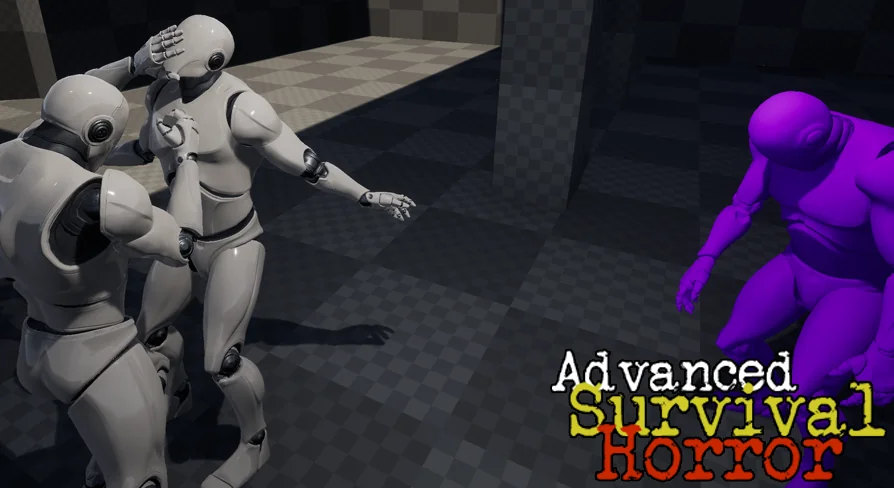
Advanced Survival Horror
A comprehensive breakdown of the Advanced Survival Horror template, covering its Blueprint mechanics, puzzles, inventory, combat, and traversal systems.
Survival horror projects depend heavily on deliberate pacing, limited resources, and calculated environmental hazards. Rather than forcing creators to assemble fundamental mechanics from disparate systems, Advanced Survival Horror supplies an integrated framework built entirely with Blueprints. It models the core interactions expected in resource-conscious horror scenarios, spanning weapon combat, navigation, logical puzzles, and deep inventory manipulation.
Blueprint Architecture and Unreal Engine Versions
Constructed entirely within visual scripting, the framework operates without requiring native C++ compilation. This Blueprint-only structure ensures that game logic, character state flows, and interaction events remain accessible directly within the Unreal Engine editor. Developers can inspect, modify, and extend gameplay events without breaking core dependencies or handling external builds.
Compatibility across engine generations reflects ongoing technical progression. While legacy builds across Unreal Engine 4.21 through 4.26 have been discontinued, support centers on Unreal Engine 4.27 and continues forward into Unreal Engine 5.0 and beyond. This focus ensures stability within modern rendering pipelines while retaining the core gameplay loops designed around classic survival experiences.
Complex Inventory, Supplies, and Item Combining Mechanics
Resource management forms the backbone of survival scenarios, where rationing ammunition, healing items, and tools directly dictates pacing. The template incorporates a complex inventory designed to process distinct supply categories, readable documents, and navigational aids. Managing supplies requires active attention, reflecting the deliberate pressure found in classic genre titles.
Key interactions include:
Item Combination: Players can select, inspect, and combine discrete items within the interface to produce critical tools or consumable supplies.
Document Inspection: Written notes and lore items can be collected and reviewed to supply background context or reveal clues for obstacles.
2D Navigation Maps: Map screens orient the player within complex level layouts, allowing developers to establish interconnected facility designs.
Quick Slot Weapons: Dedicated quick-slot inputs permit rapid weapon switching without requiring constant visits to the full inventory menu during encounters.
By coordinating inventory slots, combinable resources, and contextual supply pickups, the system maintains tension during exploration and sudden enemy encounters alike.
Weapons, Combat Mechanics, and Visible Holstered Weapons
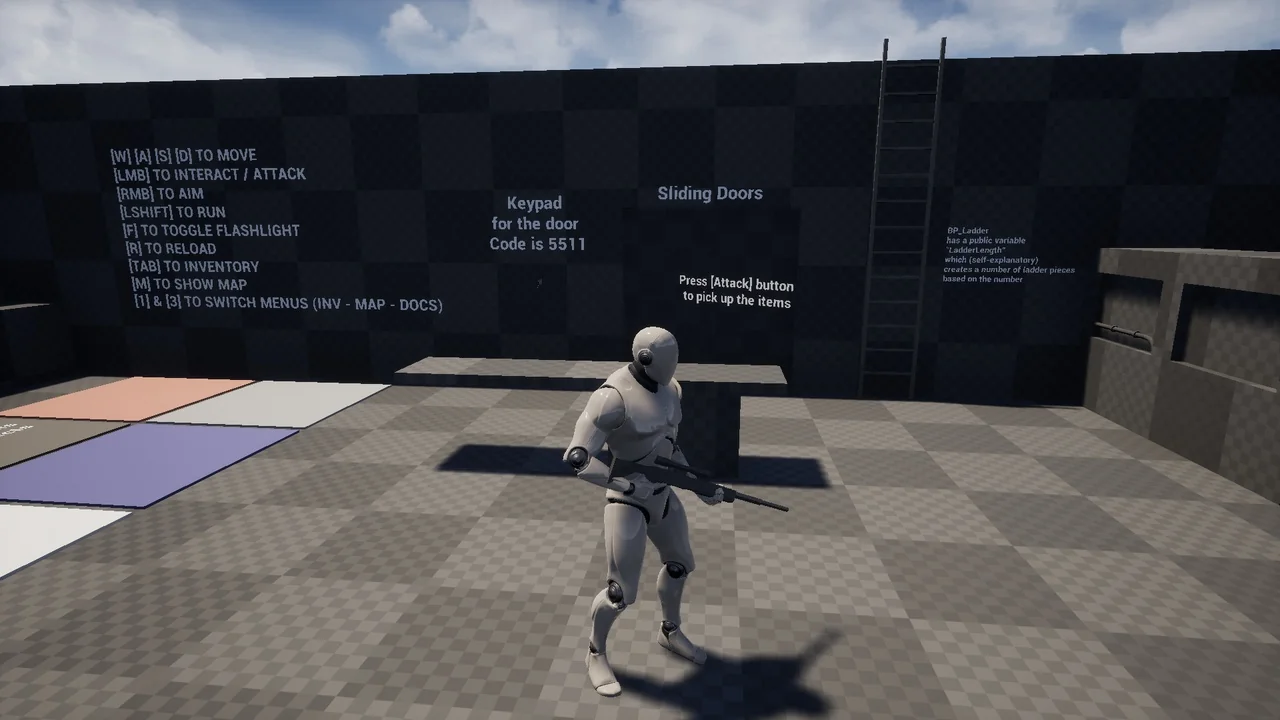
Combat in Advanced Survival Horror balances ranged firearms with close-quarters melee options. Rather than treating weapons as simple statistical variations, the template differentiates between tactical roles. Standard firearms address immediate threats, a dedicated grenade launcher supplies heavier area-of-effect capability, and a sniper rifle system introduces precision targeting paired with puzzle mechanics.
Physical presence in the world is reinforced through visible holstered weapons. When not drawn, equipped gear remains visible on the player character model, preserving continuity between character state and visual representation. When encounters shift to close proximity, melee weapon integration enables defensive swings and emergency engagements when ammunition supplies are depleted.
Animations included throughout the combat and character systems were created in cooperation with animator and rigger Jason P. Westmas, ensuring that character handling, stance transitions, and mechanical interactions remain coherent across gameplay states. Audio feedback is paired with sounds drawn from royalty-free audio libraries, providing essential acoustic cues for weapon actions and interactions.
Environmental Traversal: Ladders, Ropes, Elevators, and Sliding Doors
Level design in horror titles often relies on verticality, restricted passages, and motorized access points to control pacing. Advanced Survival Horror includes built-in traversal systems that govern how characters navigate through complex architecture.
Vertical movement is handled through dedicated ladder climbing and rope climbing systems, allowing designers to link multi-tiered floors, subterranean conduits, or emergency escape routes. Mechanical barriers and transitions use dedicated sliding doors and functional elevators, allowing seamless transit between sectors or creating isolated pockets where threats can converge. These traversal mechanics feed directly into level progression, requiring players to reach mechanical controls, navigate access shafts, or restore transit lines to advance.
Environmental Puzzles, Keypads, and Lock Combinations
Obstacles and gated pathways prevent straightforward transit through environments, demanding logical deduction from the player. Advanced Survival Horror packages distinct puzzle archetypes ready for deployment across maps and secure chambers:
Keypad Interfaces: Digital entry pads require specific numeric codes discovered throughout the environment or deduced from found documents.
Three-Combination Lock Puzzles: Mechanical combination locks challenge players to dial in corresponding sequences to open physical lockers, chests, or gates.
Sniper Integration Puzzles: Long-range optics are tied directly to puzzle scenarios, requiring players to identify distant markers or align visual targets through the scope.
These modular puzzle mechanics turn passive exploration into an active search for codes, keys, and visual markers embedded across rooms and hallways.
Patrol Routes, Free-Roaming AI, and Persistence
Threat presence relies on automated behavioral systems. The template includes patrol and free-roam logic, governing how hostile entities navigate designated paths or wander freely across search zones. Hint mechanisms assist in directing attention or shaping investigation routines, producing unpredictable search patterns that force players to rely on stealth, timing, and cautious navigation.
Progression across sessions is maintained by a dedicated Save and Load system. World states, inventory contents, puzzle status, and character placement persist between play sessions, ensuring that long-form campaigns retain player progress cleanly across game restarts.
Project Setup, Perspective Options, and Documentation
Adapting the template to specific project artistic guidelines is supported through several targeted tutorials and internal guides stored directly in the project folder. Key adaptation paths include:
First-Person Setup: Instructions show how to convert or adjust the viewpoint into a direct first-person camera perspective.
2D Map Configuration: Walkthroughs guide the setup of custom 2D layout maps to reflect bespoke environmental floor plans.
Ragdoll Recovery Adjustments: A dedicated ragdoll get-up tutorial provides the necessary steps to fix recovery transitions whenever custom character meshes and skeletons are imported into the project.
By containing documentation inside the project directory and delivering mechanics purely through organized Blueprints, Advanced Survival Horror gives development teams a robust, cohesive base for crafting survival, zombie, and psychological horror games.
 Action-Adventure
 Action-Adventure
 Action-Adventure
 Action-Adventure