"7b46a695175d8694"{"id":"1001519","slug":"horror-engine-se","title":"Horror Engine SE","category":"Action-Adventure","engine":"5.4+","assetVersion":"","engineVersion":"Engine Version: 5.4+","tag":"Action-Adventure","accent":"blue","visual":"mech","summary":"A complete no-code framework for first-person horror games, featuring dynamic event systems, modular interaction, analog media, and custom lighting.","platform":"Unreal Engine","publishedAt":"2026-10-09T13:19:25.405Z","updatedAt":"2026-10-09T13:19:25.405Z","sourceNotes":[],"fileContents":[],"compatibility":["Unreal Engine","Engine Version: 5.4+"],"featuredImage":{"alt":"Horror Engine SE","src":"/wp-content/uploads/published/2026/10/05f7ef1a91a8-3eb0a047-3f25-47b7-bff2-7488c9a3ea20-e0f46bce12.webp"},"hasDownloadLink":true,"downloads":0,"terms":[{"taxonomy":"category","slug":"action-adventure","name":"Action-Adventure"}],"galleryImages":[{"src":"/wp-content/uploads/published/2026/10/6b1bd3d152d1-c30f7484-d752-4b2f-80c6-c2eb650ed873-2a6e77ecd9.webp","alt":"Horror Engine SE"},{"src":"/wp-content/uploads/published/2026/10/3dbee0f4105e-3339a3e8-d2f6-45ac-8057-84a60ef0f51a-c861f29f9b.webp","alt":"Horror Engine SE"},{"src":"/wp-content/uploads/published/2026/10/91b906fa34ce-a9d84fc1-d3f2-4da2-8442-2bb4d3f5d671-2a9ca6313e.webp","alt":"Horror Engine SE"},{"src":"/wp-content/uploads/published/2026/10/1b2478166356-3140fc0d-95ce-4f78-ab99-7b0ce5cab8d9-7bb1c104f1.webp","alt":"Horror Engine SE"},{"src":"/wp-content/uploads/published/2026/10/a8bbb4f45ca5-5a7d41c5-2e9b-47f0-8d4e-646e6f0e2983-3b2cfbb1f0.webp","alt":"Horror Engine SE"},{"src":"/wp-content/uploads/published/2026/10/7418fa6563b0-4d3936f8-58ce-423f-b8e7-a47734bda6a0-514eef1e81.webp","alt":"Horror Engine SE"},{"src":"/wp-content/uploads/published/2026/10/000fdd55592f-caf8437e-0958-4e30-84fd-b26a08f5538e-79d6fa9d9e.webp","alt":"Horror Engine SE"},{"src":"/wp-content/uploads/published/2026/10/cac359520c90-6eaab3fb-a902-4033-8abf-4b48b3c3d346-8e8e217bb5.webp","alt":"Horror Engine SE"},{"src":"/wp-content/uploads/published/2026/10/eb23bf475e76-ac20b9de-9598-409f-af7a-1cc543c3c346-8161c8bf0f.webp","alt":"Horror Engine SE"},{"src":"/wp-content/uploads/published/2026/10/c419507ace33-0a8dcc05-d0fd-4071-8b2b-ffc42a7038bc-0ec191569c.webp","alt":"Horror Engine SE"}],"accessPanel":{"kind":"resource","title":"Download this resource","eyebrow":"Free Download","message":"Log in or create a free account to start your download.","fileName":"Horror Engine SE.7z","safetyNote":"Resources are manually reviewed before listing to improve quality and reduce obvious risks.","actionLabel":"Download Free","resourceType":"Resource archive"},"contentHtml":"\u003cp\u003eConfining an audience inside derelict interiors, subterranean tunnels, or abandoned security complexes requires precise control over presentation and player vulnerability. Horror Engine SE operates as a complete project designed to construct these interactive environments from scratch without requiring coding knowledge. Based on blueprint architecture with Earth Simulator compatibility, the framework consolidates the staple systems of the genre—ranging from analog media playback to granular physics handling—into an integrated workflow.\u003c/p\u003e \u003ch2\u003eFirst-Person Locomotion and Player Camera Controls\u003c/h2\u003e\n\u003cp\u003ePlayer movement forms the backbone of physical vulnerability in a horror setting. The locomotion setup in Horror Engine SE uses the Enhanced Input System to govern responsive navigation while simulating realistic physical mass. Movement options extend beyond standard walking to include crouching, leaning around corners, jumping, and climbing surfaces. Camera controls introduce atmospheric weight through adjustable head bobbing, customizable field of view (FOV), and depth of field (DOF) settings to simulate disorientation and focus shifts during quiet exploration or high-stress encounters.\u003c/p\u003e\n\u003cp\u003eAudio-visual feedback ties directly into movement through an integrated footstep system calibrated across seven distinct surfaces. This material-based audio ensures that steps shifting from wood to metal, concrete, or soil give immediate acoustic feedback to the player. Bodily survival is regulated through a dedicated health system that links damage detection to visual heads-up display (HUD) changes and synchronized sound effects (SFX), providing clear indications of critical injury without breaking perspective.\u003c/p\u003e \u003ch2\u003eEnvironmental Interaction: Physics, Modular Doors, and Ladders\u003c/h2\u003e\n\u003cp\u003eWorld interactivity hinges on how smoothly a player can manipulate surroundings while searching for escape routes or clues. The physics framework enables direct item handling, allowing players to pick up, hold, carry, and throw physical objects in the environment. For detailed examination of narrative objects, a dedicated inspection system transitions objects into a focused mode equipped with zoom, rotation, panning, and pivot adjustments. Inspected items flow straight into the inventory system, where players can read individual item information or trigger secondary inspections from storage menus.\u003c/p\u003e\n\u003cp\u003eTraversing level geometry relies on structural components designed to assemble complex layouts quickly:\u003c/p\u003e\n\u003cul\u003e \u003cli\u003e\u003cstrong\u003eModular Doors and Furniture:\u003c/strong\u003e Units feature built-in lock systems, operational sound effects, and behavioral scripting for varied room transitions.\u003c/li\u003e \u003cli\u003e\u003cstrong\u003eModular Ladder:\u003c/strong\u003e Configurable settings govern connection rates, total ladder height, and climb speeds to match vertical level architecture.\u003c/li\u003e \u003cli\u003e\u003cstrong\u003eDiary System:\u003c/strong\u003e Narrative entries utilize an easy update format to log plot developments, character notes, and quest progress.\u003c/li\u003e \u003cli\u003e\u003cstrong\u003eSubtitle System:\u003c/strong\u003e Supports text sequences tied to directional audio cues and ambient sounds, keeping narrative timing in sync with soundscapes.\u003c/li\u003e\n\u003c/ul\u003e \u003ch2\u003eAtmospheric Lighting Systems and Handheld Equipment\u003c/h2\u003e\n\u003cp\u003eDarkness serves as both a gameplay boundary and a primary threat. Horror Engine SE features a lighting architecture driven by spotlights, pointlights, and explosive torches, complete with controllable flicker behaviors to create unstable ambient fixtures. For period settings, a modular candle system offers precise authoring options over flame intensity, flicker rates, burn duration, and associated burning sound effects.\u003c/p\u003e\n\u003cp\u003eNavigating these low-visibility areas relies on dedicated portable illumination and scouting tools. Players can deploy a classic flashlight, light matches with a handheld lighter, activate glowsticks for low-profile area illumination, or carry open torches. When light needs to be mediated through a lens, the night vision camera introduces battery-assisted low-light scouting alongside manual zoom functions. For investigative objectives, an instant camera mechanism allows players to snap photographs that automatically catalog into an in-game photo album.\u003c/p\u003e \u003ch2\u003eSecurity Systems, Media Devices, and the VHS Pipeline\u003c/h2\u003e\n\u003cp\u003eRetro technology and surveillance setups play a major role in modern horror level pacing. The project incorporates a functional VHS system complete with physical VHS tapes, a tape deck player, and an old television set to run pre-recorded sequences or instructional footage. Broader electronic media systems include television sets and radios equipped with multi-channel selection, allowing environmental broadcasts to deliver narrative context or unexpected audio distortions.\u003c/p\u003e\n\u003cp\u003eFacility management and containment sections are supported by an expansive security system. This setup connects control panels, operational security cameras, audible alarms, proximity sensors, monitoring stations, and linked security doors into a unified network. Players can monitor feeds across display monitors or trigger lockouts from central terminals. When spatial rules need to be broken entirely, an integrated portal system supplies visual and acoustic warp effects to displace players across separate areas of the map seamlessly.\u003c/p\u003e \u003ch2\u003ePuzzle System Logic and Scripting Horror Events Without Code\u003c/h2\u003e\n\u003cp\u003eThe progression of any horror title depends on balancing obstacle navigation with scripted encounters. A modular puzzle system pairs dedicated puzzle maker logic with designated trigger areas to create sequence locks, riddle interactions, and inventory-gated mechanics. Basic combat encounters or defensive actions are supported through a functional pistol with an integrated shoot trigger mechanic, giving creators the option to include limited survival-combat loops.\u003c/p\u003e\n\u003cp\u003eTension peaks are managed through the Horror Events System, which facilitates endless combinations of scripted jump scares, lighting cuts, spatial changes, and audio triggers. Level designers can sequence multi-stage scares using trigger volumes without manually writing underlying scripts. The project configuration is backed by an official tutorial series, an active Discord channel, a playable tech demo, and v3.1.0 changelog documentation detailing structural refinements. A full main menu system—complete with functional user settings menus and input remapping—ensures that newly assembled games feature an intact front-end experience from the title screen forward.\u003c/p\u003e\n\n\u003ch2\u003eExplore Similar Assets\u003c/h2\u003e\n\u003cul\u003e\n\u003cli\u003e\u003ca href=\"https://3dcghub.com/asymmetric-multiplayer-horror/\" title=\"Asymmetric Multiplayer Horror\"\u003eAsymmetric Multiplayer Horror\u003c/a\u003e\u003c/li\u003e\n\u003cli\u003e\u003ca href=\"https://3dcghub.com/vhs-project-2-5/\" title=\"VHS Project 2.5\"\u003eVHS Project 2.5\u003c/a\u003e\u003c/li\u003e\n\u003cli\u003e\u003ca href=\"https://3dcghub.com/hyper-multiplayer-survival-template-pro-mst-v4/\" title=\"Hyper Multiplayer Survival Template Pro [MST] V4\"\u003eHyper Multiplayer Survival Template Pro [MST] V4\u003c/a\u003e\u003c/li\u003e\n\u003cli\u003e\u003ca href=\"https://3dcghub.com/environments-bundle-6-maps/\" title=\"Environments Bundle 6 Maps\"\u003eEnvironments Bundle 6 Maps\u003c/a\u003e\u003c/li\u003e\n\u003cli\u003e\u003ca href=\"https://3dcghub.com/dynamic-ragdoll/\" title=\"Dynamic Ragdoll\"\u003eDynamic Ragdoll\u003c/a\u003e\u003c/li\u003e\n\u003c/ul\u003e","contentTextLength":6501,"navigation":{"current":26,"total":3481,"previous":{"id":"1001520","slug":"house-along-the-river-house-river-village-stylized-stylised-environment-3d","title":"House Along the River ( House River Village Stylized Stylised Environment 3d )","category":"Fantasy","platform":"Unreal Engine","updatedAt":"2026-10-09T13:20:19.696Z"},"next":{"id":"1001518","slug":"hollywood-movie-props-vol-3","title":"Hollywood Movie Props VOL.3","category":"Lighting","platform":"Unreal Engine","updatedAt":"2026-10-09T13:18:49.029Z"}},"relatedResources":[{"id":"1000977","slug":"asymmetric-multiplayer-horror","title":"Asymmetric Multiplayer Horror","category":"Action-Adventure","engine":"5.0+","assetVersion":"","engineVersion":"Engine Version: 5.0+","tag":"Action-Adventure","accent":"blue","visual":"mech","summary":"Blueprint template for asymmetric multiplayer horror with 4 vs 1 play, AI or player monsters, first/third person views, and a Cursed Forest demo.","platform":"Unreal Engine","publishedAt":"2026-08-17T17:19:51.833Z","updatedAt":"2026-08-17T17:19:51.833Z","sourceNotes":[],"fileContents":[],"compatibility":["Unreal Engine","Engine Version: 5.0+"],"featuredImage":{"alt":"Asymmetric Multiplayer Horror","src":"/wp-content/uploads/published/2026/08/d3e8d4559426-f968b340-50b9-4a59-9fa7-7cdea14f055c-e0904bd06f.webp"},"hasDownloadLink":true,"downloads":1},{"id":"1000713","slug":"vhs-project-2-5","title":"VHS Project 2.5","category":"Action-Adventure","engine":"5.5+","assetVersion":"Asset Version: v2.0","engineVersion":"Engine Version: 5.5+","tag":"Action-Adventure","accent":"blue","visual":"mech","summary":"VHS Project 2.5 is a complete Unreal Engine remake featuring an improved post-process VHS shader with screen warping, tracking lines, and first-person horror me","platform":"Unreal Engine","publishedAt":"2026-07-24T02:42:53.418Z","updatedAt":"2026-07-24T02:42:53.418Z","sourceNotes":[],"fileContents":[],"compatibility":["Unreal Engine","Asset Version: v2.0","Engine Version: 5.5+"],"featuredImage":{"alt":"VHS Project 2.5","src":"/wp-content/uploads/published/2026/07/f56136406ef4-fb20dc2b-4ebf-48f0-84c5-d9d5c3643837-05329032f9.webp"},"hasDownloadLink":true,"downloads":1},{"id":"1001152","slug":"hyper-multiplayer-survival-template-pro-mst-v4","title":"Hyper Multiplayer Survival Template Pro [MST] V4","category":"Action-Adventure","engine":"5.3+","assetVersion":"","engineVersion":"Engine Version: 5.3+","tag":"Action-Adventure","accent":"blue","visual":"mech","summary":"Explore Hyper Multiplayer Survival Template Pro [MST] V4, a fully replicated Unreal Engine framework for open-world, co-op PvE, and survival projects.","platform":"Unreal Engine","publishedAt":"2026-09-10T17:56:18.119Z","updatedAt":"2026-09-10T17:56:18.119Z","sourceNotes":[],"fileContents":[],"compatibility":["Unreal Engine","Engine Version: 5.3+"],"featuredImage":{"alt":"Hyper Multiplayer Survival Template Pro [MST] V4","src":"/wp-content/uploads/published/2026/09/6060550226b8-0f2946eb-0653-4ed7-a160-e35859e9e5e9-61232ad933.webp"},"hasDownloadLink":true,"downloads":7}]}
Action-Adventure
Horror Engine SE
A complete no-code framework for first-person horror games, featuring dynamic event systems, modular interaction, analog media, and custom lighting.
Confining an audience inside derelict interiors, subterranean tunnels, or abandoned security complexes requires precise control over presentation and player vulnerability. Horror Engine SE operates as a complete project designed to construct these interactive environments from scratch without requiring coding knowledge. Based on blueprint architecture with Earth Simulator compatibility, the framework consolidates the staple systems of the genre—ranging from analog media playback to granular physics handling—into an integrated workflow.
First-Person Locomotion and Player Camera Controls
Player movement forms the backbone of physical vulnerability in a horror setting. The locomotion setup in Horror Engine SE uses the Enhanced Input System to govern responsive navigation while simulating realistic physical mass. Movement options extend beyond standard walking to include crouching, leaning around corners, jumping, and climbing surfaces. Camera controls introduce atmospheric weight through adjustable head bobbing, customizable field of view (FOV), and depth of field (DOF) settings to simulate disorientation and focus shifts during quiet exploration or high-stress encounters.
Audio-visual feedback ties directly into movement through an integrated footstep system calibrated across seven distinct surfaces. This material-based audio ensures that steps shifting from wood to metal, concrete, or soil give immediate acoustic feedback to the player. Bodily survival is regulated through a dedicated health system that links damage detection to visual heads-up display (HUD) changes and synchronized sound effects (SFX), providing clear indications of critical injury without breaking perspective.
Environmental Interaction: Physics, Modular Doors, and Ladders
World interactivity hinges on how smoothly a player can manipulate surroundings while searching for escape routes or clues. The physics framework enables direct item handling, allowing players to pick up, hold, carry, and throw physical objects in the environment. For detailed examination of narrative objects, a dedicated inspection system transitions objects into a focused mode equipped with zoom, rotation, panning, and pivot adjustments. Inspected items flow straight into the inventory system, where players can read individual item information or trigger secondary inspections from storage menus.
Traversing level geometry relies on structural components designed to assemble complex layouts quickly:
Modular Doors and Furniture: Units feature built-in lock systems, operational sound effects, and behavioral scripting for varied room transitions.
Modular Ladder: Configurable settings govern connection rates, total ladder height, and climb speeds to match vertical level architecture.
Diary System: Narrative entries utilize an easy update format to log plot developments, character notes, and quest progress.
Subtitle System: Supports text sequences tied to directional audio cues and ambient sounds, keeping narrative timing in sync with soundscapes.
Atmospheric Lighting Systems and Handheld Equipment
Darkness serves as both a gameplay boundary and a primary threat. Horror Engine SE features a lighting architecture driven by spotlights, pointlights, and explosive torches, complete with controllable flicker behaviors to create unstable ambient fixtures. For period settings, a modular candle system offers precise authoring options over flame intensity, flicker rates, burn duration, and associated burning sound effects.
Navigating these low-visibility areas relies on dedicated portable illumination and scouting tools. Players can deploy a classic flashlight, light matches with a handheld lighter, activate glowsticks for low-profile area illumination, or carry open torches. When light needs to be mediated through a lens, the night vision camera introduces battery-assisted low-light scouting alongside manual zoom functions. For investigative objectives, an instant camera mechanism allows players to snap photographs that automatically catalog into an in-game photo album.
Security Systems, Media Devices, and the VHS Pipeline
Retro technology and surveillance setups play a major role in modern horror level pacing. The project incorporates a functional VHS system complete with physical VHS tapes, a tape deck player, and an old television set to run pre-recorded sequences or instructional footage. Broader electronic media systems include television sets and radios equipped with multi-channel selection, allowing environmental broadcasts to deliver narrative context or unexpected audio distortions.
Facility management and containment sections are supported by an expansive security system. This setup connects control panels, operational security cameras, audible alarms, proximity sensors, monitoring stations, and linked security doors into a unified network. Players can monitor feeds across display monitors or trigger lockouts from central terminals. When spatial rules need to be broken entirely, an integrated portal system supplies visual and acoustic warp effects to displace players across separate areas of the map seamlessly.
Puzzle System Logic and Scripting Horror Events Without Code
The progression of any horror title depends on balancing obstacle navigation with scripted encounters. A modular puzzle system pairs dedicated puzzle maker logic with designated trigger areas to create sequence locks, riddle interactions, and inventory-gated mechanics. Basic combat encounters or defensive actions are supported through a functional pistol with an integrated shoot trigger mechanic, giving creators the option to include limited survival-combat loops.
Tension peaks are managed through the Horror Events System, which facilitates endless combinations of scripted jump scares, lighting cuts, spatial changes, and audio triggers. Level designers can sequence multi-stage scares using trigger volumes without manually writing underlying scripts. The project configuration is backed by an official tutorial series, an active Discord channel, a playable tech demo, and v3.1.0 changelog documentation detailing structural refinements. A full main menu system—complete with functional user settings menus and input remapping—ensures that newly assembled games feature an intact front-end experience from the title screen forward.
 Action-Adventure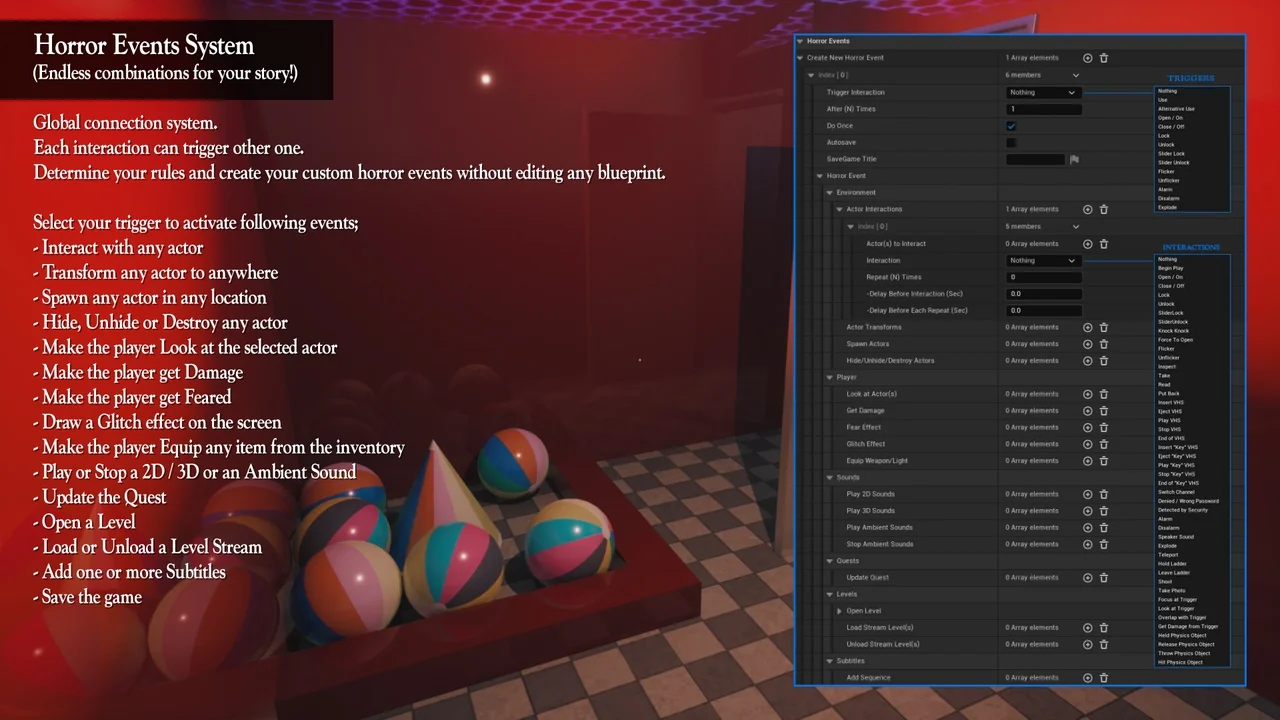
 Action-Adventure
 Action-Adventure
![Hyper Multiplayer Survival Template Pro [MST] V4](/_img/360/wp-content/uploads/published/2026/09/6060550226b8-0f2946eb-0653-4ed7-a160-e35859e9e5e9-61232ad933.webp) Action-Adventure
Action-Adventure