"7b46a695175d8694"{"id":"1001518","slug":"hollywood-movie-props-vol-3","title":"Hollywood Movie Props VOL.3","category":"Lighting","engine":"4.17+,5.0+","assetVersion":"","engineVersion":"Engine Version: 4.17+,5.0+","tag":"Lighting","accent":"blue","visual":"mech","summary":"Explore Hollywood Movie Props VOL.3 for Unreal Engine, featuring AAA studio props, modular scaffolding, dynamic lighting, and channel-packed master materials.","platform":"Unreal Engine","publishedAt":"2026-10-09T13:18:49.029Z","updatedAt":"2026-10-09T13:18:49.029Z","sourceNotes":[],"fileContents":[],"compatibility":["Unreal Engine","Engine Version: 4.17+,5.0+"],"featuredImage":{"alt":"Hollywood Movie Props VOL.3","src":"/wp-content/uploads/published/2026/10/f8dea9c3eb02-2fc7b627-b4ff-46d2-9ba9-2889cf85c60b-047cff89f3.webp"},"hasDownloadLink":true,"downloads":0,"terms":[{"taxonomy":"category","slug":"lighting","name":"Lighting"}],"galleryImages":[{"src":"/wp-content/uploads/published/2026/10/817c52e2449e-e70305f9-b46c-4425-bbb8-06af8cb29a6e-ee61c3fffd.webp","alt":"Hollywood Movie Props VOL.3"},{"src":"/wp-content/uploads/published/2026/10/e482c1752604-1bad883e-133e-4a8b-94d8-e0aa5e672696-d5ded1c55c.webp","alt":"Hollywood Movie Props VOL.3"},{"src":"/wp-content/uploads/published/2026/10/507911df90bd-64f0ab49-fc8e-4643-ba78-c02d9cf39fde-6c8797f901.webp","alt":"Hollywood Movie Props VOL.3"},{"src":"/wp-content/uploads/published/2026/10/6dcaaf6d354d-136fa946-0446-4e73-8385-100201e13c03-fd2b806c4c.webp","alt":"Hollywood Movie Props VOL.3"},{"src":"/wp-content/uploads/published/2026/10/cbe811f97f67-034dbe84-4055-483c-bb6b-3025e3754db0-526e5d7c6e.webp","alt":"Hollywood Movie Props VOL.3"},{"src":"/wp-content/uploads/published/2026/10/47c934073a66-c1170321-52dc-4b77-8e94-31281136ea1b-62ebead669.webp","alt":"Hollywood Movie Props VOL.3"},{"src":"/wp-content/uploads/published/2026/10/c58ebd9b352a-846d43bb-6964-44d7-abb0-4484f6ec5a61-5e2c445bcc.webp","alt":"Hollywood Movie Props VOL.3"},{"src":"/wp-content/uploads/published/2026/10/69aedded70ff-ff3228ba-f3f8-451b-b0dd-5165f4523e50-b4612df01a.webp","alt":"Hollywood Movie Props VOL.3"},{"src":"/wp-content/uploads/published/2026/10/5d5d1a6cb3fc-fd1945f5-733d-4597-942c-c1b8bb6b5920-c800de8f06.webp","alt":"Hollywood Movie Props VOL.3"},{"src":"/wp-content/uploads/published/2026/10/e146f913bbb4-740f84f7-0bf6-48c7-84fb-60052d71837a-c4a3088a10.webp","alt":"Hollywood Movie Props VOL.3"}],"accessPanel":{"kind":"resource","title":"Download this resource","eyebrow":"Free Download","message":"Log in or create a free account to start your download.","fileName":"Content.7z","safetyNote":"Resources are manually reviewed before listing to improve quality and reduce obvious risks.","actionLabel":"Download Free","resourceType":"Resource archive"},"contentHtml":"\u003ch2\u003eDeploying the Dynamic Lighting Scene and Modular Scaffolding\u003c/h2\u003e\u003cp\u003eWorking with film production assets inside Unreal Engine begins with scene scale and lighting calibration. Hollywood Movie Props VOL.3 delivers an integrated test dynamic lighting scene directly alongside its asset catalog, giving artists an immediate reference environment to evaluate real-time exposure, bounce light, and surface response. Instead of dropping individual props into an uncalibrated default level, the test scene establishes the foundational shadow depth and specular response required to see how realistic film gear interacts with dynamic sources.\u003c/p\u003e\u003cp\u003eA core element of this spatial layout is the modular lighting scaffolding set. Film stages require structural rigging to support overhead fixtures, high-angle equipment, and power routes. Because the scaffolding parts are built as modular pieces, they can be snapped together to match diverse soundstage footprints, warehouse studios, or exterior film sets. Dressing the scene vertically with structural trusses allows artists to elevate lights, run studio hardware along realistic paths, and generate believable soundstage architecture before populating individual hand props.\u003c/p\u003e\u003cp\u003eEvery model across the collection is detailed uniformly from all angles. In cinematic production and third-person gameplay, camera angles often push behind equipment, underneath stands, or around mechanical joints that would be hidden in standard static dressing. The 360-degree asset modeling ensures that props placed in the center of a set or viewed from unconventional angles retain their mechanical realism without exposing hollowed geometry or unfinished back faces.\u003c/p\u003e\u003ch2\u003eMaster Material Controls for Roughness, Albedo, and Normals\u003c/h2\u003e\u003cp\u003eManaging surface realism across dozens of movie props relies heavily on uniform material architecture. The collection implements a centralized master material setup that drives the majority of props and models across the pack. This framework standardizes the shader pipeline, keeping draw call overhead manageable while providing uniform property adjustment across completely different object types.\u003c/p\u003e\u003cp\u003eInside child material instances, artists gain direct control over specific texture maps and physical parameters:\u003cul\u003e\u003cli\u003e\u003cstrong\u003eAlbedo adjustments:\u003c/strong\u003e Fine-tune base coloration, brightness, and tint balance to integrate individual assets into customized project color grading.\u003c/li\u003e\u003cli\u003e\u003cstrong\u003eRoughness controls:\u003c/strong\u003e Modify surface glossiness, handling adjustments between factory-clean aluminum, scuffed paint, and matte composite plastics.\u003c/li\u003e\u003cli\u003e\u003cstrong\u003eNormal map parameters:\u003c/strong\u003e Alter normal intensity to adjust micro-surface relief and geometric edge definition under grazing light angles.\u003c/li\u003e\u003cli\u003e\u003cstrong\u003eAdditional procedural controls:\u003c/strong\u003e Balance underlying shader properties to match differing production styles and engine rendering setups.\u003c/li\u003e\u003c/ul\u003e\u003cp\u003eBy controlling roughness, albedo, and normals from instance scalar and vector parameters, changes can be rolled out across an entire stage dressing without editing base textures externally. If an environment demands weathered, high-roughness equipment that has spent weeks on a dusty location shoot, the adjustments occur inside the material instance without breaking the shared shader logic.\u003c/p\u003e\u003ch2\u003eIlluminating Film Sets with Emissive Material Instances\u003c/h2\u003e\u003cp\u003eLighting hardware constitutes a primary component of the pack, representing professional movie lights, illumination fixtures, and film recording gear. To bridge the gap between static mesh props and active scene illumination, the asset collection ships with dedicated emissive material instance versions for all lighting fixtures.\u003c/p\u003e\u003cp\u003eStandard static props represent unpowered lights, showing glass diffusers, reflective baffles, and internal bulbs at rest. Swapping these surfaces for their emissive material instance counterparts immediately shifts the mesh into an active light-emitting source. When paired with Unreal Engine dynamic lighting, the emissive surfaces illuminate lenses, faceplates, and housing frames, complementing actual light components placed within the rigs.\u003c/p\u003e\u003cp\u003eBecause these emissive settings exist as dedicated instances, artists can tune glow brightness, color temperatures, and light output balances directly against the test dynamic lighting scene. A daylight-balanced HMI fixture can run alongside tungsten-balanced work lamps simply by adjusting the emissive instance properties, matching authentic on-set lighting practices.\u003c/p\u003e\u003ch2\u003eTexture Resolution Budgets and Channel-Packed Sets\u003c/h2\u003e\u003cp\u003eHigh-fidelity visuals depend heavily on deliberate texture budgeting. Hollywood Movie Props VOL.3 structures its texture sets to deliver AAA quality while maintaining real-time game performance. The bulk of the texture resolutions sit at 2048 pixels and above, ensuring crisp surface definition even during tight camera close-ups.\u003c/p\u003e\u003cp\u003eThe texture footprint is organized across specific resolution tiers:\u003cul\u003e\u003cli\u003e\u003cstrong\u003e4096 \u0026times; 4096:\u003c/strong\u003e 2 textures dedicated to extensive hero surfaces requiring maximum visual fidelity.\u003c/li\u003e\u003cli\u003e\u003cstrong\u003e2048 \u0026times; 2048:\u003c/strong\u003e 22 textures forming the bulk of the prop surfaces, balancing sharp texel density with memory footprint.\u003c/li\u003e\u003cli\u003e\u003cstrong\u003e1024 \u0026times; 1024:\u003c/strong\u003e 2 textures assigned to mid-sized equipment housings and secondary gear.\u003c/li\u003e\u003cli\u003e\u003cstrong\u003e512 \u0026times; 512:\u003c/strong\u003e 1 texture handling compact hardware elements.\u003c/li\u003e\u003cli\u003e\u003cstrong\u003e256 \u0026times; 256:\u003c/strong\u003e 1 texture for minor trim and small components.\u003c/li\u003e\u003cli\u003e\u003cstrong\u003e128 \u0026times; 128:\u003c/strong\u003e 3 textures allocated to micro details and low-frequency utility masks.\u003c/li\u003e\u003c/ul\u003e\u003cp\u003eTo reduce sampler calls and maximize GPU memory efficiency, the pipeline uses channel-packed textures combining Roughness, Metalness, and Ambient Occlusion into a single image file. Placing individual grayscale masks into distinct color channels (Red, Green, Blue) cuts texture memory use in half compared to storing separate files, directly supporting smooth frame rates during complex scene rendering.\u003c/p\u003e\u003ch2\u003eProduction Context and Legal-Free Studio Assets\u003c/h2\u003e\u003cp\u003eEnvironmental props suited to film production frequently suffer from real-world trademark restrictions. Decals, logos, serial plates, and manufacturer badges on actual cameras, lighting rigs, and sound equipment can prevent commercial deployment due to intellectual property encumbrances. Within this collection, all branding, logos, and labels were custom designed by Dekogon Studios, making the assets entirely free of legal issues for commercial game projects, cinematics, and broadcast scenes.\u003c/p\u003e\u003cp\u003eCrafted by Dekogon Kollab Artists, the collection joined the Unreal Engine Sponsored Content Permanent Collection in November 2019. The collaborative artistic input ensures that industrial filmmaking tools—spanning cameras, rigging, scaffolding, and stage illumination—meet strict visual standards for AAA game budgets, technical optimization, and clean legal implementation.\u003c/p\u003e\n\n\u003ch2\u003eExplore Similar Assets\u003c/h2\u003e\n\u003cul\u003e\n\u003cli\u003e\u003ca href=\"https://3dcghub.com/medieval-furniture-props-gothic-props-victorian-props-medieval-furniture/\" title=\"Medieval Furniture Props (Gothic Props, Victorian Props, Medieval, Furniture)\"\u003eMedieval Furniture Props (Gothic Props, Victorian Props, Medieval, Furniture)\u003c/a\u003e\u003c/li\u003e\n\u003cli\u003e\u003ca href=\"https://3dcghub.com/roadside-vol-3-rural-props-nanite-and-low-poly-versions/\" title=\"Roadside VOL.3 - Rural Props (Nanite and Low Poly Versions)\"\u003eRoadside VOL.3 - Rural Props (Nanite and Low Poly Versions)\u003c/a\u003e\u003c/li\u003e\n\u003cli\u003e\u003ca href=\"https://3dcghub.com/buildings-vol-3-attachments-nanite-and-low-poly/\" title=\"Buildings VOL.3 - Attachments (Nanite and Low Poly)\"\u003eBuildings VOL.3 - Attachments (Nanite and Low Poly)\u003c/a\u003e\u003c/li\u003e\n\u003cli\u003e\u003ca href=\"https://3dcghub.com/lighting-vol-1-interior-nanite-and-low-poly/\" title=\"Lighting VOL.1 - Interior (Nanite and Low Poly)\"\u003eLighting VOL.1 - Interior (Nanite and Low Poly)\u003c/a\u003e\u003c/li\u003e\n\u003cli\u003e\u003ca href=\"https://3dcghub.com/lighting-vol-3-industrial-nanite-and-low-poly/\" title=\"Lighting VOL.3 - Industrial (Nanite and Low Poly)\"\u003eLighting VOL.3 - Industrial (Nanite and Low Poly)\u003c/a\u003e\u003c/li\u003e\n\u003c/ul\u003e","contentTextLength":7028,"navigation":{"current":27,"total":3481,"previous":{"id":"1001519","slug":"horror-engine-se","title":"Horror Engine SE","category":"Action-Adventure","platform":"Unreal Engine","updatedAt":"2026-10-09T13:19:25.405Z"},"next":{"id":"1001517","slug":"gatling-minigun","title":"Gatling Minigun","category":"Game Development Resource","platform":"Unreal Engine","updatedAt":"2026-10-09T13:18:03.581Z"}},"relatedResources":[{"id":"1000633","slug":"medieval-furniture-props-gothic-props-victorian-props-medieval-furniture","title":"Medieval Furniture Props (Gothic Props, Victorian Props, Medieval, Furniture)","category":"Lighting","engine":"5.1+","assetVersion":"","engineVersion":"Engine Version: 5.1+","tag":"Lighting","accent":"blue","visual":"mech","summary":"A 70-prop Unreal Engine interior pack covering medieval, gothic, and Victorian furniture with PBR materials, smoke VFX, cloth physics, and Nanite/Lumen support.","platform":"Unreal Engine","publishedAt":"2026-07-21T14:59:59.227Z","updatedAt":"2026-07-21T20:37:19.504Z","sourceNotes":[],"fileContents":[],"compatibility":["Unreal Engine","Engine Version: 5.1+"],"featuredImage":{"alt":"Medieval Furniture Props (Gothic Props, Victorian Props, Medieval, Furniture)","src":"/wp-content/uploads/published/2026/07/6e5783304c0a-2d34ddc2-41a6-4621-8d8a-1a236c14981d-d9e79dc841.webp"},"hasDownloadLink":true,"downloads":0},{"id":"1000479","slug":"roadside-vol-3-rural-props-nanite-and-low-poly-versions","title":"Roadside VOL.3 - Rural Props (Nanite and Low Poly Versions)","category":"Rocks \u0026 Stones","engine":"5.1+","assetVersion":"","engineVersion":"Engine Version: 5.1+","tag":"Rocks \u0026 Stones","accent":"blue","visual":"mech","summary":"Unreal Engine blockade pack with 16 meshes in Nanite and low-poly variants, 4K textures, channel-packed masks, tintable paint, Lumen support, and custom brandin","platform":"Unreal Engine","publishedAt":"2026-07-11T19:20:57.746Z","updatedAt":"2026-07-11T20:18:42.987Z","sourceNotes":[],"fileContents":[],"compatibility":["Unreal Engine","Engine Version: 5.1+"],"featuredImage":{"alt":"Roadside VOL.3 - Rural Props (Nanite and Low Poly Versions)","src":"/wp-content/uploads/published/2026/07/ca4df3e813dc-77a94b26-c0fa-4247-ac4a-05a0f9a13227-f4e3f5a855.webp"},"hasDownloadLink":true,"downloads":0},{"id":"28590","slug":"buildings-vol-3-attachments-nanite-and-low-poly","title":"Buildings VOL.3 - Attachments (Nanite and Low Poly)","category":"Packs","engine":"5.1+","assetVersion":"Engine version: 5.1+","engineVersion":"","tag":"Packs","accent":"blue","visual":"audio","summary":"Buildings VOL.3 - Attachments (Nanite and Low Poly) focuses on the smaller structural and utility pieces that give interiors and exteriors believable function. With matching Nanite and low poly versions, 4K textures, and a shared material setup, it fits pro...","platform":"Unreal Engine","publishedAt":"2026-05-17T13:14:04.000Z","updatedAt":"2026-05-17T13:14:05.000Z","sourceNotes":[],"fileContents":[],"compatibility":["Unreal Engine","Engine version: 5.1+"],"featuredImage":{"alt":"Buildings VOL.3 - Attachments (Nanite and Low Poly)","src":"https://3dcghub.com/wp-content/uploads/2026/05/8a5e8006583e_2f3d4470-56b3-4748-9407-11317273be5e.webp"},"hasDownloadLink":true,"downloads":0}]}
Lighting
Hollywood Movie Props VOL.3
Explore Hollywood Movie Props VOL.3 for Unreal Engine, featuring AAA studio props, modular scaffolding, dynamic lighting, and channel-packed master materials.
Category:Unreal Engine,LightingPlatform: Unreal EngineEngine Version: 4.17+,5.0+Published: Oct 9, 2026
Lighting
Resource overview
Deploying the Dynamic Lighting Scene and Modular Scaffolding
Working with film production assets inside Unreal Engine begins with scene scale and lighting calibration. Hollywood Movie Props VOL.3 delivers an integrated test dynamic lighting scene directly alongside its asset catalog, giving artists an immediate reference environment to evaluate real-time exposure, bounce light, and surface response. Instead of dropping individual props into an uncalibrated default level, the test scene establishes the foundational shadow depth and specular response required to see how realistic film gear interacts with dynamic sources.
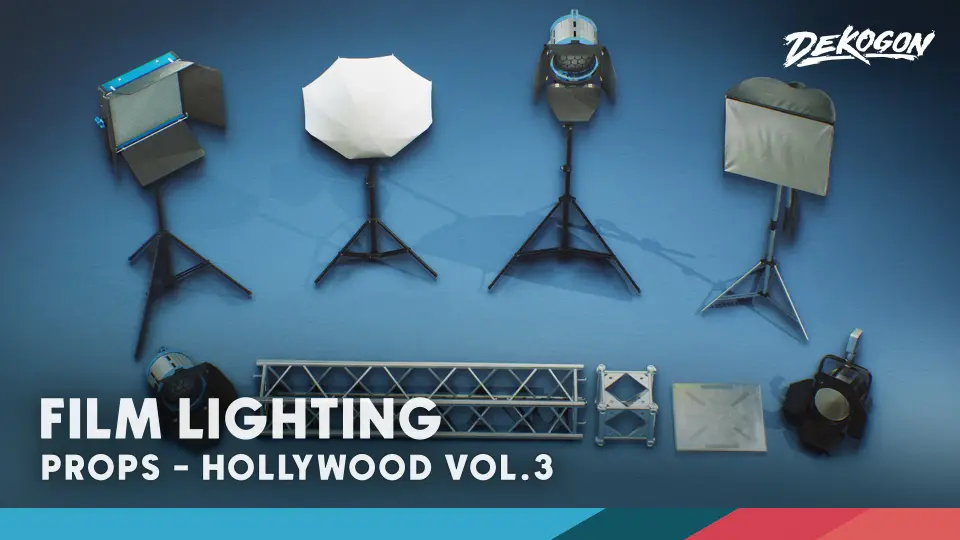
A core element of this spatial layout is the modular lighting scaffolding set. Film stages require structural rigging to support overhead fixtures, high-angle equipment, and power routes. Because the scaffolding parts are built as modular pieces, they can be snapped together to match diverse soundstage footprints, warehouse studios, or exterior film sets. Dressing the scene vertically with structural trusses allows artists to elevate lights, run studio hardware along realistic paths, and generate believable soundstage architecture before populating individual hand props.
Every model across the collection is detailed uniformly from all angles. In cinematic production and third-person gameplay, camera angles often push behind equipment, underneath stands, or around mechanical joints that would be hidden in standard static dressing. The 360-degree asset modeling ensures that props placed in the center of a set or viewed from unconventional angles retain their mechanical realism without exposing hollowed geometry or unfinished back faces.
Master Material Controls for Roughness, Albedo, and Normals
Managing surface realism across dozens of movie props relies heavily on uniform material architecture. The collection implements a centralized master material setup that drives the majority of props and models across the pack. This framework standardizes the shader pipeline, keeping draw call overhead manageable while providing uniform property adjustment across completely different object types.
Inside child material instances, artists gain direct control over specific texture maps and physical parameters:
Albedo adjustments: Fine-tune base coloration, brightness, and tint balance to integrate individual assets into customized project color grading.
Roughness controls: Modify surface glossiness, handling adjustments between factory-clean aluminum, scuffed paint, and matte composite plastics.
Normal map parameters: Alter normal intensity to adjust micro-surface relief and geometric edge definition under grazing light angles.
Additional procedural controls: Balance underlying shader properties to match differing production styles and engine rendering setups.
By controlling roughness, albedo, and normals from instance scalar and vector parameters, changes can be rolled out across an entire stage dressing without editing base textures externally. If an environment demands weathered, high-roughness equipment that has spent weeks on a dusty location shoot, the adjustments occur inside the material instance without breaking the shared shader logic.
Illuminating Film Sets with Emissive Material Instances
Lighting hardware constitutes a primary component of the pack, representing professional movie lights, illumination fixtures, and film recording gear. To bridge the gap between static mesh props and active scene illumination, the asset collection ships with dedicated emissive material instance versions for all lighting fixtures.
Standard static props represent unpowered lights, showing glass diffusers, reflective baffles, and internal bulbs at rest. Swapping these surfaces for their emissive material instance counterparts immediately shifts the mesh into an active light-emitting source. When paired with Unreal Engine dynamic lighting, the emissive surfaces illuminate lenses, faceplates, and housing frames, complementing actual light components placed within the rigs.
Because these emissive settings exist as dedicated instances, artists can tune glow brightness, color temperatures, and light output balances directly against the test dynamic lighting scene. A daylight-balanced HMI fixture can run alongside tungsten-balanced work lamps simply by adjusting the emissive instance properties, matching authentic on-set lighting practices.
Texture Resolution Budgets and Channel-Packed Sets
High-fidelity visuals depend heavily on deliberate texture budgeting. Hollywood Movie Props VOL.3 structures its texture sets to deliver AAA quality while maintaining real-time game performance. The bulk of the texture resolutions sit at 2048 pixels and above, ensuring crisp surface definition even during tight camera close-ups.
The texture footprint is organized across specific resolution tiers:
4096 × 4096: 2 textures dedicated to extensive hero surfaces requiring maximum visual fidelity.
2048 × 2048: 22 textures forming the bulk of the prop surfaces, balancing sharp texel density with memory footprint.
1024 × 1024: 2 textures assigned to mid-sized equipment housings and secondary gear.
256 × 256: 1 texture for minor trim and small components.
128 × 128: 3 textures allocated to micro details and low-frequency utility masks.
To reduce sampler calls and maximize GPU memory efficiency, the pipeline uses channel-packed textures combining Roughness, Metalness, and Ambient Occlusion into a single image file. Placing individual grayscale masks into distinct color channels (Red, Green, Blue) cuts texture memory use in half compared to storing separate files, directly supporting smooth frame rates during complex scene rendering.
Production Context and Legal-Free Studio Assets
Environmental props suited to film production frequently suffer from real-world trademark restrictions. Decals, logos, serial plates, and manufacturer badges on actual cameras, lighting rigs, and sound equipment can prevent commercial deployment due to intellectual property encumbrances. Within this collection, all branding, logos, and labels were custom designed by Dekogon Studios, making the assets entirely free of legal issues for commercial game projects, cinematics, and broadcast scenes.
Crafted by Dekogon Kollab Artists, the collection joined the Unreal Engine Sponsored Content Permanent Collection in November 2019. The collaborative artistic input ensures that industrial filmmaking tools—spanning cameras, rigging, scaffolding, and stage illumination—meet strict visual standards for AAA game budgets, technical optimization, and clean legal implementation.
 Lighting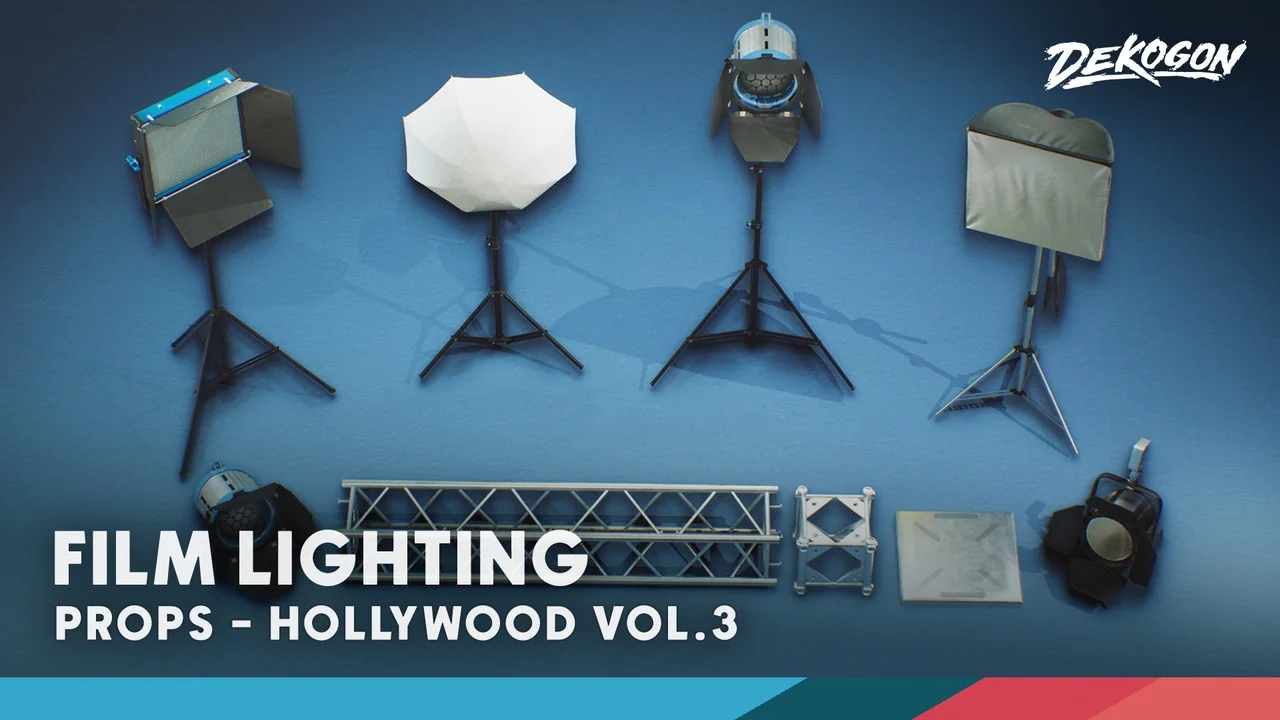
 Lighting
 Rocks & Stones
 Packs
Packs