"c14ff6bd758dadb1"{"id":"1000633","slug":"medieval-furniture-props-gothic-props-victorian-props-medieval-furniture","title":"Medieval Furniture Props (Gothic Props, Victorian Props, Medieval, Furniture)","category":"Lighting","engine":"5.1+","assetVersion":"","engineVersion":"Engine Version: 5.1+","tag":"Lighting","accent":"blue","visual":"mech","summary":"A 70-prop Unreal Engine interior pack covering medieval, gothic, and Victorian furniture with PBR materials, smoke VFX, cloth physics, and Nanite/Lumen support.","platform":"Unreal Engine","publishedAt":"2026-07-21T14:59:59.227Z","updatedAt":"2026-07-21T20:37:19.504Z","sourceNotes":[],"fileContents":[],"compatibility":["Unreal Engine","Engine Version: 5.1+"],"featuredImage":{"alt":"Medieval Furniture Props (Gothic Props, Victorian Props, Medieval, Furniture)","src":"/wp-content/uploads/published/2026/07/6e5783304c0a-2d34ddc2-41a6-4621-8d8a-1a236c14981d-d9e79dc841.webp"},"hasDownloadLink":true,"downloads":1,"terms":[{"taxonomy":"category","slug":"lighting","name":"Lighting"}],"galleryImages":[{"src":"/wp-content/uploads/published/2026/07/242e00c99dc8-38a7f4c9-c7ce-4d4c-91ad-c1f5c8eba34b-8a435c31e9.webp","alt":"Medieval Furniture Props (Gothic Props, Victorian Props, Medieval, Furniture)"},{"src":"/wp-content/uploads/published/2026/07/664eed034be0-1a775228-aa37-4132-b61d-033a841523a9-d600d542e2.webp","alt":"Medieval Furniture Props (Gothic Props, Victorian Props, Medieval, Furniture)"},{"src":"/wp-content/uploads/published/2026/07/9dbbb0c0f3a6-d5bf721e-eea8-4fe4-b83f-a6a654ec86ab-20dc3eaa1e.webp","alt":"Medieval Furniture Props (Gothic Props, Victorian Props, Medieval, Furniture)"},{"src":"/wp-content/uploads/published/2026/07/fdea0e34401b-cd4d6508-a258-4858-b6e1-0d99eb92e5ed-035ddc92b3.webp","alt":"Medieval Furniture Props (Gothic Props, Victorian Props, Medieval, Furniture)"},{"src":"/wp-content/uploads/published/2026/07/046349da6cd7-ed55f336-5e30-4626-aaae-1be076e3fad5-d932ca8ce4.webp","alt":"Medieval Furniture Props (Gothic Props, Victorian Props, Medieval, Furniture)"},{"src":"/wp-content/uploads/published/2026/07/50403fdc7ce2-6c17720a-a10f-4676-9c8f-02a07e3bc51f-972feb2104.webp","alt":"Medieval Furniture Props (Gothic Props, Victorian Props, Medieval, Furniture)"}],"accessPanel":{"kind":"resource","title":"Download this resource","eyebrow":"Free Download","message":"Log in or create a free account to start your download.","fileName":"Content.7z","safetyNote":"Resources are manually reviewed before listing to improve quality and reduce obvious risks.","actionLabel":"Download Free","resourceType":"Resource archive"},"contentHtml":"\u003cp\u003eBuilding a grand medieval hall, a haunted Victorian study, or a gothic cathedral requires props that hold up under close inspection while still performing well in a real-time engine. Medieval Furniture Props brings 70 individual assets to Unreal Engine, covering furniture, decor, lighting fixtures, and ceremonial objects across medieval, gothic, and Victorian aesthetics. The pack targets scenes rooted in historical authenticity and atmospheric storytelling.\u003c/p\u003e\u003ch2\u003eThrones, Benches, Bookshelves, and Gothic Furniture\u003c/h2\u003e\u003cp\u003eThe core furniture selection leans into medieval and gothic forms. Developers get thrones, benches, bookshelves, and wooden cabinets to populate castle interiors, noble estates, and monastery libraries. These larger pieces anchor rooms and define the social hierarchy of a space—a throne at the head of a hall, rows of benches along the walls, heavy cabinets lining a study. The furniture draws from real-world historical references, which helps ground fantasy environments in believable material weight and proportion.\u003c/p\u003e\u003cp\u003eVictorian elements run alongside the medieval pieces. Elegant furniture and decor blend with 18th- and 19th-century aesthetics, making the pack viable for period work that crosses into later historical eras. A single mansion interior could mix gothic cabinetry with Victorian seating without the props clashing stylistically.\u003c/p\u003e\u003ch2\u003eDecor, Scrolls, Quills, and Small Prop Layering\u003c/h2\u003e\u003cp\u003eBeyond the major furniture, the collection includes smaller decor items that add density to shelves and tabletops. Stacks of books, scrolls, quills, paintings, and candles let artists dress a room with personal artifacts. These small props matter most in narrative-driven environments where a desk cluttered with scrolls and a quill tells a different story than an empty table. Paintings can hang on walls to break up flat stone or wood surfaces, while candle placements establish focal points in darker corners.\u003c/p\u003e\u003cp\u003eThe PBR materials on these props include realistic aging for wood, metal, and fabric. Surfaces show wear appropriate to their era—wood grain with subtle degradation, metal with tarnish, fabric with faded color. This aging means props slot into abandoned or lived-in spaces without looking freshly manufactured.\u003c/p\u003e\u003ch2\u003eBanners With Cloth Physics and Ornate Metal Fixtures\u003c/h2\u003e\u003cp\u003eRed-and-gold medieval banners bring color and movement to stone interiors. The banners use realistic cloth physics, so they respond to environmental forces rather than hanging as static planes. A drafty cathedral hall with banners shifting subtly adds life that static textures cannot achieve. Tapestries serve a similar function, softening hard architectural lines and introducing heraldic patterning.\u003c/p\u003e\u003cp\u003eLighting fixtures form another major category. Ornate metal candelabras, chandeliers, and sconces ship with the pack, all intended for in-game dynamic lighting. These fixtures are built to hold actual light sources, so a chandelier can illuminate a room realistically rather than existing as pure decoration. This integration lets artists set up functional lighting rigs using props that match the historical setting.\u003c/p\u003e\u003ch2\u003eIncense Burners, Urns, and Realistic Smoke VFX\u003c/h2\u003e\u003cp\u003eHanging and standing ceremonial burners and urns add a layer of ritual atmosphere. These pieces carry detailed craftsmanship in their metalwork, fitting into churches, cathedrals, and magic-oriented interiors. The incense burners and candles include ambient smoke VFX. Rather than relying on static particle approximation, the smoke effects generate living atmosphere around active light sources and ceremonial objects. A monastery scene with multiple burners producing thin smoke columns gains vertical movement that draws the eye upward through the space.\u003c/p\u003e\u003cp\u003eThe smoke VFX pairs naturally with the dynamic lighting fixtures. Candles with flickering flames and trailing smoke make dark gothic interiors feel occupied. This combination serves horror games and mystery settings where environmental ambience does heavy narrative lifting.\u003c/p\u003e\u003ch2\u003eMaster Materials and Unreal Engine Pipeline\u003c/h2\u003e\u003cp\u003eThe pack runs on an efficient AAA pipeline using master materials. This setup reduces draw calls by sharing material instances across props rather than assigning unique materials to every object. For a 70-prop interior scene, draw call management directly affects frame rate stability, especially when multiple candle flames, smoke effects, and cloth-simulated banners operate simultaneously.\u003c/p\u003e\u003cp\u003eThe product requires Nanite and Lumen, with SM6 enabled. Nanite handles the high-detail mesh data on the furniture and ceremonial pieces, allowing dense model detail without traditional LOD chain dependencies. Lumen drives the global illumination for the candlelit interiors, bouncing light off stone walls, wood surfaces, and metal fixtures in real time. Artists working on dark interior scenes benefit from Lumen's ability to capture indirect light from multiple small sources scattered throughout a room.\u003c/p\u003e\u003ch2\u003eProject Fit: RPGs, Horror, and Narrative Interiors\u003c/h2\u003e\u003cp\u003eThe pack covers several genre orientations. Medieval and fantasy RPGs can use the thrones, bookshelves, and banners for faction halls and quest locations. Dark gothic and Victorian horror games benefit from the aging PBR materials, candle lighting, and smoke VFX for haunted interiors. Narrative-driven environments gain from the small prop layer—scrolls, quills, and paintings provide environmental storytelling density without requiring custom asset creation.\u003c/p\u003e\u003cp\u003eCastle interiors, churches, and monasteries form the primary architectural contexts. A cathedral dressed with hanging incense burners, lit candelabras, and red-and-gold banners produces a cohesive ceremonial space. A monastery library with bookshelves, stacked books, and reading furniture supports quieter investigative scenes. The prop selection spreads across enough functional categories that a single interior can be dressed from bare walls to a fully occupied room without leaving the asset set.\u003c/p\u003e\u003cp\u003eArtists building historically inspired or dark fantasy interiors in Unreal Engine can use this 70-prop collection to populate spaces ranging from throne rooms to Victorian studies. The combination of cloth-physics banners, smoke-equipped burners, dynamically lit candelabras, and master-material optimization addresses both the visual density and performance needs of real-time interior work.\u003c/p\u003e\n\n\u003ch2\u003eMore From The Same Workflow\u003c/h2\u003e\n\u003cul\u003e\n\u003cli\u003e\u003ca href=\"https://3dcghub.com/the-abandoned-library/\" title=\"The Abandoned Library\"\u003eThe Abandoned Library\u003c/a\u003e\u003c/li\u003e\n\u003cli\u003e\u003ca href=\"https://3dcghub.com/victorian-vol-1-furniture-nanite-and-low-poly/\" title=\"Victorian VOL.1 - Furniture (Nanite and Low Poly)\"\u003eVictorian VOL.1 - Furniture (Nanite and Low Poly)\u003c/a\u003e\u003c/li\u003e\n\u003cli\u003e\u003ca href=\"https://3dcghub.com/victorian-train-station-and-railroad-modular-set/\" title=\"Victorian Train Station and Railroad Modular Set\"\u003eVictorian Train Station and Railroad Modular Set\u003c/a\u003e\u003c/li\u003e\n\u003cli\u003e\u003ca href=\"https://3dcghub.com/gothic-cathedral/\" title=\"Gothic Cathedral\"\u003eGothic Cathedral\u003c/a\u003e\u003c/li\u003e\n\u003cli\u003e\u003ca href=\"https://3dcghub.com/abandoned-post-apoc-apartment-props/\" title=\"Abandoned Post Apoc Apartment Props\"\u003eAbandoned Post Apoc Apartment Props\u003c/a\u003e\u003c/li\u003e\n\u003c/ul\u003e","contentTextLength":6540,"navigation":{"current":1201,"total":3719,"previous":{"id":"1000660","slug":"postfx-globalscan","title":"PostFX GlobalScan","category":"Art \u0026 Traditional","platform":"Unreal Engine","updatedAt":"2026-07-21T20:38:01.703Z"},"next":{"id":"1000659","slug":"panoramic-render-pass","title":"Panoramic Render Pass","category":"Engine Tools","platform":"Unreal Engine","updatedAt":"2026-07-21T20:33:07.037Z"}},"relatedResources":[{"id":"1000388","slug":"the-abandoned-library","title":"The Abandoned Library","category":"Victorian","engine":"5.1+","assetVersion":"","engineVersion":"Engine Version: 5.1+","tag":"Victorian","accent":"blue","visual":"mech","summary":"Build eerie, neglected environments with 80+ PBR library props, featuring custom dirt materials, runtime stacking Blueprints, and real-time clock mechanics.","platform":"Unreal Engine","publishedAt":"2026-07-07T14:29:08.766Z","updatedAt":"2026-07-07T14:29:08.766Z","sourceNotes":[],"fileContents":[],"compatibility":["Unreal Engine","Engine Version: 5.1+"],"featuredImage":{"alt":"The Abandoned Library","src":"/wp-content/uploads/published/2026/07/de984685fb55-197e4358-4440-421e-b5d7-d644942f922e-005844a0ad.webp"},"hasDownloadLink":true,"downloads":1},{"id":"1000678","slug":"sicka-mansion","title":"SICKA MANSION","category":"Victorian","engine":"5.2+","assetVersion":"","engineVersion":"Engine Version: 5.2+","tag":"Victorian","accent":"blue","visual":"mech","summary":"SICKA MANSION delivers a full Victorian horror environment with nearly 200 props, character system, object inspection, hybrid lighting, and Niagara particles fo","platform":"Unreal Engine","publishedAt":"2026-07-22T14:53:18.949Z","updatedAt":"2026-07-22T14:53:18.949Z","sourceNotes":[],"fileContents":[],"compatibility":["Unreal Engine","Engine Version: 5.2+"],"featuredImage":{"alt":"SICKA MANSION","src":"/wp-content/uploads/published/2026/07/fa310693b10c-f45a39a2-9014-4980-bf08-dffeba55ee22-3178646f95.webp"},"hasDownloadLink":true,"downloads":0},{"id":"1000177","slug":"victorian-vol-1-furniture-nanite-and-low-poly","title":"Victorian VOL.1 - Furniture (Nanite and Low Poly)","category":"Furniture \u0026 Fixtures","engine":"5.1+","assetVersion":"","engineVersion":"Engine Version: 5.1+","tag":"Furniture","accent":"blue","visual":"mech","summary":"A Victorian furniture set for Unreal Engine with 54 meshes, Nanite and low poly versions, 4K textures, master materials, and Lumen support.","platform":"Unreal Engine","publishedAt":"2026-06-20T07:26:46.484Z","updatedAt":"2026-06-20T07:26:46.484Z","sourceNotes":[],"fileContents":[],"compatibility":["Unreal Engine","Engine Version: 5.1+"],"featuredImage":{"alt":"Victorian VOL.1 - Furniture (Nanite and Low Poly)","src":"/wp-content/uploads/published/2026/06/f61a7a2e9bc6-e1dcd0c8-b3b8-4fa2-8bac-ca4cbb38515d-2cdadd726b.webp"},"hasDownloadLink":true,"downloads":0}]}
Building a grand medieval hall, a haunted Victorian study, or a gothic cathedral requires props that hold up under close inspection while still performing well in a real-time engine. Medieval Furniture Props brings 70 individual assets to Unreal Engine, covering furniture, decor, lighting fixtures, and ceremonial objects across medieval, gothic, and Victorian aesthetics. The pack targets scenes rooted in historical authenticity and atmospheric storytelling.
Thrones, Benches, Bookshelves, and Gothic Furniture
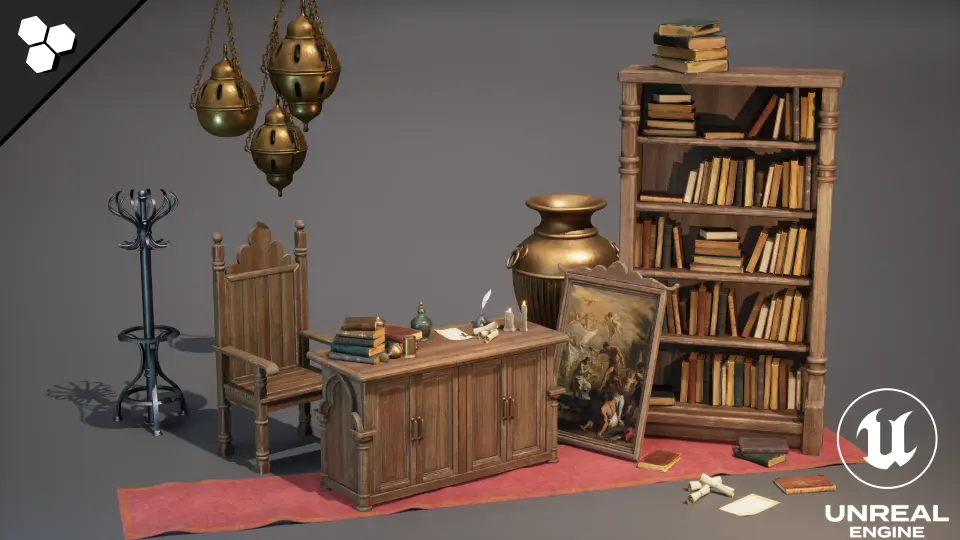
The core furniture selection leans into medieval and gothic forms. Developers get thrones, benches, bookshelves, and wooden cabinets to populate castle interiors, noble estates, and monastery libraries. These larger pieces anchor rooms and define the social hierarchy of a space—a throne at the head of a hall, rows of benches along the walls, heavy cabinets lining a study. The furniture draws from real-world historical references, which helps ground fantasy environments in believable material weight and proportion.
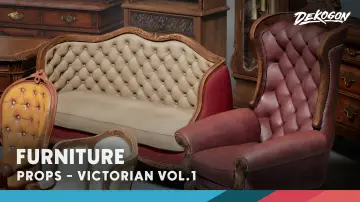
Victorian elements run alongside the medieval pieces. Elegant furniture and decor blend with 18th- and 19th-century aesthetics, making the pack viable for period work that crosses into later historical eras. A single mansion interior could mix gothic cabinetry with Victorian seating without the props clashing stylistically.
Decor, Scrolls, Quills, and Small Prop Layering
Beyond the major furniture, the collection includes smaller decor items that add density to shelves and tabletops. Stacks of books, scrolls, quills, paintings, and candles let artists dress a room with personal artifacts. These small props matter most in narrative-driven environments where a desk cluttered with scrolls and a quill tells a different story than an empty table. Paintings can hang on walls to break up flat stone or wood surfaces, while candle placements establish focal points in darker corners.
The PBR materials on these props include realistic aging for wood, metal, and fabric. Surfaces show wear appropriate to their era—wood grain with subtle degradation, metal with tarnish, fabric with faded color. This aging means props slot into abandoned or lived-in spaces without looking freshly manufactured.
Banners With Cloth Physics and Ornate Metal Fixtures
Red-and-gold medieval banners bring color and movement to stone interiors. The banners use realistic cloth physics, so they respond to environmental forces rather than hanging as static planes. A drafty cathedral hall with banners shifting subtly adds life that static textures cannot achieve. Tapestries serve a similar function, softening hard architectural lines and introducing heraldic patterning.
Lighting fixtures form another major category. Ornate metal candelabras, chandeliers, and sconces ship with the pack, all intended for in-game dynamic lighting. These fixtures are built to hold actual light sources, so a chandelier can illuminate a room realistically rather than existing as pure decoration. This integration lets artists set up functional lighting rigs using props that match the historical setting.
Incense Burners, Urns, and Realistic Smoke VFX
Hanging and standing ceremonial burners and urns add a layer of ritual atmosphere. These pieces carry detailed craftsmanship in their metalwork, fitting into churches, cathedrals, and magic-oriented interiors. The incense burners and candles include ambient smoke VFX. Rather than relying on static particle approximation, the smoke effects generate living atmosphere around active light sources and ceremonial objects. A monastery scene with multiple burners producing thin smoke columns gains vertical movement that draws the eye upward through the space.
The smoke VFX pairs naturally with the dynamic lighting fixtures. Candles with flickering flames and trailing smoke make dark gothic interiors feel occupied. This combination serves horror games and mystery settings where environmental ambience does heavy narrative lifting.
Master Materials and Unreal Engine Pipeline
The pack runs on an efficient AAA pipeline using master materials. This setup reduces draw calls by sharing material instances across props rather than assigning unique materials to every object. For a 70-prop interior scene, draw call management directly affects frame rate stability, especially when multiple candle flames, smoke effects, and cloth-simulated banners operate simultaneously.
The product requires Nanite and Lumen, with SM6 enabled. Nanite handles the high-detail mesh data on the furniture and ceremonial pieces, allowing dense model detail without traditional LOD chain dependencies. Lumen drives the global illumination for the candlelit interiors, bouncing light off stone walls, wood surfaces, and metal fixtures in real time. Artists working on dark interior scenes benefit from Lumen's ability to capture indirect light from multiple small sources scattered throughout a room.
Project Fit: RPGs, Horror, and Narrative Interiors
The pack covers several genre orientations. Medieval and fantasy RPGs can use the thrones, bookshelves, and banners for faction halls and quest locations. Dark gothic and Victorian horror games benefit from the aging PBR materials, candle lighting, and smoke VFX for haunted interiors. Narrative-driven environments gain from the small prop layer—scrolls, quills, and paintings provide environmental storytelling density without requiring custom asset creation.
Castle interiors, churches, and monasteries form the primary architectural contexts. A cathedral dressed with hanging incense burners, lit candelabras, and red-and-gold banners produces a cohesive ceremonial space. A monastery library with bookshelves, stacked books, and reading furniture supports quieter investigative scenes. The prop selection spreads across enough functional categories that a single interior can be dressed from bare walls to a fully occupied room without leaving the asset set.
Artists building historically inspired or dark fantasy interiors in Unreal Engine can use this 70-prop collection to populate spaces ranging from throne rooms to Victorian studies. The combination of cloth-physics banners, smoke-equipped burners, dynamically lit candelabras, and master-material optimization addresses both the visual density and performance needs of real-time interior work.
 Lighting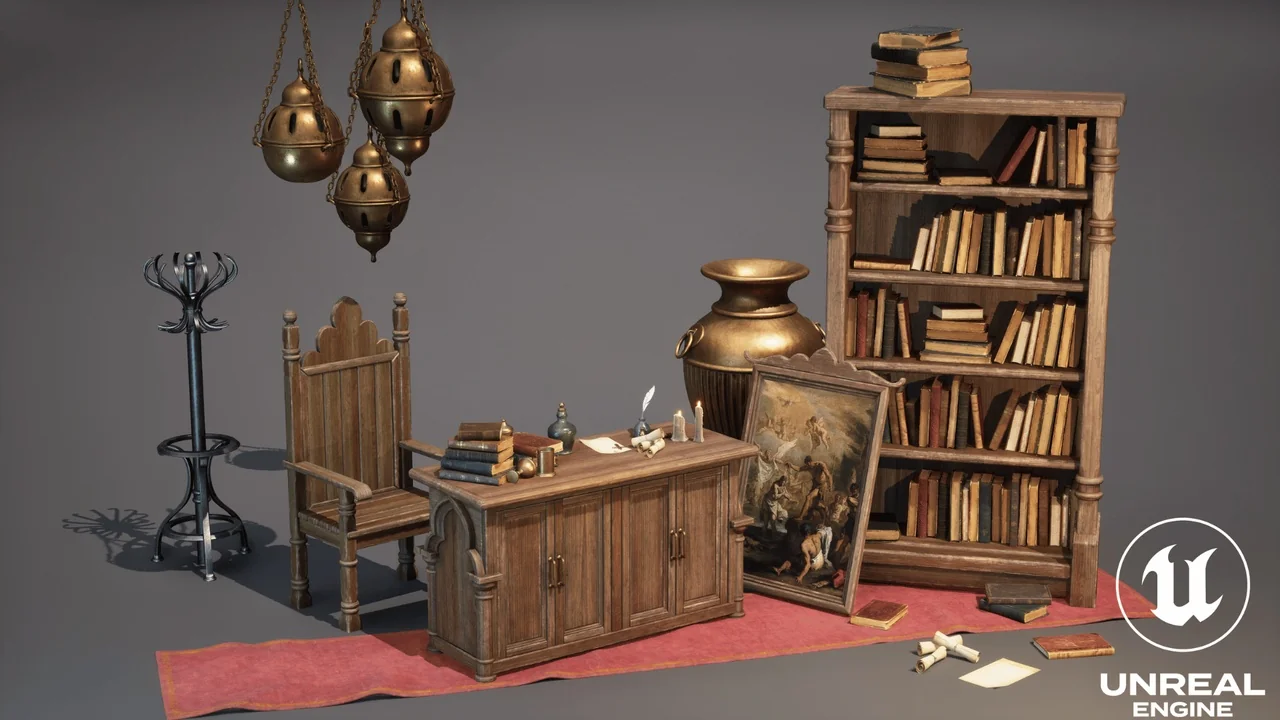
 Victorian
 Victorian
 Furniture