"6ac84fdb0bd06614"{"id":"1000177","slug":"victorian-vol-1-furniture-nanite-and-low-poly","title":"Victorian VOL.1 - Furniture (Nanite and Low Poly)","category":"Furniture \u0026 Fixtures","engine":"5.1+","assetVersion":"","engineVersion":"Engine Version: 5.1+","tag":"Furniture","accent":"blue","visual":"mech","summary":"A Victorian furniture set for Unreal Engine with 54 meshes, Nanite and low poly versions, 4K textures, master materials, and Lumen support.","platform":"Unreal Engine","publishedAt":"2026-06-20T07:26:46.484Z","updatedAt":"2026-06-20T07:26:46.484Z","sourceNotes":[],"fileContents":[],"compatibility":["Unreal Engine","Engine Version: 5.1+"],"featuredImage":{"alt":"Victorian VOL.1 - Furniture (Nanite and Low Poly)","src":"/wp-content/uploads/published/2026/06/f61a7a2e9bc6-e1dcd0c8-b3b8-4fa2-8bac-ca4cbb38515d-2cdadd726b.webp"},"hasDownloadLink":true,"downloads":0,"terms":[{"taxonomy":"category","slug":"furniture-and-fixtures","name":"Furniture \u0026 Fixtures"}],"galleryImages":[{"src":"/wp-content/uploads/published/2026/06/af95e0e5d909-909da3a1-9299-4a11-8f20-4dbfc6420b96-2c0a938f55.webp","alt":"Victorian VOL.1 - Furniture (Nanite and Low Poly)"},{"src":"/wp-content/uploads/published/2026/06/49e28151fdbf-e4d05cca-7973-4c2b-a048-49b4bdd65b64-42be5ba91b.webp","alt":"Victorian VOL.1 - Furniture (Nanite and Low Poly)"},{"src":"/wp-content/uploads/published/2026/06/3c5c09661c79-f2a1bbcd-4db4-4255-8acc-8fedaa2b061e-6fe0dca880.webp","alt":"Victorian VOL.1 - Furniture (Nanite and Low Poly)"},{"src":"/wp-content/uploads/published/2026/06/0d96444d2052-804b82b3-2a35-4420-9084-8cf8b50ff468-9efc3f12e9.webp","alt":"Victorian VOL.1 - Furniture (Nanite and Low Poly)"},{"src":"/wp-content/uploads/published/2026/06/1b6a73833b2b-cb93fda0-df4a-4903-bd5e-1a32d325f3a9-f54e403f07.webp","alt":"Victorian VOL.1 - Furniture (Nanite and Low Poly)"},{"src":"/wp-content/uploads/published/2026/06/f834d14eb781-e63ea074-61e3-4413-9b3a-f9d0fcfcb313-e6f20a8a82.webp","alt":"Victorian VOL.1 - Furniture (Nanite and Low Poly)"},{"src":"/wp-content/uploads/published/2026/06/b1a8994b141d-aca5c007-92b7-453e-97e5-dd96e047c55c-5af42f1a3e.webp","alt":"Victorian VOL.1 - Furniture (Nanite and Low Poly)"},{"src":"/wp-content/uploads/published/2026/06/9f93ec0680c0-35a88c08-824f-4206-a72c-27bf6551b952-727b109d52.webp","alt":"Victorian VOL.1 - Furniture (Nanite and Low Poly)"},{"src":"/wp-content/uploads/published/2026/06/66082e7e1f4f-26264931-9d2b-4b54-b139-ad2bc7c69d3b-589a497192.webp","alt":"Victorian VOL.1 - Furniture (Nanite and Low Poly)"},{"src":"/wp-content/uploads/published/2026/06/befdc4560996-bdf69dbb-9ee0-4c2a-9881-31187389c7b2-da72738886.webp","alt":"Victorian VOL.1 - Furniture (Nanite and Low Poly)"}],"accessPanel":{"kind":"resource","title":"Download this resource","eyebrow":"Free Download","message":"Log in or create a free account to start your download.","fileName":"Content.7z","safetyNote":"Resources are manually reviewed before listing to improve quality and reduce obvious risks.","actionLabel":"Download Free","resourceType":"Resource archive"},"contentHtml":"\u003cp\u003eRooms often gain their identity from the furniture before anything else. In a Victorian-styled interior, that identity depends on pieces that can carry ornament, age, weight, and believable material response without falling apart under close viewing. Victorian VOL.1 - Furniture (Nanite and Low Poly) leans directly into that need with a collection created in Unreal Engine and aimed at realistic AAA quality across visuals, style, and budget.\u003c/p\u003e\u003cp\u003eThe package includes everything pictured, along with the maps and materials used for the set. Rather than treating furniture as background filler, it presents it as scene-defining content: assets that can sit in the foreground, read clearly from multiple angles, and help establish the tone of a classic or old-world interior. The set’s tags point toward furniture for house scenes with classic, Victorian, old, wood, sofa, table, and clock themes, with room as well for fantasy, medieval, and horror-leaning art direction.\u003c/p\u003e\u003ch2\u003eVictorian furniture that holds up from every side\u003c/h2\u003e\u003cp\u003eOne of the most useful details here is that the models are fully detailed from all sides. That changes how the set can be staged. Furniture that only works when pushed against a wall limits camera placement and room layout, but furniture with full side-to-side detail gives artists more freedom to build walkable spaces, framed shots, and open interior compositions.\u003c/p\u003e\u003cp\u003eThat matters in practical scene building. A centerpiece arrangement can be viewed from a distance, from a doorway, or in a close pass around the room without exposing unfinished areas. It also helps when furniture is used in layouts that are less rigid than a standard showroom arrangement. A table placed near the center of a room, a sofa turned toward a focal point, or a clock used as a visual anchor benefits from complete modeling across every angle.\u003c/p\u003e\u003cp\u003eThe thematic range suggested by the set also broadens where it can sit inside a project. Victorian is the clearest identity, but the classic, old, house, fantasy, medieval, and horror tags suggest a collection that can serve more than one mood depending on lighting, dressing, and color treatment. In one scene it could support an elegant period interior. In another, the same furniture language could push toward a darker old-house atmosphere. The realistic art target keeps those shifts grounded.\u003c/p\u003e\u003ch2\u003eNanite and low poly versions across 54 meshes\u003c/h2\u003e\u003cp\u003eThe collection contains 54 meshes, and that count includes both Nanite and low poly versions. This dual approach is one of the strongest practical traits of the set because it gives teams options without forcing a single geometry strategy across every use case.\u003c/p\u003e\u003cp\u003eThe Nanite versions are constructed for high-fidelity polycounts, making them the obvious choice when the scene needs dense detail and close inspection. In furniture-heavy interiors, that can be especially valuable because carved forms, silhouettes, and surface variation are often what make a room feel convincing. Assets with more geometric fidelity can preserve those qualities in a way that reads well during slow camera movement or deliberate environmental storytelling.\u003c/p\u003e\u003cp\u003eThe inclusion of low poly versions alongside those higher-fidelity assets gives the set a second lane for production. Teams can make decisions based on the demands of the project, the density of the level, or the needs of gameplay spaces. Since the set is also described as optimized for games, the presence of both Nanite and low poly variants supports a more flexible workflow rather than locking every scene into one rendering path.\u003c/p\u003e\u003cp\u003eThat flexibility is especially useful for developers who work across different kinds of interior spaces. A hero room can lean into the Nanite assets, while other areas can rely on low poly versions where needed. Even without expanding beyond the stated features, the structure of the pack clearly supports selective deployment instead of an all-or-nothing setup.\u003c/p\u003e\u003ch2\u003e4K textures and a master material setup for scene control\u003c/h2\u003e\u003cp\u003eTexture quality is another major part of the resource’s appeal. The set includes high-quality, high-fidelity 4K texture sets, which suits the realistic target of the furniture and helps materials hold together when viewed up close. Furniture often carries much of the scene’s perceived richness through wood response, finish variation, wear, and subtle surface definition, so texture quality has a direct effect on whether an interior feels convincing or flat.\u003c/p\u003e\u003cp\u003eThe material workflow goes further than simple texture inclusion. A master material setup controls the majority of the props and models, and there are additional controls for roughness, albedo, normals, and more. That gives artists room to tune the look of the set inside a unified material framework instead of treating each object as a completely separate problem.\u003c/p\u003e\u003cp\u003eIn production terms, that kind of setup is useful because it allows visual adjustment while maintaining consistency across the collection. Roughness changes can push a piece toward a more polished or more muted response under lighting. Albedo control can help fit a piece into a darker or lighter interior palette. Normal-related control supports the surface definition that helps realistic furniture read properly in close shots. Since the majority of props and models are handled through the master material setup, those adjustments can contribute to a more coherent scene overall.\u003c/p\u003e\u003cp\u003eThe textures also use channel-packed Roughness, Metalness, and Ambient Occlusion. That packing method is explicitly part of the asset setup here, and it signals a resource built with a structured material pipeline in mind. Combined with the master material controls, it reinforces the idea that this set is not just a loose group of models, but a furniture package with a production-aware material foundation.\u003c/p\u003e\u003ch2\u003ePost process, look up table, and Unreal Engine 5.0+ Lumen support\u003c/h2\u003e\u003cp\u003eFurniture rarely carries a scene on its own. The way it lands visually depends heavily on lighting and final image treatment, which is why the inclusion of a realistic post process and look up table is notable. Those elements can help establish the intended tone of the set and support a more unified presentation of the materials and forms.\u003c/p\u003e\u003cp\u003eFor artists exploring mood, this matters because Victorian interiors often rely on controlled contrast, material depth, and a strong sense of atmosphere. A realistic post process and look up table can help maintain that feeling across the scene, particularly when furniture is expected to be more than set dressing. It becomes part of the image language.\u003c/p\u003e\u003cp\u003eThe pack also supports Lumen for Unreal Engine 5.0+. That support is a concrete compatibility point for teams building in that environment. When furniture is expected to participate fully in interior lighting, reflective behavior, and overall room mood, Lumen support fits naturally with the realistic visual target already stated for the assets.\u003c/p\u003e\u003cp\u003eBecause the project is created in Unreal Engine and includes all assets, maps, and materials in that context, the lighting and material features connect back to a single practical idea: the furniture is meant to be used as part of a complete real-time scene workflow, not treated as isolated geometry.\u003c/p\u003e\u003ch2\u003eCustom branding, game optimization, and where this set fits best\u003c/h2\u003e\u003cp\u003eThe collection is optimized for games, which keeps its realistic goals tied to an actual interactive use case. That is an important distinction for furniture sets, since visual ambition alone does not automatically translate into scene-ready content. Here, the asset package positions itself around both fidelity and production use.\u003c/p\u003e\u003cp\u003eAnother clear detail is that the branding and labels are custom made by the studio, making the product free of legal issues in that area. For teams building finished environments, that removes one common point of uncertainty around visible branded surface elements. It also helps the collection stay visually cohesive, since custom labels can align more cleanly with the overall style of the set.\u003c/p\u003e\u003cp\u003eArt for the project was created by Dekogon Studios artists, and the results align with the resource’s emphasis on realistic AAA quality. The strongest use case is a furniture-driven environment where objects need to read as more than background shapes. The set’s Victorian identity, its full-detail modeling from all sides, its paired Nanite and low poly versions, and its material controls make it especially suitable for interior scenes where furniture placement and atmosphere carry much of the storytelling.\u003c/p\u003e\u003cp\u003eFor teams weighing fit, the clearest takeaway is simple: this is a 54-mesh Unreal Engine furniture set with both Nanite and low poly coverage, 4K textures, broad material control, realistic post processing support, and Lumen compatibility for Unreal Engine 5.0+, all aimed at detailed Victorian-style scene work that still stays game-focused.\u003c/p\u003e\n\n\u003ch2\u003eContinue Browsing Similar Packs\u003c/h2\u003e\n\u003cul\u003e\n\u003cli\u003e\u003ca href=\"https://3dcghub.com/suburbs-vol-2-couches-and-sofas-nanite-and-low-poly/\" title=\"Suburbs VOL.2 - Couches and Sofas (Nanite and Low Poly)\"\u003eSuburbs VOL.2 - Couches and Sofas (Nanite and Low Poly)\u003c/a\u003e\u003c/li\u003e\n\u003cli\u003e\u003ca href=\"https://3dcghub.com/foliage-vol-24-farming-plants-low-poly/\" title=\"Foliage VOL.24 - Farming Plants (Low Poly)\"\u003eFoliage VOL.24 - Farming Plants (Low Poly)\u003c/a\u003e\u003c/li\u003e\n\u003cli\u003e\u003ca href=\"https://3dcghub.com/foliage-vol-6-broom-bushes-nanite-and-low-poly/\" title=\"Foliage VOL.6 - Broom Bushes (Nanite and Low Poly)\"\u003eFoliage VOL.6 - Broom Bushes (Nanite and Low Poly)\u003c/a\u003e\u003c/li\u003e\n\u003cli\u003e\u003ca href=\"https://3dcghub.com/foliage-vol-13-southern-oak-trees-nanite-and-low-poly/\" title=\"Foliage VOL.13 - Southern Oak Trees (Nanite and Low Poly)\"\u003eFoliage VOL.13 - Southern Oak Trees (Nanite and Low Poly)\u003c/a\u003e\u003c/li\u003e\n\u003cli\u003e\u003ca href=\"https://3dcghub.com/foliage-vol-21-cypress-trees-low-poly/\" title=\"Foliage VOL.21 - Cypress Trees ( Low Poly)\"\u003eFoliage VOL.21 - Cypress Trees ( Low Poly)\u003c/a\u003e\u003c/li\u003e\n\u003c/ul\u003e","contentTextLength":9147,"navigation":{"current":1105,"total":3181,"previous":{"id":"1000178","slug":"unreal-engine-5-blueprints-game-developer-masterclass","title":"Unreal Engine 5 - Blueprints Game Developer Masterclass","category":"Unreal Engine","platform":"Unreal Engine","updatedAt":"2026-06-20T07:37:16.401Z"},"next":{"id":"1000176","slug":"uscans-doors-01","title":"Uscans Doors 01","category":"Apocalyptic / Post-apocalyptic","platform":"Unreal Engine","updatedAt":"2026-06-20T07:03:51.520Z"}},"relatedResources":[{"id":"1000671","slug":"school-vol-1-school-interior","title":"School VOL.1 - School Interior","category":"Furniture \u0026 Fixtures","engine":"5.1+","assetVersion":"","engineVersion":"Engine Version: 5.1+","tag":"Furniture","accent":"blue","visual":"mech","summary":"Unreal Engine school interior asset pack with 220 meshes, Nanite and low-poly versions, Lumen support, 2k textures, and master material controls for tinting and","platform":"Unreal Engine","publishedAt":"2026-07-22T10:31:58.605Z","updatedAt":"2026-07-22T10:31:58.605Z","sourceNotes":[],"fileContents":[],"compatibility":["Unreal Engine","Engine Version: 5.1+"],"featuredImage":{"alt":"School VOL.1 - School Interior","src":"/wp-content/uploads/published/2026/07/cfb1c9013e9b-1be7ef61-3bfa-483b-a605-22bb77bf10a9-d22fc5f2eb.webp"},"hasDownloadLink":true,"downloads":0},{"id":"1000891","slug":"stylized-interior-set","title":"Stylized Interior Set","category":"Furniture \u0026 Fixtures","engine":"4.26+,5.0+","assetVersion":"","engineVersion":"Engine Version: 4.26+,5.0+","tag":"Furniture","accent":"blue","visual":"mech","summary":"Explore the Stylized Interior Set: low-poly furniture with polygons from 28 to 11,854, 15 wallpapers, and 2 floor materials for building crime scene interiors.","platform":"Unreal Engine","publishedAt":"2026-08-06T04:33:10.678Z","updatedAt":"2026-08-06T04:33:10.678Z","sourceNotes":[],"fileContents":[],"compatibility":["Unreal Engine","Engine Version: 4.26+,5.0+"],"featuredImage":{"alt":"Stylized Interior Set","src":"/wp-content/uploads/published/2026/08/01a41ca3334d-87e23b54-9ecd-47c5-b71f-2c8eeae4cf9d-a73de38858.webp"},"hasDownloadLink":true,"downloads":0},{"id":"1000702","slug":"ue-camping-equipment","title":"UE Camping Equipment","category":"Furniture \u0026 Fixtures","engine":"5.5+","assetVersion":"","engineVersion":"Engine Version: 5.5+","tag":"Furniture","accent":"blue","visual":"mech","summary":"A photorealistic collection of 45 camping 3D models for Unreal Engine, featuring changeable materials for color customization across survival and outdoor themes","platform":"Unreal Engine","publishedAt":"2026-07-24T00:16:19.949Z","updatedAt":"2026-07-24T00:16:19.949Z","sourceNotes":[],"fileContents":[],"compatibility":["Unreal Engine","Engine Version: 5.5+"],"featuredImage":{"alt":"UE Camping Equipment","src":"/wp-content/uploads/published/2026/07/b14dce2be696-304d05e0-ce1e-469f-b36f-a5251a79de6d-7243d972b4.webp"},"hasDownloadLink":true,"downloads":0}]}
Furniture
Victorian VOL.1 - Furniture (Nanite and Low Poly)
A Victorian furniture set for Unreal Engine with 54 meshes, Nanite and low poly versions, 4K textures, master materials, and Lumen support.
Rooms often gain their identity from the furniture before anything else. In a Victorian-styled interior, that identity depends on pieces that can carry ornament, age, weight, and believable material response without falling apart under close viewing. Victorian VOL.1 - Furniture (Nanite and Low Poly) leans directly into that need with a collection created in Unreal Engine and aimed at realistic AAA quality across visuals, style, and budget.
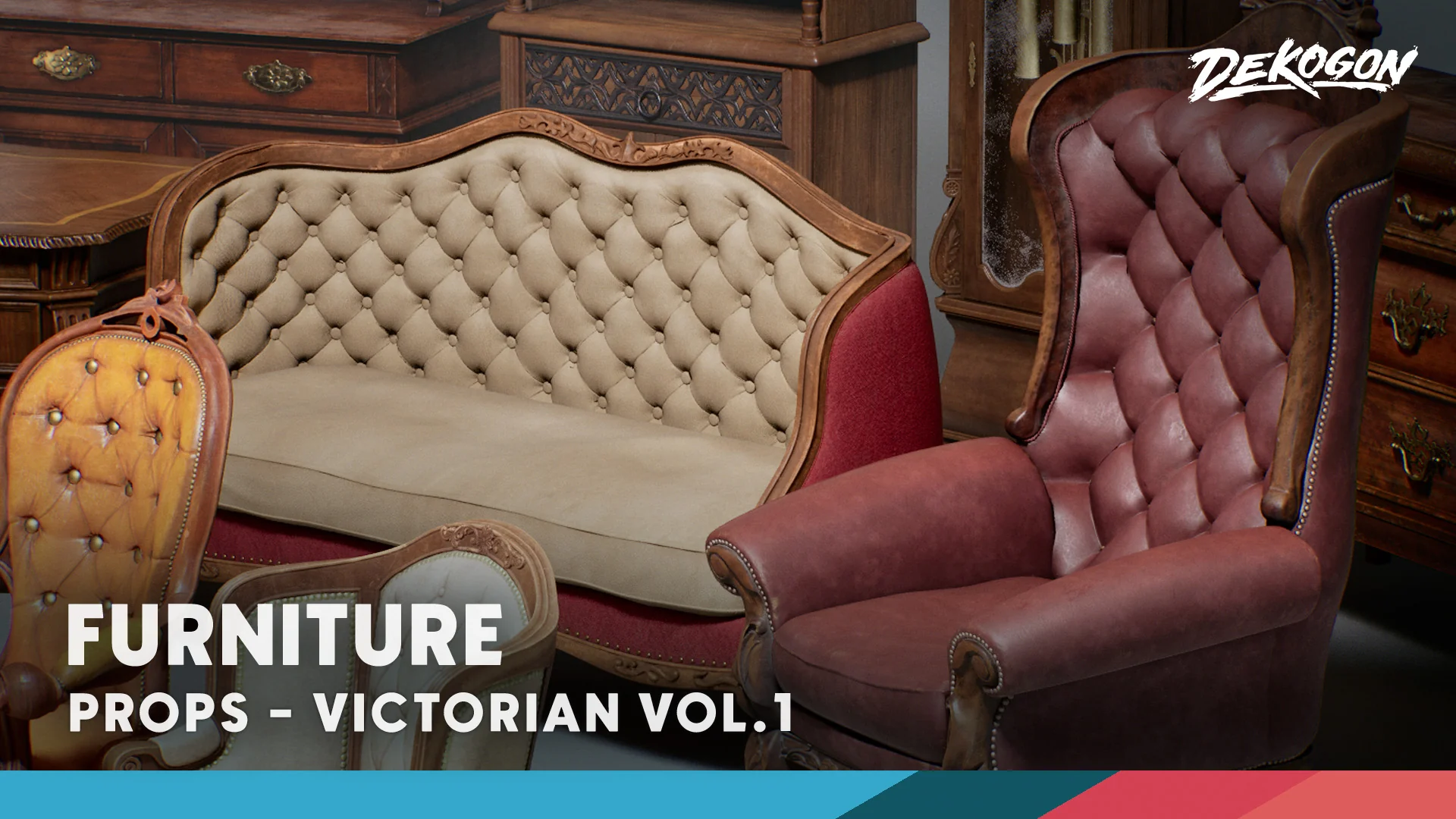
The package includes everything pictured, along with the maps and materials used for the set. Rather than treating furniture as background filler, it presents it as scene-defining content: assets that can sit in the foreground, read clearly from multiple angles, and help establish the tone of a classic or old-world interior. The set’s tags point toward furniture for house scenes with classic, Victorian, old, wood, sofa, table, and clock themes, with room as well for fantasy, medieval, and horror-leaning art direction.
Victorian furniture that holds up from every side
One of the most useful details here is that the models are fully detailed from all sides. That changes how the set can be staged. Furniture that only works when pushed against a wall limits camera placement and room layout, but furniture with full side-to-side detail gives artists more freedom to build walkable spaces, framed shots, and open interior compositions.
That matters in practical scene building. A centerpiece arrangement can be viewed from a distance, from a doorway, or in a close pass around the room without exposing unfinished areas. It also helps when furniture is used in layouts that are less rigid than a standard showroom arrangement. A table placed near the center of a room, a sofa turned toward a focal point, or a clock used as a visual anchor benefits from complete modeling across every angle.
The thematic range suggested by the set also broadens where it can sit inside a project. Victorian is the clearest identity, but the classic, old, house, fantasy, medieval, and horror tags suggest a collection that can serve more than one mood depending on lighting, dressing, and color treatment. In one scene it could support an elegant period interior. In another, the same furniture language could push toward a darker old-house atmosphere. The realistic art target keeps those shifts grounded.
Nanite and low poly versions across 54 meshes
The collection contains 54 meshes, and that count includes both Nanite and low poly versions. This dual approach is one of the strongest practical traits of the set because it gives teams options without forcing a single geometry strategy across every use case.
The Nanite versions are constructed for high-fidelity polycounts, making them the obvious choice when the scene needs dense detail and close inspection. In furniture-heavy interiors, that can be especially valuable because carved forms, silhouettes, and surface variation are often what make a room feel convincing. Assets with more geometric fidelity can preserve those qualities in a way that reads well during slow camera movement or deliberate environmental storytelling.
The inclusion of low poly versions alongside those higher-fidelity assets gives the set a second lane for production. Teams can make decisions based on the demands of the project, the density of the level, or the needs of gameplay spaces. Since the set is also described as optimized for games, the presence of both Nanite and low poly variants supports a more flexible workflow rather than locking every scene into one rendering path.
That flexibility is especially useful for developers who work across different kinds of interior spaces. A hero room can lean into the Nanite assets, while other areas can rely on low poly versions where needed. Even without expanding beyond the stated features, the structure of the pack clearly supports selective deployment instead of an all-or-nothing setup.
4K textures and a master material setup for scene control
Texture quality is another major part of the resource’s appeal. The set includes high-quality, high-fidelity 4K texture sets, which suits the realistic target of the furniture and helps materials hold together when viewed up close. Furniture often carries much of the scene’s perceived richness through wood response, finish variation, wear, and subtle surface definition, so texture quality has a direct effect on whether an interior feels convincing or flat.
The material workflow goes further than simple texture inclusion. A master material setup controls the majority of the props and models, and there are additional controls for roughness, albedo, normals, and more. That gives artists room to tune the look of the set inside a unified material framework instead of treating each object as a completely separate problem.
In production terms, that kind of setup is useful because it allows visual adjustment while maintaining consistency across the collection. Roughness changes can push a piece toward a more polished or more muted response under lighting. Albedo control can help fit a piece into a darker or lighter interior palette. Normal-related control supports the surface definition that helps realistic furniture read properly in close shots. Since the majority of props and models are handled through the master material setup, those adjustments can contribute to a more coherent scene overall.
The textures also use channel-packed Roughness, Metalness, and Ambient Occlusion. That packing method is explicitly part of the asset setup here, and it signals a resource built with a structured material pipeline in mind. Combined with the master material controls, it reinforces the idea that this set is not just a loose group of models, but a furniture package with a production-aware material foundation.
Post process, look up table, and Unreal Engine 5.0+ Lumen support
Furniture rarely carries a scene on its own. The way it lands visually depends heavily on lighting and final image treatment, which is why the inclusion of a realistic post process and look up table is notable. Those elements can help establish the intended tone of the set and support a more unified presentation of the materials and forms.
For artists exploring mood, this matters because Victorian interiors often rely on controlled contrast, material depth, and a strong sense of atmosphere. A realistic post process and look up table can help maintain that feeling across the scene, particularly when furniture is expected to be more than set dressing. It becomes part of the image language.
The pack also supports Lumen for Unreal Engine 5.0+. That support is a concrete compatibility point for teams building in that environment. When furniture is expected to participate fully in interior lighting, reflective behavior, and overall room mood, Lumen support fits naturally with the realistic visual target already stated for the assets.
Because the project is created in Unreal Engine and includes all assets, maps, and materials in that context, the lighting and material features connect back to a single practical idea: the furniture is meant to be used as part of a complete real-time scene workflow, not treated as isolated geometry.
Custom branding, game optimization, and where this set fits best
The collection is optimized for games, which keeps its realistic goals tied to an actual interactive use case. That is an important distinction for furniture sets, since visual ambition alone does not automatically translate into scene-ready content. Here, the asset package positions itself around both fidelity and production use.
Another clear detail is that the branding and labels are custom made by the studio, making the product free of legal issues in that area. For teams building finished environments, that removes one common point of uncertainty around visible branded surface elements. It also helps the collection stay visually cohesive, since custom labels can align more cleanly with the overall style of the set.
Art for the project was created by Dekogon Studios artists, and the results align with the resource’s emphasis on realistic AAA quality. The strongest use case is a furniture-driven environment where objects need to read as more than background shapes. The set’s Victorian identity, its full-detail modeling from all sides, its paired Nanite and low poly versions, and its material controls make it especially suitable for interior scenes where furniture placement and atmosphere carry much of the storytelling.
For teams weighing fit, the clearest takeaway is simple: this is a 54-mesh Unreal Engine furniture set with both Nanite and low poly coverage, 4K textures, broad material control, realistic post processing support, and Lumen compatibility for Unreal Engine 5.0+, all aimed at detailed Victorian-style scene work that still stays game-focused.
 Furniture
 Furniture
 Furniture
 Furniture