"c68a05d5e51405b3"{"id":"1000671","slug":"school-vol-1-school-interior","title":"School VOL.1 - School Interior","category":"Furniture \u0026 Fixtures","engine":"5.1+","assetVersion":"","engineVersion":"Engine Version: 5.1+","tag":"Furniture","accent":"blue","visual":"mech","summary":"Unreal Engine school interior asset pack with 220 meshes, Nanite and low-poly versions, Lumen support, 2k textures, and master material controls for tinting and","platform":"Unreal Engine","publishedAt":"2026-07-22T10:31:58.605Z","updatedAt":"2026-07-22T10:31:58.605Z","sourceNotes":[],"fileContents":[],"compatibility":["Unreal Engine","Engine Version: 5.1+"],"featuredImage":{"alt":"School VOL.1 - School Interior","src":"/wp-content/uploads/published/2026/07/cfb1c9013e9b-1be7ef61-3bfa-483b-a605-22bb77bf10a9-d22fc5f2eb.webp"},"hasDownloadLink":true,"downloads":0,"terms":[{"taxonomy":"category","slug":"furniture-and-fixtures","name":"Furniture \u0026 Fixtures"}],"galleryImages":[{"src":"/wp-content/uploads/published/2026/07/92fc83f9fa02-caf41786-3104-4d0f-b9ec-c47bdded20d8-481aa955ba.webp","alt":"School VOL.1 - School Interior"},{"src":"/wp-content/uploads/published/2026/07/11e2548b6095-1b9ca519-492e-4b04-a665-854867f9578a-6b1990cecc.webp","alt":"School VOL.1 - School Interior"},{"src":"/wp-content/uploads/published/2026/07/e2eb996336c3-6977708b-4f8f-4f92-a248-de82fec55be9-3ae0269903.webp","alt":"School VOL.1 - School Interior"},{"src":"/wp-content/uploads/published/2026/07/7d5cadd5349a-c1d475c1-1d29-4ac4-80cc-66923bd1ce08-0c5cd44cfd.webp","alt":"School VOL.1 - School Interior"},{"src":"/wp-content/uploads/published/2026/07/9fa84f326d64-33bcc3dd-5cf2-4ccf-b99b-9641503005da-d4c7589794.webp","alt":"School VOL.1 - School Interior"},{"src":"/wp-content/uploads/published/2026/07/30ae16ccacd6-fede4872-381a-48bf-91e5-05e35e0343df-5326d8f95a.webp","alt":"School VOL.1 - School Interior"},{"src":"/wp-content/uploads/published/2026/07/35809e92cf39-cbe24c18-f0c6-4a44-8774-3090957685a7-a54e4a9222.webp","alt":"School VOL.1 - School Interior"},{"src":"/wp-content/uploads/published/2026/07/f4bd3cc6a914-7d286ac1-85fb-49ea-9032-80c82d46e9f7-cf4615d31b.webp","alt":"School VOL.1 - School Interior"},{"src":"/wp-content/uploads/published/2026/07/1ccdd0f9f053-6684e4a6-f114-46fd-9e9a-abd7486aa07b-d47808cef3.webp","alt":"School VOL.1 - School Interior"},{"src":"/wp-content/uploads/published/2026/07/3aef630d1ca2-07e9ac7d-5c5b-420f-b41a-68ac659a259f-d0ae823aa5.webp","alt":"School VOL.1 - School Interior"}],"accessPanel":{"kind":"resource","title":"Download this resource","eyebrow":"Free Download","message":"Log in or create a free account to start your download.","fileName":"Content.7z","safetyNote":"Resources are manually reviewed before listing to improve quality and reduce obvious risks.","actionLabel":"Download Free","resourceType":"Resource archive"},"contentHtml":"\u003cp\u003eBuilding a credible school interior in Unreal Engine demands props that read as believable up close while staying manageable in a real-time scene. School VOL.1 - School Interior is Dekogon Studios' response to that brief, shipping a full environment kit built directly in Unreal Engine with AAA-quality visuals as the target. The pack covers everything pictured—assets, maps, and materials—so the setup path is less about assembling disparate pieces and more about placing a cohesive, pre-configured set.\u003c/p\u003e \n\n\u003ch2\u003eWorking with Nanite and Low-Poly Variants\u003c/h2\u003e\n\u003cp\u003eThe pack's 220 meshes are split between Nanite and regular low-poly versions of each model. That dual delivery gives a clear implementation choice: use the Nanite variants for higher-polycount assets where silhouette and surface detail matter most, then fall back to the low-poly equivalents when performance headroom is tighter or when Nanite isn't part of the pipeline. Because both versions ship together, teams can standardize on one variant per environment or mix them within the same level without hunting for a separate LOD pack.\u003c/p\u003e \n\u003cp\u003eNanite is specifically noted for the higher-polycount assets, so the split isn't arbitrary. The low-poly models are intended as the standard versions for game-optimized usage, while the Nanite variants exist for scenarios where Unreal Engine's virtualized geometry can absorb the additional detail cost. This setup lets environments scale across hardware targets without rebuilding assets from scratch.\u003c/p\u003e \n\n\u003ch2\u003eMaterial System and Instance Controls\u003c/h2\u003e\n\u003cp\u003eProject-wide control is centralized through a master material setup that governs the majority of props and models. Rather than exposing every material as a unique, isolated shader, the pack routes shared parameters through material instances. Color tinting is available directly in those instances, so art directors or environment artists can shift palette decisions at the instance level without opening the underlying shader graph.\u003c/p\u003e \n\u003cp\u003eBeyond tinting, the master material exposes controls for roughness, albedo, and normals, along with additional properties. This level of parameter control means surface response—how glossy or matte a desk appears, how strongly a locker reflects its surroundings—can be tuned without replacing textures. For environments that need visual variation across repeated meshes (rows of lockers, classroom desk clusters, gym equipment), this instance-based approach reduces the need for unique textures per prop.\u003c/p\u003e \n\n\u003ch3\u003eChannel-Packed Texture Workflow\u003c/h3\u003e\n\u003cp\u003eTexture sets ship at 2K resolution with high quality and fidelity as the stated baseline. The packed data follows a Roughness | Metalness | Ambient Occlusion convention, packing three data channels into a single texture. This reduces the number of sampled maps per material, which matters when dozens of props share the same master material and sample budget becomes a practical concern.\u003c/p\u003e \n\u003cp\u003eRoughness, metalness, and ambient occlusion are the three channels most relevant to how light interacts with a surface in Unreal's deferred renderer. Packing them together means the master material can read all three from a single texture lookup, and artists editing material instances adjust those properties through exposed parameters rather than swapping individual grayscale maps.\u003c/p\u003e \n\n\u003ch2\u003eLumen Compatibility and Rendering Setup\u003c/h2\u003e\n\u003cp\u003eThe product supports Lumen for Unreal Engine 5.0 and later. In use, this means the props and materials are configured to work within Lumen's global illumination and reflection pipeline—surfaces will receive bounced lighting and contribute to the scene's indirect light response. Lumen support is tied to the UE 5.0+ requirement, so projects still on earlier engine versions won't have access to that rendering path.\u003c/p\u003e \n\u003cp\u003eVisual finalization is handled through a realistic post-process setup and a lookup table (LUT). The included LUT contributes a pre-baked color grading foundation, giving the school interior a consistent tonal character out of the box. Projects can build on that LUT or replace it, but the pack provides a defined starting point rather than leaving color grading entirely to the user's default post-process chain.\u003c/p\u003e \n\n\u003ch2\u003eProp Coverage and Production Readiness\u003c/h2\u003e\n\u003cp\u003eThe 220 meshes span a range of school-interior-appropriate categories: furniture, desks, lockers, tables, banners, flags, and props tied to team spirit and events. The tag set—Furniture, Event, Banner, House, Flag, Sport, Building, Table, Prop, Team, Spirit, Desk, School, Locker—points to assets covering both the structural and decorative layers of a school environment. Classroom desks, lockers, and tables handle the functional furniture side, while banners, flags, and spirit-related props cover the decorative elements associated with events or team identity.\u003c/p\u003e \n\u003cp\u003eAll models ship as fully detailed assets rather than as proxy or placeholder geometry. The branding and labels across props are custom-made by Dekogon Studios, which removes a common legal friction point: there are no real-world brand names, school logos, or copyrighted labels baked into textures. Projects can use the assets without clearing third-party branding rights, which is a practical consideration for commercial releases.\u003c/p\u003e \n\u003cp\u003eThe pack is optimized for games, meaning the mesh counts, material setup, and texture budgets are intended for real-time rendering rather than pre-rendered or offline workflows. Combined with the dual Nanite and low-poly delivery, the optimization target is direct: drop the assets into a game level, configure material instances for the desired look, apply the post-process LUT, and render with Lumen on UE 5.0+.\u003c/p\u003e \n\u003cp\u003eDekogon Studios provides comprehensive documentation for the project, giving users a reference point for setup and material configuration beyond what can be inferred from the assets themselves. Additionally, the pack's compatibility notes reference a connection to the modular environment set known as Meridian 1988: Cedar Point School – Modular Environment (VOL 57), suggesting these interior props perfectly complement and integrate with that larger environment build.\u003c/p\u003e\n\n\u003ch2\u003eContinue Browsing Similar Packs\u003c/h2\u003e\n\u003cul\u003e\n\u003cli\u003e\u003ca href=\"https://3dcghub.com/victorian-vol-1-furniture-nanite-and-low-poly/\" title=\"Victorian VOL.1 - Furniture (Nanite and Low Poly)\"\u003eVictorian VOL.1 - Furniture (Nanite and Low Poly)\u003c/a\u003e\u003c/li\u003e\n\u003cli\u003e\u003ca href=\"https://3dcghub.com/highschool-classroom/\" title=\"HighSchool Classroom\"\u003eHighSchool Classroom\u003c/a\u003e\u003c/li\u003e\n\u003cli\u003e\u003ca href=\"https://3dcghub.com/clean-horror-school-environment/\" title=\"Clean/Horror School Environment\"\u003eClean/Horror School Environment\u003c/a\u003e\u003c/li\u003e\n\u003cli\u003e\u003ca href=\"https://3dcghub.com/highschool-restroom/\" title=\"HighSchool Restroom\"\u003eHighSchool Restroom\u003c/a\u003e\u003c/li\u003e\n\u003cli\u003e\u003ca href=\"https://3dcghub.com/chairs-asset-pack/\" title=\"Chairs - Asset Pack\"\u003eChairs - Asset Pack\u003c/a\u003e\u003c/li\u003e\n\u003c/ul\u003e","contentTextLength":6235,"navigation":{"current":1334,"total":3860,"previous":{"id":"1000672","slug":"school-vol-2-classroom","title":"School VOL.2 - Classroom","category":"Buildings \u0026 Architecture","platform":"Unreal Engine","updatedAt":"2026-07-22T13:14:21.193Z"},"next":{"id":"1000670","slug":"scans-vol-2-clothes-nanite-and-low-poly","title":"Scans VOL.2 - Clothes (Nanite \u0026 Low Poly)","category":"Clothing","platform":"Unreal Engine","updatedAt":"2026-07-22T10:19:08.974Z"}},"relatedResources":[{"id":"1001484","slug":"lighting-vol-1-interior-nanite-and-low-poly","title":"Lighting VOL.1 - Interior (Nanite and Low Poly)","category":"Lighting","engine":"5.1+","assetVersion":"","engineVersion":"Engine Version: 5.1+","tag":"Lighting","accent":"blue","visual":"mech","summary":"Examine Lighting VOL.1 - Interior, featuring 90 Nanite and low poly meshes, 4K channel-packed textures, emissive toggles, and Lumen support for Unreal Engine.","platform":"Unreal Engine","publishedAt":"2026-10-08T09:11:51.572Z","updatedAt":"2026-10-08T09:11:51.572Z","sourceNotes":[],"fileContents":[],"compatibility":["Unreal Engine","Engine Version: 5.1+"],"featuredImage":{"alt":"Lighting VOL.1 - Interior (Nanite and Low Poly)","src":"/wp-content/uploads/published/2026/10/49b718415c33-df3f065a-9ca5-4365-8cf4-3fe985ecd18c-86e1f180d7.webp"},"hasDownloadLink":true,"downloads":0},{"id":"1000177","slug":"victorian-vol-1-furniture-nanite-and-low-poly","title":"Victorian VOL.1 - Furniture (Nanite and Low Poly)","category":"Furniture \u0026 Fixtures","engine":"5.1+","assetVersion":"","engineVersion":"Engine Version: 5.1+","tag":"Furniture","accent":"blue","visual":"mech","summary":"A Victorian furniture set for Unreal Engine with 54 meshes, Nanite and low poly versions, 4K textures, master materials, and Lumen support.","platform":"Unreal Engine","publishedAt":"2026-06-20T07:26:46.484Z","updatedAt":"2026-06-20T07:26:46.484Z","sourceNotes":[],"fileContents":[],"compatibility":["Unreal Engine","Engine Version: 5.1+"],"featuredImage":{"alt":"Victorian VOL.1 - Furniture (Nanite and Low Poly)","src":"/wp-content/uploads/published/2026/06/f61a7a2e9bc6-e1dcd0c8-b3b8-4fa2-8bac-ca4cbb38515d-2cdadd726b.webp"},"hasDownloadLink":true,"downloads":0},{"id":"1001568","slug":"victorian-furniture-living-room","title":"Victorian Furniture - Living Room","category":"Furniture \u0026 Fixtures","engine":"4.22+,5.0+","assetVersion":"","engineVersion":"Engine Version: 4.22+,5.0+","tag":"Furniture","accent":"blue","visual":"mech","summary":"Create authentic period interiors with Victorian Furniture - Living Room, featuring low-poly optimized models, 4K PBR textures, and a presentation scene.","platform":"Unreal Engine","publishedAt":"2026-10-10T04:02:23.566Z","updatedAt":"2026-10-10T04:02:23.566Z","sourceNotes":[],"fileContents":[],"compatibility":["Unreal Engine","Engine Version: 4.22+,5.0+"],"featuredImage":{"alt":"Victorian Furniture - Living Room","src":"/wp-content/uploads/published/2026/10/6455d49d6b03-29b5c27e-5244-4178-aff9-ef0aaa6e97bd-dfcbac4a43.webp"},"hasDownloadLink":true,"downloads":1}]}
Furniture
School VOL.1 - School Interior
Unreal Engine school interior asset pack with 220 meshes, Nanite and low-poly versions, Lumen support, 2k textures, and master material controls for tinting and
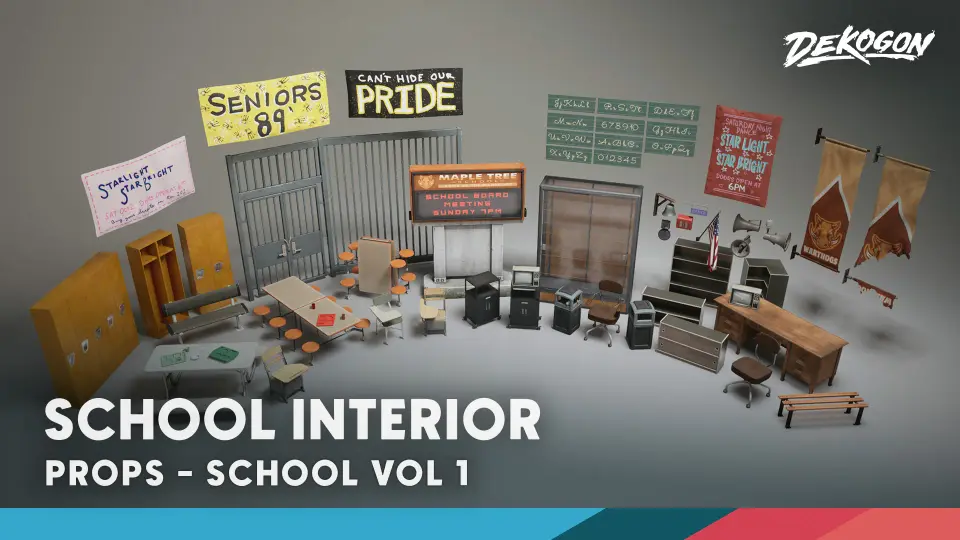
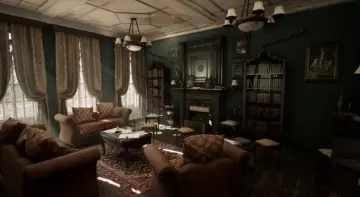
Building a credible school interior in Unreal Engine demands props that read as believable up close while staying manageable in a real-time scene. School VOL.1 - School Interior is Dekogon Studios' response to that brief, shipping a full environment kit built directly in Unreal Engine with AAA-quality visuals as the target. The pack covers everything pictured—assets, maps, and materials—so the setup path is less about assembling disparate pieces and more about placing a cohesive, pre-configured set.
Working with Nanite and Low-Poly Variants
The pack's 220 meshes are split between Nanite and regular low-poly versions of each model. That dual delivery gives a clear implementation choice: use the Nanite variants for higher-polycount assets where silhouette and surface detail matter most, then fall back to the low-poly equivalents when performance headroom is tighter or when Nanite isn't part of the pipeline. Because both versions ship together, teams can standardize on one variant per environment or mix them within the same level without hunting for a separate LOD pack.
Nanite is specifically noted for the higher-polycount assets, so the split isn't arbitrary. The low-poly models are intended as the standard versions for game-optimized usage, while the Nanite variants exist for scenarios where Unreal Engine's virtualized geometry can absorb the additional detail cost. This setup lets environments scale across hardware targets without rebuilding assets from scratch.
Material System and Instance Controls
Project-wide control is centralized through a master material setup that governs the majority of props and models. Rather than exposing every material as a unique, isolated shader, the pack routes shared parameters through material instances. Color tinting is available directly in those instances, so art directors or environment artists can shift palette decisions at the instance level without opening the underlying shader graph.
Beyond tinting, the master material exposes controls for roughness, albedo, and normals, along with additional properties. This level of parameter control means surface response—how glossy or matte a desk appears, how strongly a locker reflects its surroundings—can be tuned without replacing textures. For environments that need visual variation across repeated meshes (rows of lockers, classroom desk clusters, gym equipment), this instance-based approach reduces the need for unique textures per prop.
Channel-Packed Texture Workflow
Texture sets ship at 2K resolution with high quality and fidelity as the stated baseline. The packed data follows a Roughness | Metalness | Ambient Occlusion convention, packing three data channels into a single texture. This reduces the number of sampled maps per material, which matters when dozens of props share the same master material and sample budget becomes a practical concern.
Roughness, metalness, and ambient occlusion are the three channels most relevant to how light interacts with a surface in Unreal's deferred renderer. Packing them together means the master material can read all three from a single texture lookup, and artists editing material instances adjust those properties through exposed parameters rather than swapping individual grayscale maps.
Lumen Compatibility and Rendering Setup
The product supports Lumen for Unreal Engine 5.0 and later. In use, this means the props and materials are configured to work within Lumen's global illumination and reflection pipeline—surfaces will receive bounced lighting and contribute to the scene's indirect light response. Lumen support is tied to the UE 5.0+ requirement, so projects still on earlier engine versions won't have access to that rendering path.
Visual finalization is handled through a realistic post-process setup and a lookup table (LUT). The included LUT contributes a pre-baked color grading foundation, giving the school interior a consistent tonal character out of the box. Projects can build on that LUT or replace it, but the pack provides a defined starting point rather than leaving color grading entirely to the user's default post-process chain.
Prop Coverage and Production Readiness
The 220 meshes span a range of school-interior-appropriate categories: furniture, desks, lockers, tables, banners, flags, and props tied to team spirit and events. The tag set—Furniture, Event, Banner, House, Flag, Sport, Building, Table, Prop, Team, Spirit, Desk, School, Locker—points to assets covering both the structural and decorative layers of a school environment. Classroom desks, lockers, and tables handle the functional furniture side, while banners, flags, and spirit-related props cover the decorative elements associated with events or team identity.
All models ship as fully detailed assets rather than as proxy or placeholder geometry. The branding and labels across props are custom-made by Dekogon Studios, which removes a common legal friction point: there are no real-world brand names, school logos, or copyrighted labels baked into textures. Projects can use the assets without clearing third-party branding rights, which is a practical consideration for commercial releases.
The pack is optimized for games, meaning the mesh counts, material setup, and texture budgets are intended for real-time rendering rather than pre-rendered or offline workflows. Combined with the dual Nanite and low-poly delivery, the optimization target is direct: drop the assets into a game level, configure material instances for the desired look, apply the post-process LUT, and render with Lumen on UE 5.0+.
Dekogon Studios provides comprehensive documentation for the project, giving users a reference point for setup and material configuration beyond what can be inferred from the assets themselves. Additionally, the pack's compatibility notes reference a connection to the modular environment set known as Meridian 1988: Cedar Point School – Modular Environment (VOL 57), suggesting these interior props perfectly complement and integrate with that larger environment build.
 Furniture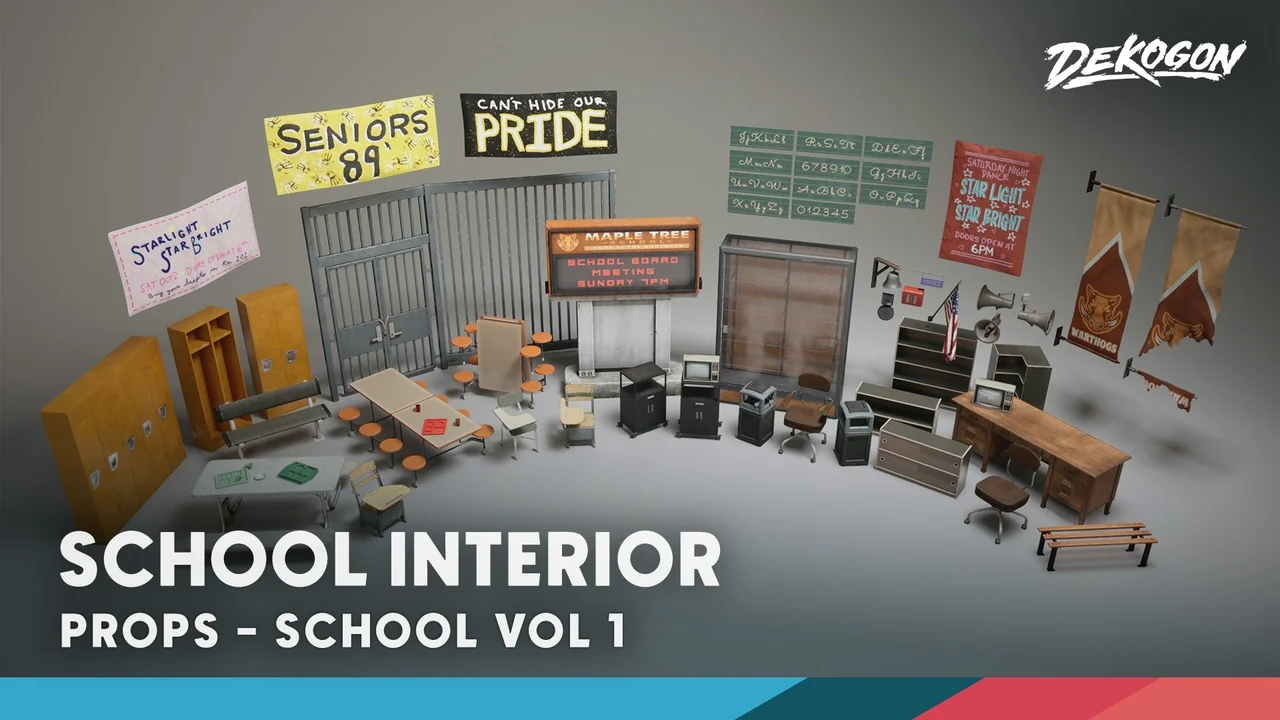
 Lighting
 Furniture
 Furniture