"7b46a695175d8694"{"id":"1000044","slug":"clean-horror-school-environment","title":"Clean/Horror School Environment","category":"Interior","engine":"4.26+,5.0+","assetVersion":"","engineVersion":"4.26+,5.0+","tag":"Interior","accent":"blue","visual":"city","summary":"A large modular school environment pack with 126 assets, 164 material instances, decals, demo scenes, and a shader for horror conversion.","platform":"Unreal Engine","publishedAt":"2026-05-22T09:27:13.248Z","updatedAt":"2026-05-22T09:27:13.248Z","sourceNotes":[],"fileContents":[],"compatibility":["Unreal Engine","Engine version: 4.26+,5.0+"],"featuredImage":{"alt":"Clean/Horror School Environment","src":"/wp-content/uploads/published/2026/05/4310d4089adb-73453a0e-4fce-44b8-b801-17b736a01616-106a84bf88.webp"},"hasDownloadLink":true,"downloads":1,"terms":[{"taxonomy":"category","slug":"interior","name":"Interior"}],"galleryImages":[{"src":"/wp-content/uploads/published/2026/05/dc34b063b4e2-e5d541d8-0207-4ad6-841e-4f9a61dc3237-0fe0cafc5d.webp","alt":"Clean/Horror School Environment"},{"src":"/wp-content/uploads/published/2026/05/913ec5512765-b7ffb281-bdf5-4e2b-8a7d-9d3dbfd3f2e5-f4a770aa03.webp","alt":"Clean/Horror School Environment"},{"src":"/wp-content/uploads/published/2026/05/d2717d32bbe0-fcecc19e-ff84-4a2c-a7ba-76f44372e0c6-6633e6e28a.webp","alt":"Clean/Horror School Environment"},{"src":"/wp-content/uploads/published/2026/05/33b5e0807a7c-757e4535-c42e-4efd-bbde-415197fcb978-20df1978be.webp","alt":"Clean/Horror School Environment"},{"src":"/wp-content/uploads/published/2026/05/4d452f2da031-f0b35a7f-bfef-4aa0-8156-47500b05a219-48d7651ecc.webp","alt":"Clean/Horror School Environment"},{"src":"/wp-content/uploads/published/2026/05/a7f56f8379fb-63ef1a3b-3f12-40e3-be4b-9861c0914b68-50332fb981.webp","alt":"Clean/Horror School Environment"},{"src":"/wp-content/uploads/published/2026/05/71ae979d6e16-8f6105c9-de03-4f24-8713-29cc867376eb-b675510715.webp","alt":"Clean/Horror School Environment"},{"src":"/wp-content/uploads/published/2026/05/d21788b81de2-4c0cc056-9921-4585-ada5-77fd12c57651-421ef3e8f9.webp","alt":"Clean/Horror School Environment"},{"src":"/wp-content/uploads/published/2026/05/c353abe9eef4-69584c4f-c55e-4a0a-8120-27bfa148ad69-92764990fc.webp","alt":"Clean/Horror School Environment"},{"src":"/wp-content/uploads/published/2026/05/104358c6a033-66af70bf-bdc4-4fb8-883f-e174e15c0f9d-382c1e1dbb.webp","alt":"Clean/Horror School Environment"}],"accessPanel":{"kind":"resource","title":"Access this resource","eyebrow":"Free Download","message":"Log in or create a free account to start your download.","fileName":"Content.7z","safetyNote":"Resources are manually reviewed before listing to improve quality and reduce obvious risks.","actionLabel":"Download Free","resourceType":"Resource archive"},"contentHtml":"\u003cp\u003eSchool corridors, classrooms, bathrooms, laboratories, and other study-focused interiors often need more than a handful of props to feel convincing. \u003cstrong\u003eClean/Horror School Environment\u003c/strong\u003e Approaches that problem as a complete modular environment package, giving scene builders a large set of pieces for school layouts while also extending beyond that setting into more generic interior spaces. The core idea is not only to assemble a believable clean school, but to let that same environment pivot into a horror or post-apocalyptic version through the included shader and material controls.\u003c/p\u003e \u003cp\u003eThat combination shapes the pack’s role in production. It supports layout work, visual variation, and mood changes without leaving the same asset set behind. Rather than treating the clean and ruined looks as separate projects, it keeps them connected through one environment library and a shared material framework.\u003c/p\u003e \u003ch2\u003eBuilding a modular school with 126 unique assets\u003c/h2\u003e\n\u003cp\u003eThe pack includes \u003cstrong\u003e126 unique assets\u003c/strong\u003e, and that scale matters because modular interior environments rely on coverage. A school setting is rarely a single room. It usually asks for repeated hallway structures, room transitions, classroom dressing, utility spaces, and details that keep one part of the building from looking identical to the next. This package is presented as large enough to contain everything needed for modular school environments, while also being broad enough to support other generic interior scenes.\u003c/p\u003e \u003cp\u003eThe tag set points clearly toward the kinds of spaces and moods the pack can support: bathroom, classroom, laboratory, study, school, old, realistic, modular, horror, post, and apocalyptic. Taken together, those details place the environment in a practical middle ground. It is not restricted to a single polished academic space, and it is not limited to a fully ruined setting either. It can serve projects that begin with a recognizable everyday institution and then push it toward neglect, damage, or threat.\u003c/p\u003e \u003cp\u003eThat flexibility is useful during blockout and set dressing. A modular school pack is most effective when the same asset library can carry multiple room types and repeated architectural patterns. Here, the emphasis falls on that broad coverage: enough parts to create school interiors, and enough general-purpose interior value to reuse the set outside a strict school-only scenario.\u003c/p\u003e \u003ch2\u003eClean/Horror School Environment and the shift in tone\u003c/h2\u003e\n\u003cp\u003eThe defining creative hook is the included \u003cstrong\u003eSpecial shader\u003c/strong\u003e, which allows the environment to be turned quickly into a \u003cstrong\u003eHorror\u003c/strong\u003e Or \u003cstrong\u003ePost-apocalyptic\u003c/strong\u003e Version. That changes how the pack can be used in production. Instead of building one set for a clean school and another set for a distressed one, the workflow supports a transition in tone on top of the same environment base.\u003c/p\u003e \u003cp\u003eThis matters for any project where condition and atmosphere are part of the storytelling. A school can read as orderly and maintained in one scene, then unsettling and abandoned in another. The pack explicitly supports that kind of transformation. The shader is not presented as a minor surface tweak, but as a practical route to reframe the whole environment’s mood. The move from clean to horror is one of the package’s central uses, not an afterthought.\u003c/p\u003e \u003cp\u003eThere is also a clear link between that shader-driven tonal shift and the included decal set. The pack contains \u003cstrong\u003e16 decals\u003c/strong\u003e, including \u003cstrong\u003eScratching, leaking, and blood\u003c/strong\u003e. Those details are small in count compared with the full asset library, yet they play a direct role in the horror and post-apocalyptic identity of the environment. Scratches can suggest wear or damage, leaking can push spaces toward neglect and decay, and blood introduces a much more explicit horror register. Because these decals sit on top of the modular environment, they help the same rooms read very differently without requiring a separate architectural kit.\u003c/p\u003e \u003ch2\u003eTwo master materials, 164 material instances\u003c/h2\u003e\n\u003cp\u003eThe material system is one of the pack’s more practical implementation details. It includes \u003cstrong\u003e164 material instances\u003c/strong\u003e That all use \u003cstrong\u003eTwo master materials\u003c/strong\u003e. That setup says a lot about how the environment is meant to be managed. A large number of instances gives room for visual variety across the asset set, while a small number of master materials keeps the core system centralized.\u003c/p\u003e \u003cp\u003eThe master material is described as having control for almost every texture map you can think of. It also includes inputs for \u003cstrong\u003eDirt masks\u003c/strong\u003e, \u003cstrong\u003eWorld space dust\u003c/strong\u003e, and more. Even without drifting beyond the stated details, that already frames the pack as more than a static library of meshes. It provides a material workflow that helps users push surfaces toward cleaner or dirtier states, and toward more settled, aged, or abandoned looks.\u003c/p\u003e \u003cp\u003eFor implementation, that means the pack supports two related needs at once. First, it gives a lot of ready material variation through the material instances. Second, it exposes a more hands-on layer of environmental treatment through the master material controls. In practice, those inputs are especially relevant for interiors, where repeated walls, floors, and fixtures can quickly look uniform if there is no system for wear, dust, and grime. The explicit mention of dirt masks and world space dust makes the environment’s condition part of the workflow rather than something left entirely to external setup.\u003c/p\u003e \u003ch2\u003eThree demo scenes that show the full range\u003c/h2\u003e\n\u003cp\u003eThe package includes \u003cstrong\u003eThree demo scenes\u003c/strong\u003e: one clean version of the school, one horror version, and one scene with all the assets laid out. These scenes do more than provide examples. They map directly to how the pack can be approached during setup and implementation.\u003c/p\u003e \u003cp\u003eThe clean school scene gives a ready reference for a maintained interior. The horror scene shows the darker end of the pack’s visual range. The laid-out asset scene serves a different purpose, making it easier to review the library itself and understand what is available before building a custom level. That last scene is especially useful in modular environment work, where knowing the parts and their relationships can save time during assembly.\u003c/p\u003e \u003cp\u003eAnother important point is that the demo scenes are \u003cstrong\u003eFully set up\u003c/strong\u003e And created using only assets included in the pack. This keeps the examples self-contained. The scenes are not leaning on outside pieces to complete their look, which makes them a direct demonstration of what the package itself can produce. For anyone evaluating the pack from a workflow angle, that is a meaningful detail: the examples are not concept pieces detached from the actual contents.\u003c/p\u003e \u003ch2\u003eDrag into a level, or work from the included levels\u003c/h2\u003e\n\u003cp\u003eThe setup path is kept straightforward. The pack states that all assets contain \u003cstrong\u003eLODs\u003c/strong\u003e, \u003cstrong\u003eCollision\u003c/strong\u003e, and \u003cstrong\u003eOptimized lightmap UVs\u003c/strong\u003e, with the correct settings already applied. Those are practical production details, not decorative extras. They speak to how the environment is prepared for immediate use inside a level-building workflow.\u003c/p\u003e \u003cp\u003eLODs help the asset set function as a complete environment rather than as isolated hero pieces. Collision means the assets are prepared for spatial use inside a scene. Optimized lightmap UVs, along with the note that the correct settings are already applied, point to a pack that has been readied for placement rather than one that expects cleanup before use. This is consistent with the package’s larger pitch: assemble scenes quickly, shift the mood when needed, and work either from scratch or from what is already included.\u003c/p\u003e \u003cp\u003eThe final workflow detail is simple but important: you can \u003cstrong\u003eDrag the assets into your level\u003c/strong\u003e, or use the \u003cstrong\u003eIncluded levels\u003c/strong\u003e. That gives the pack two practical entry points. One suits teams or solo creators who want to integrate selected pieces into an existing environment. The other suits anyone who would rather begin from a prepared scene and adjust it from there.\u003c/p\u003e \u003cp\u003eFor projects that need a realistic modular school, an old or distressed academic interior, or a horror-leaning institutional setting, the best fit here is clear. This pack is strongest when the job is not just to place props, but to build complete interior spaces and then control how clean, worn, or unsettling those spaces feel through materials, decals, and the included scene setups.\u003c/p\u003e\n\n\u003ch2\u003eExplore Similar Assets\u003c/h2\u003e\n\u003cul\u003e\n\u003cli\u003e\u003ca href=\"https://3dcghub.com/high-school-science-lab-classroom-90s-themed-day-night-lighting/\" title=\"High school Science Lab Classroom - 90\u0026#039;s themed (Day/Night Lighting)\"\u003eHigh school Science Lab Classroom - 90\u0026#039;s themed (Day/Night Lighting)\u003c/a\u003e\u003c/li\u003e\n\u003cli\u003e\u003ca href=\"https://3dcghub.com/post-soviet-hostel/\" title=\"Post Soviet Hostel\"\u003ePost Soviet Hostel\u003c/a\u003e\u003c/li\u003e\n\u003cli\u003e\u003ca href=\"https://3dcghub.com/modular-school-pack/\" title=\"Modular School Pack\"\u003eModular School Pack\u003c/a\u003e\u003c/li\u003e\n\u003cli\u003e\u003ca href=\"https://3dcghub.com/high-school-basketball-gym-day-night-afternoon-midnight-lighting/\" title=\"High School Basketball Gym - (Day/Night/Afternoon/Midnight Lighting)\"\u003eHigh School Basketball Gym - (Day/Night/Afternoon/Midnight Lighting)\u003c/a\u003e\u003c/li\u003e\n\u003cli\u003e\u003ca href=\"https://3dcghub.com/abandoned-school/\" title=\"Abandoned school\"\u003eAbandoned school\u003c/a\u003e\u003c/li\u003e\n\u003c/ul\u003e","contentTextLength":8457,"navigation":{"current":1582,"total":3481,"previous":{"id":"1000045","slug":"courtroom-environment","title":"Courtroom - Environment","category":"Interior","platform":"Unreal Engine","updatedAt":"2026-05-22T09:38:05.535Z"},"next":{"id":"1000042","slug":"cinematic-fire-3d-vdb-pack-loop","title":"Cinematic Fire 3D VDB Pack loop","category":"Fire \u0026 Explosions","platform":"Unreal Engine","updatedAt":"2026-05-22T08:25:52.982Z"}},"relatedResources":[{"id":"8864","slug":"high-school-science-lab-classroom-90s-themed-day-night-lighting","title":"High school Science Lab Classroom - 90's themed (Day/Night Lighting)","category":"Interior","engine":"4.26+,5.0+","assetVersion":"Engine version: 4.26+,5.0+","engineVersion":"4.18","tag":"Interior","accent":"blue","visual":"city","summary":"Transform your project with a realistic 90s-themed science laboratory. This environment features 461 high-quality meshes and versatile lighting for day or horror scenes.","platform":"Unreal Engine","publishedAt":"2026-02-25T17:55:37.000Z","updatedAt":"2026-04-19T15:51:21.000Z","sourceNotes":[],"fileContents":[],"compatibility":["Unreal Engine","Engine version: 4.26+,5.0+"],"featuredImage":{"alt":"High school Science Lab Classroom - 90's themed (Day/Night Lighting)","src":"https://3dcghub.com/wp-content/uploads/2026/02/e4d62a79-9c4b-4bf6-83de-5a1b736b6e06.webp"},"hasDownloadLink":true,"downloads":1},{"id":"1000065","slug":"horror-farm","title":"Horror Farm","category":"Interior","engine":"5.0+","assetVersion":"","engineVersion":"5.0+","tag":"Interior","accent":"blue","visual":"mech","summary":"Horror Farm is a farm environment pack with 127 static meshes, house modules, corn, props, textures, and decals for scary interior and exterior scenes.","platform":"Unreal Engine","publishedAt":"2026-05-29T13:38:07.885Z","updatedAt":"2026-05-29T13:38:07.885Z","sourceNotes":[],"fileContents":[],"compatibility":["Unreal Engine","Engine version: 5.0+"],"featuredImage":{"alt":"Horror Farm","src":"/wp-content/uploads/published/2026/05/873a0794819a-477096ce-1932-4c51-8fb7-e7b165bb7003-702c2b105a.webp"},"hasDownloadLink":true,"downloads":1},{"id":"8974","slug":"post-soviet-hostel","title":"Post Soviet Hostel","category":"Interior","engine":"4.26+,5.0+","assetVersion":"Engine version: 4.26+,5.0+","engineVersion":"4.24","tag":"Interior","accent":"blue","visual":"city","summary":"Create an immersive atmosphere with the Post Soviet Hostel asset pack. This collection features realistic props and interactive blueprints designed for high-end game development.","platform":"Unreal Engine","publishedAt":"2026-02-25T17:45:49.000Z","updatedAt":"2026-08-23T13:06:38.716Z","sourceNotes":[],"fileContents":[],"compatibility":["Unreal Engine","Engine version: 4.26+,5.0+"],"featuredImage":{"alt":"Post Soviet Hostel","src":"https://3dcghub.com/wp-content/uploads/2026/02/5a41db30-c23e-4751-85d8-67a0c9865ca7.webp"},"hasDownloadLink":true,"downloads":7}]}
Interior
Clean/Horror School Environment
A large modular school environment pack with 126 assets, 164 material instances, decals, demo scenes, and a shader for horror conversion.
Category:Unreal Engine,InteriorPlatform: Unreal EngineEngine version: 4.26+,5.0+Published: May 22, 2026
Interior
Resource overview
School corridors, classrooms, bathrooms, laboratories, and other study-focused interiors often need more than a handful of props to feel convincing. Clean/Horror School Environment Approaches that problem as a complete modular environment package, giving scene builders a large set of pieces for school layouts while also extending beyond that setting into more generic interior spaces. The core idea is not only to assemble a believable clean school, but to let that same environment pivot into a horror or post-apocalyptic version through the included shader and material controls.
That combination shapes the pack’s role in production. It supports layout work, visual variation, and mood changes without leaving the same asset set behind. Rather than treating the clean and ruined looks as separate projects, it keeps them connected through one environment library and a shared material framework.
Building a modular school with 126 unique assets
The pack includes 126 unique assets, and that scale matters because modular interior environments rely on coverage. A school setting is rarely a single room. It usually asks for repeated hallway structures, room transitions, classroom dressing, utility spaces, and details that keep one part of the building from looking identical to the next. This package is presented as large enough to contain everything needed for modular school environments, while also being broad enough to support other generic interior scenes.
The tag set points clearly toward the kinds of spaces and moods the pack can support: bathroom, classroom, laboratory, study, school, old, realistic, modular, horror, post, and apocalyptic. Taken together, those details place the environment in a practical middle ground. It is not restricted to a single polished academic space, and it is not limited to a fully ruined setting either. It can serve projects that begin with a recognizable everyday institution and then push it toward neglect, damage, or threat.
That flexibility is useful during blockout and set dressing. A modular school pack is most effective when the same asset library can carry multiple room types and repeated architectural patterns. Here, the emphasis falls on that broad coverage: enough parts to create school interiors, and enough general-purpose interior value to reuse the set outside a strict school-only scenario.
Clean/Horror School Environment and the shift in tone
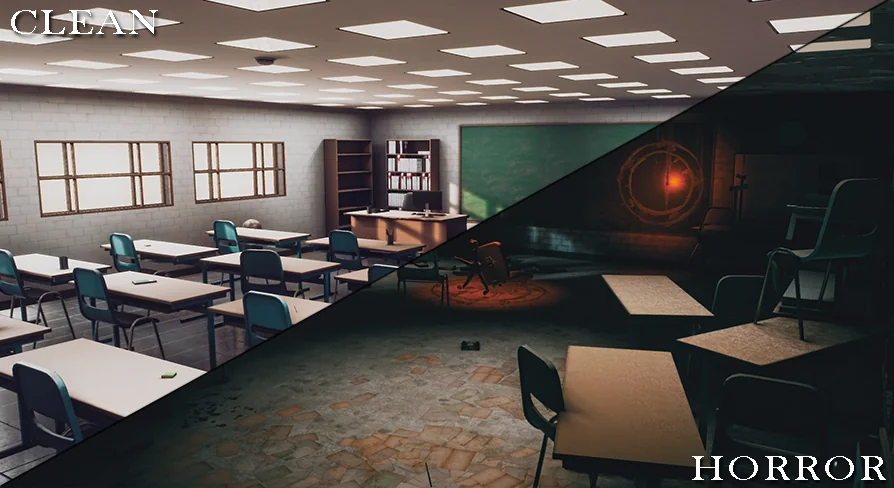
The defining creative hook is the included Special shader, which allows the environment to be turned quickly into a Horror Or Post-apocalyptic Version. That changes how the pack can be used in production. Instead of building one set for a clean school and another set for a distressed one, the workflow supports a transition in tone on top of the same environment base.
This matters for any project where condition and atmosphere are part of the storytelling. A school can read as orderly and maintained in one scene, then unsettling and abandoned in another. The pack explicitly supports that kind of transformation. The shader is not presented as a minor surface tweak, but as a practical route to reframe the whole environment’s mood. The move from clean to horror is one of the package’s central uses, not an afterthought.
There is also a clear link between that shader-driven tonal shift and the included decal set. The pack contains 16 decals, including Scratching, leaking, and blood. Those details are small in count compared with the full asset library, yet they play a direct role in the horror and post-apocalyptic identity of the environment. Scratches can suggest wear or damage, leaking can push spaces toward neglect and decay, and blood introduces a much more explicit horror register. Because these decals sit on top of the modular environment, they help the same rooms read very differently without requiring a separate architectural kit.
Two master materials, 164 material instances
The material system is one of the pack’s more practical implementation details. It includes 164 material instances That all use Two master materials. That setup says a lot about how the environment is meant to be managed. A large number of instances gives room for visual variety across the asset set, while a small number of master materials keeps the core system centralized.
The master material is described as having control for almost every texture map you can think of. It also includes inputs for Dirt masks, World space dust, and more. Even without drifting beyond the stated details, that already frames the pack as more than a static library of meshes. It provides a material workflow that helps users push surfaces toward cleaner or dirtier states, and toward more settled, aged, or abandoned looks.
For implementation, that means the pack supports two related needs at once. First, it gives a lot of ready material variation through the material instances. Second, it exposes a more hands-on layer of environmental treatment through the master material controls. In practice, those inputs are especially relevant for interiors, where repeated walls, floors, and fixtures can quickly look uniform if there is no system for wear, dust, and grime. The explicit mention of dirt masks and world space dust makes the environment’s condition part of the workflow rather than something left entirely to external setup.
Three demo scenes that show the full range
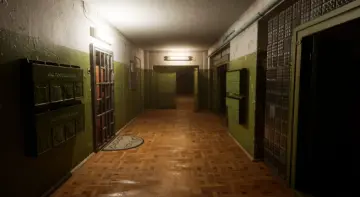
The package includes Three demo scenes: one clean version of the school, one horror version, and one scene with all the assets laid out. These scenes do more than provide examples. They map directly to how the pack can be approached during setup and implementation.
The clean school scene gives a ready reference for a maintained interior. The horror scene shows the darker end of the pack’s visual range. The laid-out asset scene serves a different purpose, making it easier to review the library itself and understand what is available before building a custom level. That last scene is especially useful in modular environment work, where knowing the parts and their relationships can save time during assembly.
Another important point is that the demo scenes are Fully set up And created using only assets included in the pack. This keeps the examples self-contained. The scenes are not leaning on outside pieces to complete their look, which makes them a direct demonstration of what the package itself can produce. For anyone evaluating the pack from a workflow angle, that is a meaningful detail: the examples are not concept pieces detached from the actual contents.
Drag into a level, or work from the included levels
The setup path is kept straightforward. The pack states that all assets contain LODs, Collision, and Optimized lightmap UVs, with the correct settings already applied. Those are practical production details, not decorative extras. They speak to how the environment is prepared for immediate use inside a level-building workflow.
LODs help the asset set function as a complete environment rather than as isolated hero pieces. Collision means the assets are prepared for spatial use inside a scene. Optimized lightmap UVs, along with the note that the correct settings are already applied, point to a pack that has been readied for placement rather than one that expects cleanup before use. This is consistent with the package’s larger pitch: assemble scenes quickly, shift the mood when needed, and work either from scratch or from what is already included.
The final workflow detail is simple but important: you can Drag the assets into your level, or use the Included levels. That gives the pack two practical entry points. One suits teams or solo creators who want to integrate selected pieces into an existing environment. The other suits anyone who would rather begin from a prepared scene and adjust it from there.
For projects that need a realistic modular school, an old or distressed academic interior, or a horror-leaning institutional setting, the best fit here is clear. This pack is strongest when the job is not just to place props, but to build complete interior spaces and then control how clean, worn, or unsettling those spaces feel through materials, decals, and the included scene setups.
 Interior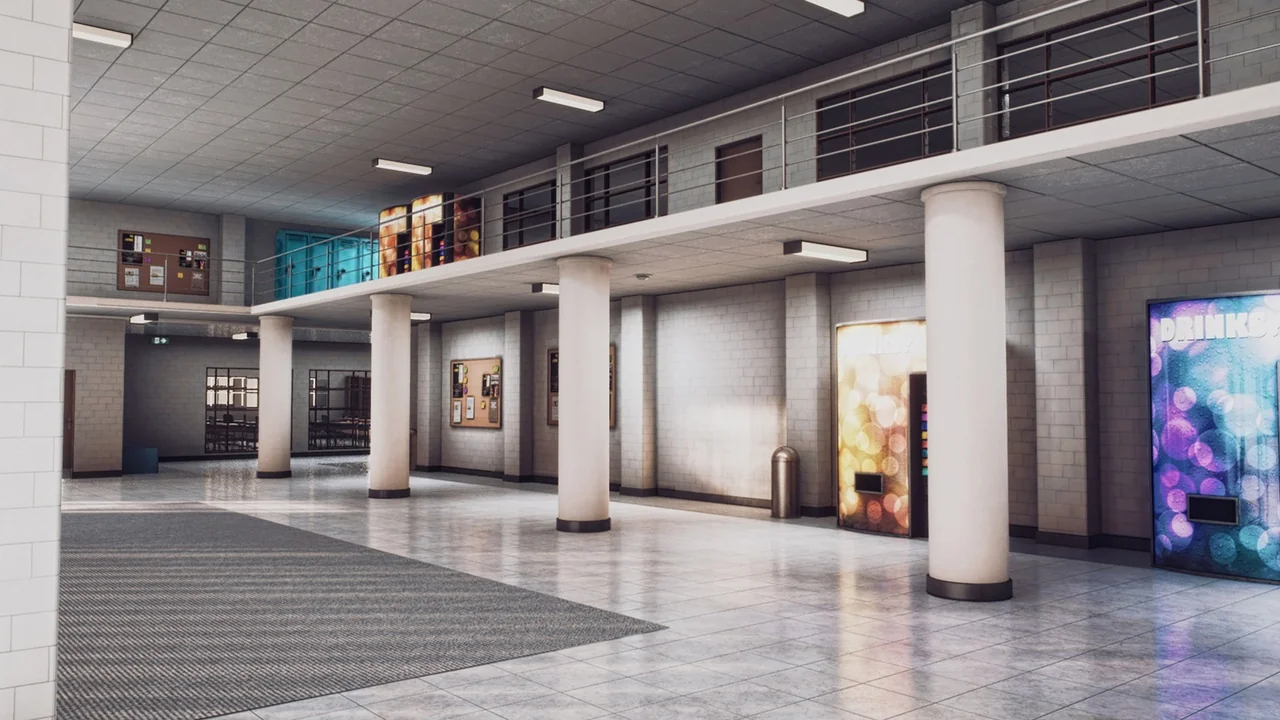
 Interior
 Interior
 Interior