"7b46a695175d8694"{"id":"1000045","slug":"courtroom-environment","title":"Courtroom - Environment","category":"Interior","engine":"4.26+,5.0+","assetVersion":"","engineVersion":"4.26+,5.0+","tag":"Interior","accent":"blue","visual":"city","summary":"Courtroom - Environment delivers a realistic courtroom scene for animation, games, or VR, with changeable screens and flags, PBR materials, LODs, collisions, an","platform":"Unreal Engine","publishedAt":"2026-05-22T09:38:05.535Z","updatedAt":"2026-05-22T09:38:05.535Z","sourceNotes":[],"fileContents":[],"compatibility":["Unreal Engine","Engine version: 4.26+,5.0+"],"featuredImage":{"alt":"Courtroom - Environment","src":"/wp-content/uploads/published/2026/05/3685d017cc8c-6c1bfb9f-1d9c-4a0f-91b2-05a1fdddbd78-d014c4d264.webp"},"hasDownloadLink":true,"downloads":1,"terms":[{"taxonomy":"category","slug":"interior","name":"Interior"}],"galleryImages":[{"src":"/wp-content/uploads/published/2026/05/bea97e9b06bb-75fede35-5ddf-4476-a233-0676e04cb953-57e7057b75.webp","alt":"Courtroom - Environment"},{"src":"/wp-content/uploads/published/2026/05/4331c5a2766f-79dd1a40-cc53-4006-a8a8-f48df2f17b89-31ec484e65.webp","alt":"Courtroom - Environment"},{"src":"/wp-content/uploads/published/2026/05/9a8beb434dfe-204cbcbe-a4c4-427b-afbf-549ab5345836-3f6ca92af1.webp","alt":"Courtroom - Environment"},{"src":"/wp-content/uploads/published/2026/05/de68e9b4a8dc-157fef15-bcd0-4f93-b327-0a71c7cb7496-9d0c2d9923.webp","alt":"Courtroom - Environment"},{"src":"/wp-content/uploads/published/2026/05/45fea9e23d19-d71591bd-6fdd-4f6a-94b9-7c8d34d6569d-6097851bea.webp","alt":"Courtroom - Environment"},{"src":"/wp-content/uploads/published/2026/05/ef7ff9ed4ba4-09bfad1a-322b-4520-9731-5a93bd103681-48a729ea4f.webp","alt":"Courtroom - Environment"},{"src":"/wp-content/uploads/published/2026/05/ec7594d8f304-ed795e3c-f10b-4ded-bfe1-8a5f192ed9ef-d04f9ff7fa.webp","alt":"Courtroom - Environment"},{"src":"/wp-content/uploads/published/2026/05/62809e5ebdc9-476c1f8f-0012-4d85-9553-dcf6c5fc8faf-4375d43b82.webp","alt":"Courtroom - Environment"},{"src":"/wp-content/uploads/published/2026/05/f9eaf2bab476-e3a7a353-f53a-47d9-849c-3a3869bd3861-4fc7e803cf.webp","alt":"Courtroom - Environment"},{"src":"/wp-content/uploads/published/2026/05/ed3b4ae7135b-059a31aa-9ee3-4657-90a1-edb8718aa472-f7b5633629.webp","alt":"Courtroom - Environment"}],"accessPanel":{"kind":"resource","title":"Access this resource","eyebrow":"Free Download","message":"Log in or create a free account to start your download.","fileName":"Сrime.7z","safetyNote":"Resources are manually reviewed before listing to improve quality and reduce obvious risks.","actionLabel":"Download Free","resourceType":"Resource archive"},"contentHtml":"\u003cp\u003eBuilding a convincing courtroom from scratch can slow down a production long before the real scene work begins. A legal setting needs more than a few benches and a judge's stand; it has to communicate authority, tension, and a specific kind of public interior the moment the camera enters the room. \u003cstrong\u003eCourtroom - Environment\u003c/strong\u003e Addresses that need with a realistic courtroom scene that can be used across animation, games, and VR, giving teams a prepared setting for crime stories, legal drama, detective work, or any project that needs a formal room shaped by justice and procedure.\u003c/p\u003e \u003cp\u003eThis environment is also part of a \u003cstrong\u003eCrime Collection\u003c/strong\u003e Presented as a \u003cstrong\u003e3-in-1 pack\u003c/strong\u003e, which places it naturally within darker narrative material. That context matters when planning a production. A courtroom rarely appears in isolation; it often sits downstream from investigation, accusation, or testimony. The scene's realistic tone, along with tags such as crime, noir, court, lawyer, law, detective, justice, and wooden, points toward projects that want a grounded dramatic interior rather than a stylized or abstract setting.\u003c/p\u003e \u003ch2\u003eUsing Courtroom - Environment for legal drama, crime scenes, and VR staging\u003c/h2\u003e\n\u003cp\u003eThe strongest immediate use for this environment is straightforward: it gives a courtroom that can function as a central story location. In animation, that may mean dialogue-heavy sequences, testimony setups, or wide establishing shots that place characters inside a formal legal chamber. In games, the same room can act as a level space, a narrative destination, or a contained scene for investigation, interrogation, or branching story moments. In VR, the courtroom format is especially useful because it already organizes space around a public focal point, letting users read the room quickly and understand where attention should go.\u003c/p\u003e \u003cp\u003eThe visual identity implied here is practical and dramatic at the same time. A realistic courtroom carries institutional weight on its own, and the noir and crime associations push it toward stories with tension rather than neutral civic architecture. That makes the environment flexible without becoming vague. It can support a traditional court proceeding, a detective reveal, a crime-fiction flashback, or a stylized legal confrontation, while still staying anchored in a room type that viewers immediately recognize.\u003c/p\u003e \u003ch2\u003eChangeable monitor screens and flags open up scene-specific storytelling\u003c/h2\u003e\n\u003cp\u003eOne of the most directly useful features in this environment is the inclusion of \u003cstrong\u003eEasily changeable monitor screens and flags\u003c/strong\u003e. That kind of built-in flexibility affects how quickly a scene can be adapted for different narrative needs.\u003c/p\u003e \u003cp\u003eMonitor screens are often small details that become important once a project enters shot production. A courtroom scene might need public information displays, custom graphics, jurisdiction-specific visuals, or simply a variation that distinguishes one case from another. Easily changeable screens make those swaps practical instead of forcing artists to rebuild the room's presentation every time the story changes. The same applies to flags. A flag can shift the location's identity, alter the tone of the room, or help a project avoid a one-size-fits-all legal space. For teams working across multiple scenes, those adjustable elements can make the courtroom feel reused in a smart way rather than repeated without change.\u003c/p\u003e \u003cp\u003eThis is where the environment becomes more than a static backdrop. A courtroom with editable display points can serve as a recurring location across different episodes, missions, or case chapters. One version might read as a high-profile criminal hearing. Another might feel more local or more formal depending on what appears on the screens and which flags are present. The core room remains the same, but those surface-level changes can support very different story beats.\u003c/p\u003e \u003ch2\u003eRealistic courtroom mood: wooden, formal, and noir-adjacent\u003c/h2\u003e\n\u003cp\u003eThe tags tied to this environment help clarify the kind of atmosphere it fits best. Words such as \u003cstrong\u003eRealistic\u003c/strong\u003e, \u003cstrong\u003eWooden\u003c/strong\u003e, \u003cstrong\u003eCrime\u003c/strong\u003e, \u003cstrong\u003eLaw\u003c/strong\u003e, \u003cstrong\u003eJustice\u003c/strong\u003e, and \u003cstrong\u003eNoir\u003c/strong\u003e Frame it as a courtroom that works well in serious productions. This is not a broad fantasy hall or a generic meeting room standing in for legal space. It is a courtroom environment intended to read clearly as a place of law.\u003c/p\u003e \u003cp\u003eThe wooden character suggested by the tags is especially useful from a staging point of view. Wood interiors often carry visual warmth while still supporting institutional severity, which makes them effective for court scenes where the room has to feel official yet cinematic. In noir-leaning work, that can help create contrast between moral seriousness and shadowy narrative themes. In detective-centered scenes, it gives the room enough realism to hold attention during extended dialogue or evidence-driven moments. In a game level, that same tone can make the environment feel like part of a larger crime setting instead of an isolated civic map.\u003c/p\u003e \u003cp\u003eBecause the setting is realistic, it can absorb a wide range of performance and camera choices. A courtroom can host broad overhead views, controlled face-to-face exchanges, or player movement through a room that already has social order built into it. Even without introducing any extra fictional detail, the legal setting naturally supports hierarchy, observation, confrontation, and public tension. That makes it a productive stage for artists who need environment storytelling without depending on exotic architecture.\u003c/p\u003e \u003ch2\u003ePBR materials, collisions, LODs, and optimized normals for real-time usage\u003c/h2\u003e\n\u003cp\u003eOn the technical side, all assets in the environment come with \u003cstrong\u003ePBR materials, collisions, LODs, and optimized normals for real-time usage\u003c/strong\u003e. Those details say a lot about where this resource fits in production.\u003c/p\u003e \u003cp\u003ePBR materials help the courtroom maintain a consistent response to lighting, which is important in a scene where wood, walls, furniture, and fixtures need to feel believable rather than flat. For artists, that supports a more dependable look when placing the environment into a real-time scene. Collisions matter from an interaction and navigation standpoint. In a game or VR setup, a courtroom is not just viewed; it may be moved through, blocked out for player presence, or used as a room where characters and users need a reliable sense of physical space. LODs support performance-minded scene management, especially when the room is seen from different distances or camera setups. Optimized normals continue that same focus on real-time practicality, helping the scene stay suitable for interactive work rather than existing only for still presentation.\u003c/p\u003e \u003cp\u003eTaken together, these features make the environment easier to place into productions where responsiveness matters. That includes story-driven games, courtroom sequences in interactive experiences, and VR scenes where stable real-time presentation is part of the basic requirement. Instead of treating optimization as an afterthought, the environment includes the technical groundwork that real-time scenes usually need from the start.\u003c/p\u003e \u003ch2\u003eRay tracing support changes how the courtroom can be lit\u003c/h2\u003e\n\u003cp\u003e\u003cstrong\u003eRay-tracing support\u003c/strong\u003e Expands the visual range of the courtroom without changing its core purpose. Courtrooms often rely on surfaces and architectural order to create mood, and a realistic interior benefits when lighting can reinforce that structure with more depth.\u003c/p\u003e \u003cp\u003eFor teams pursuing a polished dramatic look, ray tracing support can be especially relevant in scenes shaped by serious dialogue, legal suspense, or noir-inflected crime storytelling. A courtroom is a room where materials, edges, and spatial depth all contribute to the mood, so support for more advanced lighting workflows gives artists another way to push the environment toward either clean judicial formality or heavier dramatic tension. That does not redefine the asset; it simply broadens how far the scene can be taken visually while staying inside a real-time context.\u003c/p\u003e \u003ch2\u003eWhere Courtroom - Environment fits best in a production\u003c/h2\u003e\n\u003cp\u003eThis environment makes the most sense in projects that need a courtroom to do active narrative work rather than fill background space. It suits scenes where the room itself must communicate law, accusation, testimony, authority, or the aftermath of a crime. Because it is part of a Crime Collection and because its customizable elements are built into the scene, it works well for creators who expect to revisit the location with different identities or story beats.\u003c/p\u003e \u003cp\u003eFor an animation team, it offers a ready setting for courtroom drama. For a game project, it can function as a realistic level space tied to law, crime, or detective themes. For VR, it provides a recognizable public interior with enough structure to support presence and orientation. The changeable monitor screens and flags make it easier to tailor that room to the exact scene being staged, while the PBR materials, collisions, LODs, optimized normals, and ray-tracing support keep it aligned with real-time production needs. When a project calls for a realistic courtroom with a crime-adjacent tone, this is the kind of environment that can move directly into scene work instead of stopping the workflow at set construction.\u003c/p\u003e\n\n\u003ch2\u003eRelated Resources Worth Checking\u003c/h2\u003e\n\u003cul\u003e\n\u003cli\u003e\u003ca href=\"https://3dcghub.com/hospital-environment-modular/\" title=\"Hospital environment (MODULAR)\"\u003eHospital environment (MODULAR)\u003c/a\u003e\u003c/li\u003e\n\u003cli\u003e\u003ca href=\"https://3dcghub.com/modular-hotel/\" title=\"Modular Hotel\"\u003eModular Hotel\u003c/a\u003e\u003c/li\u003e\n\u003cli\u003e\u003ca href=\"https://3dcghub.com/clean-horror-school-environment/\" title=\"Clean/Horror School Environment\"\u003eClean/Horror School Environment\u003c/a\u003e\u003c/li\u003e\n\u003cli\u003e\u003ca href=\"https://3dcghub.com/cgma-studio-offices/\" title=\"CGMA Studio Offices\"\u003eCGMA Studio Offices\u003c/a\u003e\u003c/li\u003e\n\u003cli\u003e\u003ca href=\"https://3dcghub.com/science-laboratory/\" title=\"Science Laboratory\"\u003eScience Laboratory\u003c/a\u003e\u003c/li\u003e\n\u003c/ul\u003e","contentTextLength":9335,"navigation":{"current":1581,"total":3481,"previous":{"id":"1000046","slug":"crash-and-smash-designed","title":"Crash \u0026 Smash - Designed","category":"Sound Effects","platform":"Unreal Engine","updatedAt":"2026-05-22T09:40:57.365Z"},"next":{"id":"1000044","slug":"clean-horror-school-environment","title":"Clean/Horror School Environment","category":"Interior","platform":"Unreal Engine","updatedAt":"2026-05-22T09:27:13.248Z"}},"relatedResources":[{"id":"1000648","slug":"modern-library-scene-and-assets","title":"Modern Library - Scene \u0026 Assets","category":"Interior","engine":"4.26+,5.0+","assetVersion":"","engineVersion":"Engine Version: 4.26+,5.0+","tag":"Interior","accent":"blue","visual":"mech","summary":"A modern library scene and asset pack with PBR materials, weighted normals, and modular bookshelves suited for VR, games, mobile, and visualization projects.","platform":"Unreal Engine","publishedAt":"2026-07-21T18:45:17.507Z","updatedAt":"2026-07-21T18:45:17.507Z","sourceNotes":[],"fileContents":[],"compatibility":["Unreal Engine","Engine Version: 4.26+,5.0+"],"featuredImage":{"alt":"Modern Library - Scene \u0026 Assets","src":"/wp-content/uploads/published/2026/07/6f644af051b7-84ceb579-6845-48ff-b676-0385e7896e87-b8adad5df1.webp"},"hasDownloadLink":true,"downloads":0},{"id":"1001363","slug":"showroom-expo-hall","title":"Showroom Expo Hall","category":"Interior","engine":"4.27+,5.0+","assetVersion":"","engineVersion":"Engine Version: 4.27+,5.0+","tag":"Interior","accent":"blue","visual":"mech","summary":"Build customizable PC showroom interiors with Showroom Expo Hall, featuring modular lowpoly layouts, adjustable material colors, and video-ready TV screens.","platform":"Unreal Engine","publishedAt":"2026-10-04T10:32:16.987Z","updatedAt":"2026-10-04T10:32:16.987Z","sourceNotes":[],"fileContents":[],"compatibility":["Unreal Engine","Engine Version: 4.27+,5.0+"],"featuredImage":{"alt":"Showroom Expo Hall","src":"/wp-content/uploads/published/2026/10/0766dc4ab998-79369d07-efa2-4e0e-8fd4-b3de3beab6f6-eb95172069.webp"},"hasDownloadLink":true,"downloads":0},{"id":"8873","slug":"hospital-environment-modular","title":"Hospital environment (MODULAR)","category":"Interior","engine":"4.26+,5.0+","assetVersion":"Engine version: 4.26+,5.0+","engineVersion":"4.20","tag":"Interior","accent":"blue","visual":"city","summary":"Build immersive medical scenes with this high-quality modular hospital asset pack. It includes everything from operating room equipment to customizable corridors for realistic game environments.","platform":"Unreal Engine","publishedAt":"2026-02-25T17:55:40.000Z","updatedAt":"2026-04-19T15:51:20.000Z","sourceNotes":[],"fileContents":[],"compatibility":["Unreal Engine","Engine version: 4.26+,5.0+"],"featuredImage":{"alt":"Hospital environment (MODULAR)","src":"https://3dcghub.com/wp-content/uploads/2026/02/2c39981a-1347-464f-ad9d-be011471d845.webp"},"hasDownloadLink":true,"downloads":1}]}
Interior
Courtroom - Environment
Courtroom - Environment delivers a realistic courtroom scene for animation, games, or VR, with changeable screens and flags, PBR materials, LODs, collisions, an
Category:Unreal Engine,InteriorPlatform: Unreal EngineEngine version: 4.26+,5.0+Published: May 22, 2026
Interior
Resource overview
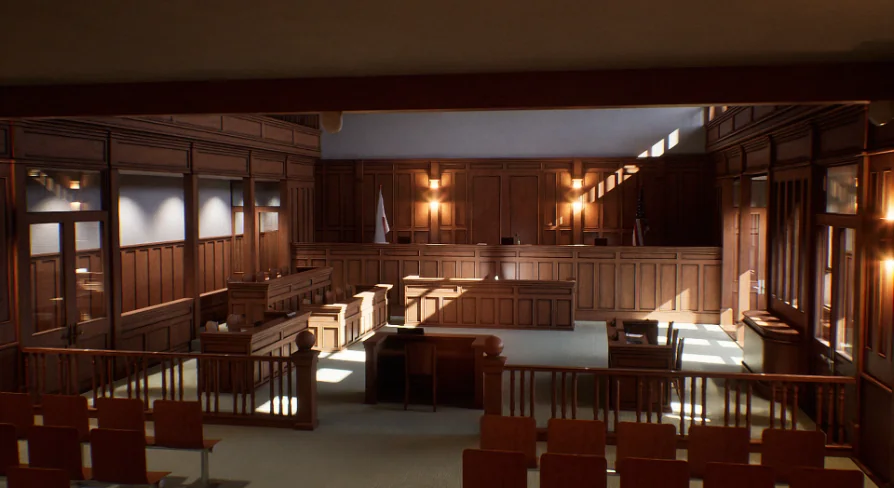
Building a convincing courtroom from scratch can slow down a production long before the real scene work begins. A legal setting needs more than a few benches and a judge's stand; it has to communicate authority, tension, and a specific kind of public interior the moment the camera enters the room. Courtroom - Environment Addresses that need with a realistic courtroom scene that can be used across animation, games, and VR, giving teams a prepared setting for crime stories, legal drama, detective work, or any project that needs a formal room shaped by justice and procedure.
This environment is also part of a Crime Collection Presented as a 3-in-1 pack, which places it naturally within darker narrative material. That context matters when planning a production. A courtroom rarely appears in isolation; it often sits downstream from investigation, accusation, or testimony. The scene's realistic tone, along with tags such as crime, noir, court, lawyer, law, detective, justice, and wooden, points toward projects that want a grounded dramatic interior rather than a stylized or abstract setting.
Using Courtroom - Environment for legal drama, crime scenes, and VR staging
The strongest immediate use for this environment is straightforward: it gives a courtroom that can function as a central story location. In animation, that may mean dialogue-heavy sequences, testimony setups, or wide establishing shots that place characters inside a formal legal chamber. In games, the same room can act as a level space, a narrative destination, or a contained scene for investigation, interrogation, or branching story moments. In VR, the courtroom format is especially useful because it already organizes space around a public focal point, letting users read the room quickly and understand where attention should go.
The visual identity implied here is practical and dramatic at the same time. A realistic courtroom carries institutional weight on its own, and the noir and crime associations push it toward stories with tension rather than neutral civic architecture. That makes the environment flexible without becoming vague. It can support a traditional court proceeding, a detective reveal, a crime-fiction flashback, or a stylized legal confrontation, while still staying anchored in a room type that viewers immediately recognize.
Changeable monitor screens and flags open up scene-specific storytelling
One of the most directly useful features in this environment is the inclusion of Easily changeable monitor screens and flags. That kind of built-in flexibility affects how quickly a scene can be adapted for different narrative needs.
Monitor screens are often small details that become important once a project enters shot production. A courtroom scene might need public information displays, custom graphics, jurisdiction-specific visuals, or simply a variation that distinguishes one case from another. Easily changeable screens make those swaps practical instead of forcing artists to rebuild the room's presentation every time the story changes. The same applies to flags. A flag can shift the location's identity, alter the tone of the room, or help a project avoid a one-size-fits-all legal space. For teams working across multiple scenes, those adjustable elements can make the courtroom feel reused in a smart way rather than repeated without change.
This is where the environment becomes more than a static backdrop. A courtroom with editable display points can serve as a recurring location across different episodes, missions, or case chapters. One version might read as a high-profile criminal hearing. Another might feel more local or more formal depending on what appears on the screens and which flags are present. The core room remains the same, but those surface-level changes can support very different story beats.
Realistic courtroom mood: wooden, formal, and noir-adjacent
The tags tied to this environment help clarify the kind of atmosphere it fits best. Words such as Realistic, Wooden, Crime, Law, Justice, and Noir Frame it as a courtroom that works well in serious productions. This is not a broad fantasy hall or a generic meeting room standing in for legal space. It is a courtroom environment intended to read clearly as a place of law.
The wooden character suggested by the tags is especially useful from a staging point of view. Wood interiors often carry visual warmth while still supporting institutional severity, which makes them effective for court scenes where the room has to feel official yet cinematic. In noir-leaning work, that can help create contrast between moral seriousness and shadowy narrative themes. In detective-centered scenes, it gives the room enough realism to hold attention during extended dialogue or evidence-driven moments. In a game level, that same tone can make the environment feel like part of a larger crime setting instead of an isolated civic map.
Because the setting is realistic, it can absorb a wide range of performance and camera choices. A courtroom can host broad overhead views, controlled face-to-face exchanges, or player movement through a room that already has social order built into it. Even without introducing any extra fictional detail, the legal setting naturally supports hierarchy, observation, confrontation, and public tension. That makes it a productive stage for artists who need environment storytelling without depending on exotic architecture.
PBR materials, collisions, LODs, and optimized normals for real-time usage
On the technical side, all assets in the environment come with PBR materials, collisions, LODs, and optimized normals for real-time usage. Those details say a lot about where this resource fits in production.
PBR materials help the courtroom maintain a consistent response to lighting, which is important in a scene where wood, walls, furniture, and fixtures need to feel believable rather than flat. For artists, that supports a more dependable look when placing the environment into a real-time scene. Collisions matter from an interaction and navigation standpoint. In a game or VR setup, a courtroom is not just viewed; it may be moved through, blocked out for player presence, or used as a room where characters and users need a reliable sense of physical space. LODs support performance-minded scene management, especially when the room is seen from different distances or camera setups. Optimized normals continue that same focus on real-time practicality, helping the scene stay suitable for interactive work rather than existing only for still presentation.
Taken together, these features make the environment easier to place into productions where responsiveness matters. That includes story-driven games, courtroom sequences in interactive experiences, and VR scenes where stable real-time presentation is part of the basic requirement. Instead of treating optimization as an afterthought, the environment includes the technical groundwork that real-time scenes usually need from the start.
Ray tracing support changes how the courtroom can be lit
Ray-tracing support Expands the visual range of the courtroom without changing its core purpose. Courtrooms often rely on surfaces and architectural order to create mood, and a realistic interior benefits when lighting can reinforce that structure with more depth.
For teams pursuing a polished dramatic look, ray tracing support can be especially relevant in scenes shaped by serious dialogue, legal suspense, or noir-inflected crime storytelling. A courtroom is a room where materials, edges, and spatial depth all contribute to the mood, so support for more advanced lighting workflows gives artists another way to push the environment toward either clean judicial formality or heavier dramatic tension. That does not redefine the asset; it simply broadens how far the scene can be taken visually while staying inside a real-time context.
Where Courtroom - Environment fits best in a production
This environment makes the most sense in projects that need a courtroom to do active narrative work rather than fill background space. It suits scenes where the room itself must communicate law, accusation, testimony, authority, or the aftermath of a crime. Because it is part of a Crime Collection and because its customizable elements are built into the scene, it works well for creators who expect to revisit the location with different identities or story beats.
For an animation team, it offers a ready setting for courtroom drama. For a game project, it can function as a realistic level space tied to law, crime, or detective themes. For VR, it provides a recognizable public interior with enough structure to support presence and orientation. The changeable monitor screens and flags make it easier to tailor that room to the exact scene being staged, while the PBR materials, collisions, LODs, optimized normals, and ray-tracing support keep it aligned with real-time production needs. When a project calls for a realistic courtroom with a crime-adjacent tone, this is the kind of environment that can move directly into scene work instead of stopping the workflow at set construction.
 Interior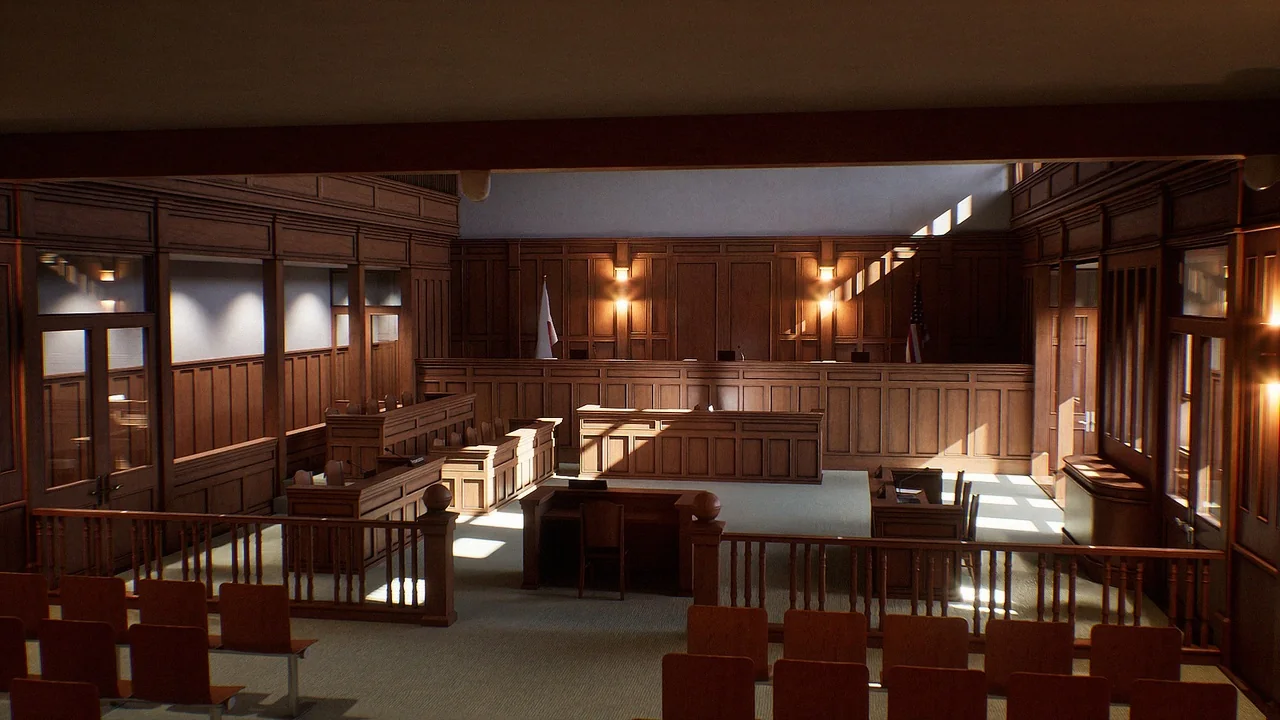
 Interior
 Interior
 Interior